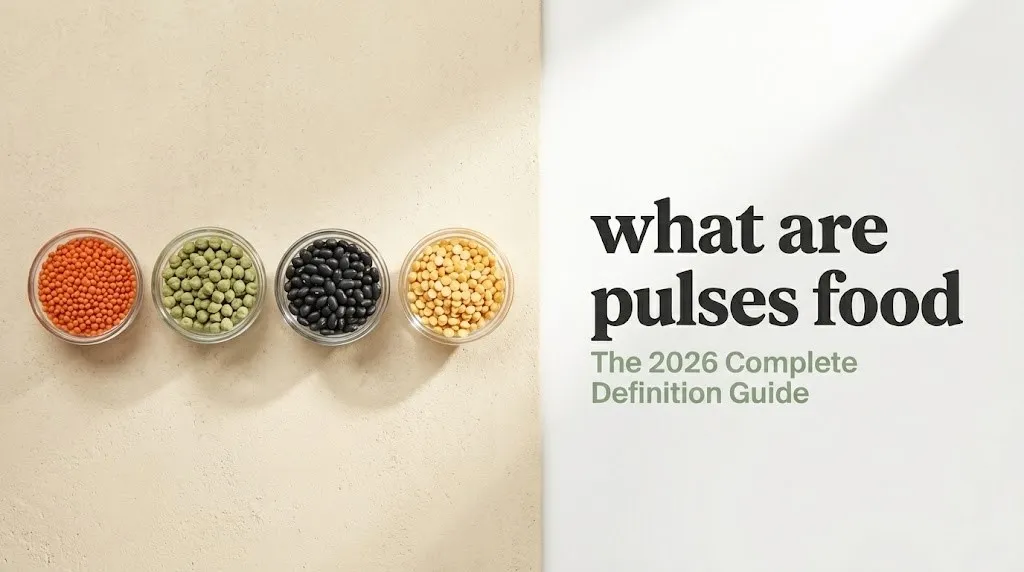
Pulses are the dry, edible seeds of plants in the legume family. They include lentils, chickpeas, dry peas, and all varieties of dried beans. If you have ever opened a bag of dried black beans or split red lentils, you have held pulses in your hand.
The United Nations Food and Agriculture Organization (FAO) recognizes pulses as a distinct food category. They are not simply “beans” or “legumes” in the way most home cooks use those terms. A fresh green bean from the garden is a legume vegetable. A dried kidney bean in a bulk bin is a pulse. The distinction matters because the nutritional density of a dried pulse is far higher than its fresh counterpart.
This guide gives you the formal definition, the nutritional science behind pulses, a clear classification table so you never confuse them again, and the exact cooking methods that reduce the digestive discomfort some people experience. You will also see the evidence for why the American Heart Association and the American Diabetes Association both recommend pulses as a dietary staple.
What Are Pulses Food?
Pulses are a subcategory of legumes harvested specifically for their dry grains. The word “pulse” comes from the Latin word “puls,” meaning a thick porridge or pottage. Only crops that are harvested dry count as pulses. This excludes fresh peas, fresh beans, soybeans, and peanuts.
The FAO defines pulses by what they are not. They are not used for oil extraction, which rules out soybeans and peanuts. They are not harvested fresh, which rules out green beans and garden peas. This narrows the field to roughly a dozen major crop types that have sustained human civilizations for over 10,000 years.
Think of pulses as the carbohydrates you can store in your pantry without refrigeration for a year and then cook into a complete meal. That shelf stability made them a cornerstone of food security long before modern logistics existed. Lentils, dried chickpeas, and dried beans are the most widely consumed pulses globally.
Key Takeaway: Pulses are the dried, edible seeds of legumes. They are not fresh vegetables, not oilseeds, and not grains.
The Official FAO Definition of Pulses
The Food and Agriculture Organization of the United Nations officially defines pulses as annual leguminous crops yielding between one and twelve grains or seeds of variable size, shape, and color within a pod, used exclusively for dry grain. This definition is the global standard for agricultural classification and international trade.
The “exclusively for dry grain” clause is what does the sorting work. A crop harvested green, like edamame or fresh peas, is classified as a vegetable. A crop used for oil, like the soybean, is an oilseed. A pulse is neither. It is a dry seed with a low oil content, typically less than 5 percent of the total composition.
The FAO’s 2016 International Year of Pulses pushed the term into mainstream food culture for the first time in decades. Before that campaign, the word had largely retreated into agricultural textbooks. Now it appears on packaging, in restaurant menu descriptions, and in dietary guidelines across North America and Europe.
Key Takeaway: The FAO’s dry grain requirement is the single criterion that separates a pulse from a fresh legume vegetable or an oilseed.
Is It a Pulse? The Complete Classification List
A simple checklist determines whether a food is a pulse. Ask three questions. Is it a legume? Is it harvested dry? Is the oil content naturally low? If all three answers are yes, the food is a pulse. The table below sorts the most commonly confused foods.
The classification matters for nutrition tracking. Pulses are more nutrient-dense and shelf-stable than their fresh counterparts. One cup of cooked lentils contains 18 grams of protein. One cup of fresh green peas contains about 8 grams. The drying process concentrates everything except the water.
Peanuts and soybeans are the two most frequent sources of confusion. Both are legumes. Neither is a pulse. Soybeans are 18 to 20 percent oil by weight, which places them firmly in the oilseed category. Peanuts are 45 to 50 percent oil. Fresh beans and peas, regardless of variety, are harvested before the seed matures and dries.
| Food | Legume? | Harvested Dry? | Pulse? |
|---|---|---|---|
| Red Lentils | Yes | Yes | Yes |
| Dried Chickpeas | Yes | Yes | Yes |
| Dried Black Beans | Yes | Yes | Yes |
| Split Green Peas | Yes | Yes | Yes |
| Fresh Green Beans | Yes | No | No |
| Fresh Garden Peas | Yes | No | No |
| Soybeans | Yes | Yes (often) | No (oilseed) |
| Peanuts | Yes | Yes (often) | No (oilseed) |
| Edamame | Yes | No | No |
Key Takeaway: If it sits in a bulk bin as a hard, dry seed and you have to soak it, it is almost certainly a pulse.
The Nutritional Profile of Pulses
Pulses deliver a dense package of plant protein, slowly digestible carbohydrates, and fermentable fiber. A 100-gram serving of cooked lentils provides about 9 grams of protein, 8 grams of fiber, and a third of your daily folate requirement. They are low in fat, contain zero cholesterol, and are naturally gluten-free.
The micronutrient profile varies by species. Lentils are the iron powerhouse among pulses, providing roughly 3.3 milligrams of non-heme iron per cooked cup. Chickpeas are rich in manganese, a cofactor for bone formation and blood clotting. Black beans deliver magnesium, which supports blood pressure regulation.
Pulses are not a source of vitamin B12. That is a bacterial product found in animal foods and fortified products. Pulses do provide folate, also called vitamin B9, which is essential for DNA synthesis and red blood cell formation. A cup of cooked lentils supplies about 90 percent of the adult daily folate requirement.
| Pulse (1 cup cooked) | Protein | Fiber | Iron | Folate |
|---|---|---|---|---|
| Lentils | 18 g | 16 g | 6.6 mg | 358 mcg (90% DV) |
| Chickpeas | 15 g | 12 g | 4.7 mg | 282 mcg (71% DV) |
| Black Beans | 15 g | 15 g | 3.6 mg | 256 mcg (64% DV) |
| Split Peas | 16 g | 16 g | 2.5 mg | 127 mcg (32% DV) |
| Kidney Beans | 15 g | 13 g | 3.9 mg | 230 mcg (58% DV) |
Key Takeaway: Lentils lead the pulse category for both iron and folate. Black beans and split peas are the fiber champions.
Pulses Are a Complete Protein Source When Paired Correctly
Pulses are an incomplete protein source on their own because they are relatively low in the essential amino acid methionine. They contain abundant lysine, which grains lack. A meal that pairs pulses with a grain, such as rice and lentils or hummus and pita, creates a complete protein profile.
The old advice that you must combine these foods at the same meal has been retired by the Academy of Nutrition and Dietetics. As long as you eat a variety of plant proteins across the day, your body pools the amino acids and synthesizes the proteins it needs. You do not need to meticulously plan a complementary protein at every sitting.
For someone following a plant-based or vegan dietary pattern in 2026, pulses are functionally the most protein-dense whole food available after soy products. A diet that includes pulses at least once daily, combined with varied grains and nuts, reliably meets the full essential amino acid requirement without animal products.
Key Takeaway: Pair pulses with grains across your day to cover all nine essential amino acids. The timing does not need to be in the same meal.
The High Fiber Content in Pulses and Satiety
A cup of cooked lentils contains 16 grams of dietary fiber. That is more than half the recommended daily intake for adult women and over a third for men. This fiber slows gastric emptying, which physically delays the return of hunger after a meal.
The fiber in pulses is a mix of soluble and insoluble types. Soluble fiber dissolves in water to form a viscous gel in the stomach. That gel slows the digestion of carbohydrates and reduces the post-meal glucose spike. Insoluble fiber adds bulk to the stool and speeds transit through the colon. Both types contribute to the satiety effect.
Think of soluble fiber like a layer of insulation in a house. It slows the rate at which heat, or in this case glucose, escapes into the walls. The more insulation you have, the steadier the indoor temperature stays. That is what happens to your blood glucose when a lentil stew replaces a white rice pilaf on your plate.
Key Takeaway: The fiber in pulses slows stomach emptying and glucose absorption. You stay fuller longer, and your blood sugar remains more stable.
Pulses and Heart Health: What the Research Shows
A daily serving of pulses reduces LDL cholesterol by an average of 5 to 10 percent, according to a 2014 meta-analysis published in the Canadian Medical Association Journal that pooled 26 randomized controlled trials. The effect is driven by the soluble fiber in pulses binding to bile acids in the intestine and carrying them out of the body.
The American Heart Association includes pulses in its recommended dietary patterns for cardiovascular health. The mechanism works like this. The liver pulls cholesterol from the blood to manufacture new bile acids. Soluble fiber traps bile acids in the gut and prevents their reabsorption. The liver responds by pulling more LDL cholesterol from circulation. The net result is a lower LDL measurement.
The potassium content in pulses also supports healthy blood pressure. A cup of cooked lima beans delivers nearly 1,000 milligrams of potassium, an electrolyte that counters the hypertensive effect of sodium. The DASH diet, designed to lower blood pressure, specifically recommends four to five servings of legumes per week.
Key Takeaway: One daily cup of pulses can drop LDL cholesterol by 5 to 10 percent through a bile acid binding mechanism that is well-supported by clinical research.
Pulses for Managing Blood Sugar and Diabetes
Pulses have a glycemic index that clusters in the low range, typically between 25 and 45. This is a direct consequence of their fiber and resistant starch content, both of which resist rapid digestion and flatten the post-meal blood glucose curve.
The American Diabetes Association lists legumes, including all pulses, as a recommended carbohydrate source for people managing type 2 diabetes or prediabetes. A 2012 study in the Archives of Internal Medicine found that participants who consumed one cup of pulses daily for three months reduced their hemoglobin A1c by 0.5 percentage points compared to a control group who ate an equivalent amount of whole wheat.
Resistant starch is a unique carbohydrate fraction in pulses that escapes digestion in the small intestine and arrives in the colon intact. Once there, gut bacteria ferment it into short-chain fatty acids like butyrate. Butyrate improves insulin sensitivity in peripheral tissues. That means pulses help manage blood glucose through both a primary effect, slowing absorption, and a secondary effect, improving your body’s response to insulin.
Key Takeaway: Low glycemic index, high fiber, and resistant starch make pulses a clinically supported food for blood sugar management.
Why Do Pulses Cause Gas? The Oligosaccharide Science
Pulses cause gas because they contain raffinose family oligosaccharides, small carbohydrate chains that humans lack the enzyme to digest. The enzyme alpha-galactosidase is missing from the human gastrointestinal tract. The oligosaccharides pass through the small intestine untouched and arrive in the colon, where trillions of bacteria ferment them rapidly.
The fermentation produces hydrogen, carbon dioxide, and in some people methane. That is the gas. It is a normal, healthy bacterial feeding response. The oligosaccharides in pulses are prebiotic. They feed beneficial Bifidobacterium and Lactobacillus species. The same thing happens when you eat onions, garlic, or Jerusalem artichokes.
The human gut microbiome adapts to regular pulse consumption. A 2011 study in the Journal of Nutrition found that participants who ate half a cup of pinto beans daily reported a 70 percent reduction in flatulence symptoms by the end of the third week. The bacterial populations shift toward species that produce less gas and more short-chain fatty acids. Consistency is the key.
Key Takeaway: The gas from pulses is a sign that your gut bacteria are eating well. Symptoms decrease significantly after three weeks of consistent consumption.
How to Soak Pulses to Reduce Lectins and Phytic Acid
A 12-hour soak in warm water with an acidulant significantly reduces the phytic acid and lectin content of dried pulses. Phytic acid is an antinutrient that binds to minerals like iron and zinc, reducing their absorption. Lectins are proteins that can cause gastrointestinal distress if pulses are eaten raw or undercooked.
The hot soak method is more effective than a cold water soak. Bring a pot of water to a boil. Pour it over the dried pulses in a large bowl. Add a tablespoon of an acidulant such as lemon juice or apple cider vinegar per cup of pulses. The acid and heat together activate the endogenous phytase enzyme in the pulse, which breaks down phytic acid. Let the pulses soak in this water as it cools for a minimum of 12 hours.
Discard the soaking water. Rinse the pulses thoroughly before cooking. The soaking water contains the leached oligosaccharides and some of the phytic acid breakdown products. Cooking the pulses in fresh water completes the process. Lectins are heat-labile proteins, which means they denature at high temperatures. Boiling pulses for at least 10 minutes destroys virtually all lectin activity.
Hot soak protocol:
- Bring a kettle or pot of water to a full boil
- Place dried pulses in a large heat-safe bowl
- Pour boiling water over the pulses until they are covered by 2 inches
- Add 1 tablespoon of lemon juice or apple cider vinegar per cup of pulses
- Let the pulses soak for 12 hours at room temperature
- Drain the soaking water completely and rinse the pulses before cooking
Key Takeaway: A 12-hour hot soak with an acid reduces antinutrients and oligosaccharides. Discard the soak water and cook in fresh water.
How to Cook Dried Pulses Perfectly
Cooking dried pulses perfectly requires fresh water, a gentle simmer, and patience with the timing. Each type of pulse has a specific cooking window. Lentils and split peas need no soaking and cook in 20 to 30 minutes. Dried chickpeas and black beans require the full soak and up to 90 minutes of simmering.
The most common cooking mistake is adding salt or acidic ingredients too early. Salt and acid, including tomatoes, vinegar, and citrus, toughen the seed coat and prevent the interior from softening. Add salt only during the last 15 minutes of cooking. Add acidic ingredients only after the pulse is fully tender.
Old pulses cook unevenly. A bag of chickpeas that has sat in your pantry for two years will never soften to the same creamy texture as a fresh crop. Buy pulses from stores with high turnover. If your cooked pulses remain hard after the full cooking time, the seeds are likely old and the only solution is to blend them into a soup or hummus rather than serving them whole.
| Pulse Type | Soak Required | Cook Time (Simmer) |
|---|---|---|
| Red/Yellow Lentils | No | 15 to 20 min |
| Green/Brown Lentils | No | 25 to 30 min |
| Split Peas | No | 30 to 40 min |
| Black Beans | Yes (8 to 12 hrs) | 60 to 90 min |
| Chickpeas | Yes (8 to 12 hrs) | 60 to 90 min |
| Kidney Beans | Yes (12 hrs) | 60 to 90 min |
Key Takeaway: No salt until the last 15 minutes. No acid until the pulse is fully tender. Old dried pulses may never soften.
Pulses vs. Beans vs. Legumes: What Is the Difference?
Legumes are the entire plant family Fabaceae, which includes trees, shrubs, vines, and herbaceous plants that produce pods. Pulses are the dry, edible seeds harvested from a specific subset of legume crops. Beans are the common name for several specific pulse types, particularly those in the Phaseolus and Vicia genera.
All pulses are legumes. Not all legumes are pulses. A carob tree is a legume. A clover plant is a legume. Neither produces a seed you would boil and eat. Soybeans are legumes but are oilseeds, not pulses, because they are crushed for their oil. Peanuts are legumes but are also oilseeds. The venn diagram is clean. The word “pulse” refers to a specific harvest state, not a biological family.
The word “bean” in English covers pulses, fresh beans, and even coffee beans, which are not legumes at all. The common language conflates what the botanical and agricultural terminology separates. When a recipe calls for “a can of beans,” it almost always means a pulse that has been cooked and canned.
Key Takeaway: Legume is the family. Pulse is a subcategory of legume harvested dry for its seed. Bean is the common name for many, but not all, pulses.
Pulses for Plant-Based and Vegan Diets in 2026
Pulses are the primary whole-food protein source for plant-based and vegan dietary patterns. They provide the lysine that grains lack and the iron that vegetables often underdeliver. A 2026 plant-forward kitchen without a steady rotation of lentils, chickpeas, and beans is missing its nutritional center of gravity.
The plant-based food industry has transformed pulses into a vast array of consumer products. Lentil pasta, chickpea flour, and fava bean tofu are now standard items in conventional grocery stores. These products retain the protein and fiber of the whole pulse while offering different culinary textures and formats. A serving of red lentil pasta contains roughly the same protein as a serving of whole cooked lentils.
Cost remains a major advantage of whole pulses over processed pulse products. A pound of dried lentils costs roughly $1.50 and yields seven cups of cooked food. A box of lentil pasta costs $4.00 and serves four. The whole pulse is almost always the better nutritional and financial value per serving.
Key Takeaway: Whole pulses remain the most cost-effective and nutrient-intact way to consume plant protein. Pulse-based pastas and flours are convenient but more expensive.
Who Should Be Careful with Pulses?
People with irritable bowel syndrome, particularly those with a diagnosed sensitivity to fermentable oligosaccharides, should reintroduce pulses gradually and in small portions. A standard elimination diet like the low-FODMAP protocol removes all pulses during the initial phase and reintroduces them at one-quarter cup portions to assess individual tolerance.
People taking monoamine oxidase inhibitors for depression should know that fava beans contain tyramine, which can interact dangerously with this class of medication. The interaction is well-documented, and the dietary restriction applies specifically to fava beans and broad beans, not to lentils, chickpeas, or common beans.
Canned pulses are a safer choice than dried pulses for anyone who has historically experienced severe digestive distress from beans. The canning process applies heat and pressure that break down a portion of the oligosaccharides. Draining and rinsing canned pulses removes additional fermentable carbohydrates from the liquid. Start with canned lentils and work your way up to dried.
Key Takeaway: Low-FODMAP followers should reintroduce pulses at one-quarter cup portions. Fava beans are contraindicated with MAOI medications. Canned pulses are often more digestible than dried.
Frequently Asked Questions About Pulses
Are green beans a pulse?
Green beans are not a pulse because they are harvested fresh while the pod is still tender and edible.
A pulse must be harvested as a dry, mature seed, and green beans are a fresh vegetable consumed pod and all.
Botanically a green bean is the same species as a dried bean like a kidney bean, but the harvest state defines the classification.
Are peanuts a pulse?
Peanuts are not a pulse because they are an oilseed with a fat content of around 45 to 50 percent.
Pulses are defined by their low fat content, typically under 5 percent, and are harvested for the dry grain, not for oil.
A peanut is a legume, but it is not a pulse.
What is the difference between a legume and a pulse?
A legume is any plant in the Fabaceae family, which includes thousands of species ranging from trees to forage crops.
A pulse is a specific subcategory of legumes harvested exclusively for the dry, edible seeds inside their pods.
All pulses are legumes, but legumes like fresh peas, soybeans, and peanuts are not pulses.
How many pulses should I eat per day?
The USDA Dietary Guidelines recommend roughly one to two cups of cooked pulses per week for most adults.
A daily half-cup serving is a reasonable target that provides health benefits without digestive distress for most people.
Those new to pulses should start with smaller portions and build up over several weeks.
Can you eat pulses every day?
Yes, you can eat pulses every day, and populations in the Blue Zones, regions with the longest-lived people, do so as a dietary staple.
A daily serving of half a cup to one cup is associated with lower cholesterol, better blood sugar control, and improved gut health in the research literature.
Start with smaller portions and increase gradually if you experience gas or bloating during the first week or two.
Pulses are the quiet workhorses of the pantry. They sit on your shelf for months, cost very little, and deliver a nutritional density that few other whole foods match. The FAO definition is the key that unlocks the category. Dry, edible seed, low in fat, from a legume. That is a pulse.
Now that you know exactly what they are, go find a bag of lentils or chickpeas. Soak them overnight with a splash of lemon juice. Simmer them gently until they yield to the back of a spoon. Your heart, your blood sugar, and the beneficial bacteria living in your colon will all register the improvement.