The best healthy snacks to lose weight are ones that keep you full longer, stay within a reasonable calorie range, and don’t trigger the kind of blood sugar spike that sends you back to the kitchen 40 minutes later. Knowing which ones actually work means understanding a small but important piece of food science.
Snacking isn’t the problem most people think it is. According to the USDA Dietary Guidelines for Americans 2020-2025, what matters most for weight management is total daily calorie intake, not the timing of when you eat. The problem isn’t snacking itself. It’s the kind of snacks most people default to.
This guide covers the full picture: what a weight-loss-friendly snack actually looks like nutritionally, the best whole food and packaged options available in 2026, practical picks for work and travel, and the most common mistakes that quietly undermine progress.
Healthy Snacks to Lose Weight: The Basics
Healthy snacks to lose weight are foods that provide meaningful satiety, deliver useful macronutrients, and stay below roughly 200 calories per serving without triggering cravings for more food within the hour.
The word “snack” covers an enormous range. A handful of almonds (Prunus dulcis) at 164 calories per ounce is nutritionally a different object than a 200-calorie “granola bar” made primarily from refined sugar and white rice flour. Both are snacks. One supports a calorie deficit. The other works against it.
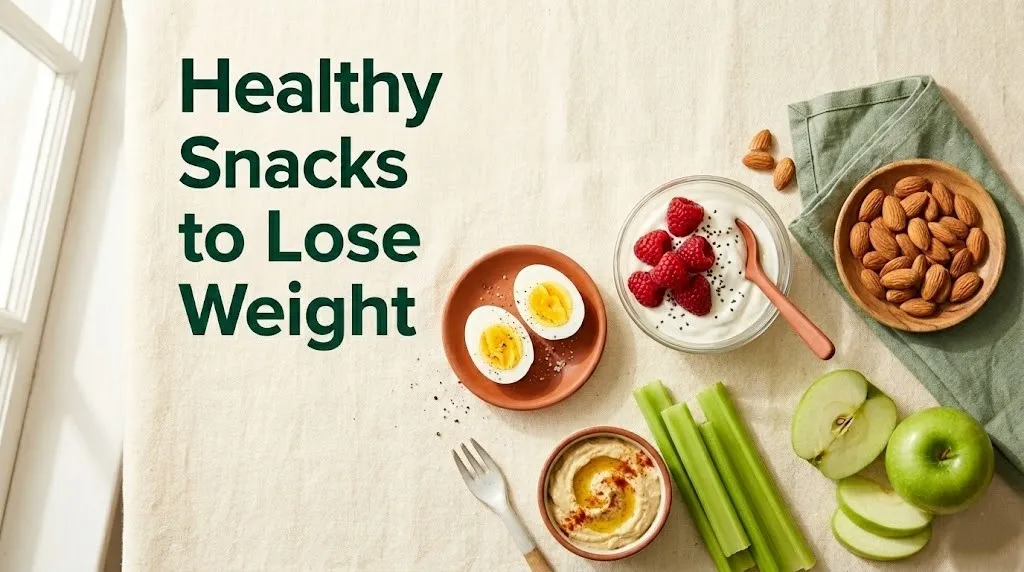
The Academy of Nutrition and Dietetics identifies three nutritional qualities that make a snack genuinely useful for weight management: a meaningful amount of protein, a meaningful amount of dietary fiber, and low caloric density relative to volume. Foods that check at least two of those three boxes are your starting point.
People with type 2 diabetes or insulin resistance have an added layer to consider: the glycemic response of the snack matters as much as the calorie count. Pairing any carbohydrate-containing snack with protein or fat slows glucose absorption and prevents the blood sugar dip that triggers hunger within the hour.
What Makes a Snack Good for Weight Loss?
A snack is good for weight loss when it reduces total calorie intake for the day by controlling hunger between meals, not when it simply has a low calorie count on its own.
Think of hunger between meals like a slow leak in a tire. A very low-calorie snack with no protein or fiber might seem like the right answer, but it doesn’t actually seal the leak. You end up hungrier by dinner than if you’d had a more satisfying 180-calorie snack at 3pm.
Three nutritional factors determine whether a snack earns its place in a weight loss plan:
- Protein content: Protein has the highest thermic effect of the three macronutrients, meaning your body burns more calories digesting it. The American Journal of Clinical Nutrition has published multiple studies showing that higher protein intake between meals reduces overall daily calorie intake.
- Dietary fiber: Soluble fiber slows gastric emptying. This means food stays in your stomach longer, suppressing the hunger hormone ghrelin more effectively than a low-fiber snack at the same calorie count.
- Caloric density: A food’s caloric density is its calories per gram. Foods with low caloric density, like most vegetables and fruits, let you eat a larger volume for fewer calories. High-caloric-density foods, like cheese crackers or dried fruit, deliver a lot of calories in a very small physical amount.
| Snack Criteria | Why It Matters | Target Per Snack |
|---|---|---|
| Protein | Reduces hunger hormone ghrelin, preserves lean muscle | 5 to 15g |
| Dietary fiber | Slows digestion, extends fullness | 3 to 6g |
| Caloric density | Controls portion volume vs. calorie load | Under 100 cal per 100g ideally |
| Added sugar | Promotes rapid blood sugar rise and crash | Under 5g per serving |
| Sodium | Relevant for blood pressure and water retention | Under 300mg per serving |
People following a low-sodium diet due to hypertension should check packaged snack sodium levels closely. Many products marketed as “healthy” contain 400 to 600mg sodium per serving.
Best Healthy Snacks for Weight Loss
The best healthy snacks for weight loss combine at least two of the three key satiety factors: protein, fiber, and water content.
Plain nonfat Greek yogurt is one of the most well-researched options available. A 6-ounce serving delivers approximately 17g of protein and around 100 calories, with 200mg of calcium. Research published in the Journal of Nutrition found that high-protein dairy snacks led to greater satiety and lower calorie intake at subsequent meals compared to high-fat, low-protein snacks.
Hard-boiled eggs remain one of the most calorie-efficient protein sources in existence. One large egg provides 6g of complete protein and 78 calories. The protein and fat combination delivers longer-lasting fullness than a similar calorie count from refined carbohydrates alone.
Edamame (Glycine max, shelled) earns its place as one of the few plant-based snacks that delivers complete protein: 9g of protein and 4g of dietary fiber per half-cup serving at only 94 calories. It’s also one of the only snack foods that supplies meaningful iron at 9mg per half-cup.
| Snack | Serving Size | Calories | Protein | Fiber |
|---|---|---|---|---|
| Plain nonfat Greek yogurt | 6 oz (170g) | 100 | 17g | 0g |
| Hard-boiled egg | 1 large (50g) | 78 | 6g | 0g |
| Edamame (shelled) | 1/2 cup (78g) | 94 | 9g | 4g |
| Almonds | 1 oz (28g) | 164 | 6g | 3.5g |
| Baby carrots with hummus | 1/2 cup + 2 tbsp | 120 | 4g | 5g |
People with a soy allergy should avoid edamame and may substitute lupini beans, which offer a comparable protein and fiber profile.
High Protein Snacks for Weight Loss
High protein snacks for weight loss are those that deliver at least 7g of protein per 100 calories, a threshold that research consistently associates with improved satiety and reduced calorie intake at the next meal.
Protein is the macronutrient most strongly linked to satiety in controlled research settings. A 2020 meta-analysis in the American Journal of Clinical Nutrition found that increasing dietary protein reduced overall energy intake across multiple meal studies, largely by suppressing appetite hormones more effectively than carbohydrates or fat.
The highest-performing protein snacks worth knowing:
- Cottage cheese (low-fat, 2%): 1/2 cup provides 14g of protein at approximately 90 calories. It’s also a source of casein protein, which digests slowly, making it particularly effective as a between-meal or pre-bed snack.
- String cheese (part-skim mozzarella): One stick provides 6 to 7g of protein at roughly 70 to 80 calories, with 200mg of calcium. It requires no preparation and stays stable without refrigeration for short periods.
- Turkey slices (deli-style, low-sodium): 2 oz provides approximately 10g of protein at 60 calories. People managing sodium intake should look for versions under 350mg sodium per 2 oz serving.
- Tuna (canned in water): 3 oz drained delivers 20g of protein at 73 calories and provides omega-3 fatty acids (docosahexaenoic acid, DHA, and eicosapentaenoic acid, EPA). Portable options in foil pouches require no can opener.
- Roasted chickpeas: 1 oz provides 5g of protein and 3g of fiber at around 120 calories. They offer a crunchy texture that satisfies the urge for something that feels like chips.
People with dairy allergies or lactose intolerance can replace cottage cheese and string cheese with firm tofu or high-protein plant-based yogurt alternatives, though the protein per calorie ratio will generally be lower.
High Fiber Snacks for Weight Loss
High fiber snacks for weight loss are those that provide at least 3g of dietary fiber per serving, enough to meaningfully slow gastric emptying and extend the feeling of fullness.
Dietary fiber works the way a slow-release dam works on a river. The more you have, the more steadily your digestive system processes everything behind it, smoothing out the energy peaks and valleys that drive between-meal hunger. The USDA Dietary Guidelines recommend 22 to 34g of total daily fiber, depending on age and sex. Most American adults consume roughly half that.
Top high-fiber snack options:
- Apple with almond butter: A medium apple (Malus domestica) provides 4.4g of dietary fiber and 95 calories. Pairing it with 1 tablespoon of almond butter adds 3.5g of fat and 3g of protein, slowing glucose release and extending fullness.
- Pear: A medium pear provides 5.5g of dietary fiber at only 101 calories. It’s one of the highest-fiber whole fruits available.
- Celery sticks with hummus: One cup of celery provides 1.6g of fiber at 16 calories. Two tablespoons of hummus adds 2g of fiber and 3g of protein, bringing the total to a satisfying and low-calorie combination.
- Chia pudding: Two tablespoons of chia seeds (Salvia hispanica) contain 10g of dietary fiber and 138 calories. Soaking them in unsweetened almond milk overnight creates a gel-like texture that is genuinely filling.
- Raspberries: One cup provides 8g of dietary fiber at 64 calories, making them the highest-fiber common fruit by calorie-to-fiber ratio.
| Snack | Fiber Per Serving | Calories | Best For |
|---|---|---|---|
| Raspberries (1 cup) | 8g | 64 | Sweet craving, low calorie |
| Chia seeds (2 tbsp) | 10g | 138 | Satiety, meal prep |
| Pear (1 medium) | 5.5g | 101 | Portable, natural sweetness |
| Apple + 1 tbsp almond butter | 4.4g + 1.6g | ~190 | Filling, balanced macro |
| Celery + 2 tbsp hummus | 3.6g | ~55 | Very low calorie, crunchy |
People with irritable bowel syndrome (IBS) or other digestive sensitivities should note that some high-fiber foods, particularly apples and chia seeds, can worsen symptoms for certain individuals. Increasing fiber intake gradually is advisable for anyone new to high-fiber eating patterns.
Key Takeaway: A weight-loss snack works by controlling hunger through protein, fiber, and caloric density, not just by being low in calories. The combination of all three is what bridges the gap between meals without adding meaningless calories.
Low Calorie Snacks That Fill You Up
Low calorie snacks that actually fill you up rely on high water content, high fiber content, or high protein content to create fullness without a high calorie load.
Volumetrics is the dietary principle at work here. Foods with a high water-to-calorie ratio, like most vegetables and certain fruits, physically fill the stomach, activating stretch receptors that signal fullness to the brain. The Harvard T.H. Chan School of Public Health cites this as one of the most evidence-backed practical strategies for calorie reduction without hunger.
High-volume, low-calorie snack options:
- Cucumber slices (1 cup): 16 calories, 0.5g protein, 0.7g fiber. Essentially free calories with real crunch.
- Cherry tomatoes (1 cup): 27 calories, 1.3g protein, 1.8g fiber. High in lycopene (a carotenoid antioxidant) and ascorbic acid (vitamin C).
- Watermelon (1 cup diced): 46 calories, 0.9g protein, 0.6g fiber, 92% water content. It satisfies sweet cravings at very low calorie cost.
- Air-popped popcorn (3 cups): 93 calories, 3g protein, 3.5g fiber. One of the most volume-efficient snacks available by weight. The key word is air-popped: the same 3 cups of butter-flavored microwave popcorn contains 170 to 220 calories.
- Frozen grapes (1 cup): 104 calories, 1g protein, 1.4g fiber. Eating them frozen slows consumption and extends the experience, which matters more than most people realize.
People following a ketogenic diet should note that fruits and popcorn are not compatible with strict carbohydrate limits under 20 to 50g per day. Cucumber, celery, and other non-starchy vegetables remain appropriate for nearly all dietary patterns.
Healthy Snacks to Buy for Weight Loss
The best healthy snacks to buy for weight loss are packaged or store-ready options that meet clear nutritional thresholds: under 200 calories per serving, at least 5g of protein or 3g of fiber, and under 8g of added sugar.
Most grocery store “health snack” aisles are designed to look nutritious without necessarily being so. Reading a nutrition label takes about 20 seconds. Knowing what you’re looking for makes those 20 seconds worth it.
What to look for on a label when buying weight-loss-friendly snacks:
- Calories per serving: Under 200, ideally 100 to 150
- Protein: At least 5g per serving
- Dietary fiber: At least 3g per serving
- Added sugar: Under 8g (under 5g is better)
- Sodium: Under 300mg for everyday snacking
- Ingredient list: The shorter, the better. Avoid snacks where the first three ingredients are a form of sugar, white flour, or refined oil
Packaged snacks that reliably meet these criteria in most U.S. grocery stores:
- Single-serve almond packets (100-calorie packs): Pre-portioned, shelf-stable, satisfying
- Unsweetened single-serve Greek yogurt cups (plain, nonfat): 100 to 120 calories, 15 to 17g protein
- Roasted seaweed snacks (per full pack, 10 sheets): 25 calories, crunchy, mineral-rich
- Foil-pouch tuna: 70 to 90 calories per 2.6 oz pouch, 17 to 20g protein, zero prep
- Individually wrapped string cheese (part-skim): 70 to 80 calories, 6g protein
- Pre-portioned hummus cups with veggie dippers: 100 to 140 calories, 4g protein, 4g fiber
People with celiac disease or gluten sensitivity should check labels carefully. Several packaged “protein snacks” contain wheat-based ingredients or are processed on shared equipment with wheat.
Easy Healthy Snacks for Weight Loss at Home
Easy healthy snacks for weight loss at home are those you can assemble in under five minutes with minimal equipment, using ingredients that keep well throughout the week.
Home snacking has one practical advantage over buying packaged food: you control every ingredient. The challenge is that most people default to whatever is most accessible. If the most visible thing in your kitchen is crackers, that’s what gets eaten.
Preparing a set of ready-to-grab snacks at the start of the week eliminates that decision entirely. Assembling five containers of the same snack takes about 10 minutes and removes every friction point between you and a good choice at 3pm.
To make a week’s worth of cottage cheese and veggie snack containers (an approachable starting point):
- Portion 1/2 cup of low-fat cottage cheese into 5 small containers.
- Slice 1 cucumber into coins and divide equally among the containers.
- Add 5 to 6 cherry tomatoes per container.
- Sprinkle a pinch of black pepper or dried dill over each portion.
- Seal and refrigerate. Use within 4 days.
Each container provides approximately 110 calories, 14g of protein, and 2g of dietary fiber.
Other easy home snack combinations that require no cooking:
- Apple slices with 1 tbsp peanut butter: 180 calories, 4g protein, 5g fiber
- 1/2 cup nonfat Greek yogurt with 1/2 cup raspberries: 116 calories, 9g protein, 4g fiber
- 2 celery stalks with 2 tbsp almond butter: 155 calories, 5g protein, 3g fiber
People managing peanut allergies can substitute sunflower seed butter (sunflower seed paste), which provides a nearly identical macro profile without tree nut or peanut exposure.
Healthy Snacks on the Go for Weight Loss
Healthy snacks on the go for weight loss need to be portable, non-perishable for at least a few hours, portion-controlled, and satisfying enough to prevent vending machine detours.
The moment hunger hits during travel or a long errand run is exactly when the worst snack choices become the most appealing. Having a specific item already packed changes that entirely.
Best non-refrigerated portable snack options for weight loss:
- Single-serve almond packets (1 oz): Shelf-stable, pre-portioned, no prep. 164 calories, 6g protein, 3.5g fiber.
- Foil-pouch tuna (2.6 oz): Fits in a bag, requires no utensil if eating directly. 73 calories per pouch, 20g protein.
- Dry-roasted edamame (1 oz): Crispy, shelf-stable. 130 calories, 11g protein, 4g fiber.
- Whole fruit (banana, apple, orange): Naturally portioned, no packaging needed. Bananas (Musa acuminata) deliver 3g of fiber, 105 calories, and 422mg of potassium per medium fruit.
- Seaweed snack packs: 25 calories per full pack, rich in iodine and minerals, genuinely satisfying crunch.
- Kind bars or RXBARs (minimal ingredient varieties): Check specific labels. The best options deliver 5g protein, 3g fiber, under 200 calories, and under 8g added sugar per bar.
Quick Tip:
- Pack snacks in a small zip-lock bag before leaving, not after hunger sets in.
- Pair any carbohydrate-forward option (fruit, whole grain crackers) with a protein source.
- If you’ll be traveling over 4 hours without refrigeration, stick to shelf-stable options only.
People with tree nut allergies should avoid mixed nut products and read labels on bars carefully, as many contain almond flour or cashew paste.
Key Takeaway: High protein and high fiber are the two most reliable tools for making a snack actually work for weight loss. Any snack that delivers at least 5g of protein and 3g of fiber will outperform a same-calorie snack that delivers neither.
Healthy Snacks for Work to Lose Weight
Healthy snacks for work to lose weight need to meet one additional constraint that home snacks don’t: they often have to survive in a bag, desk drawer, or office refrigerator for hours without becoming unappealing.
Office environments create specific snacking vulnerabilities. Communal candy bowls, birthday cakes in the break room, and vending machine proximity are real factors. Having your own snack already present eliminates the decision in the moment.
The most practical desk-drawer friendly snacks that require no refrigeration:
- Raw almonds (pre-portioned in a small bag): 1 oz is the correct portion. More than that and the calorie count climbs quickly.
- Dry-roasted edamame packs: Shelf-stable, satisfying crunch, no utensils needed.
- Roasted seaweed packs: Low calorie, mineral-rich, easy to eat quietly.
- Single-serve peanut butter packets with a small apple: Pair the apple at your desk with a 1 oz single-serve nut butter packet.
- Protein bars with under 5g added sugar: Verify labels. Bars marketed for athletes often contain 20 to 30g of added sugar per serving.
For office refrigerators, add:
- Hard-boiled eggs (2): 156 calories, 12g protein. Prep 6 at once on Sunday and use through Wednesday.
- Greek yogurt cups (plain, unsweetened): Check the label before buying flavored versions. Many contain more sugar per serving than a standard candy bar.
People who intermittently fast and don’t snack between meals should still keep emergency options available for days when work runs long and dinner gets delayed by several hours.
Healthy Snacks Under 200 Calories
Healthy snacks under 200 calories that genuinely satisfy hunger are ones where most of those calories come from protein and fiber rather than refined carbohydrates.
Two hundred calories is a widely cited benchmark for a between-meal snack. It’s enough to take the edge off hunger without meaningfully disrupting a daily calorie deficit. The challenge is that 200 calories of pretzels and 200 calories of Greek yogurt with berries produce very different hunger responses over the following two hours.
| Snack | Calories | Protein | Fiber | Notes |
|---|---|---|---|---|
| Plain nonfat Greek yogurt, 6oz + 1/2 cup raspberries | 164 | 17g | 4g | High satiety, dairy |
| 2 hard-boiled eggs | 156 | 12g | 0g | Complete protein, portable |
| 1/2 cup shelled edamame | 94 | 9g | 4g | Plant protein, soy |
| 1 oz almonds | 164 | 6g | 3.5g | Tree nut, calorie-dense |
| 3 cups air-popped popcorn | 93 | 3g | 3.5g | High volume, low calorie |
| Apple + 1 tbsp almond butter | 185 | 3.5g | 5g | Balanced, tree nut |
| 1/2 cup cottage cheese + cucumber | 110 | 14g | 1g | Low calorie, dairy |
| Foil-pouch tuna (2.6 oz) | 73 | 20g | 0g | Very high protein-to-calorie |
People managing gestational diabetes or type 2 diabetes should focus on snacks with a protein-to-carbohydrate ratio that minimizes the glycemic load. The options with higher protein and lower carbohydrates (eggs, tuna, cottage cheese) are generally better tolerated than fruit-forward options, though individual glucose responses vary.
Snacks That Suppress Hunger Between Meals
Snacks that suppress hunger between meals work primarily by modulating the hormone ghrelin, the main hunger-signaling hormone produced in the stomach.
Ghrelin rises before meals and drops after eating. Protein suppresses ghrelin release more effectively and for longer than either carbohydrates or fat at the same calorie count. A 2021 study in the Journal of Nutrition found that a protein-rich morning snack reduced afternoon energy intake by an average of 100 calories compared to a carbohydrate-matched snack of equal calories, largely through ghrelin suppression.
The leptin side of the equation matters too. Leptin is the hormone that signals long-term satiety and energy sufficiency. People with excess body weight often have developed leptin resistance, where the signal is present but not effectively processed. Improving dietary protein quality and reducing ultra-processed food intake is the primary dietary strategy associated with improving leptin sensitivity, according to research summarized by the National Institutes of Health.
Foods with the strongest documented hunger-suppressing effects:
- High-protein dairy: Cottage cheese, Greek yogurt, and string cheese are among the highest satiety-per-calorie foods in the protein category.
- Legumes: Chickpeas, edamame, and lentil snacks consistently outperform grain-based snacks in satiety research.
- Eggs: The choline and complete amino acid profile in eggs creates a lasting fullness response that most plant foods don’t replicate without large volumes.
- Nuts with intact cell walls (not nut butters): A 2019 study in the American Journal of Clinical Nutrition found that whole almonds absorbed less fat during digestion than almond butter, meaning whole nuts delivered slightly fewer bioavailable calories while producing similar satiety.
Key Takeaway: Protein is the single most powerful tool for hunger suppression between meals. Any snack that delivers at least 10 to 15g of protein will outperform a same-calorie carbohydrate snack at reducing hunger before the next meal.
Weight Loss Snack Ideas for Meal Prep
Meal prepped weight loss snacks are foods you prepare in batches at the beginning of the week so that a smart choice is always the easiest choice.
Meal prepping snacks reduces decision fatigue at the exact moment willpower is lowest: when you’re tired, distracted, or hungry. Having five containers of the same ready-to-eat snack removes the friction that sends most people toward whatever is closest.
Four practical snack meal prep ideas:
Prep 1: Boiled egg batch
- Place 8 large eggs in a saucepan and cover with cold water by 1 inch.
- Bring to a boil over high heat.
- Remove from heat, cover the pan, and let sit for 10 to 12 minutes.
- Transfer to an ice bath for 5 minutes. Peel and refrigerate.
- Eggs keep peeled for up to 5 days in a sealed container in the refrigerator.
Prep 2: Chia pudding jars (4 servings)
- Combine 1/2 cup chia seeds (Salvia hispanica) with 2 cups unsweetened almond milk.
- Stir in 1 tsp vanilla extract and a small amount of a low-glycemic sweetener if desired.
- Divide into 4 jars, seal, and refrigerate overnight.
- Each jar provides approximately 175 calories, 7g protein, 10g fiber.
- Use within 5 days.
Prep 3: Portioned nut packs
Divide 4 oz of mixed raw nuts into 4 small snack bags at 1 oz each. Pre-portioning is the single most important step with nuts, as the calorie density makes over-eating them extremely easy.
Prep 4: Greek yogurt parfait cups (3 servings)
- Portion 6 oz plain nonfat Greek yogurt into each of 3 containers.
- Top each with 1/2 cup fresh or frozen berries.
- Add 1 tablespoon ground flaxseeds (Linum usitatissimum) to each, providing additional omega-3 ALA and fiber.
- Refrigerate. Consume within 3 days for best texture.
People following a vegan diet can substitute unsweetened coconut yogurt, though the protein content will drop from approximately 17g to 3 to 5g per serving.
Healthy Late Night Snacks for Weight Loss
Healthy late night snacks for weight loss are low-calorie, protein-forward options that satisfy hunger without elevating blood sugar enough to disrupt sleep.
The idea that eating after a certain hour automatically causes weight gain is a common oversimplification. Total daily calorie intake is what drives weight change, not the clock. That said, late-night snacking often becomes a problem because of the specific foods people reach for: chips, ice cream, cereal, or whatever is convenient. The calorie density of those defaults, not the timing, is the real issue.
What makes a good late-night snack:
- Low in refined carbohydrates: High-carbohydrate snacks raise blood sugar and can disrupt sleep quality in sensitive individuals.
- High enough in protein or fat to suppress hunger without stimulating a strong insulin response.
- Under 150 to 200 calories: This keeps the late snack from pushing daily intake above the target range.
The best late-night options:
- Cottage cheese (1/2 cup): 90 calories, 14g of slow-digesting casein protein. Research suggests casein protein consumed before sleep may support overnight muscle protein synthesis, according to studies in the American Journal of Clinical Nutrition.
- Warm chamomile tea with a small piece of dark chocolate (1 square, 70% cacao): Approximately 50 calories. The low carbohydrate content and flavonoid profile of dark chocolate (Theobroma cacao, 70% or higher cacao content) creates minimal blood sugar effect.
- A small handful of walnuts (6 halves): 87 calories, 2g protein, 0.9g fiber, with the highest plant-based omega-3 (ALA) content of any nut.
- Celery with 1 tbsp peanut butter: 125 calories, 4g protein, 2g fiber. Low glycemic, satisfying.
People with insomnia or sleep disorders should be aware that while some research suggests the amino acid tryptophan in protein-rich foods may mildly support serotonin and melatonin production, the effect from a single snack is modest and not a substitute for proper sleep hygiene.
How Many Snacks Per Day to Lose Weight
Most people supporting weight loss benefit from one to two intentional snacks per day, timed between meals, rather than grazing continuously throughout the day.
There’s no universal number. The Academy of Nutrition and Dietetics emphasizes that total daily calorie intake and food quality matter more than meal frequency for weight management outcomes. But the practical reality is that most people find one or two structured snacks easier to manage than either zero snacks (leading to overeating at meals) or continuous grazing (which adds calories without satisfying hunger).
Grazing throughout the day has a specific problem: it keeps insulin levels elevated for extended periods, which can interfere with fat mobilization. The body needs windows between eating to shift toward using stored fat for energy. Continuous snacking closes those windows.
A practical daily snack timing framework:
- Morning snack (optional): If you eat breakfast before 7am and lunch isn’t until noon or later, a 100 to 150 calorie snack around 10am prevents the kind of extreme hunger at lunch that leads to larger portions.
- Afternoon snack (most beneficial): The 2pm to 4pm window is when most people experience an energy dip and the greatest hunger before dinner. A 150 to 200 calorie snack with protein and fiber bridges this gap effectively.
- Evening snack (optional, situational): If dinner was light or early and you’re genuinely hungry before bed, a small protein-forward snack is preferable to either going to bed hungry or eating a large unplanned amount.
People following a structured intermittent fasting protocol (such as 16:8) deliberately eliminate snack windows as part of their eating plan. Within that framework, snack timing is determined by the eating window, not by clock times.
Key Takeaway: One to two planned snacks per day, each under 200 calories with protein and fiber, is the practical framework that most people find both sustainable and effective for weight management.
Common Snacking Mistakes That Slow Weight Loss
The most common snacking mistake that slows weight loss is treating a 200-calorie snack label as a permission slip while ignoring the actual ingredients and their effect on hunger an hour later.
Most people who struggle to lose weight while eating “healthy snacks” are making at least one of the following errors:
Mistake 1: Eating too many snacks in a day
Even healthy snacks contain calories. Two handfuls of almonds, a protein bar, and a yogurt “in addition to three meals” can add 600 to 800 calories to a day that was already at maintenance. The word “healthy” does not mean “unlimited.”
Mistake 2: Choosing snacks based on marketing rather than labels
Products labeled “organic,” “natural,” “gluten-free,” or “made with real fruit” are not inherently low-calorie or high-protein. These are agricultural or processing terms, not nutritional quality designations. A “fruit and nut bar” can contain 30g of added sugar and 400 calories per serving.
Mistake 3: Eating snacks mindlessly
Research published in the American Journal of Clinical Nutrition found that distracted eating, such as snacking while watching a screen, significantly reduced the satiety response to the same food compared to mindful, focused eating. The same 200-calorie snack produces less fullness when eaten while scrolling.
Mistake 4: Choosing low-fat versions of foods that need fat to be satisfying
Low-fat peanut butter, reduced-fat almond butter, and fat-free cheese products often replace fat with added sugar and starches to maintain texture and palatability. The result is a product that creates a rapid blood sugar response and shorter satiety than the full-fat version at a similar or higher calorie count.
Mistake 5: Drinking calories alongside snacks
A 200-calorie snack accompanied by a 16 oz sweetened coffee drink or fruit juice doubles or triples the actual calorie intake of that snack window without producing proportional additional satiety.
| Mistake | What It Looks Like | Better Approach |
|---|---|---|
| Too many snacks | 3 to 4 snacks + 3 meals daily | Limit to 1 to 2 intentional snacks |
| Marketing-driven choices | Buying “natural” bars without reading labels | Use nutritional label, not front packaging |
| Mindless eating | Snacking while watching TV | Eat snacks seated, without a screen |
| Low-fat swaps | Fat-free “healthy” snacks with added sugar | Choose whole foods or full-fat in smaller amounts |
| Caloric beverages alongside snacks | Juice, sweetened coffee with a snack | Water, plain sparkling water, or unsweetened tea |
Frequently Asked Questions About Healthy Snacks to Lose Weight
What are the best healthy snacks to lose weight fast?
The most effective snacks for weight loss are high-protein, high-fiber options that suppress the hunger hormone ghrelin and prevent overeating at the next meal.
Top options include plain Greek yogurt, hard-boiled eggs, edamame, cottage cheese, and whole fruit paired with a small amount of nut butter.
No single snack produces rapid weight loss on its own; the snack’s value comes from how well it controls total daily calorie intake.
How many calories should a weight loss snack be?
A weight loss snack should generally contain between 100 and 200 calories per serving, with most of those calories coming from protein or fiber.
Snacks under 100 calories may not provide enough satiety to bridge the gap between meals effectively, leading to larger portions at the next meal.
The exact calorie range that works best depends on individual total daily calorie targets, which vary by body size, activity level, and weight loss goal.
Is Greek yogurt a good snack for losing weight?
Plain nonfat Greek yogurt is one of the best-studied snacks for weight loss, delivering approximately 17g of protein per 6-ounce serving at roughly 100 calories.
The high protein content suppresses hunger hormones more effectively than a same-calorie carbohydrate snack, according to research in the Journal of Nutrition.
The key is choosing plain, unsweetened varieties; flavored Greek yogurt often contains 15 to 25g of added sugar per serving, which undermines the weight loss benefit.
What can I eat between meals without gaining weight?
Foods that are very low in caloric density, like cucumber, celery, cherry tomatoes, and leafy vegetables, can be eaten in moderate volumes between meals without contributing meaningfully to a calorie surplus.
Higher-satiety options between meals should stay under 200 calories and deliver at least 5g of protein or 3g of fiber to prevent the kind of hunger that leads to overeating.
The deciding factor isn’t what you eat between meals but how much total energy you consume in a day across all meals and snacks.
Are nuts good snacks for weight loss?
Nuts are effective weight loss snacks when portioned correctly, but their high caloric density makes portion discipline essential.
One ounce of almonds provides 164 calories alongside 6g of protein and 3.5g of fiber, a strong satiety profile for the calorie count.
A 2019 study in the American Journal of Clinical Nutrition found that whole nuts were partially resistant to complete fat absorption during digestion, meaning their effective calorie contribution may be slightly lower than what nutrition labels suggest.
Closing
Weight loss snacking isn’t complicated when you know what you’re actually looking for: protein and fiber, reasonable calories, and foods that don’t leave you hungrier an hour later than you started. Swap the crackers for cottage cheese. Pack the almonds before you leave. Prep the eggs on Sunday.
The snacks that work best are usually the boring ones that take 30 seconds to grab and do exactly what they’re supposed to do: get you to the next meal without making the rest of the day harder.
Start with one change this week: replace your current afternoon snack with one of the options in this guide. One switch, sustained consistently, produces a real difference over time.