Food coloring does not expire in the way that milk or fresh produce does, but it does lose color strength and quality over time. Whether it’s still safe to use after its printed date is a different question from whether it will still do its job well.
The FDA classifies synthetic color additives, known as FD&C-certified dyes, as chemically stable compounds that do not support bacterial or mold growth under normal storage conditions. Natural, plant-based colorants are a separate story: they degrade faster and behave differently as they age.
This guide covers every format of food coloring, including liquid, gel, gel-paste, powder, and natural plant-based options. You’ll find out how long each type lasts, what the date on the label actually means, how to spot real spoilage, and when it’s genuinely time to replace what’s in your baking drawer.
Does Food Coloring Expire?
Food coloring does not truly “expire” in a food safety sense, but it does degrade in quality and potency as it ages. The printed date on the bottle is almost always a manufacturer’s quality marker, not a hard safety cutoff.
Synthetic food colorings, specifically FD&C-certified dyes approved by the FDA under 21 CFR Parts 73 and 74, are chemically stable compounds. They don’t harbor bacteria or grow mold when stored properly because they contain no meaningful water activity or nutrients to support microbial growth.
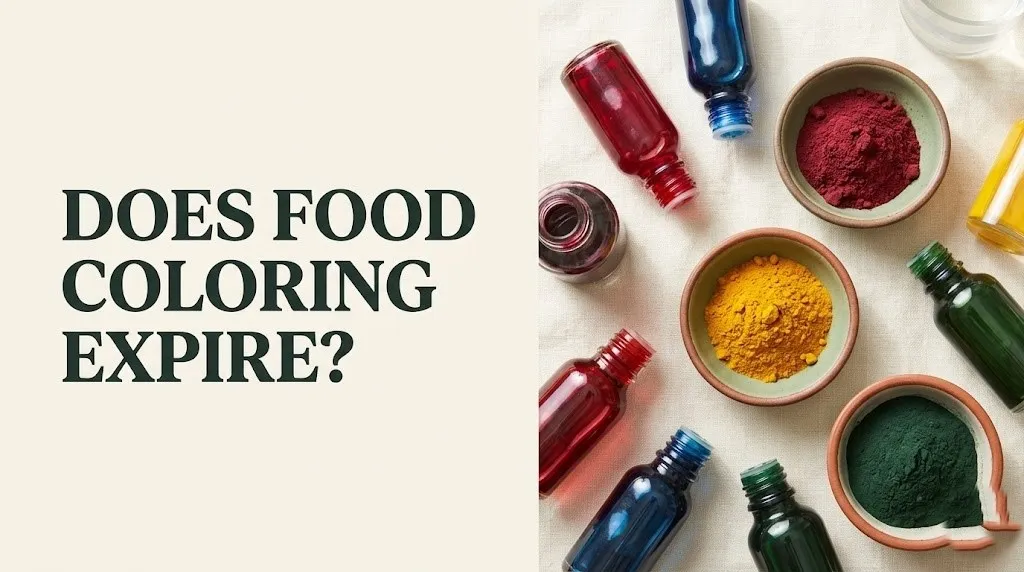
What actually changes over time is the dye’s intensity. You may find that a color that once turned a single batch of frosting a vivid red now requires twice the amount to achieve the same result. That’s potency loss, not spoilage, and it’s the main reason manufacturers print dates on their packaging.
Key points to understand:
- Synthetic food colorings are among the most shelf-stable baking pantry items you’ll own
- The FDA requires color additives to be certified for safety; they do not become chemically hazardous with age under normal conditions
- Natural and plant-based colorants behave differently and have shorter, more variable shelf lives
- A bottle showing mold growth, separation with an off odor, or an unusual texture should be discarded regardless of what the label says
Does Food Coloring Have an Expiration Date?
Most food coloring products carry a “best-by” date rather than a true expiration date, and that distinction matters significantly for how you should interpret the label. A best-by date tells you when the manufacturer expects the product to perform at its highest quality, not the point at which it becomes unsafe.
Under FDA regulations, the agency does not require expiration dates on most food coloring products sold for home use. The date you see is voluntarily printed by the manufacturer, typically as a quality assurance standard rather than a safety mandate.
The USDA Food Safety and Inspection Service distinguishes between “best-by,” “use-by,” and “sell-by” dates in general food labeling guidance. For products like food coloring, where microbial safety is not the primary concern, the date is almost entirely a quality reference.
| Date Type | What It Means | Is the Product Unsafe After This? |
|---|---|---|
| Best-by date | Peak quality window | No, quality may decline |
| Use-by date | Last date for best results | Not necessarily unsafe |
| Expiration date | Hard safety cutoff | Check context; rare for food colorings |
| No date printed | No quality guarantee from manufacturer | Use sensory checks |
If your food coloring carries only a best-by date and you’ve stored it correctly, tossing it immediately after that date passes is not necessary. Checking for actual signs of deterioration is the more reliable approach.
How Long Does Food Coloring Last?
The shelf life of food coloring varies by format, storage conditions, and whether the product uses synthetic or natural colorants. In general, properly stored synthetic food colorings last well beyond their printed dates.
According to general food science guidance and manufacturer data, liquid synthetic food colorings commonly last 4 to 6 years when stored in a cool, dark place with the cap sealed tightly. Gel food colorings have a similar or slightly longer window due to their lower water activity. Powdered colorings, when kept dry, can outlast all other formats.
Here is a practical shelf-life reference by format:
| Food Coloring Format | Typical Shelf Life (Unopened) | Typical Shelf Life (After Opening) |
|---|---|---|
| Liquid (synthetic/FD&C) | 4 to 6 years | 3 to 5 years |
| Gel / Gel-paste (synthetic) | 3 to 5 years | 2 to 4 years |
| Powdered (synthetic) | 5+ years | 3 to 5 years (if kept dry) |
| Natural / Plant-based liquid | 1 to 2 years | 6 to 12 months |
| Natural / Plant-based powder | 2 to 3 years | 1 to 2 years |
These ranges reflect correctly stored products: away from heat, light, and moisture. Exposure to any of those three factors will shorten the effective window. For people with food dye sensitivities, particularly to azo dyes like Yellow 5 (Tartrazine) or Red 40 (Allura Red AC), the format or age of the dye does not affect its allergenicity. Sensitivity reactions are tied to the chemistry of the dye itself, not its age.
Key Takeaway: Food coloring rarely becomes unsafe, but its color strength fades over time. Synthetic FD&C dyes last years beyond their printed dates; natural colorants do not.
Does Gel Food Coloring Go Bad?
Gel food coloring can go bad, but it takes significantly longer to do so than most bakers expect. Its thick, concentrated consistency is what gives gel coloring its shelf advantage.
Gel colorings are formulated with a glycerin or propylene glycol base rather than water. This matters because lower water activity means less opportunity for bacterial growth or mold. Think of it like the difference between a fresh berry and a well-made jam: reducing the free moisture dramatically extends the stable period.
A study of food-grade humectants published in food science literature consistently shows that propylene glycol and glycerin both function as effective preservative agents at the concentrations used in gel food coloring formulations. That’s why a properly sealed gel pot can remain usable well past its printed date.
Signs that gel food coloring has genuinely gone bad include:
- Visible mold growth on the surface or inside the lid
- A dried-out, cracked, or grainy texture throughout the pot (not just at the surface)
- An off or sour odor when opened
- A change in color that’s unrelated to dye mixing (grayish or brownish tinge not from the dye itself)
Surface drying at the rim or lid is not spoilage. Scraping away the dried portion and checking the color underneath is a reasonable first step before deciding to discard.
Quick Tip:
- Store gel pots upside down to keep moisture at the opening and prevent surface drying
- Wipe the rim with a clean, dry cloth before resealing to avoid contamination
- If the color produces a noticeably weaker result than before, increasing quantity is an option, but a fresh pot will give more reliable results for important baking projects
Does Liquid Food Coloring Expire?
Liquid food coloring expires in terms of peak quality, but standard synthetic liquid colorings sold in grocery stores do not become harmful with age when stored correctly. Liquid formulations contain water as a base, making them the most moisture-active format of the four main types.
The water content in liquid food coloring is why the product can eventually grow mold if contaminated: for example, if a wet spoon or dirty dropper is inserted into the bottle. Without contamination, the synthetic dye compounds in approved liquid colorings remain stable for years.
McCormick, one of the most widely recognized food coloring brands in the United States, typically prints a best-by date around 4 to 6 years from manufacture on their liquid products. Independent food safety guidance aligns with this range as a general quality reference.
For anyone sensitive to azo dyes, including Yellow 5 (Tartrazine) and Yellow 6 (Sunset Yellow FCF), liquid formulations pose the same sensitivity risk at any point in their shelf life. The age of the dye does not alter its chemical composition or reduce its potential to trigger a reaction. Individuals who avoid specific FD&C dyes should check the ingredient label of any food coloring product regardless of its format or age.
Does Powdered Food Coloring Expire?
Powdered food coloring has the longest practical shelf life of any format, often remaining viable for 5 or more years when stored away from moisture. The absence of water is what makes powder so shelf-stable.
Moisture is the primary threat to powdered colorings. A single exposure to humidity, whether from a steam-filled kitchen or a damp measuring spoon dipped into the jar, can cause clumping and create conditions where mold could eventually develop. This is less about the dye chemistry and more about basic pantry hygiene.
The Academy of Nutrition and Dietetics notes in general food safety guidance that dry goods with low water activity have extended stability compared to their liquid counterparts. Powdered food coloring, like other dry pantry staples such as baking powder or cream of tartar, belongs to that category.
Key storage practices for powdered food coloring include:
- Using a completely dry measuring spoon every single time
- Storing in an airtight container away from the stove, dishwasher, or any steam source
- Keeping in a dark cabinet or drawer, since photodegradation affects the pigment compounds
- Avoiding the refrigerator, where condensation can introduce moisture when the container is brought back to room temperature
Powdered natural colorants like beet powder, turmeric powder, and butterfly pea flower powder follow different rules. Their organic pigments are more sensitive to heat and light, and their effective range is shorter than synthetic powder colorings, typically 1 to 2 years after opening.
Key Takeaway: Powdered synthetic food coloring is the most shelf-stable format you can buy. Keep it dry and dark, and it will outlast nearly every other ingredient in your baking pantry.
Does Natural Food Coloring Expire?
Natural food coloring expires more quickly and more definitively than synthetic alternatives. The plant-derived and insect-derived pigments used in natural colorants are sensitive to heat, light, pH changes, and oxygen in ways that FD&C-certified synthetic dyes are not.
Natural colorants include pigments like betalains (from beet juice powder), curcumin (from turmeric), phycocyanin (from spirulina extract), anthocyanins (from red cabbage or butterfly pea flower), and carmine (derived from cochineal insects). Each of these compounds degrades through different pathways.
Anthocyanins, for example, are particularly sensitive to pH and light. Research published in food science literature documents that anthocyanin pigments can lose color intensity within months when exposed to alkaline conditions or UV light. This is why a natural blue food coloring might shift toward pink or purple depending on what you’re baking.
Carmine (cochineal extract) presents a dietary consideration that goes beyond shelf life: it is not suitable for vegans, vegetarians, or those following halal or kosher diets without appropriate certification. The FDA requires carmine and cochineal extract to be declared on food labels specifically because of their animal origin and the documented potential for allergic reactions in sensitive individuals.
| Natural Colorant | Primary Pigment | Heat Stable? | Light Stable? | Approximate Shelf Life (Opened) |
|---|---|---|---|---|
| Beet powder | Betalains | Low | Low | 6 to 12 months |
| Turmeric powder | Curcumin | Moderate | Low | 12 to 18 months |
| Spirulina extract | Phycocyanin | Low | Moderate | 6 to 12 months |
| Butterfly pea flower | Anthocyanins | Low | Low | 6 to 12 months |
| Carmine (cochineal) | Carminic acid | High | Moderate | 12 to 24 months |
Anyone choosing natural colorants for improved “clean label” appearance should understand that these products require more careful storage and more frequent replacement than their synthetic counterparts.
Can You Use Expired Food Coloring?
You can use expired food coloring in most cases, provided the product shows no signs of actual spoilage. Safety and quality are two separate questions, and the answer to each is different.
Synthetic FD&C food colorings that have passed their printed best-by date but show no mold, no unusual texture, no off odor, and no separation are generally safe to use. The color may be noticeably weaker. For a batch of casual cookies or a weeknight cake, that’s a manageable trade-off.
Where it gets worth reconsidering is precision work: decorating a tiered wedding cake, competing in a baking contest, or matching a specific color for professional-looking results. In those situations, older coloring introduces an unpredictable variable that a fresh product eliminates.
For natural food colorings, the calculation changes somewhat. Because plant-based pigments can degrade and shift chemically over time, the resulting color in an acid or alkaline baking environment may be different from what the label suggests. Using beet powder two years past its best-by date might give you a washed-out peach instead of the deep pink you’re after.
Quick guidance on when to use vs. when to replace:
- Use it: synthetic coloring, past best-by but no spoilage signs, low-stakes baking, color doesn’t need to be exact
- Replace it: natural coloring past its window, any product with mold or off odor, professional or precision work, coloring has been contaminated with water or a dirty tool
- Test first: mix a small amount into a tablespoon of white frosting and compare the result to your color target before committing to a full batch
Key Takeaway: Expired synthetic food coloring is usually safe to use, but “safe” and “effective” aren’t the same thing. Natural colorants are less forgiving; they lose both potency and color accuracy faster.
Is It OK to Use Expired Food Coloring?
It is generally OK to use expired food coloring if the product is synthetic, has been stored correctly, and shows no signs of contamination or spoilage. The risk is primarily one of color quality, not food safety.
That said, there are specific situations where proceeding with expired coloring is not advisable. If the product has been stored in a warm or humid environment, if the cap or seal was left loose over an extended period, or if you notice any discoloration unrelated to the dye itself, discarding it is the right call.
People with known sensitivities to specific FD&C dyes should be aware that the chemical identity of those dyes does not change as the product ages. If someone in your household has a documented sensitivity to Red 40 (Allura Red AC) or Yellow 5 (Tartrazine), an old bottle of coloring containing those compounds carries the same sensitivity risk as a new one. Checking ingredient labels is always appropriate regardless of the product’s age.
From a practical food safety standpoint, the FDA’s color additive framework is designed to ensure that approved synthetic dyes are safe at normal use levels for the general population. No credible food safety authority has issued guidance suggesting that properly stored synthetic food coloring becomes hazardous simply because a manufacturer’s best-by date has passed.
Does Food Coloring Lose Potency Over Time?
Food coloring does lose potency over time, and for most home bakers this is the real issue, not safety. The intensity of color a dye delivers gradually decreases through a process called photodegradation and through slow molecular breakdown of the dye compounds.
Photodegradation is the breakdown of color pigments when exposed to light. It’s the same process that fades bright fabrics left in a sunny window. Even the fluorescent lighting in a kitchen cabinet can contribute to potency loss in a bottle that isn’t stored in a dark location.
Think of potency loss in food coloring like the difference between a freshly brewed cup of coffee and one that’s been sitting on the burner for three hours. It’s technically still coffee. The chemical structure of caffeine hasn’t disappeared. But the experience it delivers is noticeably diminished.
For synthetic FD&C dyes, potency loss is gradual. A bottle stored correctly might show minimal potency change over two years and then accelerate once the three-year mark passes, depending on conditions. The key variables are:
- Light exposure: the single biggest factor in dye degradation; dark storage dramatically slows this
- Heat exposure: accelerates molecular breakdown, especially in natural colorants
- Oxygen exposure: less relevant for liquid and gel formats when sealed tightly, more relevant for powders in loose containers
- Contamination: introducing moisture or organic matter can change how the dye behaves in solution
For professional bakers and cake decorators where color consistency across large batches matters, a general practice is to replace food colorings within their printed date range, not because safety demands it but because predictable color results do.
How to Tell If Food Coloring Has Gone Bad
Real spoilage in food coloring is uncommon but not impossible, and the signs are fairly clear when they appear. Here’s what to look for before using a product you haven’t touched in a while.
Visual checks:
- Mold: any fuzzy or spotted growth inside the bottle, on the surface of gel, or around the cap is a firm discard signal
- Separation: liquid separating into layers is not automatically a spoilage sign; gently shaking the bottle to see if it reincorporates is a reasonable first step
- Unusual color within the product itself: a reddish dye that has turned brownish or grayish in the bottle (not as a result of mixing with another color) suggests the dye compounds have degraded
Smell checks:
- A faint chemical or characteristic scent is normal for synthetic dyes
- A sour, rancid, or fermented odor is not normal and suggests contamination, particularly relevant for natural colorants derived from plant juices or extracts
Texture checks (for gel and gel-paste):
- Surface drying at the rim is not spoilage; the gel underneath the dried layer may be completely usable
- A uniformly gritty, chunky, or separated texture throughout the entire pot is a sign of significant degradation or moisture contamination
| Sign | What It Means | Action |
|---|---|---|
| Mold growth | Contamination | Discard immediately |
| Off or sour odor | Microbial or chemical breakdown | Discard |
| Normal separation in liquid | Settling; not spoilage | Shake and test on white frosting |
| Dried rim on gel pot | Normal drying | Wipe clean; check the gel underneath |
| Weaker color result | Potency loss | Increase quantity or replace |
| Brownish tinge in bottle | Dye degradation | Replace for precision work |
Key Takeaway: Mold and off odors are the only signs that truly mean a food coloring must go. Weaker color, slight separation, or a dried rim are not safety problems; they’re just quality issues.
How to Store Food Coloring
Storing food coloring correctly is the single most effective way to extend both its safety window and its color performance. Most premature potency loss comes from poor storage, not from age alone.
The three enemies of food coloring stability are heat, light, and moisture. A cool, dark pantry drawer or cabinet shelf away from the stove and dishwasher covers all three concerns for most households. The refrigerator is generally not recommended for liquid or gel food colorings because condensation when the product is brought back to room temperature can introduce moisture inside the bottle or pot.
Proper storage by format:
Liquid food coloring:
- Upright in a cool, dark cabinet
- Cap tightly sealed after each use
- Away from the stove, dishwasher, and any steam source
- Never store near a window
Gel and gel-paste food coloring:
- Lid wiped clean and sealed completely before storing
- Upside-down storage can help keep the product moist at the opening
- Dark cabinet or drawer; avoid transparent containers on open shelves
Powdered food coloring:
- In an airtight container after opening the original packaging
- Dry measuring tools only, every single time
- Dark and dry location; never refrigerate
Natural colorants (powders and liquids):
- Refrigerating natural colorant liquids (like beet juice-based products) is appropriate and extends their usable window
- Natural powders stay in dark, airtight containers at room temperature
- Use by the date on the package more strictly than you would for synthetic options
Food Coloring Shelf Life After Opening
Opening a bottle of food coloring does start the clock on quality decline, but the timeline is longer than most people expect for synthetic products. Exposure to air and the potential for contamination from tools or fingers are the main factors that accelerate degradation after opening.
For synthetic liquid food colorings, a properly handled opened bottle remains fully effective for 3 to 5 years in most storage conditions. Gel food colorings, once opened, typically maintain good color performance for 2 to 4 years because their thick consistency limits air exposure.
The rule of “properly handled” is doing a lot of work in those timelines. Every time you introduce a wet or dirty dropper into a bottle of liquid food coloring, you’re shortening its effective life. Every time a gel pot lid is left off during a baking session, you’re accelerating surface drying and potential contamination.
Best practices for extending shelf life after opening:
- Always close the cap or lid immediately after use
- Pour or squeeze liquid colorings rather than dipping anything into the bottle
- Use clean, dry tools if you must access a gel or powder container directly
- Store opened products in the same conditions as unopened ones
- Label the opened date on the bottom of the container with a piece of tape if you want a practical reference point for freshness
For natural liquid colorings after opening, the window is considerably shorter: 6 to 12 months under normal storage is a realistic expectation before noticeable potency loss. Refrigerating opened natural colorant liquids can extend this to around 12 months in some cases.
Best-By Date vs. Expiration Date: Food Coloring
The date printed on most food coloring products is almost always a best-by date, not a true expiration date, and treating them as the same thing leads to unnecessary waste. Understanding what each term actually means helps you make better decisions at the pantry.
A best-by date is the manufacturer’s estimate of when the product will be at its best quality. It’s a voluntary label in the United States for most food coloring products, since the FDA does not mandate expiration dating on synthetic color additives used in home cooking.
A true expiration or “use-by” date carries more weight and is typically applied to perishable or time-sensitive products where safety, not just quality, is the concern. You’ll see genuine use-by dates on medications, infant formula, and certain dairy products. For synthetic food coloring, that standard simply doesn’t apply in the same way.
The USDA has worked to reduce consumer confusion around date labeling across the food industry. In general food safety communication, the agency distinguishes between quality dates (best-by, sell-by) and safety dates (use-by on perishable items). Food coloring falls firmly into the quality-date category for synthetic products.
Practical translation:
| Label | Applies To | What To Do |
|---|---|---|
| Best-by | Most synthetic food colorings | Use your senses to check; don’t discard automatically |
| Use-by | Perishable products, some natural colorants | More caution warranted; use by or shortly after |
| No date | Some imported or bulk colorings | Rely entirely on sensory checks and storage history |
| Lot number only | Professional-grade food colorings | Contact the manufacturer for shelf-life guidance |
Key Takeaway: “Best-by” on a food coloring bottle is a quality marker, not a safety alarm. The distinction matters every time you’re tempted to throw out a product that still looks, smells, and performs fine.
Does Food Dye Expire?
Food dye and food coloring refer to the same category of product, and the same expiration principles apply across both terms. Whether you’re looking at the liquid bottles in the grocery store baking aisle or the concentrated gel pots from a specialty cake supply store, all of them are food dyes.
The term “food dye” is often used to refer specifically to FD&C-certified synthetic color additives, the nine currently FDA-approved water-soluble dyes permitted for use in food produced and sold in the United States. These include Red 40 (Allura Red AC), Red 3 (Erythrosine), Yellow 5 (Tartrazine), Yellow 6 (Sunset Yellow FCF), Blue 1 (Brilliant Blue FCF), Blue 2 (Indigo Carmine), Green 3 (Fast Green FCF), and Orange B (restricted to sausage casings only).
According to FDA color additive regulations under 21 CFR Part 74, FD&C-certified dyes must pass a certification process that confirms their chemical composition and purity. That chemical stability is precisely why they remain safe well beyond a printed best-by date under normal storage conditions.
For anyone managing food dye sensitivities in their household, the relevant fact is that the type of dye matters more than its age. Yellow 5 (Tartrazine) is associated with sensitivity reactions in some people, and some research suggests a possible link between certain synthetic dyes and behavioral changes in sensitive children, though this remains an area where evidence is still being evaluated. The FDA continues to monitor the safety of approved food dyes through its ongoing review process.
Those avoiding FD&C dyes for any reason have access to a growing range of natural colorant alternatives. The trade-off, as covered in earlier sections, is shorter shelf life and less predictable color behavior in heat and alkaline baking environments.
Frequently Asked Questions About Food Coloring
Does food coloring go bad if not refrigerated?
Most synthetic food colorings do not go bad at room temperature when stored in a cool, dark place with a tightly sealed cap.
Refrigeration is not recommended for liquid or gel synthetic colorings because condensation can introduce moisture when the product returns to room temperature.
Natural, plant-based liquid colorings are an exception: refrigerating them after opening extends their usable life and is generally recommended.
How long does gel food coloring last once opened?
Opened gel food coloring typically remains effective for 2 to 4 years when stored correctly in a cool, dark place with the lid sealed tightly after each use.
The glycerin or propylene glycol base in gel colorings creates a low-moisture environment that resists bacterial growth and slows degradation.
If the gel develops mold, a sour odor, or a uniformly gritty texture throughout, it should be discarded.
Can expired food coloring make you sick?
Properly stored synthetic food coloring that has passed its best-by date is very unlikely to make you sick, as FD&C-certified dyes do not support microbial growth under normal conditions.
The risk increases significantly if the product shows visible mold, has been contaminated with organic matter, or has an off odor: those are signs of genuine deterioration.
Natural food colorings, especially liquid plant-based products stored without refrigeration past their use-by date, carry a higher potential for spoilage than synthetic options.
Does natural food coloring expire faster than artificial?
Yes. Natural food colorings expire faster than synthetic alternatives because their plant-derived or insect-derived pigments are sensitive to heat, light, pH changes, and oxygen in ways that FD&C-certified synthetic dyes are not.
An opened natural liquid colorant typically remains effective for 6 to 12 months, while an opened synthetic liquid colorant can last 3 to 5 years under comparable storage conditions.
Natural powders last longer than natural liquids but still have a shorter effective window than synthetic powder colorings.
What happens if you use old food coloring in baking?
Using old synthetic food coloring typically results in a weaker, less vibrant color in your baked goods rather than any safety issue.
You may need to use more than the recipe calls for to achieve a comparable result, which can sometimes affect the flavor slightly in large amounts, particularly with liquid colorings that have a concentrated taste.
Old natural colorants can shift color unpredictably in alkaline or acidic baking environments, so using them in precision work is not advisable.
Closing
Food coloring is one of the most shelf-stable items in your baking pantry, at least when it’s synthetic and stored correctly. The date on the bottle is mostly a quality benchmark, not a safety line you must never cross.
The more important habit is checking before you use: look for mold, smell for anything off, and test the color on a spoonful of white frosting before committing to a full batch. That thirty-second check tells you more than any printed date.
For natural and plant-based colorants, the rules are stricter. Replace them more regularly, store them more carefully, and don’t expect the same color consistency you’d get from a fresh product.