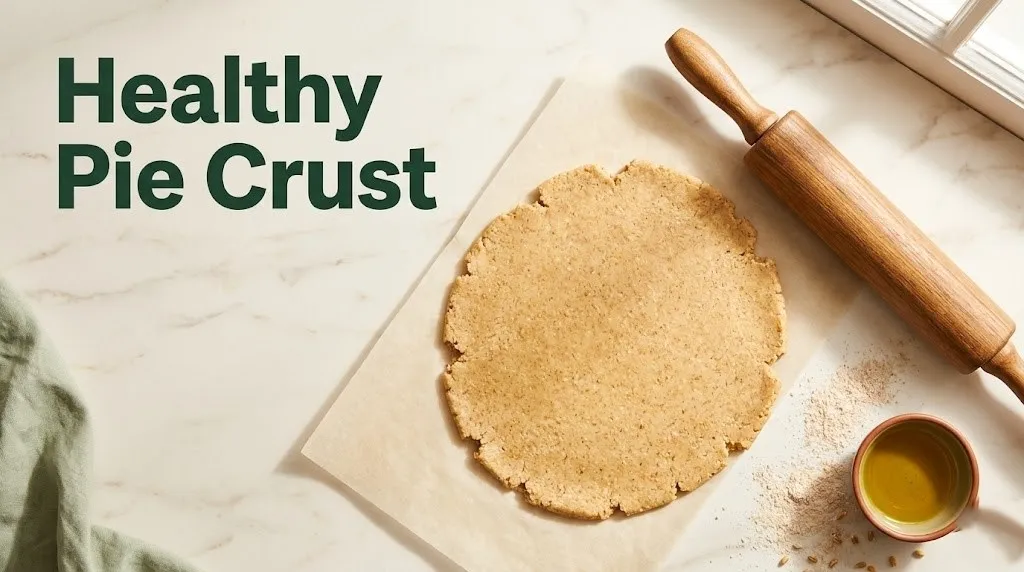
A healthy pie crust is one that swaps refined white flour and solid saturated fat for whole-grain flours and liquid unsaturated oils, all while still producing a tender, flaky pastry that holds a filling. You are not signing up for a dense, leaden disc that tastes like shredded wheat. The goal is a crust that actually tastes like pie and simply carries a better nutritional deal than the classic all-butter or shortening version.
The standard all-purpose flour and butter pie crust delivers roughly 150 calories per slice with 10 grams of fat, nearly 6 of them saturated, and less than 1 gram of fiber. According to the American Heart Association, a dietary pattern high in saturated fat from butter, lard, and hydrogenated shortening is strongly linked to elevated low-density lipoprotein cholesterol levels. A healthy crust does not eliminate fat, it changes the type of fat and adds fiber where the original recipe offers none.
This article gives you a master recipe that works, explains exactly why each ingredient earns its place, and walks through the common failure points that turn a promising healthy crust into a sad pile of crumbles. You will leave knowing how to choose your flour, your fat, and your method to match the kind of pie you are baking and the dietary pattern you follow.
healthy pie crust
A healthy pie crust is a pastry base made from whole-grain flours, unsaturated fats like olive or avocado oil, and minimal added sugar, designed to reduce saturated fat and increase fiber compared to a classic all-butter crust. It is not a different species of food. It is the same flaky, tender vehicle for fruit, custard, or savory fillings, built with ingredients that better align with current dietary guidance.
The nutritional upgrade is real and measurable. A classic all-butter crust made with all-purpose flour delivers roughly 150 calories, 10 grams of total fat, and 5.8 grams of saturated fat per slice, with less than 1 gram of fiber. A healthy crust made with whole-wheat pastry flour and olive oil drops to approximately 130 calories, 7 grams of total fat, and 1 gram of saturated fat per slice, with 2.5 grams of fiber. You are swapping the type of fat, not just the amount, and adding fiber that was entirely absent before.
The Academy of Nutrition and Dietetics recommends that most adults aim for 25 to 30 grams of dietary fiber daily, yet the average American consumes about 15 grams. Every gram of fiber you can integrate into foods you already eat moves you closer to that target without requiring a separate fiber supplement or a bran cereal you will not stick with. A pie crust is never going to be a fiber powerhouse, but replacing a zero-fiber crust with one that delivers 2 to 3 grams per slice is a meaningful incremental change in a real dietary pattern.
what makes a pie crust healthy
Three specific ingredient decisions determine whether a pie crust qualifies as genuinely healthier than the standard version: the choice of flour, the choice of fat, and the elimination of added sugar from the dough itself. Each decision changes the nutritional math, and each decision also changes how the dough handles and bakes. Healthy does not mean you ignore the physics of pastry.
The flour choice is the single largest nutritional lever. All-purpose flour is refined endosperm stripped of the bran and germ where the fiber, B vitamins, magnesium, and zinc reside. Replacing it with whole-wheat pastry flour retains the entire wheat kernel in a finely milled form that still produces a tender result. Whole-wheat pastry flour contains about 3 grams of fiber per quarter-cup serving compared to less than 1 gram in the same amount of all-purpose flour. Almond flour and oat flour are gluten-free alternatives that bring their own fat and fiber profiles.
The fat choice determines the saturated fat content and the fatty acid ratio. Butter is roughly 63 percent saturated fat. Coconut oil is about 82 percent saturated fat, which surprises many people who assume all plant oils are automatically heart-healthy. Olive oil is 14 percent saturated fat and predominantly monounsaturated. Avocado oil is 12 percent saturated fat. The American Heart Association explicitly recommends replacing saturated fats with unsaturated fats to support cardiovascular health. Using olive or avocado oil instead of butter directly aligns the crust with that guidance.
healthy pie crust alternatives
Healthy pie crust alternatives are ingredient substitutions that reduce saturated fat, increase fiber, or remove gluten and animal products from the crust while preserving a usable pastry texture. The three most practical categories are whole-grain flour swaps, oil-for-butter swaps, and nut or seed flour crusts that bypass traditional pastry structure entirely.
A whole-grain swap is the most straightforward path. Substitute 100 percent of the all-purpose flour with whole-wheat pastry flour and switch from butter to a neutral oil like avocado oil. The crust will be nuttier in flavor and slightly less flaky, but it will roll, crimp, and blind-bake similarly to the classic. For a gluten-free option, a blend of almond flour and oat flour bound with a small amount of egg or ground flaxseed mixed with water creates a press-in crust that eliminates rolling entirely.
An oil crust replaces solid fat with a liquid unsaturated oil, usually olive oil, avocado oil, or a neutral vegetable oil like grapeseed. The method skips the cutting-in step and instead mixes oil directly into the flour until the mixture resembles wet sand, then binds it with just enough ice water or milk to form a dough. The crust is more tender and mealy than flaky, which works beautifully for custard pies, pumpkin pie, and quiches where a crisp, buttery flake is less important than a sturdy, sliceable base.
| Crust Type | Flour Base | Fat Source | Saturated Fat per Slice | Fiber per Slice |
|---|---|---|---|---|
| Classic all-butter | All-purpose flour | Butter | 5.8 g | 0.5 g |
| Whole-wheat oil | Whole-wheat pastry flour | Olive oil | 1.0 g | 2.5 g |
| Almond press-in | Almond flour | Coconut oil | 4.2 g | 3.0 g |
| Vegan oat | Oat flour | Avocado oil | 0.8 g | 2.0 g |
heart healthy pie crust
A heart-healthy pie crust is one that eliminates butter, lard, shortening, and tropical oils high in saturated fat, replacing them with oils rich in monounsaturated and polyunsaturated fats. The best options are extra virgin olive oil, avocado oil, and walnut oil, each of which brings a distinct flavor that works with different fillings. The flour base should be a whole grain, adding fiber that supports healthy blood lipid levels.
The American Heart Association’s 2023 updated dietary guidance continues to emphasize replacing dietary saturated fat with unsaturated fat, particularly polyunsaturated and monounsaturated fatty acids. A single slice of classic butter crust contains about 6 grams of saturated fat, which is 30 percent of the AHA’s recommended daily limit of 20 grams for a 2,000-calorie eating pattern. A crust made with olive oil cuts that to roughly 1 gram per slice. That is a five-fold reduction with no loss of richness.
Walnut oil deserves special mention. It is high in alpha-linolenic acid, the plant-based omega-3 fatty acid. It has a low smoke point, which does not matter for pie baking since the crust never reaches frying temperatures. Its flavor is assertive and slightly bitter, pairing best with chocolate, maple, or deeply spiced pumpkin fillings. Store walnut oil in the refrigerator because its high polyunsaturated fat content makes it prone to rancidity at room temperature.
Key Takeaway: A healthy pie crust is not a single recipe but a formula you adapt: choose a whole-grain flour, a liquid unsaturated oil, and a mixing technique matched to your filling, then treat the dough gently to control gluten development.
healthy pie crust recipe
This recipe produces a tender, flaky, whole-wheat and olive oil pie crust that works for sweet and savory pies. It requires a food processor for the most consistent result, though you can make it by hand with a pastry cutter. The recipe yields one 9-inch single crust.
The combination of whole-wheat pastry flour and a small amount of all-purpose flour gives you the fiber and micronutrients of the whole grain without the density that comes from using 100 percent regular whole-wheat flour, which has a higher protein content and develops more gluten. The vodka is an optional but recommended addition. It wets the flour enough to form a dough but produces less gluten than water, yielding a more tender crust, then it evaporates during baking.
The crust contains no added sugar, making it suitable for savory applications like quiche, chicken pot pie, and vegetable tarts. For a dessert pie, the filling provides all the sweetness needed. The finished crust has a golden, slightly nutty flavor from the whole wheat and a faint fruitiness from the olive oil that disappears behind any reasonably flavorful filling.
Ingredients:
- 1 cup whole-wheat pastry flour
- 1/4 cup all-purpose flour
- 1/4 teaspoon salt
- 1/4 cup extra virgin olive oil
- 2 to 3 tablespoons ice-cold water
- 1 tablespoon cold vodka (optional, replaces 1 tablespoon water)
To make the dough:
- Place both flours and the salt in a food processor and pulse three times to combine.
- Drizzle the olive oil evenly over the flour mixture, then pulse in short bursts until the mixture looks like coarse sand with a few larger clumps the size of small peas, about 8 to 10 pulses total.
- Sprinkle 2 tablespoons of ice water and the cold vodka, if using, over the mixture.
- Pulse just until the dough begins to clump and holds together when pressed between your fingers, about 4 to 6 pulses. If the mixture still looks dry and crumbly, add the remaining tablespoon of ice water and pulse twice more.
- Dump the dough onto a piece of plastic wrap and shape it into a flat disc without kneading.
- Wrap tightly and refrigerate for at least 30 minutes or up to 2 days.
To roll and bake:
- Let the dough sit at room temperature for 5 minutes if it has been chilled longer than an hour.
- Roll the dough between two sheets of parchment paper or on a lightly floured surface into a 12-inch circle about 1/8 inch thick.
- Transfer to a 9-inch pie plate, trim the overhang to 1 inch, and crimp the edges.
- For a pre-baked shell (par-baking), prick the bottom all over with a fork, line with parchment, fill with pie weights, and bake at 375 degrees Fahrenheit for 15 minutes. Remove the weights and parchment, then bake for another 5 to 8 minutes until the bottom looks dry and lightly golden.
- For a filled pie, add the filling to the unbaked shell and bake according to your pie recipe’s instructions.
how to make a healthy pie crust
Making a healthy pie crust successfully requires understanding that you are managing three structural elements: fat distribution for tenderness, gluten development for structure, and water content for cohesion. Each healthy substitution changes how those three elements behave, and your technique must compensate accordingly.
The first compensation is hydration. Whole-wheat flour absorbs more water than all-purpose flour because the bran and germ are hydrophilic. If you simply swap whole-wheat flour into a classic recipe without increasing the liquid slightly, your dough will be crumbly and impossible to roll without cracking. Start with the amount of water the recipe calls for, then add an extra half-tablespoon if the dough refuses to come together when pressed. The dough should hold its shape but not feel wet or sticky.
The second compensation is mixing restraint. Gluten forms when glutenin and gliadin proteins in wheat flour meet water and get agitated. The more you mix, the more gluten you build. In a standard pie crust, you avoid overmixing because a tough crust is unpleasant. With whole-wheat flour, the bran particles physically cut through gluten strands as they form, weakening the network. This means whole-wheat dough is actually less prone to toughness than all-purpose dough, but the bran also makes the dough more likely to tear during rolling. Rolling between parchment sheets eliminates the need to add excess flour, which would dry the dough further.
The third compensation is temperature control. Solid fat like butter must stay cold so it remains in distinct pieces that flatten into layers during rolling, creating flakiness as they melt and steam in the oven. Liquid oil cannot form solid pieces, so the flakiness mechanism is different: the oil coats the flour particles and limits gluten development, producing a tender, mealy crust. You still want the water ice-cold to minimize gluten activation, but you do not need to chill the oil.
how to make healthy pie crust
The method for making a healthy oil-based pie crust differs enough from the classic butter method that you need to approach it as its own technique rather than a direct substitution. In a butter crust, you cut cold fat into flour, leaving visible pieces. In an oil crust, you coat the flour with fat uniformly, then add just enough liquid to bind it.
This uniform coating is what gives an oil crust its distinctive texture. Since there are no solid fat pieces to create steam pockets, the crust will not produce the dramatic layered flakes of a butter pastry. What you get instead is a beautifully tender, crisp crust that shatters rather than flakes, similar to a shortbread or a very good graham cracker crust. This texture is ideal for any pie where the filling is the star and the crust plays a supporting role.
Because oil crusts have no visible fat chunks, many bakers overcompensate by adding too much oil, producing a greasy dough that bakes into a hard, fried-cracker texture. The correct ratio is roughly 1 part oil to 4 parts flour by volume. If the dough looks and feels greasy before you add any water, you have exceeded the flour’s capacity to absorb the oil. Start with a lower amount of oil than you think you need, then add a teaspoon more only if the mixture stays powdery after thorough mixing.
Common pitfalls when making an oil-based healthy crust:
- Adding oil that is too warm, which fails to create the proper emulsion with cold water
- Using regular whole-wheat flour instead of pastry flour, creating a dense, tough result
- Skipping the resting period, which is when the bran particles fully hydrate
- Rolling the dough too thin, because oil crusts have less structural strength than butter crusts
- Baking at too low a temperature, which dries the crust out before it sets properly
healthy pie dough
Healthy pie dough is a pliable, rollable pastry mixture made from whole-grain flour, unsaturated fat, water, and salt that can be used immediately or frozen for later use. The defining characteristic of a good healthy pie dough is that it handles like conventional dough and does not announce its whole-grain identity through toughness or bitterness.
The resting period after mixing is non-negotiable. When you first combine whole-wheat flour with water, the bran particles are still sharp-edged and dry. Give the dough 30 minutes in the refrigerator, and those bran edges soften as they absorb moisture. The gluten network relaxes, making the dough less likely to spring back during rolling. Dough that has rested properly rolls smoothly, transfers without tearing, and shrinks less during baking.
You can make the dough in advance and freeze it for up to three months. Wrap the flattened disc tightly in plastic wrap, then place it in a freezer bag. Thaw overnight in the refrigerator before rolling. Freezing and thawing actually improves the dough, as the extended resting time allows even more complete hydration of the bran. A dough pulled from the freezer and thawed in the refrigerator for 24 hours will roll more cooperatively than one made the same morning.
Quick Tip for Dough Handling:
- Always flatten the dough into a disc before chilling because a disc chills evenly and rolls into a circle more naturally than a ball.
- Let frozen dough thaw completely in the refrigerator before attempting to roll it.
- If the dough cracks at the edges during rolling, let it warm up for 3 to 5 minutes and try again.
easy healthy pie crust
An easy healthy pie crust is one that does not require a food processor, a pastry cutter, or any rolling at all. The simplest version is a press-in crust made from almond flour, a small amount of coconut oil or melted butter, and a pinch of salt. You mix the ingredients in a bowl, press the mixture evenly into the pie plate with your fingers, and either bake it briefly to set or fill it directly for a no-bake pie.
This style of crust is inherently gluten-free because almond flour contains no wheat. It is also higher in fat and calories than a whole-wheat oil crust, so the word “healthy” here applies to its whole-food ingredient list and gluten-free status, not to a reduced calorie count. A slice of almond flour press-in crust contains roughly 160 to 180 calories and 15 grams of fat, most of it monounsaturated from the almonds. It is satiating, rich, and pairs perfectly with chilled chocolate or fruit fillings that do not require a pre-baked shell.
A second easy option is a pat-in-pan crust made with melted butter or oil and whole-wheat pastry flour. You melt the fat, stir it into the flour and salt with a fork until crumbly, then add just enough water to make the mixture hold together. Press it directly into the pie plate, building up the sides with your fingers. The crust bakes into a rustic, shortbread-like shell that is not flaky but tastes pleasantly toasty and holds a filling without leaking.
healthy homemade pie crust
A healthy homemade pie crust is one you make entirely from scratch using whole-food ingredients you selected yourself, rather than from a refrigerated box or a freezer aisle package. The advantage is total control over the fat source, the flour type, and the sodium content. Store-bought pie crusts, even the ones labeled “organic” or “all-natural,” are almost universally made with refined white flour and palm oil or hydrogenated lard.
The USDA FoodData Central database confirms that a standard refrigerated pie crust contains roughly 3 grams of saturated fat per serving and lists partially hydrogenated lard or palm oil among the first three ingredients. These fats are chosen by manufacturers because they are solid at room temperature, cheap, and produce a reliably flaky result after months in a freezer. They are not chosen because they align with the AHA’s recommendations for cardiovascular health.
Making crust at home also lets you eliminate the preservatives and dough conditioners found in commercial products. Butylated hydroxyanisole, citric acid as a preservative, and sodium metabisulfite as a dough conditioner appear frequently on commercial pie crust labels. None of these are dangerous at regulated levels, but they signal an industrial product formulation rather than a home kitchen approach. If your definition of healthy includes minimizing ultra-processed ingredients, homemade is the only path.
| Attribute | Homemade Healthy Crust | Store-Bought Refrigerated Crust |
|---|---|---|
| Flour type | Whole-wheat pastry, almond, or oat | Refined white flour |
| Fat source | Olive oil, avocado oil, butter | Palm oil, hydrogenated lard |
| Preservatives | None | BHA, citric acid, sodium metabisulfite |
| Sodium per slice | 50-75 mg (controlled) | 130-180 mg |
| Saturated fat per slice | 1-4 g (varies by recipe) | 3-4 g |
| Ingredient count | 4-6 | 15-20 |
Key Takeaway: The value of a homemade healthy crust is that you decide every ingredient that goes into it, cutting the saturated fat by up to 80 percent and eliminating the preservatives and conditioners that define commercial products.
healthy crust
A healthy crust, in the broader sense beyond pie, is any baked pastry base that uses whole-grain flours, unsaturated fats, and minimal added sugar to create a foundation for a dish. The concept applies to quiche shells, tart shells, galette dough, cobbler toppings, and even savory applications like pot pie tops or empanada wrappers.
The same principles scale across applications. If you are making a savory galette, use the whole-wheat olive oil dough, roll it into a rough circle, pile roasted vegetables and goat cheese in the center, and fold the edges up around the filling. The rustic, freeform nature of a galette forgives a crust that is slightly less cooperative to roll, making it an ideal vehicle for a dough you are still getting comfortable handling.
For a cobbler or a fruit crisp, a healthy topping can replace the traditional all-purpose flour, butter, and sugar biscuit. Combine rolled oats, almond flour, chopped nuts, a drizzle of maple syrup, and a splash of melted coconut oil or avocado oil. Drop the mixture in rough clumps over the fruit and bake. The result is a crisp, nutty topping with fiber from the oats and almonds and far less saturated fat than a classic butter-based cobbler biscuit.
Options for building a healthy crust across different dishes:
- Quiche: Press-in almond flour and ground flaxseed crust, par-baked for 10 minutes
- Pot pie: Whole-wheat olive oil double crust or phyllo dough top brushed with olive oil
- Hand pies: Whole-wheat pastry dough, rolled thin and folded around a savory filling
- Cheesecake: Almond flour, oat flour, and coconut oil press-in base
pie crust recipe healthy
A pie crust recipe qualifies as healthy when it demonstrably improves the fat quality, fiber content, or whole-food ingredient profile relative to the standard all-butter and white-flour formulation, and does so without adding excessive sugar or sodium to compensate for lost flavor. The recipe provided earlier in this article meets that standard with a measured approach that keeps the dough workable.
That recipe is designed as a starting point, not a rigid formula. You can adapt it to your specific dietary needs. For a vegan version, it is already dairy-free because it uses olive oil instead of butter. For a nut-free version, stick with whole-wheat pastry flour and avoid almond flour. For a gluten-free version, replace both flours with a 1-to-1 gluten-free baking flour blend that contains xanthan gum, which mimics the binding function of gluten.
The recipe’s versatility across fillings is part of what makes it useful for real-life baking. Use it for a savory mushroom and leek quiche by adding a teaspoon of dried thyme to the flour mixture before adding the oil. Use it for a fresh strawberry pie by par-baking the shell, filling it with macerated berries, and chilling until set. Use it for a Thanksgiving pumpkin pie exactly as you would a classic crust, with no one at the table aware they are eating whole wheat and olive oil unless you tell them.
healthy pie crusts
Healthy pie crusts, as a category, now span a range of dietary pattern compatibility far broader than what was available a decade ago. You can find or make a crust that fits a Mediterranean diet, a vegan diet, a gluten-free diet, a low-FODMAP diet, or a heart-healthy eating plan. Each variation trades some textural quality for nutritional alignment, and the key is matching the crust to the filling and the occasion.
A Mediterranean diet crust uses olive oil and whole-wheat flour, aligning with the dietary pattern’s emphasis on monounsaturated fats and whole grains. A vegan crust replaces butter with coconut oil or a solid vegetable shortening that is sustainably sourced and free of hydrogenation. A gluten-free crust uses a blend of almond flour, tapioca starch, and egg to create a dough that can actually be rolled, though it will be more delicate and benefits from being pressed into the pan rather than transferred from a countertop.
Understanding which crust fits your needs requires knowing the dominant fat in each option and its fatty acid profile. Coconut oil is plant-based and vegan, but it is over 80 percent saturated fat, making it a poor choice for someone specifically targeting cholesterol reduction. Almond flour is gluten-free and nutrient-dense, but it is calorie-dense and high in oxalates, which matters for people prone to calcium oxalate kidney stones. No single crust is optimal for every person, but the current landscape of options means you can find one that matches your priorities.
| Dietary Pattern | Recommended Crust | Key Fat Used | Primary Benefit |
|---|---|---|---|
| Mediterranean | Whole-wheat olive oil | Olive oil (monounsaturated) | Fiber plus healthy fat |
| Vegan | Coconut oil whole-wheat | Coconut oil | No animal products |
| Heart-healthy | Whole-wheat avocado oil | Avocado oil | Lowest saturated fat |
| Gluten-free | Almond-oat press-in | Coconut or avocado oil | No wheat protein |
| Low-FODMAP | Almond flour and egg | Butter or coconut oil | No fermentable carbs |
Key Takeaway: The expanding world of healthy pie crusts means you can bake a pastry that fits your specific dietary pattern without accepting a crust that tastes like punishment.
Frequently Asked Questions About Healthy Pie Crust
What is the healthiest type of pie crust?
The healthiest pie crust for heart health is one made with whole-wheat pastry flour and a liquid unsaturated oil like olive or avocado oil.
This combination reduces saturated fat to about 1 gram per slice while adding 2 to 3 grams of fiber from the whole grain.
For a gluten-free diet, a press-in almond flour and oat flour crust offers fiber and healthy fats without wheat.
Can you make a healthy pie crust without butter?
You can make a healthy pie crust without butter by substituting olive oil, avocado oil, or grapeseed oil in an equal volume.
The oil coats the flour particles and produces a tender, mealy crust rather than a flaky one.
Expect a texture closer to shortbread than to classic puff pastry.
Is whole-wheat pie crust actually healthy?
Whole-wheat pie crust is healthier than a white-flour crust because it retains the bran and germ of the wheat kernel, adding fiber, magnesium, and B vitamins.
However, it is not a low-calorie food and still derives most of its calories from fat and flour.
The health benefit comes from the improved nutrient density and fiber content, not from a reduction in total calories.
How do you make a healthy pie crust that doesn’t fall apart?
A healthy pie crust holds together when you fully hydrate the whole-grain flour during mixing and let the dough rest in the refrigerator for at least 30 minutes before rolling.
Adding a tablespoon of vodka in place of some water weakens gluten formation and makes the dough more tender without sacrificing structure.
Rolling the dough between two sheets of parchment paper also prevents it from sticking and tearing during the transfer to the pie plate.
What can I substitute for butter in pie crust?
You can substitute extra virgin olive oil, avocado oil, refined coconut oil, or cold vegetable shortening for butter in a pie crust.
Olive oil and avocado oil are the best choices for reducing saturated fat, while coconut oil provides a firmer texture closer to butter.
Use the same volume measurement of oil as the recipe calls for in butter, but reduce any additional water slightly since butter contains about 15 percent water and oil contains none.
The healthiest pie crust is the one you will actually make, not the theoretical one that sounds perfect on paper but demands ingredients and techniques that keep it out of your kitchen. A whole-wheat olive oil crust that you bake twice a month contributes more to your overall dietary quality than an almond-flax-chia masterpiece you attempt once and abandon.
Start with the master recipe in this article. Make it for a quiche next weekend. Pay attention to how the dough feels at each stage and adjust the water by the half-teaspoon until the texture clicks. Your hands will learn faster than your brain what properly hydrated whole-grain dough should feel like, and after three or four attempts you will not need a recipe at all.
Then adapt freely. Use avocado oil when the filling is delicate and olive oil when its fruitiness adds depth. Swap in a quarter-cup of almond flour for a more tender crumb. Freeze a second disc of dough so there is always a healthy crust waiting in the freezer. Pie is part of a life well lived, and a crust that nourishes while it delights earns its place on your table.