A food mill is a manual, non-electric kitchen tool that strains and purées soft foods into a smooth, consistent texture while automatically separating and discarding unwanted skins and seeds. It looks like a wide metal bowl or hopper with a hand crank on top and a perforated disc at the bottom. You load cooked produce into the bowl, turn the crank, and a curved blade presses the food against the disc, forcing the good pulp through while the fibrous waste stays trapped inside.
Home cooks have been using some version of this tool for well over a century under various names: passatutto in Italy, moulinette in France, and the classic Foley Food Mill in mid-century American kitchens. The tool refuses to disappear because it solves a problem no blender or food processor can truly fix. Mechanical blades chop seeds and skins into invisible fragments you still taste and digest. A food mill physically removes them without pulverizing them first.
This guide walks you through the exact mechanics of a food mill, the specific situations where it beats your electric appliances, and how to pick the right disc size, material, and capacity for the foods you actually cook. Whether you are staring down a bushel of tomatoes in August or making your infant’s first puréed peas, you will know exactly what this tool can and cannot do by the time you finish reading.
what is a food mill
A food mill is a manually operated straining and puréeing device consisting of a hopper, a hand-crank mechanism, a curved metal blade, and a removable perforated disc that sits at the base. Soft or cooked food is placed in the hopper. As you turn the crank, the angled blade pushes food against the disc, forcing the pulp through the holes while leaving skins, seeds, and fibrous strands behind.
The tool is entirely mechanical. No electricity. No motor. The friction and heat generated are negligible compared to an electric blender, which can spin blades fast enough to heat contents through friction in under a minute. This mechanical simplicity means the food mill produces a purée that has not been whipped with air or heated by motor friction, both of which can alter color, flavor, and nutrient stability in sensitive produce.
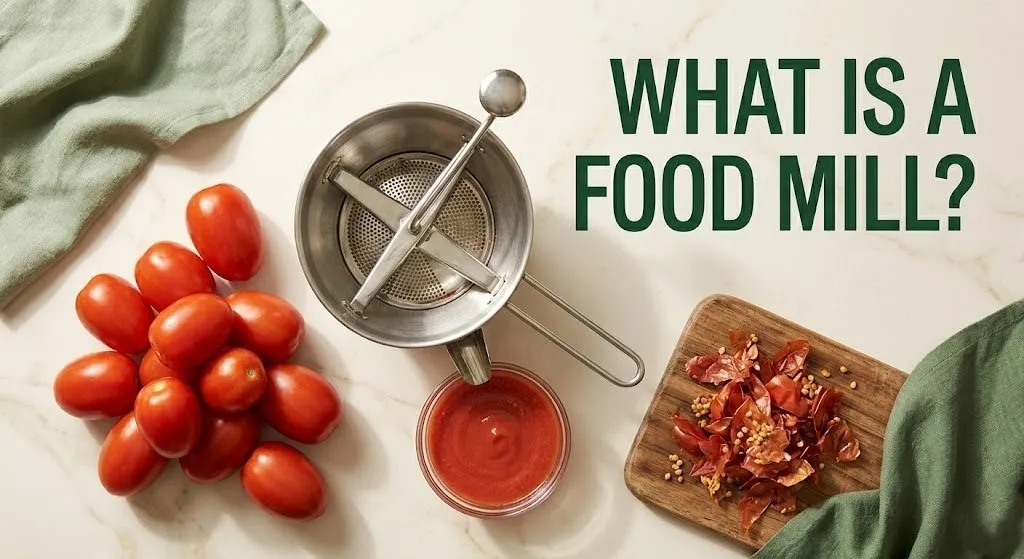
Food mills are typically constructed from stainless steel, aluminum, tinned steel, or rigid food-grade plastic. The material matters for more than just durability. A stainless steel 304 (18/8) mill will not react with acidic foods like tomatoes or citrus. An untreated aluminum mill will react, potentially imparting a metallic taste and introducing aluminum compounds into food with a pH below 4.6. If you process high-acid produce regularly, stainless steel is not an aesthetic upgrade. It is a food safety choice.
| Material | Acid Reactivity | Durability | Best For |
|---|---|---|---|
| Stainless Steel (304) | None | Excellent | Tomatoes, citrus, daily use |
| Tinned Steel | Low (when intact) | Moderate | Occasional use, non-acidic foods |
| Aluminum | High | Moderate | Non-acidic foods only, apples, potatoes |
| POM Plastic | None | Low to moderate | Light occasional use, baby food |
whats a food mill
“What’s a food mill” is the same question asked more conversationally, and the answer remains a hand-cranked straining tool that produces smooth purées free of skins and seeds. The term is a contraction of “what is a food mill,” and the searcher using this phrasing is likely looking for the fastest possible definition before deciding whether to keep reading or click away. Here is that definition: a bowl with holes and a crank that separates food pulp from waste in one motion.
The food mill occupies a specific niche that puts it somewhere between a colander, a potato ricer, and a blender. It is not a strainer alone, because it actively presses and scrapes. It is not a ricer, because it strains while it extrudes. It is not a blender, because it rejects what should not be in the final product instead of incorporating it. That rejection capability is the whole point.
In a modern 2026 kitchen filled with high-speed blenders and multi-function food processors, the food mill survives as a specialized tool that does one job better than the multi-taskers. It does not make smoothies. It does not chop onions. It will not knead dough. What it will do is produce a seedless blackberry coulis with a sheen and body no blender can match, because blender-puréed blackberries are full of gritty seed fragments no amount of blending will dissolve.
Key Takeaway: A food mill is a one-trick tool, but the trick—separating smooth pulp from fibrous waste without grinding the waste into the food—is one no other common kitchen appliance can perform.
what does a food mill do
A food mill strains and purées cooked or soft raw foods into a uniform, smooth consistency while simultaneously extracting and discarding seeds, skins, stems, and fibrous tissue. It performs two actions at once: the pressing action forces soft flesh through a sieve, and the scraping action keeps the blade moving across the disc to prevent clogging. What comes out the bottom is a smooth purée or sauce. What stays in the hopper is dryish, compressed waste called pomace.
The separation is mechanical, not chemical. The size of the holes in the disc determines what passes through and what gets caught. A fine disc with 1-millimeter holes will block tiny raspberry seeds. A coarse disc with 5-millimeter holes will pass cooked apple flesh while catching only the skin and core fragments. The blade angle forces food against the disc at a consistent pressure, so you get a uniform output without having to scrape a mesh strainer with a spoon, which is the old-fashioned, labor-intensive method the food mill replaced.
The tool is particularly useful for anyone processing large volumes. A food mill can handle a bushel of apples for applesauce or a 20-pound box of tomatoes for passata far faster than pressing through a conical strainer by hand. The crank mechanism multiplies your hand force. One rotation of the arm sweeps the blade across the entire disc surface, processing several ounces of food per turn. A hand-cranked food mill is genuinely faster for large-batch processing than loading, blending, and straining in a blender in repeated small batches.
- It removes skins from cooked apples, pears, and peaches for smooth sauces and butters.
- It extracts seeds from tomatoes, blackberries, raspberries, and grapes for coulis and jams.
- It rices cooked potatoes and other root vegetables into a fine, non-gummy mash.
- It prepares low-fiber purées for infants, people with dysphagia, or post-surgical patients on texture-modified diets.
how does a food mill work
A food mill works through the combined action of an angled rotating blade, a stationary perforated disc, and downward pressure applied to soft food. When you load cooked produce into the hopper and turn the crank, the curved metal blade rotates against the disc, catching food between the blade edge and the hole-punched surface. The blade’s angle forces the food downward and outward, pressing soft pulp through the holes while pushing fibrous material ahead of it along the disc surface.
The physics is simple but specific. The blade does not cut. It compresses and scrapes. The gap between the blade and the disc is narrow enough that soft, hydrated tissue squeezes through, but tough, flexible skin and hard seeds cannot deform enough to follow. They get swept along the disc until they collect as a mat of dryish waste or get caught in the blade’s path. This is why cranking too fast is a mistake. A rapid crank forces skins against the holes with enough pressure to extrude fragments of skin through the disc, defeating the separation purpose entirely.
The spring-loaded or tension-adjusted design of better food mills allows the blade to maintain consistent pressure on the disc even as the food mass changes consistency. Cheaper models with fixed blade positions tend to leave wet pulp behind or require manual scraping to keep the blade in contact with the last bits of food. The difference between a $30 OXO Good Grips and a generic discount mill is almost entirely in this pressure consistency and how little food remains unprocessed when you are done.
| Component | Function |
|---|---|
| Hopper (bowl) | Holds the food to be processed |
| Crank handle | Drives the blade rotation |
| Curved milling blade | Presses and scrapes food against disc |
| Perforated disc | Determines output texture by hole size |
| Legs or hooks | Anchor the mill over a pot or bowl |
| Waste outlet | Traps skins and seeds for disposal |
Key Takeaway: A food mill’s blade scrapes and presses rather than cutting or blending, which is the mechanical secret behind its unique ability to separate pulp from waste.
food mill vs food processor
A food mill produces a deseeded, skin-free purée, while a food processor chops and grinds food into a mixture that includes all the fibrous material. The fundamental difference is separation versus incorporation. A food processor’s S-shaped metal blade spins at high speed to reduce everything in the work bowl to smaller particles. Skins, seeds, and fibrous strands get chopped into micro-fragments that remain suspended in the final purée. You cannot strain them out after the fact because the blade has already pulverized them into the mixture.
Texture is the second major differentiator. Food processors trap significant air during operation, which can give a tomato sauce a pinkish, frothy appearance that settles into separated liquid and solids. A food mill introduces almost no air. The resulting purée is denser, more color-true, and emulsion-stable. For a rustic tomato sauce where you intend to simmer the purée down for hours, this texture difference largely disappears. For a fresh, raw berry coulis served immediately, the food mill’s dense, glossy output is visibly and texturally superior.
Cleanup tips the decision for many home cooks. A food processor requires washing the work bowl, lid, feed tube, and sharp blade assembly after processing seedy fruit. A food mill has three to four parts and no sharp edges. The waste from a food mill is a compressed, nearly dry mass that dumps into the trash in one piece. The waste from a food processor is a slurry coating every component. For large-batch tomato processing in August, this cleanup difference alone often justifies owning both tools.
| Factor | Food Mill | Food Processor |
|---|---|---|
| Seed and skin removal | Complete removal | Pulverizes into mixture |
| Final texture | Dense, smooth, un-aerated | Lighter, can be frothy |
| Batch size | Continuous, large capacity | Limited to work bowl size |
| Heat generation | None | Motor friction warms contents |
| Cleanup complexity | Low, no sharp parts | Moderate, blade safety concern |
food mill vs blender
A food mill separates fibrous waste from purée, while a blender pulverizes everything into a homogeneous but skin-and-seed-laden liquid. The comparison sharpens even further than the food processor distinction because blenders are designed to create perfectly smooth results through sheer blade speed and motor power. A Vitamix or high-end blender can reduce raspberry seeds to near-invisible specks. What it cannot do is remove them, and your palate will register their grittiness even if your eyes do not.
The blender’s greatest strength is also its food mill disadvantage. A blender liquefies. It introduces massive amounts of air through cavitation and can heat contents to steaming temperatures through friction in under five minutes. These are desirable outcomes for smoothies and soups. They are problems for a delicate raw sauce or a precise purée. Blender-processed tomato sauce often takes on an unappealing orange-pink hue from trapped air bubbles that a food-milled sauce never develops.
Blenders struggle with low-moisture, starchy foods that a food mill handles gracefully. Mashed potatoes in a blender turn into wallpaper paste in roughly four seconds. The high-speed blades shear potato starch granules open, releasing so much amylopectin that the entire mass becomes a gluey, unappetizing gel that no amount of added butter or cream can rescue. A food mill processes cooked potato with gentle compression, keeping starch damage minimal and producing a fluffy, particulate mash.
Quick Tip:
- If you only need a smooth tomato sauce twice a year, a blender plus a conical mesh strainer and a spatula replaces a food mill at the cost of significant arm effort and cleanup time.
- Never put white potatoes in a blender unless you are making a batter that specifically needs the gelatinized starch structure.
food mill disc sizes
Food mill disc sizes refer to the diameter of the perforations in the removable grinding plate, typically ranging from 1 millimeter to 5 millimeters, and this single variable controls the final texture of your purée more than any other factor. The disc is the gatekeeper. If the hole is too large, seeds slip through. If it is too small, output slows to a frustrating trickle. Matching the disc to the ingredient and the intended final dish determines whether the food mill experience feels like magic or a tedious chore.
A fine disc, usually 1 to 2 millimeters, is for removing small seeds and producing a perfectly smooth result. You use this disc for raspberry or blackberry coulis, tomato passata destined for a silky soup, or first-stage baby food where even the slightest grit is unacceptable. The trade-off is throughput. Fine holes clog more readily and require a steady, patient cranking rhythm. Rushing forces waste through the holes along with the pulp.
A medium disc, around 3 millimeters, handles most general cooking tasks. It strains tomato skins and seeds for a rustic sauce while allowing some pulp body through. It processes applesauce with a pleasant, slightly chunky texture. A coarse disc, 4 to 5 millimeters, is for chunky applesauce, thick vegetable soups where you want visible texture, or for ricing potatoes when you want a fluffy, not gluey, result. Some food mills come with only one disc. The better ones ship with two or three.
| Disc Size | Hole Diameter | Best Uses |
|---|---|---|
| Fine | 1 to 2 mm | Berry coulis, smooth soup, infant purée |
| Medium | 3 mm | Tomato sauce, applesauce, vegetable purée |
| Coarse | 4 to 5 mm | Chunky sauce, potato ricing, chutney |
Key Takeaway: The disc, not the tool itself, determines your final texture, and owning at least a fine and a medium disc transforms a food mill from a tomato-only tool into a general kitchen asset.
manual food mill vs electric food mill
A manual food mill gives you full tactile control over speed and pressure, runs silently, and costs less, while an electric food mill automates the cranking for high-volume or low-effort processing but introduces motor noise, heat, and a higher purchase price. The choice between the two is rarely about output quality. It is about batch size, physical ability, and how much you enjoy or resent hand-cranking.
Manual food mills dominate the market and are what most people mean when they say “food mill.” The hand-crank design has survived because it is mechanically efficient and virtually indestructible when built from decent stainless steel. There is no motor to burn out. No cord to manage. No electronic control board to fail. A well-made manual mill will outlast every electric appliance in your kitchen, including the ones you have not bought yet.
Electric food mills solve a specific problem: hand fatigue during marathon processing sessions. If you process 40 pounds of tomatoes every September, an electric model turns an upper-body workout into a one-button operation. The compromise is that electric mills run at a fixed speed, which can force skins through the disc if the blade RPM is too high. They also introduce the same motor-warmed purée issue as blenders, though to a lesser degree. For most home cooks processing fewer than 10 pounds at a time, a manual mill is the more practical, durable, and affordable choice.
| Feature | Manual Food Mill | Electric Food Mill |
|---|---|---|
| Control | Variable speed and pressure | Fixed speed, automatic |
| Durability | Decades with no motor parts | Motor lifespan 5 to 10 years |
| Batch Suitability | Up to 10 pounds per session | 20+ pounds per session |
| Price Range | $25 to $120 | $150 to $400+ |
| Cleanup | Simple, fewer parts | More components, motor base avoided |
what can you make with a food mill
You can make smooth sauces, soups, purées, baby food, jams, jellies, applesauce, mashed potatoes, and coulis with a food mill, specifically any preparation where removing skins and seeds improves the final texture. The tool’s range stretches from rustic country cooking to fine dining plating. A food mill is the bridge between a pile of garden produce and a refined, professional-textured dish that does not require picking out seeds by hand.
Fruit applications alone justify the shelf space for many home cooks. Applesauce, pear butter, and quince paste all rely on the food mill to separate the cooked fruit pulp from the skins, cores, and seeds in one efficient step. Berry coulis, seedless blackberry jam, and smooth apricot preserves are nearly impossible to achieve without a food mill or the much slower process of forcing purée through a fine-mesh strainer with a spatula. The food mill reduces a 45-minute straining task to a five-minute cranking session.
Savory applications cover an equally broad range. Tomato passata, roasted red pepper soup, butternut squash purée for ravioli filling, and hummus-style spreads all benefit from the food mill’s ability to deliver a uniform, non-aerated texture. The tool even crosses into the beverage category. A food mill processes soaked and cooked fruit for smooth cocktail bases or non-alcoholic shrubs, producing a clear, intensely flavored liquid without the haze that blender-puréed fruit carries into a drink.
- Tomato passata and marinara base with zero seeds or skin fragments
- Applesauce, pear sauce, and fruit butters for canning and freezing
- Seedless berry jams, jellies, and dessert coulis
- Smooth vegetable soups, including roasted pepper, carrot, and squash
- First-stage infant purées from peas, carrots, sweet potato, and fruits
- Fluffy riced potatoes for gnocchi dough or mash
food mill for tomato sauce
A food mill processes cooked or blanched tomatoes into a smooth, seedless, and skinless sauce base without grinding the bitter seeds into the liquid or introducing the aerated, pinkish foam that a blender creates. This is the single most common reason people buy a food mill, and it is the application where the tool’s advantages over electric alternatives are most pronounced.
The tomato presents a specific processing challenge. Tomato skins are thin, flexible, and virtually indestructible to blender blades at a home level. Tomato seeds are encased in a hard, bitter shell surrounded by a gelatinous coating that blenders struggle to break down completely. The food mill’s pressing action sends the pulp, water, and gel through the disc holes while the skins and seeds stay above the disc as a nearly dry mass that gets discarded. The result is a purée that tastes clean and tomato-forward, without the background bitterness that crushed seeds contribute.
The process works best with briefly cooked or blanched tomatoes. Raw tomatoes lack the structural softness needed to separate cleanly, and you will find yourself cranking harder and getting less yield. A three-minute blanch in boiling water followed by an ice bath loosens the skins and softens the flesh just enough for the food mill to glide through the fruit with minimal effort. For a rustic, long-simmered sauce, run the tomatoes through a medium disc. For a smooth, velvety soup or pizza sauce, use the fine disc.
To make tomato sauce with a food mill:
- Wash ripe Roma or San Marzano tomatoes and cut a small X in the bottom of each fruit.
- Blanch in boiling water for 2 to 3 minutes until skins begin to loosen, then transfer to ice water.
- Drain, pull off loosened skins, and roughly quarter the tomatoes directly into the mill hopper.
- Position mill over a large pot or bowl and crank steadily with the medium disc until only dry seeds and residual skin remain.
- Simmer the collected purée with olive oil, garlic, and herbs for your desired sauce consistency.
Key Takeaway: For tomato sauce specifically, a food mill produces a cleaner-tasting, better-textured result than any blender or food processor, and it does so without the bitter notes that pulverized seeds introduce.
food mill for baby food
A food mill produces nutritionally intact, single-ingredient purées with a controlled, consistent texture that meets the safety standards for first-stage infant feeding. Pediatric dietitians and feeding specialists often recommend the food mill specifically because it generates no motor heat that degrades heat-sensitive vitamins and introduces no air that can cause digestive discomfort in very young infants.
The nutritional case for the food mill over the blender for baby food rests on vitamin retention and texture precision. Ascorbic acid (vitamin C) and certain B vitamins degrade rapidly with heat and oxidation. A blender’s high-speed blades whip air into the purée and can raise the temperature of the food through friction. A food mill’s gentle mechanical pressing preserves more of the food’s original vitamin content simply by not heating or aerating it. For a six-month-old whose entire serving of peas might be two tablespoons, every retained milligram of vitamin C matters.
Texture safety for infants is non-negotiable. The International Dysphagia Diet Standardisation Initiative (IDDSI) sets global texture standards that apply to pediatric feeding as well as adult dysphagia care. A food mill with a fine disc consistently produces a smooth, lump-free purée that meets IDDSI Level 4 (Puréed) or the transitional textures needed as infants advance. The crank-and-disc system gives the parent complete control over output consistency without the risk of discovering an unprocessed chunk of carrot after the baby has already started eating.
| Stage | Recommended Disc | Texture Goal | Example Foods |
|---|---|---|---|
| Stage 1 (4 to 6 months) | Fine (1 to 2 mm) | Completely smooth, no lumps | Pea, carrot, sweet potato, apple, pear |
| Stage 2 (6 to 8 months) | Medium (3 mm) | Slightly thicker, minimal texture | Chicken and vegetable combos, thicker fruit |
| Stage 3 (9 to 12 months) | Coarse (4 to 5 mm) | Soft, small lumps for chewing practice | Mixed vegetables, soft cooked beans |
food mill for mashed potatoes
A food mill produces mashed potatoes with a fluffy, particulate, and light texture that is physically impossible to achieve with a blender or food processor, which shear potato starch into a gluey gel. The food mill’s gentle compression rices the cooked potato into fine, separate granules that readily absorb butter, cream, or olive oil without turning gummy.
The science here is starch chemistry, and potato starch is uniquely unforgiving. Potatoes contain starch granules packed with amylopectin, a branched glucose polymer that gelatinizes and swells during cooking. When high-speed blender blades or aggressive electric mixer beaters rupture these swollen granules, the amylopectin rushes out and forms a sticky, glue-like matrix that traps water and fat into a dense, pasty mass. The food mill’s pressing action separates the cooked potato cells from each other without tearing them open, preserving the fluffy, structured texture.
The technique for food-mill mashed potatoes is straightforward but the order of operations matters. Passing the hot, just-drained potatoes through the food mill first, before adding any liquid or fat, ensures the driest possible starting point for absorption. Adding cold butter to the hot, milled potato allows the fat to coat the starch granules before milk or cream enters the mixture, creating an emulsion that stays creamy rather than separating into a greasy puddle. A coarse or medium disc works best. The fine disc can over-process the potato into something closer to a purée than a mash.
Quick Tip:
- Pass hot potatoes through the food mill immediately after draining; cooled potatoes become stiff and resist passing smoothly.
- Fold in melted butter first, then warm milk, to build the creamiest, most stable emulsion.
- For dairy-free mashed potatoes, extra-virgin olive oil and warm vegetable stock replace butter and milk beautifully when milled for a fluffy texture.
best food mill for tomatoes
The best food mill for processing tomatoes is a stainless steel model with a capacity of at least 3 quarts, interchangeable discs including a fine and medium option, and strong, stable pot hooks that keep the mill securely positioned over a large stockpot during extended cranking sessions. The OXO Good Grips Food Mill and the RSVP International Endurance series consistently rank as the top performers for this specific task in both professional and home kitchen testing.
Material drives this recommendation. Tomatoes have a pH that hovers between 4.3 and 4.6, firmly in acidic territory. An aluminum food mill will react with that acidity over the course of processing a bushel, introducing both a metallic off-flavor and a dull gray oxidation layer on the mill’s interior. Stainless steel, specifically 304-grade (18/8) stainless, remains chemically inert against tomato acid and can handle back-to-back batches without pausing for scrubbing or flavor correction.
Capacity and stability are the practical considerations that separate a smooth tomato processing day from a frustrating one. A small, 1.5-quart mill requires constant emptying and refilling when faced with a 20-pound tomato box. A 3-quart or larger model processes enough volume per hopper load to feel productive. Pot hooks that clamp or hook securely over the pot rim prevent the mill from sliding off mid-crank, which is a genuine safety concern when you are pushing a blade against a disc with significant force directly above a pot of hot purée.
| Model Category | Material | Capacity | Discs Included | Best For |
|---|---|---|---|---|
| OXO Good Grips | Stainless steel | 2.3 qt | 3 (fine, medium, coarse) | General home use, tomatoes |
| RSVP Endurance | Stainless steel | 3 qt | 2 to 3 | Heavy garden processing |
| Kuhn Rikon | Stainless steel | 2 qt | 3 | Compact storage, moderate batches |
| Budget Aluminum | Aluminum | 2 qt | 1 to 2 | Occasional, non-acidic foods only |
Key Takeaway: Spend the extra $20 to $40 for a stainless steel food mill if you process tomatoes, because the acidic compatibility and lifetime durability of stainless steel pay off the first time you avoid a metallic batch of sauce.
what size food mill do I need
A 2-quart to 3.5-quart food mill is the right size for most home kitchens, processing enough volume per batch to handle standard recipes without being so large that storage becomes a problem. The question “what size food mill do I need” is really about how many people you cook for, how much produce you process at once, and whether your kitchen can store a bulky specialty tool.
Small food mills with a 1- to 1.5-quart capacity work for couples, small-batch baby food prep, or the occasional single-pot tomato sauce from a few pounds of fresh tomatoes. They are lighter, cheaper, and easier to store, but they require frequent emptying during larger processing jobs. If you process more than 5 pounds of produce at a time, a small mill turns a satisfying task into a stop-start chore.
Large food mills with a 3.5-quart to 5-quart capacity are made for serious home canners and gardeners who process bushels of apples, pears, and tomatoes across a full weekend. These mills are heavy, require dedicated storage space, and feel oversized for a weeknight pan sauce. The trade-off is throughput. A 5-quart mill can process a bushel of apples in roughly a third of the time a 2-quart mill requires. Match the mill to your typical batch size, not your aspirational once-a-year project.
| Mill Capacity | Batch Suitability | Storage Footprint | Home Kitchen Fit |
|---|---|---|---|
| 1 to 1.5 qt | Up to 3 lbs per batch | Very compact | Small kitchen, baby food only |
| 2 to 2.5 qt | Up to 8 lbs per batch | Moderate | Standard home cook, regular use |
| 3 to 3.5 qt | Up to 15 lbs per batch | Larger | Frequent processor, gardener |
| 4 to 5 qt | 20+ lbs per batch | Requires shelf or deep drawer | Serious canner, homestead scale |
is a food mill worth it
A food mill is worth buying if you process homegrown or bulk tomatoes annually, make seedless jams or coulis regularly, prepare baby food from whole ingredients, or are genuinely dissatisfied with the texture your blender produces for sauces and purées. It is not worth it if your cooking is heavily smoothie- and soup-focused, if you never cook with fresh tomatoes, or if you are content with the slightly grainy texture of blender-processed produce.
The cost-benefit math is straightforward. A high-quality manual food mill like the OXO or RSVP models costs between $50 and $80. That is less than the cost of a premium chef’s knife, a mid-tier blender, or a restaurant dinner for two. For a home canner who processes 40 pounds of tomatoes each August, the time savings alone justify the purchase within a single season. The tool eliminates the separate blanching, peeling, seeding, and straining steps that turn a day of canning into an endurance event.
The space cost is the real objection, not the money. Food mills are bulky, oddly shaped objects that do not nest with mixing bowls and do not fold flat. You must store them on a shelf, in a deep drawer, or on a pot rack. If your kitchen storage is already fully committed, be honest about whether you can absorb another single-task tool. If you have the space and the produce volume to match, the food mill delivers a texture result and time efficiency that make it one of the most underrated tools in a produce-forward kitchen.
- Buy if: you process 20+ pounds of tomatoes, apples, or pears per season.
- Buy if: you make infant or toddler purées weekly from whole ingredients.
- Buy if: the gritty, seedy texture of blender sauces genuinely bothers you.
- Skip if: you buy jarred pasta sauce and only occasionally cook with fresh produce.
- Skip if: you lack storage space for a tool used fewer than six times per year.
how to clean a food mill properly
Clean a food mill immediately after use by disassembling it fully, rinsing each part under running water, and using a stiff-bristled brush to dislodge any pulp or skin fragments trapped in the disc perforations before washing with warm, soapy water. The cleaning challenge with a food mill is always the same: the disc holes trap food that dries into cement-like plugs if left to sit.
Disassemble the mill completely. Remove the disc, the blade assembly, and the crank mechanism from the hopper body. Most modern food mills are designed for tool-free disassembly with a simple twist or lift mechanism. If you cannot figure out how to remove the blade from the hopper, consult the manufacturer’s instructions before applying force. Bent blade arms create uneven pressure on the disc and permanently compromise the mill’s performance.
The disc requires the most attention. Hold it under strong running water and use a dish brush or an old toothbrush to push any trapped seeds or skins out of each hole. Work from both sides. A clogged disc behaves like a partially closed gate, dramatically reducing output and increasing the cranking effort required. Most stainless steel food mill components are dishwasher-safe on the top rack, but the disc is best washed by hand to ensure every perforation is clear. Dry all metal parts thoroughly before reassembly or storage to prevent water spotting on stainless steel and corrosion on any non-stainless components.
To clean a food mill step by step:
- Disassemble the mill into its separate components: hopper, blade, disc, crank.
- Scrape excess food waste from the hopper and blade into the trash or compost.
- Rinse all parts under warm running water to remove loose pulp and sauce residue.
- Scrub the disc on both sides with a stiff brush until every perforation is clear.
- Wash all parts in warm, soapy water, rinse, and dry immediately with a soft towel.
Key Takeaway: Cleaning a food mill takes two minutes if you do it right after use, and it takes a frustrating 20-minute soak-and-scrub session if you let tomato pulp dry inside the disc holes.
Frequently Asked Questions About Food Mills
What is the difference between a food mill and a ricer?
A food mill strains and purées food while removing skins and seeds through a perforated disc.
A potato ricer simply extrudes cooked potato through holes without a scraping blade or waste separation function.
A ricer makes mashed potatoes. A food mill makes mashed potatoes and ten other things.
Do I need a food mill to make tomato sauce?
You do not need a food mill to make tomato sauce, but it produces a smoother, cleaner-tasting sauce with less effort than peeling and seeding by hand.
A blender plus a mesh strainer can substitute, though the workflow is messier and the texture less consistent.
For small batches, the canned whole peeled tomato approach eliminates the need for any milling at all.
Can a food mill replace a blender for smoothies?
A food mill cannot replace a blender for smoothies because it requires soft or cooked food and cannot process raw kale, frozen fruit, ice, or nuts.
A food mill is a straining tool, not a liquefying tool.
It separates solids from liquids rather than combining them into a drinkable consistency.
Is a manual food mill hard to use?
A manual food mill is not hard to use for a person with typical upper-body strength and mobility.
Cranking requires a steady, moderate effort that most people can sustain for 10 to 15 minutes.
Processing more than 15 pounds of produce at once can cause hand fatigue, which is the specific scenario where an electric model may be worth the investment.
What foods should you not put through a food mill?
Raw hard vegetables, raw meat, frozen foods, and large chunks of unblanched produce should not go through a food mill.
The tool is designed for cooked or very soft foods that can compress under the blade without jamming the mechanism.
Attempting to mill raw carrots, frozen fruit, or tough raw greens can bend the blade arm or damage the disc.
The food mill solves a problem that modern electric appliances only pretend to fix. It pulls skin and seed from pulp without pulverizing the waste into your food. No blender can do that. No food processor can do that. For the home cook who wants the cleanest-tasting tomato sauce, the smoothest applesauce, or the safest infant purée, the food mill earns its shelf space through sheer functional precision.
If you process seasonal produce in volume or chase a texture that electric blades cannot deliver, invest in a stainless steel mill with at least a fine and medium disc. Use it hot and clean it immediately. The tool will outlast every motorized appliance in your kitchen and produce results that make the hand-cranking effort feel entirely worthwhile.
The food mill is not for every kitchen, but for the kitchens it fits, nothing else comes close. If you know the frustration of gritty berry sauce or gluey potatoes, you have just found your solution.