Irish food is a cuisine built on a foundation of root vegetables, grass-fed dairy, whole grains, and quality meats prepared simply. It is the food of an island nation that historically used the potato, the oat, and the cabbage as survival staples and elevated them into a distinct, comforting culinary identity.
The Irish Department of Health’s Healthy Eating Guidelines emphasize whole foods, fiber, and vegetables, a nutritional pattern that matches the traditional peasant diet more closely than it matches the modern processed-food diet. A 2020 study in the British Journal of Nutrition found that the consumption of whole grains like oats is associated with a lower risk of cardiovascular disease, making the Irish oat-based breakfast a genuinely healthy start.
We will walk through the classic dishes, the key ingredients, the nutritional profile of the full Irish breakfast and stew, and the 2026 farm-to-fork movement that has transformed Ireland into a modern food destination.
What Is Irish Food
Irish food is a farmhouse cuisine rooted in the ingredients that thrive in a cool, rainy island climate. The cuisine is built on the potato, the oat, cabbage, dairy from grass-fed cows, lamb, and seafood from the North Atlantic. It is not a spice-forward cuisine. It relies on the quality of the raw ingredient and the cooking method, not a pantry of exotic seasonings.
The historical context matters to understanding the food. Ireland’s culinary reputation was shaped by the Great Famine of the 1840s, which created a cultural association between food scarcity and the potato. For generations after, Irish food was viewed internationally as bland poverty food. The 2026 reality is completely different. Ireland is now a food destination with artisan cheese producers, seaweed foragers, and grass-fed beef exporters.
The cuisine is protein-rich, starch-forward, and dairy-heavy. The traditional daily pattern was a large breakfast of porridge, eggs, and cured meats, a midday dinner of boiled potatoes with cabbage and a small amount of meat, and a light evening supper of bread and tea. This pattern has modernized, but the ingredients and the comfort-first philosophy remain.
What Food Is Ireland Known For
Ireland is known globally for six cornerstone foods: Irish stew, soda bread, colcannon, boxty, black pudding, and smoked salmon. These dishes appear on every tourist-facing pub menu and represent the culinary shorthand for Irish cuisine.
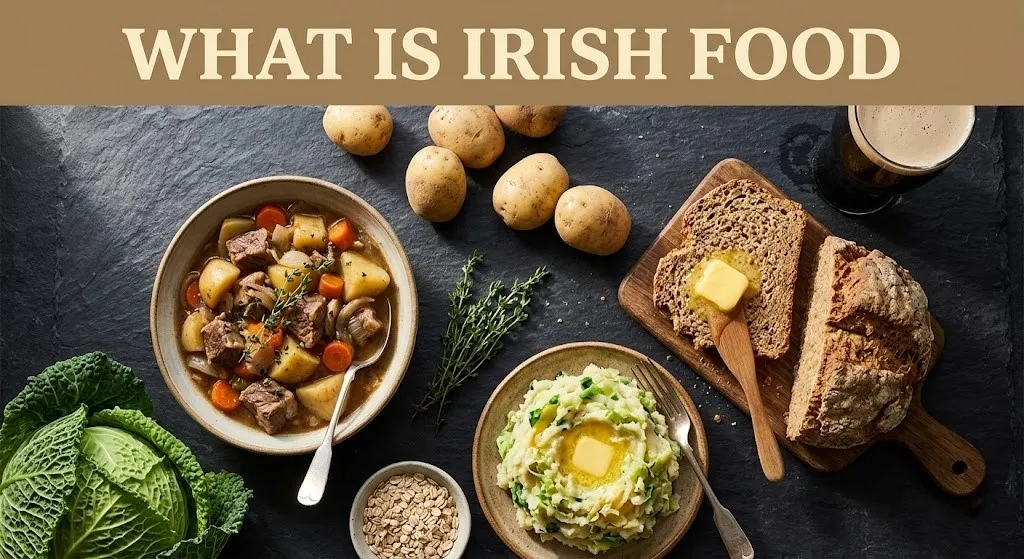
Irish stew is the national dish. It is a slow-simmered pot of lamb or mutton, potatoes, onions, and carrots, seasoned with salt, pepper, and thyme. The liquid is water, not stock, creating a clean, white broth that lets the lamb flavor dominate. A proper Irish stew is not thickened with flour or roux. The potatoes break down naturally and thicken the liquid.
Soda bread is the daily bread of Ireland. It uses baking soda and buttermilk as the leavening agent instead of yeast. The acid in the buttermilk reacts with the alkaline soda, producing carbon dioxide bubbles that lift the dough. A traditional loaf is dense, slightly tangy, and cut into a cross on top to let the fairies out, according to folklore, and to let the heat in, according to bakers.
Key Takeaway: Ireland’s most famous foods are all defined by their simplicity; Irish stew is four ingredients cooked for hours, and soda bread is four ingredients baked in minutes.
What Is Ireland Known For Food
Ireland is known for its butter. Irish butter, specifically Kerrygold, is an export phenomenon. The grass-fed, free-range dairy cattle produce milk with a higher beta-carotene content, giving the butter a visibly deeper yellow color and a richer, more complex flavor than grain-fed butter.
Ireland is also known for its seafood. The island is surrounded by the cold, clean waters of the North Atlantic. Galway oysters, Dublin Bay prawns, and wild Atlantic salmon are the crown jewels. Smoked salmon is the most famous export preparation, cold-smoked over oak and served thinly sliced on brown soda bread with a squeeze of lemon.
The pub culture is a food culture. The Irish pub is not just a drinking establishment. It is the community dining room. A pub lunch of beef and Guinness stew, brown bread with salted Irish butter, and a pint of stout is the authentic Irish food experience that tourists seek and locals maintain.
What Is Typical Irish Food
Typical Irish food eaten in a home kitchen in 2026 is simpler than the pub menu. A weekday dinner is a piece of grass-fed beef, lamb chop, or salmon fillet, boiled or roasted potatoes, and a side of steamed broccoli, cabbage, or peas. The food is uncomplicated. The ingredient quality carries the meal.
Colcannon is the most typical home-cooked Irish side dish. It is mashed potatoes mixed with finely shredded cooked cabbage or kale, butter, salt, and pepper. Some versions add scallions. It is served as a mound on the plate with a well of melted butter in the center. The potato variety matters. Floury, dry potatoes like Kerr’s Pink or Rooster produce the best texture.
Coddle is the typical Dublin city food. It is a one-pot stew of sausages, bacon, onions, and potatoes simmered in water or broth. It was a working-class meal designed to use up leftover pork products before the Friday fish day. It is not a restaurant dish. It is a home dish, often cooked overnight in a low oven.
What Food Is in Ireland
The food available in Ireland in 2026 is a mix of the traditional and the modern globalized food supply. Supermarkets carry the same international products as the rest of Europe and the United States. The distinct Irish food culture lives in the farmers markets, the artisan producers, and the home kitchens that still cook the traditional dishes.
Irish food is a seasonal cuisine by necessity. The growing season is short. Asparagus, new potatoes, and strawberries appear in late spring. Root vegetables, brassicas, and stored apples dominate the winter. The modern import economy has smoothed out this seasonality, but the traditional food culture is built around it.
A trip to a 2026 farmers market in Cork or Galway reveals the artisan food scene. Farmhouse cheeses from raw milk, fermented kombucha made with Irish seaweed, sourdough bread baked with Irish wholemeal flour, and grass-fed bone broths sold in glass jars. This is the modern Irish food reality alongside the classic stews and soda breads.
What Is Ireland’s Most Famous Food
Irish stew is Ireland’s most famous food. The dish is synonymous with the country. The classic recipe contains only lamb, potatoes, onions, and water, simmered for hours until the meat falls off the bone and the potatoes dissolve slightly into the broth.
Corned beef and cabbage is the most famous Irish food in the United States, but it is not authentically Irish. Irish immigrants in New York City in the 19th century substituted the expensive bacon they knew from home with the cheap corned beef sold by their Jewish neighbors. The dish became the St. Patrick’s Day standard in America but remains a foreign concept in Ireland.
The third most famous Irish food globally is Guinness, the dry stout brewed in Dublin since 1759. It is not a food, but it is a culinary ingredient. Beef braised in Guinness develops a deep, malty, slightly bitter richness that defines the modern Irish stew served in pubs.
Key Takeaway: Irish stew is the authentic national dish; corned beef and cabbage is a delicious Irish-American invention, not an Irish tradition.
What Food to Eat on St Patrick’s Day
On St. Patrick’s Day, eat colcannon, soda bread, Irish stew, and bacon and cabbage. These are the authentic celebratory foods eaten in Ireland, not the dyed-green beer and green cupcakes of the American celebration.
Bacon and cabbage is the traditional St. Patrick’s Day meal in Ireland. The bacon is a brined and boiled pork joint, similar to a ham but made from the back of the pig, not the leg. It is sliced and served with boiled cabbage, floury potatoes, and a parsley cream sauce. The Irish bacon is leaner and more savory than American bacon.
A 2026 healthy St. Patrick’s Day meal adapts these classics. The bacon is replaced with a leaner loin cut, boiled until tender but not falling apart. The cabbage is steamed instead of boiled to retain its sulforaphane. The potatoes are boiled, cooled, and reheated to convert some of the starch to resistant starch, which feeds beneficial gut bacteria and lowers the glycemic impact.
Traditional Irish Food
Traditional Irish food is the cuisine of the smallholder farmer from roughly 1700 to 1950. The ingredients were potatoes, oats, barley, cabbage, turnips, dairy products, and small amounts of bacon, mutton, or fish. The cooking methods were boiling, baking, and slow-simmering over a turf fire.
The potato was the center of every meal. An adult male agricultural laborer in the 19th century consumed up to 14 pounds of potatoes per day. The potato provided almost all the energy, vitamin C, potassium, and fiber in the diet. Buttermilk, a byproduct of butter-making, provided the protein and calcium. This potato-and-buttermilk diet was nutritionally complete, a fact often lost in the modern narrative of the potato as an empty starch.
The Famine broke this food system. The monoculture of the Irish Lumper potato, genetically uniform and susceptible to the Phytophthora infestans blight, collapsed. The Irish food culture that exists today is a post-Famine reconstruction. The traditional dishes, stew, colcannon, boxty, are memories of a pre-industrial food system preserved through oral tradition and home cooking.
Irish Food Ingredients
The foundational Irish food ingredients are the potato, the oat, cabbage, butter, buttermilk, lamb, and salmon. These seven items can be combined into almost every traditional Irish dish.
The potato is the starch backbone. Irish potatoes are floury, high-starch varieties that collapse into a soft, dry texture when boiled. This is desirable for mashing into colcannon or thickening a stew. Waxy, low-starch varieties are not traditional in Ireland.
Seaweed is a uniquely Irish ingredient that is re-emerging in 2026. Carrageen moss is a red seaweed used as a thickening agent for puddings and broths. Dulse is a purple seaweed eaten dried as a snack or added to soups. Seaweed is nutrient-dense, rich in iodine, iron, and soluble fiber, and aligns Irish cuisine with the modern health food movement.
| Ingredient | Nutritional Highlight | Traditional Use |
|---|---|---|
| Potato | Vitamin C, potassium, resistant starch | Boiled, mashed, in stews |
| Oats | Beta-glucan fiber | Porridge, bread, flapjacks |
| Cabbage | Sulforaphane, vitamin K | Colcannon, boiled side |
| Butter | Grass-fed CLA, vitamin A | On bread, in potatoes |
| Lamb | Iron, zinc, B12 | Irish stew, chops |
| Salmon | Omega-3 DHA, protein | Smoked, poached, grilled |
| Dulse | Iodine, iron, fiber | Dried snack, soup |
Is Irish Food Healthy
Traditional Irish food is healthy when eaten in its original proportions: mostly plants, some dairy, a small amount of meat. The problem is not the cuisine. It is the modern portion sizes and the 20th-century shift to processed foods that have diluted the ancestral pattern.
The ancestral Irish diet was high in fiber, rich in potassium, and low in added sugar. The potato provided vitamin C, preventing scurvy in the winter months. The buttermilk provided calcium and protein. The occasional mutton or fish provided iron and B12. This dietary pattern aligns closely with modern nutritional recommendations.
The modern Irish diet has diverged. The 2026 Irish Department of Health reports that Irish adults consume excess saturated fat from processed meats and excess sugar from sweetened beverages. The traditional foods are still eaten, but they are now surrounded by ultra-processed foods that did not exist a century ago. Returning to the traditional foods, prepared simply, is a nutritionally sound choice.
Key Takeaway: The traditional Irish diet of potatoes, cabbage, oats, and small amounts of meat and dairy is a fiber-rich, potassium-heavy, nutritionally complete eating pattern that modern science validates.
Irish Stew Nutrition Facts
A bowl of traditional Irish stew made with lamb, potatoes, onions, and carrots contains approximately 350 to 400 calories, 25 to 30 grams of protein, 15 grams of fat, and 20 to 25 grams of carbohydrate. It is a balanced, nutrient-dense, one-pot meal.
The lamb provides high-quality complete protein, iron, zinc, and vitamin B12. The potatoes contribute potassium and vitamin C. The onions and carrots add fiber, beta-carotene, and prebiotic compounds that feed gut bacteria. The broth, if made with bones, provides collagen and gelatin.
The stew is naturally gluten-free. It is dairy-free unless butter is added at the end for enrichment. It can be made lower in fat by trimming the lamb before simmering and skimming the surface fat. A 2026 healthy version uses lean lamb shoulder, adds extra root vegetables like parsnips and turnips, and replaces some of the potatoes to lower the carbohydrate load.
Irish Soda Bread Healthy
Irish soda bread is healthier than standard white yeast bread in one specific way: it contains no added sugar. Traditional soda bread has four ingredients: flour, baking soda, salt, and buttermilk. Standard white sandwich bread often contains sugar or high-fructose corn syrup.
The healthfulness of soda bread depends on the flour. White flour soda bread has a similar glycemic impact to white yeast bread. Brown soda bread, made with wholemeal flour, contains more fiber and has a lower glycemic index. The buttermilk adds calcium, riboflavin, and a slight probiotic benefit from the fermentation of the milk.
A 2026 healthy soda bread uses a blend of wholemeal and white flour, adds a tablespoon of oats for texture, and substitutes half the buttermilk with plain yogurt for a protein boost. The bread remains dense, tangy, and authentically Irish. It is not a fluffy sandwich bread. It is a hearty, rustic loaf meant to be sliced thick and spread with real butter.
Modern Irish Cuisine 2026
Modern Irish cuisine in 2026 is a farm-to-fork movement that connects the traditional ingredients to contemporary cooking techniques. Restaurants in Dublin, Cork, and Galway are serving seared scallops with black pudding crumble, dulse-cured salmon, and roast loin of Connemara lamb with colcannon foam.
The artisan food movement is the driver. Small-batch butter producers, raw-milk cheese makers, seaweed foragers, and craft butcher shops have re-energized the Irish food identity. The quality of the raw ingredient is the national culinary philosophy. The chef’s job is to not ruin it.
The influence of global immigration has diversified modern Irish cuisine. Indian, Polish, Nigerian, and Chinese communities have added their spices and techniques. A 2026 Dublin restaurant might serve a masala spiced lamb Irish stew or a kimchi colcannon. The Irish food identity is not static. It absorbs and adapts.
Healthy Irish Recipes
A healthy Irish recipe takes a traditional dish and makes one or two specific substitutions to reduce saturated fat, increase fiber, or lower sodium without sacrificing the soul of the dish.
Healthy Irish stew uses a leaner cut of lamb, doubles the root vegetables, and replaces one-third of the potatoes with parsnips and turnips. The flavor remains deeply savory. The calorie load drops by 15 percent. The fiber content increases.
Healthy colcannon replaces half the butter with olive oil and half the potato with steamed cauliflower. The texture is slightly lighter. The flavor is almost identical. The calorie count drops from 250 to 180 per serving. The sulforaphane from the cabbage remains intact with the gentler steaming method.
Healthy soda bread swaps half the white flour for wholemeal, adds a tablespoon of oats and a tablespoon of mixed seeds, and uses half buttermilk and half yogurt. The fiber per slice increases from 1 gram to 3 grams. The taste remains authentically Irish.
Irish Breakfast Healthy
A traditional full Irish breakfast contains fried eggs, rashers, sausages, black and white pudding, grilled tomatoes, mushrooms, and soda bread. It delivers 1,200 to 1,500 calories, 40 grams of saturated fat, and 2,000 milligrams of sodium. It is a once-in-a-while indulgence, not a daily breakfast.
A healthy Irish breakfast in 2026 keeps the grilled tomato, mushrooms, and poached eggs. It drops the fried bread and replaces it with a thick slice of toasted wholemeal soda bread. It replaces the sausages and rashers with a single slice of high-quality black pudding, which is rich in iron and requires a much smaller portion for flavor impact.
The result is a plate with roughly 500 calories, 25 grams of protein, and 8 grams of fiber. It captures the spirit of the full Irish breakfast without the sodium and saturated fat overload. A cup of Irish breakfast tea with a splash of oat milk finishes the plate. The tradition is respected. The health is considered.
Frequently Asked Questions About Irish Food
What is the national dish of Ireland?
Irish stew is the national dish of Ireland.
It is a slow-simmered pot of lamb, potatoes, onions, and carrots, seasoned simply with salt, pepper, and thyme.
The dish has been eaten by Irish people for centuries and represents the core of traditional Irish home cooking.
Is traditional Irish food healthy for you?
Traditional Irish food, in its original proportions, is a healthy, fiber-rich, plant-forward cuisine.
The ancestral diet of potatoes, cabbage, oats, and small amounts of meat aligns with modern nutritional guidelines.
The health issues in the modern Irish diet come from processed foods and large portions, not from the traditional dishes themselves.
What is a typical Irish breakfast?
A full Irish breakfast includes fried eggs, rashers, sausages, black and white pudding, grilled tomatoes, mushrooms, and soda bread.
It is a large, high-calorie, high-sodium meal traditionally eaten before a day of agricultural labor.
A healthy 2026 version keeps the eggs, tomatoes, mushrooms, and brown bread while reducing the processed meats.
Is Irish soda bread healthier than white bread?
Brown Irish soda bread made with wholemeal flour is healthier than white bread because it contains more fiber.
Traditional soda bread also contains no added sugar, unlike many commercial white breads.
White soda bread has a similar nutritional profile to white yeast bread.
What can I eat in Ireland if I’m vegetarian?
Vegetarians in Ireland can eat colcannon, boxty, vegetable soup with brown bread, soda bread with Irish butter, and modern plant-based dishes.
The traditional Irish diet is vegetable-forward, and the 2026 food scene includes excellent vegetarian restaurants in major cities.
Irish farmhouse cheeses, eggs, and smoked fish are also available for lacto-ovo vegetarians and pescatarians.
Irish food in 2026 is two things at once. It is the quiet, comforting stew your grandmother made, simmered for hours with four ingredients and a lifetime of kitchen knowledge. It is also the dulse-cured salmon and the raw-milk cheese on the menu at a Cork restaurant that sources everything from a 20-mile radius.
The potato, the oat, and the cabbage built this cuisine. They are not fashionable. They are not superfoods. They are reliable, nutrient-dense, honest foods that sustained an island nation through centuries of hardship and are now being rediscovered by a generation that values exactly those qualities.
Eat the stew. Eat the brown bread. Drink the tea. The best of Irish food does not need to be modernized to be healthy. It was already there.