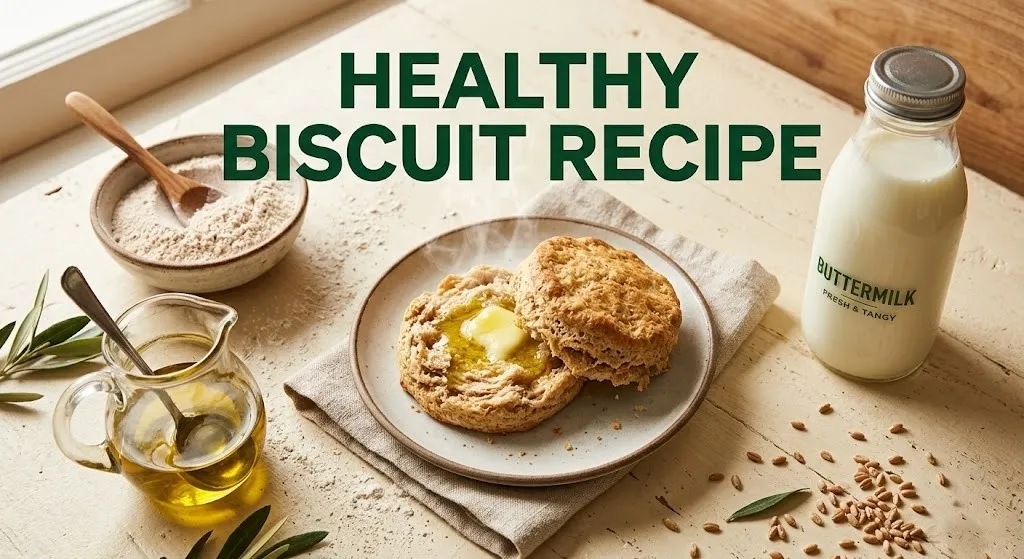
A healthy biscuit recipe replaces white all-purpose flour with whole wheat pastry flour, swaps saturated fat-laden butter for extra-virgin olive oil, and uses aluminum-free baking powder and low-fat buttermilk to create a biscuit with 3 grams of fiber, 1 gram of saturated fat, and roughly 150 calories per serving. The biscuit emerges from the oven flaky, tender, and golden, without the greasy mouthfeel and post-meal heaviness of a traditional all-butter biscuit.
The traditional Southern biscuit is a nutritional assault on the cardiovascular system. A single biscuit from a can or a fast-food restaurant contains 5 to 8 grams of saturated fat, primarily from hydrogenated shortening or butter, and 400 to 600 milligrams of sodium. The American Heart Association recommends a daily saturated fat limit of 13 grams. Two biscuits with breakfast consume the entire day’s allowance before the eggs hit the plate.
This guide provides the master recipe for a genuinely healthy biscuit, along with the specific food science that makes the swap work. You will learn why whole wheat pastry flour is the secret, why olive oil creates a flakier crumb than butter, and how to make a vegan version that tastes indistinguishable from the original.
healthy biscuit recipe
A healthy biscuit recipe uses 2 cups of whole wheat pastry flour, 1/3 cup of extra-virgin olive oil, 3/4 cup of low-fat buttermilk, 1 tablespoon of aluminum-free baking powder, and 1/2 teaspoon of salt. The dry ingredients are whisked together. The oil is cut into the flour until the mixture resembles coarse cornmeal. The buttermilk is stirred in gently. The dough is patted out, cut into rounds, and baked at 450°F for 12 minutes.
The science of this recipe is a direct swap of the unhealthy components for heart-healthy alternatives. Whole wheat pastry flour provides the fiber and nutrients of a whole grain without the dense, heavy texture of standard whole wheat flour. It is milled from soft white wheat, which has a lower protein content and produces a tender crumb. Olive oil provides monounsaturated fat, which lowers LDL cholesterol.
The nutritional comparison between this healthy biscuit and a standard canned biscuit is the entire argument for making your own. A healthy olive oil biscuit contains 1 gram of saturated fat and 3 grams of fiber. A standard buttermilk biscuit from a can contains 5 grams of saturated fat and less than 1 gram of fiber.
| Nutrient | Healthy Olive Oil Biscuit | Standard Canned Biscuit |
|---|---|---|
| Calories | 150 | 190 |
| Saturated Fat | 1g | 5g |
| Fiber | 3g | 0.5g |
| Sodium | 200mg | 450mg |
| Protein | 4g | 3g |
healthy biscuits recipe
A healthy biscuits recipe follows the same template as the singular recipe, with the plural indicating a batch of 8 to 12 biscuits. The recipe scales linearly. The technique of cutting cold fat into flour and handling the dough minimally remains the defining factor between a tender biscuit and a hockey puck.
The batch approach is ideal for meal prep. A batch of 8 healthy biscuits can be baked on Sunday, cooled completely, and stored in an airtight container at room temperature for 3 days or frozen for up to 3 months. A frozen biscuit reheats in a 350°F oven for 10 minutes and tastes freshly baked.
The dough can also be frozen raw. Cut the biscuits, place them on a parchment-lined baking sheet, and freeze until solid. Transfer the frozen dough rounds to a zip-top bag. Bake directly from frozen, adding 3 to 5 minutes to the baking time. This is the secret of the weekend meal prepper.
- Refrigerated dough: Use within 2 days.
- Baked biscuits: Store at room temperature for 3 days.
- Frozen dough: Bake from frozen, adding 3 to 5 minutes.
Key Takeaway: The healthy biscuit recipe is a batch recipe. Make a full batch on Sunday and freeze the extras for a warm, heart-healthy biscuit any morning of the week.
recipe for healthy biscuits
The recipe for healthy biscuits is a specific formula: 2 cups whole wheat pastry flour, 1 tablespoon baking powder, 1/2 teaspoon salt, 1/3 cup cold olive oil, and 3/4 cup cold buttermilk. The cold temperature of the fat and the liquid is the most critical variable in the recipe.
The cold fat principle is a piece of baking physics. When cold fat hits the hot oven, it creates steam. The steam expands, pushing apart the layers of dough and creating the flaky, tender crumb that defines a great biscuit. If the fat is warm or melted before baking, the dough absorbs it, and the biscuit bakes into a dense, greasy puck.
The same principle applies to the buttermilk. Cold buttermilk keeps the fat in the dough cold during mixing. It also reacts with the baking powder to create carbon dioxide bubbles, which provide additional lift. The acid in the buttermilk tenderizes the gluten, producing a softer crumb.
- Fat must be cold: Cold olive oil creates steam pockets.
- Liquid must be cold: Cold buttermilk keeps the fat solid.
- Handle minimally: Overworking develops gluten, toughening the biscuit.
how to make healthy biscuits
Making healthy biscuits requires the “cut, stir, pat, cut” technique and a commitment to handling the dough as little as possible. The step-by-step process is simple, but each step serves a specific food science function.
The cutting step incorporates the cold fat into the flour. Pour the olive oil over the flour mixture and use a pastry cutter or two forks to cut the fat in. The goal is a texture that looks like coarse cornmeal with some pea-sized pieces of fat remaining. These pea-sized pieces are the steam pockets that create flakiness.
The stirring step adds the cold buttermilk. Pour the buttermilk over the flour-fat mixture and stir with a fork just until the dough begins to come together. The dough will look shaggy. That is correct. Over-stirring develops gluten, and gluten is the enemy of a tender biscuit.
- Whisk flour, baking powder, and salt in a large bowl.
- Cut cold olive oil into the flour until the mixture resembles coarse cornmeal.
- Stir in cold buttermilk with a fork until a shaggy dough forms.
- Turn the dough onto a floured surface. Pat it into a 1-inch thick rectangle.
- Cut into rounds with a biscuit cutter. Do not twist the cutter. Push straight down.
- Bake at 450°F for 12 minutes until golden brown.
healthy homemade biscuits
Healthy homemade biscuits are the solution to the canned biscuit problem. Canned biscuits are an ultra-processed food product containing hydrogenated oils, preservatives, and chemical leaveners. Homemade biscuits are flour, fat, and liquid, assembled by your hands.
The ingredient list for a canned biscuit includes enriched flour bleached with benzoyl peroxide, hydrogenated palm kernel oil, sodium aluminum phosphate, and dimethylpolysiloxane, an anti-foaming agent. The ingredient list for a healthy homemade biscuit includes whole wheat pastry flour, olive oil, buttermilk, baking powder, and salt. The difference in processing is the difference in health.
The taste of a homemade biscuit is the taste of a real food. The nutty flavor of the whole wheat comes through. The olive oil adds a subtle fruitiness. The buttermilk provides a tangy richness. No chemical aftertaste. No greasy film on the roof of the mouth.
- Canned biscuits: Ultra-processed, hydrogenated oils, chemical leaveners.
- Homemade biscuits: 5 ingredients, whole food, heart-healthy.
Key Takeaway: The healthiest biscuit is the one you make yourself. The five-minute process of cutting the fat into the flour is the difference between a whole food and an industrial product.
heart healthy biscuits
Heart healthy biscuits replace saturated fat with unsaturated fat, refined flour with whole grain flour, and excess sodium with controlled seasoning. The American Heart Association’s dietary guidelines are the nutritional blueprint for this recipe.
The saturated fat swap is the most important intervention for heart health. Saturated fat raises LDL cholesterol, the type that contributes to arterial plaque. The AHA recommends limiting saturated fat to 5 to 6 percent of total daily calories, roughly 13 grams per day. A traditional butter biscuit contains 5 to 8 grams of saturated fat. The olive oil biscuit contains 1 gram.
The fiber addition is the second intervention. Whole wheat pastry flour provides 3 grams of fiber per biscuit. Fiber, particularly soluble fiber, binds to cholesterol in the digestive tract and removes it from the body. A high-fiber diet is independently associated with a lower risk of coronary heart disease.
- Saturated fat: 1g per biscuit.
- Fiber: 3g per biscuit.
- Sodium: 200mg per biscuit.
healthy whole wheat biscuits
Healthy whole wheat biscuits use whole wheat pastry flour as a direct replacement for all-purpose flour. This specific flour is the secret to the biscuit’s tender texture. Standard whole wheat flour produces a dense, heavy biscuit. Whole wheat pastry flour produces a tender, flaky one.
The difference between the two flours is the protein content. Standard whole wheat flour contains 13 to 14 percent protein, which develops strong gluten networks. Whole wheat pastry flour contains 8 to 10 percent protein, which develops weak, tender gluten networks. The lower protein content is essential for a biscuit texture that is tender, not tough.
The hydration requirement for whole wheat flour is higher than for white flour. The bran and germ in the whole grain absorb more liquid. The healthy biscuit recipe accounts for this with a slightly higher liquid-to-flour ratio. If the dough feels dry, add an extra tablespoon of buttermilk.
- Standard whole wheat: 13 to 14 percent protein. Dense biscuits.
- Whole wheat pastry flour: 8 to 10 percent protein. Tender biscuits.
- Hydration: Whole wheat absorbs more liquid.
healthy drop biscuits
Healthy drop biscuits are the easiest version of the healthy biscuit recipe. The dough is mixed exactly the same way but is dropped by spoonfuls onto the baking sheet rather than being rolled and cut. The result is a rustic, craggy biscuit with a tender interior.
Drop biscuits eliminate the risk of overworking the dough. The rolling and cutting process inevitably compresses the dough and develops some gluten. Drop biscuits bypass this entirely. The dough is scooped directly from the bowl, preserving the air pockets and the pockets of cold fat.
The baking time for drop biscuits is slightly shorter. The irregular shapes and smaller size mean the biscuits bake faster. Check for doneness at 10 minutes rather than 12. The tops should be golden brown, and a toothpick inserted in the center should come out clean.
- Texture: Rustic exterior, tender interior.
- Technique: Scoop and drop. No rolling, no cutting.
- Baking time: 10 to 12 minutes at 450°F.
Key Takeaway: Drop biscuits are the foolproof entry point to healthy biscuit baking. They eliminate the hardest step and produce a consistently tender result.
vegan healthy biscuits
Vegan healthy biscuits replace the buttermilk with soy milk curdled with lemon juice and the honey or sugar with maple syrup or coconut sugar. The olive oil remains the fat source, making this biscuit entirely plant-based.
The buttermilk substitution is a piece of vegan baking chemistry. The acid in the lemon juice curdles the soy milk, creating a thick, tangy liquid that mimics the acidity and texture of dairy buttermilk. The acid also reacts with the baking powder to provide lift. The substitution is 1 tablespoon of lemon juice per 1 cup of soy milk. Let the mixture sit for 5 minutes before using.
The fat remains extra-virgin olive oil. The solid fat substitute would be a vegan butter stick, but olive oil is the heart-healthier choice. The biscuit will be slightly less flaky than a vegan butter biscuit, but the monounsaturated fat profile is worth the small textural trade-off.
- Buttermilk substitute: 1 cup soy milk + 1 tbsp lemon juice.
- Fat: Extra-virgin olive oil or cold vegan butter.
- Sweetener: Maple syrup instead of honey.
healthy biscuit mix
A healthy biscuit mix is a pre-mixed combination of the dry ingredients, whole wheat pastry flour, aluminum-free baking powder, and salt, stored in an airtight container, ready for the addition of cold fat and liquid. The mix shaves five minutes off the morning biscuit routine.
The dry mix can be prepared in bulk. Combine 8 cups of whole wheat pastry flour, 4 tablespoons of aluminum-free baking powder, and 2 teaspoons of salt. Whisk thoroughly. Store in a sealed jar in the pantry for up to 3 months. The mix yields four batches of 8 biscuits.
The morning routine with the mix is simple. Scoop 2 cups of the mix into a bowl. Cut in 1/3 cup of cold olive oil. Stir in 3/4 cup of cold buttermilk. Pat, cut, and bake. The process takes 5 minutes of active time.
- Bulk mix ratio: 8 cups flour, 4 tbsp baking powder, 2 tsp salt.
- Storage: Airtight container, pantry, 3 months.
- Morning routine: 5 minutes from pantry to oven.
Frequently Asked Questions About Healthy Biscuits
Can biscuits be heart-healthy?
Yes, biscuits can be heart-healthy when made with whole wheat flour and olive oil instead of butter.
The saturated fat content drops from 5 grams to 1 gram per biscuit.
The fiber increases from less than 1 gram to 3 grams.
What is the healthiest flour for biscuits?
Whole wheat pastry flour is the healthiest flour for biscuits because it provides whole grain fiber and nutrients.
It has a lower protein content than standard whole wheat, producing a tender rather than tough texture.
Almond flour and oat flour are gluten-free alternatives.
How do I make my biscuits less dry?
Use whole wheat pastry flour, which absorbs liquid more evenly.
Make sure your fat is very cold, and do not overbake.
Adding an extra tablespoon of buttermilk can also help if the dough feels dry.
Can I use oil instead of butter in biscuits?
Yes, extra-virgin olive oil or avocado oil are excellent heart-healthy substitutes for butter.
The key is to keep the oil cold so it creates steam pockets for flakiness.
The biscuit will be tender and flavorful with a fraction of the saturated fat.
Are canned biscuits healthy?
Canned biscuits are not healthy. They are an ultra-processed food.
They contain hydrogenated oils, high sodium, and chemical preservatives.
Homemade biscuits are a whole-food alternative that takes only a few minutes more.
The healthy biscuit is not a compromise. It is a warm, flaky, tender bread that happens to be made from whole grains and heart-healthy oil. The swap from butter to olive oil is invisible in the finished product. The whole wheat pastry flour tastes nutty and rich, not dense or bitter.
Make a batch this weekend. Freeze half the dough. On Wednesday morning, pull a frozen biscuit from the bag, place it on a baking sheet, and slide it into the oven. In 15 minutes, you will have a warm, golden biscuit with 1 gram of saturated fat and 3 grams of fiber.
The biscuit is a blank canvas. Top it with avocado and a poached egg. Smear it with almond butter and sliced banana. Use it to soak up the last of a bowl of lentil soup. The healthy biscuit is not the end of indulgence. It is the beginning of a different kind of breakfast.