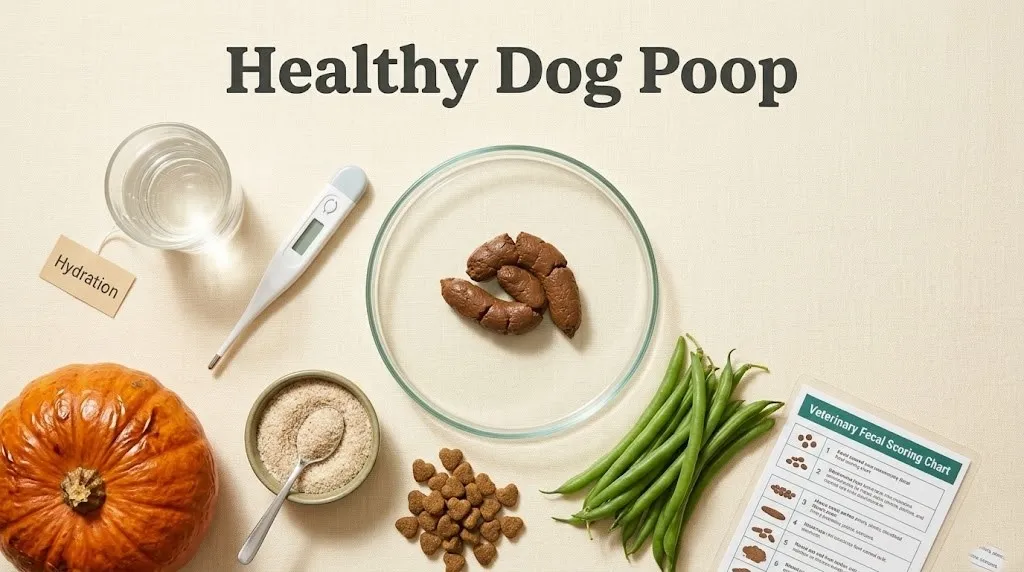
Healthy dog poop is a firm, segmented, chocolate-brown log that holds its shape when picked up, leaves no sticky residue, and has a mild, non-rancid odor. It should not look like a soft-serve swirl, a dark puddle, or a collection of hard pebbles.
A dog’s stool is a direct, real-time report card on their digestive tract, their diet, and their hydration status. According to the American Veterinary Medical Association (AVMA), consistent stool quality is one of the most reliable indicators of a well-formulated diet and a stable gastrointestinal environment. You do not need a vet to interpret every single bowel movement, but you do need to know the baseline so you can spot a problem before it becomes an emergency.
We will walk through the exact color spectrum, the consistency scale, and the specific dietary levers you can pull to turn a loose pile into a firm log. You will leave knowing how to read your dog’s poop like a veterinary nutritionist, and when to step aside and call the person with the stethoscope.
What Does Healthy Dog Poop Look Like
Healthy dog poop looks like a uniform, segmented log that is firm enough to hold its shape but soft enough to compress slightly, roughly the consistency of firm modeling clay, with a consistent medium to dark chocolate-brown color and no visible mucus, blood, or foreign objects. The ideal stool scores a 2 or 3 on the 7-point Purina Fecal Scoring System, which is the veterinary standard adapted from the Bristol Stool Scale.
The visual check takes five seconds. You look for four specific characteristics: color, consistency, coating, and content. The color should be a uniform milk chocolate to dark chocolate brown. The consistency should allow the stool to be picked up cleanly from the grass with minimal residue. The coating should be absent. A healthy stool does not have a visible slime layer of mucus. The content should be homogenous. You should not see undigested chunks of food, visible worms, or foreign material.
The size of the stool should be proportionate to the size of the dog and the amount of food consumed. A German Shepherd will produce a significantly larger volume of stool than a Chihuahua. What matters is the ratio. If a small dog is producing an alarming amount of stool for its body size, that suggests a high-fiber, low-digestibility diet where a lot of the food is passing straight through without being absorbed.
The odor should be present but not overpowering. A healthy stool smells earthy and slightly pungent. A stool that smells sharply rancid, sour, or overwhelmingly foul suggests either a high-fat diet that is not being fully digested, a bacterial dysbiosis in the colon, or the presence of a pathogen like Giardia.
Healthy Dog Poop
Healthy dog poop is the end product of a complete digestive process where the small intestine has absorbed the amino acids, fatty acids, and simple sugars, leaving the colon to ferment the remaining soluble fibers and absorb water before forming a firm, cohesive stool. The entire process is a collaboration between the diet, the pancreas, the gut microbiome, and the colon.
The firmness of the stool comes from the balance of water reabsorption in the colon. If the colon absorbs too much water, the stool turns into hard, dry pebbles. If the colon does not absorb enough water, the stool is a loose, formless puddle. The rate of peristalsis, the muscular contractions that push material through the intestines, directly affects this water balance.
The brown color originates from a compound called stercobilin, which is a breakdown product of bilirubin from old red blood cells processed by the liver. A consistent medium-brown color tells you that the liver is functioning, the bile duct is open, and the intestinal transit time is normal. A shift to yellow, orange, grey, or black indicates a disruption somewhere along that metabolic assembly line.
A healthy stool also contains a thriving population of gut bacteria that have been shed from the colon wall. This is normal and healthy. The microbiome is a dynamic ecosystem. The bacteria that ferment the soluble fiber in your dog’s diet produce short-chain fatty acids (SCFAs) like butyrate, which feed the colonocytes and strengthen the intestinal barrier. A healthy poop is evidence that this bacterial fermentation process is working correctly.
What Should Healthy Dog Poop Look Like
A healthy dog stool should have four defining characteristics: a segmented log shape, a firm-but-pliable consistency, a uniform chocolate-brown color, and a clean surface with no visible coating or foreign objects. It should be easy for you to pick up with a standard poop bag without smearing.
The segmented log shape is the mechanical result of the colon packing and segmenting the digested material as water is reabsorbed. The segment lines are a feature, not a flaw. A completely smooth, unsegmented stool often indicates a slower transit time where the material has been packed together more tightly, which can be a sign of mild constipation.
The texture should be homogeneous. When you break the stool apart with a stick or a bag, you should not see distinct pieces of undigested kibble, whole pieces of vegetable, or white specks. White specks that look like grains of rice are often proglottids, which are tapeworm segments. They require a veterinarian to diagnose and treat.
The stool should not leave a greasy, shiny residue on the grass or pavement. A greasy film, known as steatorrhea, indicates that fat is not being digested and absorbed in the small intestine. This can point to exocrine pancreatic insufficiency (EPI) or a dietary fat content that exceeds the dog’s digestive capacity. This is a condition that a veterinarian must diagnose with a specific blood test.
What Color Is Healthy Dog Poop
A healthy dog poop is a consistent milk chocolate to dark chocolate brown color, derived from the pigment stercobilin, which is the final breakdown product of bilirubin that has been processed by the liver and the gut bacteria. The specific shade of brown will vary slightly depending on the diet and the hydration level, but it should fall within the recognizable “brown” spectrum.
The color is a direct window into the hepatobiliary system. Bile, which is produced by the liver and stored in the gallbladder, is a greenish-yellow fluid. As it travels through the intestines and is acted upon by bacteria, it transitions from green to yellow to brown. A healthy brown stool confirms that bile is flowing, bacteria are fermenting, and transit time is normal.
Any deviation from the brown spectrum warrants attention. A yellow or orange stool suggests a rapid transit time where the bilirubin has not had time to fully break down, or a liver or gallbladder issue. A grey or clay-colored stool indicates a bile duct obstruction where bile is not reaching the intestines at all. A black, tarry stool indicates digested blood from the upper GI tract, which is a medical emergency. A red-streaked stool indicates fresh blood from the lower GI tract or the colon.
Diet can temporarily shift the color without signaling disease. A dog that has eaten a large quantity of carrots may produce a slightly orange stool. A dog on a raw diet with a high organ meat content may produce a very dark, almost black stool that could be confused with melena. Knowing your dog’s baseline diet makes color interpretation accurate.
| Stool Color | Possible Dietary Cause | Potential Medical Concern |
|---|---|---|
| Chocolate Brown | Balanced diet, healthy digestion | Normal |
| Yellow/Orange | High carrot/pumpkin intake | Rapid transit, liver/gallbladder issue |
| Green | High grass or green vegetable intake | Bile acid abnormality, rapid transit |
| Grey/Clay | High calcium/bone intake | Bile duct obstruction |
| Black/Tarry | High organ meat (raw diet) | Upper GI bleeding (melena) |
| Red-Streaked | None (dietary) | Lower GI bleeding (hematochezia) |
Healthy Dog Poop Chart
A healthy dog poop chart is a visual reference tool that maps the four key characteristics of stool (color, consistency, coating, content) against a healthy ideal, a dietary adjustment zone, and a veterinary intervention threshold. It allows an owner to triage a bowel movement in seconds.
The veterinary standard is the Purina Fecal Scoring System, a 7-point scale where 1 is hard, dry pellets and 7 is a liquid puddle. An ideal stool scores a 2 or 3. A score of 2 is a firm, segmented log. A score of 3 is a log that is slightly soft but holds its shape. These two scores represent the healthy range for the vast majority of adult dogs.
A score of 4 is a soft log that loses its shape when picked up. This is the “watch and wait” zone. It suggests a mild dietary intolerance, a slight fiber imbalance, or a stress response. A score of 5 is a soft pile with distinct shape, which is firmly in the “dietary adjustment needed” zone. Scores of 6 and 7 indicate significant digestive upset that, if persistent for more than 48 hours, requires veterinary attention to rule out infection, parasites, or pancreatitis.
The chart also accounts for the coating and content. Mucus on the surface of the stool indicates colonic irritation, often from a food intolerance or a stress colitis episode. Visible white specks indicate possible tapeworm segments. A greasy film indicates fat malabsorption. Each of these visual cues maps to a specific set of potential causes, and the chart directs the owner to either a dietary tweak or a vet visit.
Dog Poop Consistency Chart
The dog poop consistency chart rates stool from 1 (hard, dry pellets) to 7 (liquid puddle), with the ideal healthy range sitting firmly at 2 (firm, segmented) and 3 (log-shaped, slightly soft). This scale is the universal language that veterinarians use to standardize stool quality during consultations.
A score of 1 indicates constipation. The stool has spent too long in the colon, and the colon has over-extracted water. The stool is hard, dry, and often breaks into small pebbles. This can be caused by dehydration, a lack of dietary insoluble fiber, or a diet with too much bone content in a raw-fed dog. The dietary fix is to increase insoluble fiber from sources like green beans or wheat bran, and to increase water intake by adding moisture to the food.
A score of 2 or 3 is the target. This stool is easy to pick up, holds its shape, and leaves no puddle behind. The dog is well-hydrated, the fiber balance is appropriate, and the colonic fermentation of soluble fiber is producing the right amount of SCFAs to feed the colon lining and maintain healthy peristalsis.
A score of 4 or 5 indicates a stool that is too loose. The colon is not reabsorbing enough water, either because the transit time is too fast or because there is an osmotic force pulling water into the bowel. This can be dietary, triggered by a high-fat meal, a sudden food change, or a food intolerance. The dietary fix is to add soluble fiber, such as psyllium husk or canned pumpkin, which forms a gel that slows transit time and binds water.
| Fecal Score | Description | Action |
|---|---|---|
| 1 | Hard, dry pellets | Add insoluble fiber and hydration |
| 2 | Firm, segmented | Ideal |
| 3 | Log, slightly soft | Ideal |
| 4 | Soft log, loses shape | Monitor; slight diet tweak |
| 5 | Soft pile | Add soluble fiber |
| 6 | Mushy, no shape | Soluble fiber and vet consult |
| 7 | Liquid puddle | Veterinary attention |
Key Takeaway: A healthy dog stool is a firm, chocolate-brown, segmented log that scores a 2 or 3 on the fecal chart. The color, consistency, coating, and content are the four things you check every single time you pick up after your dog.
Healthy Puppy Poop
Healthy puppy poop is a soft but formed log, slightly softer than an adult dog’s ideal stool, and brown to tan in color, because a puppy’s digestive system is still developing its full enzymatic capacity and the diet is often higher in fat and protein to support rapid growth. A puppy stool scores a 3 to 4 on the fecal scale, where an adult dog scores a 2 to 3.
The slightly softer consistency is not a sign of a problem. Puppies have a faster intestinal transit time. Food moves through their GI tract more quickly to accommodate their frequent feeding schedule, and the colon has less time to reabsorb water. As long as the stool holds a log shape and can be picked up with minimal mess, it is normal for that developmental stage.
The color of a puppy’s stool is often lighter than an adult’s, falling into the tan or light-brown range. This is because puppies consume a milk-based diet or a highly digestible puppy formula that produces less stercobilin. A sudden shift to a dark, tarry stool in a puppy, however, is a red-alert emergency because puppies are fragile and can dehydrate from blood loss within hours.
Puppy stool is also a window into the deworming schedule. Roundworms and hookworms are extremely common in puppies, even those from reputable breeders. A puppy with a pot-bellied appearance and loose stool may be carrying a significant worm burden. A veterinarian will perform a fecal float test and prescribe a dewormer based on the specific parasite found.
Puppy Poop Stages by Age
Puppy poop transitions through four distinct stages: meconium (first 24 hours), milk stool (weeks 1 to 4), transition stool (weeks 4 to 8), and juvenile stool (week 8 onward), each with its own normal consistency and color profile. The puppy’s diet and gut microbiome shift dramatically during these eight weeks.
The first stool a puppy ever passes is called the meconium. It is a dark, sticky, tar-like substance made of cellular debris, amniotic fluid, and bile that accumulated in the intestines before birth. The mother stimulates the puppy to pass this stool by licking the perineal area. If the puppy does not pass meconium, it can become impacted and require veterinary intervention.
The milk stool phase begins after the puppy starts nursing. The stool becomes soft, yellow to tan, and has a pasty consistency. The mother continues to clean the puppies and consumes their stool, which is a natural sanitation behavior. A puppy on milk replacer may have a slightly firmer, darker stool than a puppy on natural milk.
The transition stool phase is the most delicate. The puppy’s gut is being introduced to solid food for the first time, and the microbiome is undergoing a massive ecological shift. The stool will be inconsistent, soft, and may vary in color from day to day. This is normal, but it is also the time when a puppy is most vulnerable to dietary diarrhea. The transition must be slow, over 10 to 14 days.
By week 8, the juvenile stool pattern is established. The stool should be a formed, soft log, brown in color, and passed on a predictable schedule. This is the point where the owner takes over monitoring from the breeder and can begin using the fecal scoring system as a daily health check.
What Does Unhealthy Dog Poop Look Like
Unhealthy dog poop breaks one or more of the four cardinal rules: it is the wrong color, the wrong consistency, has a coating of mucus or a greasy film, or contains visible foreign material like blood, worms, or undigested food chunks. A single abnormal bowel movement is a data point. A pattern across 48 hours is a problem.
A stool that is persistently yellow and greasy points to exocrine pancreatic insufficiency (EPI), a condition where the pancreas fails to produce enough digestive enzymes. The fat in the diet passes through undigested, creating a foul-smelling, pale, greasy stool. This condition requires a specific blood test and is managed with prescription pancreatic enzyme powders. A general veterinarian runs the initial test, but a referral to an internal medicine specialist may be warranted if the diagnosis is unclear.
A stool that is jet-black and tarry, known as melena, indicates digested blood from the upper GI tract. The blood has been swallowed, partially digested by stomach acid, and turned black by the time it reaches the rectum. This is not a dietary issue. This is a bleed in the stomach or the upper small intestine, and the dog needs emergency veterinary care.
A stool that is coated in a visible layer of clear or white mucus indicates colonic irritation. The goblet cells in the colon secrete mucus as a protective barrier when the lining is inflamed. A one-time mucus coating after a stressful event, like a car ride, is often stress colitis. A persistent mucus coating suggests a food intolerance, a bacterial dysbiosis, or a parasitic infection like whipworms.
Unhealthy Stool Red Flags:
- Black, tarry stool (melena) with a foul, metallic odor.
- Bright red blood streaks on the surface (hematochezia).
- Visible white rice-like segments (tapeworm proglottids).
- Greasy, grey, or yellow stool with a rancid odor.
- Persistent large-bowel diarrhea with straining and mucus.
Dog Poop and Diet Connection
The connection between dog poop and diet is direct and mechanical. The protein, fat, fiber, and moisture content of the food directly dictate the volume, consistency, color, and odor of the stool, often within a 12 to 24-hour window after the meal is consumed. You can trace a loose stool back to a specific dietary variable with some precision.
High-protein, low-carbohydrate diets, such as many fresh and raw formulations, tend to produce smaller, firmer, darker stools. The body absorbs a higher percentage of the input, and less indigestible material passes through to the colon. The dark color comes from the higher heme iron content in the muscle and organ meat.
High-fiber diets, common in weight-management kibbles, produce larger, bulkier, and softer stools. The insoluble fiber sweeps through the colon undigested, mechanically stimulating the colon wall and drawing water into the lumen. This is by design. The fiber creates volume and satiety for a dog on a calorie-restricted diet, but the owner must understand that a giant, soft stool on a weight-loss kibble is not a sign of illness. It is a sign the diet is working as formulated.
High-fat diets, including some raw diets and table-scrap-heavy feeding patterns, can produce greasy, foul-smelling stools. If the fat load exceeds the pancreas’s lipase output, the undigested fat passes into the stool, causing steatorrhea. The dietary fix is to reduce the fat content of the meal. For a dog on a commercial diet, this means switching to a lower-fat formula. For a home-prepared diet, this means trimming visible fat from the meat and reducing added oils.
How to Firm Up Dog Stool with Diet
To firm up a dog’s stool with diet, you add a specific source of soluble fiber, such as canned 100 percent pumpkin puree or psyllium husk powder, which absorbs excess water in the colon and forms a gel matrix that slows transit time and binds the stool into a formed log. The dose is precise and species-specific.
Canned pumpkin is the most accessible soluble fiber source. It is not a magical cure. It is a functional fiber. One tablespoon of canned pumpkin for a small dog, or two to three tablespoons for a large dog, mixed into their regular meal, provides enough soluble fiber to begin firming the stool within 24 hours. You must use plain, unsweetened pumpkin puree, not pumpkin pie filling, which contains sugar and spices that will worsen the diarrhea.
Psyllium husk powder is a more concentrated soluble fiber that is particularly effective for large-bowel diarrhea where the stool is loose but not completely liquid. The dose is a quarter-teaspoon per 25 pounds of body weight, mixed thoroughly with a small amount of water to form a slurry before adding it to the food. The slurry must be added immediately before feeding, because psyllium sets quickly into a solid gel.
The soluble fiber works by feeding the commensal bacteria in the colon, which ferment the fiber into short-chain fatty acids. These SCFAs, primarily butyrate, feed the colonocytes and reduce the luminal pH, creating an environment where pathogenic bacteria struggle to proliferate. The stool firms up not just because water is absorbed, but because the colonic ecosystem is being repaired.
Dietary Firmer Protocol:
- Withhold food for 12 hours to allow the GI tract to rest.
- Reintroduce a bland diet of boiled, fat-trimmed chicken breast and white rice (50/50 ratio).
- After 24 hours of bland diet, add the soluble fiber source (pumpkin or psyllium) at the weight-appropriate dose.
- Transition back to the regular diet over 3 days once stool has been firm for 48 hours.
- If stool does not firm up within 72 hours, a veterinary fecal test is needed.
Raw Diet Dog Poop vs Kibble Poop
Dogs fed a balanced raw diet consistently produce smaller, firmer, darker, and less odorous stools compared to dogs on a standard extruded kibble, because the raw diet has a higher digestibility coefficient and contains no plant-based fillers that pass through undigested. The stool volume can shrink by 50 to 70 percent when a dog switches from kibble to raw.
The mechanism is digestibility. A high-quality raw diet is roughly 90 to 95 percent digestible, meaning only 5 to 10 percent of the input exits as solid waste. A standard kibble, which must contain a starch source to extrude properly, is roughly 75 to 85 percent digestible. The 15 to 25 percent that is not digested includes plant fibers, starches, and the ash content, all of which bulk up the stool.
The raw-fed stool is also darker and has a crumbly, almost chalky texture when it dries out. This is from the bone content in the raw diet. The calcium phosphate from the ground bone passes through and dries to a white, crumbly consistency. This is normal for a raw-fed dog. It is not undigested food. It is the mineral matrix of the bone.
The critical safety note is that a raw-fed dog’s stool is not sterile. The FDA Center for Veterinary Medicine and the AVMA both warn that raw-fed dogs can asymptomatically shed pathogenic bacteria, including Salmonella and Campylobacter, in their stool. The stool looks healthy, but it may pose a zoonotic risk to the humans in the household, particularly children, the elderly, and immunocompromised individuals.
Key Takeaway: The single fastest dietary lever for firming up a loose stool is canned pumpkin or psyllium husk powder, because soluble fiber ferments into short-chain fatty acids that repair the colonic lining and physically bind water.
Frequently Asked Questions About Healthy Dog Poop
How often should a healthy dog poop?
A healthy adult dog typically poops one to two times per day, roughly 12 to 24 hours after a meal.
Puppies may poop three to five times per day due to their faster metabolism and frequent feeding schedule.
The frequency is less important than the consistency and the dog’s comfort when passing the stool.
Why is my dog’s poop yellow?
Yellow dog poop is often caused by a rapid intestinal transit time where the bilirubin has not fully broken down into brown stercobilin.
A persistent yellow, greasy stool can indicate exocrine pancreatic insufficiency (EPI), a condition where the pancreas fails to produce enough fat-digesting enzymes.
A veterinarian can confirm EPI with a specific blood test called a TLI (Trypsin-Like Immunoreactivity) test.
Can changing dog food change poop color?
Yes, changing your dog’s food can absolutely change the color of their stool.
A switch to a diet with higher organ meat content, like a raw diet, often produces a very dark stool.
A switch to a diet with pumpkin or sweet potato may produce a slightly orange-tinted stool.
Is pumpkin good for dog poop?
Yes, plain canned pumpkin is an effective source of soluble fiber that can help firm up a loose stool.
The dose is one tablespoon for a small dog and up to three tablespoons for a large dog, mixed into their meal.
Never use pumpkin pie filling, which contains sugar and spices that can worsen digestive upset.
Why is there mucus in my dog’s poop?
Mucus in dog poop is a sign of colonic irritation, where the goblet cells in the colon wall are secreting a protective gel layer.
A single mucus coating after a stressful event is often stress colitis.
Persistent mucus, or mucus accompanied by blood, warrants a veterinary visit to rule out parasites, a food intolerance, or a bacterial infection.
Your dog’s poop is the most honest feedback loop in pet ownership. It will not lie about the quality of the food, the state of the gut, or the presence of a hidden parasite.
Spend a week just observing. Note the color, the score on the fecal chart, the presence or absence of mucus, and how the stool changes 24 hours after a specific meal. You will build a personal database that connects a specific food input to a specific stool output.
If the stool strays from the chocolate-brown, firm-log ideal, do not panic. Reach for the canned pumpkin, pull the fat content back, or call your vet for a fecal float test. The answer is almost always in the diet, the digestive enzymes, or the microbiome. You just have to read the evidence in the bag.