Yes, apple and peanut butter is a genuinely healthy snack. The combination of a medium apple and two tablespoons of unsweetened peanut butter delivers 285 calories, 8 grams of protein, 9 grams of fiber, and a blood-sugar-stabilizing blend of monounsaturated fat and complex carbohydrates.
The American Heart Association identifies monounsaturated fat as a dietary component that can improve blood cholesterol levels when it replaces saturated fat. The peanut butter provides this fat. The apple contributes pectin, a soluble fiber that slows glucose absorption in the small intestine. Together, they create a snack with a low glycemic load that sustains energy for two to three hours.
We will break down the exact nutritional profile, explain the specific blood sugar mechanics, identify the best apple varieties and peanut butter brands for this pairing, and address the food safety concerns around aflatoxin and pesticide residue that no one else mentions.
Is Apple and Peanut Butter Healthy
This snack is healthy because it combines three key satiety drivers in one simple, whole-food pairing. The protein and fat from the peanut butter trigger the release of satiety hormones like peptide YY. The fiber from the apple stretches the stomach, activating stretch receptors that signal fullness to the brain.
The nutritional synergy is what elevates this pairing above a plain apple or a spoonful of peanut butter eaten alone. A medium Honeycrisp apple provides 4 grams of fiber and 19 grams of natural sugar. Eaten alone, that sugar hits the bloodstream relatively quickly. Adding 2 tablespoons of peanut butter slows gastric emptying. The sugar enters the bloodstream gradually over 90 minutes instead of spiking at 30 minutes.
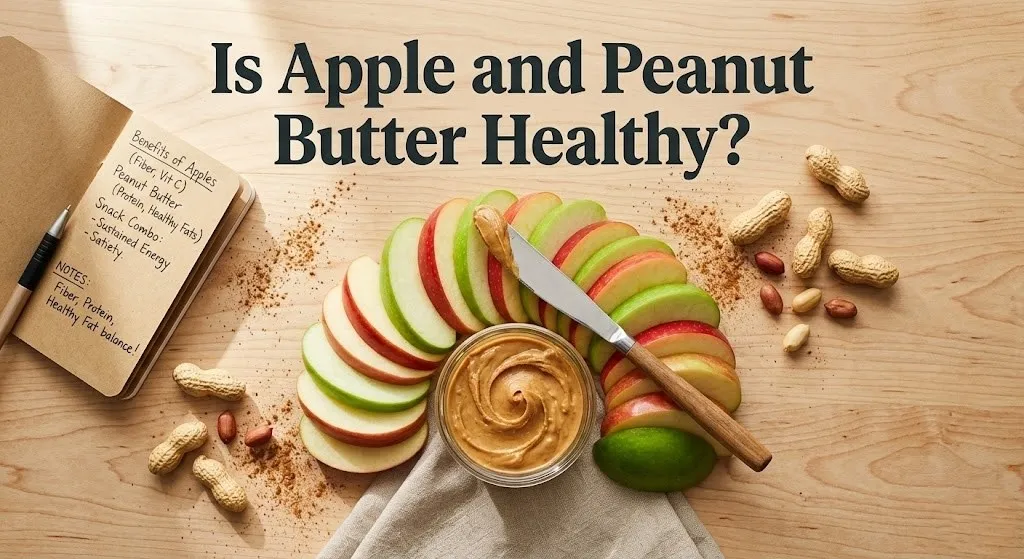
Think of the peanut butter as a slow-release traffic regulator for the apple’s natural sugar. The fiber is the road. The fat and protein are the speed bumps. The combination moves the sugar through your digestive system at a steady, controlled pace rather than a rapid highway merge.
Is Apples and Peanut Butter Healthy
Yes, apples and peanut butter as a regular snack habit is healthy for most adults. The plural “apples” often refers to the ongoing habit of eating this snack, not multiple whole apples in one sitting. The portion remains one medium apple and 2 tablespoons of peanut butter.
The habit benefits are significant for nutrient intake. One medium apple with skin delivers 14 percent of the daily value for vitamin C and 6 percent for potassium. The peanut butter adds 20 percent of the daily value for niacin, 15 percent for vitamin E, and 12 percent for magnesium. A snack that fills nutrient gaps while satisfying hunger is a rare and valuable dietary tool.
The USDA Dietary Guidelines for Americans 2025-2030 emphasize that most adults under-consume dietary fiber. This snack delivers 9 grams, nearly one-third of the recommended 28 grams per day. If you are not hitting your fiber target, this is a pleasant, crunchy way to close the gap.
Key Takeaway: The snack is healthy both as a single event and as a daily habit because it fills fiber, potassium, and magnesium gaps that most adults have.
Apples and Peanut Butter Healthy
The health profile of this pairing depends entirely on the peanut butter you choose. An unsweetened, single-ingredient peanut butter makes this snack a clean, whole-food choice. A sweetened, hydrogenated peanut butter drags it into the processed food category.
The ingredient list on the peanut butter jar is the fork in the road. A jar that reads “Peanuts, Salt” creates a healthy snack. A jar that reads “Peanuts, Sugar, Molasses, Fully Hydrogenated Vegetable Oil, Mono- and Diglycerides” creates a snack with 4 grams of added sugar and a dose of industrial stabilizers. The apple does not change. The peanut butter determines the health outcome.
The same logic applies to the apple. A conventionally grown apple washed with tap water is a healthy choice. An apple from a local orchard you trust is also a healthy choice. The apple’s health contribution is robust across all varieties and growing methods. The peanut butter’s health contribution is fragile and easily damaged by processing.
Is Apple With Peanut Butter Healthy
An apple with peanut butter is healthy for weight management because of the satiety-per-calorie ratio. At 285 calories, this snack suppresses hunger for two to three hours. A 2021 study in the journal Nutrients found that whole apple consumption was associated with lower body mass index and reduced obesity risk in a large cohort study.
The physical act of chewing matters. A whole apple requires mastication. The crunching, chewing, and swallowing process sends sensory signals to the brain that register as “eating.” A smoothie or apple sauce of the same calorie count does not trigger the same satiety response because the chewing work is eliminated.
The portion boundary is self-limiting. It is difficult to overeat whole apples in a single sitting. The fiber volume and the chewing effort create a natural stopping point. A bag of pretzels or a sleeve of cookies has no such natural stopping point. The apple and peanut butter snack protects against passive overconsumption.
Is Apples With Peanut Butter Healthy
Yes, this snack is healthy for people with diabetes when using unsweetened peanut butter and eating the apple whole with the skin. The fiber in the skin and the pectin in the flesh combine with the peanut fat to create a glycemic load of roughly 15, which is considered moderate.
The American Diabetes Association recognizes that snacks combining fiber, protein, and healthy fat help stabilize blood glucose between meals. The apple and peanut butter snack fits this template. A medium apple has a glycemic index of approximately 36. The peanut butter drops the effective glycemic load of the entire snack lower than the apple alone.
Individual blood glucose responses vary. A person with diabetes should test their own response with a continuous glucose monitor or a finger-stick reading 90 minutes after eating this snack. The population-level data supports the snack as blood-sugar-friendly. Your personal data may confirm or contradict that average.
| Snack (Single Serving) | Calories | Protein (g) | Fiber (g) | Sugar (g) |
|---|---|---|---|---|
| Apple + Peanut Butter | 285 | 8 | 9 | 21 |
| Granola Bar (Oats & Honey) | 190 | 3 | 2 | 12 |
| String Cheese + Crackers | 250 | 10 | 1 | 3 |
| Pretzels (3 oz bag) | 320 | 6 | 1 | 3 |
| Flavored Yogurt Cup | 180 | 12 | 0 | 22 |
Apple and Peanut Butter Nutrition
A medium apple with the skin on provides 95 calories, 25 grams of carbohydrate, 4.4 grams of fiber, and 8.4 milligrams of vitamin C. The peel contains quercetin, a flavonoid with anti-inflammatory properties. The flesh contains pectin, the soluble fiber responsible for the blood-sugar-modulating effect.
Two tablespoons of unsweetened natural peanut butter provide 190 calories, 16 grams of fat, 7 grams of protein, 3 grams of carbohydrate, and 2 grams of fiber. The fat profile is predominantly monounsaturated. The protein is complete, containing all nine essential amino acids in adequate amounts.
The total nutritional package delivers 285 calories, 8 grams of protein, 9 grams of fiber, 21 grams of naturally occurring sugar, and no added sugar. This is a nutritionally dense 285 calories. A 285-calorie slice of pizza or a 285-calorie candy bar delivers a fraction of the fiber and micronutrient content.
Apple and Peanut Butter Calories
The standard serving of one medium apple (182 grams) and 2 tablespoons (32 grams) of peanut butter contains 285 calories. This is an appropriate calorie count for a snack that bridges the gap between lunch and dinner, roughly 3 to 5 p.m.
The calorie breakdown is approximately 50 percent from fat, 40 percent from carbohydrate, and 10 percent from protein. This is not a balanced macronutrient ratio for a full meal, but it is an ideal ratio for a satiating snack. The fat dominates because peanut butter is a fat-forward food. The carbohydrate from the apple provides the quick energy. The protein extends the satiety window.
Measuring the peanut butter is the difference between 285 and 400 calories. A heavy-handed, unmeasured scoop can easily be 3 or 4 tablespoons. A digital kitchen scale or a level measuring tablespoon keeps this snack in the healthy calorie range. The apple size also matters. A large Honeycrisp can be twice the weight of a small Gala.
Key Takeaway: Measure the peanut butter with a tablespoon, not a butter knife, to keep the snack at 285 calories instead of drifting toward 400.
Is Peanut Butter and Apples Good for You
Yes, peanut butter and apples are good for you as a regular snack because the nutrient density is high relative to the calorie cost. You receive fiber, protein, healthy fat, potassium, magnesium, vitamin C, and vitamin E for under 300 calories.
The snack is good for specific health goals. For cardiovascular health, the monounsaturated fat from peanuts and the soluble fiber from apples both contribute to lowering LDL cholesterol. For muscle maintenance, the 8 grams of protein support tissue repair between meals. For digestive regularity, the 9 grams of fiber promote healthy bowel movements.
The snack is not good for a low-calorie diet if you do not measure the peanut butter. It is also not good for someone with a peanut allergy, for whom the substitution must be almond butter or sunflower seed butter. The snack is good, not magical. It supports health goals when consumed in measured portions as part of a balanced eating pattern.
Apple and Peanut Butter for Weight Loss
This snack supports weight loss because of the satiety-to-calorie ratio. It suppresses hunger for 2 to 3 hours on 285 calories. That delay in the next eating occasion reduces total daily calorie intake if the snacker was otherwise going to eat a higher-calorie, lower-satiety option.
The mechanism is multi-pathway. The stomach physically stretches from the apple’s volume and fiber. The small intestine releases cholecystokinin in response to the fat. The colon receives the soluble fiber, which ferments into short-chain fatty acids that signal satiety to the brain. A granola bar triggers none of these pathways with the same intensity.
Weight loss still depends on a total daily calorie deficit. This snack is a tool for creating that deficit, not a metabolic magic trick. If you add this snack on top of your regular meals without reducing anything else, you gain weight. If you replace a 500-calorie afternoon pastry with this 285-calorie snack, you create a daily deficit that compounds into fat loss over weeks.
Apple and Peanut Butter Blood Sugar
The blood sugar response to an apple with peanut butter is significantly lower than the response to an apple alone. The fat and protein in the peanut butter delay gastric emptying, the rate at which food leaves the stomach and enters the small intestine where sugar absorption occurs.
The pectin in the apple forms a gel in the presence of water. This gel physically traps some of the sugar molecules, slowing their contact with the intestinal wall. The peanut butter reinforces this effect by coating the stomach contents in a thin layer of fat. The sugar is released gradually over 90 to 120 minutes rather than in a rapid 30-minute surge.
A 2019 study in the Journal of Nutrition found that adding 15 grams of nuts to a high-carbohydrate meal reduced the post-meal blood glucose excursion by 15 to 20 percent. The peanut butter on your apple is performing a similar function. It is not eliminating the blood sugar response. It is flattening and extending the curve.
Best Apple for Peanut Butter
The best apple for peanut butter is a crisp, tart variety that contrasts with the rich, creamy peanut butter. Honeycrisp is the best all-around choice for its explosive crunch and balanced sweet-tart flavor. Granny Smith is the best choice for someone managing blood sugar, as its lower natural sugar content and high acidity create the smallest glucose response.
Fuji and Gala are sweet, mild options that work well for children or anyone who finds Granny Smith too tart. Their softer flesh is less crunchy but easier to bite. Pink Lady offers a firm texture and a tangy finish that holds up well to the peanut butter’s richness.
The apple must be sliced, not whole. Slicing increases the surface area for the peanut butter to adhere. A whole apple dipped into a jar is a portion-control disaster for the peanut butter. Pre-slice the apple into 8 to 10 wedges. Spread or dip each wedge individually. This slows the eating process and ensures every bite has the correct apple-to-peanut-butter ratio.
Key Takeaway: Choose Honeycrisp for crunch, Granny Smith for lowest blood sugar impact, and always slice the apple before eating to control the peanut butter portion.
Best Peanut Butter for Apples
The best peanut butter for apples is an unsweetened, single-ingredient creamy peanut butter. Crazy Richard’s 100% Peanuts, Smucker’s Natural, and Teddie Organic are the top three choices in 2026. Each contains only peanuts or peanuts and salt.
Creamy peanut butter coats the apple slice more evenly than crunchy. Crunchy peanut butter creates an uneven mouthfeel where the peanut chunks compete with the apple’s crispness. Creamy peanut butter stays in the background, supporting the apple rather than competing with it.
Avoid any peanut butter with added sugar, hydrogenated oil, or molasses. These ingredients add empty calories, introduce trans fats in the case of partially hydrogenated oils, and dull the natural sweetness of the apple. A sweetened peanut butter makes the snack taste like a candy apple. An unsweetened peanut butter lets the apple’s natural flavor lead.
Is Apple and Peanut Butter a Healthy Breakfast
Apple and peanut butter is a healthy light breakfast for someone who prefers a smaller morning meal. At 285 calories, it is closer to a snack than a full breakfast. For a complete breakfast, add a hard-boiled egg or a container of plain Greek yogurt to bring the protein to 20 grams.
The snack lacks sufficient protein for a full breakfast by itself. The 8 grams from peanut butter are adequate for a snack but low for a meal that breaks an overnight fast. Adding 15 grams of protein from an egg or yogurt extends the satiety window from 2 hours to 4 hours.
The carbohydrate from the apple provides morning energy. The fiber prevents the mid-morning crash that follows a low-fiber breakfast like white toast with jam. The fat sustains the energy. The missing piece is simply the additional protein. Fix that, and the apple and peanut butter snack becomes a legitimate breakfast.
Is Apple and Peanut Butter a Healthy Snack
Yes, apple and peanut butter is one of the healthiest widely available snacks in 2026. It requires no cooking, no refrigeration in the short term, and no specialty ingredients. A bag of apples and a jar of natural peanut butter sit in a desk drawer or a work locker and produce a fresh, satisfying snack in under two minutes.
It compares favorably to processed snack alternatives. A standard granola bar has 2 grams of protein, 2 grams of fiber, and 12 grams of added sugar. This snack has 8 grams of protein, 9 grams of fiber, and 0 grams of added sugar. The granola bar is cheaper and more shelf-stable. The apple and peanut butter is nutritionally superior on every metric.
The snack travels well. Slice the apple at work or pack the slices in a container with a splash of lemon juice to prevent browning. The peanut butter can be pre-portioned into a small, leakproof container. For children, cut the apple slices thinner and spread a thin layer of peanut butter on each slice like a cracker.
Apple and Peanut Butter Before Bed
Apple and peanut butter is a reasonable bedtime snack for someone who needs a small, balanced bite to prevent overnight hunger. The fiber and fat slow digestion, preventing a blood sugar crash at 2 a.m. that can disrupt sleep.
The portion should be smaller than the daytime snack. Half an apple and 1 tablespoon of peanut butter, totaling roughly 150 calories, is sufficient for a pre-bed bite. A full 285-calorie serving is unnecessary for a body about to lie still for eight hours.
The snack is better than a bowl of cereal or a cookie before bed. It is worse than eating nothing if the eater consumed a full dinner and is simply bored. The bedtime snack decision should be based on genuine physical hunger, not habit. If hunger is real, half an apple with a thin smear of peanut butter is a sleep-friendly choice.
Frequently Asked Questions About Apple and Peanut Butter
Is it okay to eat apple and peanut butter every day?
Yes, eating apple and peanut butter every day is a healthy daily habit for most adults.
The snack provides fiber, protein, and healthy fats that fill common nutrient gaps.
Rotate apple varieties and ensure the peanut butter is unsweetened to keep the snack interesting and maximally healthy.
How many calories are in an apple with peanut butter?
A medium apple with 2 tablespoons of unsweetened peanut butter contains approximately 285 calories.
A large apple with 3 tablespoons of peanut butter can reach 400 calories.
Measure the peanut butter to keep the calorie count in the 280 to 300 range.
Does apple and peanut butter spike blood sugar?
No, apple and peanut butter does not spike blood sugar in most people.
The fat and protein from the peanut butter and the fiber from the apple combine to flatten the blood sugar curve.
The glycemic load of the entire snack is moderate at roughly 15.
What is the healthiest peanut butter for apples?
The healthiest peanut butter for apples is an unsweetened, single-ingredient brand containing only peanuts or peanuts and salt.
Smucker’s Natural, Teddie Organic, and Crazy Richard’s are the top choices in 2026.
Avoid brands with added sugar, molasses, or hydrogenated oils.
Can you eat apple and peanut butter before bed?
Yes, a small portion of apple and peanut butter is a reasonable bedtime snack.
Limit the portion to half an apple and 1 tablespoon of peanut butter, roughly 150 calories.
Eat it only if genuinely hungry, not out of habit.
The apple and peanut butter on your plate is a nutritionist-approved, research-backed, genuinely satisfying snack. It earned its reputation honestly. The fiber from the apple, the monounsaturated fat from the peanuts, and the complete absence of added sugar make it superior to almost every packaged snack on the grocery store shelf.
Measure the peanut butter. Slice the apple. Eat both together. The partnership is what makes it work. The apple provides the crunch and the quick energy. The peanut butter provides the staying power.
This is the snack you can stop thinking about. It is healthy. You can eat it every day. Now go slice an apple.