Halal food originates from the dietary laws laid out in the Quran, the central religious text of Islam, which Muslims believe was revealed to the Prophet Muhammad in 7th-century Arabia. These laws define what is permissible, halal translates directly to “permissible” in Arabic, and they have shaped food production, slaughter methods, and ingredient sourcing across the Islamic world for more than 1,400 years. The specific requirements are drawn primarily from verses in the Quran and the Hadith, the recorded sayings and practices of the Prophet Muhammad.
The global halal food market was valued at over $2 trillion annually as of the 2025 State of the Global Islamic Economy Report published by DinarStandard. That figure covers not just meat but every category of food, beverage, and ingredient that carries halal certification. The market spans more than 60 countries where Muslims form the majority population and extends deep into majority-non-Muslim nations where halal-certified products are demanded by observant consumers, exported as trade goods, or chosen by people who see halal certification as a marker of cleanliness and quality control.
This article covers the religious and geographic origins of halal food, the specific rules that define it, how halal slaughter works, what halal certification means on a food label, the nutritional profile of halal foods, how halal intersects with other dietary patterns, and where to find halal food in 2026. Every section is grounded in Islamic jurisprudence sources, food science, and data from global halal certification bodies.
What Does Halal Mean? The Religious and Linguistic Origin
Halal is an Arabic word that means “permissible” or “lawful,” and in the context of food it refers to anything that is allowed under Islamic dietary law as defined by the Quran. The opposite of halal is haram, meaning “forbidden.” The foundational verse is Quran 2:168: “O mankind, eat from whatever is on earth that is lawful and good.” This establishes a dual requirement: the food must be permissible by category and it must be wholesome, tayyib in Arabic, meaning pure, clean, and good.
The dietary rules are not an arbitrary list of restrictions. They are part of a broader Islamic legal framework called Shariah that governs all aspects of life for observant Muslims. The food laws specifically draw from four sources in order of authority: the Quran itself, the Hadith collections (primarily Sahih al-Bukhari and Sahih Muslim), scholarly consensus (ijma), and analogical reasoning (qiyas). This legal methodology means that halal food rules are both textually grounded and adaptable to new foods and processing technologies that did not exist in the 7th century.
The most important food prohibitions are stated directly in the Quran. Pork and all pork-derived products are categorically haram (Quran 2:173). Blood is haram and must be drained from the carcass after slaughter (Quran 6:145). Alcohol and all intoxicants are haram (Quran 5:90). Carrion, animals that died of natural causes, is haram (Quran 5:3). Animals sacrificed to idols or any deity other than God are haram (Quran 6:121). These prohibitions form the boundaries within which all halal food production operates.
Beyond the prohibitions, the concept of tayyib adds a quality dimension that is often underappreciated. Food must not only be permissible. It must be clean, safe, ethically produced, and wholesome. This principle resonates with modern food movements around sustainability, ethical farming, and food safety. The Islamic Food and Nutrition Council of America (IFANCA), one of the largest halal certifiers in North America, explicitly incorporates tayyib into its certification standards by requiring that halal-certified foods also comply with applicable food safety regulations.
Where Did Halal Dietary Laws Originate Geographically?
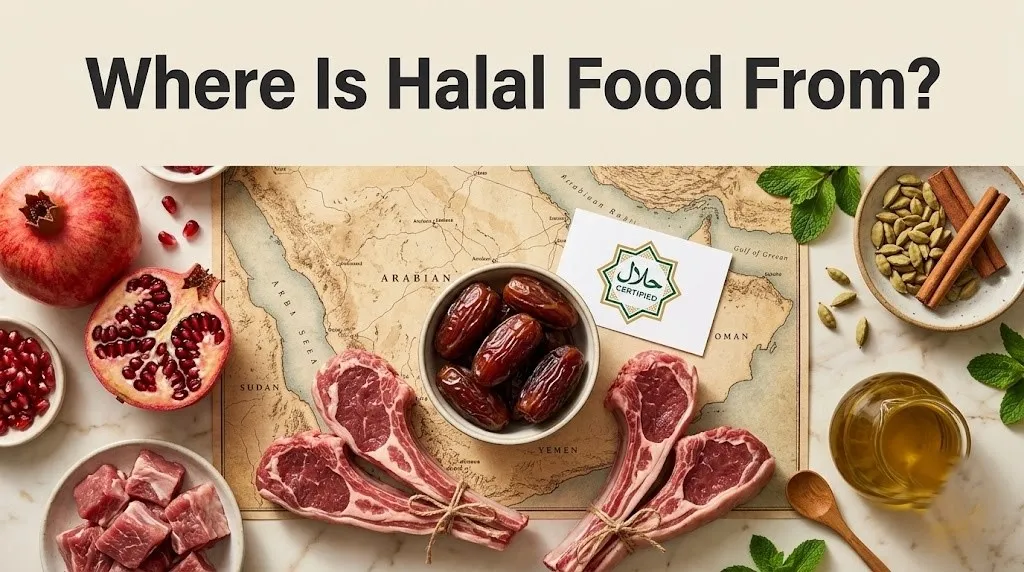
Halal dietary laws originated in the Arabian Peninsula, specifically in the cities of Mecca and Medina in what is now Saudi Arabia, where the Quran was revealed to the Prophet Muhammad between 610 and 632 CE. The food practices of pre-Islamic Arabia, including the consumption of dates, camel milk, lamb, and certain grains, were largely absorbed into halal guidelines except where they conflicted with the new prohibitions on pork, blood, carrion, and alcohol.
The geographic origin matters because it shaped which foods became central to halal cuisine. The Arabian Peninsula is an arid region where pastoral livestock herding was the primary food system. Cattle, sheep, goats, and camels were the dominant domesticated animals. This is why halal slaughter rules, known as dhabihah, focus on these species and why the method is adapted to the practical realities of animal slaughter in a hot climate where rapid bleeding and draining are also a food safety measure. The prohibition on pork in a region where pigs were not widely herded anyway aligned with existing dietary patterns.
As Islam spread across the Middle East, North Africa, Persia, South Asia, Anatolia, and eventually Southeast Asia, halal dietary principles integrated with local food cultures. Halal biryani in India, halal rendang in Indonesia, halal couscous in Morocco, and halal kebabs in Turkey are all expressions of the same core dietary law applied to regionally available ingredients. The food is local. The rules are universal. That combination is part of what makes halal cuisine so geographically diverse even as the underlying permissibility framework remains consistent.
The Organization of Islamic Cooperation (OIC), an intergovernmental body representing 57 member states, now coordinates halal food standards across borders through the Standards and Metrology Institute for Islamic Countries (SMIIC). This is a modern development. Historically, halal certification was a local matter handled by individual mosques and community scholars. The global halal trade has pushed standardization forward.
Key Takeaway: Halal food law comes from 7th-century Arabia, but halal food culture comes from everywhere. The rules are geographically specific in origin and geographically universal in application.
Which Countries Produce the Most Halal Food?
The largest producers of halal food are Brazil, Australia, India, Indonesia, and Malaysia, with Brazil leading global halal meat exports by a wide margin. Halal food production is split between countries where Muslims are the majority population and countries where a large export-oriented halal industry has developed to serve Muslim-majority markets abroad.
Brazil is the most instructive example. Muslims make up less than 2 percent of the Brazilian population. Yet Brazil is the world’s largest exporter of halal beef and poultry, shipping hundreds of thousands of metric tons annually to the Middle East and North Africa. Brazilian meatpacking giants including JBS and BRF operate dedicated halal production lines with certification from bodies recognized by Gulf Cooperation Council (GCC) import authorities. The economics drive this arrangement. Brazilian pastureland and soybean feed produce beef at a lower cost than most Muslim-majority countries can match, and the halal certification process adds a manageable cost layer for access to a premium market.
Australia is another major halal exporter with a minority Muslim population. Australian halal beef and lamb are widely accepted in Middle Eastern markets, and Australian halal certification is overseen by organizations including the Australian Federation of Islamic Councils (AFIC) and the Supreme Islamic Council of Halal Meat in Australia (SICHMA). Australian red meat has built a reputation for quality and disease-free status that commands a price premium in halal import markets.
Within the Muslim-majority world, Malaysia has positioned itself as the global leader in halal certification and standards development. The Department of Islamic Development Malaysia (JAKIM) is widely considered the gold standard halal certifier globally. A JAKIM halal logo on a product is recognized and trusted in Muslim communities from London to Jakarta. Malaysia has turned halal certification into a national economic strategy, promoting its halal ecosystem through the Halal Development Corporation (HDC) and hosting major halal trade fairs annually.
| Country | Role in Global Halal Market | Muslim Population (%) | Key Halal Exports |
|---|---|---|---|
| Brazil | Largest halal meat exporter | ~2% | Beef, poultry |
| Australia | Major halal red meat exporter | ~3% | Lamb, beef, goat |
| India | Large halal domestic market and growing exporter | ~15% | Buffalo meat, spices |
| Indonesia | Largest Muslim population, major consumer | ~87% | Processed foods, instant noodles |
| Malaysia | Halal certification leader | ~63% | Certified packaged foods, palm oil |
| Saudi Arabia | Home of Islam, major halal importer | ~93% | Dates, camel products |
What Are the Rules That Define Halal Food?
Halal food rules govern what can be eaten, how permissible animals must be slaughtered, and how food must be processed to avoid cross-contamination with haram substances. The core prohibitions, pork, blood, carrion, alcohol, and animals not slaughtered in God’s name, are absolute and apply everywhere. The slaughter method requirements are more detailed and include specific conditions for the animal, the person performing the slaughter, and the technique used.
The dhabihah slaughter method requires that a sane adult Muslim, or a person from the “People of the Book” (Christians or Jews under traditional Islamic law), performs the slaughter. The name of God, Bismillah (in the name of God) or Allahu Akbar (God is greatest), must be invoked at the time of slaughter. A sharp blade must be used to cut the throat, severing the carotid arteries, jugular veins, trachea, and esophagus in a single continuous motion. The spinal cord must remain intact so that the heart continues to pump blood out of the carcass. All flowing blood must drain completely before further processing.
The animal must be alive and healthy at the time of slaughter. It must not see the blade before the cut. It must not see other animals being slaughtered. It must be handled gently and fed and watered properly before slaughter. These animal welfare provisions are part of the halal standard, and they overlap with secular animal welfare concerns. The American Veterinary Medical Association (AVMA) does not endorse any specific religious slaughter method but acknowledges that properly performed religious slaughter can be consistent with humane handling when the cut is made by a skilled operator with a sharp blade.
Stunning before slaughter is the most debated issue in halal meat production in 2026. Some halal certifiers, including JAKIM in Malaysia and many Middle Eastern authorities, permit reversible electrical or mechanical stunning that does not kill the animal before the throat cut. The animal must be alive at the time of the halal cut. If stunning kills the animal, the meat becomes carrion and is haram. Other certifiers, particularly in the United Kingdom and parts of Europe, accept stunning as consistent with halal when it is reversible. A minority of halal certifiers reject all stunning, requiring that the animal be fully conscious at slaughter. This variation means that halal meat from different certifiers may have different stunning policies. The halal logo on the package tells you nothing about stunning unless the certifier’s policy is known.
What Is Halal Certification and How Does It Work?
Halal certification is a third-party audit process in which a recognized Islamic organization inspects a food production facility, reviews all ingredients and processing aids, and confirms that the final product meets halal standards. The certification body then grants permission to use its halal logo on the product packaging. This logo is the consumer’s assurance that the food complies with Islamic dietary law.
Certification covers the entire supply chain. A halal-certified frozen chicken dinner means that the chicken was slaughtered according to dhabihah, the spices and flavorings contain no alcohol-based extracts or pork-derived enzymes, the sauce thickener is not gelatin from non-halal sources, the production line was not used for pork products without a documented cleaning procedure, and the packaging material contains no haram-derived lubricants or coatings. Every input is verified. Every processing step is audited.
Major halal certifiers in 2026 include JAKIM (Malaysia), MUI (Indonesia), IFANCA (USA), HFA (UK), Halal Certification Europe (HCE), and GAC (Gulf region). Each has its own standards and recognized scope. Some are recognized across borders through mutual recognition agreements. Others are accepted only in their home country. This fragmented landscape is a known challenge in the halal industry. The International Halal Accreditation Forum (IHAF), based in the UAE, has been working toward global halal standards harmonization, but full consensus remains a work in progress.
The cost of halal certification varies by facility size and complexity. A small bakery seeking certification for a single product line might pay a few hundred dollars annually for inspection and certification. A large multinational meat processing plant might pay tens of thousands. The certifier assigns a halal auditor, often trained in both Islamic jurisprudence and food science, who visits the facility, reviews documentation, observes production, and files a compliance report. Certification must be renewed annually, and changes to ingredients or suppliers must be reported to the certifier between renewal cycles.
For consumers, the practical question is which halal logos to trust. A product with the JAKIM logo has passed one of the most rigorous halal certification systems in the world. A product with the IFANCA logo is widely accepted in North America and many export markets. A product with a halal logo from an unknown certifier or a vague “halal” claim without a certifier name should be approached with caution. Halal fraud, where products falsely claim halal status, is a real problem that certification is designed to prevent.
What Foods Are Halal by Default and What Foods Are Not?
Many whole foods are halal by default because they are not subject to any prohibition. The categories that require certification are mainly meat, processed foods, and products with complex ingredient lists. Understanding the default status of common food groups helps consumers shop confidently even when certified products are not available.
Foods that are automatically halal include fresh fruits, vegetables, grains, legumes, nuts, seeds, eggs, milk from halal animals, honey, and seafood. All seafood is halal according to the majority of Islamic scholars, based on the Quranic verse that says “the game of the sea is permitted to you” (Quran 5:96). Fish, shrimp, crab, lobster, and squid are all permissible without any requirement for ritual slaughter. Some scholars in the Hanafi school of jurisprudence consider only fish with scales to be halal, making shellfish restricted, though the majority position across the other three Sunni schools and most Shia scholars is that all seafood is permissible.
Foods that are automatically haram include pork and all pork derivatives (bacon, ham, lard, gelatin from pork, pepsin from pigs), blood and blood products, alcohol and all alcoholic beverages, animals that died before slaughter, and any food that has come into contact with haram substances without proper cleaning. Gelatin is one of the most common hidden haram ingredients. It appears in marshmallows, gummy candies, yogurt, capsule supplements, and many processed desserts. Unless the packaging specifies “halal gelatin” or “bovine gelatin,” the default assumption is that it may be pork-derived.
Foods that require investigation include cheese (rennet source), vanilla extract (alcohol base), fruit juice (alcohol-based flavor carriers), bread (L-cysteine from human hair or feathers), processed snacks (enzymes, emulsifiers), and medications (gelatin capsules, alcohol solvents). The complexity of modern food processing means that a product can contain dozens of sub-ingredients, and any one of them can break halal compliance.
Quick Tip:
- Fresh, single-ingredient foods from the plant and sea are halal by default.
- Meat, poultry, and processed foods require halal certification or direct knowledge of the source.
- When in doubt, contact the manufacturer and ask for their halal certifier’s name. A company that has paid for halal certification will be proud to tell you which certifier they use.
Key Takeaway: You can eat a tremendous variety of foods without any halal certification at all. Fruits, vegetables, grains, eggs, milk, and seafood form a complete and nutritious diet that is halal by nature. Certification is for meat and processed foods.
How Does Halal Food Compare Nutritionally to Conventional Food?
Halal food is not a distinct nutritional category. A halal chicken breast has the same macronutrient profile as a conventional chicken breast. Halal certification addresses how the food was produced and processed, not its inherent nutritional content. The nutritional value of a halal diet depends on the same factors as any other diet: the foods chosen, the portions eaten, and the balance of macronutrients.
The one nutritional distinction that halal meat may carry involves blood retention. The dhabihah method requires complete drainage of blood from the carcass. Blood is high in iron, which is a benefit for people with iron deficiency and a concern for people with hemochromatosis. The practical difference in iron content between halal and non-halal meat is small and has not been shown in published research to produce clinically meaningful differences in human iron status. The USDA does not publish separate nutritional data for halal versus conventional meat because the differences are nutritionally negligible.
Some consumers perceive halal meat as healthier because of the animal welfare provisions, the prohibition on dead animals, and the cleanliness requirements embedded in tayyib. There is a logic to this perception. Halal certification requires that animals be healthy at slaughter. Sick or injured animals are not permissible. The blood drainage requirement removes a medium for bacterial growth, which can contribute to faster spoilage and food safety risk. A 2023 study in the Journal of Food Protection found that properly performed halal slaughter with complete bleeding resulted in bacterial counts comparable to or slightly lower than conventional slaughter methods, though the differences were not statistically significant across all sample sets.
Where halal dietary rules may produce a nutritional advantage is through the exclusion of certain ultra-processed ingredients. A person who avoids foods with hidden pork-derived gelatin, alcohol-based flavorings, and non-halal emulsifiers ends up eliminating a range of highly processed snack foods, desserts, and convenience products. That dietary pattern, heavy on whole foods and light on processed items, aligns with the dietary recommendations of the Academy of Nutrition and Dietetics and the World Health Organization. The benefit comes from the whole-food eating pattern, not from the halal certification itself.
Is Halal Food the Same as Kosher Food?
Halal and kosher food share a common religious origin in Abrahamic dietary law but are not the same. The two systems have different slaughter rules, different prohibitions, and different certification processes. A halal consumer cannot assume that kosher food is automatically permissible, and vice versa.
Both systems prohibit pork. Both require ritual slaughter by a person of faith with a sharp blade and a blessing. Both prohibit blood. But the differences are substantial and disqualifying in both directions. Kosher law prohibits mixing meat and dairy, a rule that does not exist in halal. A halal cheeseburger is permissible. A kosher cheeseburger is not. Halal permits shellfish and all seafood. Kosher law restricts seafood to fish with fins and scales, excluding shrimp, crab, and lobster. Kosher law permits certain wines and alcohol. Halal prohibits all alcohol.
The slaughter methods diverge on several points. Shechita, the Jewish ritual slaughter method, requires a single cut across the throat by a trained slaughterer called a shochet. Unlike halal, shechita does not require the invocation of God’s name on each individual animal if the shochet recites a blessing at the start of the slaughter session. The kosher inspection of the animal’s internal organs for defects, called bedikah, is more rigorous than the standard halal inspection. The kosher process also requires soaking and salting the meat to draw out remaining blood, a step called kashering that has no equivalent in halal processing.
| Dietary Rule | Halal | Kosher |
|---|---|---|
| Pork prohibited | Yes | Yes |
| Alcohol prohibited | Yes | No (wine is kosher) |
| Shellfish permitted | Yes (majority view) | No |
| Meat and dairy mixed | Permitted | Prohibited |
| Slaughter blessing | On each animal | On session (varies) |
| Blood removal | Draining only | Draining plus salting |
| Gelatin rules | Must be from halal-slaughtered animal | Fish gelatin and certain plant gelatins accepted |
Some Muslims consume kosher meat based on the Quranic verse (5:5) that permits the food of the “People of the Book,” which has traditionally been interpreted to include Jews and Christians. This position is held by some scholars and rejected by others who argue that modern kosher slaughter does not meet the halal requirement that God’s name be invoked on each animal. In practice, most halal consumers and certifiers do not accept kosher meat as a halal substitute. The same applies in reverse: most kosher consumers do not accept halal meat as kosher.
How Has Halal Food Culture Spread Globally?
Halal food culture spread from Arabia along the trade routes of the early Islamic empires, through the Umayyad and Abbasid caliphates, across North Africa and into Spain, eastward through Persia into South and Central Asia, and via maritime routes into Southeast Asia. The food moved with the merchants, the scholars, and the armies. Local ingredients absorbed into the halal framework and created the regional halal cuisines that exist today.
Halal street food is the most visible manifestation of this global spread. The halal cart serving chicken and rice, made famous in New York City by vendors who are predominantly from Egypt, Bangladesh, and Afghanistan, has become an urban food staple across North America and Europe. The halal cart is a genuinely modern phenomenon. It emerged in the 1990s when Muslim immigrant entrepreneurs identified a market among taxi drivers, night shift workers, and late-night diners who wanted hot, affordable, halal-compliant meals. The iconic white sauce and hot sauce on halal cart chicken are now part of American food culture regardless of the consumer’s religion.
In Europe, halal food has grown through the kebab shop and the halal butcher. The Turkish diaspora in Germany, the North African diaspora in France, and the South Asian diaspora in the United Kingdom built halal food infrastructure from the ground up. A high street in a British city as of 2026 is likely to have a halal butcher, a halal Indian takeaway, and a halal-certified section in the local supermarket. Tesco, Sainsbury’s, and Carrefour all carry halal meat and prepared foods in many locations. The halal market in Europe is mainstream, not niche.
Southeast Asia represents the largest concentration of halal food consumers in the world. Indonesia alone has over 230 million Muslims. The entire food system in Indonesia and Malaysia is halal by default. Non-halal products are segregated and labeled. This is a mirror image of the Western model where halal is the segregated category. The Halal Park concept, industrial zones where all manufacturing meets halal standards, originated in Malaysia and has been replicated in China, Japan, and the UAE. These parks are economic engines, producing halal-certified products for export to the global Muslim market.
Frequently Asked Questions About Halal Food
Where does halal meat come from?
Halal meat comes from animals slaughtered according to the dhabihah method, which requires a Muslim to perform a swift throat cut while invoking God’s name.
The largest exporters of halal meat are Brazil, Australia, and India.
Halal meat is produced in both Muslim-majority countries and countries with dedicated export-oriented halal production lines.
Is all Middle Eastern food halal?
Not all Middle Eastern food is halal by default.
Some Middle Eastern restaurants serve pork dishes, use alcohol in cooking, or source meat from non-halal suppliers.
The presence of Middle Eastern cuisine does not guarantee halal compliance; look for a halal certification or ask the staff directly.
Can Muslims eat food from Christian or Jewish countries?
Muslims can eat food from Christian and Jewish countries provided the food itself meets halal requirements.
The Quran permits the food of the “People of the Book,” but this traditionally refers to the meat slaughtered by Christians and Jews under conditions that align with halal standards.
In modern practice, most halal consumers prefer certified halal meat rather than relying on the People of the Book exemption.
Why is halal certification expensive for small businesses?
Halal certification costs include the annual audit fee, the cost of sourcing certified ingredients which are often more expensive, and the administrative burden of documentation and compliance.
Small businesses may also need to segregate production lines, train staff, and pay for ongoing monitoring visits.
These costs can be disproportionate for a small bakery or restaurant compared to a large manufacturer.
Is halal food healthier than regular food?
Halal food is not inherently healthier or less healthy than conventional food in terms of nutritional content.
The healthfulness of a halal diet depends on the same factors as any diet: whole foods versus processed foods, portion sizes, and macronutrient balance.
The halal prohibition on blood and carrion and the emphasis on cleanliness align with food safety principles but do not change the calorie or nutrient profile of the food itself.
Halal food is not from one place. It is from a set of principles that originated in 7th-century Arabia and have been adopted into food cultures on every inhabited continent. The halal lamb chop on a plate in Sydney, the halal-certified instant noodles in a Jakarta convenience store, the halal biryani in a Birmingham takeaway container, and the halal beef shipped from a Brazilian processing plant to a Dubai supermarket are all halal. They share a rulebook. They do not share a geography.
The practical lesson for anyone eating, cooking, or shopping halal in 2026 is that certification and ingredient awareness matter more than origin. A halal logo from a recognized certifier tells you more about the food than the country it was produced in. Whole plant foods and seafood are halal by default. Processed foods and meat require verification. This is not complicated once you know the framework.
The halal food system is one of the oldest continuously operating dietary certification systems in the world. It predates organic certification, non-GMO labeling, and fair trade standards by over a millennium. Understanding where it comes from helps explain why it works the way it does and why it continues to grow far beyond its geographic origins.