Knowing how much food to feed a puppy depends on three things: the puppy’s current age, their expected adult weight, and the caloric density of the food you’re using. Most owners get the portion wrong not because they’re careless, but because the guidelines on the bag were written for an average dog, and your puppy isn’t average.
Individual puppies may need up to 50% more or fewer calories than chart averages, depending on metabolism, activity level, body condition, and health status. That range is enormous, and no single feeding chart accounts for it fully. Understanding how to read your specific puppy’s signals, alongside a chart-based starting point, is what actually prevents overfeeding and underfeeding.
This guide covers daily portion sizes by age and weight, a complete feeding chart you can use right now, how to assess whether your puppy’s current diet is working, when to shift feeding amounts, and how to handle the transition to adult food. Breed size matters at every stage, and veterinary guidance specific to your puppy’s individual health is the right final check before locking in any feeding plan.
How Much Food to Feed a Puppy: The Core Answer
The baseline answer: feed a puppy the amount listed on the food packaging for their age and expected adult weight, divided across multiple meals per day, and adjust based on your puppy’s body condition over time.
As a general rule of thumb, puppies need about 5 to 6 percent of their estimated adult body weight in food each day. As they get older, that amount reduces to 2 to 3 percent of their body weight. This percentage-based method is a useful sanity check against the label amounts. If the label says 2 cups but 6% of your puppy’s adult weight suggests significantly more, a conversation with your veterinarian is warranted.
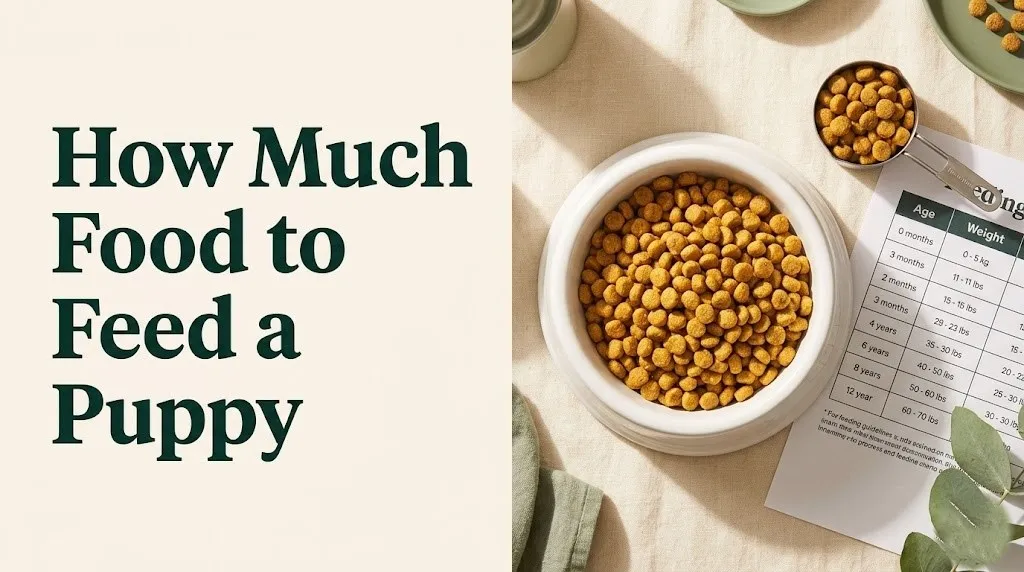
The amount of food your puppy needs depends on how much they will weigh at maturity. A Labrador Retriever will weigh more at maturity than a Russell Terrier, so the larger dog requires more food as a puppy. This seems obvious, but the implication is that you need to know your puppy’s expected adult weight before you can accurately calculate daily portions, especially for mixed-breed dogs.
If you have a mixed-breed puppy and aren’t sure of the adult size, your veterinarian can estimate based on current growth trajectory. DNA breed tests are another option, though they are not required for feeding decisions.
Key Point: Puppies are not small adult dogs nutritionally. Puppy food is higher in calories and protein because puppies require more energy to fuel growth and development, especially during the first five months of life. Young puppies need double the amount of food as an adult dog of the same size just to move, grow, and digest food.
How Much Puppy Food Per Day Does Your Puppy Actually Need?
Daily puppy food requirements are calculated from expected adult weight, current age, and the caloric density (kcal per cup) of the food being fed.
The amount of food your puppy needs depends on their age, weight, and body condition score, which measures their body fat and is best determined by your vet. The label chart is your starting point, not your final word. Puppy foods typically range from 340 to 420 kcal per cup for dry kibble, meaning two brands with the same cup recommendation can differ substantially in actual calorie delivery.
Large and giant dog breed puppies have different nutritional needs than small- and medium-breed puppies, and they should be fed a large-breed puppy formula for proper bone and joint development. Feeding a Great Dane puppy on a standard all-breed formula may expose them to excessive calcium, raising their risk of orthopedic problems. More on this in the breed-size section below.
Here is a practical reference for daily dry kibble amounts by expected adult weight. These are starting estimates based on approximately 380-400 kcal/cup dry kibble. Always verify against your specific food’s label.
| Expected Adult Weight | 8-12 Weeks | 3-4 Months | 5-6 Months | 7-12 Months |
|---|---|---|---|---|
| Under 10 lbs (toy breed) | 1/4 to 1/2 cup | 1/4 to 1/3 cup | 1/3 cup | 1/3 to 1/2 cup |
| 10-25 lbs (small breed) | 1/2 to 3/4 cup | 3/4 to 1 cup | 1 to 1.5 cups | 1 to 1.5 cups |
| 25-50 lbs (medium breed) | 3/4 to 1.5 cups | 1.5 to 2 cups | 2 to 2.5 cups | 2 to 2.5 cups |
| 50-100 lbs (large breed) | 2 to 3 cups | 2.5 to 4 cups | 3 to 4.5 cups | 3 to 5 cups |
| Over 100 lbs (giant breed) | 3 to 4 cups | 4 to 5.5 cups | 5 to 7 cups | 5 to 8 cups |
These are general estimates only. Caloric density varies by brand. Always read the specific packaging and confirm with your veterinarian.
How Much Food Should a Puppy Eat in a Day?
A puppy should eat enough food each day to support steady, controlled growth without becoming visibly overweight or showing signs of undernutrition.
Your puppy’s growing bones, muscles, brain cells, and tissues require specific nutrients. Too few or too many calories, over-supplementing, or nutrient deficiencies can all be harmful to your pup in the long run. This isn’t about hitting an arbitrary number. It’s about fueling a biological process that is happening whether or not the diet is adequate.
Think of it like scaffolding on a construction site. Remove too much material and the structure can’t be completed properly. Use too much and the weight causes structural stress. Puppy feeding works similarly: the right amount supports growth, and both extremes have real consequences.
Puppies require more calcium and phosphorus than adult dogs, but in carefully balanced ratios. Too much can lead to skeletal issues, especially in large breeds. This is the key reason a complete, AAFCO-compliant puppy food matters more than any homemade or adult-formula alternative at this stage.
According to the Association of American Feed Control Officials (AAFCO), puppy food must meet minimum nutrient profiles that include 22% crude protein and 8% crude fat on a dry matter basis, along with specific calcium and phosphorus levels. Foods that carry an AAFCO nutritional adequacy statement for “growth” or “all life stages” have met these baseline requirements.
Key Takeaway: Start with the food label’s recommended daily amount for your puppy’s expected adult weight, cross-check it against the 5-6% body weight formula, and watch your puppy’s body condition weekly to make real-time adjustments.
Puppy Feeding Chart by Weight and Age
A puppy feeding chart should be read using expected adult weight, not current weight, because current weight underestimates how much a young puppy actually needs.
Feeding charts for puppy foods are typically based on your puppy’s target adult weight. Look up how much your puppy will weigh as an adult and their current age to determine how much food to give your growing dog. This distinction matters. An 8-week-old Labrador Retriever puppy currently weighing 10 lbs is not eating like a 10-lb toy breed dog. Their adult weight of 65-80 lbs defines their caloric trajectory.
The table below translates the standard age-and-weight combination into a clear reading method:
| Step | What to Do |
|---|---|
| 1 | Find out your puppy’s expected adult weight (ask your vet or check breed standards) |
| 2 | Locate your food’s feeding chart on the packaging |
| 3 | Find the column for your puppy’s expected adult weight |
| 4 | Read across to the row for your puppy’s current age in weeks or months |
| 5 | That number is your daily total; divide it across meals per day |
| 6 | Reassess every 2-3 weeks as your puppy grows |
Not every puppy food brand uses the same measuring cup size. This means you may need to use kitchen scales to weigh the first cup and determine how many grams this translates to, in order to properly interpret feeding guidelines. A kitchen scale and a consistent measuring cup are the two tools every puppy owner should have in the feeding routine.
Quick Tip:
- Weigh your puppy weekly on a kitchen scale (step on with them, subtract your weight)
- Record the weight each week to track the growth trajectory
- If growth stalls or your puppy suddenly loses weight, contact your veterinarian promptly, as this can indicate a health issue beyond feeding
How Much Food Should an 8-Week-Old Puppy Eat?
An 8-week-old puppy should eat 3 to 4 small meals per day, with daily portions based on their expected adult weight as listed on the specific food’s packaging.
Because puppies grow at such fast rates, they need to start eating a complete and balanced puppy food as soon as they’re weaned, usually between six and eight weeks. At 8 weeks, a puppy has just been weaned and their digestive system is still adapting to solid food. Small, frequent meals reduce digestive stress at this stage.
Growing puppies from 6 to 12 weeks should be fed puppy food, a diet specifically formulated to meet the nutritional needs of puppies for normal development. Feeding a puppy adult dog food will deprive them of important nutrients. Four feedings a day are usually adequate to meet nutritional demands.
Here is a practical reference for 8-week-old puppies specifically. These estimates assume dry kibble at approximately 380 kcal/cup:
| Expected Adult Weight | Daily Amount (Dry Kibble) | Meals Per Day |
|---|---|---|
| Under 10 lbs | 1/4 to 1/2 cup | 4 |
| 10-25 lbs | 1/2 to 3/4 cup | 4 |
| 25-50 lbs | 3/4 to 1.5 cups | 4 |
| 50-100 lbs | 1.5 to 3 cups | 4 |
| Over 100 lbs | 2.5 to 4 cups | 4 |
Source: General veterinary nutrition guidelines. Confirm with your food’s specific label, as kcal/cup varies by brand and formula.
Large breed puppies should transition to unmoistened dry puppy food by 9 or 10 weeks; small dogs by 12 or 13 weeks. If you just brought home an 8-week-old large breed puppy still eating moistened kibble, begin gradually reducing the water in their food over the next 1 to 2 weeks.
Note for owners of food-sensitive puppies: Some puppies at 8 weeks show signs of food intolerance, including loose stools, skin irritation, or excessive gas. If you observe these signs consistently after the first week of a new food, a veterinary evaluation is appropriate before continuing on that formula.
How Much Food Should an 11-Week-Old Puppy Eat?
An 11-week-old puppy should still be eating 3 to 4 meals per day, with daily food amounts slightly higher than at 8 weeks to reflect continued rapid growth.
By 11 weeks, most puppies are fully transitioned to solid food and their appetites are strong. When puppies reach 3 months old, their protein and fat requirements begin to decline slightly, though they’re still greater than the amounts required in adulthood. At this stage, a puppy’s activity level ramps up, so weight and body condition should be closely monitored to ensure the right number of calories are provided.
The 11-week mark is close to the 3-month transition window, where you may begin shifting from 4 meals to 3 meals per day, particularly for large breed puppies. Sometime during the 3 to 6 month period, decrease feedings from four to three a day. This does not mean reducing total daily food. It means redistributing the same daily amount across three meals instead of four.
Key facts for 11-week feeding:
- Total daily food amount continues to increase week by week as the puppy grows
- Divide the total daily recommended amount into 3 to 4 equal meals
- If your puppy is consistently leaving food after 20 minutes, reduce daily portions by 10% and monitor for 2 weeks
- Toy breed puppies are prone to hypoglycemia (low blood glucose). Feeding every 4-6 hours is particularly important at this age for Chihuahuas, Yorkshire Terriers, and other toy breeds. If your toy breed puppy seems lethargic or unsteady, contact your veterinarian immediately.
How Much Food Should a 5-Month-Old Puppy Eat?
A 5-month-old puppy should eat 3 meals per day, with daily portions reflecting their now-significant body mass and still-elevated caloric needs for bone and muscle development.
At 5 months, small breed puppies may be approaching 50-70% of their adult size. Large breed puppies are still in an active growth phase and may be nowhere near their adult weight. The caloric demands are different between these groups.
Puppies have higher metabolic rates than adult dogs, burning through calories faster, even when they’re just resting after a play session. Puppies need up to twice the daily calories per pound of body weight compared to adult dogs. At 5 months, this metabolic rate is still elevated, even if it has started to taper slightly from the peak rate seen in the first 12 weeks.
| Breed Size | Expected Adult Weight | Daily Dry Kibble (5 months) | Meals Per Day |
|---|---|---|---|
| Toy | Under 10 lbs | 1/3 to 1/2 cup | 3 |
| Small | 10-25 lbs | 1 to 1.5 cups | 3 |
| Medium | 25-50 lbs | 2 to 2.5 cups | 3 |
| Large | 50-100 lbs | 3 to 4.5 cups | 3 |
| Giant | Over 100 lbs | 5 to 7 cups | 3 |
Estimates based on approximately 380-400 kcal/cup dry kibble. Verify against your food’s label.
For puppies with confirmed food allergies or intolerances, a hydrolyzed protein formula or novel protein puppy food may be appropriate at this stage. This decision should involve your veterinarian, who can rule out other causes of GI upset before switching formulas.
Key Takeaway: At 5 months, your puppy’s daily food amount is near its peak for small and medium breeds. For large and giant breeds, portions keep climbing through 9 to 12 months, which is why weight monitoring every two weeks matters so much at this stage.
How Much Food for a 4-Month-Old Puppy?
A 4-month-old puppy needs 3 meals per day, with portions calculated from the food label using expected adult weight, adjusted based on the puppy’s current growth rate.
Four months is the transition zone between the intense early-growth phase and the more measured mid-growth phase. At this stage, a puppy’s activity level ramps up, so their weight and body condition should be closely monitored. If you were feeding your pup four times per day, consider reducing to three meals per day.
The food amount at 4 months is typically higher than at 8 weeks, often by 30 to 50% more total daily volume, because the puppy is significantly larger and still growing fast.
To calculate how much food for a 4-month-old puppy:
- Find your puppy’s expected adult weight (ask your vet if unsure)
- Check your food bag for the daily recommended amount at that adult weight for a 4-month-old
- Divide the total into 3 equal meals spread across the day
- Feed the meals at consistent times, ideally 6 to 7 hours apart
- Remove the bowl 15 to 20 minutes after setting it down, whether or not the food was finished
- Check body condition weekly and adjust up or down by 10% if needed
A puppy that consistently leaves a significant amount of food after 20 minutes is likely being overfed. Reduce the total daily amount by 10% and monitor body condition for two weeks before adjusting further.
For puppies fed a raw or home-prepared diet at 4 months: these diets require careful formulation to meet AAFCO nutrient profiles, and supplementation errors (particularly excess calcium or phosphorus) carry real risks. A board-certified veterinary nutritionist is the right resource for formulating a home-prepared diet for a puppy at any age.
How Many Times a Day Should You Feed a Puppy?
Feeding frequency depends directly on the puppy’s age: younger puppies need more meals per day to meet their energy needs without overtaxing their small digestive systems.
Due to their small stomachs but high metabolic rate, puppies need small meals fed frequently, rather than large meals spaced apart. Big meals in little stomachs can result in bloating, slow digestion, and discomfort.
Here is the standard age-based feeding frequency guide:
| Age | Meals Per Day | Notes |
|---|---|---|
| 0-3 weeks | Mother’s milk or every 2-3 hours (bottle) | Milk only; solid food not appropriate |
| 3-6 weeks | 4-5 times daily | Weaning; soft or moistened puppy food |
| 6-12 weeks | 4 times daily | Transitioning to dry food |
| 3-6 months | 3 times daily | Reduce from 4 as growth rate stabilizes |
| 6-12 months | 2-3 times daily | Small breeds may drop to 2 by 9 months |
| 12+ months | 2 times daily | Standard adult feeding schedule |
Large breed puppies (over 50 lbs adult weight) should maintain 3 meals per day through 12-16 months to reduce bloat risk and support controlled growth.
Feeding your puppy between the hours of 7am and 6pm is ideal. Ensuring their final meal is around 6pm means they have time to fully digest before bedtime, which may also reduce nighttime accidents.
Consistency is not just convenient. It helps regulate a puppy’s digestive rhythm, which in turn makes potty training more predictable. Think of a puppy’s digestion like a train schedule: when it runs on time, you can plan around it. Irregular feeding produces irregular output.
Key Takeaway: Feeding frequency decreases as puppies age. At 8 weeks, 4 meals per day is appropriate. By 6 months, most puppies can move to 3 meals. The daily total food amount does not decrease when you drop a meal; you are redistributing the same food across fewer feedings.
Large Breed vs Small Breed Puppy Food Differences
Large and giant breed puppies require a specifically formulated puppy food that controls calcium and phosphorus levels to protect their developing skeletal system.
Small-breed food is usually smaller in size and higher in caloric density, while large- and giant-breed food typically is not as calorie-rich and supports slower growth rates to prevent skeletal issues. The caloric difference is intentional. Rapid weight gain in large breed puppies places abnormal mechanical load on developing joints before the bones have mineralized.
Large breed puppies fed excessive calcium, from all-breeds puppy food, small-breed puppy food, or adult food with added calcium supplements, are at significantly elevated risk for orthopedic developmental diseases including hip dysplasia, OCD (osteochondrosis), and HOD (hypertrophic osteodystrophy). Always use a formula specifically labeled for large or giant breed puppies. Never supplement calcium unless your veterinarian specifically recommends it for a diagnosed deficiency.
The comparison between breed-type formulas is significant:
| Factor | Small Breed Formula | Large/Giant Breed Formula |
|---|---|---|
| Kibble size | Smaller, bite-sized | Larger, supports jaw development |
| Caloric density | Higher (to match fast metabolism) | Lower (to prevent rapid weight gain) |
| Calcium level | Higher allowable range | Tightly controlled lower range |
| Phosphorus level | Standard | Controlled ratio to calcium |
| DHA support | Present | Present |
| Protein level | High | High, but growth-rate controlled |
| Transition to adult food | 9-12 months | 15-24 months |
Small breed puppies may reach adulthood by 9 months. Large-breed puppies can take anywhere from 15 to 24 months to reach full size and maturity. This is why you should not switch a Great Dane or Saint Bernard to adult food at 12 months just because your small breed neighbor’s puppy made the switch then.
Dry vs Wet Puppy Food: How Much to Give
Dry and wet puppy food deliver vastly different calorie levels per volume, so the amount you feed by cup looks different even when the total daily calories are the same.
If you’re feeding your puppy a combination of wet and dry food, it is extremely important to ensure the total caloric value does not fall short or exceed their daily energy requirement. Use the calories reported on the package to understand how much wet food will replace the dry and vice versa.
For example, one 13-ounce can of wet puppy food may contain approximately 475 kilocalories and replace approximately one cup of a dry puppy formula with a similar caloric value per cup. This is the number that matters. Not cups. Kilocalories.
Here is how to calculate a combined wet and dry feeding plan:
- Find the kcal/cup figure on your dry food label
- Find the kcal per can or kcal per 100g on your wet food label
- Determine your puppy’s total daily caloric target (from the food chart, based on adult weight and current age)
- Decide on a ratio: 50/50, 75/25, or whatever split you prefer
- Calculate how many cups of dry food deliver 50% of target calories
- Calculate how much wet food (in grams or cans) delivers the other 50%
- Adjust every 2-3 weeks as your puppy’s caloric needs increase with growth
Feeding both wet and dry food can help keep your dog’s diet varied, promotes hydration, and helps keep them interested in their food. The easiest way to work out how much food your puppy needs if you are feeding both wet and dry is to halve the daily recommended amount of each.
Wet food adds hydration, which benefits kidney function over time. Dry food supports dental health through mild mechanical abrasion during chewing. Both are acceptable for puppies when AAFCO-compliant.
Signs Your Puppy Is Overfed or Underfed
You can detect feeding errors early by observing specific physical and behavioral signs, most of which become apparent within 1 to 2 weeks of a feeding change.
Signs your puppy may be overfed:
- Ribs are difficult to feel under a layer of fat
- Visible rounding at the abdomen that persists between meals
- Loose or frequent stools, especially after meals
- Rapid weight gain beyond the breed’s growth curve
- Lethargy after meals or general low activity level
Signs your puppy may be underfed:
- Ribs are sharply visible without pressing
- Prominent spine and hip bones visible from above
- Persistent crying or whining between meals
- Sluggishness, weakness, or lack of interest in play
- Weight gain below the breed’s standard growth curve
Puppies burn calories fast, especially during growth spurts. Make sure you’re measuring food accurately and feeding a high-quality, balanced puppy formula. If your puppy still seems ravenous, ask your vet to check their weight to rule out parasites, food allergies, or other factors like the inability to absorb nutrients (EPI).
A persistently hungry puppy is not always simply underfed. Intestinal parasites such as roundworms (Toxocara canis) and hookworms (Ancylostoma caninum) are common in puppies and can cause caloric malabsorption regardless of food quantity. Deworming and fecal parasite screening at your first veterinary visit are standard care.
Key Takeaway: If you can feel your puppy’s ribs easily without pressing and their waist is visible from above, the feeding amount is in the right range. If ribs are buried or the belly sags, reduce portions. Trust what you feel and see over what the chart says alone.
How to Use the Puppy Body Condition Score
The body condition score (BCS) is a 1 to 9 veterinary scale that tells you whether your puppy is underweight, at an ideal weight, or overweight, regardless of what the scale says.
Unlike raw weight, BCS accounts for a puppy’s frame size and fat distribution. A 9-kilogram Beagle and a 9-kilogram Italian Greyhound have completely different healthy body compositions, and the BCS captures that difference where a scale alone cannot.
The 9-point BCS scale for puppies:
| Score | Description | What You Feel/See |
|---|---|---|
| 1-3 | Underweight | Ribs, spine, and hip bones sharply visible; no fat cover |
| 4 | Slightly underweight | Ribs easily visible and felt with no fat padding |
| 5 | Ideal | Ribs felt easily but not visible; waist visible from above |
| 6 | Slightly overweight | Ribs felt with light pressure; waist less defined |
| 7-8 | Overweight | Ribs difficult to feel under fat; no waist visible |
| 9 | Obese | Ribs not palpable; heavy fat deposits; distended belly |
The goal for a growing puppy is a BCS of 4 to 5. Veterinary research supports that keeping puppies at a lean-to-ideal body condition during growth reduces orthopedic stress and lowers long-term obesity risk.
Monitor your puppy’s body condition weekly and adjust portions accordingly. A veterinarian should provide personalized feeding guidance tailored to your specific puppy at every routine checkup.
To assess BCS at home: run your fingers along your puppy’s rib cage using gentle pressure. At a BCS of 5, you should feel each rib distinctly but not see them from a distance. The waist, when viewed from above, should taper inward behind the ribs. If you can’t feel the ribs at all, reduce daily portions by 10%.
Free Feeding vs Scheduled Feeding for Puppies
Scheduled, measured meals are the recommended feeding method for puppies. Free feeding, where food is left out all day, is not appropriate for most puppies.
The most effective method for feeding growing puppies is providing food-restricted meals. This can help control your puppy’s growth and physical condition. Free-choice feeding removes your ability to monitor appetite, which is one of the earliest signs of illness in puppies.
Free-feeding can lead to obesity and digestive issues. Scheduled meals ensure proper portion control and healthy growth.
Here is a comparison of the three common feeding methods:
| Method | How It Works | Best For | Drawbacks |
|---|---|---|---|
| Free choice | Food available all day | Rarely appropriate for puppies | No portion control; masks illness signs; promotes obesity |
| Time-restricted | Food offered for 15-20 min; removed after | Most puppies | Requires consistent schedule; some puppies eat too fast |
| Food-restricted | Specific measured amount per meal | All healthy puppies | Requires daily measurement; doesn’t self-adjust |
Most veterinary nutritionists recommend 15 to 20 minutes per feeding session: put measured food down, allow the puppy to eat freely during that window, and pick up the bowl when time is up whether the puppy finished or not.
Treats should make up no more than 10% of your puppy’s daily calories. Choose low-calorie training treats or use small portions of their regular kibble. If you’re using treats heavily during training, subtract those calories from the daily meal total. Ignoring treat calories is one of the most common causes of gradual, unnoticed weight gain in training-age puppies.
When to Switch from Puppy Food to Adult Food
The right time to switch from puppy food to adult food depends on breed size, not age, and switching too early is more harmful than switching too late.
Veterinarians generally believe that feeding puppy food for a longer period is healthier than prematurely switching to adult dog food. This means if you’re unsure whether your puppy is ready, waiting another month or two while tracking body condition is the safer choice.
General transition guidelines by breed size:
| Breed Size | Expected Adult Weight | Switch to Adult Food At |
|---|---|---|
| Toy | Under 10 lbs | 9-10 months |
| Small | 10-25 lbs | 10-12 months |
| Medium | 25-50 lbs | 12 months |
| Large | 50-100 lbs | 12-15 months |
| Giant | Over 100 lbs | 18-24 months |
Large breed puppies should be divided into 3 meals until 6 months; 3 meals until 12-16 months. Giant breeds (100+ lbs adult) stay on puppy food until 18 to 24 months.
As puppies near adulthood, their calorie needs may drop, and your puppy may begin leaving some food in the bowl. Don’t misinterpret this as an indication of dislike for the food. Instead, begin offering less so your puppy doesn’t overeat and stays in ideal body condition.
For puppies with medical conditions, including food allergies, GI disorders, or kidney issues, the timing and type of adult diet should be discussed with a veterinarian who knows the individual patient history. Standard breed-size timelines do not account for medical dietary requirements.
Key Takeaway: Small breeds transition to adult food around 9 to 12 months. Large and giant breeds stay on puppy food significantly longer, sometimes up to 24 months. When your puppy starts leaving food regularly and BCS is at 5, that is a useful biological signal that the growth phase is winding down.
How to Transition Your Puppy to a New Food
Transitioning a puppy to a new food should take 7 to 10 days, with a gradual ratio shift from old food to new food to prevent digestive upset.
Sudden changes in food may cause digestion problems or diarrhea. A puppy’s intestinal microbiome adapts to a specific protein and carbohydrate composition over time. Abrupt changes disrupt that balance. Loose stools, gas, and vomiting after a food change are usually signs the transition moved too fast.
To transition your puppy to a new food safely:
- Days 1-2: Serve 75% old food, 25% new food at every meal
- Days 3-4: Serve 50% old food, 50% new food
- Days 5-6: Serve 25% old food, 75% new food
- Days 7-10: Serve 100% new food
- Monitor stool consistency throughout: firm stools indicate good tolerance
- If diarrhea or vomiting occurs at any stage, hold at that ratio for 2 additional days before advancing
- If GI symptoms persist beyond 3 days at the same ratio, contact your veterinarian before continuing
Always introduce a new food gradually, starting by replacing 10% of the puppy food with the new food and slowly increasing the percentage. Depending on your dog’s tolerance for diet changes, this shift should take about a week.
Puppies switching from a kibble-based diet to a fresh or raw diet may need a longer transition period of up to 14 days, as the difference in moisture content, protein bioavailability, and fiber profile is more pronounced. Freeze-dried and dehydrated foods require rehydration according to package directions before portion sizes are meaningful.
For puppies with known food sensitivities: a longer, slower transition of up to 14 days is appropriate. A hydrolyzed protein or limited-ingredient formula transition should be guided by a veterinarian to ensure the new diet actually addresses the identified trigger ingredient.
Frequently Asked Questions About Puppy Feeding
How much food should I feed my puppy at 8 weeks old?
At 8 weeks old, feed your puppy 4 meals per day, with the daily total based on their expected adult weight as shown on the food packaging.
Most 8-week-old puppies of a medium breed need between 3/4 cup and 1.5 cups of dry kibble total per day, divided into 4 equal meals.
Always verify against your specific food’s kcal/cup figure, since caloric density varies significantly between brands.
How do I know if I’m feeding my puppy enough?
You are feeding your puppy enough if you can feel their ribs with gentle pressure but cannot see them, their waist is visible from above, and they have consistent energy during play.
A body condition score of 4 to 5 on the 9-point veterinary BCS scale indicates an ideal weight for a growing puppy.
If your puppy seems lethargic, shows prominent bones, or cries persistently between meals, contact your veterinarian to rule out underfeeding, parasites, or a metabolic issue.
Can I free-feed my puppy instead of measuring meals?
Free-feeding, where food is left out all day, is not recommended for puppies because it makes portion control impossible and removes appetite as an early illness indicator.
Measured, scheduled meals every 4 to 6 hours give you control over caloric intake and make the puppy’s digestion more predictable, which helps with potty training.
If your schedule makes multiple daily meals difficult, a time-restricted feeding method (food down for 15 to 20 minutes, then removed) is a workable alternative to full free-choice access.
How much food does a 4-month-old puppy need per day?
A 4-month-old puppy of medium breed size typically needs 1.5 to 2.5 cups of dry kibble per day, divided across 3 meals.
The exact amount depends on your puppy’s expected adult weight and the caloric density of the specific food being used.
Check your food’s feeding chart using the expected adult weight column and the 4-month-old age row, then adjust 10% up or down based on body condition weekly.
When should I switch my puppy to adult dog food?
Small breed puppies (under 25 lbs adult) can transition to adult food around 9 to 12 months of age.
Large breed puppies (over 50 lbs adult) should stay on large-breed puppy food until 12 to 18 months, and giant breed puppies may need puppy formula until 18 to 24 months.
Your veterinarian is the right person to confirm the timing for your specific dog, particularly if they are a large or giant breed where the calcium-to-phosphorus balance of the food matters most.
Getting This Right Is Simpler Than It Feels
The daily feeding amount for your puppy is not a fixed number. It is a starting point that you adjust week by week based on what your puppy’s body tells you. Start with the food label, cross-check it against the 5-6% body weight formula, and learn to read your puppy’s body condition score at home.
Weigh your puppy weekly. Feel the ribs. Look at the waist from above. Make small adjustments rather than large swings. That steady, attentive approach will serve your puppy better than any chart ever will.
Your veterinarian is your most accurate resource for feeding amounts specific to your puppy’s breed, growth trajectory, and health history. Schedule feeding plan reviews at each wellness visit, especially in the first 12 months.