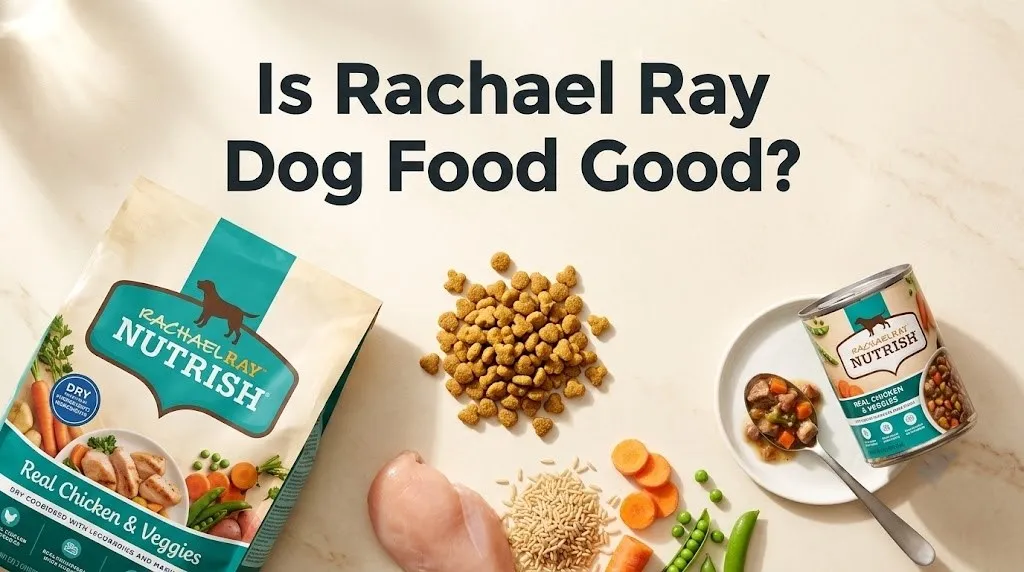
Rachael Ray Nutrish is a solid mid-tier dog food that delivers identifiable animal proteins as the first ingredient, avoids artificial preservatives and poultry by-product meal, and meets the nutritional standards set by the Association of American Feed Control Officials (AAFCO). It is a good dog food for the price. It is not a premium or therapeutic diet, and it does not compete with brands that employ full-time board-certified veterinary nutritionists and conduct extensive feeding trials. It sits comfortably in the middle, and for many healthy dogs, that is enough.
The brand launched in 2008 with a marketing promise that resonates with dog owners: real ingredients you can see and understand, no fillers, no mystery meat meals. That promise, combined with the name recognition of celebrity chef Rachael Ray, pushed Nutrish from a single dog food line into a full pet food brand spanning dry kibble, wet food, treats, and a super-premium tier called Nutrish Zero Grain. The brand was acquired by The J.M. Smucker Company in 2018, placing it under the same corporate umbrella as Meow Mix, 9Lives, and Natural Balance. That corporate ownership shift matters when assessing manufacturing consistency and ingredient sourcing in 2026.
This review walks through the ingredient panel across Nutrish lines, analyzes the nutritional profile, addresses the grain-free and DCM safety question, compares Nutrish to competitors, and identifies which dogs are good candidates for this food and which ones should eat something else. A veterinarian is the right person to guide your individual dog’s diet, especially if your dog has kidney disease, pancreatitis, food allergies, or any chronic health condition. Breed, age, and activity level all influence whether a specific food is genuinely good for a specific dog.
Who Makes Rachael Ray Nutrish and Where Is It Produced?
Rachael Ray Nutrish is manufactured by The J.M. Smucker Company, which acquired the brand from Ainsworth Pet Nutrition in 2018 for approximately $1.9 billion. Smucker’s produces Nutrish at company-owned and co-manufacturing facilities across the United States. The brand’s corporate parent is a publicly traded packaged food conglomerate with deep supply chain resources, which means Nutrish benefits from large-scale ingredient procurement and quality control infrastructure.
Smucker’s pet food portfolio includes Meow Mix, 9Lives, Kibbles ‘n Bits, Nature’s Recipe, and Natural Balance. Nutrish occupies the premium tier within that lineup. It is positioned above the grocery-store budget brands but below the super-premium Natural Balance line. This internal tiering is visible in the ingredient deck. Nutrish uses named animal proteins as the first ingredient and avoids corn, wheat, and soy in most formulas. Meow Mix leads with ground yellow corn. That is the difference that corporate portfolio strategy creates.
The acquisition by Smucker’s is a relevant detail for consumers who value independent or founder-led pet food companies. Ainsworth Pet Nutrition, the original manufacturer, was a family-owned business. Under Smucker’s, Nutrish operates as a brand within a publicly traded company that answers to shareholders. That does not automatically make the food better or worse. It does change the incentives around cost management, ingredient sourcing, and formula consistency. The pet food industry has seen multiple independent brands shift after acquisition, sometimes with ingredient downgrades and sometimes without. As of 2026, Nutrish has maintained its core formula positioning without major reformulation controversies.
Nutrish kibble is produced in the United States, and the brand states that its ingredients are sourced from trusted suppliers globally. The phrase “globally sourced” is standard in the pet food industry and does not specify which countries supply which ingredients. Lamb, for example, commonly comes from Australia or New Zealand. Chicken is typically North American. The lack of country-specific sourcing detail is an information gap that Nutrish shares with most mid-tier brands.
Rachael Ray Nutrish Ingredient Analysis: Real Chicken, Beef, or Lamb First?
Rachael Ray Nutrish formulas open with named animal proteins like chicken, beef, or lamb as the first ingredient, followed by chicken meal or beef meal in many formulas as a concentrated protein source. The ingredient deck avoids corn, wheat, and soy, which are common allergens and plant-protein fillers in budget dog foods. The overall ingredient philosophy is transparent and aligns with what most consumers expect from a premium-adjacent brand.
The Nutrish Real Chicken and Veggies recipe lists these first several ingredients: chicken, chicken meal, brown rice, brewers rice, dried peas, rice bran, pea starch, chicken fat preserved with mixed tocopherols. Chicken is a high-moisture ingredient, roughly 70 percent water before cooking. Once the moisture is removed during extrusion, the actual protein contribution from fresh chicken drops in the ingredient hierarchy. Chicken meal, which appears second, is a rendered and dried protein concentrate that provides the majority of the meat protein in the formula. This is standard formulation practice and not deceptive. The ingredient deck is honest.
The carbohydrate sources are rice, peas, and rice bran. Brown rice is a whole grain that provides fiber, magnesium, and B vitamins. Brewers rice is a processed rice fragment that is a by-product of the brewing industry. It is a low-cost carbohydrate source that is not nutritionally harmful but also not nutrient-dense. Pea starch appears in some formulas and functions as a binder and carbohydrate source. None of these are problematic for healthy dogs in the context of a complete diet.
Nutrish does not use poultry by-product meal, artificial flavors, artificial preservatives, or BHA/BHT. The fat is preserved with mixed tocopherols, a natural vitamin E-based preservative system. This is a genuine quality point. Artificial preservatives are permitted in pet food and have not been shown to cause harm at the levels used, but they are markers of lower-quality formulations. Nutrish avoids them across the entire product line.
- Protein sources in Nutrish dry food: chicken, beef, lamb, turkey, salmon, and ocean fish meal depending on the formula.
- Carbohydrate sources: brown rice, brewers rice, peas, pea starch, rice bran, sweet potatoes in some formulas.
- Fat sources: chicken fat, beef fat, sunflower oil, all preserved with mixed tocopherols.
- Added nutrients: taurine, glucosamine, chondroitin sulfate in some formulas, omega-3 and omega-6 fatty acids from flaxseed and fish meal.
Is Rachael Ray Nutrish Dog Food Healthy? Nutritional Profile
Rachael Ray Nutrish dry food delivers moderate protein, moderate fat, and a caloric density that is appropriate for the average adult dog with a normal activity level. The guaranteed analysis meets AAFCO nutrient profiles for adult maintenance, and the ingredient quality supports the numbers on the label. The food is nutritionally complete. The question is how the macronutrient spread compares to optimal ranges for different life stages and activity levels.
| Formula (dry kibble, adult) | Crude Protein (min) | Crude Fat (min) | Crude Fiber (max) | Calories (kcal/cup, approx) |
|---|---|---|---|---|
| Nutrish Real Chicken and Veggies | 26% | 14% | 4% | 340 |
| Nutrish Real Beef and Brown Rice | 25% | 13% | 4% | 335 |
| Nutrish Zero Grain Chicken and Sweet Potato | 28% | 15% | 4% | 355 |
| Nutrish Peak Northern Woodlands | 30% | 17% | 4% | 380 |
| Nutrish Little Bites Small Breed Chicken | 28% | 16% | 4% | 370 |
Data sourced from Rachael Ray Nutrish product labels as of 2026
The protein level of 25 to 28 percent is adequate for maintenance in a healthy adult dog. It is not high enough for a working dog, a pregnant or lactating female, or a growing large-breed puppy. Dogs with higher protein demands need formulas that deliver 30 percent or more crude protein from primarily animal sources. Nutrish Peak, the brand’s higher-protein sub-line, approaches this range with 30 percent protein from chicken, turkey, and duck. For the pet dog who takes two walks a day and naps on the couch for the remainder, 26 percent protein is sufficient.
The fat content at 13 to 15 percent is moderate and supports coat health without pushing caloric density into the range that promotes weight gain. The omega-6 to omega-3 fatty acid ratio is not published on the label, which makes it difficult to assess the anti-inflammatory potential of the food. Flaxseed appears in many formulas and provides alpha-linolenic acid (ALA), a plant-based omega-3. Fish meal and fish oil, which provide the more bioavailable eicosapentaenoic acid (EPA) and docosahexaenoic acid (DHA), appear in some Nutrish formulas but are not prominent across the entire line.
The fiber content at 4 percent maximum is standard for dry kibble and sufficient for normal digestive function. The fiber sources include brown rice, dried peas, and beet pulp in some formulas. Beet pulp is a soluble and insoluble fiber source that supports colonic health. It is a functional ingredient, not a filler, despite its reputation in some consumer-facing pet food marketing.
Key Takeaway: Nutrish delivers adequate nutrition for an average adult dog. The protein levels are moderate, the fat is appropriate, and the fiber supports digestion. It is healthy in the sense that it meets established nutritional standards with real-food ingredients. It is not optimized for high-performance, growth, or therapeutic needs.
Is Rachael Ray Nutrish Grain-Free Safe? The DCM Question
Rachael Ray Nutrish Zero Grain formulas replace grains with dried peas, pea starch, tapioca, and potato flour, which are the same legume and tuber carbohydrate sources that the FDA has investigated in connection with canine dilated cardiomyopathy (DCM). The DCM investigation has not established a causal link between grain-free diets and heart disease, but the association is strong enough that veterinary cardiologists and nutritionists recommend caution.
The FDA’s investigation into canine DCM, which began in 2018 and continues with ongoing monitoring through 2026, identified a statistical association between diets high in peas, lentils, chickpeas, and potatoes and cases of DCM in breeds not genetically predisposed to the disease. Nutrish Zero Grain formulas use peas as a primary carbohydrate source, and peas appear high on the ingredient list in the Zero Grain Chicken and Sweet Potato recipe. This does not mean the food causes DCM. It means the food belongs to the category of grain-free diets that the FDA and veterinary community are watching closely.
The American Veterinary Medical Association (AVMA) and Tufts University Cummings School of Veterinary Medicine recommend that dog owners avoid grain-free diets unless a veterinarian has diagnosed a specific grain allergy and recommended a grain-free therapeutic diet. The default position for healthy dogs should be a grain-inclusive diet from a brand that meets World Small Animal Veterinary Association (WSAVA) guidelines. Nutrish does not meet WSAVA guidelines because the brand does not employ a full-time board-certified veterinary nutritionist and does not publish peer-reviewed feeding trial research.
The safest choice within the Nutrish line is a grain-inclusive formula like Real Chicken and Veggies or Real Beef and Brown Rice. These formulas use brown rice and brewers rice as carbohydrate sources rather than peas and legumes. They have not been part of the DCM conversation. If your dog has a confirmed grain allergy, the Zero Grain formula is one option among many, and you should discuss taurine monitoring with your veterinarian. Annual blood work including a taurine level check is a reasonable precaution for any dog eating a legume-heavy diet long-term.
Rachael Ray Nutrish vs. Competitors: Blue Buffalo, Purina ONE, and Hill’s
Rachael Ray Nutrish competes most directly with Blue Buffalo Life Protection, Purina ONE, and Hill’s Science Diet. It beats Purina ONE on the absence of poultry by-product meal and artificial preservatives. It loses to Hill’s Science Diet on veterinary nutrition research and feeding trials. It is broadly comparable to Blue Buffalo at a slightly lower price point.
| Comparison Category | Nutrish | Blue Buffalo | Purina ONE | Hill’s Science Diet |
|---|---|---|---|---|
| First Ingredient | Chicken | Deboned chicken | Chicken | Chicken |
| By-Product Meal | No | No | Yes (poultry by-product meal) | Yes (in some formulas) |
| Corn/Wheat/Soy Free | Yes | Yes | No | No |
| Artificial Preservatives | No | No | No | No |
| Board-Certified Vet Nutritionist | No | No | Yes | Yes |
| WSAVA Compliant | No | No | Yes | Yes |
| Price (per lb, approx) | $1.80 to $2.50 | $2.50 to $3.50 | $1.50 to $2.20 | $2.00 to $3.00 |
| Grain-Free Options | Yes | Yes | Yes | Limited |
Purina ONE is the most direct budget competitor. Purina ONE costs less per pound than Nutrish and uses poultry by-product meal as a protein source. Nutrish avoids by-product meal, which is a consumer-facing advantage. Purina ONE employs board-certified veterinary nutritionists and conducts feeding trials, which is a scientific credibility advantage. The choice between them depends on whether you prioritize ingredient aesthetics (Nutrish wins) or clinical research backing (Purina ONE wins).
Blue Buffalo is the closest lifestyle brand comparison. Both market heavily on real meat first, no by-product meals, and natural ingredient stories. Nutrish holds an edge on price. Blue Buffalo has a broader product range including veterinary diet lines. Both are owned by large conglomerates, General Mills for Blue Buffalo and Smucker’s for Nutrish, which means the scrappy independent identity both brands project is a marketing story at this point.
Hill’s Science Diet is in a different category. It is a veterinary diet brand backed by decades of peer-reviewed research. It uses by-product meals and corn in some formulas. It also produces prescription diets that save the lives of dogs with kidney disease, urinary crystals, and food allergies. Nutrish is a grocery-to-premium bridge brand. Hill’s is a clinical nutrition company. Comparing them directly misses the point. They serve different consumers with different expectations.
Key Takeaway: Nutrish is better than Purina ONE on ingredient quality perception, comparable to Blue Buffalo at a better price, and not in the same research-driven league as Hill’s or Purina Pro Plan. It fits a specific niche: consumers who want identifiable whole-food ingredients without paying premium boutique prices.
Rachael Ray Nutrish Wet Dog Food: Is It Better Than the Dry?
Rachael Ray Nutrish wet dog food contains higher animal protein, higher moisture, and fewer carbohydrates than the dry kibble, making it a better nutritional choice for many dogs, especially those with urinary, kidney, or hydration concerns. The wet food line includes Nutrish Hearty Beef Stew, Chicken Paw Pie, Savory Lamb Stew, and several other recipes in tubs and cans.
The wet food’s ingredient list for Hearty Beef Stew opens with beef, beef broth, carrots, peas, and dried egg whites. This is a stew-like formulation with visible pieces of meat and vegetables. The carbohydrate content is significantly lower than dry kibble because wet food does not require the starch binders that hold kibble together during extrusion. A wet food with 8 to 10 percent protein may seem low compared to dry food at 25 percent, but the comparison is distorted by moisture. On a dry matter basis, which removes water weight to enable direct comparison, Nutrish wet food protein levels are comparable to or higher than the dry formulas.
The moisture content of wet food, approximately 78 to 82 percent, is the biggest health advantage. Dogs evolved to get water from their food, not just their water bowl. A diet of dry kibble at 10 percent moisture requires the dog to drink significantly more water to maintain hydration. Many dogs drink less than they should. Chronic low-grade dehydration stresses the kidneys over a lifetime and concentrates urine, which increases the risk of crystal formation and urinary tract issues. Adding wet food to the diet or feeding it exclusively addresses this problem at its source.
Nutrish wet food is more expensive per calorie than the dry kibble. Feeding a 50-pound dog exclusively on Nutrish wet food would cost approximately $4 to $6 per day, compared to roughly $0.75 to $1.25 per day for the dry kibble. The budget difference is real. A mixed feeding strategy, half dry and half wet, splits the difference on both cost and nutrition. It provides the hydration benefit of wet food and the cost and convenience benefit of dry kibble.
Rachael Ray Nutrish for Puppies, Seniors, and Small Breeds
Rachael Ray Nutrish offers specific formulas for puppies, senior dogs, and small breeds, but the line is not as segmented as brands that produce breed-specific or health-condition-specific diets. The puppy formula meets AAFCO growth requirements. The senior formula makes modest adjustments to protein and fat. The small breed formula adjusts kibble size and caloric density. The formulations are adequate for healthy dogs in these life stages.
Nutrish Puppy Real Chicken and Brown Rice delivers 28 percent protein and 16 percent fat with DHA from fish oil for brain and eye development. It meets AAFCO nutrient profiles for growth and reproduction. The ingredient quality is consistent with the adult formulas, chicken first, rice and peas as carbohydrates, no by-product meal. A puppy can grow well on this food. It is not formulated for large-breed puppies, which require controlled calcium and phosphorus to reduce the risk of developmental orthopedic disease. Large-breed puppy owners should choose a formula specifically designed for that purpose from a brand that publishes calcium and phosphorus data on the label or through customer service.
Nutrish Senior Real Chicken and Brown Rice drops protein slightly to 24 percent and fat to 12 percent, reducing caloric density to help prevent weight gain as metabolism slows. Glucosamine and chondroitin are added for joint support, though the levels in over-the-counter foods are typically below therapeutic doses used in veterinary medicine. Senior dogs with kidney disease need controlled phosphorus, and Nutrish does not publish phosphorus content on the guaranteed analysis. A veterinarian managing a senior dog with reduced kidney function may recommend a prescription renal diet instead.
Nutrish Little Bites Small Breed offers a smaller kibble size, 28 percent protein, and 16 percent fat to match the higher metabolic rate of small dogs. Small dogs burn more calories per pound than large dogs, and a more calorie-dense food supports that energy demand. The kibble size matters for small mouths and small teeth. A Chihuahua physically cannot chew a kibble piece designed for a Labrador. Little Bites solves that mechanical problem.
Rachael Ray Nutrish Recalls and Safety History
Rachael Ray Nutrish has experienced one major recall in its brand history. In March 2015, Ainsworth Pet Nutrition recalled select lots of Nutrish canned wet dog food due to potentially elevated levels of vitamin D. Excessive vitamin D intake can cause hypercalcemia in dogs, leading to kidney damage, gastrointestinal distress, and in severe cases, death. The recall was voluntary and limited to specific production dates.
No recalls have been issued since the Smucker’s acquisition in 2018. The six-year recall-free period through 2024 suggests that the quality control systems within Smucker’s manufacturing network have managed ingredient and finished product safety competently. Smucker’s is a large food manufacturer with established food safety protocols, and those protocols extend to pet food under the FDA’s Food Safety Modernization Act (FSMA) requirements.
The 2015 vitamin D recall is notable because vitamin D toxicity from pet food formulation errors has affected multiple brands over the years, including Hill’s Science Diet (2019, elevated vitamin D) and several private-label brands produced by co-packers. The root cause is typically a miscalculation in the vitamin premix added during manufacturing. The Nutrish recall occurred when the brand was still under Ainsworth ownership. No repeat of the issue has occurred since, which indicates the problem was identified and corrected.
Pet owners should monitor the FDA Recalls and Withdrawals database for current information on any pet food brand. Recall status is a snapshot of the past, not a guarantee of the future. A brand with no recall history can issue one tomorrow. A brand with a past recall that was properly handled and not repeated can be trusted more than a brand that issues the same recall repeatedly.
Where to Buy Nutrish and What It Costs in 2026
Rachael Ray Nutrish is one of the most widely distributed premium-adjacent dog food brands in the United States. It is available at Walmart, Target, Kroger, Publix, Amazon, Chewy, and most grocery and mass retail chains. This broad distribution is a Smucker’s corporate strength. Nutrish reaches consumers who would never walk into a specialty pet store but want a better food than the bottom-shelf options.
Pricing as of early 2026:
- Nutrish Real Chicken and Veggies (28 lb bag): $35 to $45, approximately $1.25 to $1.60 per pound.
- Nutrish Zero Grain Chicken and Sweet Potato (23 lb bag): $40 to $50, approximately $1.75 to $2.17 per pound.
- Nutrish Peak (23 lb bag): $45 to $55, approximately $1.95 to $2.39 per pound.
- Nutrish Wet Food (8 oz tub, 8-pack): $12 to $16, approximately $1.50 to $2.00 per tub.
Nutrish costs more than grocery store brands like Kibbles ‘n Bits and Pedigree and less than specialty brands like Taste of the Wild, Merrick, and Orijen. The price-to-ingredient-quality ratio is favorable. A food with real chicken first, no corn or wheat, and natural preservation at $1.50 per pound is a fair deal. The value proposition is one of Nutrish’s strongest selling points.
Automatic delivery subscriptions through Amazon or Chewy reduce the per-bag cost by 5 to 15 percent. Walmart’s everyday low pricing model often beats the subscription price for Nutrish, which is unusual in the pet food market where online subscriptions typically undercut brick-and-mortar retail. A quick price check between Walmart.com and Chewy before ordering can save five to ten dollars on a large bag.
Frequently Asked Questions About Rachael Ray Dog Food
Is Rachael Ray dog food good for dogs with allergies?
Rachael Ray Nutrish can work for dogs with grain allergies because the brand avoids corn, wheat, and soy across all formulas.
The Zero Grain line removes all grains for dogs with confirmed grain sensitivities diagnosed by a veterinarian.
Dogs with protein allergies, like chicken or beef sensitivities, need a formula with a novel protein source, and Nutrish offers limited-ingredient options but not a full hypoallergenic line.
Does Rachael Ray Nutrish cause DCM?
Rachael Ray Nutrish Zero Grain formulas contain peas and legumes, which are ingredients associated with the FDA’s ongoing investigation into canine dilated cardiomyopathy.
The grain-inclusive formulas like Real Chicken and Veggies have not been part of the DCM conversation.
Choosing a grain-inclusive Nutrish formula avoids the legume concern unless a veterinarian has specifically recommended grain-free for a diagnosed allergy.
Is Rachael Ray Nutrish better than Purina ONE?
Rachael Ray Nutrish uses identifiable whole-food ingredients and avoids poultry by-product meal, which Purina ONE includes.
Purina ONE employs board-certified veterinary nutritionists and conducts feeding trials, which Nutrish does not.
Nutrish wins on ingredient panel aesthetics for most consumers. Purina ONE wins on clinical research backing.
Can I feed Rachael Ray Nutrish to my puppy?
Yes, Nutrish offers a puppy formula with DHA that meets AAFCO nutrient profiles for growth and reproduction.
Large breed puppies need controlled calcium and phosphorus to prevent developmental orthopedic disease, and Nutrish does not offer a dedicated large breed puppy formula.
Consult your veterinarian about the best puppy food for your dog’s expected adult size and breed predispositions.
Is Rachael Ray Nutrish worth the money?
Rachael Ray Nutrish is worth the money for dog owners who want real meat first, no by-product meal, and natural preservation at a mid-tier price.
The ingredient quality is strong for the price point, typically $1.25 to $2.50 per pound depending on the formula.
The brand does not offer the clinical research backing or veterinary nutrition expertise of more expensive therapeutic brands, which is the trade-off for the lower price.
Rachael Ray Nutrish is a good dog food in the sense that it delivers on its promises: real animal protein, no artificial junk, and complete nutrition at a price that a middle-class household can afford. It is not the best dog food on the market and it does not pretend to be. It is the food you buy when you want to feed your dog better than the cheapest bag on the shelf without spending boutique-brand money.
The grain-inclusive formulas are the safest choice for most dogs in light of the DCM investigation. The wet food is a strong product that adds hydration and protein quality to a dog’s diet. The brand’s broad retail availability means you can buy it almost anywhere, and the price per pound holds up well against competitors with similar ingredient panels.
If your dog thrives on Nutrish, with a shiny coat, firm stools, good energy, and clean blood work at the annual vet visit, the food is working. That is the standard that matters. Bring the bag to your next veterinary appointment and let your vet weigh in with knowledge of your dog’s specific health profile. The right food for your dog is the one that keeps your dog visibly healthy and your vet happy with the numbers. Nutrish earns that outcome for a lot of dogs.