Healthy breakfast foods for weight loss are those that combine at least 20 grams of protein with 8 or more grams of fiber in a portion that stays under 400 calories and contains zero or very little added sugar. A breakfast built on this protein-fiber axis directly regulates the hormones that control hunger, keeping ghrelin suppressed and peptide YY elevated for four to five hours after you eat. The foods that achieve this are not exotic superfoods. They are eggs, Greek yogurt, cottage cheese, oatmeal, chia seeds, and berries, assembled in combinations that work for your actual morning schedule.
The evidence that breakfast composition matters for weight management has strengthened considerably since 2020. A 2023 randomized controlled trial published in the American Journal of Clinical Nutrition found that participants who consumed a 350-calorie breakfast with 30 grams of protein and 10 grams of fiber ate roughly 340 fewer calories at an ad libitum lunch than those who ate a lower-protein, lower-fiber breakfast matched for calories. The difference was not willpower. It was hormonal signaling and gastric emptying speed, both of which protein and fiber directly influence.
This article walks through the specific foods that deliver the satiety and nutrition you need, explains the mechanisms that make them work, and gives you recipes mapped to three real-life scenarios: the five-minute weekday sprint, the Sunday meal prep session, and the slower weekend morning when you have time to cook. You will find exact protein and fiber targets, a list of breakfast foods that work against weight loss despite their health halo, and the common mistakes that turn a solid breakfast into a calorie surplus.
What makes a breakfast good for weight loss
A breakfast that supports weight loss does three things: it provides enough protein to trigger satiety hormones, enough fiber to slow gastric emptying, and enough volume relative to calories to satisfy the sensory need for a full plate. These three mechanisms operate independently, and a breakfast that hits all three will control appetite through the late morning more effectively than one that hits only one or two.
The protein leverage hypothesis explains why protein matters specifically. Research from the University of Sydney’s Charles Perkins Centre suggests that humans regulate total food intake to reach a target protein intake, roughly 15 to 20 percent of calories. A breakfast low in protein leaves the body seeking more food across the rest of the day to hit that protein target. A breakfast that delivers 25 to 30 grams of protein satisfies a large portion of the daily protein requirement early, reducing the biological drive to overconsume calories later. This effect has been measured in controlled feeding studies where higher-protein breakfasts led to spontaneous calorie reduction at subsequent meals without increased hunger.
Soluble fiber contributes through a different mechanism. When soluble fiber from oats, chia seeds, or fruit mixes with water in the stomach, it forms a viscous gel that delays the rate at which the stomach empties its contents into the small intestine. This slower gastric emptying keeps you physically fuller for longer and moderates the post-meal blood glucose rise, which prevents the sharp insulin spike and subsequent blood sugar drop that can trigger mid-morning cravings. The Academy of Nutrition and Dietetics recommends 25 to 30 grams of total fiber per day, with at least 8 to 10 grams at breakfast for appetite control.
Energy density is the third lever. Foods with high water content, such as berries, Greek yogurt, and cooked oatmeal, provide more physical volume per calorie than dried or concentrated foods. A 150-calorie bowl of cooked oatmeal with berries looks and feels like a real meal. A 150-calorie granola bar is gone in three bites and does not register the same way in the brain’s satiety circuits.
Protein at breakfast for weight loss
Protein at breakfast supports weight loss by increasing the release of peptide YY and GLP-1, two gut hormones that signal fullness to the brain, while simultaneously suppressing ghrelin, the primary hunger hormone. This triple hormonal effect makes a high-protein breakfast the most effective dietary lever for controlling morning appetite without white-knuckling through cravings.
The target range that consistently shows appetite-suppressing effects in clinical studies is 25 to 35 grams of protein at the morning meal. A standard two-egg breakfast delivers about 12 grams of protein, which is insufficient to produce the full satiety response. Adding three-quarters of a cup of Greek yogurt or a half-cup of cottage cheese pushes the total into the effective range. Protein powder added to smoothies or oatmeal is a practical shortcut for people who do not want to eat large volumes of solid food in the morning.
The thermic effect of food adds a smaller but real contribution to the protein-at-breakfast case. Protein requires roughly 20 to 30 percent of its own calories to digest and metabolize, compared to 5 to 10 percent for carbohydrates and 0 to 3 percent for fat. A 30-gram protein breakfast at 120 calories from protein costs the body roughly 25 to 35 calories just to process. This effect is modest per meal but compounds over weeks and months.
Dairy proteins offer an additional advantage. Casein, the dominant protein in cottage cheese and Greek yogurt, coagulates in the acidic stomach environment and digests slowly, providing a steady release of amino acids over several hours. Whey, the faster-digesting dairy protein, spikes amino acid levels quickly and is useful post-workout but less relevant for morning satiety. Cottage cheese, which is about 80 percent casein, is one of the most effective single breakfast proteins for prolonged fullness.
| Protein Source | Serving | Protein (g) | Calories | Satiety Type |
|---|---|---|---|---|
| Eggs (2 large) | 100g | 12g | 140 | Moderate, mixed |
| Greek yogurt (plain, 2%) | 3/4 cup (170g) | 17g | 120 | High, casein-dominant |
| Cottage cheese (2%) | 1/2 cup (113g) | 14g | 100 | Highest, mostly casein |
| Tofu (firm, scrambled) | 1/2 block (100g) | 10g | 90 | Moderate, plant-based |
| Whey protein powder | 1 scoop (30g) | 25g | 120 | Fast-digesting |
| Smoked salmon | 3 oz (85g) | 16g | 100 | Moderate, with omega-3s |
Fiber at breakfast for weight loss
Fiber at breakfast supports weight loss by forming a viscous gel in the digestive tract that slows the absorption of nutrients, extends the feeling of physical fullness, and feeds gut bacteria that produce short-chain fatty acids linked to improved metabolic health. The target for a weight-loss-supporting breakfast is 8 to 10 grams of fiber, roughly one-third of the daily recommendation.
Soluble fiber is the specific type that creates viscosity. Beta-glucan, the soluble fiber in oats and barley, has been studied more than any other fiber for its effects on satiety and cholesterol reduction. When beta-glucan contacts water, it swells and forms a gel matrix that traps carbohydrates and slows their digestion. This blunts the post-meal blood glucose response and keeps insulin levels lower, which matters because high insulin levels after a meal signal the body to store fat rather than release it.
Insoluble fiber, found in whole grain bread, vegetable skins, and seeds, adds bulk but does not form the gel that soluble fiber does. A weight-loss-supporting breakfast includes both types. The insoluble fiber provides the physical stretch in the stomach that triggers early fullness signals. The soluble fiber extends that fullness over time. Berries deliver both types in a low-calorie package. A cup of raspberries provides 8 grams of total fiber for just 64 calories, the highest fiber-to-calorie ratio of any common breakfast fruit.
Chia seeds deserve special mention because they are almost entirely soluble fiber. A single tablespoon of chia seeds provides 5 grams of fiber and absorbs up to 10 times its weight in water, forming a gel that can be used to make puddings and thicken smoothies. The expansion rate means chia seeds must be soaked before eating for people with esophageal stricture or swallowing difficulties. For everyone else, a chia pudding or a chia-thickened smoothie is one of the most fiber-dense breakfast options available.
Key Takeaway: The 25 to 30 grams of protein and 8 to 10 grams of fiber target is not arbitrary; it is the threshold at which breakfast measurably changes the hormones and gastric mechanics that drive mid-morning hunger and lunchtime overconsumption.
Eggs for breakfast weight loss
Eggs are one of the most researched breakfast foods for weight loss, and the evidence consistently shows that an egg-based breakfast reduces calorie intake at subsequent meals more than a calorie-matched bagel or cereal breakfast. The effect is driven by the protein content, the meal’s low energy density relative to its satiety impact, and the specific amino acid profile of egg protein.
Two large eggs deliver 12 grams of complete protein, all nine essential amino acids, and roughly 140 calories. The protein quality score for eggs is the highest of any whole food, with a biological value of 100 and a protein digestibility-corrected amino acid score of 1.0. That means the body absorbs and uses egg protein more efficiently than soy, wheat, or pea protein. The choline in egg yolks, about 147 milligrams per egg, supports liver function and lipid metabolism, though its direct role in weight loss is indirect.
The cooking method changes the calorie equation. A poached or soft-boiled egg adds zero additional fat. A scrambled egg cooked in a teaspoon of butter or oil adds roughly 40 calories. A fried egg in a generous pour of oil can double the calorie count. For weight loss purposes, poaching, boiling, or cooking in a nonstick pan with a measured teaspoon of oil keeps the protein-to-calorie ratio high.
Eggs are not for everyone. Egg allergy is one of the most common food allergies, particularly in children, though many outgrow it. The cholesterol in egg yolks was once a concern for heart health, but the current consensus from the American Heart Association is that dietary cholesterol has a smaller effect on blood cholesterol than previously believed, and one to two whole eggs per day is consistent with a heart-healthy dietary pattern for most people. People with familial hypercholesterolemia or those specifically advised by their physician to limit dietary cholesterol may need to use egg whites or egg substitutes.
Greek yogurt for weight loss
Greek yogurt supports weight loss through its high casein protein content, its low calorie density relative to its satiety impact, and its effect on the gut microbiome through live bacterial cultures. A three-quarter-cup serving of plain, low-fat Greek yogurt delivers roughly 17 grams of protein for 120 calories, making it one of the most protein-efficient breakfast foods available.
The straining process that turns regular yogurt into Greek yogurt removes much of the liquid whey and lactose, concentrating the casein protein and giving the final product its thick, spoonable texture. That texture matters for satiety. Research on food viscosity shows that thicker, creamier foods are perceived as more filling than thinner versions with identical calorie and macronutrient content. A container of Greek yogurt eaten with a spoon registers as more satisfying than the same protein in a glass of milk, even though the nutritional content is similar.
The probiotic content of yogurt is a secondary benefit that may influence weight regulation through gut microbiome composition. The specific strains in yogurt, primarily Lactobacillus bulgaricus and Streptococcus thermophilus, are not the same as the probiotic strains studied for weight effects, but they contribute to a diverse gut ecosystem. Some research suggests that people with more diverse gut microbiomes maintain a healthier body weight more easily, though the evidence is observational and does not prove causation.
Flavored and fruit-on-the-bottom yogurts are a different product entirely and should be treated as a dessert, not a weight-loss breakfast. A single-serve container of fruit-flavored Greek yogurt can contain 15 to 20 grams of added sugar, equivalent to four to five teaspoons. That sugar spike triggers an insulin response that undermines the satiety benefits of the protein. Plain Greek yogurt with a half-cup of fresh berries added at home provides the sweetness without the added sugar and adds fiber.
Oatmeal for weight loss
Oatmeal supports weight loss when it is made from whole rolled or steel-cut oats, prepared without added sugar, and paired with a protein source to hit the satiety threshold that oatmeal alone cannot reach. Oatmeal’s primary weight-loss asset is beta-glucan, a soluble fiber that forms a viscous gel during cooking and digestion.
The viscosity created by beta-glucan slows the rate at which the stomach empties after a meal, which prolongs physical fullness and moderates the blood glucose response. A 2016 meta-analysis published in the American Journal of Clinical Nutrition found that beta-glucan consumption significantly reduced post-meal blood glucose and insulin levels in a dose-dependent manner, with the effect threshold starting at about 3 grams of beta-glucan, the amount in roughly 60 grams of dry rolled oats.
Oatmeal’s weakness as a weight-loss breakfast is its low protein content. A standard half-cup serving of dry rolled oats cooked with water provides 5 grams of protein and roughly 150 calories. That protein level is too low to trigger the full satiety hormone response. The solution is adding protein through the preparation method. Cooking oats in milk instead of water adds 8 grams of protein per cup of milk. Stirring in a half-cup of Greek yogurt after cooking adds another 8 to 10 grams. A scoop of protein powder stirred in while the oatmeal is still hot adds 20 to 25 grams. These additions turn oatmeal from a carb-heavy bowl that leaves you hungry by 10 a.m. into a protein-fiber combination that holds appetite steady.
Steel-cut oats, rolled oats, and instant oats all come from the same whole grain but differ in processing and glycemic response. Steel-cut oats are the least processed, take 20 to 30 minutes to cook, and produce the lowest post-meal blood glucose rise. Rolled oats are steamed and flattened, cook in 5 to 10 minutes, and have a moderate glycemic response. Instant oats are pre-cooked and dried, often with added sugar and flavorings, and produce a faster blood glucose spike that is less supportive of weight loss.
| Oat Type | Cook Time | Protein (1/2 cup dry) | Fiber | Best For |
|---|---|---|---|---|
| Steel-Cut | 20-30 min | 5g | 4g | Weekend breakfast |
| Rolled (Old-Fashioned) | 5-10 min | 5g | 4g | Everyday, meal prep |
| Instant (Plain) | 1-2 min | 4g | 3g | Office, travel |
| Overnight (Rolled, soaked) | 0 min (prepped) | 5g | 4g | Grab-and-go mornings |
Key Takeaway: Oatmeal is a fiber delivery system, not a complete breakfast; it works for weight loss only when combined with enough protein to reach the 25-gram threshold that suppresses hunger hormones through the late morning.
Chia seeds for weight loss
Chia seeds support weight loss by absorbing liquid and expanding in the stomach, creating a feeling of physical fullness with a minimal calorie load. A single tablespoon of dry chia seeds provides roughly 60 calories, 5 grams of fiber, and 3 grams of protein, and when soaked, it expands to roughly nine times its original volume.
The fiber in chia seeds is almost entirely soluble, which means it forms a gel when hydrated. That gel physically distends the stomach, triggering the stretch receptors that send early fullness signals to the brain. It also delays the rate at which the stomach empties, extending the feeling of satiety. The combination of expansion and slowed gastric emptying is why chia pudding, made by soaking two tablespoons of chia seeds in a half-cup of milk overnight, feels like a substantial breakfast despite containing only about 180 to 200 calories including the milk.
The omega-3 fatty acid content of chia seeds is often mentioned as a health benefit, and it is real in the form of alpha-linolenic acid (ALA) . Two tablespoons provide about 5 grams of ALA. The conversion of ALA to the longer-chain omega-3s EPA and DHA is inefficient in the human body, usually less than 5 to 10 percent, so chia seeds should not be relied on as a primary omega-3 source. Their weight-loss value is their fiber and expansion capacity.
Chia seeds require a hydration safety note. Dry chia seeds absorb water rapidly and can form a sticky mass that poses a choking hazard if swallowed dry, particularly for people with swallowing difficulties, esophageal narrowing, or dysphagia. Chia seeds should always be soaked in liquid for at least 10 to 15 minutes before consuming. This is not a minor caution; cases of esophageal obstruction from dry chia seeds have been documented in medical literature.
Berries for weight loss
Berries support weight loss by providing sweetness and dessert-level flavor satisfaction in a package with exceptionally low energy density and high fiber content. A full cup of fresh raspberries delivers 64 calories and 8 grams of fiber, the best fiber-to-calorie ratio of any fruit commonly available at breakfast. The same volume of blueberries provides 84 calories and 4 grams of fiber per cup.
The weight-loss advantage of berries is their ability to make other healthy breakfast foods taste more indulgent without adding meaningful calories or sugar. A cup of plain Greek yogurt with a half-cup of raspberries stirred in tastes sweet and satisfying while keeping the total breakfast under 250 calories with 22 grams of protein and 10 grams of fiber. The same flavor experience from a pre-sweetened flavored yogurt would add 15 to 20 grams of added sugar and eliminate the fiber.
The deep color of berries comes from anthocyanins, flavonoid compounds that research has associated with reduced inflammation and improved metabolic health markers. A 2020 study in the Journal of Nutrition found that higher anthocyanin intake was associated with less weight gain over a four-year period in a large cohort of health professionals. The effect size was modest and the study was observational, but the finding aligns with the broader pattern that whole fruits, and berries specifically, are associated with better weight management than processed snack foods.
Fresh, frozen, and freeze-dried berries all retain their fiber content and most of their anthocyanins. Frozen berries are often less expensive than fresh and can be added directly to oatmeal or blended into smoothies without thawing. Dried berries, including raisins and dried cranberries, are a different category entirely. They are concentrated in sugar by volume and easy to overeat. A quarter-cup of dried blueberries can exceed 130 calories with far less satiety impact than a full cup of fresh.
Key Takeaway: Berries are the lowest-calorie way to add flavor, sweetness, and visual appeal to a weight-loss breakfast, and their fiber content helps offset the blood sugar impact of any carbohydrate in the meal.
Healthy breakfast on the go for weight loss
A healthy on-the-go breakfast for weight loss is one that hits the protein and fiber targets, stays under 400 calories, and can be eaten with one hand in a car, on a train, or at a desk in under five minutes. The pre-made options in the grab-and-go section of a grocery store almost universally fail this standard, which makes five-minute assembly at home the most realistic path.
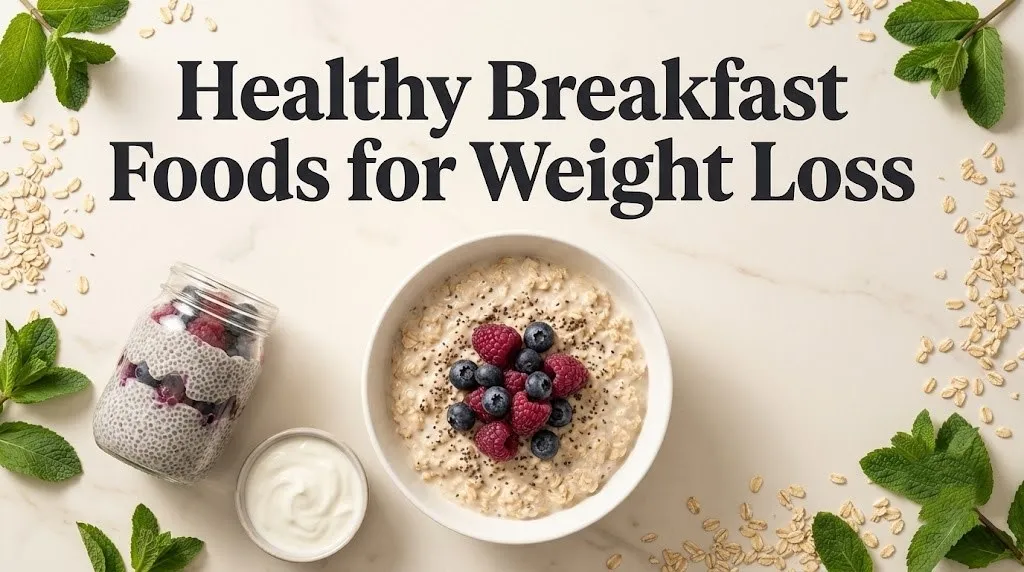
The breakfasts that work for grab-and-go situations are those prepped the night before or assembled from components stored separately. Overnight oats in a sealed jar with protein powder and frozen berries are the most portable complete option. A batch made Sunday night covers five weekday mornings and requires zero morning effort beyond grabbing a jar and a spoon. Egg muffin cups, baked in a muffin tin with vegetables and a small amount of cheese, reheat in 45 seconds and provide roughly 10 grams of protein each. Two egg cups plus a piece of whole fruit constitute a balanced portable breakfast.
A high-protein smoothie is the fastest option, taking about 90 seconds from refrigerator to drinking. A combination of plain Greek yogurt, frozen berries, a tablespoon of chia seeds or flaxseed, and a splash of milk or water blends into a drinkable breakfast that can contain 25 grams of protein and 10 grams of fiber for under 350 calories. Single-serve blenders with a travel lid allow the smoothie to be blended directly in the drinking container, eliminating the transfer step and the cleaning of a full blender pitcher.
The pre-packaged options marketed as “protein bars” or “breakfast biscuits” require careful label reading. Most contain less than 10 grams of protein and more than 15 grams of added sugar, a macronutrient ratio that drives hunger rather than suppressing it. A bar that genuinely supports weight loss will list at least 15 grams of protein, under 5 grams of added sugar, and over 5 grams of fiber. Those bars exist but represent a small fraction of the breakfast bar aisle.
Overnight oats for weight loss
Overnight oats are a cold-prepared oatmeal method where rolled oats soak in liquid in the refrigerator for at least six hours, softening the oats without cooking and creating a creamy, pudding-like texture that requires zero morning preparation time. For weight loss, overnight oats work when they contain added protein and are portioned to stay under 400 calories.
The basic ratio is one part rolled oats to one part liquid, typically half a cup of oats plus half a cup of milk or a milk alternative. This base alone delivers roughly 200 calories and 10 grams of protein if made with cow’s milk. To reach the satiety threshold, a scoop of protein powder or a half-cup of Greek yogurt must be stirred into the base before refrigeration. A tablespoon of chia seeds adds fiber and thickens the mixture further. A half-cup of frozen berries added at the start thaws overnight and releases juice into the oats.
Steel-cut oats do not soften enough in an overnight soak and should be cooked. Instant oats become mushy and are better suited to same-day preparation. Rolled old-fashioned oats are the correct choice for overnight oats. The jars can be made in pint-sized Mason jars or any sealed container, and a batch of five jars prepared on Sunday will keep safely in the refrigerator through Friday morning.
Overnight oats make it possible to eat a fiber-rich, protein-sufficient breakfast when you have literally no morning time. The jar goes from refrigerator to bag to desk. It is eaten cold, directly from the jar, with no microwave required. The flavor combinations are flexible. A base of oats, milk, Greek yogurt, protein powder, and chia seeds can be topped with berries, cinnamon, unsweetened cocoa powder, or a tablespoon of nut butter depending on the flavor profile you prefer that week.
To prepare five jars of overnight oats for a workweek:
- Place 1/2 cup rolled oats into each of five pint-sized jars
- Add 1 tablespoon chia seeds, 1 scoop vanilla protein powder, and 1/2 teaspoon cinnamon to each jar
- Pour 1/2 cup milk and 1/4 cup plain Greek yogurt into each jar and stir thoroughly
- Top each jar with 1/2 cup frozen mixed berries, seal the lid, and refrigerate for at least 6 hours
- Grab a jar on the way out the door; eat cold, directly from the jar
Healthy breakfast ideas weight loss
A list of healthy breakfast ideas for weight loss is only useful if it accounts for the three distinct types of mornings people actually experience. The five-minute weekday morning, the Sunday meal-prep session that sets up the week, and the slower weekend morning when cooking is enjoyable and possible all require different solutions.
Five-minute weekday breakfasts must be assembly-based, not cooking-based. They rely on components that are already prepped or require only portioning from larger containers. Greek yogurt with berries and a tablespoon of hemp seeds, a pre-made smoothie from the refrigerator, overnight oats, cottage cheese with sliced peaches and flaxseed, or two reheated egg muffin cups with an apple all fall into this category. These breakfasts take under five minutes from refrigerator to table and deliver the protein and fiber targets.
Meal-prep breakfasts are made in a single batch on the weekend and portioned into individual servings for the week. A vegetable frittata baked in a 9-by-13-inch pan and cut into six squares provides a week of grab-and-heat protein. Chia pudding portioned into five jars, overnight oats as described above, or a large batch of steel-cut oatmeal cooked once and reheated in portions each morning all fit this model. Meal prep is the most reliable way to eat a genuinely healthy breakfast when weekdays are chaotic.
Weekend breakfasts permit actual cooking. A two-egg scramble with spinach, mushrooms, and a sprinkle of feta cheese served with a slice of whole grain toast delivers the targets and feels like a real meal. Smoked salmon on whole grain toast with mashed avocado and capers is a savory option that requires no cooking beyond the toaster. These breakfasts are not elaborate, but they require 10 to 15 minutes and a stove, which is realistic on Saturday and unrealistic on Tuesday.
| Morning Type | Breakfast Option | Prep Time | Protein | Fiber |
|---|---|---|---|---|
| 5-Minute Weekday | Greek yogurt + berries + hemp seeds | 2 min | 22g | 8g |
| 5-Minute Weekday | Pre-made smoothie from fridge | 0 min | 25g | 10g |
| Grab-and-Go | Overnight oats jar | 0 min (prepped) | 28g | 10g |
| Meal Prep | Egg muffin cups (2) + apple | 1 min reheat | 20g | 6g |
| Weekend | Veggie scramble + whole grain toast | 12 min | 24g | 7g |
| Weekend | Smoked salmon avocado toast | 8 min | 18g | 9g |
Smoothies for weight loss
A smoothie supports weight loss when it is built as a drinkable meal replacement with a defined protein and fiber target, not as a fruit and juice blend that drinks like a meal but digests like a sugary beverage. The difference between a weight-loss smoothie and a weight-gain smoothie is entirely in the ingredient proportions.
A weight-loss smoothie follows a formula: one liquid base, one protein source, one fiber source, one or two frozen fruits, and zero added sugar. The liquid base should be unsweetened almond milk, skim milk, or water, not fruit juice. The protein source should be plain Greek yogurt, cottage cheese, or protein powder, not flavored yogurt. The fiber source should be chia seeds, flaxseed, or a tablespoon of nut butter. The fruit should be frozen berries or half a frozen banana, not mango, pineapple, or multiple bananas, which push the sugar content higher.
The calorie target for a weight-loss smoothie is 300 to 400 calories with a minimum of 25 grams of protein and 8 grams of fiber. A smoothie that falls below these thresholds, particularly on protein, will leave you hungry within two hours. A smoothie that exceeds 400 calories, particularly from added nut butters, honey, granola, or multiple servings of fruit, becomes a calorie source that works against a deficit.
Blending fruit does not destroy its fiber, a common misconception. The fiber remains in the smoothie, but the physical structure of the fruit cell walls is broken down, which means the sugars are absorbed slightly faster than they would be from whole fruit. Adding a protein and fat source to the blender slows that absorption. A smoothie of berries, spinach, Greek yogurt, and chia seeds produces a lower blood glucose response than a smoothie of banana, mango, and orange juice, even at the same calorie count. The ingredients, not the blending process itself, determine the metabolic effect.
Key Takeaway: A smoothie is not automatically healthy or automatically a weight-loss food; it is a tool that works when you build it to the protein and fiber targets and treat it as a meal, not a beverage alongside a meal.
Savory breakfast for weight loss
A savory breakfast supports weight loss by avoiding the sweet flavor profile that can trigger appetite for more sweet foods across the rest of the day and by centering the meal on vegetables, protein, and healthy fats rather than grains and sugar. The savory breakfast is the strongest counter to the American breakfast norm of cereal, pastries, pancakes, and flavored yogurts, all of which prime the palate for continued sugar consumption.
The satiety advantage of a savory breakfast is partly psychological and partly physiological. Sweet breakfasts, even those with adequate protein and fiber, can leave some people feeling like they have not eaten a “real meal” because sweet equals dessert in their food experience. A plate of scrambled eggs with sauteed spinach, roasted tomatoes, and a slice of whole grain toast registers as lunch-quality satiety at a breakfast hour. The protein and fat content of a vegetable-heavy egg scramble triggers the same hormonal satiety response as a sweet Greek yogurt bowl but adds the sensory satisfaction of a hot, savory meal.
Egg-based dishes are the most practical savory breakfast option because eggs cook quickly and accept any vegetable combination. A scramble with pre-washed spinach, sliced mushrooms, and cherry tomatoes takes 8 to 10 minutes. Tofu scramble seasoned with turmeric, black pepper, and nutritional yeast is the plant-based equivalent, providing roughly 15 grams of protein per serving with no cholesterol and a similar vegetable-carrying capacity.
Savory oatmeal is an underused option that changes oatmeal from a sweet carb base into a grain bowl. Steel-cut oats cooked in vegetable broth or water with a pinch of salt and topped with a poached egg, sauteed greens, and a drizzle of olive oil deliver the same fiber benefits as sweet oatmeal with a completely different satiety experience. A savory oatmeal bowl with a poached egg and spinach provides roughly 350 calories, 18 grams of protein, and 8 grams of fiber.
Breakfast foods to avoid for weight loss
Several foods marketed as healthy breakfast options work directly against weight loss because they are high in added sugar, low in protein, low in fiber, or all three. These foods create a mid-morning energy crash and hunger spike that drives snacking before lunch.
Granola is the most deceptive breakfast food in the weight-loss context. A half-cup serving of standard granola contains roughly 200 to 250 calories, 15 to 20 grams of added sugar, and only 4 to 6 grams of protein. The same calorie allocation on Greek yogurt and berries delivers four times the protein and fiber with zero added sugar. Granola is a dessert topping, not a breakfast base, and its health halo from the whole grain oats does not compensate for the sugar and calorie density.
Flavored yogurt in single-serve cups is a sugar delivery system dressed as a health food. A standard strawberry-flavored Greek yogurt cup contains 15 to 18 grams of added sugar, enough to trigger an insulin response that promotes fat storage and subsequent hunger. The protein is still present, but the sugar undermines the satiety benefit. Plain yogurt with fresh fruit added at home is the same flavor experience with none of the added sugar.
Breakfast cereals, even those labeled “whole grain” or “high fiber,” are ultra-processed foods that have been extruded, flaked, and sprayed with sugar and oil. The protein content is typically under 3 grams per serving. The fiber content is often from added inulin or chicory root fiber rather than intact whole grain fiber, and the satiety effect is not the same. A bowl of cereal with milk is a low-protein, low-fiber start to the day that sets up a hunger response before 11 a.m.
Store-bought smoothie bowls are a calorie bomb disguised by an acai-and-granola health aesthetic. A typical smoothie bowl from a chain shop contains 400 to 600 calories, 40 to 60 grams of sugar, and often under 10 grams of protein. The granola, honey, and dried fruit toppings add calorie density without satiety. A homemade smoothie bowl built on Greek yogurt, frozen berries, and chia seeds is a different product entirely.
- Flavored yogurt cups with more than 5 grams of added sugar per serving
- Granola and granola-based bars with less than 5 grams of protein per serving
- Standard cold cereals, including those labeled “whole grain,” with under 3 grams of protein per serving
- Pastries, muffins, croissants, and danishes of any kind
- Juice and juice-based smoothies that separate fruit fiber from fruit sugar
- Pancakes and waffles made from refined flour with syrup and butter added
Breakfast meal prep for weight loss
Breakfast meal prep for weight loss means preparing one or two large batches of protein-and-fiber-rich breakfasts on Sunday that cover Monday through Friday with zero morning cooking and minimal assembly. The meal prep model eliminates the daily decision fatigue that leads to grabbing a bagel or skipping breakfast entirely.
The two most reliable meal-prep breakfasts are egg-based bakes and oat or chia-based puddings, and prepping one of each covers variety for the week. A vegetable frittata or a tray of egg muffin cups provides the savory option. A batch of overnight oats or chia pudding jars provides the sweet option. Alternating between the two across the week keeps breakfast from becoming a chore.
Egg muffin cups are the most versatile savory prep. Whisk 10 eggs with a quarter-cup of milk, salt, pepper, and your choice of diced vegetables. Sauteed spinach, bell pepper, onion, and mushroom work well. Pour the mixture into a greased 12-cup muffin tin, top with a small sprinkle of cheese, and bake at 350 degrees Fahrenheit for 20 to 22 minutes. Each cup contains roughly 100 calories and 8 grams of protein. Two cups plus a piece of fruit make a complete portable breakfast.
Chia pudding requires even less effort. Combine two tablespoons of chia seeds, half a cup of milk, a quarter-cup of plain Greek yogurt, and a dash of vanilla extract in a jar. Stir thoroughly after 10 minutes to break up clumps, seal, and refrigerate. The pudding sets in four hours and keeps for five days. One jar with a half-cup of berries stirred in at eating time delivers roughly 250 calories, 15 grams of protein, and 12 grams of fiber.
Key Takeaway: Meal prep is not about becoming a different person who loves spending Sundays in the kitchen; it is about spending 45 minutes once a week so that the other six mornings require no thought and no willpower.
Avocado toast for weight loss
Avocado toast supports weight loss when it is built on whole grain bread, uses a measured portion of avocado, and includes a protein source that brings the meal into the satiety target range. Avocado alone on toast is a fat and carbohydrate plate with insufficient protein to suppress hunger for more than a couple of hours.
A quarter of a medium avocado, roughly 50 grams, provides about 80 calories and 7 grams of mostly monounsaturated fat. This portion covers a slice of whole grain toast generously. The fat in avocado slows gastric emptying and adds the creamy mouthfeel that makes avocado toast satisfying. The monounsaturated fat profile is the same type that olive oil provides, associated with improved cardiovascular health markers when it replaces saturated fat.
Whole grain toast is the right base. A slice of 100 percent whole grain bread with at least 3 grams of fiber provides the complex carbohydrate component. White bread, sourdough, or refined bagels turn avocado toast into a high-glycemic meal that spikes blood sugar and leaves you hungry sooner. The fiber in whole grain bread contributes to the satiety effect.
Protein addition makes or breaks avocado toast for weight loss. A slice of whole grain toast with a quarter avocado is about 200 calories with 6 grams of protein, too low to trigger full satiety. Adding a poached egg on top brings the total to 280 calories and 18 grams of protein. Adding smoked salmon, two ounces for about 60 calories and 10 grams of protein, produces a different flavor profile with similar satiety. A half-cup of cottage cheese spread under the avocado adds 14 grams of protein for 100 calories.
Healthy breakfast mistakes
The most common healthy breakfast mistake is eating foods that are nutritionally good in isolation but combined in a way that misses the protein and fiber targets, leaving you vulnerable to mid-morning hunger that drives snacking on whatever is available. A breakfast of oatmeal with berries is healthy food. A breakfast of oatmeal with berries that lacks added protein is a healthy-sounding breakfast that does not support weight loss because it fails the satiety test.
Undereating protein at breakfast is the most frequent error. Two eggs, a piece of fruit, or a smoothie made with only fruit and almond milk all fall below the 20-gram threshold that research associates with appetite control. The fix is adding a protein-dense food to whatever base you choose. Eggs get Greek yogurt on the side. Oatmeal gets protein powder or cottage cheese stirred in. Smoothies get a scoop of protein powder or a generous pour of Greek yogurt.
Drinking calories is the second major mistake. Juice, sweetened coffee drinks, and smoothies made with fruit juice and multiple bananas can add 200 to 400 liquid calories that do not register as filling. A 16-ounce orange juice contains 220 calories and 42 grams of sugar with zero fiber. A latte with whole milk and flavored syrup adds 250 calories and 30 grams of sugar. These beverages are meal-level calories with snack-level satiety.
Skipping breakfast entirely with the intention of saving calories backfires for many people because it increases ghrelin levels and reduces impulse control around food at the first eating opportunity of the day. Intermittent fasting works for some individuals, and if a delayed eating window genuinely feels sustainable and does not trigger evening overeating, it is a valid approach. For people who find themselves ravenous and overeating at lunch or snacking uncontrollably by mid-morning, a protein-and-fiber-sufficient breakfast is a more effective strategy than white-knuckling through hunger.
Frequently Asked Questions About Healthy Breakfast for Weight Loss
What should I eat for breakfast to lose belly fat?
You cannot target belly fat loss with a specific food, but a breakfast with 25 to 30 grams of protein and 8 to 10 grams of fiber controls the insulin and cortisol patterns that drive visceral fat storage.
A combination of eggs with vegetables and whole grain toast or Greek yogurt with berries and chia seeds meets these targets.
Consistency matters more than any single ingredient, because belly fat loss results from a sustained calorie deficit, not a particular breakfast food.
Is it better to eat breakfast or skip it for weight loss?
The evidence does not support a universal answer; breakfast eaters and breakfast skippers both succeed at weight loss in studies.
If skipping breakfast leads to uncontrollable hunger and overeating later in the day, eating a protein-and-fiber-sufficient breakfast supports a calorie deficit more effectively.
If you genuinely do not feel hungry in the morning and can maintain a moderate lunch without compensating, delaying your first meal is a valid personal preference.
How many calories should a weight loss breakfast have?
A weight-loss-supporting breakfast should contain 300 to 400 calories with at least 25 grams of protein and 8 grams of fiber.
This calorie level provides enough energy to support morning activity without consuming so many calories that it becomes difficult to fit lunch and dinner within a daily deficit.
The exact number varies by total daily calorie target, with 300 to 400 calories representing roughly 20 to 25 percent of a 1,500 to 1,800 calorie eating plan.
Can I eat oatmeal every morning and lose weight?
You can eat oatmeal every morning and lose weight if you add a protein source to reach the 25-gram threshold and keep the total portion under 400 calories.
Plain oatmeal with water and no additions is a low-protein, moderate-carb meal that will leave you hungry well before lunch.
Oatmeal with milk, Greek yogurt, or protein powder stirred in and berries for fiber is a completely different satiety experience that supports a calorie deficit.
Are eggs or oatmeal better for weight loss?
Eggs provide more direct satiety per calorie because their protein content is higher and their carbohydrate content is effectively zero.
Oatmeal provides fiber that eggs lack and creates a different type of fullness through beta-glucan gel formation.
The most effective breakfast combines both, such as a bowl of oatmeal with a poached egg on the side or savory oatmeal with a scrambled egg stirred in.
Your breakfast determines your hunger for the next five hours. That is not a metaphor or a wellness slogan. It is a predictable hormonal sequence that you can either work with or fight against. The 25 grams of protein and 8 grams of fiber target is the difference between white-knuckling your way to lunch and genuinely not thinking about food until your next meal.
Pick two breakfasts from the lists in this article, one savory and one sweet. Prep the components this Sunday. Eat them this week. Adjust the portions if you are hungry too soon or too full to finish. Breakfast is not magic, but a well-built breakfast is the closest thing to an appetite off-switch that real food can provide.