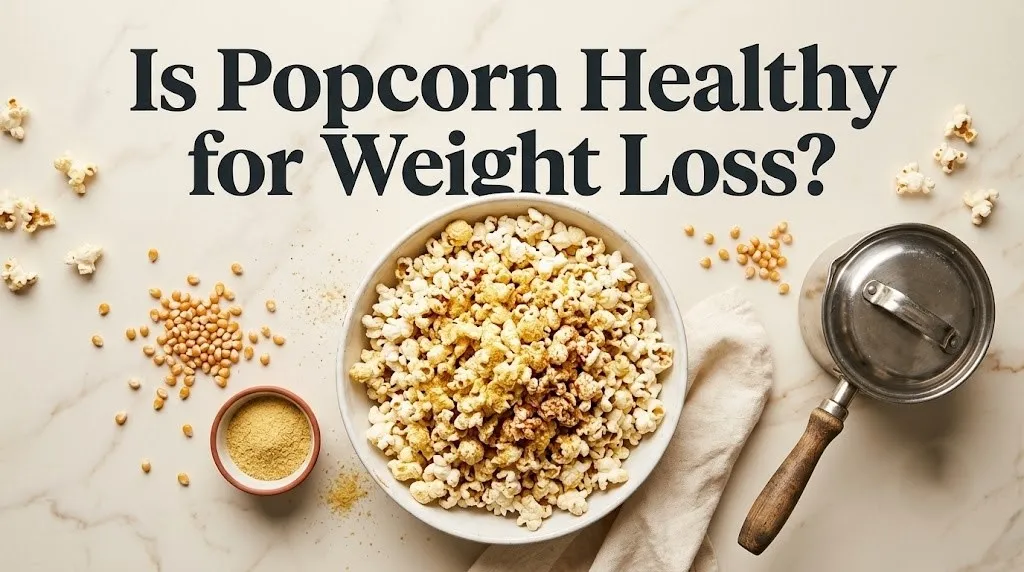
Popcorn is a genuinely useful food for weight loss when you prepare it without excessive butter or oil and keep portions to three to four cups, which delivers roughly 100 to 150 calories and enough fiber and volume to register as a real snack rather than a tease. The reason popcorn works for weight loss is not that it contains some magical fat-burning compound. It works because it is a whole grain with exceptionally low energy density, meaning you get to eat a physically large portion that fills your stomach for relatively few calories. A three-cup serving of air-popped popcorn takes up about the same bowl space as a single ounce of potato chips, but the chips deliver triple the calories and a fraction of the satiety.
According to a 2023 study in the American Journal of Clinical Nutrition, snacks with low energy density reduce total daily calorie intake more effectively than calorie-matched snacks with high energy density because the physical volume triggers gastric stretch receptors that signal fullness to the brain. Popcorn sits near the very bottom of the energy density scale at roughly 0.3 to 0.4 calories per gram for air-popped kernels. Potato chips land closer to 5.4 calories per gram. The difference is not subtle, and it explains why a bowl of popcorn feels like a meal while a handful of chips barely registers.
This article walks through the exact nutrition numbers for air-popped, stovetop, and microwave popcorn so you know what you are actually eating. You will find a breakdown of why the energy density mechanism matters more than the calorie count alone, which toppings add flavor without adding a meal’s worth of fat, and which microwave brands and chemicals to watch out for. We also cover the dental risks, the diverticulitis myth, and how to make genuinely good popcorn at home in under five minutes.
Is popcorn a healthy snack for weight loss
Popcorn is a healthy snack for weight loss because it is a 100 percent whole grain with more fiber per serving than most crackers, pretzels, or cereal bars, and its low energy density allows you to eat a satisfying volume without exceeding your calorie target. The whole grain designation is not marketing language. Popcorn is the only snack food that is both a true whole grain and regularly consumed in its intact kernel form rather than ground into flour and reconstituted.
The USDA Dietary Guidelines for Americans recommend that at least half of all grain intake come from whole grains, and popcorn qualifies directly. A three-cup serving provides roughly 15 percent of the daily recommended fiber intake for an adult, with about 3.5 grams of dietary fiber. That fiber is predominantly insoluble, the type that adds bulk to the digestive tract and promotes regularity. Insoluble fiber does not dissolve into a gel the way oat beta-glucan does, so it does not have the same cholesterol-lowering or blood-sugar-blunting effect, but it excels at providing physical fullness for zero additional calories.
The Academy of Nutrition and Dietetics identifies popcorn as a smart snack choice specifically because it replaces more energy-dense, nutrient-poor snack foods. When a person swaps an afternoon bag of chips for an afternoon bowl of air-popped popcorn, the calorie savings over a week can reach several hundred calories without increasing hunger. This is the substitution effect, and it is the most practical way that popcorn supports weight loss. Popcorn is not a negative-calorie food. Nothing is. It is a lower-calorie replacement for higher-calorie snacks that occupy the same psychological and sensory niche: crunchy, salty, hand-to-mouth eating.
Popcorn is naturally vegan and gluten-free, which makes it compatible with a wide range of dietary patterns. It is a grain-based carbohydrate, so it does not fit a strict ketogenic diet at 19 grams of carbohydrate per three-cup serving. People with corn allergies, which are uncommon but documented, must avoid popcorn entirely. For everyone else, the preparation method determines whether popcorn remains a weight-loss snack or becomes a calorie source that works against a deficit.
Popcorn nutrition facts
The nutrition facts for popcorn shift dramatically depending on the preparation method, and the numbers cited in most articles for “air-popped popcorn” do not reflect what most people actually eat. Air-popped popcorn is the nutritional baseline. Stovetop popcorn with measured oil is a reasonable real-world version. Movie theater and heavily buttered microwave popcorn are in a different category entirely.
One ounce of unpopped kernels, roughly 3 tablespoons, yields approximately 4 to 5 cups of popped popcorn. A standard three-cup serving of air-popped popcorn contains 93 calories, 3 grams of protein, 1 gram of fat, 19 grams of carbohydrate, and 3.5 grams of dietary fiber. The remaining carbohydrate is mostly starch. There is essentially no sugar and no sodium in plain air-popped popcorn. The micronutrient profile includes magnesium, phosphorus, manganese, and small amounts of zinc and B vitamins. Popcorn hulls, the brown outer layer that gets stuck in your teeth, contain polyphenols including ferulic acid, a compound with antioxidant properties that some research has measured at concentrations higher than many fruits by dry weight.
Stovetop popcorn popped in a measured tablespoon of oil adds roughly 120 calories from the oil across the batch. If the batch yields 5 cups, a three-cup serving absorbs about two-fifths of that oil, adding roughly 50 calories and 5 grams of fat, mostly unsaturated if you use olive or avocado oil. The total for a three-cup serving of stovetop popcorn is approximately 150 calories and 6 grams of fat, still a reasonable snack.
Microwave popcorn varies by brand. A standard bag of butter-flavored microwave popcorn contains 400 to 500 calories for the entire bag, with 25 to 35 grams of fat, including 5 to 8 grams of saturated fat, and 500 to 700 milligrams of sodium. A three-cup serving from that bag delivers roughly 150 to 200 calories and a significant amount of added fat and salt relative to the air-popped version. The ingredient list on a typical butter-flavored microwave bag includes partially hydrogenated oils in some brands, though many major manufacturers phased these out after the FDA’s 2015 determination that partially hydrogenated oils are not generally recognized as safe.
| Popcorn Type | Calories (3 cups) | Fat | Saturated Fat | Fiber | Sodium |
|---|---|---|---|---|---|
| Air-popped, unsalted | 93 | 1g | 0g | 3.5g | 0mg |
| Stovetop (1 tbsp oil/batch) | 150 | 6g | 0.5g | 3.5g | 0-150mg |
| Microwave, light butter | 170 | 10g | 2g | 3g | 250mg |
| Microwave, movie theater butter | 200 | 14g | 5g | 3g | 400mg |
| Movie theater, medium | 400-600 | 30-45g | 10-15g | 3g | 800-1200mg |
Key Takeaway: Air-popped popcorn is 93 calories for a satisfying three-cup bowl; the same three cups from a movie theater or heavily buttered microwave bag can exceed 200 calories with 10 times the saturated fat and sodium, which is the entire difference between a weight-loss snack and a diet obstacle.
Popcorn fiber content
Popcorn fiber content sits at about 3.5 grams per three-cup serving, which is more fiber than a slice of whole wheat bread, a cup of brown rice, or a standard granola bar. The fiber is nearly all insoluble, concentrated in the tough outer hull of the kernel, and it contributes to popcorn’s weight-loss utility primarily through physical bulk rather than metabolic effects.
Insoluble fiber does not dissolve in water. It passes through the digestive system largely intact, adding mass to the stool and accelerating transit time through the colon. For weight loss, the relevant property is that insoluble fiber occupies stomach volume without contributing calories beyond the small amount fermented by gut bacteria. The physical presence of fiber in the stomach, combined with the airy volume of popped kernels, triggers the stretch receptors that send fullness signals to the brain via the vagus nerve. This is the same mechanism that makes leafy greens and raw vegetables satiating relative to their calorie content.
The total fiber content in a three-cup serving is roughly 12 to 14 percent of the daily recommended intake for women and about 10 percent for men. Eaten as an afternoon snack, popcorn contributes meaningfully to the daily fiber target without crowding out other fiber sources at meals. The fiber is well-tolerated by most people. For individuals not accustomed to a high-fiber diet, a sudden large popcorn intake can cause temporary bloating and gas as the gut microbiome adjusts to the increased fermentable substrate.
Popcorn’s fiber content distinguishes it from other crunchy snack foods that are essentially fiber-free. Potato chips, tortilla chips, pretzels, and cheese crackers all contain less than one gram of fiber per serving because they are made from refined flours or starches with the bran removed. The whole grain status of popcorn means the bran and germ remain intact inside the popped kernel, delivering the fiber, minerals, and polyphenols that processing strips from refined grain snacks.
Popcorn calories
Popcorn calories are among the lowest per gram of any snack food when the popcorn is air-popped or prepared with minimal added fat. One gram of air-popped popcorn contains approximately 0.35 calories. One gram of potato chips contains roughly 5.4 calories. A snack-sized bag of chips at 150 calories weighs about 28 grams. The same 150 calories of air-popped popcorn weighs about 430 grams and fills roughly 15 cups of volume. The visual and sensory difference between a small bag of chips and a large mixing bowl of popcorn explains the weight-loss advantage better than any nutrient breakdown.
The calorie math shifts with added fat. A tablespoon of butter or oil adds 100 to 120 calories. Drizzled across a batch of popcorn, those calories spread across every kernel. A light coating adds flavor and mouthfeel and keeps the total snack under 200 calories. A heavy pour at the movie theater, where a medium popcorn contains an estimated 3 to 4 tablespoons of coconut oil or butter-flavored topping, pushes the calorie count above 500 for a bag that many people eat without thinking.
Portion size drives the calorie equation more than preparation method for most home popcorn eaters. A standard microwave bag contains 2.5 to 3 servings according to the nutrition label, but the bag is designed and marketed to be eaten as a single serving. Eating the whole bag means multiplying the per-serving numbers by 2.5 or 3. A bag that advertises 170 calories per serving delivers 425 to 510 calories as typically consumed. Measuring a serving and putting the rest away, or buying single-serving bags, removes the portion error.
Quick Tip:
- Measure three tablespoons of unpopped kernels before cooking to yield roughly 5 cups, a generous single serving
- If using a microwave bag, pour the popped popcorn into a bowl and measure a three-cup portion rather than eating from the bag
- Track the oil you add by measuring it in a teaspoon or tablespoon, not pouring freely from the bottle
Popcorn satiety
Popcorn’s satiety effect is the mechanism that makes it useful for weight loss, and it is driven by the combination of low energy density, high physical volume, and the mechanical act of chewing that signals the brain that food intake is occurring. A 2022 study published in the journal Nutrients examined the satiety response to iso-caloric snacks and found that popcorn produced greater subjective fullness ratings and lower subsequent food intake than potato chips matched for calories.
The physical volume of popcorn matters for satiety in a way that calorie-matched liquid or semi-solid snacks do not match. The stomach contains stretch receptors that detect distension and signal fullness to the hypothalamus. A food that takes up more space per calorie triggers those stretch receptors at a lower calorie load. Three cups of popcorn, roughly the volume of a standard mixing bowl, fills the stomach more completely than a small bag of chips or a granola bar at the same calorie count. This is the same principle that makes broth-based soups and leafy salads satiating relative to their calorie content.
Chewing time contributes to satiety through a separate pathway. Popcorn requires more chews per calorie than chips or crackers. The mechanical act of chewing, combined with the sensory experience of crunch and salt, satisfies the oral component of appetite that a smoothie or yogurt does not address. This is difficult to quantify but familiar to anyone who has craved something crunchy. Popcorn fills that sensory need without the calorie load of fried snacks.
The protein content of popcorn is low, about 3 grams per serving, and does not contribute meaningfully to the hormonal satiety signals triggered by protein-rich foods. Popcorn relies almost entirely on volume and mechanical satiety. Pairing popcorn with a protein source, a small handful of almonds or a hard-boiled egg, extends the satiety window beyond what the popcorn volume alone provides.
Key Takeaway: Popcorn fills your stomach and satisfies the need to crunch for roughly one-third the calories of chips, and that substitution is the single most effective dietary move a salty-snack lover can make for weight loss.
Air popped popcorn for weight loss
Air-popped popcorn is the ideal preparation method for weight loss because it adds zero cooking fat, keeps the calorie count at roughly 93 per three-cup serving, and preserves the whole grain’s fiber and polyphenol content without introducing the saturated fat or sodium that undermine the snack’s health profile. An electric air popper is an inexpensive countertop appliance, typically costing between $15 and $30, that uses hot air circulation to pop kernels without oil.
The process is straightforward. The air popper heats kernels to approximately 400 degrees Fahrenheit, the temperature at which the moisture inside the kernel turns to steam, the pressure ruptures the pericarp, and the endosperm expands into the familiar popped shape. The popped kernels are ejected into a bowl. There is no oil in the popping chamber, no burnt oil residue to clean, and no stovetop monitoring required. The entire batch takes about three minutes from cold start to full bowl.
The disadvantage of air-popped popcorn is that salt and dry seasonings do not adhere well to the smooth, oil-free kernel surface. The popcorn tastes dry and the seasonings fall to the bottom of the bowl. A light mist of water from a spray bottle, or a quick spritz of olive oil from a pump sprayer, provides enough surface moisture for seasonings to stick without adding more than 10 to 20 calories. Alternatively, tossing the hot popcorn with a small amount of finely grated Parmesan cheese, nutritional yeast, or powdered vinegar provides flavor adhesion through the cheese or yeast particles rather than oil.
Air-popped popcorn is the best choice for people who prefer a large volume of food for minimal calories and are willing to accept a slightly drier texture in exchange for the calorie savings. It is also the only popcorn preparation method that adds zero sodium, which matters for people with hypertension or sodium-sensitive fluid retention who are monitoring salt intake.
Stovetop popcorn healthy
Stovetop popcorn can be a healthy weight-loss snack when you measure the oil rather than pouring freely and choose an oil with a favorable fatty acid profile. The stovetop method produces better texture and flavor than air-popping because the oil conducts heat more evenly and coats each kernel with a thin layer of fat that carries seasoning. The calorie difference between air-popped and stovetop popcorn with a measured tablespoon of oil is about 50 calories per three-cup serving, a reasonable trade-off for the improvement in taste and texture.
The method requires a heavy-bottomed pot with a tight-fitting lid, preferably a Dutch oven or a dedicated stovetop popcorn popper. Heat 1 tablespoon of oil with a high smoke point, such as avocado oil or light olive oil, over medium-high heat. Add three kernels to the pot and cover. When those three kernels pop, the oil has reached popping temperature. Add 3 tablespoons of unpopped kernels, cover, and shake the pot gently to coat the kernels. The popping will begin within 30 seconds. Shake the pot intermittently to prevent burning and to allow unpopped kernels to fall to the hot surface. When the popping slows to one pop every two to three seconds, remove the pot from heat and pour the popcorn into a bowl.
Coconut oil is the traditional movie theater popping fat and produces excellent flavor. It is approximately 90 percent saturated fat, which makes it stable at high heat but contributes more saturated fat per serving than avocado or olive oil. A tablespoon of coconut oil adds roughly 11 grams of saturated fat to the batch, or about 4 grams per three-cup serving. For someone without cardiovascular risk factors who eats stovetop popcorn occasionally, the saturated fat difference is modest. For someone with elevated LDL cholesterol or a family history of heart disease, avocado oil or olive oil are better choices.
Microwave popcorn healthy
Microwave popcorn occupies a complicated position in the healthy snack conversation. The popcorn itself is the same whole grain as air-popped or stovetop popcorn. The nutritional problems with microwave popcorn come entirely from the added fats, salt, and the chemicals used in the bag lining and artificial butter flavoring, not from the popped kernel. Plain, lightly salted microwave popcorn with a short, recognizable ingredient list is a reasonable convenience option.
The ingredient panel on a bag of standard butter-flavored microwave popcorn tells the story. A typical brand lists popcorn, palm oil, salt, natural and artificial butter flavor, and color added. The palm oil provides the fat that helps the kernels pop and delivers the buttery mouthfeel. The saturated fat content runs 2 to 5 grams per serving, with 2.5 to 3 servings per bag. The sodium runs 250 to 400 milligrams per serving. The artificial butter flavor was historically formulated with diacetyl, a compound that gives butter its characteristic taste and is linked to bronchiolitis obliterans, a serious lung disease, in workers exposed to high concentrations in microwave popcorn factories. Major manufacturers phased diacetyl out of consumer products in the late 2000s following public concern and litigation, but the replacement flavorings have not been studied as extensively.
The bag itself introduces a separate concern. Microwave popcorn bags are lined with a grease-resistant coating that has historically contained perfluoroalkyl and polyfluoroalkyl substances (PFAS) , a class of chemicals that persist in the environment and accumulate in human tissue. The FDA has worked with manufacturers to phase out long-chain PFAS from food packaging, and many brands now use alternative coatings. As of 2026, several major microwave popcorn brands advertise PFAS-free packaging, but the labeling is voluntary and not standardized. Consumers concerned about PFAS exposure can avoid microwave popcorn entirely or check brand websites for explicit PFAS-free claims.
| Microwave Brand | Fat Type | Saturated Fat (per serving) | PFAS-Free Claim | Diacetyl-Free |
|---|---|---|---|---|
| Orville Redenbacher (Natural) | Palm oil | 2g | Check label | Yes |
| SkinnyPop Microwave | Sunflower oil | 0.5g | Yes | Yes |
| Angie’s Boomchickapop | Sunflower oil | 0.5g | Yes | Yes |
| Act II (Butter Lovers) | Palm oil | 3g | Check label | Yes |
Key Takeaway: Microwave popcorn can be a reasonable weight-loss snack if you choose brands with simple ingredients and unsaturated oils, but the bag chemicals add a variable that air-popping or stovetop popping eliminates completely.
Healthy popcorn toppings
Healthy popcorn toppings for weight loss add flavor without adding more than 20 to 30 calories per serving. The challenge is getting dry seasonings to stick to popcorn without oil as an adhesive. Several strategies solve this problem without loading the snack with fat.
Nutritional yeast is the most popular health-oriented popcorn topping for good reason. It is a deactivated yeast sold as yellow flakes with a savory, cheesy flavor that clings to popcorn reasonably well even without oil. A tablespoon provides about 20 calories and a significant amount of B vitamins, including B12 if the brand fortifies it. Nutritional yeast does not taste exactly like cheese, but it satisfies the same umami craving that Parmesan does.
Spice and herb blends work when applied to popcorn that is still hot and slightly steamy, or when the popcorn is misted lightly with water or a pump-sprayed oil. A combination of smoked paprika, garlic powder, and a pinch of cayenne pepper creates a smoky, spicy blend. Cinnamon and a tiny pinch of salt create a sweet-savory version that works well when the craving is for kettle corn rather than chips. Dried herbs like rosemary and thyme, ground to a powder in a mortar or spice grinder, add an aromatic, savory note.
Finely grated hard cheese like Parmesan or pecorino adds genuine flavor for about 20 calories per tablespoon. The cheese’s fat content helps it cling to the popcorn. Everything bagel seasoning, a blend of sesame seeds, poppy seeds, dried garlic, dried onion, and salt, provides texture and flavor for minimal calories, though the sodium content is high and should be accounted for by people monitoring salt intake.
To season popcorn without excess oil:
- Pop the popcorn using an air popper or measured stovetop oil method
- Transfer the hot popcorn immediately to a large mixing bowl
- Lightly mist the popcorn with water from a spray bottle or olive oil from a pump sprayer
- Sprinkle seasoning blend over the popcorn and toss thoroughly with your hands or two large spoons
- Taste and adjust seasoning; serve immediately before the moisture softens the kernels
Popcorn seasoning for weight loss
Popcorn seasoning for weight loss means avoiding pre-made popcorn seasoning shakers that list sugar or maltodextrin as the first ingredient and instead building flavor from individual spices, herbs, and umami-rich powders that add negligible calories. Many commercial popcorn seasoning blends are designed to mimic movie theater butter flavor and contain added sugar, corn syrup solids, and partially hydrogenated oils even after the FDA ban on artificial trans fats.
A standard butter-flavored popcorn seasoning shaker contains roughly 5 to 10 calories per quarter-teaspoon serving, which is not the problem. The problem is the ingredient quality. Maltodextrin, a rapidly digested carbohydrate with a glycemic index higher than table sugar, is the bulking agent in many commercial seasoning blends. The butter flavor is typically derived from natural and artificial flavor compounds, which are safe in the amounts consumed but do not contribute to the nutritional value of the snack.
Homemade seasoning blends give you control over both the flavor and the sodium level. A basic savory blend combines 2 parts nutritional yeast, 1 part garlic powder, 1 part onion powder, and a pinch of salt. A spicy blend combines smoked paprika, cumin, cayenne, and a tiny pinch of brown sugar or coconut sugar for the sweet-spicy kettle corn effect. A ranch-style blend uses dried dill, dried chives, garlic powder, onion powder, and a small amount of buttermilk powder, which is shelf-stable and adds the tangy ranch flavor for minimal calories.
People with hypertension or sodium-sensitive conditions should measure salt carefully and consider using potassium chloride-based salt substitutes or simply relying on the other spices for flavor without added sodium. Popcorn is naturally sodium-free, and even a half-teaspoon of salt across a full batch adds about 1,200 milligrams of sodium, roughly half the American Heart Association’s ideal daily limit.
Popcorn vs chips weight loss
Popcorn outperforms potato chips for weight loss by a wide margin on every metric that matters for appetite control and calorie management. A three-cup serving of air-popped popcorn provides 93 calories, 3.5 grams of fiber, and roughly 15 cups of volume per 100 calories. A one-ounce serving of potato chips, roughly 15 chips, provides 150 to 160 calories, less than 1 gram of fiber, and about 1 cup of volume per 150 calories. The satiety difference between a large bowl of popcorn and a small handful of chips is visceral, not theoretical.
The fat content drives the calorie disparity. Potato chips are fried in oil, which means the final product is roughly 35 to 40 percent fat by weight. Popcorn is roughly 4 percent fat by weight when air-popped and 15 percent fat when stovetop-popped with a measured tablespoon of oil per batch. The fat in chips is the vehicle for the flavor and the crunch, and it is also the reason chips are so easy to overeat. Fat provides 9 calories per gram compared to 4 calories per gram for the carbohydrate in popcorn, which means a gram of chips delivers more than double the energy of a gram of popcorn.
The fiber difference compounds the calorie density advantage. The fiber in popcorn slows gastric emptying and adds physical bulk. The near-absence of fiber in chips means the stomach empties faster and the brain receives weaker fullness signals. A person who eats 150 calories of chips is likely to feel hungry again sooner than a person who eats 150 calories of popcorn, even though the calorie count is identical.
Tortilla chips and pretzels fall in between potato chips and popcorn on the health spectrum. Tortilla chips are whole grain if made from whole corn masa, but they are fried and calorie-dense. Pretzels are baked, not fried, and have lower fat content than chips, but they are made from refined white flour and contain almost no fiber. Popcorn beats all three on the combination of calorie density, fiber content, and satiety volume.
| Snack (150-calorie serving) | Approximate Volume | Fiber | Fat |
|---|---|---|---|
| Air-popped popcorn | 5 cups | 5.5g | 1.5g |
| Pretzels | 1.5 oz (small handful) | 1g | 1g |
| Tortilla chips | 1 oz (12-15 chips) | 1.5g | 7g |
| Potato chips | 1 oz (15 chips) | 1g | 10g |
Key Takeaway: The weight-loss case for popcorn over chips is not about willpower; it is about physics and physiology: a 150-calorie bowl of popcorn fills a mixing bowl and takes 10 minutes to eat while a 150-calorie bag of chips fits in your palm and disappears in 90 seconds.
Healthy popcorn brands
Healthy popcorn brands are those that use minimal ingredients, avoid partially hydrogenated oils, keep saturated fat low, and offer transparency about packaging chemicals. The pre-popped bagged popcorn category has expanded significantly, and several brands now produce products that align with weight-loss goals better than traditional microwave bags.
SkinnyPop is the most widely available better-for-you popcorn brand. The original flavor contains three ingredients: popcorn, sunflower oil, and salt. A three-cup serving provides 150 calories, 10 grams of fat, and 3 grams of fiber. The saturated fat is low because sunflower oil is predominantly unsaturated. The brand is transparent about using PFAS-free packaging and does not use artificial flavors or preservatives.
Angie’s Boomchickapop offers a sea salt variety with similar simplicity: popcorn, sunflower oil, and sea salt. The calorie count is 140 per three-cup serving with 8 grams of fat. The brand’s kettle corn variety adds sugar and is significantly higher in calories and sugar, moving it from weight-loss-friendly to treat territory.
Lesser Evil produces popcorn with coconut oil, which gives it a richer flavor and higher saturated fat content than SkinnyPop or Angie’s. The brand also offers an “Omnipop” line made without oil for calorie counts similar to air-popped popcorn, though the texture is drier.
Orville Redenbacher’s SmartPop! is the mass-market microwave option positioned as healthier. It uses palm oil and contains 2 grams of saturated fat per serving with 170 calories per three-cup serving. The ingredient list is longer than the bagged alternatives and includes natural and artificial flavors.
The single-ingredient, healthiest option remains bulk popcorn kernels purchased from the dry goods section of a grocery store, popped at home with an air popper or measured stovetop oil. The cost is roughly $0.10 to $0.20 per serving compared to $0.50 to $1.00 for pre-popped bagged popcorn, and you control every ingredient that touches the kernels.
Microwave popcorn chemicals
Microwave popcorn chemicals have been the subject of health concerns and regulatory attention for two decades, and understanding which concerns are current and which are resolved helps you make an informed choice about whether the convenience of microwave popcorn is worth the potential exposure.
Diacetyl was the first microwave popcorn chemical to generate widespread concern. Diacetyl is a naturally occurring compound that gives butter its distinctive flavor and was used as an artificial butter flavoring in microwave popcorn. Workers in microwave popcorn manufacturing facilities exposed to high concentrations of diacetyl vapor developed bronchiolitis obliterans, a severe and irreversible lung disease nicknamed “popcorn lung.” The condition was documented in factory workers, not in consumers eating microwave popcorn at home. A single case report described a consumer who ate multiple bags of microwave popcorn daily and inhaled the steam from freshly opened bags, but no causal link was established at consumer exposure levels. Major manufacturers voluntarily removed diacetyl from their products in the late 2000s.
PFAS (perfluoroalkyl and polyfluoroalkyl substances) are the more current concern. PFAS are a class of chemicals used to create grease-resistant coatings on food packaging, including microwave popcorn bags. They are sometimes called “forever chemicals” because they persist in the environment and accumulate in human tissue. The FDA has worked with manufacturers to phase out long-chain PFAS from food contact applications, and as of 2024, manufacturers were in a three-year voluntary phase-out agreement. Several major brands now explicitly advertise PFAS-free packaging. This is a rapidly evolving area of food safety regulation, and consumers can check brand websites for current PFAS status.
Partially hydrogenated oils were the source of artificial trans fat in microwave popcorn. The FDA determined in 2015 that partially hydrogenated oils are not generally recognized as safe, and they have been largely removed from the food supply. Checking the ingredient list for “partially hydrogenated” oils is still a good habit because some products manufactured outside the U.S. or distributed through non-standard channels may still contain them.
Popcorn serving size weight loss
A popcorn serving size that supports weight loss is three to four cups of air-popped or lightly oiled popcorn, which delivers roughly 100 to 200 calories and provides enough volume to trigger satiety without consuming a disproportionate share of the day’s calorie budget. This serving size is realistic for a snack and easy to measure with a standard measuring cup or a designated popcorn bowl.
The three-cup serving is not arbitrary. It is the standardized reference amount that the FDA uses for nutrition labeling of popcorn, which means the numbers on the nutrition facts panel correspond directly to that volume. When the label says 93 calories per serving, it means per three cups of air-popped popcorn. When a microwave bag says 170 calories per serving and contains 2.5 servings, the total bag is 425 calories, not 170.
Measuring serving size is the single most effective behavioral strategy for keeping popcorn a weight-loss food. A large mixing bowl that holds exactly four cups serves as a built-in portion control device. If the popcorn fills the bowl, the portion is correct regardless of how many kernels went into the pot. Eating directly from the cooking vessel, whether a large stovetop pot or a microwave bag, eliminates the visual portion cue and makes overeating likely.
Popcorn is a snack food, not a meal replacement. A three-cup serving provides about 3 grams of protein, which is insufficient to sustain satiety for more than a couple of hours. Pairing popcorn with a protein source, a small handful of almonds, a stick of string cheese, or a hard-boiled egg, creates a more complete snack that covers the volume and crunch craving while adding the protein needed for longer-lasting satiety.
Popcorn glycemic index
Popcorn has a moderate glycemic index of approximately 55 to 65, placing it in the medium glycemic index category, with a glycemic load of roughly 7 per three-cup serving, which is considered low. The glycemic index measures how quickly a food raises blood glucose relative to pure glucose. The glycemic load accounts for the actual carbohydrate quantity in a serving. Popcorn’s glycemic load is low because, while the carbohydrate is moderately glycemic, the total carbohydrate in a serving is modest at 19 grams.
The fiber in popcorn, roughly 3.5 grams per serving, modestly slows the absorption of the starch. The intact whole grain structure, where the endosperm is trapped inside the fibrous pericarp hull, also slows digestion relative to finely ground corn flour. A person eating popcorn experiences a slower, more gradual blood glucose rise than a person eating the same amount of carbohydrate from corn chips or cornbread.
For people with insulin resistance, prediabetes, or type 2 diabetes, popcorn is a reasonable snack choice because the glycemic load is manageable. Pairing popcorn with a protein or fat source, a small amount of cheese or nuts, further blunts the blood glucose response. The key caution is that popcorn is easy to overeat, and a very large portion of 8 to 10 cups, while still not catastrophic in calories if air-popped, delivers a carbohydrate load that does raise blood glucose meaningfully.
Popcorn and dental work
Popcorn poses a genuine risk to dental work that should not be dismissed as a minor caution. The hard, unpopped kernels that collect at the bottom of every bowl and bag can fracture natural teeth, crack porcelain crowns, and dislodge or damage composite fillings. The thin, sharp hulls that lodge between teeth and under the gumline can cause gingival irritation and, in people with periodontal pockets, can become trapped and require professional removal.
Dentists routinely list popcorn on the foods-to-avoid list for patients with braces, as the hulls can bend wires and dislodge brackets, and the kernels can snap the archwire. People with dental implants should approach popcorn cautiously, not because the implant itself is vulnerable, but because the surrounding gum tissue can be injured by trapped hulls. Anyone with a temporary crown, recent filling, or active dental sensitivity should skip popcorn entirely until the dental work is completed and cleared by the treating dentist.
The solution is not to stop eating popcorn but to eat it carefully. Pour popcorn into a bowl and remove visible unpopped and partially popped kernels before eating. Chew slowly and be alert for hard pieces. Floss thoroughly after eating popcorn to remove hull fragments from between teeth. A water flosser is particularly effective for dislodging popcorn debris that string floss misses.
Key Takeaway: Popcorn is an excellent weight-loss snack, but unpopped kernels and sharp hulls can damage teeth and dental work; pour, inspect, and chew carefully, then floss afterward.
How to make popcorn at home
Making popcorn at home is the single most effective strategy for keeping it a weight-loss food because you control every variable: the oil type, the oil quantity, the salt level, and the seasonings. The three home methods, air popper, stovetop, and microwave using a plain paper bag, all produce excellent results with different equipment requirements.
The stovetop method is the best balance of flavor, texture, and equipment simplicity. It requires a heavy-bottomed 3-quart pot with a lid. Heat 1 tablespoon of avocado oil or light olive oil over medium-high heat with three test kernels. When they pop, add 3 tablespoons of kernels, cover, and shake. The kernels pop in 2 to 3 minutes. The result is popcorn with a light, even coating of oil that carries seasoning and produces a satisfying mouthfeel without excessive fat. One batch yields approximately 5 cups, about 150 to 200 calories total depending on the oil measured.
The air popper method produces the lowest-calorie popcorn. Pour 3 tablespoons of kernels into the air popper. Place a bowl under the chute. Turn it on. The popcorn pops in about 2 minutes with no oil, no burning risk, and no pot to clean. The texture is drier and fluffier than stovetop popcorn, and seasonings require a mist of water or oil spray to adhere.
The microwave paper bag method is a DIY alternative to commercial microwave bags. Place 3 tablespoons of kernels in a standard brown paper lunch bag. Fold the top of the bag over twice to seal. Microwave on high for 2 to 3 minutes, stopping when the popping slows to one pop every two seconds. The popcorn pops in its own steam with no added oil. This method avoids the PFAS and added fats of commercial microwave bags and costs pennies per serving.
Frequently Asked Questions About Popcorn and Weight Loss
Can I eat popcorn every day and still lose weight?
Yes, you can eat a measured serving of air-popped or lightly oiled popcorn every day and still lose weight because the calorie content is low enough to fit within a deficit.
The key is keeping the serving to three to four cups with minimal added fat and measuring what you add.
Problems arise when popcorn replaces nutrient-dense meals or when butter and oil push the calorie count past 300 per serving.
What is the healthiest way to make popcorn for weight loss?
Air-popping with an electric air popper produces the lowest-calorie popcorn at 93 calories per three-cup serving with zero added fat.
Stovetop popping with a measured tablespoon of avocado or olive oil is a close second, adding about 50 calories per serving for a better texture.
Both methods avoid the added saturated fat, sodium, and packaging chemicals found in most commercial microwave popcorn.
Is microwave popcorn bad for you?
Microwave popcorn is not uniformly bad, but many brands contain palm oil, added saturated fat, high sodium, and packaging that may contain PFAS chemicals.
Plain, lightly salted microwave popcorn with a simple ingredient list is a reasonable convenience option for occasional use.
For regular consumption, air-popping or stovetop popping gives you full control over every ingredient and eliminates the packaging chemical concern entirely.
How many calories are in a cup of popcorn?
One cup of air-popped popcorn contains approximately 31 calories and about 1.2 grams of fiber.
A cup of stovetop popcorn popped in a measured amount of oil contains roughly 50 calories.
These numbers assume no butter or seasoning added after popping, which is where the calories can multiply quickly.
Is popcorn or rice cakes better for weight loss?
Popcorn is generally better than rice cakes for weight loss because it has more fiber per calorie, a larger physical volume for the same calorie count, and a more satisfying crunch-and-chew eating experience.
Rice cakes are lighter and airier but provide almost no fiber and less sensory satisfaction, which can leave you reaching for another snack sooner.
Both are low-calorie crunchy snacks that can fit into a weight-loss plan, but popcorn wins on satiety and whole grain nutrition.
Popcorn belongs in the small group of snacks that genuinely support a weight-loss effort rather than silently undermining it. The difference between a weight-loss snack and a diet obstacle is entirely in your hands. Air-pop it or cook it on the stove with a measured tablespoon of oil. Season it with spices and nutritional yeast instead of melted butter. Measure three to four cups into a bowl and put the rest away.
The chip aisle is not going anywhere. You do not need willpower to resist it if you have a bowl of crunchy, salty, genuinely satisfying popcorn in front of you that you made in five minutes for 150 calories. That is the strategy. Not restriction. Replacement.