Most people can eat hot food after wisdom teeth removal around day 5 to day 7, once bleeding has stopped and swelling is going down. Warm food, by contrast, is usually fine much sooner, often within 24 to 48 hours.
This distinction actually matters, because heat is not just a comfort issue. It changes blood flow at the exact site your body is trying to heal, which is why dentists and oral surgeons treat “hot” and “warm” as two very different categories. Research on wound healing consistently points to blood clot stability as the single biggest factor in a smooth recovery after third molar surgery.
This guide walks through the real day by day timeline, the reasons behind it, which warm foods actually work, when coffee and soup become safe again, and what to do if you jump the gun and something goes wrong. It’s built around how healing actually progresses, not just a generic list of soft foods.
When can I eat hot food after wisdom teeth removal
Most people should wait 5 to 7 days before eating genuinely hot food after wisdom teeth removal, though warm food is generally fine within the first 24 to 48 hours.
This window exists because the extraction site needs a stable blood clot to form and stay put. That clot protects exposed bone and nerve tissue while new soft tissue grows over it. Disturbing it too early is the main cause of a painful complication called dry socket.
The 5 to 7 day mark is a general guideline, not a strict deadline for everyone. People with simple, single-tooth extractions often heal faster than people who had impacted or surgically removed wisdom teeth, so the safer approach is to let symptoms guide the pace rather than the calendar alone.
Quick Tip:
- Treat day 3 as a checkpoint, not a green light
- If swelling is going down and there’s no fresh bleeding, warm can slowly become “a bit warmer”
- When in doubt, let food cool for an extra two minutes before eating
Why hot food causes problems after tooth extraction
Hot food is risky after extraction because heat increases blood flow to the surgical site, and that extra blood flow can loosen or dissolve the healing clot.
Think of the blood clot like wet cement poured into a pothole. It needs time undisturbed to set. Pour hot water on fresh cement and it weakens the whole patch before it has a chance to cure. Heat does something similar to the clot sitting in your extraction socket.
According to the American Association of Oral and Maxillofacial Surgeons (AAOMS), protecting the blood clot in the days following extraction is one of the most important steps in preventing dry socket, also known as alveolar osteitis. Heat driven irritation adds unnecessary stress to tissue that is already inflamed and sensitive.
There’s also a simpler mechanical issue. Very hot soup or tea can burn already-tender gum tissue near the extraction site, which adds pain on top of the surgical discomfort you’re already managing. People with a history of sensitive gums or prior dry socket should be especially cautious and lean toward the longer end of the waiting window.
When can I eat warm food after wisdom teeth removal
Warm food, as opposed to hot food, is typically safe starting around 24 to 48 hours after wisdom teeth removal for most people.
Warm is not the same category as hot, and that distinction gets lost in a lot of aftercare advice. Warm generally means body temperature to slightly above, similar to a mug of coffee that’s cooled for ten minutes, not one straight off the burner.
By day two, initial bleeding has usually stopped and the earliest, most fragile stage of clot formation has passed. This is typically when dentists give the go-ahead to move past strictly cold or lukewarm liquids into slightly warmer soft foods.
| Food Temperature | Typical Timing | Example Foods |
|---|---|---|
| Cold or room temperature | First 24 hours | Yogurt, smoothies, applesauce |
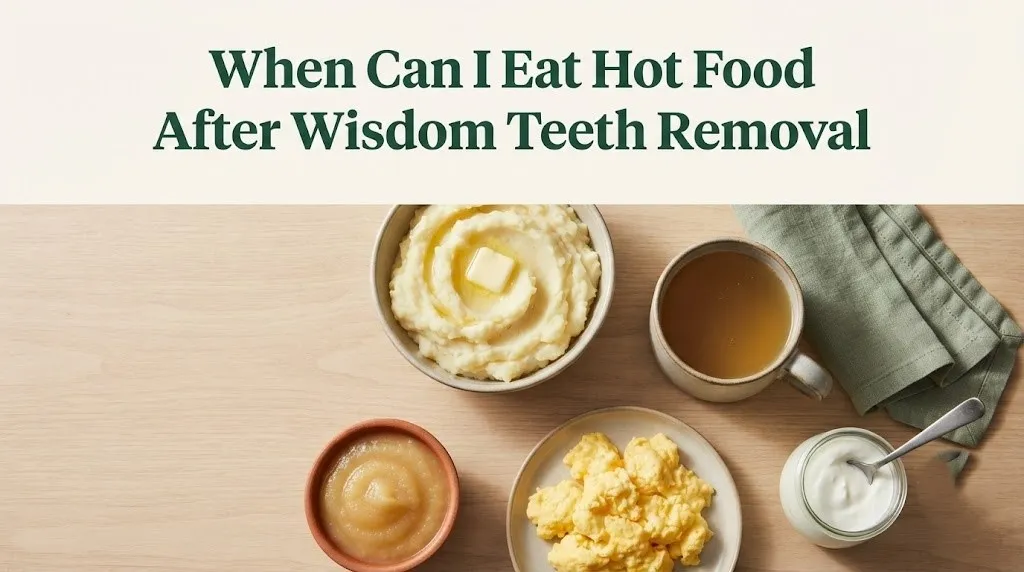
| Warm (not hot) | Day 2 to day 4 | Warm broth, mashed potatoes, oatmeal |
| Genuinely hot | Day 5 to day 7+ | Hot coffee, hot soup, hot tea |
People managing diabetes or slower wound healing in general should lean toward the longer end of every stage in this table, since blood sugar control affects how quickly tissue repairs itself.
The day by day food timeline after wisdom teeth removal
The safest approach to eating after wisdom teeth removal follows a gradual, day by day progression rather than a single fixed rule.
Day 1: Stick to cold or room temperature liquids and very soft foods. Ice cream, smoothies, and lukewarm broth are common choices. Avoid straws entirely, since suction can dislodge the clot.
Days 2 to 3: Soft foods that require almost no chewing become appropriate. Mashed potatoes, scrambled eggs, cottage cheese, and warm (not hot) oatmeal all fit here.
Days 4 to 7: Semi-soft foods enter the picture, including soft pasta, tender cooked vegetables, and well-cooked rice. This is also the stage where warm foods can gradually move closer to a normal hot temperature, as long as there’s no pain or bleeding.
After 1 to 2 weeks: Most people can return to a fully normal diet, including hot food and drinks, once the extraction site has visibly closed and chewing no longer causes discomfort.
Key points to track through this whole progression:
- Bleeding should be stopping, not restarting, at each new stage
- Swelling should be trending down, not up
- Pain should be manageable with prescribed or over-the-counter medication, not worsening
Signs your mouth is ready for warmer food
The clearest signs you’re ready for warmer food are reduced swelling, no active bleeding, and pain that’s staying steady or improving rather than spiking.
Swelling typically peaks around day 2 to day 3 after wisdom teeth removal and then starts to recede. Once you notice your cheeks and jaw looking closer to normal, that’s a reasonable signal your tissue is stabilizing enough to handle slightly warmer meals.
Bleeding is the other key marker. A small amount of pink-tinged saliva in the first 24 hours is normal, but if you’re still seeing fresh red blood on day 3 or 4, that’s a sign to stay with cooler foods and mention it to your dentist or oral surgeon.
Pain level matters too. Discomfort that’s gradually easing with your prescribed pain management plan suggests healing is on track. Pain that suddenly worsens a few days in, especially paired with a bad taste or visible empty-looking socket, can indicate dry socket, which means you should call your provider rather than experiment with temperature.
Quick Tip:
- Use a simple three-part check each morning: swelling, bleeding, pain
- All three improving means you can likely nudge the temperature up slightly
- Any one getting worse means hold at your current stage
Best warm foods to try first after wisdom teeth removal
The best first warm foods after wisdom teeth removal are soft, protein-rich, and easy to swallow without chewing near the extraction site.
Mashed potatoes are a strong choice because they deliver carbohydrates for energy and are naturally soft once cooled to a warm, not hot, temperature. Adding a small amount of butter or olive oil boosts calories, which matters since appetite often drops after oral surgery.
Scrambled eggs provide a solid dose of protein, roughly 6 grams per large egg, which supports tissue repair. Cook them soft and let them cool slightly before eating.
Greek yogurt offers protein and a naturally cool to room-temperature serving style, and it pairs well with a small amount of honey if you want extra flavor without added acidity from fruit.
Key points / foods to try include:
- Warm oatmeal cooked soft and cooled for a few minutes
- Blended vegetable soup, served warm rather than hot
- Warm (not hot) cream of wheat or grits
- Soft, well-cooked pasta with a mild sauce
People following a vegan eating pattern can swap eggs and yogurt for soft tofu, mashed lentils, or a plant-based protein smoothie to keep protein intake up during healing.
Can I eat hot soup after wisdom teeth removal
Hot soup is generally not recommended until around day 5 to day 7 after wisdom teeth removal, though warm soup is typically fine much earlier.
Soup is one of the most commonly recommended post-extraction foods because it’s soft, hydrating, and easy to customize for protein content. The issue isn’t soup itself, it’s the temperature at which it’s served.
A bowl of soup straight off the stove can easily exceed 140°F (60°C), hot enough to burn sensitive tissue and increase local blood flow at the extraction site. Letting soup sit for 5 to 10 minutes before eating, or stirring in a splash of cool broth, brings it down to a genuinely safe warm range.
Blended soups without chunky, hard-to-chew ingredients work best in the first week. Chicken broth, blended vegetable soup, and miso soup are common choices, but miso and other higher-sodium broths should be enjoyed in moderation by anyone managing high blood pressure, since the American Heart Association recommends limiting sodium intake regardless of recovery status.
When can I drink hot coffee or tea after wisdom teeth removal
Hot coffee and tea should generally wait until at least day 5 to day 7 after wisdom teeth removal, the same window recommended for other hot foods and drinks.
Coffee and tea carry a double risk. The heat itself can irritate the extraction site the same way hot soup can, and caffeine has a mild dehydrating effect that isn’t ideal during early healing when hydration supports tissue repair.
There’s also a practical issue with how people drink these beverages. Sipping through a straw creates suction that can dislodge a healing clot, so even once temperature is no longer a concern, straw use should still be avoided for about a week.
If you can’t skip your morning coffee entirely, an iced or well-cooled version is a reasonable middle ground in the first few days. Once you reach the point where warm food is comfortable, a coffee that’s warm rather than fresh-brewed hot is the next reasonable step before returning to your normal cup.
Key Takeaway: Warm food is usually fine within two days, but genuinely hot food and drinks, including coffee, tea, and soup, are safer to wait on for a full 5 to 7 days.
What temperature is actually safe to eat after tooth extraction
A generally safe eating temperature after tooth extraction is close to body temperature, roughly 98°F to 105°F (37°C to 40°C), rather than anything piping hot.
This range feels warm on the tongue without triggering the kind of heat response that increases blood flow to inflamed tissue. It’s roughly the temperature of a bath that feels comfortably warm rather than hot.
A simple test at home is the wrist test many people use for baby bottles. If food or liquid feels warm but not uncomfortably hot on the inside of your wrist, it’s likely in a reasonable range for early healing.
| Temperature Range | Feels Like | Safe Timing |
|---|---|---|
| Below 98°F (37°C) | Room temperature to cool | Day 1 onward |
| 98°F to 105°F (37°C to 40°C) | Comfortably warm | Day 2 onward |
| Above 130°F (54°C) | Hot, freshly cooked | Day 5 to 7+ |
People who wear dentures or have naturally sensitive teeth even outside of recovery may want to stay on the cooler end of these ranges a little longer, since sensitivity can compound with post-surgical inflammation.
Foods and drinks to avoid while your mouth heals
The foods and drinks to avoid most strictly after wisdom teeth removal are anything hot, spicy, hard, crunchy, or consumed through a straw.
Hot liquids top this list because of the clot disruption risk already covered, but spicy food deserves equal caution. Capsaicin, the compound responsible for heat in chili peppers, can irritate already inflamed tissue and increase discomfort even without a temperature component.
Crunchy and hard foods, including chips, nuts, and raw vegetables, carry a mechanical risk. Small fragments can lodge directly in the extraction socket, which is uncomfortable and increases infection risk if they’re not cleared out properly.
Alcohol and carbonated soft drinks belong on this list too. Alcohol can interact poorly with prescribed pain medication, and carbonation can create pressure changes in the mouth similar to straw suction.
Things to watch out for include:
- Popcorn and seeds, which are notorious for getting stuck in extraction sites
- Acidic foods like citrus and vinegar-based dressings, which sting healing tissue
- Sticky candy or caramel, which can pull at stitches or a forming clot
- Anything requiring aggressive chewing near the extraction site
Anyone managing acid reflux should already be cautious with acidic foods generally, and that caution matters even more during this recovery window.
When can I eat regular hot food again after wisdom tooth extraction
Most people can return to a fully normal diet, including regular hot food, around 1 to 2 weeks after wisdom tooth extraction.
This timeline lines up with the point where soft tissue over the extraction site has largely closed and the risk of dislodging a clot has dropped significantly. A study published in the Journal of Oral and Maxillofacial Surgery has documented that soft tissue healing at extraction sites typically progresses substantially within the first two weeks, though full bone remodeling continues for months afterward.
Getting back to a normal diet doesn’t need to happen all at once. A gradual return, moving from warm soft foods to warm semi-solid foods to normal hot meals, tends to feel more comfortable and lowers the odds of a painful surprise.
Comfort should be the real guide here more than the calendar. If chewing near the site still causes pain at the two week mark, that’s worth mentioning to your dentist rather than pushing through, since healing pace varies by individual, age, and how complex the original extraction was.
How extraction complexity changes your hot food timeline
Extraction complexity is one of the biggest factors in how long you should wait to eat hot food, with surgical or impacted removals generally needing a longer waiting period than simple extractions.
A simple extraction, where the tooth is fully erupted and comes out in one piece with minimal manipulation, tends to heal faster. Someone in this category may be comfortable with warmer foods slightly earlier than the general 5 to 7 day range.
An impacted or surgically removed wisdom tooth, which often requires cutting gum tissue or removing bone, creates a larger wound and a higher baseline risk of complications. Research cited by oral surgery practices places dry socket rates for surgical third molar extractions meaningfully higher than for routine dental extractions, which is part of why surgical patients are often told to be more conservative with both food temperature and texture.
| Extraction Type | Typical Hot Food Timeline | Dry Socket Risk Level |
|---|---|---|
| Simple, fully erupted tooth | Closer to day 5 | Lower |
| Impacted or surgical removal | Closer to day 7 or beyond | Higher |
Anyone who smokes should also expect a longer safe window, since smoking is independently linked to higher dry socket risk and slower healing regardless of how the extraction itself went.
What to do if hot food causes pain or bleeding
If hot food causes new pain or bleeding after wisdom teeth removal, the right response is to stop eating it immediately and go back to cool or room-temperature foods.
A small amount of renewed pink saliva right after a slightly-too-warm meal isn’t necessarily an emergency, but it is a clear signal to back off the temperature for another day or two before trying again.
Sudden, sharp pain that appears 1 to 4 days after surgery, especially alongside a bad taste in the mouth or a visibly empty-looking socket, matches the classic pattern of dry socket. This is a situation where confirming with the treating dentist or oral surgeon is genuinely warranted, since dry socket typically needs a clinical dressing to manage properly rather than home treatment alone.
Persistent bleeding that doesn’t slow down with gentle pressure from a clean gauze pad, or swelling that keeps increasing rather than peaking and receding, are both reasons to contact your provider the same day rather than waiting to see if it resolves on its own.
Quick Tip:
- Bite gently on gauze for 20 to 30 minutes if bleeding restarts
- Rinse gently with warm salt water rather than swishing hard
- Call your dentist promptly if pain spikes rather than gradually improves
Key Takeaway: Reintroducing hot food is safest as a gradual step rather than a single switch, and any new pain or bleeding is a clear signal to slow down and check in with your dentist.
Frequently Asked Questions About Eating Hot Food After Wisdom Teeth Removal
Can I eat hot food after wisdom teeth removal?
You should generally wait about 5 to 7 days before eating truly hot food after wisdom teeth removal.
Heat increases blood flow to the extraction site, which can disturb the healing clot.
Warm food is usually fine much sooner, often within 24 to 48 hours.
When can I eat warm food after wisdom teeth removal?
Most people can eat warm, non-hot food starting around 24 to 48 hours after surgery.
This is after the earliest and most fragile stage of clot formation has passed.
Warm should still mean body temperature rather than freshly cooked hot.
How long until I can drink hot coffee after wisdom teeth removal?
Hot coffee is best delayed until about 5 to 7 days after wisdom teeth removal.
Both the heat and the caffeine’s mild dehydrating effect can work against early healing.
Avoiding straws for about a week matters just as much as the temperature itself.
Is hot soup okay after wisdom teeth removal?
Hot soup should generally wait until around day 5 to day 7, though warm soup is fine much earlier.
Letting soup cool for 5 to 10 minutes typically brings it into a safer temperature range.
Blended, chunk-free soups are the easiest and safest option in the first week.
What happens if I eat hot food too soon after wisdom teeth removal?
Eating hot food too soon can dislodge the healing blood clot and increase the risk of dry socket.
Symptoms of dry socket include sudden worsening pain, often days 1 through 4 after surgery.
Contacting your dentist promptly is the right move if you notice these symptoms.
Getting back to hot coffee and your normal meals doesn’t have to be complicated. Track swelling, bleeding, and pain each day, and let those three signs, not the calendar alone, decide when you nudge the temperature up.
Start with warm mashed potatoes and broth in the first couple of days, then work toward soft solids by the end of the first week. By the two week mark, most people are back to eating and drinking exactly the way they did before, hot coffee included.