Puppies can start eating soft puppy food as early as 3 to 4 weeks of age, once weaning begins. By 7 to 8 weeks, most puppies are ready to eat moistened or dry puppy kibble without relying on their mother’s milk.
Getting this timing right matters more than most new owners realize. The Purdue University Canine Welfare Center notes that puppies depend entirely on mother’s milk for their first two to three weeks of life, during which that milk delivers not just calories but critical maternal antibodies. Moving to solid food too early or too late can affect growth, digestion, and long-term skeletal health.
This guide covers everything from the first signs your puppy is ready for solid food to how breed size changes the formula, how to soften dry kibble safely, and when to make the switch to adult food.
When Can Puppies Eat Puppy Food?
Puppies can begin eating soft puppy food at 3 to 4 weeks old, when their deciduous (baby) teeth start to emerge and they become physically capable of lapping food from a shallow bowl.
Before that point, a puppy’s entire nutrition comes from nursing. Their digestive system produces lactase enzymes in high quantities, which break down the lactose in mother’s milk. As those enzyme levels naturally decline around weeks three to four, the puppy’s body signals readiness for other food sources.
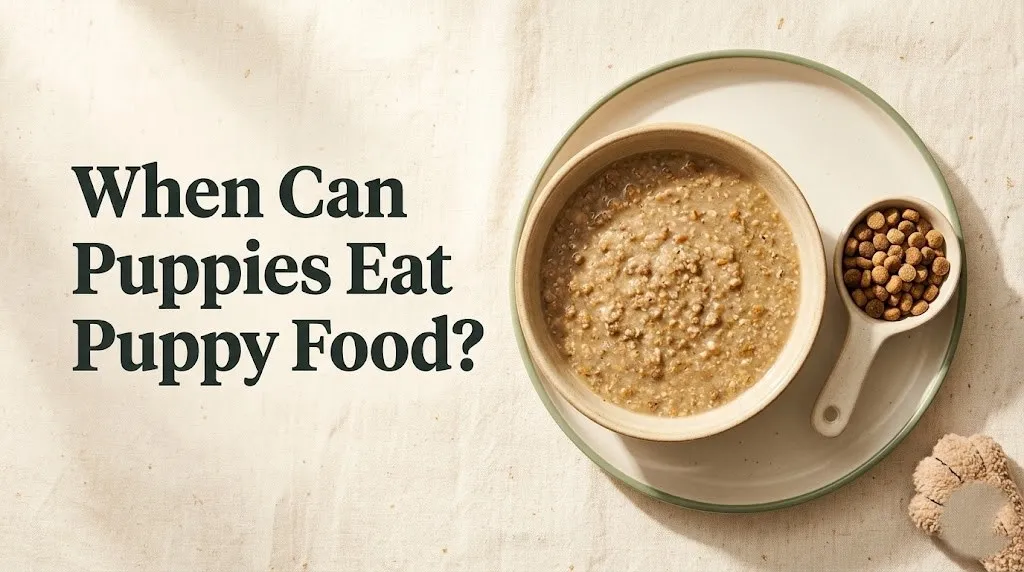
The first food introduced is typically a soft puppy gruel: moistened dry kibble or wet puppy food blended with warm water or puppy-safe milk replacer to a thin, porridge-like consistency. It’s not glamorous. It’s often messy. But that gradual textural bridge is what makes the transition safe for a stomach still adapting to non-milk nutrition.
| Puppy Age | Feeding Stage | Food Type |
|---|---|---|
| 0 to 3 weeks | Nursing only | Mother’s milk or milk replacer |
| 3 to 4 weeks | Weaning begins | Thin puppy gruel (80% liquid) |
| 4 to 6 weeks | Increasing solids | Thicker gruel (50% liquid) |
| 6 to 7 weeks | Transitioning | Soft wet food or lightly moistened kibble |
| 7 to 8 weeks | Mostly dry | Moistened or dry kibble |
| 8 to 10 weeks | Fully weaned | Dry puppy kibble (breed-appropriate) |
A puppy showing no interest in gruel at three and a half weeks isn’t failing. Different litters, different mothers, and different breeds develop at slightly different rates. Larger retriever breeds may transition faster than toy breeds. Patience in the first week of weaning prevents digestive upset and food aversion later.
What Age Do Puppies Start Eating Food?
Most puppies start tasting food between 3 and 4 weeks of age, though true nutritional dependence on solid food doesn’t begin until closer to 5 to 6 weeks.
The distinction matters. In the early weaning window, puppies are exploring and mouthing food more than consuming it for fuel. Their mother’s milk still supplies the majority of their calories. The Kennel Club notes that a puppy food for this stage should contain all five essential nutrient categories: protein, fat, carbohydrates, vitamins, and minerals, in proportions calibrated for rapid growth.
Think of early solid food introduction like training wheels. The puppy is practicing the mechanics of eating while the mother’s milk still handles the nutritional heavy lifting. Solid food gradually takes over that role across four to six weeks.
Puppies that are bottle-raised without a mother dog typically begin solid food introduction slightly earlier, at around 3 weeks, since their caretaker can control the pace of the transition more actively.
Quick Tip:
- Offer gruel in a shallow, heavy-bottomed dish that a small puppy can reach into without climbing over the edge.
- Keep each feeding session to 20 minutes maximum. Remove uneaten food promptly.
- Never leave moistened food out longer than 30 minutes. Bacteria multiply rapidly in wet, room-temperature food.
How Soon Can Puppies Eat Food?
The earliest a puppy can be introduced to any food beyond mother’s milk is 3 weeks of age, but this should not be rushed.
Before three weeks, a puppy’s gastrointestinal tract isn’t ready to process solid food. Their gut motility, enzyme activity, and oral motor coordination are all still maturing. Introducing food before this window can cause digestive distress and potentially interfere with the passive immunity they receive through nursing.
The American Veterinary Medical Association (AVMA) guidelines on puppy care emphasize that weaning should be gradual, not abrupt. An abrupt removal from nursing stresses both the puppy and the mother and can lead to diarrhea, dehydration, and weight loss in the litter.
For bottle-raised puppies with no nursing mother available, weaning can begin at three weeks using a commercial puppy milk replacer blended with a small amount of soft wet puppy food. Regular cow’s milk and goat’s milk are not appropriate substitutes for puppies. Their lactose content is higher than canine milk, and puppies lack sufficient lactase activity to process it properly without GI upset.
Key Takeaway: Puppies can start soft food at 3 to 4 weeks, but they still need nursing or milk replacer for nutrition until at least 5 to 6 weeks old.
When Should Puppies Start Eating Puppy Food?
Puppies should start eating food specifically formulated for puppies, not adult dogs, from the moment solid food is introduced at 3 to 4 weeks through to breed-appropriate adulthood.
Adult dog food is formulated for maintenance, meaning it’s calibrated for a body that’s finished growing. Puppy food is formulated for growth and reproduction, a nutritional stage defined by AAFCO that requires significantly higher levels of protein, fat, calcium, phosphorus, and certain vitamins.
According to AAFCO nutrient profiles, puppy food for the growth stage requires a minimum crude protein content of 22% (on a dry matter basis), compared to 18% for adult maintenance food. Fat minimums are similarly higher, at 8% for growth versus 5% for adult maintenance.
These numbers aren’t arbitrary. A puppy at peak growth can require roughly twice the calories per pound of body weight compared to an adult dog of the same breed. Their muscles, bones, brain, and organs are all developing simultaneously. Underfueling that process has real consequences: poor coat condition, low energy, stunted growth, and compromised immune function.
Puppies with grain sensitivities or food allergies can still find puppy-specific formulas. Grain-free puppy foods exist, though the FDA has ongoing research into a potential link between grain-free diets and dilated cardiomyopathy in dogs. Speaking with a veterinarian before choosing a grain-free puppy formula is worth doing specifically if the puppy is a larger breed.
At What Age Do Puppies Start Eating Solid Food?
Puppies begin eating solid food, in its initial soft and moistened form, at 3 to 4 weeks of age. True solid food, meaning dry kibble without added liquid, becomes appropriate closer to 7 to 8 weeks.
The weaning window between these two points is where texture management matters most. Rushing a puppy from watery gruel to dry hard kibble before their jaw strength and swallowing coordination are developed can lead to choking, food aversion, and poor intake.
The Purdue University Canine Welfare Center recommends starting puppies at 3 to 4 weeks with a gruel made from the dam’s food mixed with 65 to 70% warm water, then gradually reducing the water content over subsequent weeks as solid food tolerance builds.
Physical readiness cues that a puppy is ready to move to firmer textures include:
- Active interest in watching or approaching the food bowl
- Lapping food confidently rather than just mouthing it
- Consistent weight gain on a normal growth curve
- Less crying or rooting behavior after feeds
- Visible emerging deciduous teeth (usually appearing from week 3 onward)
These cues are more reliable than calendar age alone. A puppy that meets these markers at six weeks is more ready for firmer food than a puppy the same age still struggling to lap gruel cleanly.
When Can a Puppy Start Eating Hard Food?
A puppy can start eating unsoftened dry kibble between 7 and 10 weeks of age, depending on individual development and breed.
Hard food introduction is not a single event. It’s a gradient. The correct approach is to reduce the amount of water added to kibble incrementally over one to two weeks, watching the puppy’s response at each step. If a puppy starts leaving food in the bowl, shows hesitation, or loses weight during the transition, the kibble may still be too firm. Slow the pace.
Some breeders, particularly those managing large litters of bigger breeds, continue adding warm water to soften kibble until 4 to 6 months of age, by which point all the adult teeth have erupted and jaw musculature is more developed. This isn’t excessive caution. For large-breed puppies, hard kibble inhaled too quickly during a competitive mealtime in a group litter setting carries a genuine choking risk.
Kibble size is a factor that rarely gets enough attention. Small-breed puppies have proportionally smaller mouths. Standard kibble designed for medium or large dogs may be physically difficult for a four-pound Chihuahua puppy to chew safely. Purpose-designed small-breed puppy kibble uses smaller pellets that suit the jaw size.
| Kibble Type | Suitable Puppy Size | Age to Introduce Dry |
|---|---|---|
| Small-breed puppy kibble | Adults under 20 lbs | 7 to 9 weeks |
| Standard puppy kibble | Adults 20 to 50 lbs | 8 to 10 weeks |
| Large-breed puppy kibble | Adults 50 to 70 lbs | 8 to 10 weeks |
| Giant-breed puppy kibble | Adults over 70 lbs | 9 to 12 weeks (watch carefully) |
How to Soften Dog Food for Puppies
The standard method for softening dry puppy kibble is to add warm water at a ratio of roughly 3 parts kibble to 1 part liquid, let it soak for 10 to 15 minutes, and serve at a lukewarm temperature.
Early in weaning, the consistency should resemble thin porridge. Over several weeks, you reduce the liquid until the food holds its shape but is still slightly yielding when pressed. By the end of the transition, most kibble should need no soaking at all.
Liquids that work safely for softening puppy food:
- Warm water (most reliable; no added calories or sodium)
- Low-sodium, unseasoned chicken or beef broth (adds palatability; check labels carefully for onion or garlic, both toxic to dogs)
- Puppy milk replacer (appropriate during the earliest weeks of weaning when lactase activity is still present)
- A small amount of wet puppy food mixed in (increases moisture and caloric density; use the same brand or protein to avoid sudden dietary shifts)
Liquids that should not be used:
- Regular cow’s milk (high lactose; causes GI upset in most puppies beyond a few weeks old)
- Goat’s milk (lower lactose than cow’s milk but still higher than canine milk; use with caution)
- Seasoned broths or stocks with onion, garlic, chives, or excessive sodium
To soften food step by step:
- Measure the puppy’s appropriate portion of dry kibble per the feeding guide on the package.
- Place kibble in a clean, shallow bowl.
- Add warm (not boiling) water at a 3:1 kibble-to-liquid ratio.
- Let it sit for 10 to 15 minutes until the kibble has absorbed the liquid and softened throughout.
- Mash lightly with a fork if the puppy is very young (3 to 4 weeks).
- Check the temperature before serving. It should be body-warm, not hot.
- Discard any uneaten moistened food after 20 to 30 minutes. Do not refrigerate and re-serve.
Key Takeaway: Soften kibble with warm water at a 3:1 ratio, serve lukewarm, and never leave moistened puppy food out for more than 30 minutes.
When Can Puppies Eat Dog Food?
Puppies can eat food labeled “for all life stages” from the beginning of weaning, but they should NOT eat food labeled “adult maintenance only” until they have finished growing.
“Dog food” is not a single category. Some products on the shelf are appropriate for puppies. Others are not. The difference is visible on the label. Products that meet AAFCO’s “growth and reproduction” profile or “all life stages” profile are appropriate for puppies. Products labeled “adult maintenance” are not formulated to support the caloric density, protein levels, and micronutrient ratios that a growing puppy requires.
A puppy fed adult maintenance food exclusively is not automatically in danger short-term, but sustained feeding of adult food to a growing puppy risks nutrient deficiencies, particularly in calcium, phosphorus, and protein, that affect bone density and muscle development over time.
For new owners who have adopted a puppy and are unsure what the breeder or shelter was feeding, switching food abruptly causes digestive upset. The standard transition protocol is to mix the new food with the original food over 7 to 10 days, gradually increasing the proportion of new food. This gives the puppy’s gut microbiome time to adapt.
When to Start Puppy Food
The right time to start puppy food is the moment solid food of any kind is introduced, beginning at 3 to 4 weeks of age.
From that first bowl of gruel onward, everything a puppy eats should be formulated specifically for puppy growth, not adult maintenance. This isn’t a marketing distinction. It’s a biochemical one. The Association of American Feed Control Officials (AAFCO) mandates that growth-stage foods contain minimum levels of nutrients that adult maintenance foods don’t have to meet.
If you’re a new owner receiving a puppy at 8 weeks from a breeder, start with whatever the breeder was feeding and transition gradually if you plan to switch brands. Continuity in those first weeks in a new home reduces digestive stress during an already-disorienting adjustment period.
For bottle-raised litters, puppy food (as wet food or rehydrated gruel) begins at 3 weeks, slightly earlier than mother-raised litters because there’s no nursing mother to provide supplemental nutrition.
Quick Tip:
- Ask your breeder or shelter exactly what food and how much the puppy was eating before coming home.
- Bring a sample bag or note the brand name so you can match it for at least the first week.
- Any feeding changes should happen over 7 to 10 days minimum to avoid diarrhea and food refusal.
At What Age Can Puppies Eat Dog Food?
Puppies can eat food labeled “for all life stages” at any point from weaning onward, but they should not transition to “adult maintenance” food until they reach breed-appropriate physical maturity.
For most small and medium breeds, that transition happens around 12 months. For large breeds, it’s typically closer to 18 months. For giant breeds like Great Danes, Mastiffs, and Saint Bernards, the puppy-to-adult food transition may not happen until 24 months or later.
Continuing to feed puppy food after a dog reaches adulthood carries its own risks. Puppy food is calorie-dense and protein-rich to support growth. An adult dog eating puppy food long-term is consuming more calories and protein than their maintenance needs require. The Association for Pet Obesity Prevention found in its most recent survey that approximately 59% of dogs in the United States are overweight or obese, and dietary mismanagement during the transition from puppy to adult food contributes to that figure.
The practical guide is this: watch the puppy’s body condition, not just the calendar. A dog that appears to have reached its breed-expected adult size, with a healthy body condition score and confirmed by veterinary weight check, is likely ready for adult food. The right veterinarian can give a breed-specific and growth-trajectory-specific recommendation.
Key Takeaway: Small breeds switch to adult food around 12 months; large breeds at 18 months; giant breeds may not switch until 24 months.
What Age Do Puppies Eat Solid Food?
Puppies eat their first solid food at 3 to 4 weeks, though it’s soft and heavily moistened at that stage. Firm, mostly dry food typically begins between 7 and 10 weeks.
The word “solid” is worth parsing here. Early weaning food is technically solid in that it’s not liquid, but the texture is closer to baby food than kibble. The progression from that first watery gruel to a crunchy bite of dry kibble takes four to six weeks in most cases.
Tufts University Cummings School of Veterinary Medicine notes that puppy food transitions should be monitored through observable outcomes, not just checked off a timeline. A healthy puppy eating solid food appropriately should show:
- Consistent weight gain (your vet can assess whether the gain is appropriate for breed and age)
- Formed, brown fecal matter (not loose, watery, or excessively frequent)
- A shiny coat and alert demeanor
- Interest and energy at mealtimes
Loose stool that persists more than two days after any food texture change, refusal to eat, or sudden weight loss warrants a veterinary call. These signs can indicate that the transition was too fast, the food is not a good match for that puppy, or an underlying GI issue needs attention.
Large Breed vs. Small Breed Puppy Food Age Differences
Large-breed puppies and small-breed puppies have genuinely different nutritional needs, and feeding them the wrong formula has documented health consequences.
The central issue for large-breed puppies is calcium and phosphorus balance. According to AAFCO guidelines, foods formulated for the growth of large-size dogs (those whose adult weight is expected to exceed 70 pounds) must contain calcium and phosphorus within defined limits. Specifically, calcium levels must stay between 1.2% and 1.8% on a dry matter basis, and the calcium-to-phosphorus ratio must fall between 1:1 and 2:1.
Why does this matter? Excessive calcium during skeletal development in large-breed puppies accelerates bone growth disproportionately. The Merck Veterinary Manual documents that oversupplementation with calcium in large-breed puppies increases the risk of developmental orthopedic disease (DOD), a category that includes conditions like osteochondrosis, hip dysplasia, and angular limb deformities.
Standard puppy food (not formulated specifically for large breeds) often contains calcium levels appropriate for small dogs but excessive for a growing Great Dane or Rottweiler.
| Breed Size Category | Adult Weight | Puppy Food Type Needed | Switch to Adult Food At |
|---|---|---|---|
| Toy/Small | Under 20 lbs | Small-breed puppy formula | 10 to 12 months |
| Medium | 20 to 50 lbs | Standard puppy formula | 12 months |
| Large | 50 to 70 lbs | Large-breed puppy formula | 12 to 18 months |
| Giant | Over 70 lbs | Giant-breed/large-breed puppy formula | 18 to 24 months |
Small-breed puppies face different but related concerns. They have faster metabolisms and higher caloric needs per pound of body weight. They also have smaller mouths and need smaller kibble sizes. Small-breed puppy formulas account for all three factors.
Puppy Feeding Schedule by Age
A puppy’s feeding frequency changes significantly across the first year of life, and getting it right supports stable blood sugar, consistent energy, and a healthy growth curve.
Puppies from weaning through 4 months of age should eat 3 to 4 times per day. Their small stomachs can’t hold enough at one sitting to fuel several hours of growth and activity. Spreading meals across the day prevents energy crashes and overeating at each sitting.
The AKC Canine Health Foundation and standard veterinary practice both recommend:
- 3 to 4 weeks: Gruel offered 4 times daily (nursing still primary)
- 4 to 8 weeks: Soft or moistened puppy food 3 to 4 times daily
- 8 weeks to 4 months: Dry or moistened kibble 3 times daily
- 4 to 6 months: 2 to 3 times daily
- 6 to 12 months: 2 times daily (morning and evening)
- 12 months and beyond (small/medium breeds): 2 times daily as adult
Amount per feeding should be guided by the weight-based feeding chart on the puppy food packaging. These charts are formulated around the food’s caloric density. Overfeeding is a real and common problem. A puppy that looks chubby at 10 weeks is not “healthy and well-fed.” Excess weight at that age stresses developing joints, particularly in breeds already predisposed to hip issues.
Free-choice feeding (leaving food out all day) is not recommended for most puppies. Scheduled meals help with house training, allow you to monitor appetite changes, and prevent competitive overeating in multi-puppy households.
Key Takeaway: Feed puppies 3 to 4 times daily from weaning through 4 months, then drop to 2 to 3 meals through 6 months, then twice daily as they approach adulthood.
When Should Puppies Start Eating Dog Food vs. Puppy Food?
Puppies should eat food labeled for puppy growth from the start of weaning and only transition to adult “dog food” when they have reached their breed’s mature body size.
The phrase “dog food” is ambiguous because it technically includes both puppy-stage and adult-stage formulas. The distinction that actually matters is the AAFCO nutritional adequacy statement on the bag. Here’s what to look for:
- “Formulated to meet AAFCO profiles for growth and reproduction” = appropriate for puppies
- “Formulated to meet AAFCO profiles for all life stages” = appropriate for puppies
- “Formulated to meet AAFCO profiles for all life stages, including growth of large-size dogs (70 lbs or more as an adult)” = appropriate for large-breed puppies
- “Formulated to meet AAFCO profiles for adult maintenance” = NOT appropriate for puppies
One phrase to watch carefully: “all life stages, excluding growth of large-size dogs.” This means the food is fine for small and medium puppies but should not be fed to large or giant breed puppies due to the calcium and phosphorus issue.
Reading this label takes about ten seconds. It’s the single most reliable way to confirm whether a food is genuinely suitable for your puppy’s age and size.
When to Switch from Puppy Food to Adult Dog Food
The transition from puppy food to adult dog food should happen when a dog reaches physical maturity, which varies by breed size.
For small and toy breeds, this typically occurs at 10 to 12 months. Medium breeds are usually ready at 12 months. Large breeds need puppy food until 12 to 18 months. Giant breeds may need to stay on a large-breed puppy formula until 18 to 24 months.
These are guidelines, not rigid rules. The best person to confirm the right timing for a specific dog is a veterinarian who can assess body condition score, compare current weight to expected adult weight, and factor in the dog’s breed-specific growth patterns.
When the time comes to switch, do it gradually:
- Day 1 to 2: Serve 75% puppy food, 25% adult food per meal.
- Day 3 to 4: Serve 50% puppy food, 50% adult food per meal.
- Day 5 to 6: Serve 25% puppy food, 75% adult food per meal.
- Day 7 onward: Serve 100% adult food.
If loose stools or appetite changes appear during this process, slow down the transition. Extend each ratio stage by a few extra days. A dog’s gut microbiome takes time to adjust to a new food composition, and the gentler the ramp, the smoother the outcome.
Continuing puppy food past the point of maturity isn’t a neutral choice. The extra calories and fat in growth-stage food steadily accumulate in a body that no longer needs them for growth. The transition to adult food at the right time is genuinely the better long-term choice for a dog’s body weight and metabolic health.
Frequently Asked Questions About When Puppies Can Eat Puppy Food
At what age can a puppy eat dry food without soaking it?
Most puppies can eat dry, unsoftened kibble without added liquid between 7 and 10 weeks of age, depending on their breed and individual development.
Smaller breeds or puppies that were slow to wean may benefit from slightly moistened kibble through 12 weeks.
Always transition to dry food gradually over one to two weeks, reducing liquid content incrementally.
Can puppies eat adult dog food instead of puppy food?
Puppies should not be fed adult maintenance food as their primary diet because it lacks the protein, fat, and mineral levels required for healthy growth.
Adult food provides roughly 18% protein on a dry matter basis, while AAFCO requires a minimum of 22% protein for puppy growth-stage foods.
A puppy fed adult food long-term risks nutritional shortfalls that affect bone density, muscle development, and coat quality.
How do I know if my puppy is ready to move from soft food to dry kibble?
A puppy ready for firmer food will approach the bowl confidently, eat without hesitation, and maintain consistent weight gain after meals.
Other signs include clearly visible deciduous teeth, formed and normal brown fecal output, and no loose stool from the current food texture.
If weight gain stalls or diarrhea appears when you firm up the texture, return to a softer consistency and advance more slowly.
How many times a day should I feed my puppy?
Puppies from weaning through 4 months old need 3 to 4 meals per day; from 4 to 6 months, 2 to 3 meals per day; and from 6 months to adulthood, twice daily.
Spreading meals through the day keeps blood sugar stable and prevents overeating at any single sitting.
Free-choice feeding (leaving food available all day) is generally not recommended for puppies because it makes monitoring intake, appetite changes, and house training harder.
What is the difference between large breed and small breed puppy food?
Large-breed puppy food contains controlled calcium and phosphorus levels to prevent the accelerated bone growth that causes developmental orthopedic disease in bigger dogs.
Small-breed puppy food is typically higher in caloric density per cup and uses a smaller kibble size suited to smaller mouths and jaws.
Feeding a large-breed puppy a small-breed or standard puppy formula with excess calcium increases the documented risk of hip dysplasia and other skeletal problems.
Getting the Feeding Timing Right from the Start
The window between 3 weeks and 10 weeks of a puppy’s life is one of the most nutritionally consequential periods in their development. The food type, texture, frequency, and formula you choose during this time shapes bone quality, muscle mass, digestive health, and even long-term weight trajectory.
Start with soft, species-appropriate food at 3 to 4 weeks. Transition to dry kibble gradually over the following weeks. Choose a formula that matches your puppy’s breed size, and read the AAFCO statement on the bag before buying.
When in doubt about timing, formula choice, or a specific puppy’s growth trajectory, a veterinarian who knows the individual animal’s breed and body condition is the most reliable resource.