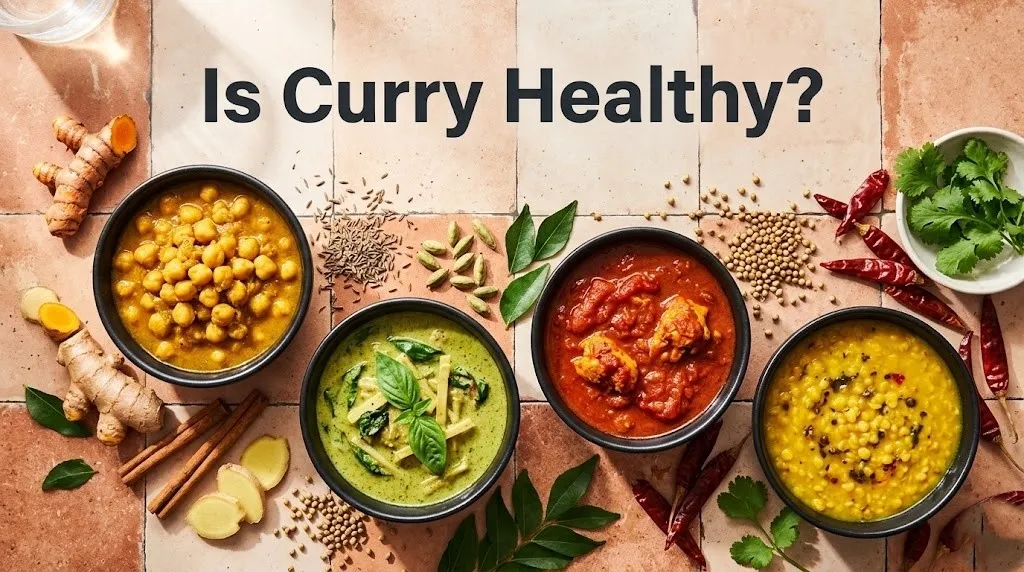
Curry is fundamentally a healthy food category because it is built on a foundation of anti-inflammatory spices, aromatic vegetables, and lean proteins or legumes, but the health value of any specific curry depends almost entirely on its fat base, its protein source, and what you eat with it. A legume-heavy chana masala with a tomato-onion base served with brown rice is a nutritional powerhouse. A coconut-milk-laden Thai curry with fatty beef and a side of fried flatbread is an indulgent meal. Both are curry. They are not nutritionally equivalent.
The word “curry” is not a spice, a plant, or a single dish. It is an anglicized term that describes a vast category of spiced, sauce-based dishes originating primarily from the Indian subcontinent but now spanning Thai, Japanese, Malaysian, Caribbean, and British cuisines. The USDA FoodData Central database lists hundreds of commercially prepared curry products with wildly different nutritional profiles. The average Indian curry made at home, however, contains roughly 300 to 400 calories per serving with 15 to 25 grams of protein and meaningful fiber from legumes and vegetables. The average Thai curry from a restaurant can exceed 600 calories and 35 grams of fat, mostly from coconut milk.
This article examines curry through the lens of its component parts: the spices, the sauce base, the protein, and the accompaniments. You will learn which curries support your health goals, which ones to approach with caution, and how to make your favorite curry healthier without sacrificing the flavor that made you love it in the first place.
is curry healthy
Curry is a healthy meal category when it is built on a foundation of dry spices bloomed in a modest amount of oil, a tomato or yogurt-based sauce, lean protein or legumes, and plenty of vegetables, served with a whole grain. The spices are the star. The fat and the accompaniments are the variables that move the needle toward or away from health.
The nutritional case for curry begins with its spice blend. Turmeric contains curcumin, a polyphenol with well-documented anti-inflammatory properties. Ginger contains gingerols, which have been studied for their effects on nausea and inflammatory markers. Garlic and onion, the aromatic base of nearly every curry, are allium vegetables rich in organosulfur compounds associated with cardiovascular benefits. Cumin and coriander contribute antioxidants and assist with digestion. A 2023 study in the British Journal of Nutrition found that regular consumption of curry was associated with better cognitive performance in older adults, an effect the researchers attributed partly to the cumulative anti-inflammatory effects of the spice blend.
The Academy of Nutrition and Dietetics recognizes that dietary patterns rich in herbs and spices tend to be associated with higher overall diet quality, partly because the flavor complexity reduces the need for added salt and sugar. A well-made curry delivers layers of flavor from spices, not from a salt shaker or a sugar spoon. This is a structural advantage that curry holds over plainer protein-and-starch meals.
what is curry made of
Curry is made of three structural components: a spice blend, a sauce base, and a protein or main ingredient, layered together through a cooking process that typically begins with blooming spices in hot fat and builds depth through simmering. The specific ingredients in each component determine the nutritional profile and the flavor.
The spice blend can be a dry powder like curry powder or garam masala, a wet paste like Thai curry paste, or individual spices added in sequence. A typical Indian curry begins with whole cumin seeds, coriander seeds, and cardamom pods toasted in oil, followed by ground turmeric, chili powder, and garam masala. A Thai curry paste is a wet blend of fresh chilies, lemongrass, galangal, shallots, garlic, shrimp paste, and spices pounded into a smooth paste. The spices are where the anti-inflammatory and antioxidant compounds live.
The sauce base is where the nutritional divergence between curry types becomes most visible. North Indian curries often use a base of pureed tomatoes, onions, and yogurt, producing a sauce that is moderate in fat and high in lycopene from the tomatoes. South Indian and Thai curries frequently use coconut milk as the primary liquid, adding richness and body but also significant saturated fat. Japanese curry uses a roux made from butter and flour, making it the most calorically dense curry base. The choice of sauce base is the single largest lever for modifying the health profile of a curry.
curry spices and health benefits
The health benefits of curry spices are concentrated in their bioactive compounds: curcumin in turmeric, gingerols in ginger, allicin in garlic, quercetin in onions, and capsaicin in chili peppers, each of which has been independently studied for anti-inflammatory, antioxidant, and metabolic effects. The whole is greater than the sum of its parts, but the parts are impressive on their own.
Cumin, the seed of Cuminum cyminum, is a staple of curry blends worldwide. It contains thymoquinone and other volatile oils that stimulate the release of digestive enzymes from the pancreas, which is why it has been used traditionally as a carminative to reduce bloating and gas. A 2022 randomized controlled trial published in the journal Phytotherapy Research found that cumin extract supplementation modestly reduced body weight and waist circumference in overweight adults compared to placebo, though the effect size was small and the mechanism is not fully understood.
Coriander, the seed of Coriandrum sativum, appears in almost every curry blend. It is a source of linalool, an antioxidant compound that also gives coriander its floral, citrusy aroma. Traditional Ayurvedic medicine has used coriander as a digestive aid for centuries. The fresh leaves of the same plant, cilantro, are a common finishing garnish that adds vitamin K and a bright, green contrast to the rich sauce.
Fenugreek, the seed of Trigonella foenum-graecum, is a less famous but nutritionally interesting curry spice. It contains a type of soluble fiber called galactomannan, which forms a viscous gel in the digestive tract and can slow carbohydrate absorption. Fenugreek has been studied for its potential to modestly lower post-meal blood glucose, which makes it particularly relevant for curries served with rice or bread.
turmeric in curry health benefits
Turmeric is the single most studied spice in the curry blend, and its primary active compound, curcumin, has demonstrated anti-inflammatory, antioxidant, and potentially neuroprotective properties in laboratory and animal studies, but its poor bioavailability means that the turmeric in your curry must be paired with black pepper and a fat source to be absorbed in meaningful amounts.
The bioavailability problem is the most important nutritional fact about turmeric that most people do not know. Curcumin is poorly soluble in water and is rapidly metabolized and eliminated by the liver. The NIH Office of Dietary Supplements notes that consuming curcumin with piperine, the alkaloid that gives black pepper its pungency, can increase curcumin absorption by up to 2,000 percent. Traditional Indian cooking solves this problem naturally. Curry powders, garam masala, and most curry recipes include black pepper as a matter of course. The cooking fat, whether ghee or oil, further aids absorption because curcumin is fat-soluble.
The anti-inflammatory mechanism of curcumin involves the inhibition of NF-kB, a protein complex that acts as a master switch for the inflammatory response. In laboratory studies, curcumin blocks NF-kB activation, reducing the downstream production of pro-inflammatory cytokines. Human studies have shown modest but consistent reductions in inflammatory markers like C-reactive protein in people with metabolic syndrome and osteoarthritis who take curcumin supplements, though the doses used in clinical trials far exceed what you would get from a serving of curry.
types of curry and their nutrition
The nutritional profile of curry varies enormously by type, with tomato-based Indian curries being generally the lowest in fat, coconut-milk-based Thai curries being the highest in saturated fat, and legume-based curries being the highest in fiber. Understanding these categories allows you to make informed choices when cooking or ordering.
A chana masala, a North Indian chickpea curry with a tomato-onion base, is arguably the healthiest widely available curry. A 1.5-cup serving with chickpeas, tomatoes, onions, and dry spices cooked in 1 tablespoon of oil delivers roughly 300 calories, 8 grams of fat (1 gram saturated), 45 grams of carbohydrate, 12 grams of fiber, and 14 grams of protein. The fiber comes from the chickpeas. The lycopene comes from the tomatoes. The spice antioxidants are present throughout.
A Thai green curry with chicken, on the other hand, uses a full can of coconut milk as its base. A 1.5-cup serving delivers roughly 500 to 600 calories, 35 to 40 grams of fat, and 25 to 30 grams of saturated fat. The American Heart Association recommends limiting saturated fat to 13 grams per day. A single serving of coconut-milk curry can deliver double that. This does not make Thai curry unhealthy in absolute terms, but it does make it a food to be aware of rather than one to eat without thought.
| Curry Type | Base | Calories (1.5 cups) | Saturated Fat | Fiber | Protein |
|---|---|---|---|---|---|
| Chana masala (chickpea) | Tomato-onion | 300 | 1 g | 12 g | 14 g |
| Dal (lentil curry) | Water/broth | 250 | 0.5 g | 10 g | 16 g |
| Chicken tikka masala | Tomato-cream | 400 | 8 g | 3 g | 30 g |
| Thai green curry (chicken) | Coconut milk | 550 | 28 g | 2 g | 28 g |
| Japanese curry (beef) | Roux | 500 | 10 g | 3 g | 20 g |
which curry is healthiest
The healthiest curry is a lentil or chickpea-based curry with a tomato-onion sauce base, such as chana masala, dal tadka, or rajma, because these combine high fiber, high protein, low saturated fat, and a full complement of anti-inflammatory spices in a single dish that requires no modification to be nutritionally sound.
Dal, the generic term for lentil curries across the Indian subcontinent, is the everyday health food of a billion people. A simple dal tadka consists of split lentils simmered until soft, then finished with a tarka, a quick sizzle of cumin seeds, garlic, and dried red chilies in a tablespoon of ghee or oil. The lentils provide protein, fiber, folate, magnesium, and iron. The tarka provides flavor and ensures that the fat-soluble nutrients in the spices are absorbed. A bowl of dal with a side of rice is a complete protein and a nutritionally complete meal.
Rajma, a kidney bean curry from the Punjab region, is another nutritional standout. Kidney beans are rich in resistant starch, a type of carbohydrate that resists digestion in the small intestine and ferments in the colon, producing short-chain fatty acids that nourish the gut lining. The tomato-onion base adds lycopene and quercetin. A serving of rajma with brown rice delivers roughly 20 grams of protein and 15 grams of fiber.
Indian curry health
Indian curries span the full range from extremely healthy to indulgent, with the dividing line being the fat source: tomato and yogurt-based curries are health-supporting, while ghee-heavy and cream-based curries like butter chicken and korma are treat-level foods. The cuisine is too diverse for a single judgment.
Tandoori chicken, which is technically a dry spice-marinated roasted dish rather than a sauce-based curry, is one of the healthiest Indian restaurant orders. The chicken is marinated in yogurt and spices, then roasted at high heat in a tandoor oven. There is no heavy sauce. The yogurt marinade tenderizes the meat and adds calcium and protein. Order tandoori chicken with a side of dal and a piece of roti for a balanced meal.
Palak paneer, a spinach and cheese curry, is nutritionally mixed. The spinach delivers iron, vitamin K, and carotenoids. The paneer delivers protein and calcium. However, the dish is often finished with cream and butter in restaurant preparations, adding significant saturated fat. At home, you can make palak paneer with a modest amount of oil and skip the cream entirely. The spinach puree provides all the richness needed.
Thai curry health
Thai curries are generally higher in saturated fat than Indian curries because of the coconut milk base, but they also contain a potent array of fresh aromatics including lemongrass, galangal, kaffir lime leaves, and Thai basil, which contribute antimicrobial and anti-inflammatory compounds. The health profile is mixed but improvable.
The coconut milk in a standard Thai curry recipe delivers roughly 21 grams of saturated fat per half-cup. A restaurant portion of curry often contains a full cup or more of coconut milk. The saturated fat in coconut is primarily lauric acid, a medium-chain fatty acid that is metabolized differently from the long-chain saturated fats in butter and red meat. Some research suggests lauric acid raises HDL cholesterol more than LDL cholesterol, producing a less atherogenic lipid profile than butterfat. However, the American Heart Association maintains that replacing saturated fat with unsaturated fat is the most evidence-backed dietary strategy for cardiovascular health.
A practical strategy for Thai curry is to use half the coconut milk called for in the recipe and replace the other half with vegetable or chicken broth. The flavor is lighter but still recognizably Thai. Add a squeeze of fresh lime juice and extra fresh herbs at the end to compensate for the lost richness. You can also use light coconut milk, which contains roughly 60 percent less fat than full-fat coconut milk.
coconut milk in curry healthy
Coconut milk makes curry taste rich and satisfying, but it is the single largest source of saturated fat in the curry category, delivering 21 grams of saturated fat per half-cup, which is 160 percent of the American Heart Association’s recommended daily limit. Coconut milk curry is a food to enjoy with awareness, not to avoid entirely.
The saturated fat in coconut milk is not metabolically identical to the saturated fat in butter. A 2023 meta-analysis in the Journal of the American College of Cardiology reviewed the evidence on coconut oil and coconut milk and found that while both raise LDL cholesterol compared to unsaturated oils, the magnitude of the increase is smaller than the increase from butter. The authors concluded that coconut products are not a health food but are also not uniquely harmful. Moderation is the appropriate stance.
The practical move is to treat full-fat coconut milk curry as an occasional meal rather than a weekly staple, or to modify the recipe by using light coconut milk, diluting the coconut milk with broth, or using a coconut milk alternative like unsweetened cashew cream. If you eat a coconut-milk-based curry once or twice a month, the saturated fat load is not a health concern for most people. If you eat it three times a week, the math changes.
Key Takeaway: The healthiness of curry is determined by three choices: the fat base (tomato and yogurt are healthier than coconut milk and cream), the protein (legumes and lean meats are healthier than fatty red meat), and the grain (brown rice or roti are healthier than naan or fried rice).
Japanese curry health
Japanese curry is nutritionally the most Westernized of the major curry types, built on a butter-and-flour roux that makes it higher in saturated fat and refined carbohydrate than most Indian or Thai curries, but the inclusion of carrots, onions, and potatoes provides vegetable content that partially offsets the dense base.
A standard serving of Japanese curry with beef over white rice delivers roughly 500 to 600 calories, 20 to 25 grams of fat, and 8 to 10 grams of saturated fat from the roux. The roux is essentially a French sauce technique adapted to Japanese ingredients. The curry powder itself is milder and sweeter than Indian blends, reflecting the dish’s evolution through British and Japanese culinary history.
The vegetables in Japanese curry, typically carrots, onions, and potatoes, are cooked until soft in the sauce. The potatoes add starch and bulk. The carrots contribute beta-carotene. The onions provide quercetin. The nutritional downside is primarily the roux and the white rice, both of which can be modified. A homemade Japanese curry using half the roux and served with brown rice or barley is a substantially improved meal.
how to make curry healthier
Making curry healthier involves five specific, research-backed modifications: reducing the quantity of added fat, replacing saturated fat sources with unsaturated alternatives, increasing the vegetable and legume content, serving the curry with a whole grain, and controlling sodium by using whole spices instead of pre-made pastes and powders.
The fat reduction is the highest-impact change. A standard curry recipe often calls for 3 to 4 tablespoons of ghee or oil to bloom the spices and fry the aromatics. You can achieve the same flavor extraction with 1 to 2 tablespoons. The spices need enough fat to dissolve their fat-soluble flavor compounds. They do not need a deep pool of oil. If the pan becomes dry during the blooming phase, add a splash of water instead of more oil.
The cream replacement is the second highest-impact change. Full-fat cream and coconut milk can be replaced with plain Greek yogurt stirred in off heat to prevent curdling, or with pureed white beans or cashews soaked in water and blended until smooth. These alternatives reduce saturated fat by 60 to 80 percent while maintaining a creamy texture.
- Use 1-2 tablespoons of oil instead of 3-4 for blooming spices
- Replace cream with Greek yogurt stirred in off heat
- Replace half the coconut milk with vegetable broth
- Double the vegetables in any curry recipe
- Add a can of drained, rinsed chickpeas or lentils to meat-based curries
- Serve with brown rice, quinoa, or whole-wheat roti instead of white rice or naan
healthy curry swaps
Healthy curry swaps are simple ingredient substitutions that reduce saturated fat, increase fiber, or lower sodium without fundamentally changing the character of the dish. Greek yogurt for cream, light coconut milk for full-fat, chickpeas for half the meat, and whole spices for pre-made pastes are the four swaps with the highest impact-to-effort ratio.
Swapping half the meat in a curry for chickpeas or lentils is a nutritional win that also saves money. The legumes add fiber, which meat does not contain, and reduce the calorie density of the dish while maintaining the protein content. A lamb curry that typically uses a pound of lamb can use half a pound of lamb and a can of chickpeas. The flavor is virtually identical because the spices dominate. The fiber per serving doubles.
Making your own curry paste or powder is a sodium-control strategy. A tablespoon of store-bought Thai curry paste contains 300 to 500 milligrams of sodium. A tablespoon of homemade curry paste with fresh chilies, lemongrass, garlic, and spices contains zero added sodium. If making paste from scratch is unrealistic, compare labels on store-bought pastes and choose the one with the lowest sodium per serving.
restaurant curry vs homemade curry health
Restaurant curry is almost always higher in calories, fat, and sodium than homemade curry because restaurants use more fat for flavor and texture, often finish dishes with cream or butter regardless of what the menu says, and serve larger portions with refined carbohydrates. The gap is not small. It is often the difference between a 400-calorie meal and an 800-calorie meal.
The “finishing fat” is the restaurant practice of swirling a tablespoon of butter or cream into a curry just before serving to add gloss and richness. This fat is invisible to the diner. It is not listed on the menu. It is not part of the traditional recipe. It is a restaurant technique that adds roughly 100 calories and 10 grams of saturated fat to the dish.
Portion size is the second restaurant pitfall. A restaurant serving of curry is often 2 to 2.5 cups, roughly double a standard home serving. The rice portion that accompanies it is often 1.5 to 2 cups of white rice, adding another 300 to 400 calories. A meal that you might cook at home for 500 calories arrives at the table at 900 to 1,200 calories. Ordering a half portion, sharing a curry with a dining partner, or immediately boxing half the dish before eating are practical strategies.
| Factor | Homemade Curry | Restaurant Curry |
|---|---|---|
| Oil/fat per serving | 1-2 tbsp | 3-5 tbsp (often more) |
| Cream/butter finish | Optional, controlled | Almost always |
| Sodium | Controlled by cook | 800-1,500 mg per serving |
| Portion size | 1-1.5 cups | 2-2.5 cups |
| Rice portion | Controlled | 1.5-2 cups white rice |
who should be careful with curry
People with irritable bowel syndrome, those taking anticoagulant medications, individuals with nightshade sensitivity, and anyone with a diagnosed allium intolerance should approach curry with caution, because the very ingredients that make curry healthy for the general population can trigger symptoms in these specific groups.
The allium family, onion and garlic, forms the aromatic base of nearly every curry on earth. For people with IBS, particularly those sensitive to fructans, the fermentable carbohydrates in onions and garlic, alliums are among the most common dietary triggers for bloating, gas, and abdominal pain. A low-FODMAP curry is possible but requires substituting the allium base with garlic-infused oil, which contains the fat-soluble flavor compounds but not the fermentable fructans, and using the green tops of scallions instead of onion bulbs.
Turmeric and curcumin have mild anticoagulant effects due to their inhibition of platelet aggregation. For people taking warfarin or other blood-thinning medications, high-dose turmeric supplements are a genuine concern. The amount of turmeric in a serving of curry is far below the doses used in clinical trials that showed anticoagulant effects, but anyone on blood thinners should inform their prescribing physician that they eat curry regularly so that their INR can be monitored accordingly.
Key Takeaway: Curry is a healthy food category for the large majority of people, but individuals with IBS, nightshade sensitivity, or those on anticoagulant medication need to understand the specific ingredients that may cause them problems.
Frequently Asked Questions About Curry
Is curry good for weight loss?
Curry can support weight loss when it is legume-based, tomato-sauced, and served with a moderate portion of brown rice.
The spices increase satiety and the fiber from chickpeas or lentils keeps you full.
Coconut-milk-based curries are higher in calories and saturated fat and should be eaten less frequently during active weight loss.
Is coconut milk in curry unhealthy?
Coconut milk is not unhealthy in moderation, but it is high in saturated fat, with 21 grams per half-cup.
Eating coconut milk curry once or twice a month is fine for most people.
Eating it multiple times per week may raise LDL cholesterol, and diluting the coconut milk with broth reduces the saturated fat load.
Which is healthier, Indian or Thai curry?
Indian tomato and yogurt-based curries are generally healthier than Thai coconut-milk-based curries because they are lower in saturated fat.
A chana masala or dal has less than 2 grams of saturated fat per serving.
A Thai green curry can have 25 to 30 grams of saturated fat per serving.
Can I eat curry if I have high cholesterol?
You can eat curry if you have high cholesterol, but choose tomato-based or yogurt-based curries over coconut-milk or cream-based ones.
Replace full-fat coconut milk with light coconut milk or cashew cream.
Focus on legume and vegetable curries and serve with brown rice instead of white rice or naan.
Is curry anti-inflammatory?
Curry is anti-inflammatory primarily because of the curcumin in turmeric, the gingerols in ginger, and the organosulfur compounds in garlic and onions.
The effect is cumulative and works best when curry is eaten regularly as part of an overall healthy dietary pattern.
A single serving of curry will not produce a measurable change in inflammatory markers.
Curry is one of the most nutritious meal templates in global cuisine when you understand its structure. The spices deliver anti-inflammatory compounds that you will not get from a plain chicken breast. The vegetables and legumes provide fiber that supports your gut and your blood sugar. The sauce, when it is built on tomatoes, yogurt, or broth rather than coconut milk or cream, adds richness without tipping the saturated fat scale.
The most practical approach is to make curry at home where you control the fat, the sodium, and the accompaniments. A batch of chana masala or dal takes 30 minutes, costs less than 10 dollars, and feeds you for three days. Serve it with brown rice or whole-wheat roti. Add a spoonful of yogurt and a handful of fresh cilantro.
When you order curry at a restaurant, choose tomato-based curries like chana masala, dal, or tandoori chicken. Order brown rice if available. Skip the naan. Share a coconut-milk curry as a treat rather than ordering it as your main dish. Curry is a food worth eating for the rest of your life. Understanding its anatomy lets you enjoy it with pleasure and confidence.