Indian food is healthy in its traditional, home-cooked form, built on lentils, legumes, vegetables, and some of the most well-studied bioactive spices in nutritional research. The question most people are actually asking, though, is whether the Indian food they’re ordering at a restaurant or picking up as takeout deserves the same answer, and that answer is more nuanced.
Indian cuisine spans an enormous range of cooking traditions, ingredients, and preparation methods. According to the USDA Dietary Guidelines for Americans 2020-2025, the dietary pattern closest to traditional Indian home cooking, emphasizing legumes, vegetables, whole grains, and moderate dairy, aligns closely with the nutrient targets most Americans are failing to meet, particularly dietary fiber and plant-based protein.
This guide covers the full nutritional picture of Indian food: actual calorie data by dish, what the research says about Indian spices, which restaurant choices support your health goals, and how cooking method changes everything. You’ll also find specific guidance for people managing weight, blood sugar, or heart health.
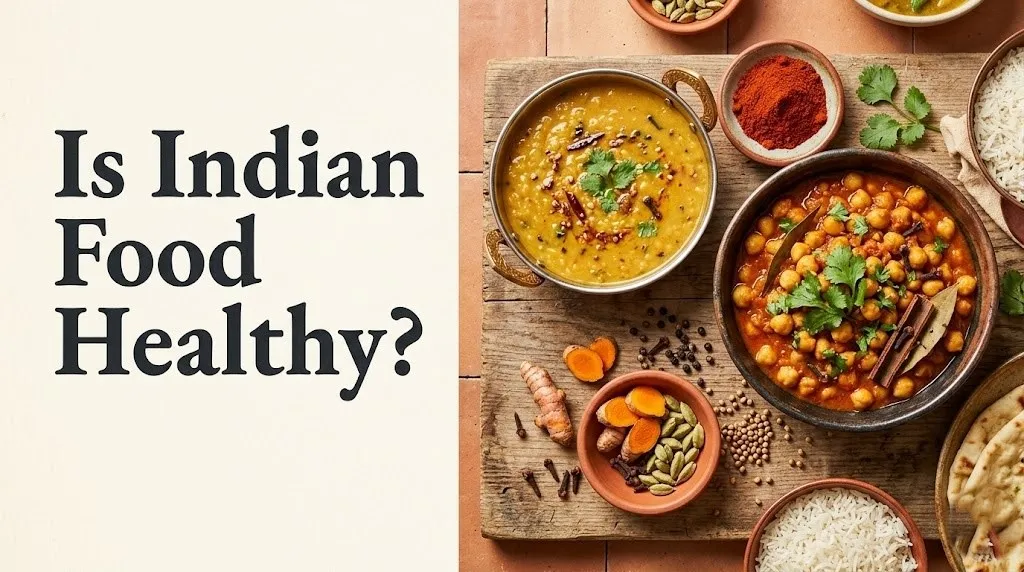
Is Indian Food Healthy?
Indian food is genuinely healthy when it emphasizes its traditional base of lentils, vegetables, legumes, and spices, but restaurant versions often add cream, butter, and refined carbohydrates that change the nutritional equation considerably.
The foundation of Indian cooking across most regional traditions is plant-forward: lentils (Lens culinaris), chickpeas (Cicer arietinum), tomatoes, onions, garlic (Allium sativum), ginger (Zingiber officinale), and an array of spices with documented bioactive compounds. This base provides substantial dietary fiber, plant protein, and micronutrients including iron, folate (vitamin B9), and potassium.
Where Indian food gets nutritionally complicated is the restaurant adaptation, particularly in North Indian-influenced menus common in the UK, US, and Australia. Restaurant gravies frequently use cream, butter, and ghee (clarified butter) at levels well above what a home cook would use, which increases saturated fat and calorie density considerably.
The honest answer is that the same cuisine contains some of the most nutrient-dense dishes available at any restaurant table, alongside some of the richest, most calorie-dense preparations on any menu. The dish you choose matters more than the cuisine you’re eating from.
| Dish Category | Typical Preparation | Nutritional Orientation |
|---|---|---|
| Dal, chana masala, rajma | Simmered legumes, spiced | High fiber, high protein, lower fat |
| Tandoori proteins | Dry-heat grilled in tandoor | High protein, lower fat, moderate sodium |
| Vegetable curries (dry) | Spiced, sautéed | Low calorie, micronutrient-rich |
| Cream-based curries | Butter, cream, cashew gravy | High saturated fat, high calorie |
| Deep-fried items | Samosa, pakora, puri | High fat, high calorie |
| Breads (whole wheat) | Roti, chapati | Moderate carbs, some fiber |
| Breads (refined/fried) | Naan, paratha, puri | Higher refined carbs, higher fat |
People with celiac disease or non-celiac gluten sensitivity should note that wheat flour is used extensively in Indian breads and occasionally as a thickener in gravies. Rice-based dishes and most dal preparations are naturally gluten-free.
Indian Food Nutrition Facts
Indian food’s nutritional profile varies more widely by dish than almost any other cuisine, ranging from high-fiber, high-protein legume dishes to cream-saturated restaurant gravies with three times the calorie density.
The most nutritionally consistent feature of Indian cuisine is its use of dietary fiber from legumes and vegetables. The Academy of Nutrition and Dietetics recommends 25 grams of fiber per day for adult women and 38 grams per day for adult men. A single cup of dal tadka (spiced cooked lentils) provides approximately 6 to 8 grams of dietary fiber, making one serving a meaningful contribution to the daily target.
Plant protein is Indian cuisine’s other standout nutritional feature. Lentils provide approximately 9 grams of protein per cooked half-cup. Chickpeas provide approximately 7 to 8 grams per half-cup cooked. These compare favorably to animal protein sources in the context of total calorie density.
The micronutrient picture is strong across vegetable and legume-based dishes. Iron (particularly non-heme iron from lentils and spinach), folate, potassium, calcium (from dairy-containing dishes), and beta-carotene (from tomatoes, carrots, and turmeric-spiced preparations) all appear at meaningful levels.
People with iron-deficiency anemia should note that non-heme iron from plant sources is less bioavailable than heme iron from meat. Pairing iron-rich Indian dishes with a source of vitamin C (ascorbic acid), such as a tomato-based curry or a fresh lime squeeze, increases non-heme iron absorption, according to research reviewed by the NIH Office of Dietary Supplements.
Indian Food Calories by Dish
Indian food calories range from approximately 100 to 150 calories per cup for light vegetable and lentil dishes to 350 to 500 calories per cup for cream-based or fried preparations.
These numbers matter because the Indian food category is often treated as either categorically healthy or categorically indulgent, when the actual caloric spread is enormous. A person eating chana masala (spiced chickpeas) for lunch is eating a very different meal, nutritionally, from someone eating lamb korma (cream and cashew-based curry), even if both are ordering from the same restaurant menu.
| Dish | Serving Size | Approx. Calories | Protein (g) | Fat (g) | Fiber (g) |
|---|---|---|---|---|---|
| Dal tadka | 1 cup (240ml) | 150 to 180 | 9 to 11 | 3 to 5 | 6 to 8 |
| Chana masala | 1 cup | 180 to 220 | 9 to 12 | 4 to 6 | 8 to 10 |
| Tandoori chicken | 2 pieces (approx. 200g) | 200 to 250 | 30 to 35 | 5 to 8 | 0 |
| Palak paneer | 1 cup | 250 to 300 | 12 to 15 | 18 to 22 | 3 to 4 |
| Butter chicken | 1 cup | 300 to 400 | 25 to 30 | 18 to 25 | 1 to 2 |
| Lamb korma | 1 cup | 380 to 480 | 22 to 28 | 28 to 36 | 1 |
| Samosa (1 piece) | 1 piece (approx. 60g) | 130 to 180 | 3 to 4 | 7 to 10 | 2 |
| Naan (plain) | 1 piece (approx. 90g) | 260 to 310 | 8 to 9 | 5 to 7 | 1 |
| Basmati rice (cooked) | Half cup (90g) | 100 to 110 | 2 to 3 | 0.2 | 0.3 |
| Mango lassi | 1 glass (300ml) | 200 to 280 | 5 to 7 | 3 to 5 | 0.5 |
People with Type 2 diabetes or those managing blood glucose should pay specific attention to the carbohydrate-dense items in the list: white basmati rice, naan, and mango lassi all carry high glycemic loads relative to their fiber content.
Key Takeaway: Indian food’s nutritional profile ranges from genuinely excellent (high-fiber legume dishes, grilled tandoori proteins) to calorie-dense (cream gravies, deep-fried snacks). The dish you choose matters far more than the cuisine category.
Health Benefits of Spices in Indian Food
Indian cooking uses a collection of spices with documented bioactive compounds that have been studied for antioxidant, anti-inflammatory, and metabolic effects in human research trials.
The most studied of these is curcumin, the primary polyphenol in turmeric (Curcuma longa). Research published in the Nutrients journal and the American Journal of Clinical Nutrition has found curcumin to have antioxidant properties in laboratory and some human studies, though bioavailability from food alone is limited. Piperine, the active alkaloid in black pepper (Piper nigrum), has been shown to increase curcumin absorption by up to 2,000% when the two are consumed together, according to research published in Planta Medica. Traditional Indian cooking combines these spices naturally in masala blends.
Fenugreek (Trigonella foenum-graecum) seeds, used in many Indian spice blends and bread recipes, have been studied for effects on postprandial (post-meal) blood glucose. Research published in the Journal of Ethnopharmacology found that fenugreek seed supplementation was associated with modest reductions in blood glucose response in people with Type 2 diabetes, with effects attributed to its galactomannan fiber content and the compound trigonelline.
Other well-researched spice compounds in Indian cooking include:
- Allicin from garlic (Allium sativum): studied for potential blood pressure and cholesterol effects in human trials reviewed by the NIH
- Gingerols from fresh ginger (Zingiber officinale): associated with reduced nausea and anti-inflammatory effects in peer-reviewed trials
- Capsaicin from chili peppers (Capsicum annuum): studied for effects on metabolism and appetite regulation in research published in the British Journal of Nutrition
- Eugenol from cloves (Syzygium aromaticum): studied for antioxidant activity
- Cineole from cardamom (Elettaria cardamomum): associated with digestive effects in preliminary research
People taking blood-thinning medications including warfarin should use large quantities of turmeric and ginger in food preparations consistently rather than sporadically, as both compounds may affect platelet function at high supplemental doses. Culinary quantities in everyday cooking are generally not a concern, but high-dose spice supplementation warrants discussion with a prescribing physician.
Is Turmeric Good for You?
Turmeric (Curcuma longa) is good for you as a culinary spice, delivering curcumin and other polyphenols with antioxidant properties, though curcumin’s bioavailability from food sources alone is low and supplements carry different considerations than culinary use.
Ground turmeric powder contains approximately 3 to 5% curcumin by weight. A teaspoon of turmeric used in cooking (approximately 3 grams) provides roughly 90 to 150 milligrams of curcumin. Human clinical trials on curcumin have typically used supplemental doses of 500 to 2,000 milligrams per day, which is far above what regular turmeric-spiced cooking delivers.
The Harvard T.H. Chan School of Public Health notes that while early research on curcumin is promising, most high-quality human trials have used curcumin supplements rather than dietary turmeric, and direct extrapolation from supplement research to food intake is scientifically imprecise.
The practical benefit of cooking with turmeric regularly is real, even if modest compared to supplement doses. Traditional Indian cooking pairs turmeric with black pepper and fat-containing ingredients, which together improve curcumin absorption. The spice also contributes iron, manganese, and vitamin B6 in culinary amounts.
Quick Tip:
- Add black pepper to any turmeric-spiced dish to improve curcumin bioavailability.
- Cooking turmeric briefly in a small amount of oil (standard Indian tempering technique) further improves absorption of its fat-soluble compounds.
- People considering high-dose curcumin supplements rather than culinary turmeric should discuss this with the physician managing any relevant conditions, as supplemental doses interact with anticoagulants and some chemotherapy medications.
Is Ghee Healthy?
Ghee (clarified butter, anhydrous milk fat) is a natural, minimally processed fat that is nearly lactose-free and high in saturated fat, making it neither universally harmful nor unlimited in its healthfulness depending on total dietary fat intake.
Ghee is produced by simmering butter (Brassica dairy) to remove water and milk solids, leaving nearly pure butterfat. A tablespoon of ghee contains approximately 130 calories and 9 grams of saturated fat, which represents about 45% of the American Heart Association’s recommended daily maximum of 13 grams of saturated fat on a 2,000-calorie diet.
Unlike standard butter, ghee is essentially free of lactose and casein (milk protein), because these components are removed with the milk solids during clarification. This makes ghee a practical option for people with lactose intolerance who want a butter-like fat in cooking. People with a true dairy protein allergy should note that trace casein may remain and should approach ghee cautiously.
Ghee does contain conjugated linoleic acid (CLA) and butyric acid, two compounds that have been studied for potential metabolic and intestinal health effects. Research in this area is ongoing and has not established strong clinical recommendations for ghee consumption specifically. Ghee should not be marketed internally or externally as a health food on the basis of these compounds without appropriate caveats about the current evidence level.
| Fat Source | Calories per tbsp | Saturated Fat (g) | Smoke Point |
|---|---|---|---|
| Ghee | 130 | 9 | 232°C (450°F) |
| Butter | 100 | 7 | 177°C (350°F) |
| Extra-virgin olive oil | 120 | 1.9 | 190°C (375°F) |
| Coconut oil | 120 | 11 | 177°C (350°F) |
| Canola oil | 120 | 1 | 204°C (400°F) |
Key Takeaway: Ghee is a flavorful cooking fat that’s almost entirely lactose-free, but its high saturated fat content means it works best as a finishing fat or flavor enhancer used in small amounts, not as a daily cooking oil used in large quantities.
Is Paneer Healthy?
Paneer (fresh acid-set cow’s milk cheese) is a nutritionally dense food that provides concentrated protein and calcium alongside substantial saturated fat, making portion size the key variable in its healthfulness.
Per 100 grams, paneer contains approximately 265 calories, 18 grams of protein, 20 grams of fat (of which approximately 13 grams are saturated), and 200 to 250 milligrams of calcium (roughly 20 to 25% of the daily value for most adults). It’s one of the higher-protein, higher-fat vegetarian foods available in any cuisine.
For vegetarians, particularly in the Indian dietary tradition where many people avoid meat, paneer serves as a primary protein source. The Academy of Nutrition and Dietetics recognizes that well-planned lacto-vegetarian diets including dairy can meet all protein and calcium requirements at any life stage.
The consideration with paneer is the cooking context. Eaten as a modest addition to a vegetable dish, paneer’s protein-to-calorie ratio is reasonable. Eaten in a cream-based dish like shahi paneer or paneer makhani, where the gravy already carries 200 to 300 calories per cup before the paneer is added, the combined calorie and saturated fat load becomes more relevant.
People with lactose intolerance should approach paneer with caution. Unlike ghee, paneer retains lactose from the original milk, and individuals with moderate to severe lactose intolerance may experience digestive discomfort after consuming it. The severity varies by individual lactase activity.
Is Dal Healthy?
Dal (cooked lentils or split pulses, from Lens culinaris and related species) is one of the nutritionally strongest foods in any dietary tradition, delivering high plant protein, soluble and insoluble fiber, iron, folate, and potassium at very low calorie cost.
Think of dal as a nutritional overachiever disguised as a humble soup. One cup provides roughly the fiber of four slices of whole-grain bread, the protein of two eggs, and meaningful amounts of iron and folate, all for approximately 150 to 180 calories. No other staple food in any cuisine delivers that combination at that calorie level as reliably.
According to USDA FoodData Central, cooked lentils per half-cup (approximately 100g) provide:
- Calories: 116
- Protein: 9g
- Dietary fiber: 8g (32% of the recommended daily intake for women)
- Folate (vitamin B9): 179 micrograms (45% of the daily value)
- Iron: 3.3mg (18% of the daily value for men; approximately 9% for women of reproductive age)
- Potassium: 365mg (8% of the daily value)
Lentils are naturally gluten-free, making dal one of the safest Indian dishes for people with celiac disease, provided the preparation doesn’t include wheat-based thickeners or shared cooking surfaces. Lentils are also among the lowest glycemic index legumes studied, with a glycemic index of approximately 21 to 30 depending on preparation method, according to research compiled in the American Journal of Clinical Nutrition.
People following a vegan or plant-based diet should note that lentil iron is non-heme and less bioavailable than heme iron from meat. Pairing dal with a tomato-based preparation (which is standard in most dal recipes) provides vitamin C to enhance non-heme iron absorption.
Key Takeaway: Dal made from lentils or split pulses is one of the most nutrient-dense, low-calorie, high-fiber foods in any cuisine. If you eat Indian food regularly, dal in some form should be a fixture on your plate.
Is Indian Food High in Sodium?
Restaurant-prepared Indian food can be very high in sodium, with some gravy-based dishes containing 600 to 1,200 milligrams of sodium per cup serving, which represents a large fraction of the 2,300 milligram daily limit recommended by the American Heart Association.
The sodium in Indian restaurant food comes primarily from salt used in spice blends and gravies, from commercial tomato pastes and sauces with added sodium, and from restaurant cooking practices that generally use more salt than home recipes to maximize flavor at volume cooking scale.
Home-cooked Indian food is typically far lower in sodium because the cook controls salt addition. Traditional Indian spicing is flavor-forward from spices, aromatics, and acids like tamarind and tomato, meaning a home cook can reduce salt substantially without losing the characteristic flavor profile.
The specific high-sodium items to watch at Indian restaurants include:
- Butter chicken and tikka masala gravies: tomato-cream base often heavily salted, approximately 700 to 900mg sodium per cup
- Samosas and pakoras: seasoned filling plus commercial chutney dips, 300 to 600mg sodium per serving
- Pickle (achaar): concentrated fermented condiment, extremely high sodium per teaspoon
- Papadum with tamarind chutney: moderate calorie but high sodium combination as a starter
- Restaurant raita: lower sodium than main dishes but still contributes 150 to 250mg per serving
People managing hypertension, heart failure, or chronic kidney disease should treat restaurant Indian food as a high-sodium environment by default, request that dishes be prepared with reduced salt, and balance the meal with unsalted, unflavored accompaniments like plain basmati rice.
Healthiest Indian Dishes to Order at a Restaurant
The healthiest Indian dishes to order are tandoori proteins, lentil and legume-based curries, and dry vegetable dishes, all of which provide high nutritional value with controlled fat and calorie loads.
Restaurant menus vary extensively by region, ownership, and the country of operation. An Indian restaurant in the UK, US, Canada, or Australia may use adapted recipes that differ substantially in cream, butter, and oil content from traditional subcontinental preparations. The nutritional data below reflects typical restaurant preparations and should be treated as a guide, not precise data. Readers should ask about preparation methods and ingredients directly.
| Dish | Why It’s a Better Choice | Watch For |
|---|---|---|
| Tandoori chicken or fish | Grilled, high protein, minimal added fat | Sodium in the marinade |
| Dal tadka or dal makhani | High fiber, high protein, plant-based | Dal makhani uses butter; ask for less |
| Chana masala | Chickpea base, high fiber, plant protein | Oil content varies by kitchen |
| Saag (spinach curry, without paneer) | Iron, folate, vitamin K1, low calorie | High in vitamin K1; relevant for warfarin users |
| Raita | Low calorie yogurt condiment, probiotic | Added salt; request plain if on low-sodium diet |
| Tandoori roti or chapati | Whole wheat, lower fat than naan | Portion size; two pieces adds up |
| Mixed vegetable curry (sukhi sabzi) | Low calorie, micronutrient variety | Variable oil content |
Ordering strategies that consistently improve the nutritional profile of an Indian restaurant meal:
- Request gravies on the side for cream-based dishes and add a small amount yourself
- Choose tandoori roti or chapati over naan or paratha to reduce fat and refined flour
- Start with a dal soup or rasam rather than deep-fried appetizers
- Replace white basmati rice with a second serving of dal or vegetable curry for more fiber
- Ask whether cashew paste or cream is used in the gravy before ordering a korma or pasanda
Is Butter Chicken Healthy?
Butter chicken (murgh makhani) is a high-protein dish but also high in saturated fat and calories due to its cream and butter-based gravy, making it an occasional rather than daily choice for most people watching fat intake.
A standard restaurant cup of butter chicken contains approximately 300 to 400 calories, 25 to 30 grams of protein, and 18 to 25 grams of fat, with the fat split between saturated fat from cream and butter and some unsaturated fat from oil. The protein content is strong. The saturated fat load is the limiting factor.
The tomato base of butter chicken’s gravy provides lycopene (the carotenoid in cooked tomatoes, studied for antioxidant properties) and beta-carotene, which are genuine nutritional positives. The dish is not nutritionally empty. The issue is specifically the cream and butter volume, which most restaurant kitchens add liberally.
A practical modification: ordering butter chicken and requesting the sauce be made with plain yogurt instead of heavy cream reduces saturated fat by roughly 40 to 50% while maintaining creaminess. Many restaurants will accommodate this if asked. The dish is also naturally gluten-free in its protein component, though the gravy may be thickened with cornstarch or occasionally wheat flour in some kitchens, so confirming is worth doing for anyone with celiac disease.
People following a ketogenic diet may find butter chicken’s fat content compatible with their macros, but the moderate carbohydrate load from onion, tomato, and any added sugar in the marinade warrants checking.
Key Takeaway: Butter chicken offers strong protein and real lycopene from its tomato base, but the cream and butter gravy makes it a higher-saturated-fat choice. Requesting a yogurt-based modification when ordering is a practical and widely accepted ask at most Indian restaurants.
Is Biryani Healthy?
Biryani is a layered rice and protein dish that ranges from moderately caloric to very high in calories depending on the oil, ghee, and protein used in preparation, with a typical restaurant serving running 450 to 650 calories per plate.
Biryani’s calorie range is wide because the dish varies enormously. A chicken biryani made with skinless chicken, minimal ghee, and aromatic spices sits at the lower end of the range. A lamb biryani cooked with generous ghee and fried onions (birista) sits at the higher end. Vegetable biryani typically lands at 350 to 450 calories per restaurant serving.
The dish’s nutrient profile includes long-grain basmati rice (Oryza sativa var. indica), which has a lower glycemic index than regular white rice due to its high amylose content. Research published in the Journal of Nutrition found that basmati rice has a glycemic index of approximately 50 to 58, compared to regular white rice at 64 to 72, making it a relatively better choice for blood glucose management among white rice varieties.
The spices in biryani, including whole cardamom, cloves (Syzygium aromaticum), cinnamon (Cinnamomum verum), and star anise (Illicium verum), contribute aromatic compounds with studied antioxidant properties, though at culinary quantities their measurable physiological impact is modest.
People eating biryani at restaurants should be aware that the dish frequently contains fried onions (high calorie addition) and sometimes nuts such as cashews or almonds, making it a tree nut allergy concern. Anyone with a tree nut allergy should confirm the preparation with the kitchen before ordering.
Is Indian Food Good for Weight Loss?
Indian food can support a weight-loss eating pattern when it emphasizes lentil and legume-based dishes, grilled proteins, and vegetable preparations, because this style of eating is naturally high in fiber and protein while being relatively low in calorie density.
The fiber and protein combination from Indian legume cooking is particularly well-suited to appetite management. Dietary fiber slows gastric emptying and increases meal satiety, while protein is the most satiating macronutrient per calorie. A meal of dal and chapati provides this combination at approximately 350 to 450 calories for a full serving, which is genuinely filling.
The USDA Dietary Guidelines for Americans 2020-2025 specifically list legumes as a food group associated with healthy weight maintenance in dietary pattern research, a finding consistent with eating traditions where legumes form a daily dietary staple.
Where Indian food works against weight-loss goals is in portion size of calorie-dense items: naan, rice, cream gravies, and fried starters can add 400 to 600 calories to a meal before the main protein dish is even counted. Restaurant portions of biryani alone often exceed 600 calories per serving.
Practical adjustments for weight-conscious Indian food eating:
- Build the plate around dal or chana masala as the protein-fiber anchor
- Use one chapati instead of naan to reduce fat and refined carbohydrates
- Limit rice to half a cup rather than a full-cup restaurant serving
- Skip deep-fried starters entirely and start with raita, salad, or soup
- Treat cream-based gravies as a condiment amount rather than a main
Is Indian Food Good for Diabetics?
Indian food can be a good dietary choice for people managing diabetes when it centers on lentils, chickpeas, non-starchy vegetables, and spiced grilled proteins, all of which have low to moderate glycemic indices.
The research on this is fairly consistent. A study published in the American Journal of Clinical Nutrition found that a dietary pattern high in legumes and non-starchy vegetables, the foundation of many traditional Indian meals, was associated with better postprandial blood glucose control compared to refined carbohydrate-dominant patterns. This aligns with the Indian legume-forward dietary tradition.
The glycemic concerns in Indian food for people with diabetes include:
- White basmati rice: glycemic index of approximately 50 to 58; lower than most white rice but still moderate
- Naan and paratha: made from refined wheat flour, higher glycemic load per serving than whole-wheat roti or chapati
- Mango lassi and sweet beverages: high in added and natural sugars, up to 35 to 45 grams of total sugar per glass
- Sweetened chutneys: mango and tamarind chutneys typically contain 6 to 12 grams of added sugar per tablespoon
- Deep-fried items: samosas and pakoras slow gastric emptying due to fat content, but the refined carbohydrate filling still raises blood glucose
The better choices for blood glucose management within Indian cuisine are dal, chana masala, rajma (kidney beans), saag, tandoori dishes, and any dry vegetable preparation. These consistently produce a lower glycemic response than the rice and bread components of the same meal.
Anyone using insulin or oral hypoglycemic medications should work with a registered dietitian to determine appropriate carbohydrate portions from Indian meal components within their individual management plan. Portion size is as important as food selection for blood glucose outcomes.
Key Takeaway: For people managing diabetes, the lentil and legume dishes at the heart of Indian cuisine are genuinely diet-compatible. The items to limit are the same ones that cause problems in any dietary context: refined bread, white rice in large portions, and sweet beverages.
How to Make Indian Food Healthier
Making Indian food healthier at home centers on three changes: reducing saturated fat in the cooking medium, controlling sodium, and shifting the plate ratio toward legumes and vegetables.
The most impactful single change is adjusting how you use cooking fat. Traditional tadka (tempering) technique uses ghee or oil to bloom whole spices, releasing fat-soluble aromatic compounds. You can reduce the oil quantity by 30 to 50% from most recipe quantities without losing the aromatic effect, because the spice-to-oil ratio matters more than the total oil volume.
For creamy gravies, plain non-fat Greek yogurt is the single most effective substitution for heavy cream. Stir it in off the heat or at very low temperature to prevent curdling. It delivers the same creamy texture with approximately 80% less saturated fat than double cream, and it adds protein. This technique works in any tomato-cream base including butter chicken, tikka masala, and palak.
Specific modifications ranked by nutritional impact:
- Replace heavy cream (1 cup: approximately 820 calories, 55g saturated fat) with plain Greek yogurt (1 cup: approximately 130 calories, 0.5g saturated fat) in gravies
- Reduce ghee or oil in tempering from 3 to 4 tablespoons to 1 to 1.5 tablespoons without loss of flavor
- Switch naan for whole-wheat chapati to add 2 to 3g fiber per piece and reduce fat by 50 to 60%
- Use a non-stick tawa (flat griddle) to cook chapati without added fat
- Add extra lentils or chickpeas to any vegetable curry to increase protein and fiber without calories
- Salt dishes at the table rather than during cooking to allow people to control their own sodium intake
- Include fermented sides like home-made curd (yogurt) or lassi without added sugar for probiotic benefit from live Lactobacillus cultures
People managing sodium-sensitive hypertension should replace commercial spice blends, which often contain added salt, with individual whole or ground spices combined at home without sodium additions.
Healthy Indian Food for Vegans and Plant-Based Diets
Indian cuisine is one of the most vegan-friendly food traditions in the world, with a centuries-old foundation of plant-based cooking that naturally provides protein, iron, fiber, and micronutrients without animal products.
Traditional vegetarian Indian cooking, practiced across wide regions of India including Rajasthan, Gujarat, and much of South India, relies on lentils (Lens culinaris), chickpeas (Cicer arietinum), mung beans (Vigna radiata), kidney beans (rajma) (Phaseolus vulgaris), and a wide range of vegetables as primary protein sources. This pattern closely resembles what the Academy of Nutrition and Dietetics describes as a well-planned plant-based diet capable of meeting all nutritional needs at any life stage.
Removing dairy is the primary adaptation for vegans, since ghee, paneer, yogurt, and cream appear across many popular dishes. The substitutions are manageable:
- Replace ghee with cold-pressed coconut oil (Cocos nucifera) or refined avocado oil for high-heat cooking
- Replace paneer with firm tofu (soybean curd, Glycine max) in equal weight for protein content, though texture differs
- Replace yogurt-based raita with a coconut yogurt version (made from Cocos nucifera milk cultured with Lactobacillus strains)
- Replace cream in gravies with blended cashew cream (soaked raw cashews, pureed) for a rich texture, noting this adds tree nut allergen content
Vegan Indian dishes that require no substitution include: dal tadka, chana masala, aloo gobi (potato and cauliflower), baingan bharta (roasted eggplant/aubergine), rajma, sambar (South Indian lentil and vegetable soup), rasam, and most rice and bread preparations.
The one nutritional gap for vegans eating a traditional Indian diet is vitamin B12 (cobalamin), which is not present in plant foods. The NIH Office of Dietary Supplements recommends B12 supplementation or fortified food consumption for anyone following a strict vegan diet regardless of overall dietary quality.
Key Takeaway: Indian cuisine is one of the easiest food traditions to eat well on as a vegan. The plant-based core of the cuisine already delivers protein, fiber, iron, and folate. The main swap is replacing dairy; the main supplement need is vitamin B12.
Frequently Asked Questions About Indian Food and Health
What is the healthiest Indian dish to order?
Tandoori chicken or fish, dal tadka, chana masala, and dry vegetable preparations are consistently the healthiest choices at an Indian restaurant.
These dishes provide high protein, dietary fiber, and key micronutrients with lower fat and calorie loads than cream or butter-based gravies.
Pairing any of these with a whole-wheat chapati rather than naan further improves the meal’s fiber and fat profile.
Is Indian food good for weight loss?
Indian food supports weight-loss eating when it centers on legume and vegetable dishes with grilled proteins, because these are high in fiber and protein at moderate calorie levels.
The items that work against weight-loss goals are naan, large rice portions, cream gravies, and deep-fried appetizers, all of which add calories rapidly.
Building a plate around dal or chana masala as the protein-fiber core, with one chapati and a vegetable side, delivers a genuinely filling meal in the 450 to 550 calorie range.
Is Indian restaurant food high in calories?
Indian restaurant food varies from approximately 150 calories per cup for lentil dishes to 500 calories per cup for cream-based curries, with portions often larger than what’s served at home.
Restaurant gravies typically use more cream, butter, and oil than home recipes to develop flavor at scale.
Asking about preparation method and requesting modifications like yogurt instead of cream, or sauce on the side, are practical ways to reduce calorie density when eating out.
Can diabetics eat Indian food safely?
People with diabetes can eat Indian food safely by focusing on lentil, chickpea, and vegetable dishes, and limiting white rice, naan, and sweet beverages.
The legume-based dishes at the heart of Indian cuisine have a low to moderate glycemic index and provide fiber that slows blood glucose response after eating.
Anyone managing diabetes with medication or insulin should determine appropriate Indian meal carbohydrate portions with a registered dietitian rather than applying a one-size approach.
Is ghee healthier than butter?
Ghee and butter have similar caloric and saturated fat profiles, with ghee providing approximately 130 calories and 9 grams of saturated fat per tablespoon versus butter’s 100 calories and 7 grams of saturated fat per tablespoon.
The key practical difference is that ghee is nearly free of lactose and casein, making it a usable cooking fat for many people with lactose intolerance, while retaining dairy allergen concerns for people with milk protein allergy.
Neither ghee nor butter should be used as a primary cooking oil in large amounts if saturated fat intake is already at or above the American Heart Association’s recommended daily limit.
The Practical Verdict on Indian Food and Your Health
Indian cuisine, at its foundation, is one of the most nutritionally considered food traditions available. Lentils, legumes, vegetables, and a spice cabinet full of compounds that researchers have spent decades studying: this is real food with genuine nutritional depth.
The restaurant version of that tradition is more complicated. Cream, butter, salt, and deep-frying transform some dishes into high-calorie, high-sodium choices that need the same attention you’d give any indulgent meal.
The actionable path is simple. Learn which dishes reflect the nutritional core (dal, chana masala, tandoori preparations, vegetable curries) and eat those regularly. Treat butter chicken, biryani with ghee-fried onions, and naan with butter as occasional rather than weekly choices. And if you cook Indian food at home, know that swapping cream for Greek yogurt and cutting the oil in your tadka by half costs you almost nothing in flavor and gains you quite a bit in nutritional quality.