Healthy baked chicken breast recipes deliver some of the best protein-to-calorie ratios of any food you can prepare at home. A single 3.5-ounce cooked serving of boneless, skinless chicken breast contains approximately 31 grams of protein and only 165 calories, according to USDA FoodData Central.
That protein content matters beyond just hitting a macro target. The Academy of Nutrition and Dietetics notes that adequate dietary protein supports muscle maintenance, satiety, immune function, and enzyme production. Chicken breast delivers all nine essential amino acids, making it a complete protein source that fits virtually every dietary approach, from Mediterranean to DASH to higher-protein eating plans.
This guide covers the actual cooking science behind staying juicy, the specific nutrients in chicken breast and why they matter, six tested recipe variations, marinade guides, meal prep strategies, and every common mistake that turns an easy dinner into a dry, disappointing slab. You’ll also find clear guidance for low-sodium, gluten-free, and dairy-free modifications throughout.
Healthy Baked Chicken Breast Recipes: What Makes Them Actually Healthy?
Healthy baked chicken breast recipes earn that label because baking requires little to no added fat, preserves the meat’s natural nutrient profile, and avoids the extra calories and oxidized oils that come from deep frying.
Baking is a dry-heat cooking method. Heat surrounds the chicken from multiple directions inside the oven. This means you’re not submerging the meat in oil or adding saturated fat from pan drippings. The chicken’s own natural fat content stays relatively stable during baking, unlike frying, where the meat absorbs cooking oil.
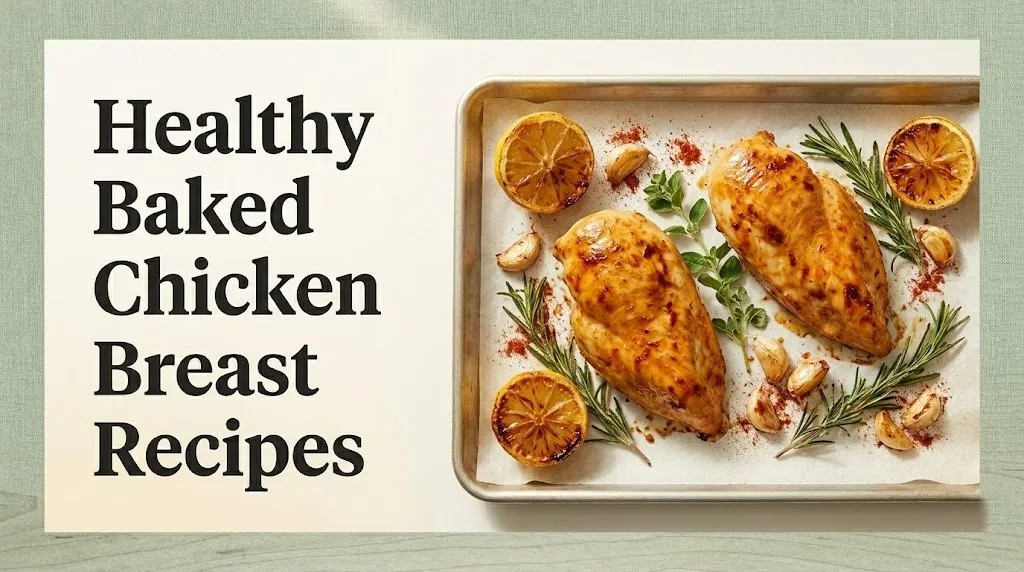
The “healthy” descriptor becomes meaningful only when you consider the full recipe. A baked chicken breast slathered in a heavy cream sauce is not the same nutritional proposition as one rubbed with olive oil, garlic (Allium sativum), and dried oregano (Origanum vulgare). The protein foundation is the same; the surrounding ingredients change everything.
| Cooking Method | Avg. Calories Added per Serving | Saturated Fat Impact | Retained Protein |
|---|---|---|---|
| Baking (light oil) | 30 to 50 | Minimal | High |
| Pan frying (butter) | 80 to 120 | Moderate to high | High |
| Deep frying (battered) | 150 to 200+ | High | Moderate |
| Poaching (water/broth) | 0 to 10 | None | High |
| Grilling | 0 to 30 | Minimal | High |
Quick Tip:
- Choose extra-virgin olive oil (Olea europaea) over vegetable or seed oils for baking. Its monounsaturated fat profile holds better at moderate temperatures.
- Keep added oil to 1 tablespoon per 4 chicken breasts to keep total calories in a reasonable range.
- Skip heavy cream-based sauces if calorie control is a priority; substitute plain Greek yogurt for similar creaminess at a fraction of the calories.
Why Baked Chicken Breast Is a Smart Protein Choice
Baked chicken breast stands out as a smart protein choice because it combines a high complete protein density with a low saturated fat content and a significant package of B vitamins that many people don’t get enough of.
Protein quality is measured in part by its amino acid completeness. Chicken breast contains all nine essential amino acids, including leucine, which research published in the American Journal of Clinical Nutrition has linked to stimulating muscle protein synthesis. This makes it particularly relevant for anyone trying to build or maintain lean muscle mass while controlling overall calorie intake.
Beyond protein, chicken breast is one of the better dietary sources of niacin (vitamin B3), which plays a role in converting food into usable energy. A single 3.5-ounce cooked serving provides roughly 14.8 milligrams of niacin, covering well over 90% of the daily value for most adults, according to USDA FoodData Central data. It’s also a meaningful source of pyridoxine (vitamin B6), which supports neurotransmitter production and immune response.
The saturated fat picture is also favorable. Boneless, skinless chicken breast contains approximately 1 gram of saturated fat per 3.5-ounce serving. The American Heart Association recommends limiting saturated fat to 5% to 6% of total daily calories for heart health. Chicken breast fits comfortably within that framework for most people.
People managing chronic kidney disease (CKD) should be aware that high protein intake from any source, including lean poultry, may require adjustment based on their specific stage of disease. A nephrologist or registered dietitian familiar with CKD can provide appropriate guidance based on current lab values and disease progression.
Baked Chicken Breast Nutrition Facts and Macros
One cooked boneless, skinless chicken breast (approximately 3.5 ounces or 100 grams) contains the following nutritional profile, per USDA FoodData Central:
| Nutrient | Amount per 100g Cooked | % Daily Value (approx.) |
|---|---|---|
| Calories | 165 kcal | 8% |
| Protein | 31g | 62% |
| Total Fat | 3.6g | 5% |
| Saturated Fat | 1g | 5% |
| Carbohydrates | 0g | 0% |
| Niacin (B3) | 14.8mg | 93% |
| Pyridoxine (B6) | 0.9mg | 53% |
| Cobalamin (B12) | 0.3mcg | 13% |
| Selenium | 27.6mcg | 50% |
| Phosphorus | 220mg | 18% |
| Choline | 73mg | 13% |
Selenium deserves specific attention here. The NIH Office of Dietary Supplements notes that selenium functions as an antioxidant cofactor, supporting thyroid hormone metabolism and DNA synthesis. Getting half your daily selenium from one chicken breast serving is a genuinely useful contribution.
Choline, often overlooked in food discussions, is critical for cell membrane structure and neurotransmitter synthesis. The NIH lists choline as an essential nutrient that many adults don’t consume in sufficient quantities, making chicken breast a practical dietary source.
Note that actual values shift based on breast size, which varies. Commercially sold chicken breasts in the U.S. have grown significantly over the past few decades; a single raw breast commonly weighs 8 to 10 ounces, meaning a full breast delivers roughly double the above figures. Adjust serving size to match your actual portion.
Key Takeaway: Baked chicken breast earns its reputation as a healthy protein not just from its calorie count, but from its dense package of B vitamins, selenium, and complete amino acids that many people genuinely fall short on.
What Temperature to Bake Chicken Breast
Bake chicken breast at 425°F (218°C) for the best balance of a well-cooked exterior and a moist interior that hasn’t been subjected to prolonged heat exposure.
The logic is straightforward. Lower temperatures, like 325°F to 350°F (163°C to 177°C), work for slow-roasting larger cuts. For a boneless, skinless chicken breast, that low-and-slow approach means the meat sits at a temperature that drives out moisture for a longer period before the center reaches the safe internal temperature. The result is textural dryness, not undercooked chicken, that’s still safe to eat but noticeably less pleasant.
At 425°F, the surface develops light color and slight texture quickly. The interior reaches 165°F (73.9°C), which is the USDA’s required safe internal temperature for poultry, in approximately 18 to 25 minutes depending on breast thickness. Less time in the oven means less moisture lost.
| Breast Thickness | Baking Temp | Estimated Cook Time | Target Internal Temp |
|---|---|---|---|
| Thin (under 1 inch) | 425°F (218°C) | 15 to 18 minutes | 165°F (73.9°C) |
| Medium (1 to 1.5 inches) | 425°F (218°C) | 20 to 25 minutes | 165°F (73.9°C) |
| Thick (over 1.5 inches) | 425°F (218°C) | 25 to 30 minutes | 165°F (73.9°C) |
| Bone-in, skin-on | 400°F (204°C) | 35 to 45 minutes | 165°F (73.9°C) |
A reliable instant-read food thermometer inserted into the thickest part of the breast, without touching bone, is the only way to confirm doneness. Time estimates are starting points, not safety guarantees.
How Long to Bake Chicken Breast Without Drying It Out
The most effective way to bake chicken breast without drying it out is to use high heat, pound uneven pieces to a uniform thickness, and rest the meat for at least 5 minutes before cutting.
Resting matters because of how protein behaves during heat. As chicken breast cooks, its muscle fibers contract and push moisture toward the center of the meat. Cutting immediately after removing it from the oven releases that pooled liquid onto your cutting board instead of redistributing through the meat. Five minutes of rest allows the muscle fibers to relax slightly and reabsorb that moisture.
Pounding chicken breasts to an even thickness of roughly 3/4 inch to 1 inch before baking removes the thin-end-overcooks-while-thick-end-undercooks problem entirely. Place the breast between two sheets of plastic wrap or in a zip-lock bag and use a meat mallet or the bottom of a heavy pan. Even thickness means even cooking from edge to center.
A 30-minute brine in salted water (1 tablespoon of kosher salt per cup of cold water) before baking adds another layer of moisture protection. Salt enters the meat through osmosis during brining and alters the protein structure slightly, increasing the meat’s ability to retain moisture during cooking. The Academy of Nutrition and Dietetics notes this technique is particularly effective for lean cuts that lack intramuscular fat to self-baste during cooking.
Quick Tip:
- Never skip the rest period. Set a 5-minute timer after pulling the pan from the oven.
- Cover loosely with foil during resting to retain heat without steaming.
- If you’re slicing for meal prep, wait until the chicken is fully cooled to room temperature before cutting.
Healthy Chicken Breast Marinade for Baking
A well-built marinade for healthy baked chicken breast does three things: adds flavor without excess calories, provides an acid component that begins to denature surface proteins for better texture, and creates a thin coating that protects the outer meat from direct oven heat.
Most healthy marinades follow a simple ratio: 3 parts fat, 1 part acid, aromatics to taste. The fat creates a barrier. The acid (lemon juice, wine vinegar, plain yogurt) starts the tenderizing process. Aromatics like garlic, fresh herbs, and spices add flavor with negligible caloric impact.
For baking specifically, avoid marinades with high sugar content (honey-heavy or maple-heavy bases) unless you’re comfortable with the browning and slight caramelization that results. Sugar-heavy marinades can burn at 425°F before the chicken is cooked through. If you want a touch of sweetness, add a teaspoon of honey to a marinade that’s primarily olive oil and lemon juice; that quantity adds roughly 20 calories total to the whole batch.
| Marinade Style | Key Ingredients | Approximate Cal/Serving Added | Dietary Notes |
|---|---|---|---|
| Lemon Herb | Olive oil, lemon juice, garlic, oregano | 40 to 50 | Dairy-free, gluten-free |
| Greek Yogurt Herb | Greek yogurt, garlic, dill, lemon | 30 to 40 | Gluten-free; contains dairy |
| Balsamic Garlic | Balsamic vinegar, olive oil, garlic | 45 to 55 | Dairy-free, gluten-free |
| Cumin Lime | Olive oil, lime juice, cumin, chili powder | 40 to 50 | Dairy-free, gluten-free |
| Low-Sodium Herb | Olive oil, lemon, garlic, herb blend, no added salt | 40 to 50 | Suitable for low-sodium diets |
Marinate for a minimum of 30 minutes and a maximum of 4 hours for boneless, skinless breasts. Beyond 4 hours, high-acid marinades begin to break down the surface proteins too aggressively, resulting in a mushy texture rather than a tender one.
Key Takeaway: A healthy marinade for baked chicken is built on the 3:1 fat-to-acid ratio, uses olive oil and natural acids like lemon juice or yogurt, and marries food safety timing (30 minutes to 4 hours) with maximum flavor payoff.
Best Seasoning for Healthy Baked Chicken Breast
The best seasoning approach for healthy baked chicken breast is a dry rub applied directly to the surface, pressed in gently, and left to rest on the meat for at least 15 minutes before baking.
Dry rubs build a crust during high-heat baking that seals in juices and adds textural contrast without adding fat. They’re also the most flexible approach for adapting to different cuisines and dietary needs in the same cooking session.
A foundational dry rub for healthy baked chicken includes:
- 1 teaspoon smoked paprika (adds color and a mild smoky flavor without fat)
- 1 teaspoon garlic powder (Allium sativum, dried; more concentrated than fresh for rub applications)
- 1/2 teaspoon onion powder
- 1/2 teaspoon dried oregano (Origanum vulgare)
- 1/4 teaspoon black pepper
- 1/4 teaspoon cayenne (optional; omit for low-heat diets)
- 1/2 teaspoon kosher salt (reduce to 1/4 teaspoon for low-sodium requirements)
This combination adds approximately 5 to 10 calories per serving from the spices themselves. The flavor payoff is significant relative to that caloric cost.
For people managing hypertension or following a DASH diet, replacing salt with a combination of smoked paprika, garlic powder, and dried lemon zest creates a convincing savory profile. Lemon zest in particular contains limonene and other volatile aromatic compounds that trick the palate into perceiving more saltiness than is actually present.
People with nightshade sensitivities should note that paprika and cayenne are both derived from peppers (Capsicum annuum), and should substitute with cumin, coriander, or turmeric-based blends instead.
Easy Healthy Baked Chicken Breast Recipe (The Classic)
This healthy baked chicken breast recipe is the base version. It works for meal prep, weeknight dinners, and as a starting point for every variation in the sections that follow.
Ingredients (serves 4):
- 4 boneless, skinless chicken breasts (approximately 6 to 8 oz each), pounded to 1-inch uniform thickness
- 2 tablespoons extra-virgin olive oil
- 2 cloves garlic (Allium sativum), minced
- 1 teaspoon smoked paprika
- 1 teaspoon dried oregano (Origanum vulgare)
- 1/2 teaspoon garlic powder
- 1/2 teaspoon black pepper
- 3/4 teaspoon kosher salt (reduce to 1/4 teaspoon for low-sodium)
- Juice of 1/2 lemon (Citrus limon)
Instructions:
- Preheat oven to 425°F (218°C). Line a rimmed sheet pan with parchment paper or lightly coat an oven-safe skillet with cooking spray.
- Place each chicken breast between two sheets of plastic wrap. Pound with a meat mallet to a uniform 1-inch thickness throughout. This step is not optional if you want even cooking.
- In a small bowl, combine olive oil, minced garlic, smoked paprika, dried oregano, garlic powder, black pepper, salt, and lemon juice. Stir to combine.
- Place chicken breasts on the prepared pan. Pour the marinade over the top and use your hands or a pastry brush to coat all surfaces evenly, including the underside.
- Let the chicken rest with the marinade at room temperature for 15 minutes while the oven finishes preheating. Do not skip this; cold chicken placed in a hot oven takes longer to cook and loses more moisture.
- Bake for 20 to 25 minutes, checking internal temperature at the 20-minute mark. Remove from the oven when the thickest part reads 165°F (73.9°C) on an instant-read thermometer.
- Transfer to a cutting board. Tent loosely with foil. Rest for 5 minutes before slicing.
- Slice against the grain (perpendicular to the direction of the muscle fibers) for maximum tenderness when serving.
Approximate nutrition per serving (1 chicken breast with marinade): 210 to 230 calories, 32g protein, 7g fat, 1g carbohydrates.
This recipe is naturally gluten-free and dairy-free. For a halal-compliant version, verify that the chicken carries halal certification at the point of purchase.
High Protein Baked Chicken Breast for Weight Loss
Baked chicken breast supports weight loss primarily because its high protein content promotes satiety at a relatively low calorie cost, helping reduce overall calorie intake without requiring you to feel chronically hungry.
Research published in the American Journal of Clinical Nutrition found that higher-protein diets, generally defined as providing 25% to 35% of total calories from protein, are associated with greater feelings of fullness and reduced late-day caloric intake compared to lower-protein dietary patterns. Chicken breast is one of the most practical foods for building a higher-protein diet because of its versatility and neutral flavor profile.
One medium cooked chicken breast (approximately 6 ounces or 170 grams) delivers roughly 52 grams of protein at approximately 280 calories. That protein-to-calorie ratio is among the highest of any commonly available animal protein.
| Protein Source | Protein per 100g Cooked | Calories per 100g | Saturated Fat per 100g |
|---|---|---|---|
| Chicken breast (skinless) | 31g | 165 | 1g |
| Salmon (Atlantic) | 25g | 206 | 3.5g |
| 93% lean ground beef | 26g | 218 | 4.5g |
| Canned tuna (in water) | 26g | 128 | 0.3g |
| Tofu (firm) | 8g | 76 | 0.5g |
Weight loss context matters here. Baked chicken breast is a tool, not a solution on its own. The USDA Dietary Guidelines for Americans 2020-2025 emphasize that no single food drives weight management; overall dietary pattern, total calorie intake, and physical activity level determine outcomes. Replacing fried or heavily sauced chicken with a well-seasoned baked version reduces calorie load, but results vary between individuals.
People with diabetes should note that pairing chicken breast with non-starchy vegetables and minimizing high-glycemic accompaniments (white rice, bread) creates a more stable postmeal blood glucose response.
Key Takeaway: The case for baked chicken breast in weight management is built on its exceptional protein-to-calorie ratio and the documented satiety effect of dietary protein, not on any magical fat-burning property of the food itself.
Healthy Baked Chicken Breast with Vegetables
Building a sheet pan dinner with healthy baked chicken breast and vegetables is one of the most efficient ways to create a complete, nutritionally balanced meal with a single pan and minimal active cooking time.
The key challenge is timing. Chicken breast and most vegetables don’t cook at identical rates. Dense root vegetables like sweet potatoes (Ipomoea batatas) and beets need 30 to 40 minutes at 425°F. Cruciferous vegetables like broccoli (Brassica oleracea) and cauliflower (Brassica oleracea var. botrytis) need 20 to 25 minutes. Softer vegetables like cherry tomatoes, asparagus (Asparagus officinalis), and zucchini (Cucurbita pepo) need only 15 to 18 minutes.
To solve the timing problem: start dense vegetables first, add the chicken and medium-density vegetables partway through, and add the softest vegetables in the last 10 minutes.
Sheet Pan Timing Guide:
| Vegetable | Start Time (from oven preheat) | Notes |
|---|---|---|
| Sweet potato cubes | 0 minutes (first in) | Toss in olive oil, salt, pepper |
| Broccoli florets | 15 minutes in | Add alongside chicken |
| Bell peppers (Capsicum annuum) | 15 minutes in | Add alongside chicken |
| Chicken breast | 15 minutes in | After sweet potatoes have a head start |
| Cherry tomatoes | 20 minutes in | Add in final stage |
| Asparagus | 20 minutes in | Add in final stage |
For a complete macro picture, one sheet pan serving of this combination delivers approximately 300 to 340 calories, 33 to 35 grams of protein, 8 to 10 grams of fat, and 18 to 22 grams of carbohydrates depending on vegetable selection and oil quantity.
The cruciferous vegetables in this combination (broccoli, cauliflower) also contribute sulforaphane and indole-3-carbinol, compounds that research has associated with antioxidant activity. This creates a genuinely more nutrient-dense meal than chicken breast alone.
Healthy Baked Boneless Chicken Breast Recipe Variations
Beyond the classic, there are five well-tested healthy baked boneless chicken breast recipe variations that cover different flavor profiles and nutritional goals without straying from the core technique.
Variation 1: Lemon Herb Baked Chicken
Marinade: 2 tablespoons olive oil, zest and juice of 1 lemon (Citrus limon), 2 cloves minced garlic, 1 tablespoon fresh rosemary (Rosmarinus officinalis), 1/2 teaspoon salt. Bake at 425°F for 20 to 25 minutes. Clean, bright flavor with minimal calories added.
Variation 2: Greek Yogurt Baked Chicken
Coat each breast with 3 tablespoons plain whole-milk Greek yogurt mixed with 1 teaspoon each of garlic powder, dried dill, and lemon juice. The yogurt’s lactic acid tenderizes the surface. Contains dairy; substitute with unsweetened coconut yogurt for dairy-free versions.
Variation 3: Smoked Paprika and Cumin Baked Chicken
Dry rub of 1 teaspoon smoked paprika, 1 teaspoon cumin, 1/2 teaspoon garlic powder, 1/4 teaspoon coriander, olive oil to bind. Earthy, warm profile that pairs well with roasted chickpeas (Cicer arietinum) and greens.
Variation 4: Balsamic Glazed Baked Chicken
Whisk 2 tablespoons balsamic vinegar with 1 tablespoon olive oil, 1 teaspoon Dijon mustard (check label for gluten-free certification), and 1 teaspoon honey. Adds approximately 35 calories per serving. Not suitable for strict low-sugar diets.
Variation 5: Cilantro Lime Baked Chicken
Marinade: olive oil, juice of 2 limes (Citrus aurantiifolia), 1/4 cup fresh cilantro (Coriandrum sativum), cumin, and garlic. Bright and herbal. Some individuals experience cilantro as soapy-tasting due to a well-documented genetic variation in olfactory receptor genes; substitute flat-leaf parsley (Petroselinum crispum) if needed.
All five variations are naturally gluten-free when verified ingredients are used. All are dairy-free except Variation 2.
Key Takeaway: The most useful thing about these variations isn’t the individual recipes; it’s understanding that the base technique (425°F, pound to 1 inch, rest 5 minutes) stays constant across all of them. Change the marinade, keep the method.
Low-Sodium Baked Chicken Breast Recipe
A low-sodium baked chicken breast recipe is achievable without flavor sacrifice, because salt is rarely the primary source of flavor in a well-seasoned chicken dish; herbs, acids, and aromatics do most of the actual work.
The American Heart Association recommends limiting sodium intake to 2,300 milligrams per day for most adults, and further suggests that many adults, particularly those with hypertension, may benefit from targeting 1,500 milligrams per day. A standard chicken breast recipe with 1 teaspoon of table salt adds approximately 2,300 milligrams of sodium per batch of four servings, or roughly 575 milligrams per serving.
Reducing salt to 1/4 teaspoon per four breasts drops that to approximately 145 milligrams per serving. Combined with the natural sodium content of chicken (approximately 74 milligrams per 100 grams cooked), the total per serving stays well under 250 milligrams.
Low-Sodium Flavor Builders:
- Lemon zest and juice: Citric acid and aromatic compounds in the zest activate savory perception
- Smoked paprika: Adds depth without sodium
- Garlic powder: More concentrated savory flavor than fresh garlic in dry applications
- Dried herbs (oregano, thyme, rosemary): Add complexity that salt alone can’t replicate
- Balsamic vinegar (small amounts): A teaspoon adds umami-adjacent flavor with minimal sodium
- Black pepper: Its piperine compound enhances flavor perception of other ingredients
Avoid commercial spice blends labeled as “seasoning salt” or “garlic salt,” which typically contain 300 to 500 milligrams of sodium per half teaspoon. Use pure garlic powder, onion powder, and individual dried herbs instead.
People on diuretic medications or with kidney conditions should confirm their specific sodium targets with their treating physician or registered dietitian, as sodium needs can vary substantially based on kidney function and medication type.
Gluten-Free Baked Chicken Breast Recipe
A gluten-free baked chicken breast recipe is simpler to execute than most people expect, because plain chicken breast in its natural state contains no gluten. The risks come from marinades, spice blends, and coatings that introduce wheat-derived ingredients.
The key contamination sources to check:
- Soy sauce: Traditional soy sauce contains wheat. Substitute tamari (verify the label reads “wheat-free”) or coconut aminos.
- Commercial spice blends: Many contain anti-caking agents derived from wheat starch. Buy pure individual spices from brands that process in dedicated gluten-free facilities.
- Dijon mustard: Some brands use wheat-based thickeners. Read labels.
- Breadcrumb coatings: Replace with certified gluten-free rolled oats (Avena sativa, processed in a dedicated GF facility) ground into crumbs, or with almond flour (Prunus dulcis).
For a fully verified gluten-free version of the classic recipe, use pure olive oil, single-ingredient spices (smoked paprika, garlic powder, cumin, oregano), fresh lemon juice, and fresh minced garlic. No label-checking required for those ingredients.
People with celiac disease (an autoimmune condition triggered by gluten ingestion) should also verify that their chicken is not processed in a shared facility with wheat products. Many commercial poultry processors include this information on the packaging or their website. The FDA defines gluten-free as containing fewer than 20 parts per million of gluten.
This recipe variation is also compatible with paleo, Whole30, and grain-free dietary approaches.
Baked Chicken Breast Meal Prep Guide
Meal-prepped baked chicken breast is one of the most efficient ways to ensure high-protein, low-calorie meals are immediately available throughout a busy week without daily cooking effort.
The practical approach: bake four to six chicken breasts at once, cool completely to room temperature, then refrigerate or portion for freezing. According to USDA food safety guidelines, cooked chicken stored in an airtight container in a refrigerator set at or below 40°F (4.4°C) remains safe to eat for up to 3 to 4 days.
For longer storage, cooked chicken breast freezes well for up to 3 months without significant quality loss when stored in airtight freezer bags with excess air removed. Frozen portions thaw overnight in the refrigerator and reheat well by either microwave (covered, with a tablespoon of water added to prevent drying) or in a 325°F oven covered with foil for 12 to 15 minutes.
Meal Prep Serving Ideas:
- Sliced over mixed greens with lemon vinaigrette for a high-protein salad
- Diced into a grain bowl with quinoa (Chenopodium quinoa), roasted vegetables, and tahini
- Shredded and folded into lettuce wraps with cucumber, shredded carrot, and a low-sodium sauce
- Sliced cold over roasted vegetable plates for no-reheat lunches
- Cubed into pasta dishes added after cooking to maintain texture
Reheating safety note: always reheat cooked chicken to an internal temperature of 165°F (73.9°C) before eating. This applies even when the chicken was safely cooked initially. Reheat only the portion you plan to eat; repeated heating and cooling cycles degrade both texture and food safety margins.
Key Takeaway: Baked chicken breast meal prep works when you commit to the 3-to-4-day refrigerator window, reheat to the correct internal temperature, and store in airtight containers immediately after cooling rather than leaving cooked chicken at room temperature for extended periods.
Common Baked Chicken Breast Mistakes to Avoid
Most dry, flavorless baked chicken breast outcomes trace back to five specific, avoidable mistakes rather than any inherent limitation of the ingredient itself.
Think of it like this: chicken breast is like a sponge with a time limit. Handle it correctly and it’s tender, flavorful, and genuinely satisfying. Push it past that limit in the wrong conditions and no sauce, seasoning, or technique will rescue it.
The five most common mistakes:
- Baking straight from the refrigerator: Cold chicken placed in a hot oven cooks unevenly. The exterior overcooks before the center reaches temperature. Remove chicken from the refrigerator 15 to 20 minutes before baking.
- Skipping the pound-to-even-thickness step: Chicken breasts are naturally thicker at one end. Without evening the thickness, the thin end dries out before the thick end is safe.
- Using too low an oven temperature: Baking at 325°F to 350°F extends the time in the oven unnecessarily. High heat at 425°F gets to safe temperature faster, leaving less time for moisture to escape.
- Cutting immediately after removing from the oven: This releases the pooled moisture before it can redistribute. Rest for a minimum of 5 minutes.
- Over-marinating in high-acid mixtures: Citrus or vinegar marinades left on chicken breast for more than 4 hours begin to break down surface proteins, resulting in a mushy texture on the exterior even after baking.
One additional mistake worth naming: relying on time alone instead of using a thermometer. Breast thickness varies enough that a “cook for 25 minutes” instruction can result in either undercooked chicken (a genuine food safety risk) or overcooked chicken (a texture problem). The USDA is clear that 165°F internal temperature is the safety standard, not cooking time.
Frequently Asked Questions About Healthy Baked Chicken Breast
What temperature should I bake chicken breast at for the juiciest result?
Bake chicken breast at 425°F (218°C) for the best combination of moisture retention and properly cooked interior.
Higher heat gets the chicken to a safe internal temperature of 165°F (73.9°C) faster, reducing the total time moisture is being driven out of the meat.
Baking at lower temperatures like 350°F increases total cooking time and consistently produces drier results for boneless, skinless chicken breast.
How many calories are in a healthy baked chicken breast?
A single baked boneless, skinless chicken breast (approximately 3.5 ounces or 100 grams) contains roughly 165 calories with 31 grams of protein, per USDA FoodData Central.
Larger breasts common in U.S. supermarkets often weigh 7 to 10 ounces raw, meaning a full breast may deliver 280 to 460 calories depending on size and marinade.
Tracking weight rather than counting “one breast” gives you the most accurate calorie data.
How do I keep baked chicken breast from drying out?
The three most effective techniques are pounding to even thickness, baking at high heat (425°F), and resting for 5 minutes before cutting.
An optional 30-minute brine (1 tablespoon kosher salt per cup of cold water) before cooking adds further moisture protection by altering protein structure.
Using a food thermometer and pulling the chicken the moment it hits 165°F eliminates the most common cause of dryness: overcooking.
Can I meal prep baked chicken breast and how long does it last?
Cooked baked chicken breast stored in an airtight container in a refrigerator at or below 40°F (4.4°C) remains safe for 3 to 4 days, per USDA food safety guidelines.
Frozen cooked chicken breast maintains quality for up to 3 months when stored in an airtight freezer bag with excess air removed.
Always reheat to an internal temperature of 165°F before eating, regardless of how recently it was cooked.
Is baked chicken breast good for weight loss?
Baked chicken breast is a practical food for weight management because it delivers high protein at a low calorie cost, and dietary protein has a documented satiety effect.
Research published in the American Journal of Clinical Nutrition found that higher-protein diets are associated with reduced total calorie intake and greater feelings of fullness between meals.
Baked chicken breast supports a calorie deficit when it replaces higher-calorie protein sources; it doesn’t cause weight loss independently of the broader dietary pattern.
One Final Note
The best healthy baked chicken breast you’ll ever make is the one you actually cook tonight, not the one you bookmark and forget. Start with the classic recipe, pull it at 165°F, rest it five minutes, and taste what the correct technique actually produces.
Once that click happens, the variations follow easily. The marinade changes. The vegetables rotate. The meal prep rhythm builds on its own.
High-protein, genuinely satisfying dinners don’t require complicated techniques. They require consistent ones.