The foods most commonly cited for killing mice instantly include baking soda, instant mashed potatoes, plaster of Paris, and foods containing xylitol or theobromine. None of them kill instantaneously, but several can cause death within hours to days when consumed in sufficient quantities by a mouse.
This matters because millions of households deal with rodent intrusions each year. According to the Centers for Disease Control and Prevention (CDC), mice can spread more than 35 diseases to humans directly or indirectly, making effective and safe control a real public health concern, not just a nuisance problem.
This article covers how each commonly cited food affects mice at a physiological level, which methods have genuine evidence behind them, which are myths, and how to handle any bait safely in a home with children and pets.
What Food Kills Mice Instantly?
No single food kills mice the moment they eat it. The phrase “kills mice instantly” is widespread online, but it misrepresents how rodent toxicology actually works.
What’s accurate is that certain foods cause fatal physiological responses in mice within a window of a few hours to a few days. The speed depends on the substance, the dose consumed, and the individual mouse’s size and health. A mouse weighing roughly 20 to 30 grams requires only a small absolute quantity of certain substances to reach a lethal threshold, which is why some household items can be genuinely dangerous to rodents.
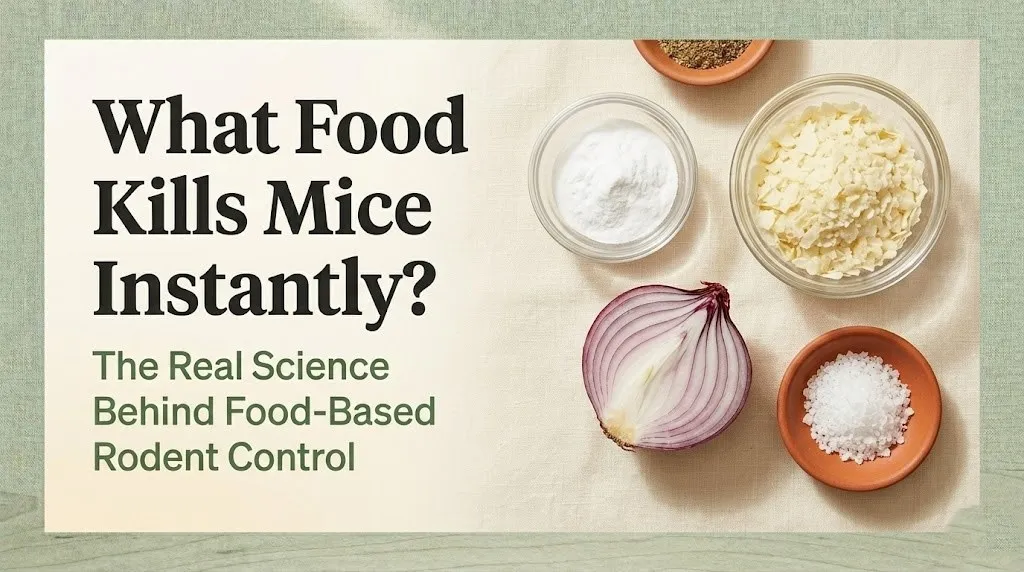
The most evidence-supported options are sodium bicarbonate (baking soda), calcium sulfate hemihydrate (plaster of Paris), and substances containing the sugar alcohol xylitol. Foods like chocolate and onions are toxic to mice but require quantities most mice won’t consume voluntarily from an unsupervised bait.
Key points about food-based mouse control:
- No household food causes truly instant death in mice
- Lethal effect timelines range from several hours to 48 to 72 hours
- Dose is everything: a tiny amount of some substances is fatal; large amounts of others produce no effect
- Bait placement, palatability to the mouse, and household safety all determine whether any method works
- Commercial rodenticides with regulated active ingredients remain more reliable and predictable than DIY food methods
How These Foods Actually Kill Mice: The Toxicological Mechanism
Each food that harms mice works through a distinct physiological pathway. Understanding the mechanism helps you assess which methods are credible and which are folklore.
Sodium bicarbonate (baking soda) is the most frequently cited DIY mouse killer. Mice, unlike humans, cannot burp or vomit. When baking soda reaches the acidic environment of a mouse’s stomach, it reacts with hydrochloric acid to produce carbon dioxide gas (CO2). Because mice lack the reflex to release that gas, pressure builds internally. A 2019 review published in the Journal of Pest Science confirmed that rodents have limited gastric gas-expelling capacity compared to humans, making CO2-producing ingestions genuinely hazardous.
Expanding starches, such as instant mashed potato flakes, work differently. They absorb gastric fluid and expand significantly in volume inside the stomach. For a mouse with a stomach roughly the size of a small grape, this expansion causes severe gastric distension and rupture.
Plaster of Paris (calcium sulfate hemihydrate) hardens when it contacts moisture. Inside a mouse’s digestive tract, it sets into a solid mass that causes obstruction and organ failure.
| Substance | Mechanism | Time to Effect |
|---|---|---|
| Baking soda | CO2 gas production, internal rupture | 2 to 12 hours |
| Instant mashed potatoes | Starch expansion, gastric distension | 4 to 24 hours |
| Plaster of Paris | Hardening mass, intestinal obstruction | 12 to 72 hours |
| Xylitol | Hypoglycemia, liver failure | 6 to 48 hours |
| Theobromine (chocolate) | Cardiac and neurological toxicity | 12 to 72 hours |
| Salt (sodium chloride) | Hypernatremia, seizures, organ failure | Variable, dose-dependent |
Baking Soda as a Mouse Killer: Does It Work?
Baking soda mixed with a palatable attractant is one of the more plausible DIY mouse control methods, primarily because its mechanism is biologically sound and the materials are inexpensive and widely available.
The critical challenge is palatability. Mice are cautious and food-selective. Plain baking soda has a mildly alkaline, off-putting taste. Most pest management researchers and university extension programs recommend combining 1 part baking soda with 1 part powdered sugar or cocoa powder to mask the taste and attract the mouse to the bait.
According to guidance from several university cooperative extension services, including Penn State Extension, baking soda-based baits show some practical effectiveness as a low-cost supplementary control method. They are not a replacement for integrated pest management and work best in low-infestation situations.
To prepare a basic baking soda mouse bait:
- Measure 1 tablespoon of sodium bicarbonate (standard baking soda).
- Measure 1 tablespoon of powdered sugar or cocoa powder.
- Mix thoroughly until evenly combined.
- Place 1 teaspoon portions in small bottle caps or shallow containers.
- Position bait at least 6 inches from any wall, along known mouse travel paths (look for droppings or grease marks).
- Replace bait every 48 hours to maintain freshness and effectiveness.
People with dogs must keep baking soda baits completely inaccessible. Cocoa-mixed bait contains theobromine, which is toxic to dogs.
Key Takeaway: Baking soda can kill mice by producing gas their bodies can’t release, but it only works when mixed with something attractive enough to get the mouse eating it in the first place.
Instant Mashed Potatoes and Mice: The Expanding Starch Method
Dry instant mashed potato flakes are one of the most consistently reported effective DIY mouse baits, and the mechanism behind them is physiologically credible.
Standard instant potato flakes are almost entirely dehydrated starch. When a mouse consumes them dry and then drinks water (mice drink frequently and seek water after eating salty or starchy foods), the flakes absorb moisture and expand dramatically inside the stomach. For context, many instant potato products expand to four to five times their dry volume when fully hydrated. A mouse’s stomach capacity is roughly 1 to 3 milliliters. The math is straightforward.
The practical appeal of this method is that mice find potato flakes genuinely palatable. Plain dry flakes, scattered near a known mouse pathway, require no mixing or preparation. This lowers the barrier compared to baking soda mixtures.
A critical safety note: dry potato flakes are non-toxic to dogs and cats in small quantities, making this one of the slightly safer DIY options in households with pets. However, any bait station should still be placed in a location pets cannot access, since consuming large quantities of dry starch is not without risk for animals either.
University extension programs across the United States have documented field reports of this method producing results, though controlled efficacy studies are limited. It’s regarded as a supplementary measure rather than a standalone infestation solution.
Does Chocolate Kill Mice?
Chocolate is genuinely toxic to mice, but the claim that it “kills mice instantly” is misleading without dose-response context.
Chocolate contains theobromine, a methylxanthine alkaloid that inhibits phosphodiesterase enzymes and blocks adenosine receptors. In mice and other small mammals, this causes cardiac arrhythmia, seizures, and neurological disruption. Dark chocolate and baking chocolate contain the highest theobromine concentrations, ranging from 130 to 450 milligrams per ounce depending on cacao content. Milk chocolate contains far less.
The challenge is that a mouse would need to consume a relatively meaningful quantity of chocolate to reach a lethal dose, and mice are erratic, cautious eaters. Unlike baking soda or instant potato flakes, chocolate doesn’t offer a mechanical, dose-efficient kill mechanism.
More importantly: theobromine is highly toxic to dogs and cats. According to the ASPCA Animal Poison Control Center, as little as 0.1 ounce of baking chocolate per pound of body weight can be lethal to a dog. Using chocolate as a rodent bait in any household with a dog creates a serious secondary poisoning risk.
Chocolate is better understood as a bait attractant than a reliable killing agent on its own. If you’re using it at all, it should be combined with a more mechanically reliable killing substance, like baking soda.
Key Takeaway: Instant mashed potatoes work through a simple physical mechanism mice can’t counteract, and chocolate is real but slow rodent poison that creates unacceptable secondary risk for dogs.
Salt and Onions: Are They Genuinely Lethal to Mice?
Salt (sodium chloride) and onions are both toxic to mice at sufficient doses, but neither is a practical or reliable instant-kill method for household use.
Salt causes hypernatremia (sodium toxicity) in mice. A mouse’s body, operating on a much smaller fluid volume than a human’s, can reach dangerous serum sodium levels from relatively modest salt intake. The lethal dose of sodium chloride in rodents is roughly 3 to 4 grams per kilogram of body weight in acute exposure studies. For a 25-gram house mouse, that translates to approximately 0.075 to 0.1 grams of pure sodium. Table salt is 40% sodium by weight, so roughly 0.2 grams of table salt in a concentrated dose could be lethal.
The practical problem is palatability. Mice avoid highly salted foods instinctively. Getting a mouse to consume a toxic dose of salt voluntarily is unreliable.
Onions (Allium cepa) contain allyl disulfide and related organosulfur compounds that cause oxidative damage to red blood cells in rodents and many other mammals. Raw onion is genuinely toxic at sustained exposure, but mice tend to avoid the smell of fresh onion, making it more of a repellent than a reliable kill method.
| Food | Toxicity Mechanism | Practical Lethality Rating | Pet Safety Risk |
|---|---|---|---|
| Salt | Hypernatremia | Low (palatability problem) | Low at bait quantities |
| Raw onion | Organosulfur oxidative damage | Low (acts as repellent) | High for dogs and cats |
| Garlic (Allium sativum) | Same as onion | Very low | High for dogs and cats |
Xylitol and Artificial Sweeteners: Rodent Toxicity Explained
Xylitol, a sugar alcohol (chemical formula C5H12O5) used as a sugar substitute in many chewing gums, peanut butters, and baked goods, is acutely toxic to several mammal species, including mice.
In rodents and dogs, xylitol triggers a rapid, exaggerated insulin release from the pancreas. Blood glucose crashes severely in a condition called hypoglycemia. At higher doses, it causes direct hepatotoxic (liver-damaging) effects leading to liver failure. According to the ASPCA Animal Poison Control Center, xylitol is one of the most acutely dangerous household substances for dogs, with effects beginning within 30 to 60 minutes of ingestion.
For mice, the mechanism is the same. A small quantity of xylitol-containing food, if consumed in sufficient amount, can produce fatal hypoglycemia relatively quickly compared to other DIY methods.
The serious problem with using xylitol as a mouse bait is the secondary poisoning risk it poses for dogs. Xylitol is present in many seemingly benign products: sugar-free peanut butter (a common trap bait), sugar-free candy, some vitamins, and certain baked goods. Anyone using peanut butter as a trap attractant should verify it contains no xylitol before using it in a home with a dog.
Other artificial sweeteners, including aspartame and sucralose, are not meaningfully toxic to mice at practical bait quantities. The xylitol risk is specific to that compound.
Plaster of Paris Mouse Bait: Risks and Realities
Plaster of Paris, the common name for calcium sulfate hemihydrate (CaSO4·0.5H2O), is one of the older folk remedies for mouse control, and it does have a credible kill mechanism.
When mixed with water, plaster of Paris undergoes an exothermic setting reaction, hardening into a rigid solid. Inside a mouse’s digestive tract, it contacts gastric fluid and intestinal moisture and sets, creating a hardened mass that causes complete intestinal obstruction and death through organ failure.
The traditional bait preparation combines plaster of Paris with flour and a small amount of cocoa powder or powdered sugar to improve palatability. Ratios commonly cited in historical pest management literature suggest 1 part plaster of Paris to 1 part flour, with enough water to form a paste, then dried into pellet shapes.
The practical concerns are real:
- Plaster of Paris is a construction material, not a food-grade product. It may contain impurities or additives depending on brand.
- It hardens unpredictably in humid environments before a mouse even encounters it, reducing reliability.
- The bait is not tamper-resistant and poses a risk if found by young children or pets.
USDA Wildlife Services guidance on integrated pest management consistently emphasizes tamper-resistant, commercially formulated bait stations over DIY preparations for exactly these safety and reliability reasons.
Key Takeaway: Xylitol is one of the fastest-acting food-based rodent killers, but its extreme danger to dogs makes it one of the riskiest to use as a DIY bait in most households.
Homemade Mouse Bait Recipes That Actually Attract Mice
The most effective homemade mouse baits combine a mechanically lethal ingredient with a genuinely palatable attractant that overrides a mouse’s natural food neophobia.
Mice are not reckless eaters. They’re cautious foragers that often test new foods in tiny amounts before committing. This is called “bait shyness,” and it’s the reason one-time DIY baits often fail. Consistent availability matters more than potency.
Three practically viable homemade bait formulations:
Formulation 1: Baking Soda and Peanut Butter Bait
This uses peanut butter’s fat content and strong scent to attract mice, with baking soda as the active agent.
- Combine 1 teaspoon baking soda with 1 tablespoon peanut butter (verify it contains no xylitol).
- Mix until evenly blended. The mixture should hold its shape.
- Roll into pea-sized balls (roughly 1 centimeter in diameter).
- Place balls in areas with confirmed mouse activity.
- Replace every 48 hours as peanut butter oxidizes and loses attractiveness.
Formulation 2: Instant Potato Bait
Place 1 to 2 teaspoons of dry instant mashed potato flakes directly near a water source or a mouse pathway. No mixing needed. Ensure a water source is within the mouse’s normal range.
Formulation 3: Baking Soda and Powdered Sugar
Combine equal parts baking soda and powdered (icing) sugar. Place half a teaspoon in a bottle cap. Replace every 24 to 48 hours.
People with dogs should not use peanut butter-based baits without confirming the brand is xylitol-free. The ASPCA Animal Poison Control Center hotline is available at all hours for pet poison emergencies.
Foods Mice Hate and Natural Repellents
Mice avoid certain strong-smelling substances consistently enough that they function as practical deterrents, even if none eliminate an existing infestation on their own.
The most documented natural repellent is peppermint oil (Mentha piperita). A 2014 study published in the Journal of Pest Science found that high-concentration peppermint oil reduced rodent activity in treated zones compared to controls. The active compound, menthol, appears to overwhelm rodent olfactory receptors. Saturating cotton balls with pure peppermint essential oil and placing them in entry points, corners, and under appliances shows short-term deterrent effect.
Foods and substances mice demonstrably avoid:
- Fresh raw onion and garlic: The allyl disulfide compounds act as olfactory deterrents, not just internal toxins
- Cayenne pepper (capsaicin): Rodents have capsaicin receptors and generally avoid high-capsaicin environments
- Cloves and clove oil (eugenol): Strong aromatic deterrent with limited research but consistent anecdotal reports
- Bay leaves: A traditional pantry protectant; the linalool and other volatile compounds repel many insects and rodents
- Ammonia: Mimics the scent of predator urine; mice avoid it, though it’s an irritant in enclosed spaces
Think of these repellents like a yellow light at an intersection. They slow and redirect mice; they don’t stop the car. A mouse that’s hungry, cold, or already established in a wall cavity will push through a peppermint deterrent. Repellents work best as part of exclusion, not as a standalone solution.
Mouse Bait Safety Around Pets and Children
Any food-based mouse control method poses secondary poisoning or ingestion risks for pets and young children, and this consideration must come before choosing a bait type.
The substances most dangerous to dogs that overlap with mouse baits include:
- Xylitol: Acutely lethal to dogs even in small quantities
- Theobromine (chocolate): Toxic to dogs and cats; risk scales with body weight and chocolate type
- Allium compounds (onion, garlic): Toxic to both dogs and cats, causing hemolytic anemia
- Baking soda in large quantities: Can cause sodium toxicity in dogs if consumed directly
According to the American Veterinary Medical Association (AVMA), rodent bait secondary poisoning in household pets is a documented and preventable problem. The organization recommends tamper-resistant bait stations as a minimum safety requirement for any household using rodenticide methods.
For households with children under five or free-roaming pets, best practice recommendations from NPMA-affiliated pest management professionals include:
- Use only enclosed, tamper-resistant bait stations (available at hardware stores for under $15)
- Place stations in locations physically inaccessible to children and pets, such as inside walls via bait station openings, inside cabinets with child locks, or in crawl spaces
- Never scatter loose food baits on floors or open surfaces
- Check bait stations every 48 to 72 hours and remove dead rodents promptly to prevent secondary exposure
Key Takeaway: The biggest risk in DIY food-based mouse control isn’t whether the bait kills mice. It’s whether it also harms the dog, cat, or toddler who finds it first.
Mouse Trap Bait: Which Foods Work Best as Lure
The best foods for baiting snap traps or live traps are different from kill-mechanism foods. Here, palatability and scent are the only goals.
Research and field experience from pest management professionals consistently point to a short list of highly effective attractants. Peanut butter tops every practical list because its fat content carries scent over distance and its sticky texture means a mouse can’t grab it and run. A hazelnut spread (like standard Nutella, without xylitol) performs comparably.
Other high-performing trap baits include:
- Nesting materials over food: According to university extension guidance, placing a small piece of cotton ball or dental floss near the trap trigger attracts nesting-focused mice as effectively as food, especially females
- Chocolate: Small smear of milk chocolate on a snap trap trigger; the scent is highly attractive even if the quantity consumed is sub-lethal
- Dried fruit: Raisins or small pieces of dried apricot work well in live traps
- Bacon or cooked meat: High fat, strong scent, particularly effective in cold months when mice prioritize calorie-dense foods
- Pet kibble (dry dog or cat food): Ironically effective, because it smells like animal-based protein
One critical bait technique note: use less than you think. A pea-sized amount of peanut butter is more effective than a large dollop, because a small quantity forces the mouse onto the trigger mechanism rather than allowing it to lick from the edges.
Signs of a Mouse Infestation in Your Home
The earliest reliable sign of a mouse infestation is small, dark droppings, roughly the size and shape of a grain of uncooked rice, along walls, behind appliances, and inside cabinets.
Mice are nocturnal and cautious, so most people hear them before they see them. A faint scratching or scurrying sound inside walls, especially in the 30 minutes after the house goes quiet at night, is a consistent early indicator. The smell is also distinctive: active mouse activity produces a musky, ammonia-like odor from urine, which becomes noticeable in enclosed spaces like under sinks or inside pantry cabinets.
Other clear infestation indicators:
- Gnaw marks: Mice gnaw continuously to manage incisor growth. Look for small, rough-edged chew marks on food packaging, baseboards, wood trim, and electrical wiring insulation.
- Grease marks: Mice travel consistent routes and leave oily smear marks along baseboards and walls from the oils in their fur.
- Nesting materials: Shredded paper, fabric, insulation, or plant matter gathered into a hidden corner indicates an active nest.
- Food damage: Partially eaten items in pantries, especially grains, nuts, chocolate, and cereals.
The CDC notes that mouse droppings can carry hantavirus, leptospirosis, and salmonella. Droppings should never be swept or vacuumed, as this aerosolizes particles. Dampen droppings with a bleach solution (1 part bleach to 9 parts water), then wipe with paper towels and dispose of in a sealed bag.
When to Call a Pest Control Professional
Call a licensed pest control professional when you find droppings in three or more locations, hear activity inside walls, or when DIY methods have failed after two weeks.
These thresholds matter because a mouse sighted once may be an isolated entry. But multiple droppings in different areas of a home, combined with sound in walls, almost always indicates an established colony, not a lone animal. House mice (Mus musculus) reproduce rapidly: a single female can produce 5 to 10 litters per year of 3 to 14 pups per litter. A two-mouse problem becomes a forty-mouse problem within a single season without intervention.
Licensed pest management professionals bring three things DIY methods cannot fully replicate: entry-point identification and physical exclusion (sealing the actual gaps mice use to enter), bait placement expertise using commercially formulated rodenticides in properly sited tamper-resistant stations, and follow-up monitoring.
According to the National Pest Management Association (NPMA), rodents are one of the most common reasons Americans contact pest control companies, with mice accounting for a large share of residential rodent calls. The NPMA recommends inspection and professional treatment when an infestation is confirmed inside a structure rather than just in outdoor areas adjacent to it.
If you’re seeing mice during daylight hours, that’s a meaningful escalation signal. Mice are nocturnal by nature. Daytime activity typically indicates a population large enough that competition for food has pushed individuals out of their normal patterns.
Key Takeaway: Signs of infestation tell you whether you’re dealing with one mouse or a growing colony. The answer changes everything about what method you should use.
Frequently Asked Questions About What Foods Kill Mice
What food kills mice instantly at home?
No food kills mice the moment they eat it, despite what many websites claim.
Baking soda mixed with sugar, dry instant mashed potato flakes, and plaster of Paris preparations can cause death in mice within a few hours to a few days, depending on dose and mouse size.
These are supplementary control methods best used alongside snap traps or professional pest management, not as standalone instant solutions.
Is baking soda safe to use around dogs for killing mice?
Baking soda in small quantities is not acutely dangerous to dogs, but any bait mixing baking soda with cocoa powder or chocolate introduces theobromine, which is toxic to dogs.
The bigger risk is placement: any loose bait that a dog can access directly could cause problems if consumed in large quantities.
Place baking soda baits inside enclosed, tamper-resistant bait stations to prevent dog access.
Do instant mashed potatoes really kill mice?
Yes, dry instant mashed potato flakes are one of the more credible DIY mouse control methods.
Mice that consume dry flakes and then drink water experience severe stomach expansion that their small digestive systems can’t accommodate.
Scattered dry flakes near known mouse pathways and water sources is the simplest application method.
What smells do mice hate the most?
Mice consistently avoid the strong scent of peppermint oil (Mentha piperita), fresh raw onion, cayenne pepper, clove oil, and ammonia.
A 2014 study in the Journal of Pest Science found peppermint oil reduced rodent activity in treated areas compared to controls.
These repellents work best at points of entry as a preventive deterrent; they won’t drive out an established infestation.
When should I call an exterminator instead of using food baits?
Call a licensed pest control professional when you find droppings in three or more separate areas, hear activity inside walls, or when two weeks of DIY methods have produced no reduction in activity.
The National Pest Management Association recommends professional treatment once mice are confirmed inside the structure itself, not just in outdoor perimeter areas.
Established infestations grow faster than most DIY methods can address them.
Final Word
The foods that can genuinely harm mice work through real physiological mechanisms: gas accumulation, gastric expansion, intestinal obstruction, or metabolic failure. These aren’t myths, but they’re not magic either. Dose, placement, palatability, and household safety determine whether any of them actually work in your specific home.
Start with dry instant potato flakes or a baking soda and peanut butter bait in tamper-resistant stations. Use snap traps baited with peanut butter as your primary mechanical control. If you’re seeing daytime activity or droppings in multiple rooms, skip the DIY phase and call a licensed pest management professional.
The goal isn’t an instant kill. It’s a house with no mice, achieved safely for everyone in it.