A healthy chewing gum is one that uses a natural chicle tree sap base instead of petroleum-derived plastic, is sweetened with xylitol or erythritol instead of aspartame or sugar, and contains no titanium dioxide, BHT, or artificial colors. Most gum sold at the checkout counter fails every one of those criteria.
The gum industry sits in a strange regulatory gap. Manufacturers are not required to disclose the specific ingredients in their “gum base” because it is classified as a proprietary trade secret. What that means in practice is that when you chew a standard stick of gum, you are chewing a soft, flavored plastic polymer, typically polyisobutylene, the same family of synthetic rubber used to make inner tubes and adhesives. The FDA classifies this as generally recognized as safe, but the definition of “food” is being stretched to its limit. The Environmental Working Group has flagged several common gum additives, including BHT and titanium dioxide, as ingredients of concern based on animal studies and the European Union’s precautionary bans.
This article identifies the specific ingredients worth avoiding, explains which sweeteners actually benefit your teeth, and ranks the best available healthy chewing gum brands in 2026. You will learn how to read a gum label in under 30 seconds and pick a product that you can chew without wondering what, exactly, you are swallowing.
Healthy Chewing Gum
Healthy chewing gum is defined by three criteria: a plant-based, biodegradable gum base instead of synthetic plastic, a tooth-friendly sweetener like xylitol or erythritol instead of sugar or aspartame, and the absence of controversial additives including titanium dioxide and BHT. A gum that meets all three criteria is a genuinely different product from the gum sold at most registers.
The gum base is the structural heart of the product. Conventional gum base is a proprietary blend of food-grade polymers, resins, and plasticizers that give gum its chewiness and elasticity. Because the exact formulation is protected as a trade secret, the consumer has no way of knowing the specific chemicals in the base they are chewing. Natural gum brands use chicle, a latex sap harvested from the Manilkara chicle tree in Central America. Chicle is biodegradable, renewable, and has been used for chewing gum for centuries. It behaves differently in the mouth, slightly softer initially, with a less aggressive chew than synthetic base.
The sweetener is the second pillar. Sugar is obviously bad for teeth, feeding the bacteria that produce cavity-causing acids. Aspartame, the most common artificial sweetener in sugar-free gum, has been the subject of decades of safety debates. The FDA maintains that aspartame is safe at current exposure levels, but consumer concern persists. Xylitol and erythritol, by contrast, have a clean safety profile and actively benefit dental health by reducing the population of Streptococcus mutans bacteria and buffering oral pH. A healthy gum sweetened with xylitol or erythritol is not just harmless to teeth. It is actively good for them.
| Attribute | Conventional Gum | Healthy Gum |
|---|---|---|
| Gum Base | Synthetic (plastic polymers, trade secret) | Natural (chicle sap) or biodegradable |
| Sweetener | Aspartame, acesulfame K, sucralose | Xylitol, erythritol, or small amount of cane sugar |
| Colorants | Titanium dioxide, artificial dyes | None or natural fruit and vegetable extracts |
| Preservatives | BHT | None |
| Environmental Fate | Non-biodegradable, persists as litter | Biodegradable |
Key Takeaway: A healthy chewing gum replaces plastic with plant sap, aspartame with xylitol or erythritol, and artificial additives with nothing. The ingredient list should be short and readable.
What Is the Healthiest Chewing Gum
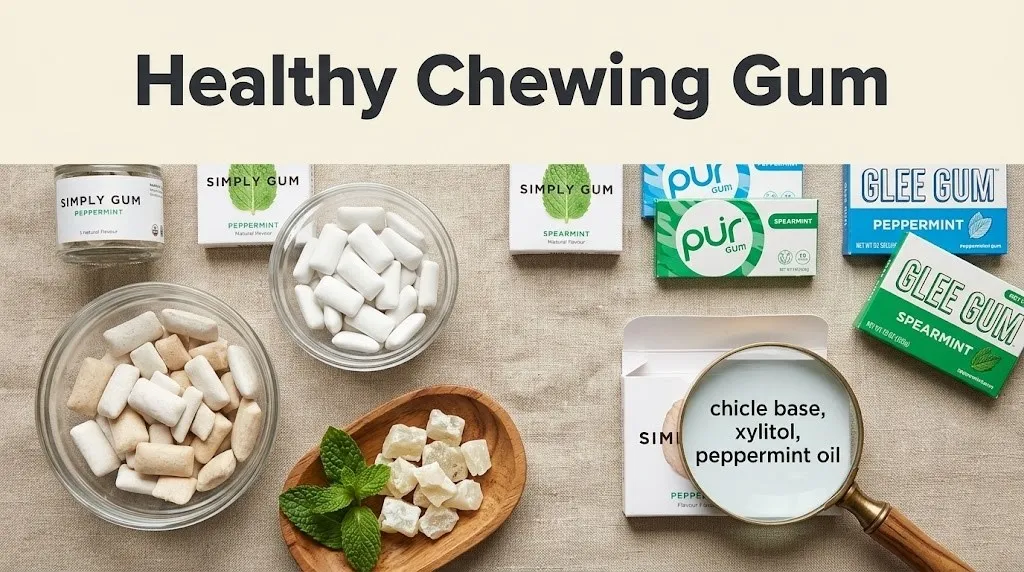
The healthiest chewing gums in 2026 are Simply Gum, Pur Gum, and Glee Gum, all of which use a natural chicle base, avoid artificial sweeteners and titanium dioxide, and are available in flavors derived from real mint oils and spices. These three brands represent the current best-in-class for ingredient transparency and safety.
Simply Gum is the most minimalist option. Its ingredient list is a model of simplicity: organic raw cane sugar, natural chicle base, organic vegetable glycerin, organic rice flour, and natural flavor. The sugar content is small, roughly 1 gram per piece, and is not enough to cause a significant dental acid challenge, especially since the gum stimulates saliva flow that buffers the pH drop. The trade-off for the clean ingredient list is a slightly less explosive flavor and a softer chew that fades faster than synthetic gum.
Pur Gum uses xylitol as its sweetener, which gives it the dental health advantage. The ingredient list includes xylitol, gum base, gum arabic, natural flavors, glycerol, citric acid, and carnauba wax. The gum base in Pur is not chicle but is marketed as aspartame-free and plastic-free. The texture is closer to conventional gum than the chicle-based brands, making it an easier transition for someone used to standard gum. Glee Gum uses chicle base and comes in both sugar-sweetened and xylitol-sweetened varieties, offering a bridge between traditional natural gum and the sugar-free dental health market.
Chewing Gum Ingredients to Avoid
The chewing gum ingredients to actively avoid include aspartame, acesulfame potassium, butylated hydroxytoluene (BHT), titanium dioxide, and any artificial color listed as a number or lake dye. These are not theoretical risks. Several of them are banned in the European Union while still permitted in the United States.
BHT is a synthetic antioxidant used as a preservative. The FDA classifies it as generally recognized as safe, but the European Food Safety Authority has flagged it for its potential endocrine-disrupting properties, and consumer pressure has led many major cereal brands to remove it from their products. Gum remains one of the last widely consumed products to still use BHT.
Titanium dioxide is a whitening agent that gives gum its bright white color. In 2022, the European Union banned titanium dioxide as a food additive based on a review by the European Food Safety Authority that found it could not rule out genotoxicity, the ability to damage DNA. The FDA has not taken similar action, and titanium dioxide remains legal in U.S. food products. Healthy gum brands have universally removed it, relying on the natural off-white color of the gum base instead.
- Aspartame: artificial sweetener, FDA-approved but consumer concern persists.
- Acesulfame potassium: artificial sweetener, often paired with aspartame to mask bitterness.
- BHT: synthetic preservative, potential endocrine disruptor.
- Titanium dioxide: whitening agent, banned in the EU, still legal in the U.S.
- Artificial colors (Red 40, Yellow 5, Blue 1): petroleum-derived dyes with no nutritional function.
Xylitol Gum Benefits
Xylitol-sweetened gum provides a specific, well-documented dental health benefit: it reduces the population of Streptococcus mutans, the oral bacteria primarily responsible for dental caries, by starving the bacteria of fermentable sugar while simultaneously stimulating a protective flow of saliva. This is the reason the American Dental Association grants its Seal of Acceptance to xylitol-containing gum.
The mechanism is elegant. Streptococcus mutans metabolizes fermentable sugars, producing lactic acid that demineralizes tooth enamel. Xylitol is a sugar alcohol that the bacteria cannot ferment. When they take up xylitol instead of sugar, they waste energy without producing acid, and over time, the bacterial population declines. The gum’s physical chewing action also stimulates salivary flow, which raises the oral pH, buffers existing acid, and delivers calcium and phosphate ions that remineralize enamel.
The American Dental Association’s Seal of Acceptance program requires that gum manufacturers demonstrate a minimum reduction in plaque acidity or a minimum increase in salivary flow to qualify. Gums sweetened with xylitol or erythritol meet these criteria. A 2023 meta-analysis in the Journal of Dental Research found that regular use of xylitol gum reduced caries incidence by approximately 30 to 60 percent in children and adolescents, with the strongest effect seen when gum was chewed for 15 to 20 minutes after meals.
- Xylitol starves cavity-causing bacteria and reduces their population over time.
- The mechanical chewing action increases salivary flow, buffering oral acid.
- The American Dental Association grants its Seal of Acceptance to xylitol and erythritol gum.
Chicle Gum Base vs Synthetic
Natural chicle gum base is a biodegradable tree sap harvested from the Manilkara chicle tree, while synthetic gum base is a proprietary blend of petroleum-derived polymers, primarily polyisobutylene, plasticizers, and resins. The difference is the difference between chewing a plant and chewing a flexible plastic.
Chicle is harvested by chicleros, farmers who make diagonal cuts in the bark of the chicle tree, allowing the latex sap to flow down into collection bags. The sap is boiled down into a solid, elastic mass that is then shaped into blocks and sold to gum manufacturers. The process is labor-intensive and sustainable when managed properly. The trees are not cut down. They are tapped like rubber trees, and the same trees can be harvested repeatedly for decades. Chicle gum has a distinct chew. It starts slightly firmer than synthetic gum and softens more quickly. The flavor release is less explosive and fades sooner, which is actually an advantage if you are chewing gum to freshen your breath after a meal rather than for an hour-long sensory experience.
Synthetic gum base is a marvel of modern food engineering. It is consistent, cheap, and can be formulated to produce an extremely long-lasting chew and a powerful initial flavor burst. The trade-off is that it is a petroleum product, it is not biodegradable, and the specific formulation is a trade secret that the consumer cannot evaluate. Discarded synthetic gum is a persistent environmental pollutant. The Singaporean government banned the sale of chewing gum in 1992 in part because of the cost of removing gum wads from public transit seats and sensors. A natural chicle base will biodegrade in the environment. A synthetic base will remain as a plastic residue for years.
Key Takeaway: The gum base is the ingredient most gum brands do not want you to think about. Chicle is plant sap. Polyisobutylene is synthetic rubber. The choice is between renewable and petroleum.
Aspartame in Chewing Gum
Aspartame is the most common non-sugar sweetener in conventional chewing gum, and it remains FDA-approved and classified as safe at current exposure levels, but its presence is one of the primary reasons consumers seek out “healthy” gum alternatives. The controversy is not resolved, but the market has voted with its feet.
Aspartame is a dipeptide composed of two amino acids, aspartic acid and phenylalanine, with a methyl ester group that gives it its sweetness. It is roughly 200 times sweeter than sugar. In the body, it is broken down into its constituent amino acids and methanol. The methanol is produced in very small quantities, less than the amount found in a glass of fruit juice. For the general population, this metabolic pathway is not a health concern. For people with phenylketonuria, a rare genetic disorder, the phenylalanine from aspartame is dangerous and must be avoided.
The consumer concern around aspartame is largely driven by a series of animal studies in the 1990s and 2000s that suggested a possible link to cancer, studies that were reviewed by the FDA, the European Food Safety Authority, and the World Health Organization, all of which concluded that aspartame does not pose a carcinogenic risk at current levels of consumption. The International Agency for Research on Cancer classified aspartame as “possibly carcinogenic to humans” in 2023 based on limited evidence, which places it in the same category as aloe vera and pickled vegetables. The classification reflects uncertainty, not a confirmed risk. The practical consumer response is that if aspartame makes you uncomfortable, you do not need it. Xylitol and erythritol are effective alternatives with documented dental benefits and no carcinogenicity classification of any kind.
Best Healthy Chewing Gum Brands 2026
The best healthy chewing gum brands in 2026, ranked by ingredient quality, sweetener choice, and availability, are Simply Gum, Pur Gum, Glee Gum, Spry, and Xylichew. Each brand meets the core criteria of avoiding aspartame, BHT, and titanium dioxide, and each uses either a natural chicle base or a transparently marketed synthetic base.
Spry and Xylichew are the dentist-favorite options. Both are sweetened exclusively with xylitol and are widely available in health food stores and online. They do not use a chicle base, opting for a synthetic gum base that is at least free of the major controversial additives. The xylitol content is high enough to deliver the dental health benefit, typically 1 gram of xylitol per piece. The American Dental Association recommends 5 grams of xylitol per day, spread across multiple exposures, for cavity prevention. Chewing two pieces of Spry or Xylichew after each meal hits that target.
Simply Gum is the cleanest-label option for those who prioritize ingredient minimalism over dental claims. The organic cane sugar sweetener eliminates it from ADA consideration, but the ingredient list is otherwise unimpeachable. Pur Gum splits the difference, offering xylitol sweetness with an aspartame-free, plastic-free marketing position. The brand does not disclose whether its gum base is chicle or a plant-based synthetic alternative, which is a transparency gap worth noting.
| Brand | Base | Sweetener | Key Features |
|---|---|---|---|
| Simply Gum | Chicle | Organic cane sugar | Shortest ingredient list |
| Pur Gum | Plant-based (unspecified) | Xylitol | Widely available, affordable |
| Glee Gum | Chicle | Cane sugar or xylitol | Both options available |
| Spry | Synthetic (additive-free) | Xylitol | Dentist recommended, high xylitol |
| Xylichew | Synthetic (additive-free) | Xylitol | Strong mint flavor |
Natural Chewing Gum Without Aspartame
Natural chewing gum without aspartame is available in every health food store and online marketplace, and the category has expanded from a single niche brand to a competitive shelf of options that use xylitol, erythritol, stevia, or a small amount of organic cane sugar as sweeteners. There has never been a better time to avoid aspartame in gum.
The term “natural” on a gum package is not regulated by the FDA in the same way it is for meat or poultry. A gum labeled “natural” may still contain a synthetic gum base because the base is considered a processing aid rather than a food ingredient by some manufacturers. The only way to confirm the base is natural chicle is to look for the word “chicle” on the ingredient list. Brands that use chicle are proud of it and list it prominently. Brands that use a synthetic base but call their gum “natural” because of the flavors or sweeteners are using the term loosely.
The sweetener options in natural gum are xylitol, erythritol, stevia, and organic cane sugar. Xylitol and erythritol offer the dental health benefit. Stevia is a zero-calorie plant extract that does not feed oral bacteria, though its dental benefits are less studied than xylitol. Organic cane sugar is a real sugar that does feed bacteria, but the quantity per piece is small, roughly 1 gram, and the gum’s salivary stimulation helps neutralize the acid. A consumer who wants the absolute cleanest ingredient label might choose Simply Gum with sugar. A consumer who wants the strongest dental benefit might choose Spry with xylitol. The category now supports both preferences.
Chewing Gum for Teeth and Cavity Prevention
Chewing gum is one of the few commercially available products that carries the American Dental Association Seal of Acceptance, and the science is clear: sugar-free gum sweetened with xylitol or erythritol, chewed for 15 to 20 minutes after meals, measurably reduces the risk of dental caries. This is not a marketing claim. It is a clinical fact.
The mechanism works on three levels. First, the mechanical act of chewing stimulates the salivary glands to produce saliva, which raises the oral pH from acidic to neutral or slightly alkaline within minutes. Acid demineralizes tooth enamel. Saliva remineralizes it. The faster the pH is neutralized after a meal, the less net mineral loss from the enamel. Second, the saliva carries calcium and phosphate ions that are the building blocks of enamel repair. Chewing gum accelerates the delivery of these ions to the tooth surface. Third, xylitol and erythritol specifically reduce the bacterial load of Streptococcus mutans over time, decreasing the acid production capacity of the oral microbiome.
The timing matters. Chewing gum is most effective immediately after a meal, when the oral pH is at its lowest. A piece of xylitol gum chewed for 15 to 20 minutes after lunch can cut the duration of the post-meal acid challenge by more than half. The effect is not permanent. It resets with each meal. Chewing gum is not a substitute for brushing and flossing. It is a supplementary intervention that provides protection during the hours between brushing when the teeth are most vulnerable.
- Stimulates saliva, which neutralizes acid and delivers remineralizing minerals.
- Xylitol and erythritol starve cavity-causing bacteria.
- Most effective when chewed for 15 to 20 minutes immediately after meals.
Key Takeaway: Chewing xylitol or erythritol gum after meals is a simple, evidence-based habit that reduces cavity risk. The effect is real, and the ADA Seal backs it.
Is Sugar Free Gum Healthy
Sugar-free gum is healthier than sugar-sweetened gum, but not all sugar-free gum is healthy. The health value depends on which sugar substitute is used, and the differences between xylitol, erythritol, sorbitol, aspartame, and sucralose matter. “Sugar-free” is a starting point, not an endpoint.
Sorbitol and maltitol are sugar alcohols commonly used in conventional sugar-free gum. They do not cause cavities, which is the primary benefit over sugar, but they can cause gastrointestinal discomfort, including bloating, gas, and diarrhea, when consumed in large quantities. A pack of sorbitol-sweetened gum chewed over the course of a day can deliver enough sugar alcohol to produce noticeable digestive effects in sensitive individuals. Xylitol and erythritol are generally better tolerated and have the added dental benefit of actively reducing Streptococcus mutans populations.
Aspartame-sweetened sugar-free gum provides no dental benefit beyond the salivary stimulation from chewing. It is calorie-free and does not cause cavities, which makes it a better choice than sugar gum, but it lacks the active anti-cariogenic properties of xylitol or erythritol. A consumer choosing between aspartame gum and xylitol gum for dental health should choose xylitol every time.
- Sugar-free means no sugar, but the substitute matters.
- Xylitol and erythritol: actively good for teeth, well tolerated.
- Sorbitol and maltitol: neutral for teeth, potential digestive discomfort.
- Aspartame and sucralose: neutral for teeth, no active dental benefit.
Chewing Gum Bad for You
Chewing gum can be bad for you in specific, limited circumstances: if you have a temporomandibular joint (TMJ) disorder, if you chew gum excessively for hours daily, if you swallow large amounts of synthetic gum base, or if you are sensitive to sugar alcohols. For most people without these conditions, moderate chewing of a healthy gum is benign or beneficial.
TMJ disorders affect the hinge joint connecting the jaw to the skull, causing pain, clicking, and restricted jaw movement. Chewing gum places repetitive mechanical stress on this joint. A 2018 study in the Journal of Oral Rehabilitation found that gum chewing exacerbated pain in individuals with pre-existing TMJ dysfunction. If your jaw clicks, locks, or aches, stop chewing gum entirely and see a dentist or oral surgeon who specializes in TMJ disorders.
Excessive chewing can cause hypertrophy of the masseter muscles, the large jaw muscles that power mastication. This is a cosmetic concern for some people, as enlarged masseters can create a square, wide jawline. It is also a potential functional concern, as chronically tight jaw muscles can contribute to tension headaches. A couple of pieces of gum per day will not cause this. A pack a day for years might. The digestive effects of sugar alcohols are dose-dependent. A person chewing two pieces of xylitol gum after meals is unlikely to experience any issues. A person who goes through a pack in an afternoon might.
- TMJ disorders: avoid gum entirely.
- Excessive daily chewing: can cause jaw muscle hypertrophy and headaches.
- Sugar alcohol sensitivity: sorbitol and maltitol can cause bloating and diarrhea at high doses.
- Swallowing gum: occasional small amounts pass harmlessly. Large amounts or deliberate swallowing can cause obstruction.
Simply Gum vs Pur Gum
Simply Gum and Pur Gum are the two leading healthy gum brands, and the choice between them comes down to sweetener preference and ingredient philosophy. Simply Gum uses organic cane sugar and a chicle base. Pur Gum uses xylitol and a plant-based but not explicitly chicle base.
Simply Gum is the purity champion. Its ingredient list for the peppermint flavor is: organic raw cane sugar, natural chicle base, organic vegetable glycerin, organic rice flour, natural peppermint oil, organic peppermint extract. There are eight words on the label, and every one of them is recognizable as food. The sugar content is roughly 1 gram per piece, which is a negligible amount of sugar in the context of a whole-food diet. The gum base is real chicle, sustainably harvested. The flavor is real peppermint oil, not “natural flavor” of unspecified origin. The trade-off is a shorter chew time and a softer initial texture.
Pur Gum is the dental health champion. Its xylitol sweetener actively fights cavities, and the brand is more widely available in mainstream grocery stores than Simply Gum. The ingredient list is longer and includes “gum base” without specifying chicle, which is a transparency gap. The brand states the base is plant-based and plastic-free, but the specific plant source is not disclosed. The texture is closer to conventional gum, making it an easier switch for someone accustomed to standard brands. The price point is lower than Simply Gum. For a consumer whose primary goal is cavity prevention, Pur Gum is the practical choice.
| Attribute | Simply Gum | Pur Gum |
|---|---|---|
| Gum Base | Chicle (disclosed) | Plant-based (unspecified) |
| Sweetener | Organic cane sugar | Xylitol |
| ADA Dental Benefit | No | Yes (xylitol) |
| Ingredient List Length | 6 to 8 ingredients | 10 to 12 ingredients |
| Availability | Health food stores, online | Grocery stores, online |
| Chew Texture | Softer, shorter | Firmer, longer |
Erythritol Gum Dental Benefits
Erythritol delivers dental benefits comparable to xylitol, reducing the population of cavity-causing bacteria and buffering oral pH, with the added advantage of being better tolerated by the digestive system and having a glycemic index of zero. It is an underappreciated sweetener in the gum category.
Erythritol is a sugar alcohol that occurs naturally in small amounts in fruits like melons and pears. It is manufactured on a commercial scale by fermenting glucose with yeast. It has roughly 70 percent of the sweetness of sugar and a clean, cooling mouthfeel. Unlike xylitol, erythritol is almost entirely absorbed in the small intestine and excreted unchanged in the urine, meaning it causes far less digestive distress than sorbitol or maltitol at equivalent doses. Its glycemic index is zero, making it suitable for people with diabetes or those following ketogenic diets.
A 2020 study in the Journal of Dentistry compared the effects of xylitol and erythritol gum on oral bacteria and found that both significantly reduced Streptococcus mutans counts, with no statistically significant difference between the two sweeteners. Erythritol gum is less common on the market than xylitol gum, but brands like Simply Gum’s xylitol-free line and some smaller natural brands have begun incorporating it. A gum sweetened with erythritol or a blend of erythritol and xylitol is an excellent choice for someone who wants the dental benefits of a sugar alcohol without the potential digestive side effects of xylitol or sorbitol.
Titanium Dioxide in Chewing Gum
Titanium dioxide is a whitening agent used to make chewing gum bright white, and it was banned as a food additive in the European Union in 2022 based on a precautionary assessment that could not rule out genotoxicity. It remains legal in the United States, but healthy gum brands have universally removed it.
The European Food Safety Authority reviewed titanium dioxide in 2021 and concluded that it could not establish a safe level of daily intake because of concerns about the accumulation of titanium dioxide nanoparticles in the body and the potential for DNA damage. The ban took effect in 2022. The FDA has not updated its assessment and continues to classify titanium dioxide as generally recognized as safe at levels up to 1 percent of the food’s weight.
Titanium dioxide has no nutritional function. It is purely aesthetic. It makes gum look clean, white, and commercially appealing. Gum without titanium dioxide is naturally off-white or slightly beige, which is the color of the gum base itself. The aesthetic preference for bright white gum is a learned consumer expectation that healthy gum brands are trying to un-teach. A gum that is not bright white is not defective. It is missing a cosmetic additive that has been banned in Europe and serves no purpose beyond visual marketing.
Plastic in Chewing Gum Base
Most conventional chewing gum contains a synthetic plastic polymer base, typically polyisobutylene or polyvinyl acetate, which are the same families of materials used in adhesives, tire inner tubes, and plastic wrap. The term “gum” is a historical artifact. Modern gum is a soft plastic delivery system for flavor and sweetener.
The gum base is listed on the ingredient label as “gum base” with no further detail, because the FDA allows manufacturers to treat the base formulation as a trade secret. The consumer has no way to know whether the base is chicle, a plant-based synthetic, or a petroleum-based polymer. The practical consequence of chewing a plastic base is not acute toxicity. The polymers are too large to be absorbed through the oral mucosa. The concern is environmental and perceptual. A product made from petroleum that is chewed for 15 minutes and discarded onto a sidewalk, where it will persist for years as a non-biodegradable pollutant, is out of step with consumer expectations for food products.
Natural gum brands that use chicle are the exception. Chicle is biodegradable, renewable, and has a documented supply chain from Central American rainforests. The trees are tapped sustainably, and the industry provides income for rural communities that might otherwise turn to logging or cattle ranching. Choosing a chicle-based gum is an environmental choice as much as a personal health choice.
Key Takeaway: The “gum base” on most labels is a trade-secret plastic. Chicle is plant sap. If the label does not say chicle, assume it is synthetic polymer.
Biodegradable Chewing Gum
Biodegradable chewing gum is made with a natural chicle base or other plant-based polymers that will break down in the environment over weeks to months, unlike synthetic gum base, which persists as a plastic pollutant for years. This is the environmental dimension of the healthy gum conversation.
Conventional gum litter is a persistent urban blight. The synthetic polymers in gum base are hydrophobic and resist degradation by water, enzymes, and microorganisms. A wad of gum spat onto a sidewalk will remain there, accumulating dirt and hardening, for years. Cities spend significant money on gum removal, using steam cleaners and chemical solvents to dissolve the deposits. The Singaporean government’s ban on chewing gum, while primarily focused on vandalism to public transit, was driven by the cost of gum cleanup.
Chicle-based gum addresses this problem at the material level. Chicle is a natural latex that biodegrades when exposed to the elements. It will not disappear overnight, but it will break down over weeks to months, not years to decades. The environmental benefit of biodegradable gum is not that it gives people permission to litter. It is that the inevitable litter that occurs from a product chewed daily by millions of people becomes less permanent and less harmful. A consumer choosing biodegradable gum is making a choice that affects the sidewalk, the landfill, and the supply chain for a rainforest crop instead of a petroleum derivative.
Chewing Gum for Bad Breath Halitosis
Chewing gum is an effective short-term treatment for bad breath because it mechanically cleans the oral cavity, stimulates saliva that washes away odor-causing volatile sulfur compounds, and delivers a masking mint or spice flavor. It does not treat the underlying causes of chronic halitosis.
Bad breath, or halitosis, is caused primarily by volatile sulfur compounds produced by anaerobic bacteria on the tongue, between teeth, and in the throat. These bacteria break down proteins and produce hydrogen sulfide, methyl mercaptan, and other malodorous gases. Chewing gum addresses this in two ways. The chewing action scrapes bacteria and food debris from the surfaces of the teeth. The increased salivary flow washes volatile sulfur compounds out of the mouth and down the esophagus. The flavor compounds in mint, cinnamon, or cardamom oil mask any remaining odor.
The effect is temporary, lasting roughly 30 to 60 minutes after the gum is discarded. For someone with chronic halitosis caused by periodontal disease, sinus infections, or gastrointestinal reflux, gum is a cosmetic cover-up, not a treatment. The underlying condition needs medical or dental intervention. For someone who just finished a garlic-heavy meal and wants to feel confident in a meeting, a piece of mint gum is a legitimate social tool.
- Gum mechanically cleans teeth and stimulates odor-washing saliva.
- The mint or spice flavor provides a temporary masking effect.
- Chronic halitosis requires dental or medical diagnosis. Gum treats the symptom, not the cause.
How to Choose Healthy Gum at the Store
To choose a healthy gum at the store, flip the package over and read the ingredient list. Look for a disclosed natural gum base like chicle, a sweetener of xylitol or erythritol, and the absence of aspartame, BHT, and titanium dioxide. The evaluation takes 15 seconds.
The ingredient list is the only source of truth. The front of the package will say “sugar-free,” “natural,” or “made with real mint,” none of which are regulated claims. The ingredient list is legally required to list ingredients in descending order of weight. A healthy gum’s ingredient list will be short, with words you recognize as food or plant derivatives. The gum base will be specified as chicle, or the brand will explicitly market itself as plastic-free and biodegradable.
The sweetener will be xylitol, erythritol, or organic cane sugar. If the sweetener is sorbitol, maltitol, aspartame, acesulfame potassium, or sucralose, put the package back unless you have a specific preference for those sweeteners and are comfortable with them. The color of the gum in the package is a quick visual test. If it is brilliantly white, it likely contains titanium dioxide. If it is off-white or slightly beige, it is probably free of whitening agents.
- Look for chicle gum base or a “plastic-free” claim on the label.
- Choose xylitol or erythritol as sweeteners for dental benefits.
- Avoid aspartame, BHT, titanium dioxide, and artificial colors.
- The ingredient list should be short and readable.
Frequently Asked Questions About Healthy Chewing Gum
What is the healthiest gum for your teeth?
The healthiest gum for your teeth is one sweetened with xylitol or erythritol that carries the American Dental Association Seal of Acceptance.
These gums actively reduce cavity-causing bacteria and stimulate remineralizing saliva when chewed for 15 to 20 minutes after meals.
Brands like Spry, Xylichew, and Pur Gum meet these criteria and are widely available.
Is chewing gum bad for your jaw?
Chewing gum is bad for your jaw if you have a diagnosed temporomandibular joint disorder, as the repetitive mechanical stress can worsen pain and joint dysfunction.
For people with healthy jaw joints, moderate gum chewing does not cause damage.
Excessive daily chewing over years can enlarge the masseter muscles, which may be a cosmetic concern for some people.
Does swallowing gum really stay in your stomach for seven years?
No, swallowing gum does not stay in your stomach for seven years, but the synthetic gum base is indigestible and passes through the digestive system intact over a few days.
Occasional accidental swallowing is harmless for most people.
Swallowing large amounts of gum, particularly by young children, can cause gastrointestinal obstruction and should be discouraged.
Which is better xylitol or erythritol in gum?
Xylitol and erythritol are both effective at reducing cavity-causing bacteria and are functionally equivalent for dental health.
Erythritol has a lower glycemic index and causes less digestive discomfort at high doses compared to xylitol.
Xylitol is more widely available in gum products, so the practical choice often comes down to what is on the shelf.
Is there a gum without plastic in it?
Yes, gums made with a chicle base, such as Simply Gum and Glee Gum, contain no synthetic plastic polymers.
Chicle is a natural tree sap harvested from the Manilkara chicle tree in Central America.
If the ingredient list says “chicle,” the gum is plant-based and biodegradable. If it only says “gum base” without specifying, assume it contains synthetic polymers.
Chewing gum is a food product that sits at the intersection of dental health, plastic pollution, and personal preference. You chew it for minutes, not seconds. It spends sustained contact with the mucosa of your mouth. It is worth caring about what it is made of.
The switch to a healthy gum is one of the lowest-effort, lowest-cost upgrades you can make in your daily routine. A pack of Simply Gum costs roughly 50 cents more than a pack of conventional gum and replaces petroleum polymers with chicle tree sap, aspartame with organic cane sugar or xylitol, and titanium dioxide with nothing. If you chew gum after meals, the xylitol-based options like Pur or Spry provide a genuine dental health benefit that conventional sugar-free gum does not.
Flip the pack over. Read the ingredients. If you see chicle, xylitol or erythritol, and no BHT or titanium dioxide, you have found a healthy chewing gum. The category is small but growing. The demand for gum that is not plastic is reshaping the industry, one pack at a time.