Healthy flatbread is any flatbread made with whole grain flour, legume flour, or nut flour that delivers more fiber, more protein, and a lower glycemic impact than standard refined white flour flatbread. A flatbread is not automatically healthy just because it is thin. The health value depends entirely on the flour it starts with and what you put on it.
A standard white flour tortilla or naan is nutritionally similar to white sandwich bread. It digests quickly, spikes blood sugar, and contains minimal fiber. A flatbread made from chickpea flour, whole wheat flour, or almond flour delivers more protein, more fiber, and a slower, steadier energy release. The difference between a refined flour naan and a chickpea flour socca is the difference between a food that leaves you hungry in an hour and one that fuels you through the afternoon.
This guide walks you through exactly what makes one flatbread healthier than another, the best flours to use for specific dietary goals, and tested recipes that work. You will find a 15-minute high-protein yogurt flatbread, a gluten-free chickpea flour socca, and a low-carb almond flour wrap. Plus, you will get a ranking of the best store-bought healthy flatbreads in 2026 for the days when you do not feel like rolling dough.
Flatbread Healthy
Flatbread can be healthy when it is made with nutrient-dense flours, includes a source of protein or healthy fat, and is served with vegetables, lean protein, or fiber-rich toppings. The flatbread itself is a vehicle. The flour choice, the cooking method, and the toppings determine whether the final meal supports your health goals or works against them.
The health reputation of flatbread benefits from a sort of “thinness halo.” People assume a thin flatbread is lower in calories and carbs than a thick slice of bread. This is sometimes true by volume, but a large flour tortilla can contain 300 calories and 50 grams of carbohydrates. A naan made with white flour and brushed with butter or ghee can exceed 400 calories before any toppings are added. Flatbread is not inherently lighter than leavened pan bread. It is just shaped differently.
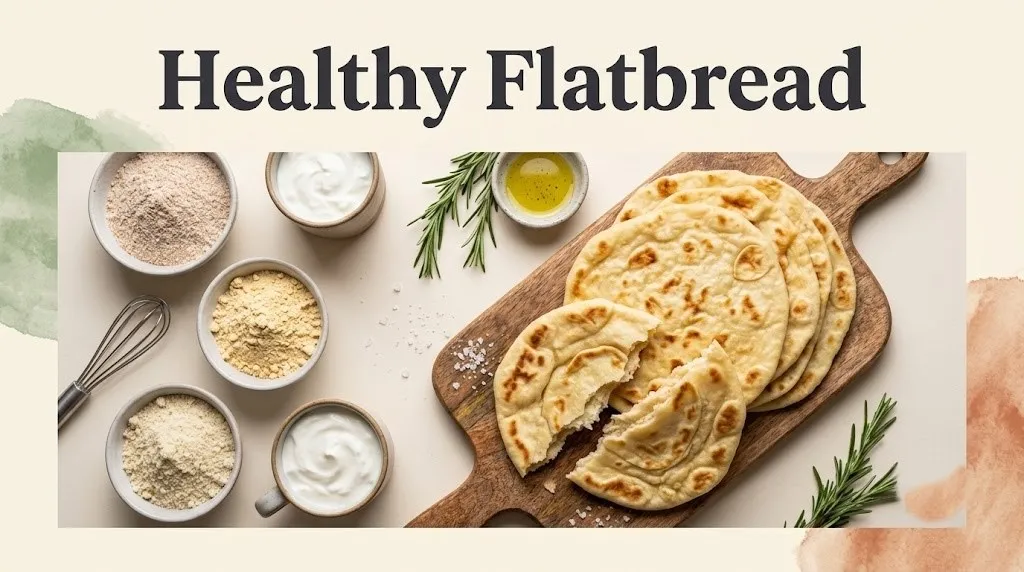
The healthiest approach to flatbread is to match the flour to your nutritional goal and treat the flatbread as the base of a meal, not a side to be eaten in addition to a full plate of food. A whole grain pita stuffed with grilled chicken, cucumber, tomato, and tahini is a balanced meal. The same pita torn into pieces and dipped in a heavy spinach artichoke dip alongside a pasta dinner is a calorie surplus.
Healthy Flatbread Recipes
Healthy flatbread recipes use whole grain, legume, or nut flours, often combined with yogurt or olive oil for tenderness and flavor, and cook quickly in a hot skillet without deep-frying. The goal is a pliable, flavorful flatbread that holds up to toppings and delivers measurable nutritional value.
The simplest healthy flatbread recipe requires two ingredients: self-rising flour and Greek yogurt. The yogurt provides protein, tang, and enough moisture to form a dough that rolls out easily and puffs in a dry skillet. This flatbread contains roughly 8 grams of protein per serving and can be made from start to finish in 20 minutes. It works as a wrap, a pizza base, or a dipper for soup. The recipe is a starting point, not a destination. You can swap half the flour for whole wheat, add garlic powder and dried herbs, or brush the finished flatbread with olive oil and za’atar.
Beyond the two-ingredient version, the healthy flatbread recipe universe expands into chickpea flour socca, a French-Italian street food flatbread that is naturally gluten-free and high in plant protein. Almond flour flatbreads fit a low-carb or keto eating pattern and cook more like a thick crepe than a dough-based bread. Buckwheat flour flatbreads bring an earthy, nutty flavor and a complete amino acid profile. Each flour creates a different flatbread with a different nutritional profile, and learning the differences is the key to finding your go-to.
Key Takeaway: A healthy flatbread recipe is defined by its flour, not its shape. Whole grain, chickpea, and almond flours are the foundations. White flour is not.
Healthy Flatbread Recipe
A two-ingredient dough made from 1 cup of self-rising flour and 1 cup of plain Greek yogurt creates a high-protein, no-yeast flatbread that is ready in under 30 minutes. This recipe is the gateway healthy flatbread because it requires no rising, no special equipment, and produces a soft, pliable bread that holds its own against any store-bought wrap.
Self-rising flour is a combination of all-purpose flour, baking powder, and salt. You can make your own by whisking 1 cup of all-purpose flour with 1.5 teaspoons of baking powder and 0.25 teaspoon of salt. For a healthier version, use white whole wheat flour in place of half the all-purpose flour. The yogurt provides the acidity that activates the baking powder, creating tiny gas bubbles that lift and tenderize the dough. It also adds protein, roughly 12 grams per cup, and a subtle tang that mimics the long-fermented flavor of traditional sourdough flatbreads.
The dough comes together in a bowl with a spoon, then requires a brief knead on a floured surface until smooth. Divide it into four equal pieces, roll each into a thin round roughly an eighth of an inch thick, and cook in a dry, hot cast iron skillet for 2 to 3 minutes per side. The flatbread will puff and develop brown spots. Stack them on a plate and cover with a towel to keep them soft and pliable. They will not be crispy. They will be soft, foldable, and ready to wrap around anything you would put in a tortilla or pita.
To Make the Two-Ingredient Yogurt Flatbread:
- In a medium bowl, stir together 1 cup self-rising flour and 1 cup plain Greek yogurt until a shaggy dough forms.
- Turn the dough onto a lightly floured surface and knead gently for 1 minute until smooth. Do not overwork.
- Divide into 4 equal pieces. Roll each into an 8-inch round approximately 1/8 inch thick.
- Heat a cast iron skillet over medium-high heat until a drop of water sizzles and evaporates instantly.
- Cook each flatbread for 2 to 3 minutes per side until puffed and browned in spots. Keep covered with a towel until serving.
Flat Bread Healthy
“Flat bread” as two words is a common search variant, and the answer is the same. Flat bread is healthy when made from whole grains and minimally processed ingredients. The term “flat bread” encompasses a vast global category that includes some of the healthiest traditional breads on the planet and some of the least healthy industrial products.
Traditional flatbreads like Ethiopian injera, made from fermented teff flour, are nutritional powerhouses. Teff is a tiny grain high in iron, calcium, and resistant starch, and the fermentation process adds B vitamins and partially breaks down the phytic acid that can inhibit mineral absorption. Indian roti or chapati, made from whole wheat atta flour, is a daily staple for hundreds of millions of people and delivers fiber, protein, and complex carbohydrates in a simple, two-ingredient package. These are healthy flatbreads by any reasonable definition. They have been sustaining populations for centuries.
Industrial flatbreads, like some shelf-stable wraps and tortillas, are a different food entirely. They often contain hydrogenated oils, cellulose gum, preservatives like calcium propionate, and a long list of dough conditioners designed to keep the bread soft for weeks at room temperature. These products are convenient and sometimes fortified with fiber or protein, but they are far removed from the simple flour, water, and salt flatbreads of traditional diets. The rule of thumb is the same for flatbread as for any packaged food. The shorter the ingredient list, the closer to a traditional recipe, the healthier the product.
Healthy Flatbreads
Healthy flatbreads come in dozens of forms across different culinary traditions. The common thread is a short ingredient list, a whole grain or nutrient-dense flour, and a cooking method that does not involve deep-frying. Understanding the landscape of flatbreads helps you choose the right one for your meal and your health goals.
Pita bread is a Middle Eastern and Mediterranean flatbread that puffs during baking, creating a pocket. Whole wheat pita is widely available and contains more fiber than white pita. A standard 6-inch whole wheat pita contains roughly 140 calories, 5 grams of protein, and 4 grams of fiber. It is an excellent vehicle for stuffing with vegetables, lean protein, and tahini or yogurt-based sauces.
Lavash is a thin, soft flatbread from Armenia and surrounding regions, traditionally baked in a tandoor. Commercially available whole wheat lavash is one of the healthiest wrap options because it is large, thin, and high in fiber relative to its calorie count. A full sheet of whole wheat lavash can contain 100 to 120 calories and 4 to 5 grams of fiber, making it a lighter wrap choice than a flour tortilla.
Socca is a chickpea flour flatbread from Nice, France, and neighboring Italy. It is naturally gluten-free, high in plant protein, and contains roughly 5 grams of protein and 3 grams of fiber per slice. It is traditionally cooked in a cast iron pan with olive oil until crisp on the edges and tender in the center.
Almond flour flatbreads are modern creations designed for low-carb and keto diets. They are high in fat, moderate in protein, and very low in carbohydrates. A serving typically contains 150 to 200 calories, 5 to 8 grams of protein, and 3 to 4 net grams of carbohydrates. They cook more like thick crepes than traditional dough.
Global Healthy Flatbread Comparison:
| Flatbread Type | Primary Flour | Calories (per piece) | Protein (g) | Fiber (g) | Gluten-Free |
|---|---|---|---|---|---|
| Whole Wheat Pita | Whole wheat flour | 140 | 5 | 4 | No |
| Whole Wheat Lavash | Whole wheat flour | 110 | 4 | 4 | No |
| Socca | Chickpea flour | 120 | 5 | 3 | Yes |
| Almond Flour Wrap | Almond flour | 160 | 6 | 2 | Yes |
| Corn Tortilla | Masa harina | 50 | 1 | 1 | Yes |
| Roti/Chapati | Whole wheat atta | 100 | 3 | 2 | No |
Healthy Flat Bread Recipes
Healthy flat bread recipes fall into two categories: dough-based flatbreads that require rolling and skillet cooking, and batter-based flatbreads that are poured like a crepe or pancake. Both are valid. The choice depends on the flour you are using and the texture you want.
Batter-based flatbreads are generally faster and require less technique. Chickpea flour socca is the classic example. Whisk chickpea flour, water, olive oil, and salt into a thin batter, let it rest for 10 to 15 minutes to hydrate the flour fully, then pour it into a hot, oiled cast iron skillet and bake or cook until set and browned. The result is a sturdy, sliceable flatbread that works as a pizza crust, a dipping bread, or a side for soup. Resting the batter is non-negotiable. Chickpea flour needs time to absorb water fully, and skipping the rest produces a gritty, raw-flour-tasting flatbread.
Dough-based flatbreads require more hands-on work but produce a more traditional bread-like texture. The yogurt dough recipe from earlier is the fastest. A traditional yeasted whole wheat pita dough takes longer but develops deeper flavor from fermentation. To make whole wheat pita at home, combine 2 cups of white whole wheat flour, 1 teaspoon of instant yeast, 1 teaspoon of salt, and 1 cup of warm water with 1 tablespoon of olive oil. Knead for 8 minutes until smooth and elastic. Let rise for 1 hour. Divide into 8 balls, rest 15 minutes, roll into 6-inch rounds, and bake on a preheated baking stone or inverted sheet pan at 500 degrees Fahrenheit for 3 to 4 minutes until puffed and lightly browned.
What Makes Flatbread Healthy
A flatbread earns the “healthy” label when its primary flour is a whole grain, legume, or nut flour, it contains at least 3 grams of fiber per serving, it has minimal added sugar and no hydrogenated oils, and its ingredient list is short enough to replicate in a home kitchen. The absence of problematic ingredients is as important as the presence of beneficial ones.
Fiber is the single most important nutritional metric for flatbread. The USDA Dietary Guidelines recommend 25 to 30 grams of fiber per day, and most Americans get less than half of that. A flatbread with 4 or 5 grams of fiber per serving makes a meaningful contribution to the daily total. Fiber slows digestion, increases satiety, feeds beneficial gut bacteria, and helps regulate blood sugar and cholesterol. A flatbread with 1 gram of fiber does none of those things.
The fat source matters too. Traditional flatbreads use olive oil, ghee, or no added fat at all. Industrial flatbreads often use soybean oil, palm oil, or hydrogenated vegetable oils to extend shelf life and create a soft texture. These oils are not acutely harmful in small amounts, but they are markers of a highly processed product. A healthy flatbread should get its fat, if any, from olive oil, avocado oil, or the natural fats present in nut and seed flours. The ingredient list should not include partially hydrogenated anything.
Key Takeaway: A healthy flatbread is a short-ingredient, high-fiber food with a recognizable fat source. The label tells you everything you need to know in 10 seconds or less.
Best Flour for Healthy Flatbread
The best flour for healthy flatbread depends on your dietary goal. Whole wheat flour is best for all-purpose health and fiber. Chickpea flour is best for gluten-free, high-protein flatbread. Almond flour or coconut flour is best for low-carb and keto flatbread. There is no single best flour, only the best flour for your specific needs.
White whole wheat flour is the easiest swap for all-purpose flour in traditional flatbread recipes. It is milled from white wheat rather than red wheat, which gives it a milder, sweeter flavor than standard whole wheat flour. It contains the same fiber and nutrient profile, roughly 4 grams of fiber per quarter cup, but does not taste bitter or heavy. Most people, including children, will not notice the difference in a pita or roti made with white whole wheat versus refined flour.
Chickpea flour (besan) is a legume flour made from ground chickpeas. It is naturally gluten-free, high in protein, and high in fiber. It has a distinct nutty, slightly earthy flavor that works beautifully in savory flatbreads but clashes with sweet toppings. Chickpea flour requires a longer hydration time than wheat flour. A batter made from chickpea flour and water should rest for at least 15 minutes, ideally 30, before cooking.
Almond flour is made from blanched, ground almonds. It is high in monounsaturated fat, vitamin E, and magnesium. It contains no gluten and very few carbohydrates, making it suitable for low-carb and keto diets. Almond flour flatbreads are fragile and do not roll or fold like wheat flatbreads. They are more like soft, pliable crepes or thick tortillas. Coconut flour is even more absorbent and cannot be substituted one-for-one for almond flour or wheat flour. It requires significantly more liquid and more eggs to create a workable flatbread dough.
Flour Selection by Dietary Goal:
| Goal | Best Flour | Why |
|---|---|---|
| High fiber | White whole wheat, oat flour | 4-5g fiber per serving, familiar taste |
| High protein | Chickpea flour, almond flour | 5-7g protein per serving |
| Gluten-free | Chickpea flour, buckwheat flour | Naturally GF, good structure |
| Low-carb/keto | Almond flour, coconut flour | Low net carb, high fat for satiety |
| Budget-friendly | Whole wheat flour | Widely available, inexpensive |
Whole Wheat Flatbread Nutrition vs White
A whole wheat flatbread delivers more fiber, more magnesium, more zinc, and a lower glycemic response than an identical flatbread made from refined white flour. The two flatbreads look similar and contain roughly the same number of calories, but the nutritional difference is substantial.
A 6-inch whole wheat pita contains about 140 calories, 5 grams of protein, and 4 grams of dietary fiber. A 6-inch white pita contains about 130 calories, 4 grams of protein, and 1 gram of fiber. The calorie difference is negligible. The fiber difference means the whole wheat pita digests more slowly, keeps you full longer, and feeds your gut bacteria in a way the white pita cannot. The mineral differences are harder to see on a nutrition label but equally real. Whole wheat flour retains the germ, which is rich in magnesium, a mineral involved in over 300 enzymatic reactions in the body. Refined white flour loses the germ during processing.
The glycemic index of whole wheat pita is roughly 35 to 40, compared to 55 to 60 for white pita. This means the whole wheat version raises blood sugar roughly half as quickly. For people managing diabetes, insulin resistance, or simply the afternoon energy crash that follows a high-glycemic lunch, this difference is meaningful. The fiber in whole wheat flatbread forms a physical barrier that slows the digestion of starch into glucose.
High Protein Flatbread Recipe
A chickpea flour and Greek yogurt flatbread delivers roughly 10 grams of protein per serving without any meat, eggs, or protein powder. This flatbread combines the high-protein legume flour with the additional protein and tenderness from yogurt to create a pliable, savory flatbread that works as a wrap or a side.
To make it, whisk 1 cup of chickpea flour with 0.5 cup of plain Greek yogurt, 0.25 cup of water, 1 tablespoon of olive oil, and 0.5 teaspoon of salt until a thick, pourable batter forms. Let the batter rest for 20 minutes. This step is essential. The chickpea flour needs time to hydrate fully, and skipping the rest results in a gritty texture and a raw legume aftertaste. After resting, heat a nonstick or cast iron skillet over medium heat, brush with a small amount of oil, and pour in a quarter of the batter. Spread it with the back of a spoon into a 7 to 8-inch round. Cook for 3 to 4 minutes per side until golden brown and cooked through.
This flatbread contains no gluten, no nuts, and no animal products besides the yogurt. For a dairy-free version, substitute the yogurt with an equal amount of water and add an extra tablespoon of olive oil for tenderness. The batter will be thinner and the protein will drop by about 2 grams per serving, but the flatbread will still hold together and taste good.
Protein Content of Healthy Flatbreads (per serving):
| Flatbread Type | Protein (g) |
|---|---|
| Standard White Pita | 4 |
| Whole Wheat Pita | 5 |
| Chickpea Yogurt Flatbread | 10 |
| Almond Flour Flatbread | 6 |
| 2-Ingredient Yogurt Dough | 8 |
Almond Flour Flatbread Low Carb
Almond flour flatbread contains 3 to 4 net grams of carbohydrates per serving, compared to 30 to 35 net grams in a standard wheat flour flatbread. It is the best flatbread option for low-carb, keto, and diabetic-friendly eating patterns, though its texture is more delicate and crepe-like than traditional dough-based bread.
Making almond flour flatbread requires a fundamentally different technique than wheat flatbread. Almond flour contains no gluten, so the dough has no elasticity. It will not stretch like pizza dough. It rolls out between two sheets of parchment paper and transfers carefully to the skillet. A basic recipe combines 1 cup of blanched almond flour, 2 tablespoons of psyllium husk powder for flexibility, 1 large egg, 2 tablespoons of olive oil, and a pinch of salt. The psyllium husk absorbs water and creates a gel that mimics some of the binding properties of gluten. Without it, the flatbread will crumble.
Mix the ingredients into a dough, divide into 4 pieces, and roll each between parchment paper into a 6-inch round. Cook in a dry or lightly oiled skillet over medium heat for 2 to 3 minutes per side. The flatbread will be soft and flexible when warm. It is best used immediately, as almond flour flatbreads dry out and stiffen when they cool. Reheating in a dry skillet restores some flexibility.
Chickpea Flour Flatbread Gluten Free
Chickpea flour flatbread, also known as socca, is a naturally gluten-free flatbread that originated in the Liguria region of Italy and the south of France. It requires only chickpea flour, water, olive oil, and salt, and it cooks in a cast iron skillet in under 10 minutes once the batter has rested.
Socca is unique among flatbreads because it is a batter, not a dough. The consistency is closer to a crepe batter than a bread dough. This means it cannot be rolled or shaped by hand. It must be poured into a hot, oiled pan and spread quickly before it sets. The traditional cooking method uses a very hot oven or broiler to cook the top while the skillet heats from below. A home cook can achieve a similar effect by cooking the socca on the stovetop for 3 to 4 minutes until the bottom is set and browned, then sliding the skillet under a preheated broiler for 1 to 2 minutes to brown the top.
The resulting flatbread is crisp at the edges, tender in the center, and sturdy enough to cut into wedges and eat by hand. It has a nutty, savory flavor from the chickpea flour that pairs well with rosemary, black pepper, and olive oil. Socca can also be used as a pizza crust. Spread the batter slightly thicker, bake until fully set, add toppings, and return to the broiler just until the toppings are heated through.
Key Takeaway: Chickpea flour socca is the best gluten-free healthy flatbread because it tastes good, holds together, and delivers protein and fiber without any gums, starches, or additives.
Healthy Flatbread for Wraps and Pizza
The best healthy flatbread for wraps is a whole wheat lavash or a homemade two-ingredient yogurt flatbread because both are pliable, large enough to hold fillings, and relatively low in calories per square inch. The best healthy flatbread for pizza is a chickpea flour socca or a whole wheat pita because both are sturdy enough to hold toppings without collapsing and crisp up well under a broiler.
Wraps require flexibility and a neutral flavor that does not compete with the fillings. A whole wheat lavash sheet is thin enough to wrap tightly without cracking, and it contains fiber and protein without the 300-calorie load of a large flour tortilla. The two-ingredient yogurt flatbread is even more neutral in flavor and can be rolled to any thickness you prefer. For a low-carb wrap, almond flour flatbread with psyllium husk is the best option, though it is more delicate and benefits from gentle handling and a warm temperature.
Pizza demands a flatbread that can support the weight of sauce, cheese, and vegetables without buckling. Whole wheat pita baked at high heat until crisp makes an excellent individual pizza crust. Socca, because it is naturally sturdy and slightly thicker than a tortilla, holds up well under toppings. For a keto pizza crust, an almond flour flatbread pre-baked until firm before adding toppings works well, though it will not mimic the chew of a wheat-based pizza crust.
Flatbread Best Use Guide:
| Flatbread | Best Used For | Notes |
|---|---|---|
| Whole wheat lavash | Wraps, pinwheels | Thin, pliable, high fiber |
| Yogurt dough | Wraps, dipping, pizza | Neutral flavor, soft |
| Chickpea socca | Pizza, dipping | Sturdy, naturally GF |
| Almond flour | Low-carb wraps, keto pizza | Delicate, use parchment |
| Whole wheat pita | Stuffed sandwiches, pizza | Pocket for filling |
Best Store Bought Healthy Flatbread 2026
The best store-bought healthy flatbreads in 2026 are those with a whole grain or legume flour as the first ingredient, at least 3 grams of fiber per serving, zero hydrogenated oils, and fewer than 8 ingredients total. Several brands have improved their formulations in recent years, and the market for genuinely healthy packaged flatbreads is better than it was five years ago.
Joseph’s Bakery continues to dominate the high-fiber, high-protein wrap and pita category. Their flax, oat bran, and whole wheat lavash contains 100 calories, 8 grams of protein, and 5 grams of fiber per sheet. The ingredient list is longer than homemade, but the flour base is whole grain and the protein boost comes from wheat gluten and flax, not isolates or fillers. The texture is soft and pliable, suitable for wraps and pinwheels.
Angel Bakeries produces a whole wheat pita with 4 grams of fiber and a clean ingredient list: whole wheat flour, water, yeast, salt, and a small amount of wheat gluten for elasticity. No oils, no sugars, no preservatives beyond the natural fermentation. These pitas freeze well and puff reliably in a toaster or hot skillet.
Mission Carb Balance tortillas are a widely available option for low-carb shoppers. They use modified wheat starch and wheat gluten to create a pliable tortilla with 4 net grams of carbohydrates and 15 grams of fiber per tortilla. The ingredient list is long and processed. These are not a clean-label product. They are a functional food for people who need to limit carbohydrates and are willing to accept a more industrial ingredient list to achieve that goal.
Best Store-Bought Healthy Flatbreads 2026:
| Brand | Product | Calories | Fiber (g) | Protein (g) | Clean Label |
|---|---|---|---|---|---|
| Joseph’s Bakery | Flax Oat Bran Lavash | 100 | 5 | 8 | Moderate |
| Angel Bakeries | 100% Whole Wheat Pita | 130 | 4 | 5 | Yes |
| Lavash Bread Co. | Whole Grain Lavash | 110 | 4 | 4 | Yes |
| Mission Carb Balance | Whole Wheat Tortilla | 70 | 15 | 5 | No |
| BFree | Chickpea Flour Wrap | 90 | 4 | 5 | Moderate |
Frequently Asked Questions About Healthy Flatbread
What is the healthiest type of flatbread to eat?
A whole wheat pita or a chickpea flour socca are the healthiest flatbreads for most people.
They provide 4 to 5 grams of fiber and 5 to 10 grams of protein per serving with minimal ingredients.
The healthiest flatbread is the one made from whole grains or legumes that fits your dietary needs.
Can I eat flatbread every day?
Yes, you can eat whole grain flatbread every day as part of a balanced diet.
The USDA recommends making at least half of all grains whole.
The portion size and what you put on the flatbread matter more for daily health than the flatbread itself.
Is flatbread healthier than sliced bread?
Flatbread is not inherently healthier than sliced bread.
A whole grain flatbread is healthier than white sandwich bread.
A white flour flatbread is less healthy than whole grain sliced bread. The flour, not the shape, determines the health value.
What can I use instead of flour for healthy flatbread?
Chickpea flour, almond flour, and oat flour are the best flour alternatives for healthy flatbread.
Chickpea flour provides protein and a sturdy texture for gluten-free flatbread.
Almond flour works best for low-carb and keto flatbreads. Oat flour produces a mild, whole grain flavor similar to wheat.
How do you store homemade healthy flatbread?
Store homemade flatbread in an airtight container or zip-top bag at room temperature for up to 2 days.
Place a paper towel in the bag to absorb excess moisture and prevent sogginess.
For longer storage, freeze flatbreads with parchment paper between each piece and reheat in a dry skillet.
Flatbread is one of the oldest foods in human civilization, and it has been healthy for most of that history. The problem is not flatbread. The problem is what industrial food processing did to it, stripping the germ and bran, adding hydrogenated oils and preservatives, and selling the resulting product as a convenient wrap with a one-year shelf life. That version of flatbread is a modern invention, not a traditional staple.
Making your own flatbread takes less time than driving to the store. A bowl, a skillet, and 20 minutes are all you need to produce something softer, more flavorful, and nutritionally superior to anything in a plastic bag. If you cannot make your own, read the label and choose the flatbread with whole grain flour, a few grams of fiber, and an ingredient list your grandmother would recognize. Top it with vegetables, lean protein, olive oil, or yogurt. That is a healthy meal. That is what flatbread was always meant to be.