A healthy frosting recipe replaces the butter and powdered sugar in traditional buttercream with whole food bases like Greek yogurt, avocado, or coconut cream and sweetens lightly with fruit, maple syrup, or sugar alternatives. The result is a frosting that cuts calories by 60 to 75 percent and sugar by 70 to 80 percent compared to standard buttercream, while still spreading, piping, and tasting like a real dessert topping. The challenge is not making a healthy frosting. It is making one that does not slide off the cake, weep liquid into the crumb, or taste like a sad, gritty compromise.
A standard American buttercream contains roughly one cup of butter and three to four cups of powdered sugar for a batch that frosts 12 cupcakes. That is approximately 1,600 calories from butter and 1,800 calories from powdered sugar before the batch is divided. A two-tablespoon serving delivers roughly 140 to 160 calories and 18 to 22 grams of sugar, exceeding the American Heart Association’s recommended daily added sugar limit for women in a single swipe of frosting. The healthy alternatives in this article bring that serving down to 30 to 80 calories and 3 to 8 grams of sugar, using ingredients that contribute protein, fiber, or healthy fats alongside the sweetness.
We tested six base ingredients across multiple batches and temperatures. The recipes that follow specify exact measurements, chilling requirements, and serving yields. They also warn you about the structural limitations of healthy frostings: no vegan yogurt frosting will hold a piped rosette at an outdoor July party, and no avocado frosting will taste right if your avocado was not perfectly ripe. You will find full nutrition comparisons, storage instructions, and the specific situations where each recipe works and where it will let you down.
How to make healthy frosting
To make healthy frosting, replace the two structural components of traditional buttercream, the fat and the sugar, with whole food ingredients that provide similar texture and stability, then adjust sweetness with a liquid or granulated sweetener that dissolves completely or blends smoothly into the base. The fat in traditional frosting provides richness and mouthfeel. The powdered sugar provides sweetness, bulk, and the crystalline structure that traps air and creates a light, spreadable texture. A healthy frosting must solve for both functions.
The fat replacement is the easier problem. Greek yogurt, cream cheese, avocado, coconut cream, nut butter, and sweet potato puree each provide creaminess and body. Greek yogurt and cream cheese bring tang and protein. Avocado and coconut cream bring monounsaturated or saturated plant fat with a neutral flavor base that disappears under chocolate or vanilla. Nut butter brings protein and a strong flavor that pairs well with chocolate and banana cakes. Sweet potato puree brings fiber, beta-carotene, and a natural sweetness that reduces the amount of added sweetener needed.
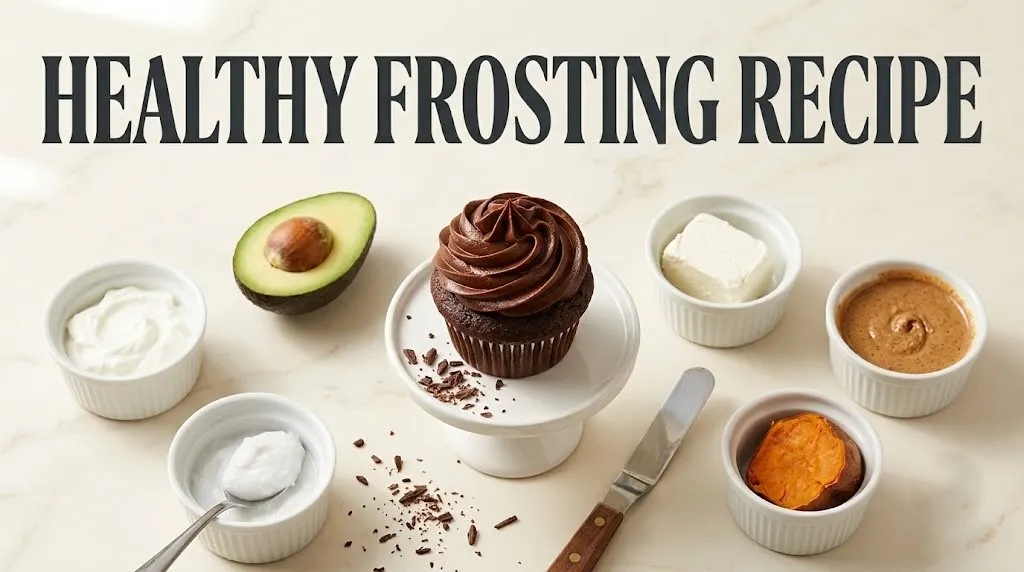
The sugar replacement is the harder problem because powdered sugar is not just a sweetener. It is a structural ingredient whose fine crystals create the light, airy texture of buttercream by cutting into the fat and creating air pockets during mixing. No natural sweetener replicates this crystalline structure exactly. The most successful healthy frostings either use a small amount of powdered sugar for structure alongside healthier ingredients, blend the frosting in a food processor to create smoothness without crystalline sugar, or use liquid sweeteners like maple syrup or honey in recipes where the frosting is intended to be denser and glossier than traditional buttercream.
The most common failure point in healthy frosting is excess moisture. Greek yogurt, fresh avocado, and coconut cream all contain water that butter does not. That water can break an emulsion, make the frosting runny, or weep out of the frosting and onto the cake surface over time. Draining yogurt through cheesecloth, using only the solid portion of chilled coconut cream, and adding a small amount of cornstarch or arrowroot powder to absorb free water are the three techniques that solve the moisture problem across the different recipes.
Healthy frosting alternatives
Healthy frosting alternatives are ingredient swaps that replace all or most of the butter and powdered sugar in traditional recipes, and the six best options are Greek yogurt, avocado, coconut cream, cream cheese, nut butter, and sweet potato puree. Each alternative has a specific flavor profile, best-use cake pairing, and structural limitation that determines when it works and when it will fail.
Greek yogurt frosting is tangy, protein-rich, and best for refrigerated cakes and cupcakes that will be served cold. It pipes reasonably well when thickened with cream cheese or drained to remove excess whey. It will weep and slide at room temperature after 60 to 90 minutes, which makes it a poor choice for outdoor parties or buffet displays.
Avocado frosting is creamy, rich in monounsaturated fat, and flavor-neutral when blended with cocoa powder or melted dark chocolate. The green color disappears completely under dark chocolate, which makes chocolate avocado frosting the stealth healthiest option for convincing picky eaters. It must be made with perfectly ripe avocados free of brown spots, which will show as bitter, stringy bits in the finished frosting.
Coconut cream frosting is dairy-free, lightly sweet, and whips up similarly to whipped cream. It works best as a dolloped or spread frosting, not a piped design, because it lacks the structural rigidity of butter-based frostings. It must be made with full-fat canned coconut cream or coconut milk that has been refrigerated overnight so the solid cream separates from the liquid.
Cream cheese frosting is the closest healthy alternative to traditional buttercream in texture and spreadability. Using a light or Neufchatel cream cheese and replacing most of the powdered sugar with a sugar alternative or a small amount of maple syrup produces a frosting that tastes nearly identical to full-sugar cream cheese frosting with roughly half the calories.
| Healthy Base | Best Flavor Pairing | Piping Ability | Must Be Refrigerated | Calories per 2 tbsp |
|---|---|---|---|---|
| Greek yogurt | Vanilla, lemon, berry | Moderate (with cream cheese) | Yes | 30-45 |
| Avocado | Chocolate | Good (thick texture) | Yes | 40-60 |
| Coconut cream | Vanilla, coconut, lime | Poor (soft) | Yes | 35-50 |
| Cream cheese | Carrot, red velvet, pumpkin | Excellent | Yes | 50-70 |
| Nut butter | Chocolate, banana | Good (dense) | No (1-2 hours ok) | 70-90 |
| Sweet potato | Chocolate, spice cake | Moderate | Yes | 40-55 |
Key Takeaway: The healthy frosting alternative you choose should match the cake flavor, the serving environment, and whether you need to pipe decorations; no single alternative works for every situation the way buttercream does.
Greek yogurt frosting healthy
Greek yogurt frosting is made by combining thick, drained Greek yogurt with a small amount of cream cheese for stability and sweetening it with honey, maple syrup, or a sugar-free alternative. The result is a tangy, creamy frosting with roughly 30 to 45 calories and 4 to 6 grams of sugar per two-tablespoon serving, compared to 140 to 160 calories and 18 to 22 grams of sugar in the same amount of traditional buttercream.
The technique that makes or breaks Greek yogurt frosting is draining. Standard Greek yogurt contains enough whey to ruin a frosting. Even thick, full-fat Greek yogurt should be drained for at least 2 hours, and ideally overnight, in a fine-mesh strainer lined with cheesecloth set over a bowl in the refrigerator. The drained yogurt will be thick enough to hold a spatula upright. This step is not optional. Skipping it produces a frosting that slides off the cake and pools on the plate.
The recipe: combine 1 cup of drained full-fat Greek yogurt, 4 ounces of softened cream cheese (full-fat or Neufchatel for lower calories), 2 to 3 tablespoons of honey or maple syrup, and 1 teaspoon of vanilla extract in a mixing bowl. Beat with a hand mixer on medium speed for 1 to 2 minutes until smooth and slightly aerated. Do not overbeat, which can break the emulsion and turn the frosting grainy. Taste and adjust sweetness. If the frosting is too thin, refrigerate it for 30 minutes before spreading. The cream cheese adds stability and cuts the yogurt tang, creating a frosting that tastes similar to a cream cheese icing but is lighter and higher in protein.
This frosting works best on vanilla, lemon, or berry cakes. It pairs poorly with chocolate because the tang fights the cocoa notes. It must be refrigerated and served cold. A cake frosted with Greek yogurt frosting can sit at room temperature for roughly 60 to 90 minutes before the frosting begins to soften and weep. For a party, frost the cake close to serving time and return any leftovers to the refrigerator immediately. People with dairy allergies or lactose intolerance should avoid this frosting entirely.
Avocado frosting healthy
Avocado frosting is made by blending ripe avocado with melted dark chocolate or cocoa powder and a liquid sweetener until completely smooth. The avocado provides the fat and creaminess that butter would provide in traditional frosting. The chocolate completely masks the avocado flavor and color. The result is a dense, silky frosting with roughly 40 to 60 calories and 3 to 5 grams of sugar per two-tablespoon serving, plus the monounsaturated fat and potassium of the avocado.
The avocado must be perfectly ripe. An underripe avocado will not blend smooth and will leave hard, bitter pieces in the frosting. An overripe avocado with brown spots will carry those spots into the frosting, creating an off flavor and unappetizing dark specks. The avocado should yield to gentle pressure but not feel mushy, and the flesh under the stem should be green, not brown. The avocado is a fruit, Persea americana, and the Hass variety commonly sold in the United States works best because of its high fat content and creamy texture.
The recipe: combine the flesh of 2 ripe medium Hass avocados, 4 ounces of melted 70 percent dark chocolate or 1/2 cup of unsweetened cocoa powder, 3 tablespoons of maple syrup or honey, 1 teaspoon of vanilla extract, and 1/8 teaspoon of salt in a food processor. Process for 60 to 90 seconds, stopping to scrape down the sides, until the frosting is completely smooth with no visible avocado flecks. The melted chocolate version will be glossier and richer. The cocoa powder version will be thicker and more intensely chocolate-flavored. Taste and adjust the sweetener. The salt is not optional. It suppresses any remaining grassy avocado notes and sharpens the chocolate flavor.
Use this frosting immediately or refrigerate it in a sealed container with plastic wrap pressed directly onto the surface to prevent oxidation browning. The frosting will keep for 2 days in the refrigerator. It pipes well because the avocado and chocolate create a dense, stable texture. It pairs best with chocolate cake, where the double chocolate effect tastes indulgent, or with banana or zucchini bread for a snack-cake application.
Coconut cream frosting healthy
Coconut cream frosting is made by whipping the solid portion of chilled full-fat coconut milk or coconut cream with a small amount of sweetener and vanilla until light and fluffy. It is dairy-free, naturally sweet, and works as a dolloped or spread frosting with roughly 35 to 50 calories and 3 to 6 grams of sugar per two-tablespoon serving.
The critical step is chilling the coconut cream. Place a can of full-fat coconut milk or coconut cream in the refrigerator for at least 12 hours, preferably 24. Do not shake the can before opening. The cream will have separated from the liquid and solidified at the top. Scoop only the solid white cream into a mixing bowl, leaving the clear liquid behind for smoothies or soups. Any liquid that gets into the bowl will prevent the cream from whipping properly.
The recipe: scoop the solidified cream from one 14-ounce can of chilled full-fat coconut milk into a mixing bowl. Add 1 to 2 tablespoons of maple syrup or powdered monk fruit sweetener, 1 teaspoon of vanilla extract, and a pinch of salt. Whip with a hand mixer on high speed for 1 to 2 minutes until soft peaks form. The frosting will be lighter than buttercream but stable enough to spread. It will not hold piped rosettes or detailed decorations for more than a few minutes at room temperature. For a more stable version, add 1/2 teaspoon of agar agar powder dissolved in 1 tablespoon of hot water and cooled slightly before whipping into the cream.
This frosting works best on coconut cake, vanilla cake, or tropical fruit-flavored desserts. It must be refrigerated and will soften noticeably after 45 to 60 minutes at room temperature. Serve it cold and return leftovers to the refrigerator. People with tree nut allergies should note that the FDA classifies coconut as a tree nut for labeling purposes, though most individuals with tree nut allergy tolerate coconut without reaction.
Key Takeaway: Greek yogurt, avocado, and coconut cream frostings all solve the fat-and-creaminess problem without butter, but they share the same structural limitation: they are perishable refrigerator frostings, not room-temperature stable decorations, and you must plan your serving timeline around that fact.
Cream cheese frosting healthy
A healthy cream cheese frosting uses light cream cheese or a blend of cream cheese and Greek yogurt as the base, replaces most of the powdered sugar with a small amount of maple syrup or a granulated sugar alternative, and adds vanilla and a pinch of salt to round out the flavor. The result is the closest healthy match to traditional frosting texture, with roughly 50 to 70 calories and 5 to 8 grams of sugar per two-tablespoon serving.
Cream cheese is naturally lower in fat than butter and carries a tang that makes less sugar taste balanced. Traditional cream cheese frosting uses roughly equal parts cream cheese and butter plus several cups of powdered sugar. The healthy version drops the butter entirely, reduces the cream cheese quantity with Greek yogurt for a lighter texture and protein boost, and uses a fraction of the sweetener. The frosting still spreads, still pipes, and still holds its shape on a carrot cake or red velvet cupcake because the cream cheese provides structure that yogurt or avocado alone cannot match.
The recipe: in a mixing bowl, beat 8 ounces of softened light cream cheese (Neufchatel) with 1/4 cup of drained full-fat Greek yogurt until smooth. Add 3 tablespoons of maple syrup or honey, 1 teaspoon of vanilla extract, and 1/8 teaspoon of salt. Beat for 1 minute on medium speed. For a thicker, sweeter version that pipes more cleanly, add 1/4 cup of powdered monk fruit sweetener or erythritol and beat for an additional 30 seconds. Do not overbeat. Cream cheese can break and become grainy if whipped too long. If the frosting is too soft, refrigerate it for 30 minutes before using.
This frosting must be refrigerated. It will hold its shape at cool room temperature for roughly 2 hours, longer than yogurt or coconut cream frostings but shorter than buttercream. It pipes cleanly with a star tip and holds rosettes well on a chilled cake. It pairs best with carrot cake, spice cake, pumpkin bread, and red velvet, the traditional cream cheese frosting vehicles. The slight tang and moderate sweetness complement the warm spices in those cakes.
Sugar free frosting recipe
A sugar-free frosting recipe replaces all caloric sweeteners with non-nutritive alternatives like monk fruit sweetener, erythritol, or stevia, and uses cream cheese or coconut cream as the base to provide body without the structural contribution of powdered sugar. The most successful sugar-free version is a cream cheese-based frosting that uses powdered monk fruit sweetener as a one-to-one replacement for powdered sugar.
Powdered monk fruit sweetener and powdered erythritol are the only sugar alternatives that function structurally like powdered sugar in frosting. Their crystalline form provides the bulk, air-trapping texture, and mouthfeel that liquid alternatives cannot replicate. Granular versions will make the frosting gritty unless they are ground to a fine powder in a blender or food processor first. Stevia drops alone add sweetness without bulk, which leaves the frosting thin and wet. A sugar-free frosting needs a granulated or powdered bulk sweetener to work.
The recipe: beat 8 ounces of softened cream cheese and 1/4 cup of unsalted butter or refined coconut oil with a hand mixer until smooth and combined. Add 1/2 cup of powdered monk fruit sweetener or powdered erythritol, 1 teaspoon of vanilla extract, and 1/8 teaspoon of salt. Beat for 2 minutes on medium speed until light and fluffy. If the frosting is too thick, add 1 tablespoon of unsweetened almond milk. If it is too thin, add 1 to 2 tablespoons more powdered sweetener and beat again. This frosting pipes well, holds at room temperature longer than dairy-based healthy frostings because the butter provides structure, and contains roughly 70 to 90 calories and 0 grams of sugar per two-tablespoon serving.
Sugar alcohols like erythritol can cause digestive discomfort in some people when consumed in large amounts. A two-tablespoon serving of frosting contains roughly 12 grams of erythritol, which is well below the 30 to 50-gram threshold at which gastrointestinal symptoms typically appear in sensitive individuals. Anyone with known sugar alcohol sensitivity should use monk fruit sweetener, which is not a sugar alcohol and rarely causes digestive effects.
Dairy free healthy frosting
A dairy-free healthy frosting uses coconut cream, avocado, or nut butter as the fat base instead of butter, cream cheese, or yogurt. Coconut cream produces the lightest, fluffiest result. Avocado produces the richest, silkiest result. Nut butter produces the densest, most filling result. All three are naturally free of dairy and can be sweetened with maple syrup, agave, or a sugar alternative to keep the added sugar low.
Coconut cream frosting is the best choice for a dairy-free vanilla frosting. The recipe described in the coconut cream section above is naturally dairy-free. For a chocolate version, add 3 tablespoons of unsweetened cocoa powder during whipping. For a stabilized version that holds slightly longer at room temperature, melt 2 tablespoons of refined coconut oil and stream it into the whipping cream. The additional saturated fat firms up the structure without adding dairy.
Avocado chocolate frosting is the best choice for a dairy-free chocolate frosting. The recipe in the avocado section above is naturally dairy-free. Avocado provides the same creamy mouthfeel that butter provides, and the chocolate masks the avocado flavor completely. This frosting is also vegan, which the coconut cream version is.
Nut butter frosting is the simplest dairy-free option and requires no refrigeration for short periods. Combine 1/2 cup of creamy almond butter or sunflower seed butter, 2 tablespoons of maple syrup, 1 tablespoon of melted coconut oil, and 1/8 teaspoon of salt in a bowl. Beat for 1 minute until smooth and slightly aerated. This frosting is dense, rich, and filling. A two-tablespoon serving contains roughly 80 calories and 5 grams of sugar from the maple syrup. It works best as a spread on brownies, banana bread, or muffin tops rather than a cake frosting. The flavor is distinctly nutty and pairs well with chocolate and banana.
Vegan healthy frosting recipe
A vegan healthy frosting recipe avoids all animal products, which means no dairy, no honey, and no cream cheese. The three best vegan options are avocado chocolate frosting, coconut cream frosting, and sweet potato chocolate frosting. All three are naturally vegan, require no specialty ingredients beyond what a standard grocery store carries, and deliver frosting that tastes like a treat rather than a compromise.
Avocado chocolate frosting, detailed above, is the richest and creamiest vegan option. It uses maple syrup or agave as the sweetener rather than honey. It pipes well and holds its shape. Coconut cream frosting, also detailed above, is the lightest vegan option. It works best as a dolloped or spread frosting. Both have been described in their own sections.
Sweet potato frosting is the third vegan option, and it is the one that surprises people most. A baked and mashed sweet potato, when blended with melted dark chocolate or cocoa powder and a small amount of maple syrup, produces a frosting that is dense, glossy, and naturally sweet. The sweet potato provides the fiber and beta-carotene that make this the most nutrient-dense frosting in the entire article. The flavor is earthy and rich, not distinctly potato-like. The chocolate dominates.
The recipe: peel and cube 1 medium sweet potato. Steam or boil until fork-tender, about 12 to 15 minutes. Drain and let cool for 10 minutes. Transfer the cooked sweet potato to a food processor with 3 ounces of melted 70 percent dark chocolate, 2 tablespoons of maple syrup, 1 teaspoon of vanilla extract, and 1/8 teaspoon of salt. Process for 60 seconds until completely smooth and glossy. Taste and adjust sweetener. Use immediately or refrigerate. The frosting thickens as it chills. It pipes adequately but not as cleanly as cream cheese or avocado frosting.
Key Takeaway: Vegan healthy frostings using avocado, coconut, or sweet potato are some of the most nutrient-dense options available, and the chocolate versions in particular succeed at masking any vegetable flavor while delivering a genuinely creamy frosting texture.
Healthy frosting for cupcakes
Healthy frosting for cupcakes must be thick enough to stay on top of the cupcake dome without sliding down the sides, and it must set up slightly so that the frosted cupcakes can be transported or arranged on a platter without the frosting smearing onto the neighboring cupcake. The best healthy cupcake frosting is the cream cheese frosting described above, followed closely by the avocado chocolate frosting and the Greek yogurt frosting if served immediately.
Cream cheese frosting holds its shape on a cupcake better than any other healthy alternative because the cream cheese provides the structural integrity that yogurt, coconut cream, and whipped avocado lack. The cream cheese version can be piped with a star tip into a classic swirl, and it will hold that shape in the refrigerator for days. At cool room temperature, it holds for roughly 2 hours before beginning to soften. For a child’s birthday party where the cupcakes will sit on a table for an hour before serving, cream cheese frosting is the safest choice.
Avocado chocolate frosting also pipes well and holds its shape, but it has a denser, ganache-like texture rather than a light, airy buttercream texture. It spreads more like a thick chocolate spread than a fluffy frosting. This texture works beautifully on chocolate cupcakes but may not satisfy someone expecting a classic vanilla buttercream swirl. The flavor is excellent.
Greek yogurt frosting is the most temperature-sensitive option for cupcakes. It must be piped or spread onto cupcakes that are completely cool, ideally chilled, and the frosted cupcakes must go directly into the refrigerator until serving time. At room temperature, the frosting begins to soften within 30 minutes and will slide off the cupcake entirely within 90 minutes on a warm day. This frosting works for home use where cupcakes go from refrigerator to table to mouth in quick succession. It does not work for events.
Low calorie frosting
A low calorie frosting delivers the frosting experience for under 50 calories per two-tablespoon serving, which is roughly one-third to one-quarter of traditional buttercream. The lowest-calorie options are the Greek yogurt frosting and the coconut cream frosting, both of which can stay under 50 calories per serving when sweetened lightly with a sugar alternative.
Greek yogurt frosting made with nonfat Greek yogurt and light cream cheese, sweetened with monk fruit sweetener instead of honey or maple syrup, delivers roughly 25 to 35 calories per two-tablespoon serving with 1 to 2 grams of fat and under 1 gram of sugar. This is the lowest-calorie frosting that still tastes like a real dessert topping. The trade-off is the tangy yogurt flavor, which does not pair well with every cake, and the strict refrigeration requirement.
Coconut cream frosting sweetened with monk fruit drops or powdered erythritol rather than maple syrup delivers roughly 30 to 40 calories per serving with 3 to 4 grams of fat and under 1 gram of sugar. It is lighter in texture than the Greek yogurt version and works well on vanilla and fruit-flavored cakes. The coconut flavor is present but mild.
The caloric savings across a dozen cupcakes are substantial. Traditional buttercream for 12 cupcakes uses roughly 3 cups of powdered sugar and 1 cup of butter, totaling roughly 3,400 calories for the batch. Dividing that among 12 cupcakes yields approximately 280 calories of frosting per cupcake. The Greek yogurt frosting for 12 cupcakes uses roughly 1 cup of yogurt, 4 ounces of cream cheese, and 3 tablespoons of sweetener, totaling roughly 500 calories for the batch. Divided among 12 cupcakes, that is approximately 42 calories of frosting per cupcake.
| Frosting Type | Calories per 2 tbsp | Sugar (g) | Fat (g) | Best Use |
|---|---|---|---|---|
| Traditional buttercream | 140-160 | 18-22 | 7-9 | Any cake, any event |
| Greek yogurt (monk fruit) | 25-35 | <1 | 1-2 | Refrigerated vanilla/lemon cakes |
| Coconut cream (monk fruit) | 30-40 | <1 | 3-4 | Refrigerated vanilla/coconut cakes |
| Avocado chocolate | 40-60 | 3-5 | 3-5 | Chocolate cake, pipes well |
| Cream cheese (light) | 50-70 | 5-8 | 4-5 | Carrot, red velvet, pipes best |
| Sweet potato chocolate | 40-55 | 4-6 | 1-2 | Vegan chocolate, nutrient-dense |
Healthy frosting that hardens
A healthy frosting that hardens slightly on the surface, forming a thin crust similar to traditional buttercream, requires a fat that is solid at cool room temperature and a sweetener that can crystallize or dry slightly. The only healthy frosting that achieves this effect is the coconut oil-based sugar-free cream cheese frosting, which uses refined coconut oil in place of butter. Coconut oil is solid at temperatures below 76 degrees Fahrenheit, which means it firms up at cool room temperature the way butter does.
The recipe for a crusting healthy frosting: beat 1/4 cup of refined coconut oil (solid but softened, not melted) with 8 ounces of softened cream cheese until smooth and combined. Add 1/2 cup of powdered monk fruit sweetener or powdered erythritol, 1 teaspoon of vanilla extract, and 1/8 teaspoon of salt. Beat for 2 minutes on medium-high speed until light and fluffy. Add 1 to 2 tablespoons of cornstarch or arrowroot powder during the final 30 seconds of mixing. The starch absorbs any free moisture and helps the surface set. Spread or pipe the frosting onto a cooled cake and let it sit at cool room temperature for 30 minutes. The surface will form a thin, dry skin similar to traditional buttercream crusting.
This frosting is not truly shelf-stable. The cream cheese still requires refrigeration for food safety. But the surface crust allows the cake to be transported and displayed without the frosting sticking to plastic wrap or smearing at the slightest touch. This is the best option for a healthy frosting that needs to hold up to gentle handling during transport.
Healthy frosting for piping
Healthy frosting for piping must be thick enough to hold the shape of a piped rosette or star and stable enough that the ridges and details do not blur and melt into each other within minutes. The two healthiest frostings that pipe well are the cream cheese frosting and the avocado chocolate frosting. Both are dense enough to hold piped detail and stable enough to keep those details for hours in the refrigerator.
The cream cheese frosting pipes with the cleanest definition. A star tip produces sharp ridges. A round tip produces smooth beading. The key to piping healthy cream cheese frosting is temperature. The frosting must be cold but not rock-hard. Remove it from the refrigerator 15 minutes before piping, fill the piping bag, and test a small rosette on a plate. If the edges are ragged, the frosting is too cold. If the rosette slumps, it is too warm. The sweet spot is roughly 50 to 55 degrees Fahrenheit.
The avocado chocolate frosting pipes with a glossier, denser result. It does not hold sharp ridges the way cream cheese does, but it holds smooth shapes like swirls, dollops, and rounded peaks. It works best with a large round tip or a French star tip rather than a fine open star tip that requires sharp definition. The piped shapes will hold in the refrigerator for days.
Greek yogurt frosting and coconut cream frosting do not pipe well. They lack the structural rigidity to hold piped shapes for more than a few minutes, even when cold. They can be spread with a spatula or dolloped with a spoon, but a piping bag is the wrong tool. Knowing this limitation before you start prevents the frustration of watching your carefully piped rosettes melt into a sad, delicious puddle.
Key Takeaway: For piping, use cream cheese frosting or avocado chocolate frosting, chill it to the right temperature, and accept that you will not get the razor-sharp buttercream definition that a 1,600-calorie batch of traditional frosting provides; the trade-off is worth it.
Keto healthy frosting
A keto healthy frosting keeps total carbohydrate under roughly 3 to 5 grams per serving by using full-fat cream cheese, butter or coconut oil, and a non-caloric sugar alternative. No fruit purees, no maple syrup, no honey. The base must be almost entirely fat, and the sweetener must be a sugar alcohol or a high-intensity sweetener like monk fruit or stevia.
The best keto frosting is a variant of the sugar-free cream cheese frosting described earlier, with the addition of butter or coconut oil for more fat and the exclusive use of powdered erythritol or monk fruit sweetener. The recipe: beat 4 ounces of full-fat cream cheese with 4 tablespoons of unsalted butter or refined coconut oil until completely smooth and no cream cheese lumps remain. Add 1/2 cup of powdered erythritol, 1 teaspoon of vanilla extract, and 1/8 teaspoon of salt. Beat for 2 to 3 minutes until light and aerated. This frosting contains roughly 80 to 90 calories, 9 grams of fat, and 2 to 3 grams of net carbohydrate per two-tablespoon serving.
Coconut oil chocolate ganache is a simpler keto option with fewer ingredients. Melt 3 ounces of 85 to 90 percent dark chocolate with 3 tablespoons of refined coconut oil in a double boiler or microwave. Stir in 2 tablespoons of powdered erythritol and a pinch of salt. Let the ganache cool until it thickens to a spreadable or pipeable consistency. This is not technically a frosting. It is a ganache. But it functions as a frosting on keto cakes and brownies.
People following a ketogenic diet for therapeutic purposes, such as epilepsy management, should calculate net carbohydrates precisely based on the specific sweetener and chocolate brand used and confirm with their treating dietitian that the frosting fits within their prescribed macronutrient ratios.
Healthy frosting storage
Healthy frosting storage is more demanding than traditional buttercream storage because the whole food bases, Greek yogurt, avocado, coconut cream, cream cheese, are all perishable and cannot sit at room temperature for extended periods. The storage rule for all healthy frostings in this article except the nut butter version is: refrigerate within 2 hours of making, use within 3 to 5 days, or freeze for up to 1 month.
Refrigerated healthy frosting should be stored in an airtight container with a piece of plastic wrap pressed directly against the surface to prevent a skin from forming and to slow oxidation. Avocado frosting in particular will brown on the surface if exposed to air, even when well-chocolate-coated. The browning is harmless but unappetizing. Pressing plastic wrap onto the surface eliminates the air contact.
Frozen healthy frosting can be made ahead and thawed in the refrigerator overnight. Greek yogurt frosting and cream cheese frosting may separate slightly after freezing and thawing due to ice crystal formation disrupting the emulsion. A quick re-whip with a hand mixer for 30 seconds restores the texture in most cases. Coconut cream frosting does not freeze and thaw well. It tends to separate into liquid and solid fractions that do not recombine smoothly. Make coconut cream frosting fresh.
Room temperature display is the biggest practical limitation of healthy frostings. None of the frostings in this article are stable at room temperature for more than 2 hours. For a wedding or party cake that will sit on display for hours, traditional buttercream or a professionally formulated vegan shortening-based frosting is the safer choice. For a home birthday cake that goes from refrigerator to table to plates in under an hour, the healthy options work without issue.
Nut butter frosting healthy
Nut butter frosting is made by beating creamy nut butter with a small amount of sweetener, a liquid fat, and salt until smooth and spreadable. It is the most protein-dense healthy frosting option and the only one that does not strictly require refrigeration for short periods. Almond butter, peanut butter, cashew butter, and sunflower seed butter for nut-free needs all work as the base.
Nut butter frosting is denser than any other frosting in this article. It does not whip up light and airy. It is a thick, rich spread closer to a ganache than a buttercream. The flavor is distinctly nutty. It pairs best with chocolate cake, banana bread, and muffins, where the nut flavor complements rather than competes. It does not work on vanilla or fruit-flavored cakes unless the nut flavor is intentional.
The recipe: combine 1/2 cup of creamy almond butter or peanut butter, 2 tablespoons of maple syrup or honey, 1 tablespoon of melted coconut oil, 1/2 teaspoon of vanilla extract, and 1/8 teaspoon of salt in a mixing bowl. Beat with a hand mixer for 1 to 2 minutes until the frosting lightens slightly in color and texture. If it is too thick to spread, add 1 teaspoon of warm water and beat again. If it is too thin, refrigerate it for 20 minutes. This frosting spreads best with an offset spatula dipped in warm water. It pipes poorly because of its density.
For a chocolate version, add 2 tablespoons of unsweetened cocoa powder and an extra tablespoon of maple syrup. For a nut-free version, substitute sunflower seed butter for the nut butter. The flavor of sunflower seed butter is earthier and less sweet than almond butter. Add an extra teaspoon of sweetener and a touch more salt to compensate.
Sweet potato frosting healthy
Sweet potato frosting is made by blending cooked, mashed sweet potato with melted dark chocolate or cocoa powder and a liquid sweetener until smooth and glossy. It is the most nutrient-dense frosting in this article, delivering fiber, vitamin A as beta-carotene, potassium, and complex carbohydrates alongside the chocolate flavor. A two-tablespoon serving contains roughly 40 to 55 calories and 4 to 6 grams of sugar.
The sweet potato must be cooked until completely soft. Steaming produces a drier, starchier puree that works better for frosting than boiling, which can make the potato waterlogged. Microwave baking, piercing the potato and cooking it for 6 to 8 minutes until collapsing, also works well. The cooked potato must be pureed while still warm because the starch sets as it cools and will not blend as smoothly.
The recipe, detailed in the vegan section above, combines steamed sweet potato with melted dark chocolate, maple syrup, vanilla, and salt in a food processor. The food processor is required. A hand mixer or a fork will not produce a smooth enough puree, and the frosting will have fibrous potato strands. The frosting tastes like a rich, earthy chocolate spread. It does not taste like a baked potato. The chocolate and vanilla do the heavy lifting.
This frosting is naturally vegan, dairy-free, and nut-free, which makes it the best choice for a classroom or party where multiple allergies are present. It contains no major allergens other than the soy lecithin that may be present in the dark chocolate. Choosing a soy-free dark chocolate eliminates that risk.
Key Takeaway: Sweet potato frosting is the stealth healthiest option for feeding a crowd with unknown allergies; it tastes like chocolate, costs very little to make, and delivers fiber and vitamin A that no other frosting provides.
Frequently Asked Questions About Healthy Frosting
Can you make healthy frosting without powdered sugar?
Yes, you can replace powdered sugar with a combination of whole food fats like cream cheese or avocado and liquid sweeteners like maple syrup or honey, or with powdered sugar alternatives like monk fruit sweetener and erythritol.
The texture will be denser and glossier than traditional buttercream because the crystalline structure of powdered sugar provides air-trapping texture that liquid sweeteners do not replicate.
Adding a small amount of cornstarch or using a food processor for blending helps create smoothness without the crystalline sugar structure.
What is the lowest calorie frosting for cupcakes?
Greek yogurt frosting made with nonfat drained Greek yogurt, light cream cheese, and a non-caloric sweetener is the lowest-calorie option at 25 to 35 calories per two-tablespoon serving.
Coconut cream whipped frosting is also very low in calories at 30 to 40 calories per serving when sweetened without sugar.
Both options must be refrigerated and will not hold at room temperature for more than an hour.
Does healthy frosting need to be refrigerated?
Yes, all healthy frostings made with Greek yogurt, cream cheese, avocado, coconut cream, or sweet potato must be refrigerated within 2 hours and stored in the refrigerator.
Nut butter frosting is the only exception and can sit at room temperature for several hours.
Healthy frostings lack the high sugar concentration that acts as a preservative in traditional buttercream, which means they are perishable and should be treated like dairy products.
Can you pipe healthy frosting?
Yes, cream cheese frosting and avocado chocolate frosting pipe well and hold their shape on a chilled cake.
Greek yogurt and coconut cream frostings do not pipe well because they lack the structural rigidity to hold detailed shapes.
For piping, chill the frosting until it is firm but not rock-hard, and work in a cool kitchen.
Why did my Greek yogurt frosting turn out runny?
Your Greek yogurt frosting turned out runny because the yogurt was not drained before mixing or the frosting was overbeaten, which breaks the emulsion and releases water.
Full-fat Greek yogurt must be drained through cheesecloth for at least 2 hours, preferably overnight, to remove excess whey.
If the frosting is already mixed and runny, add a small amount of cream cheese or cornstarch to absorb moisture and refrigerate the frosting to firm it up.
The best healthy frosting is the one that matches your cake and your situation. For a carrot cake at a family dinner, make the cream cheese version. For chocolate cupcakes at a kids’ party, make the avocado chocolate version and watch nobody guess the ingredient. For a vegan birthday cake, the sweet potato chocolate frosting delivers the most nutrition and the most surprise. For a Tuesday night snack cake that will be eaten straight from the fridge, Greek yogurt frosting is perfectly adequate.
Traditional buttercream will always win on nostalgia, room-temperature stability, and piped sharpness. Healthy frosting wins on everything else: less sugar, fewer calories, more protein, more fiber, more vitamins, and the genuine satisfaction of eating something that tastes like a treat without the sugar hangover. Pick one recipe. Try it this weekend. The worst outcome is a delicious cake with slightly softer frosting, and that is not really a problem at all.