Popcorn is a genuinely healthy food when it is air-popped and lightly seasoned at home. It stops being healthy the moment it is drowned in butter, coated in sugar, or loaded with the sodium and additives found in most microwave and movie theater versions.
The American Heart Association recognizes popcorn as a whole grain that can support heart health when prepared without excessive saturated fat or salt. Three cups of air-popped popcorn deliver 3.5 grams of fiber and roughly 93 calories, making it one of the most volume-efficient whole food snacks available. The problem is not the kernel. It is what happens to the kernel between the farm and your bowl.
This guide breaks down exactly which types of popcorn earn a spot in a healthy eating pattern and which ones you should skip. You will find a full nutrition comparison table for six preparation methods, a glycemic index analysis for blood sugar management, topping ideas that add nutrition instead of just calories, and a clear verdict on microwave popcorn safety in 2026.
Is Popcorn Healthy for You? The Direct Answer
Popcorn is healthy for you when it is prepared as an air-popped or lightly oil-popped whole grain snack with minimal added salt, sugar, and saturated fat. It is a 100 percent whole grain that delivers fiber, polyphenols, and satiety for relatively few calories.
The whole grain status matters. The USDA Dietary Guidelines for Americans recommend that at least half of all grains consumed be whole grains. Most Americans fall short of this target. A 3-cup serving of popcorn supplies roughly 3.5 grams of dietary fiber, which is about 12 to 14 percent of the daily recommended intake for adults. That fiber supports digestive regularity, feeds beneficial gut bacteria, and slows gastric emptying, which helps with appetite control.
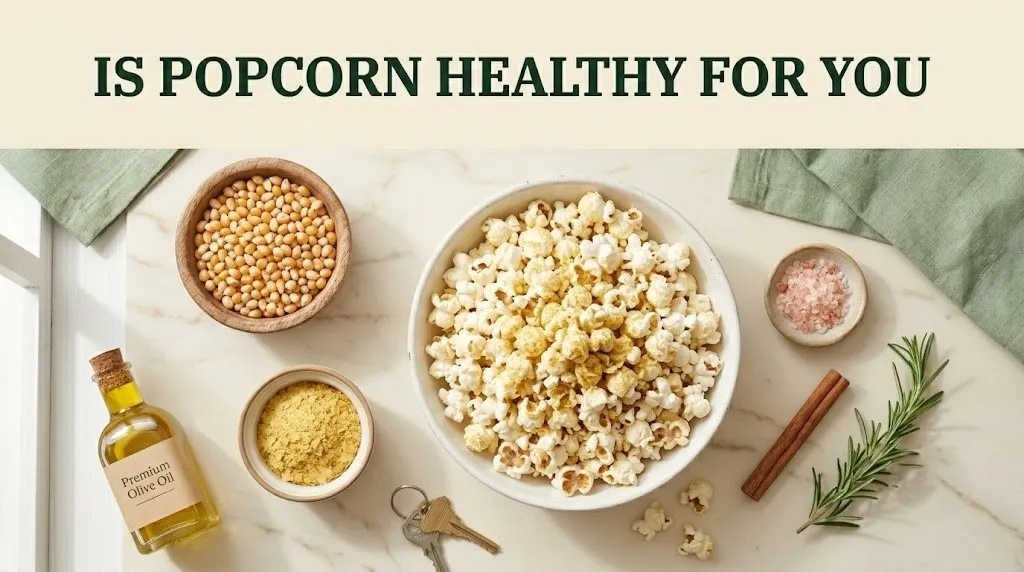
Popcorn is not a nutritional replacement for vegetables. It lacks the water-soluble vitamins, folate, and vitamin C found in produce. What it offers is a whole grain delivery system that people actually want to eat. No one snacks on a bowl of dry oats. Popcorn is a whole grain that tastes like a treat and crunches like a snack food. That behavioral advantage should not be underestimated in a food environment where most convenient snacks are ultra-processed.
Popcorn: Healthy or Unhealthy Depending on Preparation
Popcorn is healthy or unhealthy depending almost entirely on how it is popped and what is added after. The kernel itself is a nutritious whole grain. The oil, butter, salt, sugar, and chemical flavorings are where the problems start.
A plain air-popped bowl of popcorn and a large movie theater popcorn with butter topping share the same starting ingredient. They share almost nothing else nutritionally. A small movie theater popcorn without butter contains roughly 400 to 500 calories and 25 to 30 grams of fat. A large with butter topping can exceed 1,200 calories and 60 grams of saturated fat, more than a full day’s recommended limit according to the American Heart Association.
The preparation method dictates fat content, sodium level, and caloric density. The topping choices layer on additional saturated fat, sugar, or sodium. Control over both factors is why homemade popcorn is nutritionally superior to most commercial versions. The kernel is not the variable. The process is.
| Preparation Method | Calories (3 cups) | Fat | Fiber | Sodium |
|---|---|---|---|---|
| Air-popped, no toppings | 93 | 1 g | 3.5 g | 0 mg |
| Stovetop with 1 tbsp olive oil | 165 | 12 g | 3.5 g | 0 mg |
| Light microwave, no butter | 120 | 4 g | 3 g | 180 mg |
| Butter microwave, standard bag | 170 | 12 g | 3 g | 350 mg |
| Movie theater, small, no butter | 400 | 27 g | 3 g | 600 mg |
| Caramel or kettle corn | 220 | 5 g | 2 g | 150 mg |
Key Takeaway: The kernel is healthy. The preparation and toppings decide whether the final bowl supports your health goals or works against them.
Is Popcorn Healthy to Eat Every Day?
Popcorn is healthy enough to eat every day as part of a balanced diet, provided the daily serving is air-popped or lightly seasoned, portion size stays around 3 to 4 cups, and it does not displace other nutrient-dense foods.
A daily whole grain snack is aligned with the Dietary Guidelines for Americans recommendation of three to five servings of whole grains per day. Popcorn can fill one of those slots. Three cups of air-popped popcorn supply about 15 grams of carbohydrate, which fits within most eating patterns without dominating the day’s calorie or carb budget.
The risk of daily popcorn consumption is not the popcorn. It is the possibility that popcorn crowds out other foods. If a daily bowl of popcorn replaces a daily bowl of leafy greens, fruit, or lean protein, the overall diet quality drops. Popcorn is a whole grain, not a vegetable. Treat it as the grain component of a snack or meal rather than a free pass to skip produce.
Portion control requires attention because popcorn is so light and voluminous that a large bowl can look like a moderate snack. A standard mixing bowl can hold 6 to 8 cups, which doubles the reasonable serving. Measure once to calibrate your eye. Most people underestimate how much they are eating when they pour directly from a large batch into a bowl.
Popcorn Nutrition Facts and Health Benefits
The nutritional profile of popcorn explains why it earns consistent endorsements from heart health and nutrition organizations. A 3-cup serving of air-popped popcorn contains 93 calories, 3 grams of protein, 3.5 grams of fiber, and 18 grams of carbohydrate, with less than 1 gram of fat.
Fiber is the headline nutrient. The 3.5 grams of fiber in popcorn are predominantly insoluble fiber, the type that adds bulk to stool and promotes regular bowel movements. Insoluble fiber does not dissolve in water. It passes through the digestive tract largely intact, acting like a gentle internal scrub brush. The Academy of Nutrition and Dietetics recommends 25 grams of fiber daily for women and 38 grams for men. A bowl of popcorn gets you roughly 10 to 14 percent of the way there.
Popcorn is naturally low in calories per volume, a concept called energy density. Foods with low energy density take up more space in the stomach relative to their calorie content, which triggers stretch receptors that signal fullness to the brain. This is why popcorn is frequently recommended in weight management contexts.
Popcorn also delivers small amounts of B vitamins, including thiamin, niacin, and vitamin B6, as well as minerals like magnesium, phosphorus, and zinc. These are present in the whole grain germ and bran, which are stripped away in refined grains but retained in popcorn.
Key Takeaway: Three cups of air-popped popcorn deliver 3.5 grams of fiber, B vitamins, and minerals for under 100 calories. The fiber and low energy density make it unusually satiating for a snack food.
Is Butter Popcorn Healthy?
Butter popcorn is not healthy in the quantities most people consume it, though a small amount of real butter on homemade popcorn can fit into a balanced diet. The problem with butter popcorn is primarily a portion and sourcing issue.
Real butter is roughly 80 percent milk fat, predominantly saturated fat. One tablespoon of butter contains 7 grams of saturated fat. The American Heart Association recommends limiting saturated fat to 5 to 6 percent of total daily calories, which is roughly 13 grams on a 2,000-calorie diet. One tablespoon of butter on a bowl of popcorn uses more than half that budget.
Movie theater and commercial butter popcorn rarely use real butter. The butter topping at most theaters is a hydrogenated oil product with butter flavoring, beta-carotene for color, and salt. The fat profile is a mix of saturated and trans fats, though trans fat levels have decreased since the FDA partially hydrogenated oil ban took full effect. The calorie load and sodium content are the bigger concerns.
You can enjoy a butter-like flavor at home with a fraction of the saturated fat. Melt one teaspoon of real butter and drizzle it over a full bowl of air-popped popcorn. The butter flavor coats the surface without soaking every kernel. One teaspoon of butter adds roughly 34 calories and 2.3 grams of saturated fat to the entire bowl.
Is Light Butter Popcorn Healthy?
Light butter microwave popcorn is healthier than full-butter microwave popcorn, but it is still not as healthy as homemade air-popped or stovetop popcorn. The term light butter is a marketing claim, not a standardized nutritional definition.
A typical light butter microwave popcorn contains 100 to 130 calories per 3-cup serving, with 3 to 5 grams of fat and 200 to 300 milligrams of sodium. Compare that to full-butter microwave popcorn at 160 to 190 calories, 10 to 14 grams of fat, and 350 to 450 milligrams of sodium for the same serving. The calorie and fat reduction is real. The food is an improvement over the full-fat version.
The remaining concerns with light butter microwave popcorn are the sodium content, the potential presence of PFAS in bag linings, and the artificial butter flavorings. A 300-milligram sodium serving is 13 percent of the American Heart Association’s ideal daily limit of 2,300 milligrams. If you eat two servings, which is easy to do with a standard bag, that number doubles.
The ingredient list on light butter microwave popcorn often includes partially hydrogenated oils in trace amounts, artificial flavors, and preservatives. These do not make the food acutely dangerous. They make it a processed food with a longer ingredient list than popcorn, oil, and salt. If convenience is the priority, light butter microwave popcorn is an acceptable occasional choice. If health optimization is the goal, the stovetop or air popper is the better route.
Key Takeaway: Light butter microwave popcorn is a moderate improvement over full-butter versions but still lags behind homemade popcorn in sodium, ingredient simplicity, and fat quality.
Is Sweet Popcorn Healthy?
Sweet popcorn, including kettle corn and caramel corn, is a dessert, not a health food. The added sugar transforms popcorn from a fiber-rich whole grain into a source of empty calories with a higher glycemic load.
Kettle corn, the sweet and salty variety often sold at farmers markets and fairs, contains roughly 8 to 12 grams of added sugar per 3-cup serving. That is about 2 to 3 teaspoons of sugar. The USDA Dietary Guidelines recommend that added sugars make up less than 10 percent of total daily calories. For a 2,000-calorie diet, that is a maximum of 50 grams. A single serving of kettle corn uses roughly 20 percent of that budget.
Caramel corn and candy-coated popcorn are more extreme. A 3-cup serving of caramel corn packs 20 to 30 grams of added sugar, which is 40 to 60 percent of the daily limit. These products are confections built around popcorn, not popcorn with a light sweetener. They should be evaluated like any other candy or dessert.
A better approach for sweet popcorn cravings is to air-pop a batch at home and add a light dusting of cinnamon and a teaspoon of coconut sugar or maple sugar. The spice provides sweetness perception without calories. The small amount of sugar satisfies the craving without turning the entire bowl into a sugar delivery system. A teaspoon of sugar across an entire bowl of popcorn contributes 4 grams of added sugar total.
Air Popped Popcorn Benefits for Heart and Weight
Air popped popcorn delivers the maximum nutritional benefits of popcorn with the minimum caloric cost. It is the preparation method that dietitians, cardiologists, and weight management researchers consistently recommend.
The benefit for heart health comes from what air-popped popcorn lacks. There is no added saturated fat, no trans fat, and no sodium until you choose to add a measured amount. The American Heart Association specifically endorses popcorn as a whole grain snack that supports heart health when prepared without butter or excess salt. The fiber in popcorn also supports healthy cholesterol levels. Soluble fiber, though a smaller fraction of popcorn’s total fiber, binds to cholesterol in the digestive tract and helps remove it from the body.
The benefit for weight management comes from the energy density math. Three cups of air-popped popcorn at 93 calories can fill a large bowl. The equivalent calorie count of potato chips is roughly 10 to 12 chips, which fits in the palm of a hand. The psychological experience of eating a full bowl versus a small handful is profoundly different. Volume eating strategies use this principle to increase meal satisfaction without increasing calories.
A 2012 study published in Nutrition Journal found that popcorn was more satiating than potato chips when compared calorie for calorie. Participants who ate popcorn reported feeling fuller and more satisfied than those who ate the same number of calories as chips. The water content trapped in the popped kernel, the fiber, and the sheer volume all contribute to this effect.
Key Takeaway: Air-popped popcorn is the healthiest preparation method. It maximizes fiber delivery per calorie, contains no added saturated fat, and supports heart health and satiety.
Microwave Popcorn Health Risks in 2026
Microwave popcorn health risks in 2026 center on sodium, saturated fat, and lingering questions about packaging chemicals, though the specific dangers have shifted over the past decade as manufacturers reformulated products.
Diacetyl, the butter flavoring compound linked to a condition called bronchiolitis obliterans or popcorn lung, was voluntarily removed from most microwave popcorn products starting around 2007. The concern applied primarily to workers in manufacturing facilities exposed to high concentrations of diacetyl vapor, not to consumers eating popcorn at home. By 2026, diacetyl is largely absent from microwave popcorn ingredient lists. Replacement flavoring compounds are used instead, though occupational exposure concerns remain for some substitutes.
The more current packaging concern involves perfluoroalkyl and polyfluoroalkyl substances or PFAS, a class of chemicals used to make paper and cardboard grease-resistant. Microwave popcorn bags have historically been treated with PFAS to prevent oil from soaking through. These chemicals persist in the environment and in the human body. The FDA has worked with manufacturers to phase out certain PFAS from food packaging, and many brands now label their bags as PFAS-free. As of 2026, several major brands explicitly market PFAS-free microwave popcorn bags. Check the packaging for this claim if it concerns you.
The remaining everyday health risks of microwave popcorn are nutritional, not toxicological. The sodium, saturated fat, and caloric density are the real reasons to limit consumption. A bag of butter-flavored microwave popcorn can contain 500 to 600 calories and over 1,000 milligrams of sodium if the entire bag is eaten as one serving.
Quick Tip:
- Look for microwave popcorn labeled PFAS-free if packaging chemicals concern you.
- Choose plain or light versions and add your own seasonings.
- Check the serving size. A standard bag often contains 2 to 3 servings.
Popcorn as a Healthy Snack for Weight Loss
Popcorn is an effective snack for weight loss because it provides volume, fiber, and crunch for very few calories when air-popped or lightly oiled. The satiety factor helps prevent overeating later in the day.
A weight-loss-friendly popcorn approach uses the food as a bridge snack between meals or as an evening snack replacement for higher-calorie options. A 3-cup bowl of air-popped popcorn at 93 calories with a sprinkle of nutritional yeast and a pinch of salt satisfies the crunch craving that might otherwise lead to chips, crackers, or cookies. A single serving of potato chips can run 150 to 300 calories with far less fiber and satiety.
The fiber in popcorn slows gastric emptying, meaning the stomach stays distended longer after eating. This triggers vagus nerve signals to the brain that reduce hunger signaling. A 2015 study in the Journal of the Academy of Nutrition and Dietetics found that increased dietary fiber intake was associated with lower body weight and reduced waist circumference independent of other dietary changes.
Portion awareness remains important. Popcorn is not a negative-calorie food or a weight loss magic bullet. Eating a gallon of popcorn with butter and salt will not produce weight loss. The calorie deficit required for weight loss still applies. Popcorn helps by making the deficit feel less restrictive.
Popcorn for Diabetics and Blood Sugar Management
Popcorn can fit into a diabetic eating plan, but portion size and preparation method are non-negotiable. The carbohydrate content and glycemic impact of popcorn are moderate, and the fiber helps buffer the blood sugar response.
The glycemic index or GI of plain air-popped popcorn is approximately 55 to 65, placing it in the moderate GI category. A 3-cup serving contains about 18 grams of carbohydrate, of which 3.5 grams are fiber. The net carbohydrate is roughly 14 to 15 grams, which is manageable within a diabetic meal plan that accounts for total carbohydrate intake. The American Diabetes Association notes that whole grains can be part of a diabetes-friendly diet when portions are measured and blood glucose responses are monitored individually.
The addition of fat and protein to a popcorn snack can further moderate the blood sugar response. A small handful of nuts eaten alongside popcorn adds protein and unsaturated fat that slow carbohydrate absorption. Pairing popcorn with a hard-boiled egg or a piece of string cheese serves the same purpose.
The preparation method matters for blood sugar because added sugar changes the calculation completely. Kettle corn and caramel corn have a higher GI and a much higher glycemic load. The sugar coating digests rapidly and can spike blood glucose. Diabetics and people with insulin resistance should stick to plain popcorn with savory seasonings and avoid sweetened varieties.
Key Takeaway: Air-popped popcorn at 14 to 15 grams of net carbs per 3 cups fits into diabetic meal plans. Pairing with protein or fat slows the blood sugar response further.
Popcorn Polyphenols and Antioxidant Content
Popcorn contains polyphenols, specifically ferulic acid, at concentrations that rival or exceed some fruits and vegetables per gram. This is the most surprising and underpublicized nutritional feature of popcorn.
A 2012 study from the University of Scranton presented at the American Chemical Society national meeting found that popcorn contains up to 300 milligrams of polyphenols per serving. That concentration is higher than the polyphenol content found in an equivalent weight of many fruits and vegetables. The hull, the brownish outer layer that gets stuck in your teeth, is where the polyphenols concentrate. The researchers noted that the hull has the highest polyphenol and fiber content, which is a strong argument for eating the whole popped kernel rather than discarding the hulls.
Ferulic acid is the dominant polyphenol in popcorn. It is a hydroxycinnamic acid with antioxidant properties. It scavenges free radicals and may contribute to the anti-inflammatory effects observed in whole grain consumption patterns. Popcorn’s antioxidant capacity is measurable in laboratory assays, though translating antioxidant capacity to a specific health outcome in humans is complex.
The comparison to fruits and vegetables is useful for perspective but not for substitution. Popcorn lacks the vitamin C, potassium, folate, and water content of fresh produce. The polyphenol finding reinforces that whole grains contribute phytonutrients to the diet, not just fiber and minerals. It does not mean popcorn replaces broccoli.
Popcorn vs Chips: A Full Nutrition Comparison
Popcorn outperforms potato chips and tortilla chips on fiber, calorie density, and whole grain status. The comparison is not close, but the specific numbers make the case clearly.
A 3-cup serving of air-popped popcorn provides 93 calories and 3.5 grams of fiber. A 1-ounce serving of potato chips, roughly 15 chips, provides 150 to 160 calories and 1 gram of fiber. The popcorn serving is larger in physical volume by a factor of roughly three to four times, meaning you get more food, more chewing, more stomach distention, and more fiber for fewer calories.
| Snack (standard serving) | Calories | Fat | Fiber | Sodium | Whole Grain |
|---|---|---|---|---|---|
| Air-popped popcorn, 3 cups | 93 | 1 g | 3.5 g | 0 mg | Yes |
| Potato chips, 1 oz (15 chips) | 150 | 10 g | 1 g | 180 mg | No |
| Tortilla chips, 1 oz (12 chips) | 140 | 7 g | 1 g | 120 mg | Sometimes |
| Cheese puffs, 1 oz (about 20) | 160 | 10 g | 0 g | 300 mg | No |
Tortilla chips can be a whole grain product if made from whole corn masa, but most commercial tortilla chips are fried and salted. The calorie density and fat content push them closer to potato chips than popcorn.
The sodium comparison is notable. Popcorn starts at zero sodium. You control the salt shaker. Chips arrive pre-salted at 120 to 300 milligrams per serving, and most people eat more than the standard serving.
Key Takeaway: Popcorn beats chips on fiber, calorie density, and whole grain content. You control the sodium on popcorn. Chips arrive pre-loaded with salt and oil.
Healthy Popcorn Toppings and Seasoning Ideas
Healthy popcorn toppings add flavor, nutrition, or both without pouring on saturated fat, sugar, or excess sodium. The right seasoning turns plain popcorn into a genuinely interesting snack.
Nutritional yeast is the single best savory topping for popcorn. It is deactivated yeast sold as yellow flakes or powder. It has a naturally cheesy, umami flavor. Two tablespoons deliver roughly 5 grams of protein and significant amounts of B vitamins, including B12 if fortified. It sticks well to lightly oiled or water-misted popcorn.
Spice blends add flavor without calories. Smoked paprika, garlic powder, onion powder, cumin, turmeric, and black pepper can be combined in endless variations. A mixture of turmeric, black pepper, and a pinch of salt creates a golden, anti-inflammatory popcorn. The black pepper enhances the absorption of curcumin from the turmeric.
Herb and citrus combinations brighten popcorn. Finely grated lemon or lime zest mixed with dried herbs like oregano, thyme, or rosemary creates a fresh, aromatic bowl. A light mist of olive oil or a spritz of lemon juice helps the zest and herbs adhere.
For a sweet option that stays healthy, a dusting of cinnamon with a teaspoon of coconut sugar or monk fruit sweetener provides warmth and sweetness with minimal or zero added sugar. Nutmeg, cardamom, and a tiny pinch of cloves turn popcorn into a chai-inspired snack.
Quick Tip:
- Mist popcorn with water or a tiny amount of oil from a spray bottle before adding dry seasonings. The moisture helps toppings stick.
- Nutritional yeast plus a pinch of salt is the simplest upgrade.
- Store seasoning blends in small jars so they are ready when the popcorn finishes popping.
How to Make Healthy Popcorn at Home
Making healthy popcorn at home takes less than 10 minutes and requires either an air popper, a stovetop pot, or a microwave and a plain paper bag. The stovetop method produces the best texture with a small amount of healthy oil.
The stovetop method gives you control over the oil type and amount. Use a heavy-bottomed pot with a tight-fitting lid. A thin pot will scorch the kernels. A loose lid will send popcorn flying across the kitchen.
To make stovetop popcorn:
- Add 2 tablespoons of high-smoke-point oil to the pot. Coconut oil, avocado oil, or light olive oil work well.
- Add 3 popcorn kernels and place the pot over medium-high heat with the lid on.
- When all 3 test kernels pop, the oil is at the correct temperature, roughly 400 to 460 degrees Fahrenheit.
- Add 1/3 cup of popcorn kernels in an even layer. Cover immediately.
- Remove the pot from the heat for 30 seconds. This step allows all kernels to reach a uniform temperature, which reduces unpopped kernels.
- Return the pot to medium-high heat. The popping will begin almost immediately.
- Shake the pot gently a few times as kernels pop. Keep the lid slightly cracked to release steam, which makes the popcorn crispier.
- When popping slows to 2 to 3 seconds between pops, remove from heat. Pour immediately into a large bowl.
- Season while warm.
For oil-free popcorn, an air popper is the best tool. The machine circulates hot air around the kernels until they pop, producing a dry, crisp result with no added fat. Air poppers are inexpensive, typically $20 to $40, and require no cleanup beyond wiping down the chute.
Best Popcorn Makers for Healthy Preparation
The best popcorn maker for healthy preparation depends on your priorities: oil-free volume eating, stovetop flavor, or microwave convenience without the chemical concerns of commercial bags.
Electric air poppers produce the lowest-calorie popcorn with zero added fat. They are the best choice for weight loss and heart health. Brands like Presto and Cuisinart dominate the category. The downside is that dry popcorn does not hold seasonings well, so you may need a light oil or water mist to make toppings stick.
Stovetop poppers, including specialized pots with a hand-crank mechanism like the Whirley Pop, produce the best-tasting popcorn. The small amount of oil used during popping toasts the kernels slightly, adding flavor depth that air poppers cannot match. The hand crank keeps kernels moving, preventing scorching. The cleanup requires washing an oily pot, which takes slightly more effort than wiping down an air popper.
Microwave popcorn makers are silicone or glass bowls with vented lids. You add loose kernels, optionally add a small amount of oil, and microwave. This method avoids the chemical linings and artificial flavorings of commercial microwave bags while keeping the speed and convenience of microwave preparation. A silicone microwave popper costs $10 to $20 and collapses for storage.
| Popcorn Maker | Price Range | Oil Needed | Texture | Cleanup Effort |
|---|---|---|---|---|
| Electric air popper | $20 to $40 | None | Dry, crisp | Minimal |
| Stovetop pot (standard) | Already owned | 1 to 2 tbsp | Crisp, rich | Moderate |
| Whirley Pop stovetop | $35 to $45 | 1 to 2 tbsp | Crisp, rich, even | Moderate |
| Silicone microwave popper | $10 to $20 | Optional | Close to air-popped | Minimal |
| Paper bag in microwave | Pennies | Optional | Close to air-popped | None |
Key Takeaway: An air popper is best for the lowest-calorie popcorn. A stovetop popper with a small amount of healthy oil produces the best flavor and texture.
Frequently Asked Questions About Popcorn and Health
Is microwave popcorn bad for you?
Microwave popcorn is less healthy than homemade popcorn because of the added sodium, saturated fat, and artificial flavorings in most brands. The chemical diacetyl that caused popcorn lung concern was removed from most products years ago. Current packaging may or may not contain PFAS, so look for brands labeled PFAS-free if this is a concern.
How many calories are in a bowl of popcorn?
A 3-cup bowl of air-popped popcorn contains 93 calories. A 3-cup bowl of oil-popped stovetop popcorn made with 1 tablespoon of oil contains roughly 165 calories. A 3-cup bowl of butter microwave popcorn contains roughly 170 calories. The size of the bowl matters; measure once to see what your actual serving looks like.
Can dogs eat popcorn?
Dogs can eat small amounts of plain, air-popped popcorn as an occasional treat. Popcorn with butter, salt, or flavorings should not be given to dogs due to the fat and sodium content. Unpopped kernels pose a choking hazard and can damage teeth, so fully popped pieces only.
Is popcorn a good snack for weight loss?
Popcorn is an excellent snack for weight loss because it provides high volume, fiber, and crunch for very few calories when air-popped. A 3-cup serving is physically large and satiating at under 100 calories. It works well as an evening snack replacement for chips, crackers, or sweets.
What is the healthiest way to pop popcorn?
Air-popping is the healthiest method because it requires no oil and produces popcorn at 93 calories per 3 cups with zero added fat. Stovetop popping with a small amount of olive or avocado oil is a close second and produces better texture and flavor. Both methods avoid the sodium and additives in microwave popcorn bags.
Air-popped popcorn seasoned with nutritional yeast and a light pinch of salt is one of the most nutritious, satisfying snacks you can eat. It is a whole grain that crunches like a treat, fills a bowl for under 100 calories, and supplies fiber and polyphenols that support health from digestion to cellular protection.
The next time you want a snack, skip the chip bag. Grab the popcorn kernels instead. Pop them in an air popper or a pot with a tablespoon of olive oil. Dust them with nutritional yeast or smoked paprika. Eat the whole bowl. Your body will get fiber, antioxidants, and the satisfaction of a snack that does not require guilt or portion anxiety after the last kernel is gone.