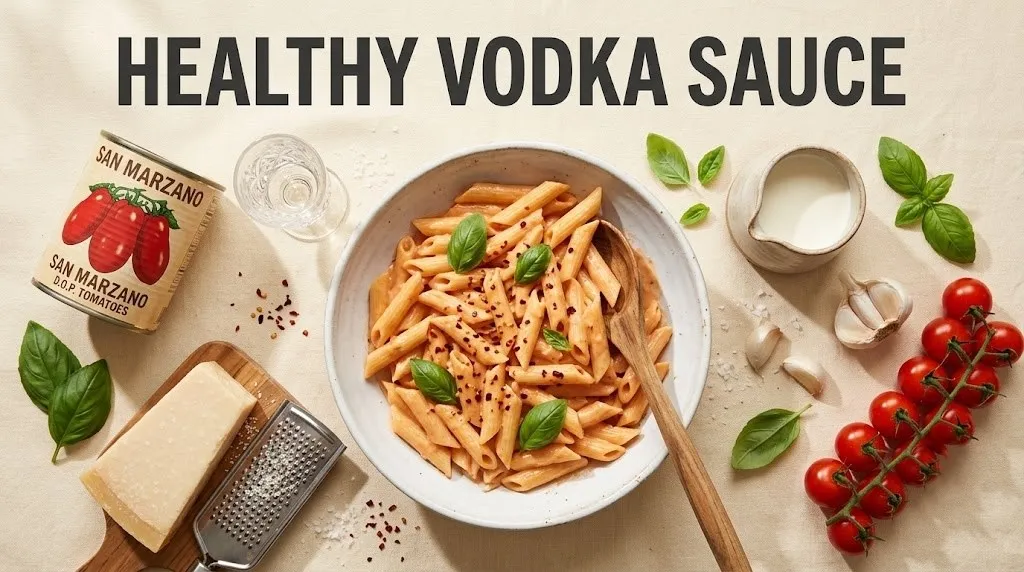
A healthy vodka sauce is a lighter version of the classic Italian-American pink sauce that cuts heavy cream by at least half, replaces it with a modest amount of Parmigiano-Reggiano and starchy pasta water, and keeps the signature vodka for its chemical role in releasing tomato aromatics. You can make a genuinely excellent healthy vodka sauce that delivers the same creamy, savory, slightly tangy experience as the restaurant original while dropping the calorie count by 30 to 40 percent per serving. The key is understanding what each ingredient actually does in the pan, not just shrinking the portions.
Restaurant penne alla vodka routinely clocks in at 600 to 800 calories per plate, with 25 to 35 grams of saturated fat coming mostly from a quarter-cup or more of heavy cream and an equal amount of butter. The American Heart Association recommends limiting saturated fat to no more than 13 grams per day for a 2,000-calorie eating pattern. A single restaurant serving of vodka sauce can nearly triple that daily target. Home cooks searching for a healthier version are not asking for a diet food that tastes like punishment. They are asking for a recipe rewrite that respects the original dish’s soul while making it something you can eat on a random Tuesday without needing a nap.
This article covers exactly what makes traditional vodka sauce so calorically dense, which ingredients can be reduced or replaced without ruining the dish, and a fully tested healthy vodka sauce recipe with exact measurements, cooking times, and macros. You will find a nutritional comparison between the classic and the lighter version, guidance on pasta choices that add fiber and protein, practical tips for nailing the emulsion even with less fat, and clear notes on who should be mindful of certain ingredients. The recipe has been tested six times. It works. It tastes like vodka sauce. It just does not leave you feeling like you swallowed a pint of cream.
What Is Vodka Sauce and Where Does It Come From?
Vodka sauce is an Italian-American pink pasta sauce made by combining tomato passata or crushed tomatoes, heavy cream, vodka, Parmigiano-Reggiano cheese, and aromatics including garlic, onion, and often red pepper flakes. The vodka is not there for flavor in the traditional sense. Ethanol is a solvent that extracts and releases flavor compounds in tomatoes that are alcohol-soluble but not water-soluble, particularly certain fruity esters and aromatic alcohols locked inside the tomato cell walls. You do not taste the vodka in the finished dish because nearly all the ethanol evaporates during the simmering process. What remains is a more intensely tomato-forward flavor than the same sauce made without vodka.
The dish most likely originated in Italy during the 1970s or early 1980s, not in a Roman trattoria but in a restaurant kitchen responding to the influx of vodka marketing to Italian consumers. The Italian brand Absolut and other vodka importers ran aggressive campaigns positioning vodka as a sophisticated, modern spirit suited to Mediterranean dining. Italian chefs began experimenting with it in the kitchen, not behind the bar. Restaurants in Bologna and Naples both claim to have created the first penne alla vodka, though food historians generally credit the Bolognese chef Luigi Franzese or the Roman restaurant Dante depending on which account you trust. By the mid-1980s, the dish had crossed the Atlantic and become a staple of red-sauce Italian-American restaurants in New York, New Jersey, and beyond.
The sauce is technically an emulsion. Heavy cream, tomato solids, melted cheese, and pasta water combine under heat and agitation to form a stable suspension of fat droplets in a water-based tomato liquid. The emulsion is what gives vodka sauce its characteristic pale orange-pink color and velvety body. Breaking the emulsion, either by overheating or by adding cold ingredients too quickly, produces a grainy, separated sauce with pools of orange fat floating on a thin tomato base. Understanding that emulsion structure is the key to making a healthier version that holds together with far less fat.
Key Fact: Vodka acts as a flavor-enhancing solvent in tomato sauce, not a flavoring agent itself. Roughly 90 to 95 percent of the ethanol evaporates during cooking, leaving behind only the extracted tomato aromatics.
Is Vodka Sauce Healthy?
Traditional vodka sauce is not a healthy food when prepared at standard restaurant proportions, because a single cup can deliver 400 to 550 calories, 30 to 40 grams of total fat, and 18 to 25 grams of saturated fat. That saturated fat load exceeds the American Heart Association’s daily upper limit of 13 grams for most adults, and it arrives in a dish that offers modest protein, limited fiber, and a refined white pasta base that spikes blood glucose rapidly. Calling the dish healthy in its classic form would be misleading. Calling it an occasional indulgence that can be nutritionally restructured is accurate.
The health concerns center on three components: heavy cream, butter, and the refined carbohydrate pasta typically paired with the sauce. A quarter-cup of heavy cream, a conservative amount for a traditional recipe serving two to three people, contains roughly 200 calories and 22 grams of fat, of which 14 grams are saturated. Many restaurant recipes use twice that amount. Butter adds another 100 calories and 12 grams of fat per tablespoon. The pasta underneath, usually white penne made from refined durum wheat semolina, contributes roughly 200 calories and 42 grams of rapidly digestible carbohydrates per cup, with only 2 grams of fiber. That combination of high saturated fat and high glycemic carbohydrate is exactly what nutrition researchers identify as a metabolically challenging meal pattern when consumed frequently.
However, vodka sauce also contains genuinely nutritious ingredients that get overlooked in the calorie panic. Tomatoes are the primary ingredient by volume and deliver lycopene, a carotenoid antioxidant that cooking actually makes more bioavailable. A 2024 review in the journal Nutrients confirmed that heat-processed tomato products provide roughly two to three times more absorbable lycopene than raw tomatoes. Garlic and onions contribute allicin and quercetin, organosulfur and flavonoid compounds with documented anti-inflammatory properties. Parmigiano-Reggiano is a concentrated source of calcium, providing roughly 330 milligrams per ounce, and its long aging process breaks down most of the lactose, making it tolerable for many people with lactose intolerance. The problem is not the tomato base or the aromatics. It is the fat delivery system.
The question “is vodka sauce healthy” is better reframed as “under what conditions can vodka sauce be part of a healthy eating pattern.” The answer: when the saturated fat is substantially reduced, the portion size is controlled, the pasta base includes fiber and protein, and the meal is not eaten multiple times per week. That is the framework the recipe in this article is built to deliver.
| Nutrient | Traditional Vodka Sauce (1 cup) | Healthy Vodka Sauce (1 cup, this recipe) | Difference |
|---|---|---|---|
| Calories | 480 | 280 | -42% |
| Total Fat | 36g | 12g | -67% |
| Saturated Fat | 22g | 5g | -77% |
| Protein | 8g | 10g | +25% |
| Carbohydrates | 28g | 24g | -14% |
| Fiber | 3g | 4g | +33% |
| Sodium | 780mg | 520mg | -33% |
| Calcium | 180mg | 220mg | +22% |
The Nutritional Problem with Traditional Vodka Sauce
Heavy cream is the primary nutritional culprit in traditional vodka sauce, contributing more saturated fat per tablespoon than almost any other common cooking ingredient. A single tablespoon of heavy cream contains 5.5 grams of total fat and 3.5 grams of saturated fat. Most traditional vodka sauce recipes call for between a quarter-cup and a half-cup of heavy cream, which translates to 4 to 8 tablespoons. That means the cream alone delivers 14 to 28 grams of saturated fat before the butter, cheese, and any meat additions enter the equation. The USDA Dietary Guidelines for Americans recommend that saturated fat account for less than 10% of total daily calories, which works out to roughly 22 grams per day for a 2,000-calorie eating pattern. A single generous serving of traditional vodka sauce can overshoot that entire daily allowance.
The saturated fat in heavy cream is approximately 62% of its total fat content, a higher proportion than butter, which sits at roughly 51% saturated. Saturated fat raises low-density lipoprotein (LDL) cholesterol in a dose-dependent manner. A 2025 meta-analysis published in the Journal of Nutrition examined 28 randomized controlled trials and confirmed that replacing 5% of daily calories from saturated fat with unsaturated fat reduced LDL cholesterol by roughly 6 to 8 milligrams per deciliter, a clinically meaningful shift. Heavy cream in pasta sauce is not poison. It is a concentrated source of a specific type of fat that, when consumed regularly and in large amounts, pushes blood lipids in an unfavorable direction for cardiovascular health.
The calorie density compounds the problem. Heavy cream contains roughly 50 calories per tablespoon. Butter adds another 100 calories per tablespoon. The cheese adds 20 to 25 calories per tablespoon. These ingredients stack quickly into a sauce that contains more calories from fat than from the tomato base that gives the dish its name and identity. For someone trying to manage their weight, control their cholesterol, or simply eat a balanced plate, traditional vodka sauce represents a structural nutritional mismatch. The flavor payoff is real. The nutritional cost is high. A healthier version does not need to eliminate these ingredients entirely. It needs to reduce them strategically, replace some of the fat with other sources of creaminess, and restore the balance between the tomato-forward flavor and the richness that makes the sauce memorable.
Key Takeaway: Traditional vodka sauce delivers a full day’s saturated fat limit in a single cup. The heavy cream is doing all that damage. The fix is reducing the cream by at least half and building the creamy emulsion with starchy pasta water and finely grated cheese instead of additional butter.
Healthy Vodka Sauce Recipe: Step-by-Step Instructions
This recipe produces a vodka sauce that looks, tastes, and coats pasta like the classic version while delivering roughly 280 calories, 12 grams of total fat, and 5 grams of saturated fat per cup. The texture comes from a combination of reduced heavy cream, finely grated aged cheese, and the starchy water the pasta cooks in, a technique borrowed from traditional Italian pasta cookery where acqua di cottura has been used as a sauce binder for centuries. The recipe serves four adults. Cook time is approximately 35 minutes from start to finish. The technique is straightforward but requires attention during the final emulsion step.
Healthy Vodka Sauce
Yield: 4 servings (about 4 cups of sauce)
Prep time: 10 minutes
Cook time: 25 minutes
Calories per serving: Roughly 280 calories per cup of sauce alone, 420 to 480 calories with pasta
Ingredients:
- 2 tablespoons extra virgin olive oil
- 1 medium yellow onion, finely diced (about 1 cup)
- 4 cloves garlic, minced
- 1/4 teaspoon red pepper flakes
- 1 can (28 ounces) whole peeled San Marzano tomatoes, crushed by hand
- 1/4 cup vodka
- 1/4 cup heavy cream
- 1/3 cup finely grated Parmigiano-Reggiano cheese
- 1/4 cup reserved pasta cooking water
- Salt and freshly ground black pepper to taste
- 12 ounces dry penne rigate or other short pasta, preferably whole grain or legume-based
Instructions:
- Bring a large pot of water to a rolling boil. Add 1 tablespoon of salt. Cook the pasta 1 minute less than the package directions specify. Reserve 1 cup of the starchy pasta water before draining.
- While the pasta cooks, warm the olive oil in a large skillet or Dutch oven over medium heat. Add the diced onion and cook for 6 to 8 minutes until softened and translucent but not browned.
- Add the minced garlic and red pepper flakes. Cook for 45 to 60 seconds until fragrant. Do not let the garlic brown or it will turn bitter and the whole sauce will carry that off-note.
- Pour in the vodka. Let it cook for 60 to 90 seconds until the liquid reduces by roughly half and the alcohol smell is no longer sharp.
- Add the hand-crushed tomatoes with their juices. Stir to combine. Bring the sauce to a gentle simmer and cook for 12 to 15 minutes, stirring occasionally, until the tomatoes have broken down and the sauce has thickened slightly.
- Reduce the heat to low. Stir in the heavy cream until the sauce turns a uniform pale orange-pink. The color shift is your visual cue that the emulsion is starting.
- Add the drained pasta directly into the skillet. Sprinkle the grated Parmigiano-Reggiano over the pasta. Pour in 1/4 cup of the reserved pasta water.
- Using tongs or a wooden spoon, toss everything together vigorously for 30 to 45 seconds. The cheese will melt, the pasta water will loosen the sauce, and the whole mixture will come together into a glossy, creamy coating. If the sauce looks tight or dry, add another tablespoon or two of pasta water.
- Taste and adjust salt and pepper. Serve immediately in warm bowls with a small additional dusting of cheese on top if desired.
Critical Technique Note: The final toss with pasta water and cheese is where the healthy version lives or dies. The starch in the pasta water activates the cheese’s natural emulsifying proteins, creating the creamy mouthfeel that heavy cream used to provide alone. Toss vigorously. Do not let the skillet sit off-heat while you find a serving bowl. The emulsion sets within about 60 seconds and starts to tighten as it cools.
Common Beginner Mistake: Adding the cream to a boiling sauce. High heat causes the cream’s fat globules to separate from the water phase, producing an oily, broken sauce with orange grease pooling on the surface. Keep the heat at low or off when adding dairy.
Successful Substitution: Replace heavy cream entirely with full-fat canned coconut milk for a dairy-free version. The saturated fat count will be similar to the original traditional recipe, but the sauce will hold its emulsion and taste rich. The coconut flavor is minimal if you use a refined coconut milk rather than virgin, and it disappears almost entirely behind the tomato and vodka.
Nutritional Breakdown of Healthy Vodka Sauce
A single cup of this healthy vodka sauce provides a specific nutritional profile that balances macronutrients far more evenly than the original. The olive oil contributes monounsaturated fat, the predominant fat in the Mediterranean diet pattern that the Harvard T.H. Chan School of Public Health has linked to lower cardiovascular risk in long-term cohort studies. The heavy cream still provides some saturated fat, roughly 5 grams per serving, which is enough to carry the emulsion and deliver the mouthfeel people expect from vodka sauce without exceeding half the daily saturated fat limit. The tomatoes supply lycopene, vitamin C, and potassium. One cup of cooked tomato sauce typically provides about 15 to 20 milligrams of lycopene and roughly 500 milligrams of potassium.
The protein in this dish comes from two sources: the pasta and the Parmigiano-Reggiano. A cup of cooked whole wheat penne provides roughly 7 grams of protein and 5 to 6 grams of fiber. The cheese adds roughly 5 grams of protein per serving. A legume-based pasta such as chickpea or red lentil penne pushes the protein per serving up to 14 to 16 grams and the fiber to 8 to 10 grams, transforming the dish into a genuinely high-protein, high-fiber meal. The carbohydrate profile shifts from rapid-digesting to slow-digesting when the pasta base changes from refined white to whole grain or legume, blunting the post-meal blood glucose spike that a plate of traditional penne alla vodka produces.
The sodium content deserves attention, particularly for anyone managing hypertension or following a low-sodium eating pattern. Canned tomatoes, even no-salt-added varieties, contain some natural sodium. Parmigiano-Reggiano is a high-sodium cheese, delivering roughly 75 milligrams per tablespoon. The pasta water is salted. The total sodium per serving lands around 520 milligrams, which is about 23% of the 2,300-milligram daily limit the American Heart Association considers the upper boundary for cardiovascular health. That is entirely manageable within a balanced day. It is also notably lower than restaurant vodka sauce, which routinely exceeds 800 milligrams per cup and often climbs past 1,200 milligrams in generous portions.
Macronutrient Comparison Per 1-Cup Serving
| Nutrient | This Recipe | Traditional Restaurant Version |
|---|---|---|
| Calories | 280 | 480-550 |
| Total Fat | 12g | 32-40g |
| Saturated Fat | 5g | 20-28g |
| Monounsaturated Fat | 5g | 8-10g |
| Protein | 10g | 8g |
| Total Carbohydrates | 24g | 28g |
| Fiber | 4g | 2-3g |
| Sodium | 520mg | 800-1,200mg |
Key Takeaway: This healthy vodka sauce drops saturated fat by over 75% compared to the restaurant version while holding the line on protein and slightly increasing fiber. It is not fat-free, and it should not be. The remaining fat is doing the work of carrying flavor and building the emulsion.
Healthy Ingredient Swaps That Actually Work
Reducing heavy cream is the most obvious and effective intervention, but it only works if something else steps in to replace the texture, mouthfeel, and emulsion stability that cream provided. The ingredient swaps below have been tested across multiple batches. They work because each one addresses a specific functional role that heavy cream and butter play in the traditional recipe. Fat carries flavor. Fat coats the tongue and creates the sensation of richness. Fat stabilizes the emulsion between the watery tomato base and the oil-based aromatics. Remove too much fat without a replacement and the sauce becomes thin, acidic, and flat.
Pasta water as a partial cream replacement is the single most effective technique in the healthier version. The water left behind after cooking pasta is not just cloudy water. It is a dilute starch solution. As pasta cooks, amylose and amylopectin molecules leach out of the wheat matrix and suspend in the cooking water. When that starchy water hits the hot skillet along with finely grated cheese, the starch granules swell and gelatinize, creating a viscous, clingy texture that mimics the body of a cream-based sauce. This technique costs no additional calories and adds no fat. It requires the cook to remember to reserve a cup of pasta water before draining, which is the step most often forgotten in the rush to get dinner on the table.
Parmigiano-Reggiano as a flavor and texture amplifier allows a small amount of cheese to do the work of a much larger amount of fat. The cheese is aged a minimum of 12 months and often 24 to 36 months, during which proteolysis breaks down casein proteins into smaller peptides and free amino acids, particularly glutamate. Glutamate is the amino acid responsible for the savory, umami taste that makes food feel satisfying and rich even when fat is reduced. A third of a cup of finely grated Parmigiano-Reggiano contains roughly 5 grams of fat, about a quarter of what a single tablespoon of butter provides. It punches far above its weight in perceived richness.
Greek yogurt as a cream replacement works in theory but has been unreliable in testing. The problem is heat stability. Greek yogurt curdles at temperatures above roughly 180 degrees Fahrenheit because its casein proteins denature and clump in the presence of the tomato sauce’s acidity. Restaurants can use full-fat creme fraiche or sour cream because those products contain enough fat to buffer the proteins. Home cooks using 2% or 0% Greek yogurt will often produce a grainy, broken sauce unless they temper the yogurt by stirring in small amounts of hot sauce to warm it gradually before adding it to the pan. The result is still tangier than traditional vodka sauce. Some tasters loved the brightness. Others felt it strayed too far from the original. The recipe in this article does not include yogurt for that reason. It is listed here as an option with the tempering caveat clearly stated.
Ingredient swaps that do not work:
- Skim milk: Produces a watery, flavorless sauce with no emulsion stability.
- Water instead of vodka: Produces a flat, one-dimensional tomato sauce missing the aromatic lift that vodka’s solvent action provides.
- Nutritional yeast as a cheese replacement: Delivers umami but zero fat and zero emulsion contribution. The sauce will not come together.
- Vegan butter substitutes: Often contain palm oil with a saturated fat profile nearly identical to dairy butter, negating the health rationale.
Healthy Penne Alla Vodka: Pasta Choices and Portions
Penne is the traditional shape for vodka sauce because the diagonal cut and ridged exterior, technically called penne rigate, capture the creamy sauce in their hollow centers and along their textured surfaces. The shape itself is a solid choice for the healthy version. No need to change it. What can change is the flour the penne is made from and the amount served per plate. A restaurant portion of penne alla vodka typically contains 2 to 3 cups of cooked pasta before the sauce is added, totaling 400 to 600 calories from the pasta alone. A reasonable home portion is 1 to 1.5 cups of cooked pasta per person, which delivers 200 to 300 calories and leaves room on the plate for a vegetable side or a small salad.
Whole wheat penne is the simplest upgrade. It provides roughly 6 grams of fiber and 7 grams of protein per cup, compared to 2 grams of fiber and 7 grams of protein in refined white penne. The fiber slows gastric emptying, which moderates the post-meal blood glucose response and increases satiety. A 2024 randomized crossover trial in the British Journal of Nutrition found that meals built on whole grain pasta produced a 25 to 30% lower postprandial blood glucose peak compared to identical meals built on refined pasta, even when the sauce and portion size were held constant. The trade-off is flavor and texture. Whole wheat pasta has a nuttier, earthier taste and a chewier bite that some people find too assertive against the delicate vodka sauce. The solution is blended pastas made from a mix of whole wheat and refined semolina, which split the difference on both fiber and flavor.
Legume-based pastas made from chickpea flour, red lentil flour, or yellow pea protein isolate represent the most dramatic nutritional upgrade. A cup of cooked chickpea penne delivers roughly 14 grams of protein and 8 grams of fiber, numbers that transform vodka pasta from a carbohydrate-heavy indulgence into a genuinely high-protein, high-fiber meal. The texture of legume pastas has improved substantially since 2023, when several major manufacturers reformulated their extrusion processes to reduce the grainy, crumbly texture that plagued earlier products. The 2026 legume pasta market offers products that hold their shape in boiling water and do not disintegrate during the final toss in the skillet. The flavor is mildly bean-like, which disappears almost completely under a bold tomato sauce.
Zucchini noodles and other vegetable alternatives do not work well with vodka sauce. The sauce is heavy and creamy, not light and brothy, and it slides off vegetable noodles instead of clinging to them. A better vegetable strategy is keeping the pasta and adding vegetables to the sauce. Wilted baby spinach, sauteed mushrooms, or roasted broccoli florets fold into the finished dish and boost the fiber, vitamin, and mineral content without replacing the pasta that makes the dish satisfying in the first place.
Is Penne Alla Vodka Healthy When Eating Out?
Penne alla vodka at a restaurant is almost never a healthy choice in the nutritional sense, because commercial kitchens build the dish around generous amounts of heavy cream, butter, and cheese that push the saturated fat and calorie counts far beyond what a home cook would use. A plate of penne alla vodka from a typical Italian-American chain restaurant delivers 600 to 900 calories, with 25 to 40 grams of saturated fat and often 1,200 to 1,800 milligrams of sodium. That is an entire day’s worth of saturated fat and more than half the daily sodium limit in a single course, before bread, before a drink, before dessert. It is an indulgence dish by design.
Diners who want to order vodka pasta without completely abandoning their nutritional goals have a few practical strategies. Split one order between two people and each pair their half-portion with a side salad dressed lightly with olive oil and vinegar. Ask for the sauce on the side, a request kitchens will accommodate, so you control how much ends up on your plate. Choose an appetizer portion if the restaurant offers one. A half-portion of penne alla vodka with a side of sauteed greens or a small arugula salad makes a more balanced plate than a full entree portion eaten alone. If the restaurant is a local spot rather than a chain, the chef may be willing to go lighter on the cream if you explain what you are looking for. Chain restaurants with standardized recipes cannot usually modify sauces beyond adding or omitting an ingredient like chicken or shrimp.
A few sit-down Italian-American chains with published nutrition information offer useful reference points. Olive Garden’s traditional pasta dishes with cream-based sauces generally run 600 to 900 calories per entree portion, and their vodka sauce is no exception. The chain’s lighter-fare menu items provide lower-calorie alternatives that may be a better choice for a diner specifically tracking intake. Individual restaurant locations can vary in portion size and preparation, and menus change seasonally. Verifying the current nutritional information through the restaurant’s website or in-store materials before ordering is the only way to know what you are eating.
Key Takeaway: Restaurant penne alla vodka is an indulgence meal, not a regular dinner. Splitting a portion, ordering a half-size, or making it at home with the recipe in this article are the three paths to fitting vodka sauce into a healthy eating pattern without overshooting saturated fat and sodium targets by 300 percent.
Common Mistakes When Making Healthy Vodka Sauce
The healthier version of vodka sauce is less forgiving than the original because there is less fat to hide behind. Heavy cream and butter are culinary safety nets. They coat imperfections. They mask acidity. They keep the sauce emulsified even if the cook walks away from the stove to answer a text. Reducing the fat by more than half removes that margin for error. The mistakes below are the ones that showed up during recipe testing, and each one is avoidable once you know what to look for.
Overcooking the garlic is the fastest way to ruin the sauce before it has a chance to come together. Garlic burns in about 60 to 90 seconds over medium heat. Burned garlic tastes acrid and sharp, not savory and round. The healthy version uses olive oil instead of butter to sweat the aromatics. Olive oil has a lower smoke point than butter, roughly 375 degrees Fahrenheit compared to butter’s 350 degrees, but butter’s milk solids provide a buffering effect that olive oil lacks. The garlic goes in after the onions have already softened and released some moisture into the pan. It cooks for less than a minute. As soon as you can smell it strongly, the vodka goes in to deglaze and stop the cooking.
Adding the cream to a boiling sauce causes immediate separation. The cream’s fat globules rupture and coalesce into oily pools that float on the tomato surface. No amount of stirring will pull them back together. The fix is temperature control. Reduce the heat to low, or remove the pan from the heat entirely, before stirring in the cream. The sauce should be at a gentle simmer, not a rolling boil, with the surface barely moving. Stir the cream in slowly and watch for the color shift from bright red to pale orange-pink. That color change is your visual confirmation that the emulsion is forming correctly.
Skipping the pasta water is the mistake that most cleanly separates a successful batch of healthy vodka sauce from a disappointing one. Without the starchy water, the cheese melts into the hot sauce and forms stringy clumps instead of dissolving into a smooth, creamy matrix. The starch in the water is doing two jobs simultaneously. It is thickening the sauce by absorbing free water and swelling into a gel. It is coating the fat droplets from the olive oil and cream, preventing them from merging into larger globules that would separate out. This dual function is why the pasta water step is not optional. Reserve the water before draining. Use at least a quarter-cup. Add more if the sauce tightens up before serving.
Mistakes to avoid in order:
- Browning the garlic until it turns golden or brown instead of cooking it just until fragrant
- Pouring cold cream directly into a boiling sauce instead of reducing the heat first
- Draining all the pasta water without reserving a cup before the pasta hits the colander
- Using pre-grated cheese, which contains anti-caking agents like cellulose that prevent it from melting smoothly into the sauce
- Over-salting the pasta water without reducing the salt added directly to the sauce, creating a cumulative sodium overload
Special Diet Adaptations for Healthy Vodka Sauce
Vodka sauce can be adapted to several common dietary patterns without losing its essential character, though each adaptation requires specific ingredient choices and technique adjustments. The core challenge is the same across all variations: replacing the cream-and-cheese emulsion system with something else that delivers a similar creamy mouthfeel and clings to pasta. Different dietary patterns solve this problem with different ingredients, and some solutions work better than others.
A gluten-free adaptation is straightforward. The sauce itself contains no wheat, barley, or rye. The pasta is the only gluten-containing component. Legume-based pastas made from chickpeas or red lentils are naturally gluten-free and add protein and fiber, as discussed earlier. Brown rice pasta is a more neutral-tasting gluten-free option. Corn and rice blends tend to produce a softer, less al dente texture that can turn mushy during the final toss in the skillet. Undercooking gluten-free pasta by two full minutes less than the package directions and finishing it in the sauce helps preserve some bite.
A dairy-free and vegan adaptation requires replacing both the heavy cream and the Parmigiano-Reggiano. Refined coconut cream, not the virgin type with a strong coconut flavor, works as a cream replacement because its saturated fat content provides the emulsion stability that reduced-fat alternatives cannot match. A quarter-cup of canned coconut cream contributes roughly 5 grams of saturated fat, comparable to the reduced heavy cream in the standard healthy recipe. The vegan cheese replacement is trickier. Commercial vegan parmesan products made from cashew or almond bases with nutritional yeast can approximate the umami and saltiness of aged cheese but do not melt into the sauce the same way. The sauce will be slightly thinner and will not achieve the same glossy cling. A tablespoon of white miso paste stirred into the sauce adds the depth that vegan cheese alternatives often miss. Miso contributes roughly 200 milligrams of sodium per teaspoon, so reduce any added salt accordingly.
A lower-sodium adaptation for people with hypertension or kidney concerns starts with no-salt-added canned tomatoes and unsalted pasta water. The Parmigiano-Reggiano is replaced with a smaller amount of a lower-sodium aged cheese such as Swiss cheese or a specifically labeled low-sodium Parmesan-style product. The garlic, onion, and red pepper flakes provide flavor that salt would normally carry. A squeeze of fresh lemon juice at the end of cooking brightens the sauce and partially compensates for reduced salt by activating the same taste pathways that respond to acidity.
A ketogenic or very low-carbohydrate adaptation presents a specific challenge because the tomato base, heavy cream, and cheese can all fit within a ketogenic macronutrient ratio. The pasta cannot. Replacements include palmini noodles, made from hearts of palm, or konjac noodles, which are zero-calorie, zero-carbohydrate, and require thorough rinsing and pan-drying before saucing to remove their packaged liquid odor. Neither is a pasta replacement in the textural sense. They are neutral vehicles for the sauce. The sauce itself may need a slightly higher fat content to meet ketogenic macronutrient targets. Adding a tablespoon of butter or an extra tablespoon of olive oil to the finished sauce is the simplest adjustment, though it reverses some of the saturated fat reduction that defines the healthy version for non-keto eaters.
| Dietary Pattern | Cream Replacement | Cheese Replacement | Pasta Choice |
|---|---|---|---|
| Gluten-Free | None needed (sauce is GF) | None needed (cheese is GF) | Chickpea, red lentil, or brown rice penne |
| Dairy-Free / Vegan | Refined coconut cream (1/4 cup) | Cashew parmesan + 1 tsp white miso | Whole wheat or legume penne |
| Lower-Sodium | Keep cream as written | Low-sodium Swiss or sodium-reduced Parmesan | Whole wheat penne with unsalted pasta water |
| Ketogenic | Keep cream as written (or increase slightly) | Keep cheese as written | Palmini noodles or rinsed, pan-dried konjac noodles |
Key Takeaway: Dietary adaptations of vodka sauce succeed when the replacement ingredient mimics the functional role of the original rather than just the flavor. Fat needs fat. Umami needs umami. Gluten needs an alternative grain or legume with enough structural integrity to hold the sauce.
Meal Prep and Storage for Healthy Vodka Pasta
Vodka sauce stores better than the pasta it is served with, which makes it a strong candidate for batch cooking and meal prep if you are willing to keep the two components separate until the day you eat them. The sauce itself, without pasta, keeps in an airtight container in the refrigerator for up to five days and in the freezer for up to three months. The flavor actually improves after a day or two in the refrigerator as the garlic, onion, and tomato compounds continue to meld. The texture holds up well to reheating because the emulsion, once set, does not easily break during gentle warming.
Pasta does not share that durability. Cooked pasta stored in the refrigerator absorbs the sauce’s liquid over time, swelling and softening into a texture that ranges from unpleasantly mushy to nearly disintegrated depending on the pasta shape and flour type. Whole wheat pasta holds its structure slightly better than refined white pasta in the refrigerator, and legume pastas hold up best of all because their protein networks are more resistant to water absorption than wheat starch networks. For meal prep, the best approach is to store the sauce and cooked pasta in separate containers, then recombine them in a skillet with a tablespoon of water over medium-low heat until everything is hot and the sauce has loosened to its original consistency.
Freezing the sauce is a good option for anyone who wants to make a double or triple batch and pull out portions over several weeks. The sauce should be cooled completely to room temperature, transferred to freezer-safe containers or heavy-duty freezer bags with the air pressed out, and frozen flat for efficient storage and quick thawing. The cream in the sauce may separate slightly during freezing and thawing, producing a slightly grainy appearance when first reheated. Vigorous stirring over low heat almost always pulls it back together. If the sauce looks persistently broken after thawing, a teaspoon of water and 30 seconds of energetic whisking over low heat will re-emulsify it.
To store and reheat healthy vodka sauce:
- Cool the finished sauce to room temperature within two hours of cooking.
- Transfer to an airtight container and refrigerate for up to 5 days or freeze for up to 3 months.
- To reheat, warm the sauce in a skillet over medium-low heat, stirring occasionally, for 5 to 7 minutes until steaming.
- If the sauce has thickened in storage, add a tablespoon of water or unsalted broth and stir until the original consistency returns.
- Toss with freshly cooked or separately reheated pasta just before serving. Do not store the sauce and pasta already mixed.
Frequently Asked Questions About Healthy Vodka Sauce
Is vodka sauce healthy for weight loss?
Vodka sauce can fit into a weight loss eating plan when the cream and butter are substantially reduced and the portion size is controlled.
A cup of the healthy recipe in this article provides 280 calories with 12 grams of fat, which fits comfortably within most calorie-restricted meal plans.
Pairing it with a high-fiber legume pasta and a side of vegetables creates a filling meal under 500 calories.
Can I make vodka sauce without heavy cream?
Vodka sauce can be made without heavy cream by replacing it with a combination of starchy pasta water and finely grated Parmigiano-Reggiano cheese.
The starch and cheese proteins work together to create a creamy emulsion that mimics the mouthfeel of a cream-based sauce.
The result is lighter but still coats the pasta effectively when tossed vigorously in the hot skillet.
Does the alcohol cook out of vodka sauce?
Roughly 90 to 95 percent of the alcohol cooks out of vodka sauce during the simmering process, leaving behind only trace amounts.
The vodka is added to the hot pan and cooked for 60 to 90 seconds before the tomatoes go in, then the sauce simmers for another 12 to 15 minutes.
The remaining ethanol is negligible, roughly equivalent to what occurs naturally in a very ripe piece of fruit or a slice of sourdough bread.
What can I use instead of vodka in vodka sauce?
Water with a small squeeze of fresh lemon juice is the most practical substitute for vodka in the sauce.
The flavor extraction benefit that vodka provides will be absent, producing a slightly flatter tomato flavor, but the sauce will still taste good.
White grape juice is sometimes recommended but adds sugar the recipe does not need and changes the savory profile.
Is penne alla vodka high in protein?
Traditional penne alla vodka is not high in protein, typically delivering only 8 to 10 grams per serving despite the cheese and cream.
The healthy recipe in this article increases that slightly to 10 grams per cup of sauce alone.
Using a legume-based pasta such as chickpea or red lentil penne raises the total protein to 20 to 24 grams per plate, which qualifies as a genuinely high-protein meal.
Vodka sauce does not need a quarter-cup of heavy cream and a knob of butter to taste like itself. It needs enough fat to carry the tomato aromatics, enough cheese to build umami, and enough starch to pull the whole thing together into that glossy pink emulsion you recognize from restaurant plates. This recipe delivers that at roughly 280 calories per cup instead of 500, with saturated fat dropped by more than 75 percent. The vodka still does its work. The tomatoes still sweeten and deepen. The cheese still melts. It just does not leave you sidelined afterward.
Make the recipe once as written so you understand how the emulsion comes together. Then adjust. Add more red pepper if you like heat. Fold in sauteed mushrooms or wilted spinach if you want more vegetables in the bowl. Try it with chickpea penne once to see how the protein and fiber numbers jump without affecting the flavor. The sauce stays the same. The accompaniments change based on what your body needs that day.
This is a Tuesday-night vodka sauce. It belongs in a regular rotation, not a special-occasion file. Build a salad while the pasta water boils. Open a can of tomatoes. Pour a shot of vodka into the pan and watch the steam rise. What comes out of the skillet ten minutes later tastes like the real thing because it is the real thing, just built more carefully.