Yuca is a healthy, gluten-free starchy root vegetable that delivers complex carbohydrates, resistant starch for gut health, and vitamin C. It is a staple food for over 800 million people worldwide and can be a nutritious part of a balanced diet when cooked properly.
The USDA FoodData Central database confirms that a cup of boiled yuca contains roughly 330 calories, 4 grams of fiber, and 42 milligrams of vitamin C, which is nearly half the Recommended Dietary Allowance for adults. What makes yuca particularly interesting from a nutrition science perspective is its resistant starch content, which behaves more like fiber than carbohydrate in the digestive tract and feeds beneficial gut bacteria.
This guide covers everything you need to know about yuca nutrition, how it compares to potatoes and sweet potatoes, the critical safety warning about raw yuca, and exactly how to cook it. You will find a full nutrition comparison table, a step-by-step cooking guide, and clear answers on whether yuca fits into a weight loss, gluten-free, or blood sugar-conscious eating pattern.
Is Yuca Healthy?
Yuca is a healthy whole food when it is properly cooked and eaten as part of a balanced meal that includes protein, healthy fat, and additional vegetables. It is a whole food carbohydrate source, not a processed one.
The health value of yuca comes from its status as a minimally processed, gluten-free, fiber-containing starchy vegetable. A cup of boiled yuca provides 4 grams of fiber, which is 14 to 16 percent of the daily recommended intake. It provides vitamin C, manganese, and folate. It contains no added sugar, no sodium, and virtually no fat. These are the characteristics of a whole food that supports health.
The primary nutritional limitation of yuca is its high carbohydrate and calorie density relative to other vegetables. At 330 calories and 78 grams of carbohydrate per cup, yuca is more calorie-dense than potatoes and significantly more so than non-starchy vegetables. This does not make it unhealthy. It makes it a starchy staple, like rice, pasta, or bread. Portion awareness is required. A quarter to a half cup of yuca as part of a plate that also includes protein and non-starchy vegetables is a reasonable portion for most eating patterns.
Key Takeaway: Yuca is a healthy whole food carbohydrate source. It is not a low-calorie or low-carb vegetable. Treat it as you would rice, potatoes, or pasta: a reasonable portion alongside protein and vegetables.
Is Yucca Healthy? Clearing Up the Spelling Confusion
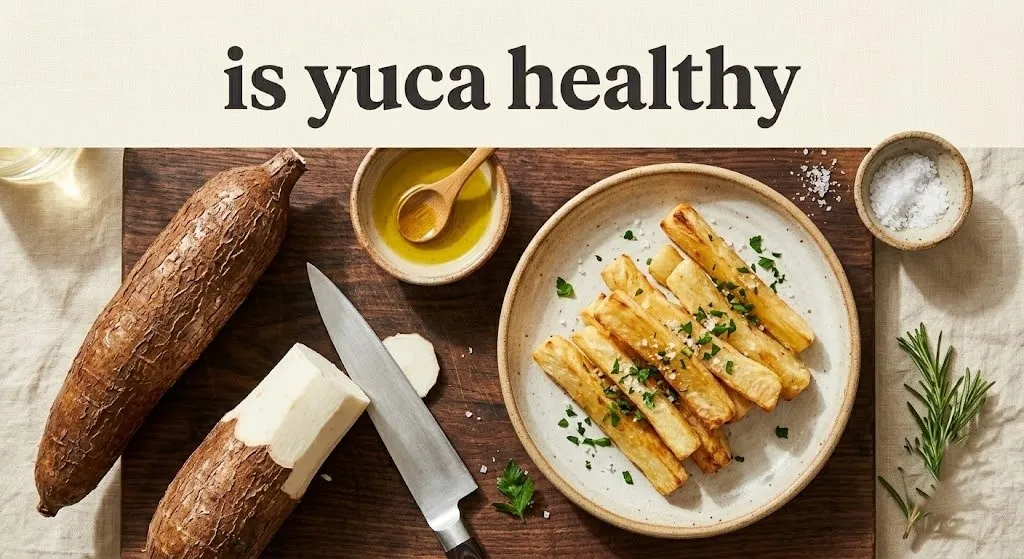
The spelling “yucca” with two c’s refers to an entirely different plant, an ornamental desert plant in the Agavaceae family that is not eaten as a root vegetable. The edible root is yuca, spelled with one c, also called cassava or manioc (Manihot esculenta).
The confusion between yuca and yucca is one of the most persistent spelling errors in food writing. Yuca, the edible starchy root, is a shrub native to South America and is a staple food across Latin America, Africa, and parts of Asia. Yucca, the desert plant, produces spiky leaves and white flowers. Some parts of the yucca plant are edible, including the flowers, but the plant is not cultivated as a root vegetable.
The common name cassava is unambiguous and refers specifically to the edible root Manihot esculenta. Tapioca is the starch extracted from the yuca root, processed into pearls, flour, or flakes. When you see tapioca pudding, tapioca starch in gluten-free baking, or cassava flour tortillas, you are looking at processed forms of yuca.
The spelling matters for search accuracy and food safety. A person searching for yucca recipes will find information about an ornamental plant, not the starchy root they bought at the grocery store. Throughout this article, the edible root is referred to as yuca or cassava.
Yuca Healthy: The Nutritional Verdict
The nutritional verdict on yuca is that it is a healthy, naturally gluten-free starchy vegetable that provides complex carbohydrates, fiber, resistant starch, and vitamin C. It is a whole food carbohydrate source suitable for most dietary patterns.
Yuca fits into multiple recognized healthy dietary patterns. It is naturally gluten-free, making it safe for people with celiac disease or gluten sensitivity. It is a whole food, not a processed or ultra-processed product. It is a staple food in traditional diets across multiple continents, consumed by populations with historically low rates of the chronic diseases associated with Western dietary patterns.
The Academy of Nutrition and Dietetics recognizes that starchy vegetables, including yuca, potatoes, and corn, can be part of a healthy diet when prepared with minimal added fat, salt, and sugar. The issue is not the vegetable itself. It is the deep-frying, the heavy salting, and the large portions that shift a starchy vegetable from a healthy staple to an indulgence.
The bottom line is that yuca is healthy in the same way a potato is healthy. Boiled or baked, served in a reasonable portion, it is a nutritious whole food. Deep-fried into fritters or drenched in cheese sauce, it becomes a less healthy version of itself. The preparation method and portion size determine the health outcome more than the root itself.
Yuca Nutrition Facts and Calories
A one-cup serving of boiled yuca, roughly 206 grams, contains 330 calories, 3 grams of protein, 78 grams of carbohydrate, 4 grams of fiber, and less than 1 gram of fat. The calorie density is similar to white potatoes and rice.
The macronutrient profile of yuca is predominantly carbohydrate. Of the 78 grams of carbohydrate, roughly 4 grams are fiber and the remainder is starch. The starch is a mix of amylose and amylopectin, the same two starch molecules found in all starchy plants. The ratio of amylose to amylopectin determines how the starch behaves during cooking and digestion. Yuca has a moderate amylose content, which contributes to its ability to form resistant starch when cooked and cooled.
| Nutrient (1 cup boiled) | Amount | Percent of RDA |
|---|---|---|
| Calories | 330 | N/A |
| Protein | 3 g | 6 percent |
| Carbohydrate | 78 g | 28 percent (based on 275g RDA) |
| Fiber | 4 g | 14 to 16 percent |
| Fat | 0.3 g | N/A |
| Vitamin C | 42 mg | 47 to 56 percent |
| Manganese | 0.8 mg | 35 to 44 percent |
| Folate | 56 mcg | 14 percent |
| Potassium | 550 mg | 12 percent |
The vitamin C content is notable. A cup of boiled yuca provides nearly half the RDA for vitamin C, which is unusual for a starchy staple food. Potatoes also contain vitamin C, but the amount in yuca is competitive and sometimes higher depending on the variety and cooking method. Boiling does cause some vitamin C loss into the cooking water. Steaming or roasting preserves more of the heat-sensitive vitamin.
Yuca Carbs and Fiber Content Explained
Yuca is a high-carbohydrate, moderate-fiber food. A cup of boiled yuca contains 78 grams of carbohydrate and 4 grams of fiber. The carbohydrate is almost entirely starch, and the fiber is a mix of insoluble and soluble types.
The fiber in yuca is predominantly insoluble, which adds bulk to stool and promotes bowel regularity. The soluble fiber fraction, while smaller, contributes to the formation of short-chain fatty acids when fermented by gut bacteria. This fermentation process is part of what makes the resistant starch in yuca nutritionally interesting.
The high carbohydrate content means yuca is not suitable for very low-carbohydrate or ketogenic diets. A single cup of boiled yuca contains more than three times the daily carbohydrate allowance for a standard ketogenic diet. For people following a moderate-carbohydrate or balanced macronutrient approach, yuca can fit comfortably as the starch component of a meal. A half-cup serving alongside protein and vegetables provides roughly 165 calories and 39 grams of carbohydrate.
The carbohydrate in yuca is complex starch, not added sugar. The digestion of complex starch is slower than the digestion of simple sugars, though the glycemic index of freshly cooked yuca is still moderately high. The resistant starch that forms when yuca is cooked and then cooled changes this picture.
Key Takeaway: Yuca is high in complex carbohydrate and moderate in fiber. It is not suitable for keto diets but fits well in balanced, moderate-carbohydrate eating patterns.
Yuca Resistant Starch and Gut Health
The most interesting nutritional feature of yuca is its ability to form resistant starch when it is cooked and then cooled. Resistant starch is a type of carbohydrate that resists digestion in the small intestine and ferments in the large intestine, behaving more like soluble fiber than starch.
Resistant starch forms through a process called retrogradation. When starchy foods are cooked in water, the starch granules absorb water and swell, a process called gelatinization. The starch becomes digestible. When the cooked starch cools, some of the amylose molecules realign into a crystalline structure that digestive enzymes cannot break down. This retrograded starch is resistant starch.
Resistant starch travels to the colon, where gut bacteria ferment it. The fermentation produces short-chain fatty acids, primarily butyrate, acetate, and propionate. Butyrate is the preferred fuel source for the cells lining the colon. It supports the integrity of the gut barrier, reduces inflammation, and may have protective effects against colorectal cancer. These benefits are well-documented in nutrition research.
To maximize resistant starch in yuca, cook it by boiling or steaming, then cool it completely in the refrigerator for at least 4 to 6 hours. Reheating the cooled yuca does not destroy the resistant starch. The retrograded structure is heat-stable. This means yuca that is boiled, cooled overnight, and then reheated for a meal the next day contains more resistant starch and less digestible carbohydrate than freshly boiled yuca eaten immediately.
Yuca Glycemic Index and Blood Sugar Response
The glycemic index of freshly cooked yuca is moderately high, estimated between 65 and 80 depending on the variety and cooking method. However, the glycemic index drops significantly when the yuca is cooked, cooled, and consumed as resistant starch-rich leftovers.
The glycemic index measures how quickly a food raises blood glucose. A GI of 70 or above is considered high. Freshly boiled yuca, with its high starch content and moderate fiber, produces a fairly rapid glucose response. This is comparable to white potatoes or white rice. For someone managing diabetes or insulin resistance, a large portion of freshly cooked hot yuca is not ideal.
Cooled yuca tells a different story. The resistant starch that forms during cooling is not digested into glucose. It does not contribute to the post-meal blood glucose rise. A 2015 study in the Journal of Nutritional Science found that replacing standard starch with resistant starch in a meal reduced the post-meal blood glucose response by 20 to 30 percent. The glycemic index of reheated yuca is lower than the glycemic index of freshly boiled yuca, though the exact number depends on the cooling time and the specific yuca variety.
The practical takeaway for blood sugar management is to cook yuca ahead of time, cool it, and reheat it. This preparation method reduces the effective carbohydrate load and produces a more gradual blood sugar response. Pairing yuca with protein, fat, and fiber at the same meal further blunts the glucose response.
Key Takeaway: Freshly cooked yuca has a moderate to high glycemic index. Cooked and cooled yuca has a lower GI due to resistant starch formation. Cool your yuca before eating it for better blood sugar control.
Yuca vs Potato: A Full Nutrition Comparison
Yuca and white potatoes are nutritionally similar in calorie and carbohydrate content, but they differ in fiber, vitamin C, and resistant starch potential. Neither is universally healthier. The better choice depends on your nutritional priorities.
| Nutrient (1 cup boiled) | Yuca | White Potato | Difference |
|---|---|---|---|
| Calories | 330 | 135 | Yuca is higher (portion sizes differ) |
| Carbohydrate | 78 g | 30 g | Yuca is more carbohydrate-dense |
| Fiber | 4 g | 3 g | Yuca has slightly more fiber |
| Protein | 3 g | 3 g | Equivalent |
| Vitamin C | 42 mg | 13 mg | Yuca has more than triple the vitamin C |
| Potassium | 550 mg | 540 mg | Equivalent |
| Resistant Starch | Higher when cooled | Moderate when cooled | Yuca forms more resistant starch |
The portion comparison requires an important note. A cup of boiled yuca weighs roughly 206 grams. A cup of boiled potato weighs roughly 150 grams. The calorie and carbohydrate differences are partly due to the density difference. Per 100 grams, yuca contains roughly 160 calories and 38 grams of carbohydrate. White potato contains roughly 90 calories and 20 grams of carbohydrate. Yuca is roughly twice as calorie-dense as white potato.
The vitamin C advantage of yuca is genuine and significant. A cup of yuca provides nearly half the RDA for vitamin C. A cup of potato provides about 14 percent. This makes yuca a more meaningful contributor to daily vitamin C intake.
Yuca vs Sweet Potato: Which Is Healthier?
Sweet potato is generally healthier than yuca due to its dramatically higher vitamin A content in the form of beta-carotene, its higher fiber content, and its lower glycemic index. However, yuca has advantages in vitamin C content and resistant starch formation.
A cup of baked sweet potato with skin provides roughly 180 calories, 6.5 grams of fiber, 4 grams of protein, and a staggering 769 percent of the RDA for vitamin A. The orange-fleshed varieties are among the most nutrient-dense foods available. Yuca cannot compete with sweet potato on vitamin A or fiber. It wins on vitamin C, providing 42 milligrams to sweet potato’s 22 milligrams, and on resistant starch formation, which is more pronounced in yuca than in sweet potato.
| Nutrient (1 cup) | Yuca (boiled) | Sweet Potato (baked, with skin) |
|---|---|---|
| Calories | 330 | 180 |
| Fiber | 4 g | 6.5 g |
| Vitamin A | 0 percent RDA | 769 percent RDA |
| Vitamin C | 47 percent RDA | 25 percent RDA |
| Glycemic Index | Moderate-High | Moderate |
| Resistant Starch | High when cooled | Moderate when cooled |
The choice between yuca and sweet potato depends on nutritional goals. If vitamin A intake is a priority, sweet potato wins easily. If vitamin C or resistant starch is the target, yuca is a strong choice. Both are whole food starchy vegetables. Alternating between them provides a wider range of nutrients than eating either exclusively.
Key Takeaway: Sweet potato wins on vitamin A and fiber. Yuca wins on vitamin C and resistant starch. Eat both in rotation for nutritional variety.
Yuca as a Gluten Free Grain Alternative
Yuca is a naturally gluten-free starchy vegetable and a valuable alternative to wheat-based grains for people with celiac disease, non-celiac gluten sensitivity, or anyone reducing gluten intake. Cassava flour, made from dried and ground yuca, is one of the most versatile gluten-free flours available.
Cassava flour is not the same as tapioca starch, though both come from the yuca root. Tapioca is the extracted starch, used as a thickener and in gluten-free baking for chew and elasticity. Cassava flour is the whole root, peeled, dried, and ground. It contains the fiber and nutrients of the whole vegetable. It has a neutral flavor and a texture closer to wheat flour than most other gluten-free flours. This makes it popular in gluten-free tortillas, breads, and baked goods.
For people with celiac disease, cross-contamination is a concern with any grain or flour product. Cassava flour labeled certified gluten-free has been processed in a dedicated gluten-free facility and tested to contain less than 20 parts per million of gluten. Standard cassava flour may be processed on shared equipment. Those with celiac disease should choose certified products.
Yuca in its whole root form is also gluten-free and can be used as a carbohydrate source in place of pasta, bread, or rice. Boiled yuca can be mashed like potatoes, cut into fries, or added to soups and stews. It provides the starchy satisfaction of a grain-based meal without any gluten.
Yuca Vitamins and Minerals
Yuca provides a meaningful amount of vitamin C, manganese, and folate, with smaller contributions of potassium, magnesium, and thiamine. It is not a nutritional powerhouse on the scale of leafy greens or brightly colored vegetables, but it contributes more micronutrients than many refined grain staples.
Vitamin C in yuca supports collagen synthesis, immune function, and antioxidant protection. A cup of boiled yuca provides 42 milligrams, which is roughly half the adult RDA. This is notable for a starchy staple food and makes yuca a more nutrient-dense carbohydrate source than white rice or pasta.
Manganese is a trace mineral that functions as a cofactor in bone formation, blood clotting, and antioxidant defense. A cup of yuca provides about 0.8 milligrams, roughly 35 to 44 percent of the Adequate Intake level. Folate is a B vitamin required for DNA synthesis and cell division. Yuca provides about 56 micrograms per cup, roughly 14 percent of the RDA.
The potassium content of yuca, roughly 550 milligrams per cup, is comparable to a banana. Potassium supports blood pressure regulation by counteracting the effects of sodium and helping blood vessels relax. The American Heart Association recommends adequate potassium intake as part of a heart-healthy diet.
Key Takeaway: Yuca provides meaningful amounts of vitamin C, manganese, folate, and potassium. It is more micronutrient-dense than refined grains like white rice or pasta.
Yuca Poisonous Raw: Critical Safety Warning
Raw yuca contains cyanogenic glycosides, compounds that release hydrogen cyanide when the root is damaged, cut, or chewed. Eating raw or improperly cooked yuca can cause cyanide poisoning. This is a serious food safety issue, not a minor caution.
The cyanogenic glycosides in yuca are primarily linamarin and lotaustralin. When the plant cells are damaged, these compounds come into contact with an enzyme called linamarase, which breaks them down and releases hydrogen cyanide gas. In the human body, cyanide interferes with cellular respiration by binding to cytochrome c oxidase, preventing cells from using oxygen. Acute cyanide poisoning causes headache, dizziness, vomiting, confusion, and in severe cases, respiratory failure and death.
The FDA and the World Health Organization recognize properly processed yuca as safe. The processing, specifically peeling, soaking, and thorough cooking, removes or destroys the cyanogenic glycosides and the enzyme. Commercially available yuca in the United States is typically the sweet variety, which has lower cyanogenic glycoside content than the bitter varieties grown in some parts of Africa and South America. However, even sweet yuca must be cooked.
Never eat raw yuca. Never juice raw yuca. Do not taste raw yuca. Peel it completely, removing both the brown skin and the pinkish-purple layer just beneath. Cook it thoroughly by boiling, roasting, or frying until the flesh is completely opaque and fork-tender. The white, chalky interior should become a uniform off-white or pale yellow with no translucent or chalky spots.
How to Cook Yuca Safely Step by Step
Cooking yuca safely requires peeling, cutting, and thorough boiling or roasting. The process is straightforward, and fully cooked yuca is perfectly safe to eat.
To cook yuca safely:
- Cut off both ends of the yuca root to create flat surfaces. The ends are often the most damaged and dehydrated parts.
- Using a sharp knife, cut the yuca crosswise into 3 to 4-inch sections. This makes the root easier to handle.
- Stand each section on its flat end. Slice down the sides to remove the brown bark-like skin and the pinkish or purplish layer directly underneath. This inner layer contains a higher concentration of cyanogenic glycosides. Remove it completely.
- Split each peeled section in half lengthwise. Remove the fibrous central core, which runs like a string down the center. This core is tough and unpleasant to eat even when cooked.
- Cut the yuca into chunks of the desired size for your recipe.
- Place the yuca in a pot and cover with cold water. Add a pinch of salt if desired.
- Bring to a boil. Reduce heat and simmer for 20 to 30 minutes, until the yuca is fork-tender and the flesh has turned completely opaque. There should be no chalky white center.
- Drain. Use as desired: mash, fry, roast, or add to soups and stews.
The visual cue of doneness is essential. Properly cooked yuca transforms from white and chalky to a uniform pale yellow or off-white. The texture changes from hard and crisp to tender and slightly translucent. Any remaining white or chalky center means the yuca is not fully cooked.
Key Takeaway: Peel yuca completely, removing the inner pink layer. Boil until the flesh is uniformly opaque and fork-tender with no chalky white center. Fully cooked yuca is safe.
Healthy Yuca Fries: Baked, Not Fried
Baked yuca fries offer the crispy satisfaction of french fries with more fiber and vitamin C than potato fries. The key to success is parboiling the yuca before baking.
Parboiling serves two purposes. It ensures the yuca is fully cooked and safe to eat. It also gelatinizes the starch on the surface of the fries, which creates a crispy exterior when exposed to high oven heat. Skipping the parboil results in fries that are hard, dry, and potentially unsafe in the center.
To prepare baked yuca fries:
- Peel and cut 2 large yuca roots into fry-sized batons, roughly 1/2 inch thick and 3 inches long. Remove the fibrous central core from each piece.
- Bring a large pot of salted water to a boil. Add the yuca batons. Boil for 15 minutes, until fork-tender.
- Drain the yuca. Pat dry thoroughly with a clean kitchen towel. The drier the surface, the crispier the fries.
- Toss the parboiled yuca with 2 tablespoons of olive or avocado oil, 1 teaspoon of salt, and any desired spices: smoked paprika, garlic powder, cumin, or black pepper.
- Spread the yuca in a single layer on a parchment-lined baking sheet. Do not overcrowd. Use two sheets if necessary.
- Bake at 425 degrees Fahrenheit for 25 to 30 minutes, flipping once halfway through. The fries are done when they are golden brown and crisp on the outside.
- Serve immediately with a dipping sauce of your choice.
Nutrition per serving (one-quarter of the batch): approximately 280 calories, 3 grams protein, 5 grams fiber, 7 grams fat (predominantly unsaturated from olive oil), 52 grams carbohydrate.
Cassava Flour Nutrition and Baking Uses
Cassava flour is a gluten-free, grain-free, nut-free flour made from the whole yuca root. It is one of the most versatile gluten-free flours for baking and cooking, with a neutral flavor and a texture that closely mimics wheat flour.
Unlike almond flour, which is high in fat and produces dense baked goods, or coconut flour, which absorbs large amounts of liquid, cassava flour behaves similarly to wheat flour in many recipes. It can often be substituted 1:1 for wheat flour in recipes like pancakes, tortillas, and quick breads. This makes it a valuable tool for gluten-free and grain-free home cooks.
The nutritional profile of cassava flour is similar to whole yuca root, concentrated by the removal of water. A cup of cassava flour contains roughly 460 calories, 4 grams of protein, 8 grams of fiber, and 100 grams of carbohydrate. It is not low-carb, but it is a whole food flour alternative for those avoiding grains.
Cassava flour tortillas are a popular use. Combined with water, oil, and salt, cassava flour produces a pliable, rollable tortilla that tastes remarkably similar to a flour tortilla. The neutral flavor also works well in sweet applications like muffins, banana bread, and cookies.
Quick Tip:
- Cassava flour is denser than wheat flour. In recipes that require rising, such as cakes and breads, additional leavening may be needed.
- Store cassava flour in an airtight container in a cool, dry place. It has a shelf life of roughly 6 to 12 months.
- Verify that the cassava flour is labeled as a food-grade product from a reputable source. Industrial cassava products may not be processed to food safety standards.
Yuca for Weight Loss and Satiety
Yuca can be part of a weight loss diet when portions are controlled and the yuca is prepared by boiling, baking, or roasting without excessive added fat. The resistant starch that forms in cooled yuca may support weight management through its effects on satiety and gut hormone signaling.
Weight loss ultimately requires a sustained calorie deficit. Yuca is a calorie-dense food at 330 calories per cup, which is higher than potatoes, sweet potatoes, or rice on a per-volume basis. A person carefully tracking calories might choose a half-cup portion of yuca rather than a full cup to keep the meal within their calorie budget.
The resistant starch in cooled yuca may actively support weight management. Research published in the Journal of Nutrition and Metabolism suggests that resistant starch increases satiety, reduces subsequent meal calorie intake, and improves insulin sensitivity. The fermentation of resistant starch in the colon produces short-chain fatty acids that stimulate the release of satiety hormones like peptide YY and GLP-1.
The practical weight loss strategy for yuca is to cook it, cool it, and reheat it. This maximizes the resistant starch content and reduces the effective calorie and carbohydrate load. Pair a half-cup portion of cooled and reheated yuca with a palm-sized portion of lean protein and a large serving of non-starchy vegetables. This meal is satiating, nutrient-dense, and compatible with a calorie deficit.
Key Takeaway: Yuca can fit into weight loss when portions are controlled. Cooled and reheated yuca contains more resistant starch, which supports satiety and may reduce the effective calorie load.
Yuca Meal Prep and Storage Tips
Yuca can be meal prepped by boiling a batch, cooling it completely, and storing it in the refrigerator for use throughout the week. This convenience is also what unlocks the resistant starch benefit.
To meal prep yuca:
- Peel, cut, and boil a large batch of yuca until fully cooked and fork-tender.
- Drain and let cool to room temperature on a baking sheet.
- Transfer the cooled yuca to an airtight container. Refrigerate for up to 5 days.
- Use the prepped yuca throughout the week: reheat and mash as a side, slice and pan-fry for a crispy breakfast hash, add chunks to soups, or chop and toss into salads.
Raw yuca has a short shelf life. It should be stored in a cool, dry, dark place, similar to potatoes. Once cut, raw yuca oxidizes and discolors quickly. If you peel and cut yuca but do not cook it immediately, submerge it in cold water and refrigerate. Use within 24 hours.
Frozen yuca is widely available in Latin American grocery stores and the frozen section of many mainstream supermarkets. Frozen yuca has been peeled, cut, and often parboiled before freezing. It is a convenient and safe alternative to fresh yuca because the processing removes much of the cyanogenic glycoside concern. Cook frozen yuca directly from frozen according to package instructions.
Frequently Asked Questions About Yuca
Is yuca healthier than potatoes?
Yuca and potatoes are both healthy whole foods with different nutritional strengths. Yuca has more vitamin C and forms more resistant starch when cooled. Potatoes are lower in calories per volume and contain more potassium per calorie. Alternating between them provides nutritional variety.
Can you eat yuca raw?
No, yuca cannot be eaten raw. Raw yuca contains cyanogenic glycosides that release hydrogen cyanide. Eating raw yuca can cause cyanide poisoning. Yuca must be peeled, with the inner pink layer removed, and thoroughly cooked by boiling, roasting, or frying before it is safe to eat.
Is yuca good for weight loss?
Yuca can be part of a weight loss diet in controlled portions. A half-cup serving provides roughly 165 calories. Cooking and cooling yuca forms resistant starch, which increases satiety and reduces the effective calorie load. Pair yuca with lean protein and vegetables for a filling weight-loss-compatible meal.
Is yuca safe for people with diabetes?
Yuca can be eaten by people with diabetes with attention to portion size and preparation. Freshly cooked yuca has a moderate to high glycemic index. Cooking, cooling, and reheating yuca lowers the glycemic response by increasing resistant starch. A small portion paired with protein and fiber is the best approach.
What is the difference between yuca and yucca?
Yuca, spelled with one c, is the edible starchy root vegetable also called cassava (Manihot esculenta). Yucca, spelled with two c’s, is an unrelated ornamental desert plant in the Agavaceae family. The edible root is yuca. The ornamental plant is yucca.
Yuca is a root that has fed civilizations for millennia. It is a whole food carbohydrate source that delivers vitamin C, resistant starch, and a satisfying, starchy texture that works in everything from fries to stews to gluten-free tortillas.
Treat yuca like you would a potato with a safety rule. Peel it completely. Cook it thoroughly. Cool it if you want the resistant starch benefit. Serve a reasonable portion alongside protein and vegetables. Yuca is not a superfood and it is not a dietary villain. It is a food. A good one. Cook it right, and it earns its place on your plate.