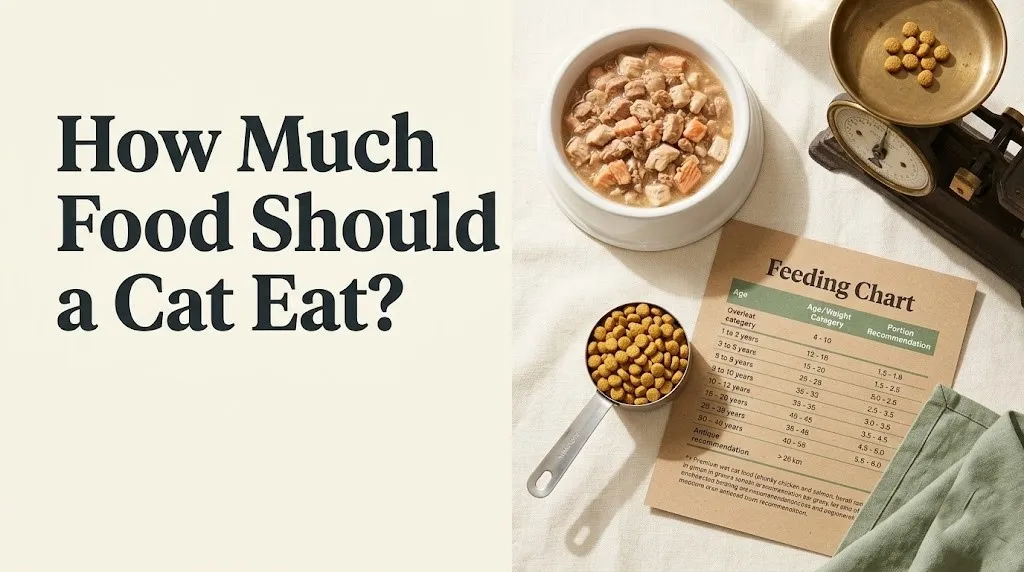
Most adult cats need between 200 and 250 calories per day, though the exact amount depends on weight, age, activity level, and whether the cat has been spayed or neutered. Knowing how much food should a cat eat is one of the most practical things you can do for your pet’s long-term health.
Feline obesity is a serious and growing concern. The Association for Pet Obesity Prevention has found that over 60 percent of domestic cats in the United States are classified as overweight or obese, a figure that has climbed steadily over the past decade. Overfeeding is the primary driver, and most of it happens not out of neglect but out of genuine uncertainty about the right amount.
This guide covers daily calorie targets, portion sizes by food type, life stage differences, the wet-versus-dry-versus-mixed feeding question, feeding schedules, and what to watch for if your cat seems hungry all the time or is gaining weight unexpectedly. Every number and recommendation here reflects current veterinary nutrition guidance as of 2026.
How Much Food Should a Cat Eat Per Day?
The baseline answer: most adult cats need roughly 20 calories per pound of body weight per day under standard maintenance conditions.
A 10-pound adult cat requires approximately 200 calories daily. A 12-pound cat needs around 240 calories. These are starting estimates, not fixed rules. A sedentary indoor cat will need fewer; a highly active outdoor cat may need more.
Cats are obligate carnivores, meaning their bodies run on protein and fat, not carbohydrates. Their caloric needs reflect a biology designed for small, frequent prey meals rather than one large bowl left out all day. This matters when you are calculating how much to serve at each meal.
The figures above apply to cats in maintenance condition: healthy weight, adult age, moderate activity. Kittens, seniors, pregnant queens, cats recovering from illness, and cats with certain medical conditions all require different calculations. A registered veterinary nutritionist or your regular veterinarian is the right resource when a cat falls outside the standard profile.
| Cat Weight | Daily Calorie Target (Maintenance) |
|---|---|
| 6 lbs | 120 calories |
| 8 lbs | 160 calories |
| 10 lbs | 200 calories |
| 12 lbs | 240 calories |
| 14 lbs | 280 calories |
| 16 lbs | 320 calories |
How Many Calories Does a Cat Need Per Day?
A cat’s daily calorie requirement is calculated using its resting energy requirement (RER), then adjusted by a life stage and activity factor.
The RER formula used in veterinary nutrition is: RER = 70 x (body weight in kilograms)^0.75. For a 4.5 kg (approximately 10-pound) cat, this yields roughly 150 to 160 RER calories. Multiplying by a life factor of 1.2 to 1.4 for a typical neutered adult gives a daily target of 180 to 224 calories.
This math is not something most owners need to perform manually. The point is that the right calorie target is genuinely individual, and the number on the back of a food bag is an average that may not fit your specific cat. According to guidance published by the American College of Veterinary Nutrition (ACVN), feeding guidelines on commercial pet food packaging tend to reflect unadjusted population averages rather than individual metabolic needs.
Cats with hyperthyroidism, diabetes, or kidney disease have caloric requirements that can differ substantially from healthy cats of the same weight. If your cat has any diagnosed condition, work directly with your veterinarian to establish a daily calorie target appropriate for that condition.
Key research finding: A study published in the Journal of Nutritional Science found that neutered cats have a 20 to 30 percent lower metabolic rate than intact cats of the same body weight, which directly affects how many calories they need each day.
Cat Feeding Chart by Weight
A weight-based feeding chart gives you a practical starting point before you fine-tune based on your cat’s individual response.
These figures apply to a typical adult neutered or spayed cat in maintenance condition. Adjust upward by approximately 10 to 20 percent for intact cats or highly active outdoor cats. Adjust downward by 10 to 20 percent for sedentary, indoor-only cats.
| Cat Weight | Dry Food Per Day | Wet Food Per Day | Mixed (50/50 split) |
|---|---|---|---|
| 6 lbs | 1/3 cup (approx. 40g) | 1.5 oz canned | 1/6 cup dry + 0.75 oz wet |
| 8 lbs | 1/2 cup (approx. 55g) | 2 oz canned | 1/4 cup dry + 1 oz wet |
| 10 lbs | 2/3 cup (approx. 70g) | 2.5 oz canned | 1/3 cup dry + 1.25 oz wet |
| 12 lbs | 3/4 cup (approx. 85g) | 3 oz canned | 3/8 cup dry + 1.5 oz wet |
| 14 lbs | 7/8 cup (approx. 95g) | 3.5 oz canned | 7/16 cup dry + 1.75 oz wet |
These portions assume a standard-calorie food: approximately 350 to 400 calories per cup for dry food and approximately 25 to 35 calories per ounce for canned food. Higher-calorie or lower-calorie foods require proportional adjustments.
Always verify calorie density on the specific product you are using. It varies substantially between brands and even between product lines from the same brand.
Key Takeaway: Most adult cats need roughly 20 calories per pound of body weight per day, but neutered, sedentary, or indoor cats often need 10 to 20 percent less than standard feeding charts suggest.
How Much Food Should a Kitten Eat?
Kittens need significantly more calories per pound than adult cats because they are simultaneously fueling growth and normal activity.
From birth to 4 weeks, kittens depend entirely on their mother’s milk or a commercial kitten milk replacer. Starting at 4 to 6 weeks, you can introduce wet kitten food. By 8 weeks, most kittens are ready to transition fully to solid food.
Between 8 weeks and 6 months, kittens generally need about two to three times the caloric density per pound compared to an adult cat. A typical 3-pound kitten needs approximately 150 to 200 calories per day, while a 6-pound kitten approaching six months may need 250 to 300 calories daily. These are not maintenance figures; they reflect the active growth phase.
Between 6 and 12 months, kittens begin approaching adult caloric requirements as their growth rate slows. Many veterinary nutritionists recommend transitioning to adult food portions around 10 to 12 months, depending on breed. Large breeds like the Maine Coon may not reach full adult size until 18 to 24 months, so they may need extended kitten-level feeding.
- Feed kittens under 6 months at least 3 times per day
- Between 6 and 12 months, 2 to 3 meals per day is appropriate
- Wet food is recommended during kittenhood for hydration and high protein bioavailability
- Kittens with small appetites or low birth weight should be assessed by a veterinarian before adjusting portions independently
How Much Food Should an Adult Cat Eat Per Day?
An adult cat, defined as 1 to 7 years old, has reached its full size and caloric maintenance needs.
The range for most adult cats is 180 to 280 calories per day, with the specific target depending on body weight, activity level, reproductive status, and whether any health conditions apply. For a healthy, neutered adult at a normal weight, the 200-calorie mark is a reasonable midpoint for a 10-pound cat.
What makes adult cat feeding more nuanced than the number suggests is the enormous variation within this life stage. A 10-pound active male outdoor cat and a 10-pound sedentary indoor female spayed cat technically weigh the same, but their caloric needs can differ by 40 to 60 calories per day, which is significant over the course of months and years.
Think of it like two people who both weigh 150 pounds. One runs 30 minutes daily; the other works from a desk all day. Same body weight, very different fuel needs. The same principle applies to cats.
According to the American Veterinary Medical Association (AVMA), routine annual veterinary check-ups for adult cats should include a body condition score assessment, which is the most reliable tool for confirming whether your cat’s current food intake is appropriate.
| Life Stage | Age Range | Daily Calorie Range |
|---|---|---|
| Kitten | 0 to 12 months | 150 to 300 calories |
| Junior Adult | 1 to 3 years | 200 to 260 calories |
| Prime Adult | 3 to 7 years | 180 to 240 calories |
| Mature | 7 to 10 years | 170 to 220 calories |
| Senior | 10+ years | 150 to 200 calories |
How Much Should I Feed My Senior Cat?
Senior cats, generally defined as 7 years and older (with cats over 10 sometimes categorized as “geriatric”), have changing nutritional needs that most generic feeding guides don’t address well.
Older cats can experience muscle mass loss (sarcopenia) even when body fat levels remain stable or increase. This makes the scale a poor measure of nutritional adequacy for older cats. A senior cat may weigh the same as it did at age 4 but have significantly less lean muscle mass.
Research published in the Journal of Feline Medicine and Surgery has found that cats over 12 years old are more likely to be underweight than overweight, a reversal of the pattern seen in middle-aged cats. Their digestive efficiency declines with age, meaning they may absorb fewer nutrients from the same quantity of food.
Practically, this means some senior cats need more food, not less, to maintain healthy muscle mass. Others develop kidney disease, hyperthyroidism, or diabetes that require specific dietary modifications. This is the life stage where individual veterinary guidance carries the most weight.
- Senior cats often benefit from high-protein, moderate-phosphorus food
- Wet food is especially useful for seniors because hydration supports kidney function
- Feeding 3 smaller meals per day can improve digestion in older cats
- Significant weight loss of more than 0.5 pounds in one month in a senior cat warrants prompt veterinary evaluation
Key Takeaway: Senior cats often need more food, not less, because their digestive efficiency declines with age; tracking muscle mass and body condition rather than just scale weight is more reliable for older cats.
How Much Wet Food Should a Cat Eat Per Day?
Most standard 3.5-ounce cans of cat food contain approximately 75 to 100 calories, and most 5.5-ounce cans contain approximately 125 to 170 calories, depending on the brand, protein source, and formula.
A typical 10-pound adult cat eating wet food exclusively needs approximately two to two and a half 3.5-ounce cans per day, or roughly one full 5.5-ounce can plus a portion of a second. This varies significantly depending on the calorie density of the specific product.
Wet food has a major practical advantage: its high moisture content (typically 70 to 80 percent water) contributes to your cat’s daily hydration. Cats evolved in arid environments and have a naturally low thirst drive. Feeding wet food helps compensate for this by delivering water directly through food.
According to guidance from the ASPCA, cats fed wet food as their primary diet tend to consume more total water per day than cats fed dry food, even when both groups have constant access to fresh water.
Quick Tip:
- Always check the calorie count per can, not just the serving size on the label
- Store opened wet food in a sealed container in the refrigerator for no longer than 3 days
- Cats with urinary tract issues often benefit from the higher moisture content of wet food; confirm this with your veterinarian
How Much Dry Food Should a Cat Eat Per Day?
Dry cat food typically contains 300 to 500 calories per cup, with the average mainstream kibble landing around 350 to 400 calories per cup.
For a 10-pound adult neutered cat needing approximately 200 calories per day, that translates to roughly half a cup of dry food daily, often divided across two meals. That is a smaller amount than most owners assume, which is precisely why so many cats are overfed on kibble.
The convenience of dry food makes it popular, but measuring it matters. Using a standard kitchen measuring cup rather than eyeballing portions is one of the single most effective changes an owner can make. Research from the American Animal Hospital Association (AAHA) indicates that owners who estimate portions without measuring consistently exceed their cat’s caloric needs by 20 to 30 percent.
Dry food is significantly lower in moisture than wet food (approximately 8 to 12 percent water). Cats fed exclusively on dry food must drink substantially more water to stay adequately hydrated. Many cats don’t compensate fully, which can contribute to lower urinary tract issues over time, particularly in male cats with naturally narrow urethras.
| Dry Food Calorie Density | Portion for 200-Calorie Daily Target |
|---|---|
| 300 cal/cup | 2/3 cup per day |
| 350 cal/cup | Slightly over 1/2 cup per day |
| 400 cal/cup | 1/2 cup per day |
| 450 cal/cup | 7/16 cup per day |
| 500 cal/cup | 2/5 cup per day |
How to Mix Wet and Dry Cat Food Portions
Mixing wet and dry food is genuinely common and can be nutritionally effective, but it requires intentional portion adjustment to avoid accidental overfeeding.
The core principle is simple: every calorie from wet food must be subtracted from the dry food allocation, and vice versa. Half your cat’s daily calorie target from wet food plus half from dry food equals one complete day’s intake. The math sounds obvious, but many owners add wet food as a supplement on top of a full dry food ration, effectively doubling the cat’s intake.
To calculate a mixed feeding plan:
- Determine your cat’s daily calorie target (e.g., 200 calories for a 10-pound adult neutered cat).
- Decide on the split (e.g., 50 percent from wet, 50 percent from dry = 100 calories each).
- Check the calorie count on your wet food (e.g., 80 calories per 3.5 oz can = serve about 1.25 cans daily, split into portions).
- Check the calorie count on your dry food (e.g., 400 calories per cup = serve about 1/4 cup daily, split into portions).
- Divide total daily amounts across your chosen number of meals.
- Weigh or measure each portion at every meal. Do not eyeball.
Mixing formats also works well for cats who prefer texture variety or who are transitioning between food types. The higher moisture in wet food balances the lower moisture in dry kibble.
Key Takeaway: When mixing wet and dry food, you must subtract calories from each format to reach the total daily target; adding wet food on top of a full dry food ration is one of the most common causes of unintentional overfeeding.
How Often Should I Feed My Cat?
Most adult cats do well on two meals per day, spaced approximately 8 to 12 hours apart.
This mirrors something close to a natural hunting pattern and gives the digestive system time to process each meal fully before the next. Some cats handle three meals well. Very few adult cats genuinely need more than three. Frequency matters less than total daily caloric intake, but consistency in timing helps regulate hunger and reduces food-begging behavior.
Kittens under 6 months benefit from 3 to 4 smaller meals per day because their smaller stomachs and higher metabolic rate make less frequent feeding harder to sustain comfortably. Senior cats with certain conditions may also do better with more frequent, smaller portions.
Quick Tip:
- Feed at the same times each day; cats are highly routine-driven and become anxious when meal timing is unpredictable
- Use an automatic feeder if consistent timing is difficult; programmable models can dispense precise portions at set intervals
- Always remove uneaten wet food within 30 minutes to prevent bacterial growth, particularly in warm environments
Can You Free-Feed Cats Dry Food?
Free feeding means leaving dry food available at all times, allowing the cat to eat whenever it chooses. It works for some cats and is actively problematic for others.
A small percentage of cats are genuinely self-regulating eaters who will not overeat even with constant access to food. For these cats, free feeding is manageable. The reality is that most domestic cats, particularly indoor cats with limited physical stimulation, will overeat when food is always available.
Free feeding also makes it nearly impossible to monitor how much a cat is actually eating, which is one of the earliest indicators of illness. A cat who has stopped eating requires immediate attention. In a free-fed household, this signal is easy to miss for 24 to 48 hours.
According to the Association of American Feed Control Officials (AAFCO), controlled portion feeding is the recommended method for maintaining healthy body weight in domestic cats. Free feeding may be appropriate for certain underweight cats or cats with high metabolic needs, but this should be confirmed with a veterinarian rather than assumed.
For multi-cat households, free feeding creates an additional problem: you cannot accurately monitor which cat ate what, making it very difficult to spot changes in individual appetite.
How Much Should a Neutered or Spayed Cat Eat?
Spaying or neutering reduces a cat’s daily caloric requirement by approximately 20 to 30 percent compared to an intact cat of the same weight and activity level.
This is a direct hormonal effect. Reproductive hormones influence metabolic rate, and their removal lowers the number of calories the body requires to maintain its current weight. Many cats begin gaining weight within weeks of being altered if their food intake isn’t adjusted accordingly.
A study published in the Journal of Nutritional Science found that energy intake in cats should be reduced by at least 20 percent after neutering to prevent post-operative weight gain. In practice, this means a cat who needed 250 calories per day before surgery may need only 175 to 200 calories once fully recovered.
This adjustment doesn’t need to happen overnight. A gradual reduction over 2 to 3 weeks post-recovery is more comfortable for the cat and easier for the owner to manage.
| Cat Weight | Pre-Neuter Daily Calories | Post-Neuter Daily Calories |
|---|---|---|
| 8 lbs | 190 calories | 135 to 155 calories |
| 10 lbs | 230 calories | 165 to 185 calories |
| 12 lbs | 270 calories | 190 to 215 calories |
Your veterinarian can advise on the exact timing and rate of reduction for your specific cat.
Key Takeaway: Neutered and spayed cats need roughly 20 to 30 percent fewer daily calories than intact cats of the same size, and failing to reduce food portions after surgery is one of the leading causes of feline obesity.
How Much Food Does an Overweight Cat Need?
An overweight cat needs a calorie deficit, not a crash diet.
Reducing a cat’s calories too rapidly carries a genuine medical risk: hepatic lipidosis (fatty liver disease), a serious condition that develops when a cat’s body mobilizes fat stores faster than the liver can process them. This can happen within 48 to 72 hours of severe caloric restriction.
The safe approach is a gradual reduction toward a target weight, typically 1 to 2 percent of body weight per month. For a 14-pound cat with a healthy target weight of 10 pounds, this means aiming to lose roughly 2 to 3 ounces per week, not multiple pounds in a month.
Veterinary nutritionists generally recommend calculating calorie needs based on the ideal body weight, not the current weight, and then adjusting feeding to gradually reach that target. This usually means feeding approximately 60 to 70 percent of what the current body weight calculation would suggest.
- Never cut a cat’s food by more than 25 percent at once without veterinary supervision
- Weight loss cat foods are formulated with higher protein and lower fat to preserve lean muscle during caloric reduction
- Weigh your cat every 2 to 4 weeks to track progress; a kitchen food scale works well for small animals
- Rapid or unintended weight loss in any cat warrants immediate veterinary evaluation
How Much Should an Indoor Cat Eat?
Indoor cats generally need fewer calories than outdoor cats because their activity level is lower and their energy expenditure is significantly reduced.
An indoor cat who spends most of its time sleeping, sitting by windows, and engaging in light play will typically need 10 to 20 percent fewer calories than the standard maintenance estimate. For a 10-pound indoor cat, this can mean a daily target closer to 160 to 180 calories rather than the often-cited 200.
The risk for indoor cats is gradual, almost invisible weight gain. Because they’re always home, owners tend to use feeding as a bonding activity, which is understandable but easy to overdo. Extra treats, larger portions “because the bowl looked empty,” and food given by multiple household members all add up.
Enrichment matters here too. Indoor cats who are mentally and physically stimulated through play, climbing structures, and foraging toys burn more calories daily and maintain better muscle condition. The nutritional and behavioral dimensions of indoor cat health are directly connected.
Quick Tip:
- Use a puzzle feeder or snuffle mat to slow eating and increase mental stimulation
- Divide daily food into at least 2 measured portions, even for small amounts
- Monitor weight monthly; a consistent trend upward is a sign to reassess portion size before weight becomes a health issue
Key Takeaway: Indoor cats burn fewer calories than outdoor cats and typically need 10 to 20 percent less food than standard charts suggest; consistent measuring and monthly weight monitoring prevent the slow, invisible weight gain that is extremely common in this group.
How to Read Cat Food Labels for Portion Size
Cat food labels contain the information you need, but you have to know where to look and what the numbers actually mean.
The feeding guidelines printed on the package are a starting point, not a prescription. They are calculated for average, intact adult cats and frequently overestimate portions, particularly for neutered or indoor cats.
The most important number on the label is kilocalories (kcal) per kilogram or per can/cup. This figure, often listed in small print near the guaranteed analysis, tells you the actual energy density of the food. Without it, you cannot accurately calculate portions.
The guaranteed analysis section lists minimum percentages of crude protein and crude fat, and maximum percentages of crude fiber and moisture. These are wet-weight values. To compare two foods accurately (especially a wet food versus a dry food), you need to convert both to dry matter basis, which removes moisture from the calculation.
To convert wet food to dry matter basis for protein:
- Note the moisture percentage from the label (e.g., 75 percent moisture).
- Subtract from 100 to get the dry matter percentage (100 – 75 = 25 percent dry matter).
- Divide the crude protein percentage by the dry matter percentage (e.g., 10 percent protein / 25 percent = 40 percent protein on a dry matter basis).
This reveals that a wet food showing 10 percent crude protein often delivers more protein per calorie than a dry food showing 30 percent crude protein, once moisture is factored out.
How Do I Know If I’m Feeding My Cat Enough?
The most reliable tool for assessing whether your cat is eating the right amount is the body condition score (BCS), a standardized veterinary assessment that evaluates body fat and muscle mass on a scale of 1 to 9 (with 5 being ideal).
You don’t need a vet to do a basic BCS check. Run your hands along your cat’s sides. You should be able to feel the ribs without pressing hard, but they shouldn’t be visually prominent. Look at your cat from above: there should be a slight waist visible behind the ribcage. From the side, the belly should not hang down noticeably.
Signs that a cat may not be getting enough food include visible ribcage or spine, dull coat, lethargy, muscle wasting along the back and hindquarters, and increased food-seeking behavior. Signs of overfeeding include visible fat deposits at the base of the tail, no waist definition, difficulty grooming the hindquarters, and labored breathing during light activity.
According to the American Association of Feline Practitioners (AAFP), cats should have their body condition assessed at every routine veterinary visit. If you notice an unexpected change in your cat’s body condition between visits, that’s the right moment to contact your veterinarian, not to adjust food amounts independently based on a guess.
| BCS Score | Description | Action |
|---|---|---|
| 1 to 3 | Underweight; ribs and spine visible | Increase food; vet evaluation recommended |
| 4 | Slightly lean; ribs easily felt | Minor increase in portions |
| 5 | Ideal; ribs felt easily, slight waist | Maintain current feeding |
| 6 | Slightly overweight; ribs harder to feel | Reduce portions by 10 percent |
| 7 to 9 | Overweight to obese; ribs difficult to feel, fat deposits visible | Reduce food; vet-guided weight loss plan |
Frequently Asked Questions About Cat Feeding
How much should I feed my cat per day in grams?
A typical adult cat needs approximately 40 to 70 grams of dry food per day, depending on the calorie density of the specific kibble.
For wet food, most adult cats need roughly 170 to 220 grams per day (approximately two 3.5-ounce cans).
Always confirm calorie density on the specific brand you use, as values vary significantly between products.
Is it okay to feed my cat only dry food every day?
Dry food can be a complete and balanced diet if it carries an AAFCO nutritional adequacy statement for the correct life stage.
The main consideration is hydration: cats fed exclusively on dry food must drink significantly more water to compensate for the food’s low moisture content.
Providing a water fountain or multiple fresh water sources encourages adequate water intake in dry-food-fed cats.
How do I know if my cat is eating the right amount?
Check your cat’s body condition score monthly by feeling the ribs and observing waist definition from above and the side.
A cat at a healthy weight has ribs that are easily felt but not visually prominent, a slight waist visible from above, and no hanging belly from the side.
Any unexpected change in body condition warrants a conversation with your veterinarian before you adjust portions.
Can I feed my cat twice a day?
Twice daily feeding works well for the majority of healthy adult cats and is the most common schedule recommended by veterinary professionals.
Splitting the daily calorie allowance into two meals, spaced 8 to 12 hours apart, supports steady energy and helps prevent food-seeking behavior between meals.
Kittens and senior cats with certain conditions often benefit from three smaller meals per day instead.
Why is my cat always hungry even after eating?
Persistent hunger after eating can have several causes, including insufficient portion size, a low-satiety diet, hyperthyroidism, diabetes, or intestinal parasites.
A cat that appears to be eating normal amounts but is consistently hungry, losing weight, or vocalizing excessively around meal times should be examined by a veterinarian.
Simply increasing food without identifying the underlying cause can worsen conditions like diabetes or create obesity in cats where the hunger signal is behavioral rather than physiological.
The Bottom Line on Cat Feeding
Feeding your cat the right amount is not guesswork once you have the right framework. Start with your cat’s weight, calculate a calorie target, check the calorie density of your specific food, measure every portion, and monitor body condition monthly.
Adjust as your cat moves through life stages, as activity levels change, and after spaying or neutering. The goal isn’t a perfect number on a chart. It’s a cat that holds a healthy body condition year after year.
When something changes unexpectedly, a drop in appetite, sudden weight gain or loss, or persistent hunger despite adequate portions, that’s when your veterinarian’s input becomes the most valuable tool you have.