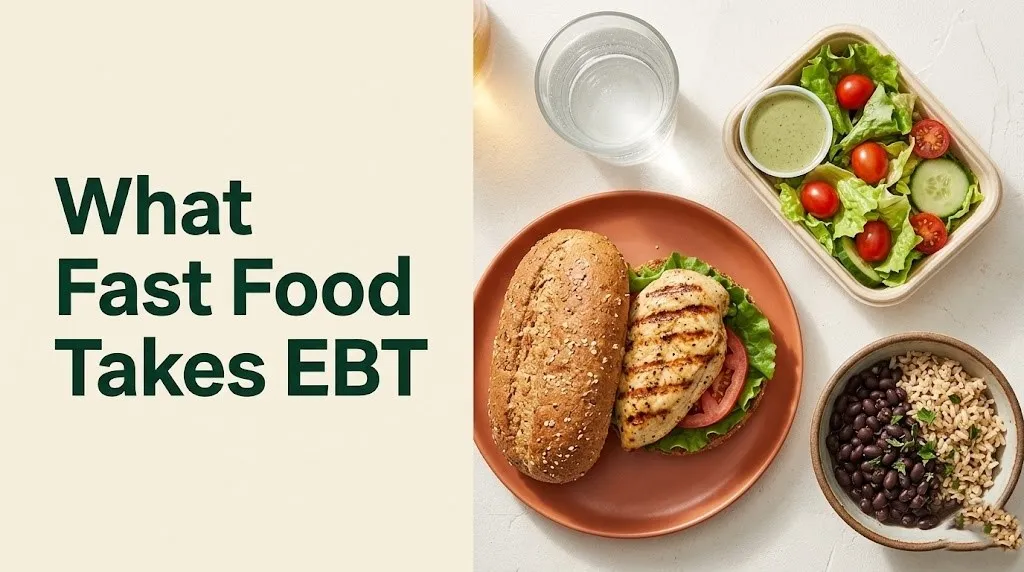
Not all fast food restaurants take EBT, and the ones that do are limited to specific states through a federal program called the SNAP Restaurant Meals Program (RMP). Understanding what fast food takes EBT means knowing both which chains participate and whether your state has been approved to run the program.
This matters for millions of Americans. According to the USDA Food and Nutrition Service, more than 42 million people participate in SNAP as of 2024 data. The Restaurant Meals Program exists specifically for SNAP recipients who cannot easily prepare food at home, including elderly, disabled, and homeless individuals, but the rules and participating locations vary considerably by state and even by individual franchise location.
This guide covers every major chain that has participated in the RMP, which states currently allow it, who qualifies, how to actually pay at the register, and how to make the most nutritious choices available when you’re ordering with EBT.
What Fast Food Takes EBT?
Fast food restaurants that take EBT include McDonald’s, Subway, KFC (Kentucky Fried Chicken), Burger King, Taco Bell, Pizza Hut, Domino’s, Popeyes Louisiana Kitchen, Jack in the Box, and Wingstop, but only in states that have an active SNAP Restaurant Meals Program and only at specific locations within those states.
This is the core point that most people searching this question miss. EBT at fast food is not a nationwide program. It operates through a state-level opt-in called the Restaurant Meals Program, which the USDA Food and Nutrition Service administers. States must apply for and receive approval to run the program before any restaurant in that state can accept EBT for hot prepared food.
The program is also not available to all SNAP recipients. It was designed for specific eligible groups: elderly recipients aged 60 or older, people with disabilities, and individuals experiencing homelessness. If you fall outside those categories, standard SNAP rules apply, and hot prepared restaurant food is not covered.
The distinction between hot prepared food and shelf-stable or uncooked food matters here. Grocery items, cold prepared foods, and take-and-bake products like those from Papa Murphy’s can be purchased with a standard EBT card in all states, no Restaurant Meals Program required. It is only the hot prepared fast food meal at the counter that requires the RMP.
Key facts about EBT at fast food:
- Program name: SNAP Restaurant Meals Program (RMP)
- Governing body: USDA Food and Nutrition Service (FNS)
- Who qualifies: Elderly SNAP recipients (60+), people receiving disability-related SNAP benefits, and homeless individuals
- Chain participation: Varies by state; not all franchise locations of a chain participate even in qualifying states
- Standard SNAP recipients: Cannot use EBT for hot prepared restaurant food in non-RMP states
What Is the SNAP Restaurant Meals Program?
The SNAP Restaurant Meals Program (RMP) is a federal program administered by the USDA Food and Nutrition Service that allows certain qualifying SNAP recipients to purchase hot prepared meals at approved restaurants using their EBT card.
The program was created because standard SNAP rules prohibit the purchase of hot, prepared-for-immediate-consumption foods. A rotisserie chicken from the grocery store deli counts as a hot prepared food and is not covered under standard SNAP. Cold deli items sold by weight, however, generally are covered. This distinction created a genuine access problem for people who cannot cook for themselves.
The RMP exists to solve that access problem for three groups: people aged 60 or older who may have mobility, cognitive, or health challenges that make home cooking difficult; people with disabilities who face similar barriers; and homeless individuals who have no cooking facilities at all.
According to the USDA Food and Nutrition Service, states must formally apply to operate the RMP and receive federal approval. Not every state has pursued this authorization, which is why the program remains limited to a small number of states despite existing at the federal policy level since the 1970s.
The RMP does not change what the food costs. Participating restaurants charge the same prices to all customers. The only difference is the payment method accepted: EBT is processed like a debit transaction with a PIN.
Quick Tip:
- The RMP approval status of individual states changes periodically; always verify current state participation through the USDA FNS SNAP Retailer Locator before relying on information from any single source
- Restaurant participation within a qualifying state is voluntary; individual franchise owners choose whether to join
- The RMP is separate from SNAP Online Purchasing, which is a different program allowing EBT use on grocery delivery
Who Qualifies to Use EBT at Fast Food Restaurants?
Only three groups of SNAP recipients qualify to use EBT for hot prepared meals at fast food restaurants through the Restaurant Meals Program: people aged 60 or older, individuals with qualifying disabilities, and people experiencing homelessness.
This eligibility structure reflects the program’s original purpose. The majority of SNAP recipients, including working-age adults and families with children, are not eligible to use their EBT card at participating fast food restaurants, even if they live in a state with an active RMP.
The disability qualification follows the same definition used for SNAP eligibility generally: a person receiving disability-related federal benefits (SSI, SSDI) or certified as disabled under the Social Security Administration’s criteria. A household with one qualifying member may be eligible for the RMP even if other household members do not qualify individually; state rules vary on this point.
Homeless individuals qualify under the USDA FNS definition: people who lack a fixed and regular nighttime residence or who are living in supervised temporary shelters, transitional housing, or similar settings. This group benefits most directly from the program’s intent, as they typically have no access to any cooking facilities whatsoever.
Who does NOT qualify for EBT at fast food:
- Standard working-age adult SNAP recipients without disability status
- Families with children who do not include an elderly or disabled household member
- SNAP recipients living in states without an active Restaurant Meals Program, regardless of their age or disability status
- People using SNAP benefits for the first time who have not confirmed their household’s RMP eligibility with their state agency
If you are uncertain whether your household qualifies for the RMP, your state’s SNAP agency is the appropriate contact, as eligibility determinations are made at the household level.
Key Takeaway: EBT at fast food is not for all SNAP recipients; it is a specific program for elderly, disabled, and homeless individuals in states that have applied for and been approved to run the Restaurant Meals Program.
What States Allow EBT at Fast Food in 2026?
The states with active SNAP Restaurant Meals Programs as of 2026 include California, Arizona, Michigan, Maryland, Virginia, Rhode Island, and Illinois, with several other states operating pilot or limited versions of the program.
State participation changes over time. California (which runs the program as part of CalFresh, the state’s SNAP brand) has the most extensive RMP infrastructure and the largest number of participating restaurant locations. Arizona has a well-established program with participation from several major chains. Michigan, Maryland, Virginia, Rhode Island, and Illinois operate the program with varying levels of chain participation.
Florida has piloted versions of the program in limited counties. New York has explored RMP authorization. Several other states have pending applications or legislative proposals as of early 2026; these states are not yet active participants.
| State | Program Status (2026) | Major Chains Participating |
|---|---|---|
| California | Active (CalFresh RMP) | McDonald’s, Subway, KFC, Burger King, Jack in the Box, Popeyes, Taco Bell, Pizza Hut, Domino’s |
| Arizona | Active | McDonald’s, Subway, KFC, Burger King, Taco Bell |
| Michigan | Active | Subway, select locations only |
| Maryland | Active | Subway, select locations |
| Virginia | Active | Subway, select locations |
| Rhode Island | Active | Subway, select locations |
| Illinois | Active (limited) | Subway, select locations |
| Florida | Pilot/limited | Select locations only |
Important: Chain and location participation within each state varies. A McDonald’s in Los Angeles participating in CalFresh’s RMP does not guarantee that a McDonald’s in Sacramento participates. Always confirm with the specific location before ordering.
Does McDonald’s Accept EBT?
McDonald’s accepts EBT at participating locations in states with an active Restaurant Meals Program, most notably in California, Arizona, and a smaller number of locations in other RMP states.
McDonald’s is the largest fast food chain participating in the RMP. California has the most McDonald’s locations accepting EBT, reflecting the state’s large CalFresh program and long-running RMP infrastructure. In Arizona, McDonald’s EBT acceptance is also widespread at participating locations.
Outside California and Arizona, McDonald’s EBT acceptance is limited. RMP-authorized McDonald’s locations in other states tend to be concentrated in urban areas with higher proportions of elderly and homeless SNAP recipients.
Nutritionally useful options at McDonald’s when paying with EBT:
- Egg McMuffin: Approximately 310 calories, 17 grams of protein, 820 mg sodium; one of the most protein-efficient breakfast items available
- McDouble without sauce: Approximately 400 calories, 22 grams of protein; a reasonable protein source at a low price point
- Side salad: Low calorie; provides vitamin A (as beta-carotene) and vitamin C (ascorbic acid); pair with grilled chicken for a more complete meal
- Grilled chicken sandwich: Approximately 380-410 calories, 28 grams of protein; lower in saturated fat than the crispy version
People managing hypertension should note that most McDonald’s items contain 800 to 1,200 mg of sodium per entree; the American Heart Association recommends no more than 2,300 mg of sodium per day total.
Menus and nutritional data vary by location and are updated periodically. Verify current nutrition information on McDonald’s official nutrition guide before ordering.
Does Subway Take EBT?
Subway accepts EBT at participating locations across multiple RMP states and has the broadest geographic spread of any chain in the program, with accepted locations reported in California, Arizona, Michigan, Maryland, Virginia, Rhode Island, and Illinois.
Subway’s widespread RMP participation reflects the chain’s franchise model, where individual owners make participation decisions, and its menu structure, which features customizable sandwiches that span a wide calorie and protein range.
From a nutritional standpoint, Subway is among the most flexible fast food options for EBT users who want to make intentional food choices. The ability to choose protein, bread, vegetables, and condiments individually makes it possible to build a reasonably balanced meal.
Recommended Subway choices when ordering with EBT:
- 6-inch turkey breast on whole wheat: Approximately 280-320 calories, 18 grams of protein, 500-700 mg sodium (before condiments)
- 6-inch veggie delite on whole wheat: Approximately 200-230 calories; add extra avocado for monounsaturated fat and potassium
- Rotisserie-style chicken on whole grain: Approximately 350-380 calories, 26 grams of protein
- Avoid: Footlong portions double all nutrient values including sodium; sweet onion chicken teriyaki sauce adds approximately 70 calories and 240 mg of sodium per serving
People with celiac disease or gluten sensitivity should know that Subway’s wheat and multigrain breads are not gluten-free; cross-contamination is a risk in Subway’s standard sandwich-making environment.
Does KFC Accept EBT Food Stamps?
KFC (Kentucky Fried Chicken) accepts EBT at participating locations in California and Arizona, where the chain has enrolled in the Restaurant Meals Program, but KFC EBT acceptance is not available nationwide or in all RMP states.
California has the largest number of KFC locations participating in the CalFresh RMP. Arizona’s program includes KFC at select locations. Outside those two states, KFC EBT acceptance is rare to nonexistent.
KFC’s menu includes both fried and grilled protein options. The grilled chicken line, introduced company-wide, offers meaningfully different nutritional profiles than the original fried recipe.
| KFC Item | Calories | Protein | Sodium |
|---|---|---|---|
| Grilled chicken breast | 210 kcal | 38g | 710mg |
| Original Recipe chicken breast | 390 kcal | 39g | 1,010mg |
| Extra Crispy breast | 530 kcal | 35g | 1,010mg |
| Cole slaw (individual) | 170 kcal | 2g | 160mg |
| Green beans (individual) | 25 kcal | 1g | 260mg |
| Mashed potatoes (no gravy) | 90 kcal | 2g | 260mg |
The grilled chicken breast at KFC provides 38 grams of protein at only 210 calories, making it one of the highest protein-to-calorie ratios available at any national fast food chain. Pairing it with green beans and mashed potatoes without gravy keeps the meal under 400 calories with excellent protein content.
Nutritional data reflects standard serving sizes and varies by preparation batch. Confirm current information with KFC’s published nutrition guide.
Key Takeaway: California and Arizona have the most established EBT fast food programs with the broadest chain participation; if you’re in either state and qualify for the RMP, your options at McDonald’s, Subway, KFC, and Burger King are relatively robust.
Does Burger King Take EBT?
Burger King accepts EBT at participating locations in California and Arizona, with individual franchise owners making the final decision on RMP enrollment, so acceptance varies even between locations in the same city.
Burger King’s EBT participation mirrors the broader pattern across chains: California first, Arizona second, and very limited or no participation elsewhere. The chain’s franchise model means that corporate policy sets the option to participate, but each franchise operator decides independently.
From a practical standpoint, Burger King’s EBT terminal looks and works identically to a standard debit transaction. The customer swipes or inserts the EBT card, selects “EBT/food stamps” on the terminal, and enters their PIN.
Nutritionally better choices at Burger King when using EBT:
- Grilled chicken sandwich (without mayo): Approximately 360-390 calories, 24 grams of protein, 900 mg sodium
- Hamburger (single patty): Approximately 260 calories, 13 grams of protein; one of the lower-calorie burger options
- Garden side salad: Low calorie; provides dietary fiber and beta-carotene; add grilled chicken for complete protein
- Avoid: The Double Whopper with cheese reaches approximately 900 calories and 1,360 mg of sodium before any sides or drinks
People with dairy allergies should confirm cheese-free preparation requests, as Burger King’s kitchen handles dairy extensively across its menu.
Which Other Fast Food Chains Accept EBT?
Beyond McDonald’s, Subway, KFC, and Burger King, several other fast food chains accept EBT in qualifying states, including Taco Bell, Domino’s, Pizza Hut, Popeyes Louisiana Kitchen, Jack in the Box, Wingstop, and Papa Murphy’s.
The participation levels vary considerably by chain and state. Taco Bell has enrolled in California’s CalFresh RMP program at a meaningful number of locations. Domino’s and Pizza Hut participate in California primarily, where pizza delivery chains found natural RMP participation given their elderly and homebound customer bases.
Papa Murphy’s deserves specific mention because it operates differently from every other chain on this list. Papa Murphy’s sells uncooked, take-and-bake pizzas. Because the product is sold cold and uncooked, it qualifies as a grocery item under standard SNAP rules. EBT is accepted at Papa Murphy’s in all 50 states without any need for RMP authorization. This makes Papa Murphy’s the most widely accessible “fast food adjacent” option for all SNAP recipients, not just those in RMP states.
| Chain | EBT Acceptance | States Active |
|---|---|---|
| Taco Bell | RMP states only | California, Arizona (select) |
| Domino’s | RMP states only | California (select) |
| Pizza Hut | RMP states only | California (select) |
| Popeyes Louisiana Kitchen | RMP states only | California, Arizona (select) |
| Jack in the Box | RMP states only | California (select) |
| Wingstop | RMP states only | California (select) |
| Papa Murphy’s | All 50 states | No RMP required (uncooked food) |
Location participation within each state varies. Call ahead or use the USDA FNS SNAP Retailer Locator to confirm that a specific address is enrolled before traveling there.
How to Use Your EBT Card at Fast Food Restaurants
Using your EBT card at a participating fast food restaurant works the same way as a standard debit card transaction, with two differences: you select “EBT/food stamps” as the payment type and enter your four-digit EBT PIN instead of a signature.
The process is straightforward:
To pay with EBT at a participating fast food restaurant:
- Order your food at the counter or drive-through as you normally would. Confirm with the cashier that this location accepts EBT before the order is finalized, as not all locations of a chain participate.
- When the total appears, tell the cashier you are paying with EBT. The register will route the transaction to the EBT payment terminal.
- Insert or swipe your EBT card in the card reader. The process varies slightly by terminal model; newer terminals use chip insertion while older ones use magnetic stripe swipe.
- Select “EBT” or “SNAP/food stamps” on the payment screen when prompted to choose the payment type.
- Enter your four-digit PIN using the keypad. Shield the keypad from view as you would at any PIN transaction.
- Confirm the transaction amount on screen and press confirm. The terminal will authorize the purchase and deduct the amount from your SNAP balance.
- Collect your receipt, which will show your remaining EBT balance. Keep this; it helps you track your remaining benefit for the month.
If the transaction is declined despite being at an enrolled location, contact your state’s EBT customer service line rather than the restaurant, as declines typically reflect a balance, card status, or eligibility issue rather than a restaurant system error.
Key Takeaway: Paying with EBT at fast food is mechanically identical to a debit card transaction; the only practical steps are confirming the location participates before you order and selecting “EBT” at the payment terminal.
What Items Can You Buy with EBT at Fast Food?
At RMP-participating fast food restaurants, your EBT card covers hot prepared meals and most standard menu food items, but it typically does not cover alcoholic beverages (which fast food chains don’t sell anyway), vitamins and supplements, non-food items, and in most cases, hot beverages like coffee.
The RMP authorization allows EBT to be used for the same items a non-SNAP customer would order. That means a burger, sandwich, or meal combination. It does not create a special category of approved or restricted menu items within the restaurant’s standard food menu.
What is generally covered:
- Hot entrees: burgers, sandwiches, chicken items, pizza, tacos
- Side items: fries, salads, coleslaw, beans, rice
- Cold beverages: fountain drinks, bottled water, juice (though choosing water over soda is a nutritionally better use of benefit dollars)
- Combo meals: the full combo including entree, side, and cold drink
What is generally not covered even at RMP restaurants:
- Hot coffee or hot tea at chains where these are sold separately (rules vary by state and location)
- Alcohol (not sold at fast food chains, but noted for completeness)
- Non-food items such as napkins, utensils packs, or branded merchandise
- Tips or service fees added by delivery platforms when ordering online
People managing type 2 diabetes who are using EBT at fast food restaurants should be aware that standard combo meals often include high-glycemic-index refined carbohydrates (white bread, fried starches) and high-sodium sauces; requesting grilled protein without the bun and substituting a side salad where available keeps the carbohydrate and sodium load more manageable.
Can You Use EBT on DoorDash or Food Delivery Apps?
EBT is accepted on DoorDash, Uber Eats, and Instacart for grocery purchases from eligible retailers, but EBT use for fast food delivery through these apps is generally not available because app-based restaurant orders are processed differently from in-person RMP transactions.
Think of it like two separate payment rails running side by side. The Restaurant Meals Program works at the physical point-of-sale terminal in the restaurant. Delivery apps run their own payment processing, which is not currently connected to the RMP authorization system for restaurant meals at most fast food chains.
DoorDash launched EBT/SNAP acceptance in partnership with select grocery retailers starting in 2022. Uber Eats similarly accepts EBT for grocery orders through partnered grocery stores on its platform. Both programs cover eligible grocery items from partnered retailers, not hot prepared restaurant meals from fast food chains.
Instacart accepts EBT across a wide range of partnered grocery retailers. SNAP Online Purchasing, the federal program enabling this, is separate from the Restaurant Meals Program and covers a broader range of SNAP recipients without the elderly, disabled, or homeless restriction.
What delivery app EBT currently covers:
- Grocery orders from partnered grocery retailers on DoorDash, Uber Eats, and Instacart
- Eligible SNAP food items including cold prepared foods, packaged groceries, and produce
What it does not currently cover:
- Hot prepared meals from fast food restaurants ordered through delivery apps
- Delivery fees, service fees, or driver tips (these cannot be paid with EBT on any platform)
The policy landscape around EBT on delivery apps is evolving. Confirm current options with your state’s SNAP agency or the specific app’s help center, as program expansions are announced periodically.
Healthy Fast Food Choices When Paying with EBT
The healthiest fast food choices when paying with EBT are grilled proteins over fried, side salads or vegetable sides over fries, water over soda, and single-item orders over combo meals built around refined-carbohydrate sides.
This is practical nutrition, not preaching. EBT benefits have real dollar limits, and the same calorie-for-dollar math that makes fast food convenient can work against you nutritionally if you default to the highest-calorie, lowest-nutrient combination on the menu.
According to the USDA Dietary Guidelines for Americans 2020-2025, a balanced meal for an average adult targets roughly 450 to 700 calories, at least 25 to 35 grams of lean protein, at least 5 grams of dietary fiber, and no more than 600 to 800 mg of sodium per meal as a practical guideline for a person managing intake across a full day.
| Chain | Healthier EBT Choice | Approx. Calories | Protein | Sodium |
|---|---|---|---|---|
| McDonald’s | Grilled chicken sandwich + side salad | 430-460 kcal | 30g | 1,000mg |
| McDonald’s | Egg McMuffin | 310 kcal | 17g | 820mg |
| Subway | 6-inch turkey on whole wheat | 280-320 kcal | 18g | 600mg |
| KFC | Grilled breast + green beans | 235 kcal | 39g | 970mg |
| Burger King | Hamburger + side salad | 340 kcal | 16g | 700mg |
| Taco Bell | Fresco-style chicken soft taco (x2) | 300 kcal | 18g | 800mg |
| Popeyes | Blackened chicken tenders (3 pc) | 170 kcal | 28g | 630mg |
Calorie and sodium data reflect published nutrition guides from each chain as of 2024 and are subject to change. Verify with the chain’s current nutritional information before ordering.
People with sodium-sensitive hypertension should note that even the “healthier” options on this table approach or exceed 600 to 800 mg sodium per item; choosing grilled proteins without added sauces and drinking water rather than soda helps keep the full meal within a more manageable sodium range.
Best Value Fast Food Meals to Buy with EBT
The best value fast food meals with EBT balance the lowest price per gram of protein against the highest nutrient density available at that price point, making grilled chicken items, egg-based breakfast options, and bean-based Mexican menu items the strongest choices dollar for dollar.
Value at fast food is like buying ingredients at a farmers market: you can spend the same dollar amount and come home with either a week’s worth of dried lentils or a single artisanal jam. The caloric and nutritional return on your EBT dollar varies enormously by what you order.
Best value picks by protein efficiency:
- KFC Grilled Chicken Breast: One of the highest protein-to-calorie ratios at a national chain; 38 grams of protein for approximately 210 calories at a price point typically under $5
- McDonald’s McDouble: Approximately 400 calories and 22 grams of protein at the lowest price point on McDonald’s core menu; skip the processed cheese slice to reduce saturated fat
- Subway 6-inch turkey on whole wheat: Strong protein and fiber combination; the 6-inch format keeps portions reasonable and price below $7 at most locations
- Taco Bell Bean Burrito: Approximately 350 calories, 13 grams of plant protein, 7 grams of dietary fiber from black beans (Phaseolus vulgaris); one of the few fast food items providing meaningful fiber
- McDonald’s Egg McMuffin: At breakfast, provides 17 grams of protein from egg (albumen and yolk) and Canadian bacon at one of the most affordable price points in fast food breakfast
The bean burrito option is notable for vegetarians and vegans using EBT, as it provides plant-based protein and dietary fiber from beans in a format available at most Taco Bell locations, including those in RMP states.
Key Takeaway: Grilled chicken, egg-based breakfast items, and bean-filled menu options deliver the strongest nutritional return per EBT dollar across participating chains; defaulting to fried items and combo sodas is where benefit value gets spent fastest.
EBT Fast Food by State: Where It Works in 2026
The states where EBT works at fast food restaurants in 2026 are those with active SNAP Restaurant Meals Programs: California, Arizona, Michigan, Maryland, Virginia, Rhode Island, and Illinois, with Florida operating limited pilot locations and additional states in various stages of program consideration.
California operates the most extensive RMP in the country under the CalFresh umbrella. The state has enrolled the widest variety of chains and has the largest number of participating restaurant locations. For CalFresh recipients who are elderly, disabled, or homeless, the range of fast food options available with EBT in California is substantially broader than in any other state.
Arizona’s program is well-established, with meaningful participation from McDonald’s, Subway, KFC, Burger King, and Taco Bell at select locations. The program is concentrated in urban areas including Phoenix and Tucson.
For states outside this list, SNAP recipients should not assume EBT will work at fast food. Attempting to pay with EBT at a non-enrolled location or in a non-RMP state will result in a declined transaction.
| State | RMP Status | Best Chain Options |
|---|---|---|
| California | Active, extensive | McDonald’s, Subway, KFC, Burger King, Taco Bell, Domino’s, Pizza Hut, Jack in the Box, Popeyes, Wingstop |
| Arizona | Active, moderate | McDonald’s, Subway, KFC, Burger King, Taco Bell |
| Michigan | Active, limited | Subway (select) |
| Maryland | Active, limited | Subway (select) |
| Virginia | Active, limited | Subway (select) |
| Rhode Island | Active, limited | Subway (select) |
| Illinois | Active, limited | Subway (select) |
| Florida | Pilot only | Select locations, limited chains |
| All other states | Not active | EBT not accepted at fast food (hot prepared meals) |
Papa Murphy’s reminder: Because take-and-bake pizzas are sold uncooked, EBT is accepted at Papa Murphy’s locations in all 50 states regardless of RMP status, making it the only nationally available “fast food adjacent” option for SNAP recipients everywhere.
Program authorization and location participation change. The USDA FNS SNAP Retailer Locator tool allows users to search by address for confirmed EBT-accepting food retailers, including restaurant locations enrolled in the RMP.
Frequently Asked Questions About What Fast Food Takes EBT
Does McDonald’s take EBT for food?
McDonald’s accepts EBT at participating locations in California and Arizona, where those states operate active SNAP Restaurant Meals Programs.
Not all McDonald’s locations accept EBT, even within qualifying states; individual franchise owners decide whether to enroll.
Confirm with the specific McDonald’s location before ordering by calling ahead or using the USDA FNS SNAP Retailer Locator.
Can I use my EBT card at fast food in any state?
No, EBT can only be used at fast food restaurants in states with an active SNAP Restaurant Meals Program.
As of 2026, those states are California, Arizona, Michigan, Maryland, Virginia, Rhode Island, Illinois, and Florida (limited pilot).
SNAP recipients in all other states cannot use EBT for hot prepared restaurant meals, regardless of which chain they visit.
Who is eligible to use EBT at fast food restaurants?
Only three groups of SNAP recipients qualify for the Restaurant Meals Program: people aged 60 or older, individuals with qualifying disabilities, and people experiencing homelessness.
Standard working-age adult SNAP recipients without disability status are not eligible to use EBT for hot prepared fast food, even in RMP states.
Contact your state’s SNAP agency to confirm whether your household qualifies for RMP participation.
Can you use EBT on DoorDash or Uber Eats for fast food?
EBT is accepted on DoorDash and Uber Eats for grocery orders from partnered retailers, but not for hot prepared fast food restaurant meals ordered through those apps.
The Restaurant Meals Program operates at the physical point-of-sale terminal in participating restaurants; delivery app ordering is a separate payment system not currently connected to RMP authorization for fast food.
Delivery fees, service fees, and driver tips cannot be paid with EBT on any platform.
What fast food items can you not buy with EBT?
EBT cannot be used to purchase hot beverages (in most states), non-food items, vitamins, or supplements at any retailer, including fast food restaurants.
At RMP-enrolled fast food locations, standard menu food items including entrees, sides, and cold beverages are generally covered; specific exclusions vary by state and location.
When in doubt, ask the cashier at the specific location before finalizing your order.
Know Your Benefits, Know Your Options
The RMP gives qualifying SNAP recipients a real and useful option when cooking isn’t possible. Knowing which states and chains participate means you spend less time guessing and more time making choices that work for your situation.
If you’re in California or Arizona, your options are broad. Elsewhere, Subway and Papa Murphy’s are your most consistent starting points.
And when you do order: grilled over fried, water over soda, beans or eggs for protein. Your EBT dollar goes further when the meal actually fuels you.