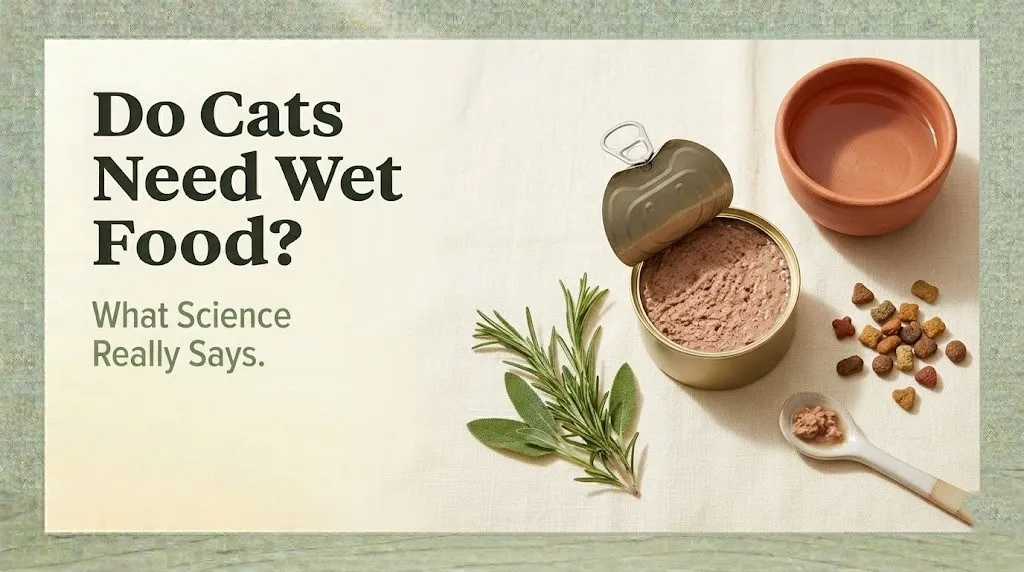
Most cats do need wet food, or at minimum a diet that compensates for their natural resistance to drinking water. Cats are obligate carnivores who evolved to get the majority of their hydration from prey, not from a water bowl, and dry food alone rarely provides enough moisture for long-term health.
This matters more than most pet owners realize. The Cornell Feline Health Center notes that chronic low-level dehydration is a contributing factor in two of the most common feline health conditions: feline lower urinary tract disease (FLUTD) and chronic kidney disease (CKD). Both conditions are far more prevalent in cats fed exclusively dry diets.
This guide covers why hydration matters for cats at a biological level, how wet and dry food compare across key nutritional measures, which cats benefit most from wet food, how to read a label, and what to do when your cat won’t touch it. The guidance here is educational and applies broadly; a veterinarian is the right person to confirm the specific diet for any cat managing a diagnosed health condition.
Do Cats Need Wet Food?
Cats do not require wet food in the way they require specific amino acids or vitamins, but the vast majority of cats benefit from it. The core issue is water intake.
Cats evolved in arid environments where moisture came almost entirely from prey. A freshly caught mouse is roughly 70% water. Dry kibble is typically 8 to 12% moisture. The gap between those two numbers is where most feline urinary and kidney problems begin.
A cat eating only dry food must compensate by drinking significantly more water. Research published in the Journal of Feline Medicine and Surgery has shown that cats on wet food diets consume roughly twice the total daily moisture compared to cats on dry food diets, even when a water bowl is always available. Most cats simply don’t drink enough from a bowl to fully compensate.
That said, some cats thrive on dry food with consistent water access, especially when paired with a circulating water fountain. The right answer depends on your cat’s age, health status, and individual drinking habits.
| Feeding Type | Moisture % | Avg Daily Water from Food | Notes |
|---|---|---|---|
| Wet food only | 70 to 80% | High; meets most of daily needs | Best for urinary health |
| Dry food only | 8 to 12% | Very low; requires heavy supplemental drinking | Risk if cat drinks poorly |
| Mixed feeding | Varies | Moderate | Most common compromise |
| Dry + water fountain | 8 to 12% | Moderate if cat drinks well | Works for some cats |
Why Do Cats Need Wet Food
The short answer is biology. Cats are obligate carnivores, which means they are biologically required to get specific nutrients exclusively from animal tissue.
Unlike dogs or humans, cats cannot synthesize taurine (an amino acid essential for heart and eye function) or arginine (required for protein metabolism and urea cycle function) in sufficient quantities on their own. They must consume them through food. Wet food, particularly pate-style formulas, tends to deliver these amino acids in a more bioavailable form than heavily processed dry kibble.
Cats also cannot convert beta-carotene into vitamin A (retinol) the way humans can. They need preformed retinol from animal tissue. Wet food made primarily from meat and organ ingredients typically provides this more directly.
The Association of American Feed Control Officials (AAFCO) sets minimum nutrient requirements for cat food, including a minimum taurine level of 0.1% on a dry matter basis for wet food and 0.1% for dry food. Both can technically meet this standard, but the moisture content of wet food affects how these nutrients are processed and absorbed at the cellular level.
Quick Tip:
- Look for “complete and balanced” on the label; this means the food meets AAFCO nutrient profiles
- Wet food labeled “for all life stages” meets requirements from kittenhood through adulthood
- Organ meats like liver in wet food are particularly rich in retinol and taurine
Do Cats Have to Eat Wet Food or Can They Live on Dry Food Only?
Cats can survive on dry food only, but survival and thriving are not the same thing. Many cats live long lives on predominantly dry diets, particularly those who drink water consistently from a fountain or running water source.
The risk is cumulative. A cat that drinks poorly and eats only dry food may spend years in a mildly concentrated urinary state before symptoms of kidney strain or urinary crystals appear. By the time clinical signs show up, the condition is often well established.
The American Animal Hospital Association (AAHA) feeding guidelines for cats note that increasing dietary moisture is one of the primary preventive recommendations for urinary tract health. This does not mean every cat on dry food will develop problems, but it does mean the risk profile is meaningfully higher without adequate moisture intake.
Think of it this way: a car can run on low oil for a while before the engine seizes. The low oil itself isn’t immediately catastrophic, but it creates conditions where damage becomes likely over time. Chronic mild dehydration in cats works similarly at the kidney and bladder level.
For cats who genuinely can’t tolerate wet food textures or who refuse all formulas, adding a tablespoon of low-sodium broth to dry kibble or providing a circulating water fountain significantly improves outcomes. A veterinarian can check urine specific gravity during routine visits to assess whether a cat is staying adequately hydrated.
Key Takeaway: Cats evolved to get moisture from prey, not water bowls. Wet food dramatically increases daily fluid intake, which is the single most important dietary factor in preventing urinary and kidney disease over a cat’s lifetime.
Do Cats Need Wet Food in Their Diet for Hydration
Hydration is the strongest evidence-backed argument for wet food. The Cornell Feline Health Center reports that cats need approximately 3.5 to 4.5 ounces of water per 5 pounds of body weight daily. A 10-pound cat needs roughly 7 to 9 ounces of total daily water.
A 3-ounce serving of wet food contains approximately 2.1 to 2.4 ounces of water. A 10-pound cat eating two standard 3-ounce servings per day is consuming close to 4 to 5 ounces of water through food alone. That leaves a much smaller gap to fill from a bowl.
Dry kibble delivers almost none. A full cup of dry kibble contains roughly 0.3 to 0.5 ounces of water. A cat eating only kibble must drink 6 to 8 ounces of fresh water daily from a bowl to compensate, and studies on feline drinking behavior consistently show most cats fall short of that target voluntarily.
| Cat Weight | Daily Water Need | Water from 2 Wet Food Servings | Remaining from Bowl |
|---|---|---|---|
| 5 lbs | 3.5 to 4.5 oz | ~2 to 2.5 oz | ~1.5 to 2 oz |
| 10 lbs | 7 to 9 oz | ~4 to 5 oz | ~2 to 4 oz |
| 15 lbs | 10 to 13 oz | ~4 to 5 oz | ~5 to 8 oz |
Cats with kidney disease require even higher fluid intake. For those cats, wet food is not optional. It becomes a central part of managing kidney function and slowing disease progression. A veterinarian overseeing a CKD cat will typically recommend wet food specifically for this reason.
Is Wet Food Better for Cats Than Dry Food
Wet food is better than dry food for hydration and urinary health in most cats. Dry food has some practical advantages in cost, convenience, and dental-adjacent chewing behavior, though the dental benefit of dry food is widely overstated.
The American Veterinary Dental College has stated that there is limited evidence dry kibble provides clinically meaningful dental cleaning for cats. Most cats do not chew kibble in a way that mechanically cleans tooth surfaces. Dental disease in cats requires active veterinary dental care, not dietary reliance on crunchy texture.
Where dry food genuinely wins: cost per calorie is typically lower, it can be left out without spoiling for several hours (relevant for free-fed cats), and it is calorie-dense in a way that can help underweight cats gain weight more efficiently.
| Factor | Wet Food | Dry Food |
|---|---|---|
| Moisture content | 70 to 80% | 8 to 12% |
| Protein per calorie | Higher | Moderate |
| Caloric density | Lower per gram | Higher per gram |
| Urinary health support | Strong | Weak |
| Cost per day | Higher | Lower |
| Shelf life once opened | 24 to 48 hrs refrigerated | Weeks if sealed |
| Dental cleaning benefit | Minimal | Minimal (despite common belief) |
| Palatability for picky eaters | Generally higher | Variable |
For cats with a healthy weight, good kidney function, and reliable water intake, either format can work. For cats with any urinary history, senior cats over age 10, or cats who are known poor drinkers, wet food holds a clear nutritional advantage.
Do Cats Need Wet Food Daily
Feeding wet food daily is the approach most veterinary nutritionists recommend, though the exact frequency depends on the individual cat’s health, age, and current diet.
Daily wet food feeding ensures consistent moisture intake rather than sporadic top-ups. A cat who gets wet food three times a week still spends four days relying on dry food moisture, which partially undermines the hydration benefit.
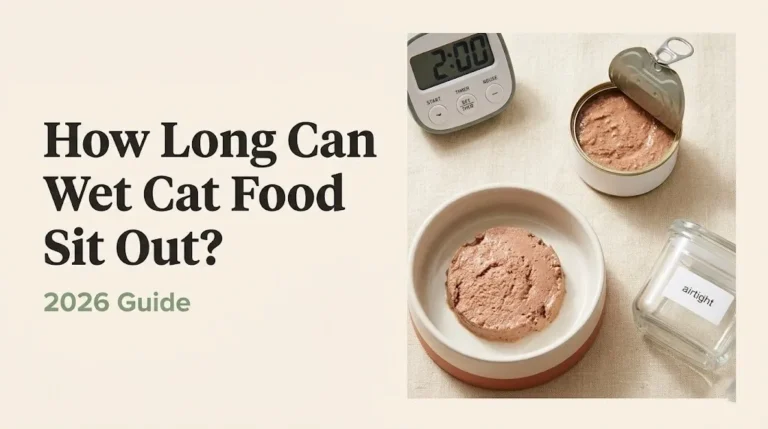
For cats eating exclusively wet food, twice-daily meal feeding is the most common recommendation, typically following a morning and evening schedule that mirrors natural predator hunting patterns. Free feeding wet food is not practical because of bacterial growth risk once food is left out longer than two hours at room temperature.
Quick Tip:
- Serve wet food at room temperature, not cold from the fridge; cold food reduces palatability significantly
- If feeding twice daily, offer a 3-ounce can or pouch per meal for a typical 10-pound adult cat
- Refrigerate any unused portion in a sealed container and use within 48 hours
Cats with diabetes or hyperthyroidism may need feeding schedules timed around medication. In those situations, confirm feeding frequency with the managing veterinarian, as food timing can affect medication efficacy.
Key Takeaway: Daily wet food feeding gives the most consistent hydration benefit. Sporadic or occasional wet food still helps, but it won’t fully compensate for daily dry-food moisture deficits.
How Much Wet Food Should I Feed My Cat
A standard adult cat of approximately 8 to 10 pounds typically needs around 200 to 250 kilocalories per day on a maintenance diet. Most 3-ounce cans of wet food contain between 70 and 110 kilocalories, depending on formula and protein source.
That means most average-sized adult cats eating wet food exclusively need two to three 3-ounce servings per day. Larger cats, more active cats, or cats recovering from illness may need more. Overweight cats need less, often under veterinary guidance.
The caloric content on wet food labels is often listed as kilocalories per can (kcal/can) or kilocalories per kilogram (kcal/kg). Check the label specifically rather than assuming all wet foods are equal. A fish-based pate and a chicken-in-gravy formula from the same brand can differ by 30 to 40 kilocalories per serving.
| Cat Weight | Daily Calorie Target | 3 oz Wet Food Servings Needed |
|---|---|---|
| 5 to 7 lbs | 130 to 170 kcal | 1.5 to 2 servings |
| 8 to 10 lbs | 200 to 250 kcal | 2 to 3 servings |
| 11 to 14 lbs | 260 to 320 kcal | 3 to 4 servings |
| 15 lbs+ | 330+ kcal | 4+ servings or vet guidance |
These are general ranges. A veterinarian can calculate a more precise target based on your cat’s actual body condition score, which accounts for muscle mass and fat distribution rather than weight alone.
Should I Be Feeding My Cat Wet Food for Urinary Health
Yes, wet food is one of the most evidence-supported dietary interventions for feline urinary health. Cats who develop struvite crystals or calcium oxalate crystals in their urine are almost always chronically under-hydrated at the urinary level.
Higher fluid intake through wet food dilutes urine concentration, measured clinically as urine specific gravity (USG). A lower USG means minerals are less likely to precipitate out and form crystals or stones. This is the core mechanism behind the wet food recommendation for urinary health.
A study published in the Journal of Veterinary Internal Medicine found that cats fed high-moisture diets had significantly lower urine specific gravity values compared to cats on dry diets, supporting the role of wet food in reducing crystal formation risk.
Cats who have already experienced a urinary blockage (more common in male cats), recurrent cystitis, or diagnosed FLUTD are typically placed on high-moisture diets by their veterinarian, sometimes including prescription wet formulas. These therapeutic diets may also control mineral levels (phosphorus, magnesium) more precisely than over-the-counter wet food.
For cats without a current diagnosis but with a family history or breed predisposition (Persian, Himalayan, Siamese, and male cats of any breed carry higher risk), increasing dietary moisture is a reasonable preventive step. Discussing this with your veterinarian at the next routine visit is worthwhile.
Key Takeaway: Wet food dilutes urine concentration, which directly reduces the risk of urinary crystals and supports long-term kidney function. It’s the single dietary change with the strongest evidence base for feline urinary health.
Wet Food for Cats with Kidney Disease
For cats with chronic kidney disease (CKD), wet food is not just beneficial; it is a cornerstone of dietary management. CKD is one of the most prevalent diseases in cats over age 10, affecting an estimated 30 to 40% of geriatric cats according to research cited in the Journal of Feline Medicine and Surgery.
The kidneys of a CKD cat are less efficient at concentrating urine. These cats need more fluid intake to help the remaining functional kidney tissue clear waste products. Wet food is the most practical way to consistently increase that intake without relying on voluntary water drinking, which CKD cats often do poorly.
Dietary phosphorus restriction is the other major nutritional management tool for CKD in cats. Many prescription wet food formulas for CKD cats are specifically formulated with reduced phosphorus levels, alongside controlled protein content. The goal is to reduce the workload on compromised kidneys without inducing protein deficiency, which is a genuine risk in a species that requires relatively high dietary protein.
Do not attempt to manage feline CKD with a standard over-the-counter wet food diet. The caloric, protein, and phosphorus requirements for a CKD cat vary based on disease stage, and a veterinarian or board-certified veterinary nutritionist should guide formula selection. Prescription renal diets are designed around specific therapeutic targets that general pet store formulas do not meet.
| CKD Dietary Goal | Wet Food Advantage |
|---|---|
| Increase fluid intake | High moisture content reduces dehydration risk |
| Reduce phosphorus load | Prescription wet formulas control phosphorus precisely |
| Maintain muscle mass | High digestible protein in wet food supports lean tissue |
| Palatability for sick cats | Wet food is more appealing to nauseated or appetite-suppressed cats |
Do Senior Cats Need Wet Food
Senior cats, generally defined as cats over age 10 to 11, have a particularly strong case for wet food as a dietary staple. Multiple physical changes happen as cats age that make wet food more appropriate.
Kidney function naturally declines with age in cats, even without diagnosed CKD. Wet food’s higher moisture content supports whatever kidney capacity remains. Dental disease, which affects an estimated 70 to 90% of cats over age 3 according to the American Veterinary Dental College, often makes chewing dry kibble uncomfortable or impossible for older cats. Wet food textures eliminate that barrier entirely.
Older cats also tend to lose lean muscle mass, a condition called sarcopenia, even when their calorie intake appears adequate. Higher bioavailable protein from wet food supports muscle maintenance in aging cats better than the processed proteins in many dry food formulas.
Some senior cats develop reduced digestion efficiency and absorb nutrients less effectively. Wet food is generally more digestible than dry kibble because of lower carbohydrate content and higher moisture.
The AAHA Senior Care Guidelines for Dogs and Cats recommend that cats over age 10 have a dietary reassessment with a veterinarian at least every six months. Food type, formula, and caloric targets may all need adjustment as kidney function, dental status, and body condition change. A feeding plan that worked at age 7 may not be adequate at age 12.
Key Takeaway: Senior cats face compounding physical changes that make wet food increasingly important with age: kidney function decline, dental disease, muscle loss, and reduced nutrient absorption all favor a high-moisture, highly digestible diet.
Do Kittens Need Wet Food
Kittens benefit from wet food, but they have slightly different needs than adults. From weaning (around 3 to 4 weeks of age) through approximately 12 months, kittens are in a period of rapid growth that demands higher caloric density and specific nutrient levels.
Wet kitten food typically provides higher protein and fat levels relative to adult formulas, matching the energy demands of growth. Look specifically for food labeled “for kittens” or “for all life stages” with an AAFCO nutritional adequacy statement, as these are formulated to meet elevated growth-phase requirements. Adult wet food formulas do not always meet kitten nutritional targets.
Very young kittens transitioning from mother’s milk to solid food often adapt to wet food more readily than dry kibble, both because of texture familiarity (softer, moisture-rich) and palatability. A gradual transition starting around 3 to 4 weeks using moistened pate-style wet food is a common veterinary recommendation.
Kittens who eat both wet and dry food during early development often show greater dietary flexibility as adults, making future diet transitions easier. Introducing variety in protein sources (chicken, turkey, fish, rabbit) during kittenhood also reduces the likelihood of extreme food selectivity in adulthood.
The feeding amount for kittens is higher on a per-pound basis than for adults. A 3-pound kitten may need as much as a 10-pound adult in caloric terms, because of the energy demands of growth. A veterinarian can confirm appropriate kitten feeding targets at each growth-stage checkup.
Do Cats Need Soft Food for Dental Reasons
Cats with dental disease, dental pain, or post-dental-procedure recovery do need soft food. Attempting to eat hard kibble with an inflamed gum line, loose teeth, or tooth extraction sites causes pain and can disrupt recovery.
Dental disease is not a minor issue in cats. The American Veterinary Medical Association (AVMA) estimates that the majority of cats show signs of dental disease by age three. The condition ranges from mild gingivitis to tooth resorption, a particularly painful feline-specific condition in which the tooth structure breaks down from within.
For cats in active dental pain or recovering from extractions, soft pate-style wet food with no chunks or hard pieces is the most comfortable texture. Shredded or flaked wet food in gravy may present difficulty for cats with multiple missing teeth or significant oral inflammation. Smooth pate, briefly warmed to just above room temperature to enhance scent, tends to be the most accessible and palatable format for these cats.
Beyond dental pain, some flat-faced (brachycephalic) breeds like Persians and Exotic Shorthairs have anatomical challenges with grasping dry kibble. Wet food pate textures are often more manageable for these cats structurally.
The idea that dry kibble prevents dental disease is not supported by current veterinary dental evidence. Dental health in cats requires professional cleanings, home brushing where tolerated, and veterinary dental care. Diet texture alone does not substitute for active dental hygiene.
Key Takeaway: Cats with dental disease, tooth extraction recovery, or brachycephalic facial anatomy need soft wet food textures specifically. Dry food is not a substitute for dental care, and it causes genuine pain when teeth or gums are compromised.
Do Cats Like Wet Food or Do Some Cats Refuse It
Most cats prefer wet food to dry kibble when given both options, but individual preference varies substantially. Palatability in cats is influenced by protein source, texture, temperature, and the individual cat’s early food exposure history.
A cat raised exclusively on one texture or protein type from early kittenhood can develop a strong resistance to other foods, a pattern sometimes called food imprinting. These cats are not being difficult. Their preference is a learned and reinforced neurological response. Changing a firmly imprinted cat’s diet takes patience and a gradual approach.
Temperature makes a significant difference. Wet food served cold from the refrigerator is substantially less aromatic than food served at room temperature or slightly warmer. Since cats rely heavily on scent to assess food palatability, cold food fails the first sensory test before a cat even tastes it. Letting wet food sit for 10 minutes at room temperature, or briefly warming it for 5 to 8 seconds in a microwave (then checking temperature before serving), often dramatically improves acceptance.
Texture also matters. Some cats refuse pate textures but accept shredded or flaked formats. Others reject anything with gravy. Trying multiple textures across multiple protein sources before concluding a cat “won’t eat wet food” is worth the effort.
Cats with dental pain often appear to refuse wet food but are actually responding to mouth discomfort. A veterinary dental check before assuming food refusal is preference-based is a reasonable step.
How to Make a Cat Eat Wet Food
Transitioning a dry-food-only cat to wet food requires a slow, structured approach. Rapid food changes in cats can trigger food aversion, a learned avoidance response that makes future acceptance even harder.
The standard veterinary recommendation is a gradual transition over 7 to 14 days, mixing wet and dry in progressively shifting ratios.
To transition a cat to wet food:
- Days 1 to 3: Mix 25% wet food into the cat’s regular dry food. Serve at room temperature. Do not leave the mixture out for more than 30 minutes.
- Days 4 to 6: Increase to 50% wet food mixed with dry food. Note whether the cat is eating the wet portion or eating around it.
- Days 7 to 9: Move to 75% wet food with a small amount of dry food on the side. Try warming the wet food slightly if acceptance is low.
- Days 10 to 12: Offer wet food only, with dry food available separately if the cat refuses. Some cats need to smell the dry food nearby before they approach the wet food.
- Days 13 to 14: Wet food as the primary meal. Evaluate acceptance and adjust texture, protein source, or temperature if needed.
Key factors that help:
- Warm wet food to approximately room temperature or slightly above (not hot)
- Try multiple textures (pate, shredded, flaked, sliced in gravy)
- Try multiple protein sources (chicken, turkey, salmon, rabbit) since cats often have strong preferences
- Keep dry food available during transition to prevent hunger-driven food aversion
- Avoid switching wet food brands repeatedly during the same transition period
Should You Feed Your Cat Wet Food and Dry Food Together
Combination feeding, offering both wet and dry food, is a practical middle-ground approach that works well for many cats. It provides the hydration benefits of wet food while maintaining the convenience and cost efficiency of dry food.
The typical combination approach is wet food as the morning and evening meal, with a measured portion of dry food available midday or overnight for free-fed cats. The key word is measured. Free-feeding unlimited dry food alongside wet food meals is a reliable path to obesity, particularly in indoor cats with limited activity levels.
Obesity in cats is a serious health concern. Overweight cats face elevated risk of diabetes mellitus, joint disease, hepatic lipidosis (fatty liver disease), and reduced life expectancy. The Association for Pet Obesity Prevention has reported that over half of domestic cats in the United States are classified as overweight or obese. Combination feeding must account for total daily caloric intake across both food types.
To make combination feeding work without overfeeding:
- Calculate the calorie target for your cat’s ideal body weight (not current weight if overweight)
- Subtract the calories in the wet food servings from the daily target
- Feed only the remaining calorie balance in dry food
- Re-evaluate every three to six months with a body condition score check
Cats with specific health conditions, including CKD, diabetes, or FLUTD, may need to avoid dry food entirely rather than split feeding. A veterinarian is the right person to determine whether combination feeding suits your cat’s health profile.
Key Takeaway: Combination feeding works for many healthy adult cats, but requires calorie tracking across both food types to prevent obesity. It is not appropriate for cats managing kidney disease, diabetes, or chronic urinary issues.
AAFCO Standards: What Makes Wet Cat Food Nutritionally Complete
The Association of American Feed Control Officials (AAFCO) is the body that sets the nutrient profile standards all commercial cat foods must meet to be labeled “complete and balanced.” Understanding what AAFCO compliance means on a wet food label helps cat owners choose appropriately.
There are two ways a wet cat food can earn the AAFCO nutritional adequacy statement:
- Formulation method: The recipe meets all AAFCO Cat Food Nutrient Profile minimums on paper through ingredient analysis.
- Feeding trial method: The food was fed to actual cats for a defined period and the cats maintained health across all tracked measures.
Feeding trial formulas are generally considered the stronger evidence standard. Look for language like “Animal feeding tests using AAFCO procedures substantiate that [product name] provides complete and balanced nutrition.”
Key AAFCO minimum requirements for adult wet cat food include:
- Taurine: minimum 0.1% dry matter basis
- Protein: minimum 26% dry matter basis
- Fat: minimum 9% dry matter basis
- Calcium: minimum 0.6% dry matter basis
- Phosphorus: minimum 0.5% dry matter basis
The life stage designation matters. A food labeled “for maintenance” is appropriate for adult cats. A food labeled “for all life stages” meets both kitten and adult requirements. A food labeled “for supplemental feeding only” or “for intermittent or supplemental use” is not a complete diet and should not be fed as a primary food source.
Cats with specific medical needs may require formulas that go beyond AAFCO minimums or below certain nutrient maximums, such as reduced-phosphorus formulas for CKD cats. Those decisions sit firmly in veterinary territory.
Frequently Asked Questions About Wet Food for Cats
Can a cat be healthy on dry food only?
Some cats maintain good health on dry food only, particularly those who drink water consistently and have no urinary or kidney history.
The risk is real but not universal: cats on dry-only diets face statistically higher rates of urinary tract disease and kidney disease over time.
A veterinarian can check urine specific gravity during routine visits to assess whether a dry-food cat is staying adequately hydrated.
How often should I feed my cat wet food?
Daily wet food feeding provides the most consistent hydration benefit for cats.
Most veterinary nutritionists recommend two wet food meals per day for adult cats, typically morning and evening.
Cats with urinary or kidney conditions may benefit from wet food at every meal; confirm the feeding schedule with your veterinarian for cats managing a diagnosed condition.
What happens if cats don’t drink enough water?
Chronic low-level dehydration in cats increases urine concentration, which raises the risk of urinary crystals, blockages, and kidney damage over time.
The Cornell Feline Health Center notes that concentrated urine is a primary risk factor for feline lower urinary tract disease (FLUTD), which can cause painful or blocked urination.
Wet food, water fountains, and broth supplementation are the three most effective ways to improve daily fluid intake in reluctant drinkers.
Is wet food bad for cats’ teeth?
Wet food is not harmful to cats’ teeth, but it also does not protect them.
The American Veterinary Dental College has clarified that no food format reliably prevents dental disease in cats; dental health requires professional cleaning and, where tolerated, home tooth brushing.
For cats with existing dental pain or tooth extractions, wet food is actually the better choice because it eliminates the discomfort of chewing hard kibble.
What should I look for on a wet cat food label?
The most important label elements are the AAFCO nutritional adequacy statement (“complete and balanced”), the life stage designation (kitten, adult, or all life stages), and the ingredients list.
Named meat sources (chicken, turkey, salmon) should appear in the first two to three ingredients; generic “meat by-products” without species identification are a lower quality signal.
Check the calorie content listed as kcal per can, and verify it aligns with your cat’s daily caloric target to prevent accidental overfeeding or underfeeding.
The Bottom Line on Wet Food for Cats
Wet food earns its place in most cats’ diets not as a treat, but as a genuine health tool. The hydration it provides is the clearest, best-supported benefit, and the downstream effects on urinary and kidney health are documented across multiple veterinary research sources.
If your cat is currently eating only dry food and drinking well from a circulating fountain, they may be managing. But if your cat is a poor drinker, over age 10, has any urinary history, or is showing signs of dental discomfort, transitioning to at least partial wet food feeding is worth doing now rather than waiting for a health problem to force the change.
Start with one wet food meal per day, try a few textures and protein sources to find what your cat will actually eat, and check the AAFCO statement on the label before committing to a formula. A veterinarian can confirm the right approach for your specific cat’s age, weight, and health profile.