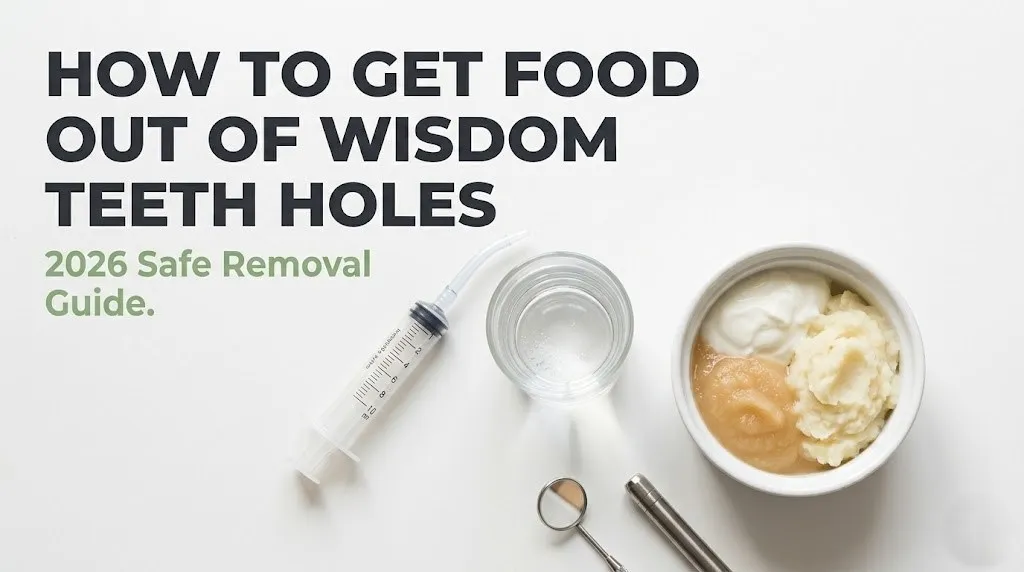
The safest way to get food out of wisdom teeth holes is to gently irrigate the socket with a curved-tip syringe filled with warm salt water, directing the stream at the socket opening without touching the healing tissue, a method that removes food particles without disturbing the protective blood clot or developing granulation tissue.
Looking into your mouth and seeing a piece of rice or a bit of spinach sitting in the hole where your tooth used to be is unnerving. The first instinct is to poke at it with your tongue, your finger, or anything nearby. Do not do any of those things. The blood clot and healing tissue in that socket are fragile and essential. Damaging them leads to dry socket, a painful condition that delays healing and requires professional treatment.
The American Association of Oral and Maxillofacial Surgeons recommends gentle irrigation with a syringe starting around day 5 after extraction as the safest method for removing food debris. Before day 5, only gentle salt water rinsing with head tilting, no swishing, is appropriate. This article walks you through exactly what to do, what never to do, and how to tell the difference between a harmless food particle and a healing socket that needs professional attention.
Why Does Food Get Stuck in Wisdom Teeth Holes
Food gets stuck in wisdom teeth holes because the extraction creates an open socket in the jawbone that acts like a small pocket, and as the gum tissue heals from the bottom up over several weeks, this pocket naturally traps food particles, especially small, soft, or sticky ones like rice, seeds, and bread.
After a wisdom tooth is removed, the socket that remains is not a flat surface. It is a depression in the gum and bone that can be surprisingly deep, especially for impacted teeth that required surgical sectioning. The socket is essentially a small bowl. Gravity and the movement of chewing push food into that bowl. The tongue, which normally clears food from teeth and gums, cannot reach into the socket without pressing on it, which is painful and discouraged.
The size and depth of the socket determine how much food gets trapped. A straightforward extraction of a fully-erupted wisdom tooth leaves a smaller, shallower socket. An impacted tooth that required bone removal and surgical extraction leaves a larger, deeper socket that will trap food for a longer period.
The healing process itself contributes to food trapping. As the socket heals, it fills with granulation tissue from the bottom up. The gum tissue grows across the top from the edges inward. During this process, which takes weeks, the socket remains an open depression that collects debris. The opening gradually becomes smaller and shallower. Food trapping decreases over time but persists until the gum surface is fully closed.
The types of food most likely to get stuck include rice, quinoa, popcorn kernels, seeds, nuts, bread, pasta, and fibrous vegetables like celery or spinach. Small, particulate foods are the worst offenders because they fit perfectly into the socket and are difficult to flush out. Soft, sticky foods like bread and pasta can adhere to the socket walls.
Key Takeaway: The extraction socket is a natural pocket that traps food during healing. This is normal and expected, not a sign that something is wrong with your recovery.
How to Know If Food Is Stuck in Wisdom Tooth Hole
You can tell food is stuck in a wisdom tooth hole when you feel a sensation of fullness or pressure in the socket, see a visible particle when looking with a flashlight and mirror, or notice a mild odor or taste that improves after irrigation.
The feeling of food in the socket is distinctive. It is a sensation of something being present where there should be nothing. You may feel it with your tongue as a small bump or a soft mass. You may notice it when you close your teeth together and feel something between them that should not be there.
Visual identification is possible with good lighting. Stand in front of a mirror with a flashlight or use your phone’s flashlight. Angle the light so it shines into the socket. Healthy healing tissue appears whitish or yellowish-gray and is firmly attached to the socket walls. Food particles appear as distinct pieces, often the color of whatever you ate, white rice, green spinach, brown bread, sitting loosely in the socket.
A mild odor or taste can indicate trapped food. As food particles sit in the warm, moist environment of the mouth, they begin to break down. This produces a mild, unpleasant taste that improves after you irrigate the socket. If the odor is strong, foul, or persists after thorough irrigation, it may indicate infection rather than simple food trapping.
The timing of the sensation helps distinguish food from healing tissue. Food trapping typically occurs within minutes to hours after eating. If you notice something new in the socket right after a meal, it is almost certainly food. If the material has been there for days and does not change after irrigation, it may be granulation tissue.
Dietary Sensitivity Note: If you have eaten rice, quinoa, small pasta, seeds, or popcorn, and then feel something in your socket, it is very likely food. These are the most common foods to become trapped.
How to Get Food Out of Wisdom Teeth Holes
Remove food from wisdom teeth holes by following a step-by-step protocol that starts with gentle salt water rinsing, progresses to irrigation with a curved-tip syringe filled with warm salt water, and uses gravity and head positioning to help dislodge stubborn particles, all performed with gentle pressure to protect the healing tissue.
This is the core protocol. Work through the steps in order. Do not skip to aggressive methods. Most food particles can be removed with steps 1 through 3.
Step 1: Prepare warm salt water. Mix half a teaspoon of table salt into 8 ounces of warm water. The water should be comfortably warm, not hot. Hot water can damage healing tissue and increase bleeding. Stir until the salt is completely dissolved.
Step 2: Perform a gentle salt water rinse. Take a mouthful of the warm salt water. Gently tilt your head from side to side. Let the water flow over the extraction sites. Do not swish vigorously. Vigorous swishing creates pressure changes that can dislodge the blood clot. Let the water fall out of your mouth into the sink. Do not spit forcefully.
Step 3: If rinsing alone does not work, fill a curved-tip irrigation syringe with the warm salt water. The curved tip allows you to direct the stream into the socket without inserting the tip into the tissue.
Step 4: Position yourself in front of a mirror with good lighting. Hold the syringe in your dominant hand. Place the tip of the syringe just outside the socket opening. Do not insert the tip into the socket. The tip should hover a few millimeters above or at the edge of the opening.
Step 5: Angle the syringe tip so the stream of water will flow into the socket at roughly a 45-degree angle. The goal is to direct the water into the socket so it flows around the food particle and flushes it out from underneath, not to blast the food deeper.
Step 6: Depress the plunger with gentle, steady pressure. A slow, controlled stream is safer and more effective than a sudden, forceful blast. The water should flow into the socket and then run back out, carrying the food particle with it.
Step 7: Observe the water as it drains from your mouth. If you see the food particle in the sink, the irrigation was successful. If not, repeat the process two to three times.
Step 8: If food remains after several attempts, try tilting your head so the socket faces downward. Gravity helps food exit. Irrigate while holding this position.
Step 9: Rinse gently with plain warm water after irrigation to remove any remaining salt taste.
Quick Tip:
- Irrigate after every meal, not just when you feel food. Regular irrigation prevents food from accumulating and breaking down in the socket.
How to Use an Irrigation Syringe for Wisdom Tooth Holes
Use a curved-tip irrigation syringe by filling it with warm salt water, positioning the curved tip just outside the socket opening at a 45-degree angle without touching the healing tissue, and gently depressing the plunger to direct a slow, steady stream of water into the socket to flush out food particles.
The irrigation syringe is the tool your oral surgeon likely provided or recommended. It is sometimes called a monoject syringe or curved-tip syringe. The curved tip is essential. It allows you to direct water into the socket from an angle that would be impossible with a straight syringe.
Here is the detailed technique:
Syringe preparation: Fill a clean cup with warm salt water (half teaspoon salt per 8 ounces water). Draw the water into the syringe by pulling back the plunger. Fill the syringe completely. You will use the full volume for each socket.
Hand position: Hold the syringe like a pen, with your thumb on the plunger. This grip gives you the most control over pressure.
Tip placement: This is the most important step. Position the curved tip so it hovers just above the socket opening. The tip should be a few millimeters away from the tissue. It should not touch the socket walls, the blood clot, or the granulation tissue. If the tip touches tissue, it can cause bleeding and pain, and it can dislodge the healing clot.
Angle: Direct the tip at approximately a 45-degree angle to the socket opening. The stream should enter the socket and wash around the inside walls. Think of it like spraying water into a small cup to rinse it out. The water goes in, swirls around, and flows back out.
Pressure: Depress the plunger slowly and steadily. A gentle stream is sufficient to flush out food particles. High-pressure irrigation can damage healing tissue and force food deeper into the socket. If you feel pain, the pressure is too high or the tip is too close to the tissue.
What to expect: The water will enter the socket and then flow back out, carrying food particles and debris. You may see pieces of food in the sink. The water may be slightly cloudy or contain small white or tan specks. This is normal. It is food debris and harmless oral bacteria being flushed out.
Frequency: Irrigate after every meal and before bed. Even if you do not feel food in the socket, food particles too small to sense can still be present.
Dietary Sensitivity Note: Use warm, not hot, water. Hot water increases blood flow to the area and can cause bleeding or discomfort. Test the water temperature on your wrist before using it.
Key Takeaway: The irrigation syringe is the safest and most effective tool for removing food from extraction sockets. The key techniques are hovering the tip above the tissue, angling at 45 degrees, and using gentle pressure.
Salt Water Rinse Technique for Food Removal
A gentle salt water rinse removes loose food particles from wisdom tooth holes by tilting the head from side to side to let warm saline flow over and around the extraction site without swishing, spitting, or creating suction that could dislodge the blood clot.
Salt water rinsing is the first-line method, especially during the first 5 days after extraction when irrigation with a syringe is not yet recommended. It is gentler than irrigation and safe to begin 24 hours after surgery.
Proper salt water rinse technique:
- Prepare the solution: Half a teaspoon of table salt dissolved in 8 ounces of warm water. Stir until fully dissolved.
- Take a small mouthful. Do not fill your entire mouth.
- Close your mouth gently. Do not puff out your cheeks.
- Tilt your head to the side so the water pools over the extraction site. If you had extractions on both sides, tilt to one side first, then the other.
- Hold the water there for 10 to 15 seconds. Let gravity and the warmth of the water loosen food particles.
- Tilt your head the opposite direction to move the water across the socket.
- Open your mouth over the sink and let the water fall out. Do not spit. Spitting creates pressure that can dislodge the blood clot.
- Repeat 2 to 3 times, or until the water runs clear.
The mechanism is gentle. Salt water has a mild antimicrobial effect. The warmth increases blood flow, which supports healing. The movement of water across the socket, without forceful swishing, is often enough to dislodge loose particles that are sitting on top of the healing tissue.
Salt water rinsing should be done after every meal and before bed during the entire healing period, even after you have started irrigation. The rinse removes surface debris. The syringe removes debris from deeper in the socket. The two methods complement each other.
Dietary Sensitivity Note: Some patients find that table salt stings slightly. If this happens, reduce the salt to one-quarter teaspoon per 8 ounces. The mild antimicrobial benefit remains at the lower concentration.
How to Get Food Out Without a Syringe
If you do not have an irrigation syringe, remove food from wisdom teeth holes using warm salt water rinses with gentle head tilting, drinking water and letting it flow over the sockets, and using gravity by tilting your head so the socket faces downward while rinsing.
Not every oral surgeon provides a syringe. Some patients lose theirs. Others need to remove food before day 5 when syringe use is not yet recommended. Here are safe alternatives:
Warm water drinking method: Take a sip of warm water. Instead of swallowing, let the water flow over the extraction site by tilting your head. The water will naturally flow into and out of the socket, carrying loose particles. Spit gently or let the water fall from your mouth.
Gravity-assisted rinsing: After taking a mouthful of warm salt water, tilt your head so the socket faces the floor. Gently shake your head from side to side. Gravity plus the movement of the water can dislodge food.
Soft-bristled toothbrush method (for food on the gum, not in the socket): If food is sitting on the gum surface next to the socket, use a very soft toothbrush with a small head. Gently brush the food away from the socket, not toward it. Do not let the bristles enter the socket.
Tongue method (with extreme care): If food is very loose and sitting at the very edge of the socket, you may be able to gently push it out with your tongue. Use the tip of your tongue to nudge the particle sideways, not deeper. If this causes any pain or the particle does not move easily, stop immediately.
Methods to never use without a syringe:
- Toothpicks, dental picks, or any pointed object
- Fingernails or fingers
- Cotton swabs pushed into the socket
- Water flossers or Waterpiks (the pressure is far too high)
- Pressurized water from a faucet or shower head
- Forcing a piece of gauze into the socket
If you do not have a syringe and cannot remove the food with gentle rinsing, contact your oral surgeon’s office. They can provide a syringe or demonstrate proper technique. Most offices will give you a syringe at no charge if you ask.
Quick Tip:
- Pharmacies sell curved-tip irrigation syringes, often labeled as “monoject syringes” or “dental irrigation syringes,” for a few dollars. They are available without a prescription.
What to Avoid When Removing Food From Extraction Sites
Never use toothpicks, dental picks, fingernails, cotton swabs, Waterpiks, or any solid object to remove food from extraction sites, and never swish vigorously, spit forcefully, or apply suction, as all of these actions can dislodge the blood clot and cause dry socket.
The blood clot in the extraction socket is the foundation of healing. It protects the underlying bone and nerve endings. It provides a scaffold for new tissue to grow into. Losing the clot too early exposes bone, causes severe pain, and delays healing by days to weeks. Protecting the clot is the single most important rule of post-extraction care.
Things to never do when trying to remove food:
Insert objects into the socket: Toothpicks, dental picks, sewing needles, bobby pins, fingernails. Any solid object pushed into the socket will almost certainly dislodge the clot. The object itself can damage healing tissue and introduce bacteria deep into the socket.
Use high-pressure water devices: Waterpiks, water flossers, faucet sprayers, shower heads. These devices produce water pressure far higher than a hand-operated irrigation syringe. The pressure can blast the clot out of the socket and force bacteria into the healing tissue.
Swish vigorously: Forceful swishing creates turbulence and pressure changes in the mouth that can lift the clot out of the socket. Gentle head tilting is safe. Cheek-puffing swishing is not.
Spit forcefully: Spitting creates negative pressure in the mouth that can suction the clot out. Let water and saliva fall from your mouth passively.
Smoke or vape: The suction action of inhaling on a cigarette or vape dislodges clots. Nicotine constricts blood vessels, reducing blood flow to healing tissue. The combination dramatically increases dry socket risk.
Drink through a straw: The suction created by a straw reliably dislodges blood clots. Do not use a straw for at least two weeks after extraction.
Probe with your tongue: Gentle tongue exploration at the very edge of the socket may be harmless, but pressing the tongue into the socket can dislodge the clot and push food deeper.
Dietary Sensitivity Note: If you are taking anticoagulant or antiplatelet medications, your clot may be less stable. Be even more cautious with any mechanical manipulation of the socket.
Key Takeaway: If it is not warm salt water, a prescribed irrigation syringe, or a very soft toothbrush at the gum edge, do not put it near your extraction socket.
When Can You Start Irrigating Wisdom Tooth Holes
Begin irrigating wisdom tooth holes no earlier than day 5 to 7 after extraction, once the blood clot has stabilized and early granulation tissue has begun to form, and only after confirming the timing with your oral surgeon.
The first 24 to 72 hours after extraction are the highest-risk period for dry socket. During this time, the blood clot is fresh and fragile. The fibrin mesh that anchors the clot to the socket walls has not fully formed. Irrigation during this period is extremely likely to dislodge the clot.
Days 3 to 5 are a transition period. The clot is more stable. Early granulation tissue is beginning to form at the base of the socket. Some oral surgeons permit very gentle irrigation starting on day 4 or 5. Others prefer to wait until day 7. Follow your surgeon’s specific instructions.
Day 5 to 7 is when most patients are cleared to begin irrigation. By this point, the clot has been replaced or covered by granulation tissue. The socket is less vulnerable to mechanical disruption. Gentle irrigation is safe and recommended.
Here is the general timeline for cleaning methods by day:
| Days Post-Extraction | Allowed Cleaning Methods |
|---|---|
| Day 1 | No rinsing at all; let saliva dribble out |
| Days 2-5 | Gentle salt water rinses with head tilting; no swishing, no spitting |
| Days 5-7 | Begin irrigation with syringe if cleared by surgeon |
| Day 7 onward | Regular irrigation after meals; gentle brushing of adjacent teeth |
| Weeks 2-4 | Continue irrigation until socket no longer traps food |
If your oral surgeon provided a syringe and instructed you to begin irrigation on a specific day, follow that instruction. Surgeon-specific guidance always supersedes general timelines. The surgeon knows the specifics of your extraction and can assess your individual healing.
Dietary Sensitivity Note: If you had a particularly traumatic extraction, multiple teeth removed, or a history of dry socket, your surgeon may recommend waiting longer to begin irrigation.
What If You Can’t Get Food Out of Wisdom Tooth Hole
If food remains stuck after several attempts with warm salt water irrigation, do not panic, do not escalate to aggressive methods, and contact your oral surgeon for professional removal if the food persists for more than a few days or is accompanied by pain, odor, or other concerning symptoms.
This is one of the most anxiety-producing situations for post-extraction patients. You have tried the salt water rinses. You have used the syringe. The food is still there. Your mind starts racing: will it cause an infection, will the hole close with food inside, will it rot, do I need to go to the emergency room.
Take a breath. Here is what to do:
Step 1: Attempt irrigation once more, but differently. Change the angle of the syringe tip. Try irrigating from a different direction. Sometimes food is lodged in a specific corner of the socket that responds to a different approach angle.
Step 2: Try irrigating with slightly warmer water. The warmth can soften food particles, especially bread or pasta, making them easier to flush out.
Step 3: Try eating something soft and wet, like yogurt or applesauce. Sometimes the action of swallowing and the movement of soft food through the mouth can dislodge a particle. Do not chew on the extraction side.
Step 4: If the food remains but you have no pain, no odor, no swelling, and no other symptoms, it is reasonable to wait. Small food particles are often pushed out naturally as the socket heals and granulation tissue fills from the bottom. The particle will rise as new tissue grows beneath it.
Step 5: If the food remains for more than 3 to 4 days, or if you develop any concerning symptoms, call your oral surgeon’s office. A quick in-office irrigation and inspection takes minutes and provides peace of mind.
Step 6: If you notice increasing pain, a foul odor or taste that does not improve with irrigation, swelling, redness spreading beyond the socket, or fever, contact your surgeon immediately. These are signs of infection, not simple food trapping.
Dietary Sensitivity Note: Do not fast or avoid eating because you are afraid of getting food in the socket. Proper nutrition supports healing. Eat soft foods on the opposite side of your mouth and irrigate after every meal.
Food vs Granulation Tissue in Wisdom Tooth Hole
Food particles in a wisdom tooth hole appear as distinct, movable pieces that match the color and texture of recently eaten food, while granulation tissue is a whitish, yellowish, or grayish firm tissue that is attached to the socket walls and cannot be flushed away.
This is one of the most common causes of anxiety during post-extraction recovery. A patient looks in the mirror, sees something white or yellowish in the socket, and assumes it is food. They irrigate aggressively. The “food” does not come out. They panic. In many cases, the white material is granulation tissue, the normal healing tissue that fills the socket from the bottom up.
Here is how to distinguish the two:
| Feature | Food Particle | Granulation Tissue |
|---|---|---|
| Color | Matches the food eaten (white rice, green spinach) | Whitish, yellowish, or grayish |
| Texture | Soft, loose, breaks apart | Firm, attached, does not break apart |
| Location | Often floating or sitting loosely | Attached to socket walls or filling from bottom |
| Response to irrigation | Flushes out easily | Does not move or flush out |
| Change over time | Appears after eating, disappears after irrigation | Gradually changes and fills socket over days |
| Odor | Mild food odor, improves with irrigation | No odor or mild healing odor |
Granulation tissue is a good sign. It means the socket is healing. It is made of new blood vessels, collagen, and immune cells that are rebuilding the tissue. It appears during the second week of healing and gradually fills the socket. It is not food. It is not pus. It is not infection. Do not try to remove it.
A simple test: irrigate the socket gently. If the white material moves or flushes out, it was food. If it remains firmly in place, it is granulation tissue. Leave it alone.
If you are genuinely unsure whether something in your socket is food or tissue, and it does not flush out with gentle irrigation, contact your oral surgeon for an evaluation. They can identify it in seconds and save you days of worry.
Key Takeaway: White or yellowish tissue that stays put after irrigation is normal healing tissue, not food. Do not attempt to remove it.
Will Wisdom Tooth Hole Close With Food in It
A wisdom tooth hole will generally still close even if small food particles are present, as the healing tissue grows from the bottom up and pushes debris toward the surface, but larger food particles that remain for extended periods can delay healing and increase infection risk.
The body’s healing process is not stopped by a grain of rice. Granulation tissue forms at the base of the socket, where the blood supply is richest. New tissue grows upward, filling the socket from the bottom. As it grows, it pushes anything sitting in the socket, food particles, debris, dead cells, toward the surface where they can be rinsed or irrigated away.
This means a small food particle that has been in the socket for a day or two will not prevent healing. The socket will close around it or push it out. This is reassuring for patients who discover food in their socket hours after a meal and worry they have ruined their recovery.
However, larger amounts of food that remain for many days can cause problems. Food that sits in the socket provides a nutrient source for bacteria. This can lead to localized infection, inflammation of the healing tissue, and delayed wound closure. The socket may still eventually close, but the healing will be slower and more uncomfortable.
Food that is actively causing problems will usually announce itself. You will notice increasing pain, a persistent foul taste or odor that does not improve with irrigation, swelling, or discharge. These symptoms warrant a call to your oral surgeon.
The takeaway is practical, not alarming. Irrigate after meals to remove food. If a small particle remains, it is probably fine. If food persists for days or symptoms develop, seek professional care.
Dietary Sensitivity Note: Do not skip meals to avoid getting food in the socket. Proper nutrition, especially adequate protein and vitamin C, is necessary for wound healing.
Is It Bad If Food Gets in Wisdom Teeth Holes
It is normal and generally harmless for food to get into wisdom teeth holes during the healing period, as long as the food is removed through regular gentle irrigation after meals and does not cause increasing pain, foul odor, or other signs of infection.
Food getting into the socket is an expected part of the healing process, not a sign that you have done something wrong. Even with careful eating on the opposite side of your mouth, small particles migrate. Saliva carries food debris. The tongue moves food around the mouth. Some will inevitably end up in the socket.
The concern is not that food gets in. It is whether the food stays in and causes problems. Regular irrigation after meals removes food before it has time to break down and cause irritation. A food particle that sits in the socket for 30 minutes and is then flushed out does no harm. A food particle that sits for 3 days may begin to cause localized irritation.
The distinction between harmless and harmful food trapping:
| Harmless Food Trapping | Concerning Food Trapping |
|---|---|
| Food present after meals | Food present constantly, even after irrigation |
| Removed by irrigation | Does not respond to irrigation |
| No pain | Increasing pain |
| Mild taste that resolves with irrigation | Persistent foul taste or odor |
| No swelling | Swelling, redness, or warmth around socket |
| Socket looks normal otherwise | Pus or discharge from socket |
If you are irrigating after meals and the food comes out, your socket is clean enough. Do not chase perfection. Obsessive, aggressive irrigation can irritate healing tissue and do more harm than good.
Dietary Sensitivity Note: If you are immunocompromised due to chemotherapy, transplant medications, or uncontrolled diabetes, trapped food carries a higher infection risk. Discuss specific cleaning protocols with your oral surgeon.
Signs of Infection From Food in Extraction Site
Signs that trapped food has caused an infection in an extraction site include increasing pain after day 4, a persistent foul odor or taste that does not improve with irrigation, pus or discharge from the socket, spreading redness and swelling around the site, and fever or swollen lymph nodes.
Infection after wisdom tooth extraction is uncommon but possible. The incidence is approximately 1 to 5 percent in healthy patients. Food debris that remains in the socket for extended periods increases the risk by providing a nutrient source for bacteria.
The key distinction is between normal healing symptoms and infection symptoms:
| Symptom | Normal Healing | Possible Infection |
|---|---|---|
| Pain | Decreasing daily after day 3 | Increasing or returning after day 4 |
| Odor/taste | Mild, improves with irrigation | Foul, persists despite irrigation |
| Socket appearance | Whitish granulation tissue, firm | Yellow or green discharge, loose |
| Swelling | Peaks day 2-3, then decreases | Spreading or returning swelling |
| Gum color | Pink to red, fading | Bright red, spreading beyond socket |
| Body temperature | Normal | Fever above 100.4 degrees Fahrenheit |
| Lymph nodes | May be slightly tender | Swollen, painful under jaw or neck |
Infection from trapped food typically develops gradually. A food particle sits in the socket for several days. Bacteria multiply in the nutrient-rich environment. The surrounding tissue becomes inflamed. Pain increases. A foul taste develops. These symptoms progress over days, not hours.
If you notice signs of infection, contact your oral surgeon. Do not attempt to treat a socket infection at home. Treatment typically involves professional irrigation and debridement of the socket, possibly antibiotics. The earlier it is addressed, the simpler the treatment.
Dietary Sensitivity Note: If you are prescribed antibiotics, take them as directed and complete the full course. Some antibiotics require food in the stomach to prevent nausea. A smoothie or yogurt consumed before the dose helps if eating is still difficult.
Foods Least Likely to Get Stuck in Wisdom Teeth Holes
Smooth, soft foods that require no chewing and leave minimal particulate residue are the least likely to get stuck in wisdom teeth holes, including yogurt, smoothies, applesauce, mashed potatoes, pudding, broth, and well-blended soups.
Choosing the right foods during the healing period reduces food trapping and the need for frequent irrigation. The goal is to eat foods that are nutritionally adequate for healing while being physically unlikely to lodge in the socket.
Best food choices for minimizing food trapping:
| Food Category | Best Choices | Why |
|---|---|---|
| Dairy | Yogurt, kefir, cottage cheese (small curd), pudding | Smooth, no particles, protein for healing |
| Fruits | Applesauce, banana mashed smooth, fruit smoothies | No seeds or fiber strands |
| Vegetables | Mashed potatoes, pureed soups, smooth hummus | Smooth consistency, no fibers |
| Proteins | Scrambled eggs, tofu, protein shakes, bone broth | No particles, essential for healing |
| Grains | Cream of wheat, smooth oatmeal, polenta | Much safer than rice or quinoa |
| Liquids | Water, milk, broth, meal replacement shakes | Hydration, calories, no particles |
Foods to avoid during the active healing period:
| Food Category | Foods to Avoid | Why |
|---|---|---|
| Grains | Rice, quinoa, couscous, barley | Individual grains lodge perfectly in sockets |
| Snacks | Popcorn, chips, crackers, nuts, seeds | Hard, sharp particles |
| Breads | Crusty bread, bagels, toast | Crumbly and sticky |
| Vegetables | Celery, broccoli, corn, leafy greens | Fibrous and stringy |
| Fruits | Berries with seeds, pineapple, oranges | Seeds and fibrous membranes |
| Meat | Tough cuts, jerky, bacon | Requires chewing that stresses socket |
The goal is not to eat only liquids for weeks. As healing progresses, you can gradually add more textured foods. The soft food diet is most critical during the first 5 to 7 days when the socket is most vulnerable and irrigation may not yet be permitted.
Dietary Sensitivity Note: Vegan patients can meet protein needs with silken tofu, pea protein smoothies, thinned lentil purees, and soy yogurt. Ensure adequate calorie intake to support healing.
How Long Does Food Get Stuck in Wisdom Teeth Holes
Food will get stuck in wisdom teeth holes until the gum surface fully closes, which typically takes 2 to 4 weeks, though food trapping decreases significantly after week 2 as the socket becomes shallower and the opening narrows.
The timeline of food trapping follows the timeline of socket healing. The socket is deepest and most open during the first week after extraction. Food trapping is at its peak. By week 2, granulation tissue has filled much of the socket depth. Food still enters but is easier to remove because the pocket is shallower. By weeks 3 to 4, the gum surface is closing or closed. Food trapping becomes minimal or stops entirely.
Here is what to expect week by week:
| Timeframe | Socket Status | Food Trapping | Irrigation Needed |
|---|---|---|---|
| Week 1 | Deep open socket, clot and early granulation | Significant | Yes, after day 5 |
| Week 2 | Socket shallower, granulation tissue filling | Moderate | Yes, after meals |
| Week 3 | Socket nearly closed at surface | Minor | Yes, if food collects |
| Week 4 | Gum usually fully closed | Minimal to none | Only if indentation remains |
| Weeks 5-6 | Healed at surface | None | No |
The socket may appear closed at the surface while still having a small indentation underneath. This indentation can trap food for an additional week or two after the surface looks healed. Continue irrigating as long as food collects after meals.
You will know the socket is fully closed and no longer needs irrigation when you eat a full, normal meal and feel no food debris in the socket afterward, and irrigation produces no particles. This milestone typically arrives between weeks 3 and 5.
Dietary Sensitivity Note: If you had multiple teeth extracted or impacted teeth requiring extensive surgery, the healing timeline may extend. Larger sockets take longer to close and trap food for a longer period. Be patient with the process.
Key Takeaway: Food trapping is a temporary phase that lasts 2 to 4 weeks for most patients. It decreases steadily as the socket heals. Consistent irrigation shortens the duration of trapped food and reduces the risk of complications.
Frequently Asked Questions About Food in Wisdom Teeth Holes
Can I use a Waterpik to clean my wisdom tooth holes?
No, never use a Waterpik or any powered water flosser on wisdom tooth holes.
The pressure is far too high and will dislodge the blood clot, causing dry socket.
Use only a manual curved-tip irrigation syringe with gentle hand pressure.
How do I know if it is food or healing tissue in the hole?
Food particles are loose, match the color of recently eaten food, and flush out with gentle irrigation.
Granulation tissue is whitish or yellowish, firmly attached to the socket walls, and does not move when irrigated.
If the material stays put after irrigation, it is healing tissue. Leave it alone.
What happens if I leave food in my wisdom tooth hole?
Small food particles left for a day or two are usually harmless and will be pushed out as the socket heals.
Food left for many days can cause localized irritation, inflammation, and a foul taste.
If food persists despite irrigation or you develop pain and odor, contact your oral surgeon.
Can food stuck in a wisdom tooth hole cause infection?
Yes, food that remains in a socket for extended periods can become a breeding ground for bacteria and cause localized infection.
Signs of infection include increasing pain, foul odor that persists despite irrigation, pus or discharge, and spreading redness.
Prompt irrigation after meals prevents food from sitting long enough to cause problems.
When can I stop irrigating my wisdom tooth holes?
Stop irrigating when the socket no longer traps food after meals.
This typically occurs between 3 and 5 weeks after extraction when the gum surface has fully closed.
You will know it is time to stop when you eat a normal meal and feel no food debris in the socket, and irrigation produces no particles.
Finding food in your wisdom tooth hole is unsettling but almost never an emergency. The extraction socket is designed by biology to heal from the bottom up, pushing debris toward the surface as it closes. Your job is to help that process along with gentle salt water rinses and irrigation, not to poke, prod, or panic.
Fill your syringe with warm salt water. Angle it at 45 degrees just outside the socket. Depress gently. Watch the food float out. Do this after every meal. If the food does not come out, try again from a different angle. If it still does not come out and you have no pain or odor, give it a day. The socket will likely push it out on its own.
Call your oral surgeon if the food persists for days, if pain increases, or if you notice a foul taste that does not improve. A quick in-office irrigation takes minutes and gives you peace of mind. Healing from wisdom tooth extraction is a waiting game, but it is a waiting game you win by being gentle, consistent, and patient.