Taco Bell is not Mexican food in the cultural or culinary sense, but it is a highly successful American fast-food chain that draws inspiration from Mexican and Tex-Mex flavor profiles. Calling Taco Bell Mexican food is like calling a gas station croissant French pâtisserie. The lineage is visible, but the execution, ingredients, and cultural context are entirely different.
This distinction matters because Mexican cuisine is one of the most sophisticated and historically deep food traditions on the planet. In 2010, UNESCO designated traditional Mexican cuisine as an Intangible Cultural Heritage of Humanity, recognizing the farming, nixtamalization, and communal cooking practices that stretch back thousands of years to Mesoamerican civilizations. Comparing a Crunchwrap Supreme, a flour tortilla filled with seasoned ground beef, nacho cheese sauce, tostada shell, sour cream, lettuce, and tomato, to that heritage requires acknowledging the gap is not minor. It is categorical.
This guide explains exactly why Taco Bell does not qualify as Mexican food, what it actually is, how its ingredients differ from traditional Mexican cooking, and why the “authentic” debate often misses a bigger and more interesting story about how immigrant food traditions evolve in America. You will walk away understanding the difference, not just repeating a one-word dismissal.
Is Taco Bell Considered Mexican Food?
Taco Bell is not considered Mexican food by culinary professionals, Mexican cooks, or the chain itself. Taco Bell describes its menu as “Mexican-inspired” in corporate materials, a phrase that accurately reflects the gap between inspiration and identity. The company does not claim to be a Mexican restaurant. It claims to serve affordable, craveable food that borrows the architecture of a taco, a burrito, and a quesadilla.
The distinction between “Mexican food” and “Mexican-inspired food” is not a polite euphemism. It is a meaningful category boundary. Mexican food refers to a specific set of regional cuisines within Mexico, each with distinct ingredients, techniques, and cultural rituals. Mexican-inspired food refers to any dish that borrows some of those shapes and flavors but operates in a different culinary logic, usually one optimized for speed, cost, and shelf stability rather than tradition or seasonality.
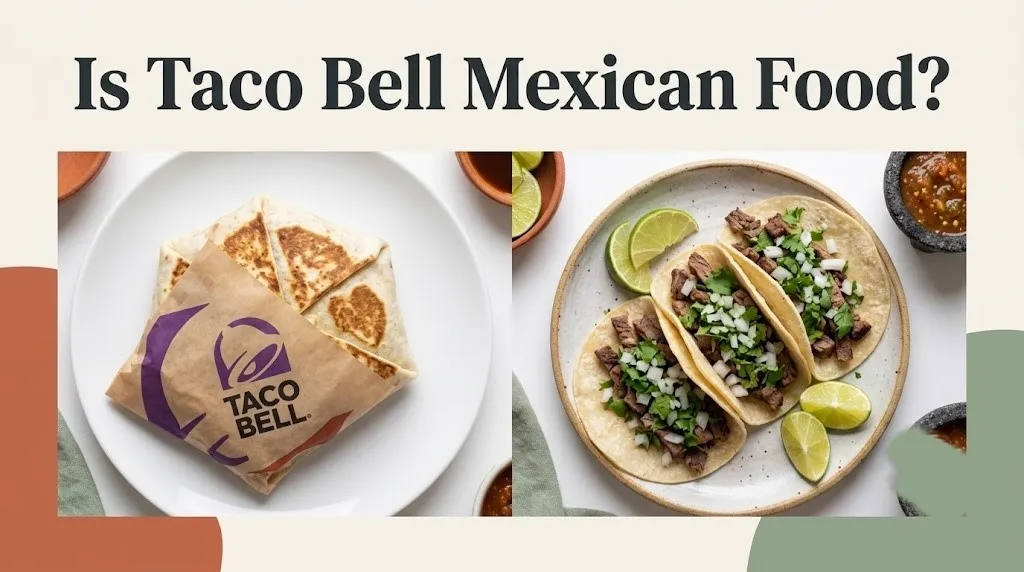
Food critics and culinary schools, including the Culinary Institute of America, define a cuisine by its foundational ingredients and techniques. Taco Bell’s kitchen does not include a comal for fresh tortillas, a molcajete for grinding salsa, or a pot of slowly simmered carnitas. Its kitchen is designed for assembly speed and consistency across thousands of locations. That kitchen produces something real and culturally significant in its own right, but it is not a Mexican kitchen.
Key Takeaway: Taco Bell borrows the silhouette of Mexican food, but not its substance. The chain itself agrees.
Is Taco Bell Authentic Mexican Food?
Taco Bell is not authentic Mexican food by any reasonable culinary, cultural, or historical standard. Authenticity in food is a loaded and often unfair concept, but if we define it as alignment with the traditional ingredients, techniques, and cultural context of a specific cuisine, Taco Bell does not meet the threshold.
Authentic Mexican food begins with masa, the dough made from field corn that has been nixtamalized, or cooked and soaked in an alkaline solution like food-grade lime. This process unlocks niacin and creates the distinctive flavor and pliable texture of a real corn tortilla. A taco in Mexico City or Oaxaca starts with a freshly pressed and griddled tortilla, filled with a specific, simply prepared protein, and finished with chopped white onion, cilantro, a squeeze of lime, and a spoonful of salsa made from fresh or dried chiles. Nothing on the Taco Bell menu begins that way.
Taco Bell’s foundational tortilla is made from flour, a wheat-based product that entered northern Mexican and Tex-Mex cooking relatively late in culinary history. The ground beef is seasoned with a proprietary blend that includes soy lecithin, oats, and textured vegetable protein as binders and extenders, a formulation designed for consistency and cost, not tradition. The cheese is a processed shredded blend, not crumbled queso fresco or cotija. The salsa comes in shelf-stable packets. Each of these choices is rational from a business standpoint. Together, they define a food that is unmistakably American in its industrial logic.
Authenticity Comparison Table:
| Component | Authentic Mexican Cuisine | Taco Bell |
|---|---|---|
| Tortilla base | Nixtamalized corn masa, pressed fresh | Pre-made flour tortilla or factory corn shell |
| Protein | Carne asada, al pastor, barbacoa, carnitas | Seasoned ground beef with binders, pre-cooked chicken |
| Cheese | Queso fresco, cotija, Oaxaca | Processed cheddar blend, nacho cheese sauce |
| Salsa | Fresh molcajete-ground salsa, fresh chiles | Shelf-stable hot sauce packets |
| Fat source | Lard, avocado, crema | Soybean oil, sour cream, processed cheese |
| Cooking method | Grilled, braised, steamed in corn husks | Rehydrated, assembled, heated on a flat top |
What Type of Food Is Taco Bell Classified As?
Taco Bell is classified as American fast food that operates within the Tex-Mex and Mexican-inspired quick-service restaurant categories. The most accurate culinary classification is Tex-Mex adjacent, meaning it borrows heavily from the Tex-Mex tradition while further simplifying and industrializing it for mass production.
Tex-Mex is itself a legitimate regional American cuisine with roots in Tejano culture, the cooking of Mexican-descended Texans that developed long before Taco Bell existed. Dishes like chili con carne, nachos, fajitas served on a sizzling platter, and crispy tacos with ground beef are all Tex-Mex inventions, not traditional Mexican ones. Taco Bell did not invent these foods. It took an existing American regional cuisine and applied fast-food economics to it, standardizing the recipes, removing labor-intensive steps, and using processed ingredients that could be shipped frozen or shelf-stable across the country.
Industry analysts and restaurant classification databases, including Yum! Brands’ own investor materials, categorize Taco Bell under the Quick Service Restaurant (QSR) segment within the Mexican-inspired category. It competes not with taquerias but with McDonald’s, Burger King, and Wendy’s. Its competitive advantage is not cultural authenticity but speed, price, and a flavor profile distinct from the burger-and-fries default.
Difference Between Taco Bell and Authentic Mexican Cuisine
The fundamental difference between Taco Bell and authentic Mexican cuisine is that Taco Bell is a centralized, industrial food assembly system optimized for speed and cost, while authentic Mexican cuisine is a decentralized, technique-driven culinary tradition based on fresh masa, whole chiles, and slow-cooked meats. The two share the shape of a taco and little else.
This difference plays out in every component of the food. A traditional Mexican taco uses a tortilla made that day, often pressed by hand and cooked to order on a hot comal. The tortilla has a distinct aroma of toasted corn with a slight alkaline tang from the nixtamalization process. Taco Bell’s crunchy taco shell is a pre-fried, U-shaped corn product that arrives in a box and sits on a warming rack. The flour tortilla for a burrito is soft, pliable, and designed to stretch without cracking, a marvel of industrial food science that has nothing to do with a comal.
A similar gap exists in the protein. Carne asada is grilled steak, sliced against the grain, seasoned with salt, lime, and perhaps a simple rub. Al pastor is pork marinated in adobo and pineapple, stacked on a vertical spit and shaved to order. Barbacoa is beef or lamb slow-cooked in an underground pit or a steamer until it collapses. Taco Bell’s beef arrives pre-cooked and seasoned, then is rehydrated with water and held in a steam table. The chicken on the 2026 Cantina Chicken Menu is a higher-quality product than the chain’s standard shredded chicken was, but it is still a fast-food protein prepared in a central kitchen and reheated on site.
Is Taco Bell Tex Mex or Mexican?
Taco Bell is best described as a mass-market, fast-food version of Tex-Mex cuisine, which is itself a distinct American regional cuisine and not interchangeable with Mexican food. Tex-Mex and Mexican food share a border and many ingredients, but they are separate culinary traditions with different histories and flavor profiles.
Tex-Mex cuisine developed in Texas among Tejano communities and later spread across the American Southwest and the entire country. Its defining dishes include chili con carne, made with ground beef and chile powder thickened with flour. Fajitas, which originally used skirt steak, are served sizzling with flour tortillas, sour cream, and shredded yellow cheese. Nachos were invented in Piedras Negras, Mexico, just across the Texas border, but they became the ultimate Tex-Mex bar food after spreading north. Crispy ground beef tacos with lettuce, tomato, and shredded cheese are a Tex-Mex creation, and they are the direct ancestor of the Taco Bell taco.
Taco Bell took this Tex-Mex foundation and pushed it further away from both Mexican and Tejano roots. The chain added items that have no equivalent in any traditional cuisine, like the Crunchwrap Supreme, which is a hexagonal grilled flour tortilla enclosing layers of seasoned beef, nacho cheese, tostada, sour cream, lettuce, and tomato. That is not Tex-Mex. That is an entirely new category of industrial food innovation that happens to use the vocabulary of tacos and burritos.
Culinary Identity Map:
| Dish | Origin Tradition | Present at Taco Bell? |
|---|---|---|
| Soft corn taco with al pastor | Mexican | No |
| Crunchy ground beef taco | Tex-Mex | Yes |
| Nachos | Tex-Mex (border origin) | Yes (Nacho Fries, Nachos BellGrande) |
| Flour tortilla burrito | Tex-Mex/Northern Mexican | Yes |
| Crunchwrap Supreme | Taco Bell original | Yes |
| Quesabirria taco | Mexican (Jalisco) | No |
| Enchilada with red chile sauce | Mexican | No |
Taco Bell History and Mexican Food Origins
Taco Bell was founded by a man named Glen Bell in 1962 in Downey, California. Bell did not grow up cooking Mexican food. He was an entrepreneur who noticed a successful Mexican restaurant called the Mitla Cafe in San Bernardino and reverse-engineered the hard-shell taco he ate there to create a fast-food version that could be mass-produced.
The Mitla Cafe, which still operates today, was and is a legitimate Mexican American restaurant serving traditional food. Bell was a customer who became fascinated by the line of people waiting for tacos dorados, crispy fried tacos filled with seasoned beef and topped with shredded lettuce and cheese. He experimented with his own recipe, simplifying the process so that the shells could be pre-fried and the filling could be prepared quickly and cheaply. His first Taco Bell stand sold tacos for 19 cents.
This origin story is not a secret. It is a well-documented piece of American fast-food history. It illustrates exactly what Taco Bell is. An American fast-food entrepreneur saw a successful ethnic food business, identified a single product he thought he could industrialize, and built a global empire on that product. The result is not Mexican food. It is an American business story that used a taco as its vehicle. The Mitla Cafe serves Mexican food. Glen Bell sold a simplified, standardized copy of one of its most popular items. Those two things are not the same.
Taco Bell Ingredients vs Real Mexican Ingredients
A side-by-side ingredient comparison makes the distinction between Taco Bell and Mexican food immediately clear. Authentic Mexican cooking relies on a relatively short list of fresh, minimally processed ingredients that have been used for centuries. Taco Bell relies on a long list of processed ingredients designed for shelf stability, rapid assembly, and consistent flavor across thousands of locations.
A traditional Mexican taco filling might be carne asada, which is beef steak, salt, lime juice, and perhaps a rub of dried chiles. The ingredient list is five or six items long. Taco Bell’s seasoned beef contains beef, water, seasoning that includes chili pepper, onion powder, tomato powder, sugar, garlic powder, and cocoa powder processed with alkali, along with salt, oats, soy lecithin, and textured vegetable protein as binders and extenders. This is not a value judgment about which tastes better. It is an observation about what each product is designed to do. The traditional taco filling is designed to celebrate the flavor of a single animal and a few aromatics. The fast-food filling is designed to taste identical every time, hold on a steam table without degrading, and cost as little as possible per serving.
Taco Bell’s 2026 menu includes some items that use recognizable ingredients, like the Cantina Chicken, which is slow-roasted and served with purple cabbage and pico de gallo. That product is the chain’s clearest attempt to close the gap between fast food and a real taqueria experience. But it remains a fast-food product assembled from pre-cooked components, not a freshly grilled piece of chicken carved to order. The gap narrows but does not close.
Ingredient Contrast:
| Ingredient Category | Traditional Mexican Example | Taco Bell Equivalent |
|---|---|---|
| Tortilla fat | Lard or vegetable oil in masa | Soybean oil in flour tortillas |
| Chile | Dried ancho, guajillo, pasilla rehydrated and blended | Chili powder, paprika, extractives |
| Dairy | Queso fresco, cotija, crema | Shredded cheddar, nacho cheese sauce, sour cream |
| Bean preparation | Pinto beans simmered with onion, garlic, epazote | Canned refried beans, rehydrated with water |
| Sweetener in savory food | Minimal; piloncillo in select moles | Sugar added to beef seasoning, sauces |
Does Taco Bell Use Real Tortillas or Masa?
Taco Bell uses wheat flour tortillas and pre-formed crunchy corn taco shells, neither of which begin with fresh nixtamalized masa made in-house. The chain does not operate a masa program. It does not nixtamalize corn. It does not press tortillas to order.
A real corn tortilla is made by mixing masa harina, or fresh masa, with water and salt, pressing it into a thin round, and cooking it on a hot comal until it puffs and develops charred spots. The entire process takes about two minutes but requires skill, fresh ingredients, and dedicated equipment. The result is a warm, pliable, fragrant disc that tastes unmistakably of corn and lime. Taco Bell’s crunchy corn shell is a factory-made product that arrives pre-fried in a U shape. It has no masa aroma because the corn flavor has been overwhelmed by the frying oil and the texture is designed for crunch, not pliability.
The flour tortillas Taco Bell uses for burritos are large, soft, and stretchy, designed to wrap around a dense filling without tearing. They are effective at their job. A flour tortilla in northern Mexico or Tex-Mex cooking is also a legitimate traditional product, and flour tortillas have a real place in northern Mexican cuisine. But a handmade flour tortilla made with lard and cooked on a griddle tastes and feels different from an industrial tortilla made with soybean oil and preservatives for a supply chain. Taco Bell’s tortilla is a tool for containing a meal. A traditional tortilla is part of the meal itself.
Taco Bell Ground Beef vs Carne Asada Preparation
Taco Bell’s seasoned ground beef is a processed, emulsified meat product designed for consistency and cost. Carne asada is a whole-muscle cut of beef, typically skirt or flank steak, grilled over high heat and sliced against the grain. They are not the same ingredient, the same technique, or the same eating experience.
The preparation methods could not be more different. Carne asada starts with a piece of recognizable beef. It is seasoned, often simply with salt, lime, and perhaps a dry rub of chiles. It hits a hot grill or a cast iron plancha. It develops a charred crust. It rests. It is sliced thinly across the grain so each bite is tender. The beef at Taco Bell arrives pre-cooked, seasoned with a blend of spices, sugars, and binders, and is rehydrated and held warm until it is scooped onto a taco or burrito. This process produces a soft, uniform, mildly spiced filling that tastes the same in Seattle as it does in Miami.
Neither product is inherently “bad.” Carne asada at a taqueria costs more, takes more skill to prepare, and delivers a more complex, beef-forward flavor. Taco Bell’s seasoned beef costs less, requires no skilled labor to prepare at the point of service, and delivers a consistent, comforting flavor profile that millions of people enjoy. The issue is not morality. It is category. Calling both “taco meat” collapses a world of difference into one misleading word.
Key Takeaway: Taco Bell’s beef is a well-engineered fast-food protein. Carne asada is a specific, recognizable cut of grilled beef. Knowing the difference is the starting point for the entire authenticity conversation.
What Makes Mexican Food Authentic?
Authentic Mexican food is defined by its foundation in nixtamalized corn masa, its use of fresh and dried whole chiles, its slow-cooking techniques for meats, and its deep regional diversity rooted in pre-Columbian and Spanish culinary traditions. It is not a single set of recipes. It is a cooking philosophy built on specific ingredients and methods passed down through generations.
The chile, not the bell pepper or the jalapeno, is the soul of Mexican cooking. Dried chiles like ancho, guajillo, pasilla, and chipotle are toasted, soaked, and blended into complex sauces that take hours to develop. A mole, the most famous example, can contain 20 or more ingredients and requires a full day of preparation. Nothing on a fast-food menu approximates this. The mild, uniform heat of Taco Bell’s hot sauce packets, which rely on vinegar and chili extract, is a completely different category of flavor.
UNESCO recognized Mexican cuisine as an Intangible Cultural Heritage specifically because it encompasses not just recipes but agricultural systems like the milpa, which interplants corn, beans, and squash. It includes the nixtamalization process that transformed corn into a nutritionally complete staple food capable of sustaining civilizations. It includes the markets, the communal cooking, and the specific tools like the metate and the comal. Authenticity, in this context, is not about gatekeeping who can cook what. It is about recognizing the depth and specificity of a food culture that cannot be reduced to a taco shell and a packet of fire sauce.
Taco Bell Cantina Chicken Menu 2026 Review
The Cantina Chicken Menu, which Taco Bell expanded significantly for 2026, represents the chain’s most deliberate attempt to offer a product that feels closer to a taqueria-style experience. It features slow-roasted chicken, purple cabbage, pico de gallo, and a new creamy chipotle sauce, assembled in a burrito, taco, or bowl format.
From a nutritional standpoint, the Cantina Chicken items are generally a better choice than the classic beef-based menu. The chicken is a whole-muscle product, not a ground and bound filling, and it provides leaner protein with less saturated fat than the seasoned beef. A Cantina Chicken Soft Taco, depending on location-specific preparation, contains roughly 200 to 240 calories, with about 12 to 14 grams of protein. That is a respectable fast-food taco by any standard. The purple cabbage and pico de gallo add a small amount of vegetable matter and fresh acidity that the standard lettuce and cheese tacos lack.
However, this is still a fast-food product, not a taqueria taco. The chicken is pre-cooked in a central kitchen, not grilled to order. The tortilla is a standard flour tortilla, not a fresh corn tortilla pressed from masa. The creamy chipotle sauce adds calories and sodium without adding the complexity of a real adobo made from dried chiles. The Cantina Chicken line is Taco Bell at its most ambitious and its most self-aware. It is a better fast-food taco. It is not a Mexican taco.
Cantina Chicken vs Traditional Chicken Taco:
| Feature | Cantina Chicken Taco (2026) | Traditional Tinga or Grilled Chicken Taco |
|---|---|---|
| Tortilla | Flour, soft | Corn, pressed fresh from masa |
| Chicken | Pre-cooked, slow-roasted, shredded | Cooked to order, shredded tinga or grilled breast |
| Toppings | Purple cabbage, pico de gallo, chipotle sauce | White onion, cilantro, lime, salsa verde or roja |
| Cooking method | Assembly from prepped components | Grilled or stewed on site |
| Calorie range (approx.) | 200 to 240 | 150 to 250 |
Americanized Mexican Food Culture and Identity
Americanized Mexican food is its own legitimate cultural category, born from the intersection of Mexican immigrant cooking traditions and American ingredients, tastes, and business models. Taco Bell is not an imposter in this category. It is arguably the most commercially successful expression of it.
This is where the conversation moves beyond “real versus fake” into something more useful. Tex-Mex cuisine, the San Antonio chili queens, the invention of the frozen margarita machine, the spread of the breakfast burrito, and the rise of Taco Bell are all part of a 150-year story of Mexican food adapting to American soil. Immigrant cooks opened restaurants. They substituted ingredients they could find for ingredients they could not. American customers developed preferences. Dishes changed. A crispy taco with ground beef, lettuce, tomato, and cheese is not a betrayal of Mexican food. It is an American dish with Mexican ancestry, a culinary descendant, not an imposter.
The problem is not that Taco Bell exists. The problem is when Taco Bell is treated as the default reference point for “Mexican food” in the American imagination, erasing the actual taquerias, fondas, and home kitchens where real Mexican cooking happens. You can enjoy a Cheesy Gordita Crunch and also know the difference between that and a taco al pastor. You can eat at Taco Bell on a road trip and still seek out a great local taqueria when you want the real thing. The existence of one does not threaten the other, as long as the distinction stays clear.
Can Fast Food Be Authentic Ethnic Cuisine?
Fast food, by its operational nature, cannot be fully authentic ethnic cuisine because authenticity in food depends on traditional ingredients and techniques that do not survive the centralization, standardization, and cost-cutting required to run a national quick-service chain. A taqueria can make al pastor on a vertical spit because it serves a few hundred customers a day in one location. Taco Bell cannot because it serves millions of customers across thousands of locations.
This is not a criticism of fast food. It is a recognition that different food formats have different capabilities. A fine-dining restaurant can serve a dish that takes three days to prepare. A food truck can specialize in one thing and do it perfectly. A fast-food chain must produce food that can be assembled in seconds by a worker with minimal training, using components that arrived on a truck and can sit in a refrigerator or freezer without degrading. That system is a miracle of logistics. It is not a vehicle for culinary authenticity.
There are exceptions that prove the rule. Some regional fast-casual chains manage to maintain higher-quality ingredients and more traditional techniques by limiting their geographic spread and charging higher prices. But Taco Bell operates globally. Its supply chain, training, and pricing all require the industrial ingredient deck. Authentic ethnic cuisine and national fast food are simply different categories, like a handwritten letter and a mass-market greeting card. Both communicate something. One is not inherently better than the other for every purpose. But no one confuses the two.
Key Takeaway: Fast food and authentic cuisine run on different engines. One prioritizes tradition and ingredient integrity. The other prioritizes speed, cost, and scale. Taco Bell is a master of the second.
Where to Find Real Mexican Food Near Me Instead of Taco Bell
If you want to taste real Mexican food instead of Taco Bell, the best places to look are independent taquerias, Mexican-owned restaurants in your area, food trucks parked at construction sites early in the morning, and regional Mexican grocery stores with a hot food counter in the back. Authenticity is not a price point. It is a set of signals you can learn to recognize.
A real taqueria will usually have a short menu focused on a few proteins. Look for words like al pastor, carnitas, barbacoa, lengua, or birria. Watch for a trompo, the vertical spit for al pastor, visible from the counter. The tortillas should be small corn tortillas, preferably made in-house or sourced from a local tortilleria. The salsa bar should have at least two options, usually a red and a green, made from whole chiles, not shelf-stable packets. The cheese, if any, should be queso fresco or cotija, not shredded cheddar. The onion and cilantro topping should be bright and fresh, not wilted.
Regional Mexican grocery stores with a taqueria or hot food counter inside are often the best-kept secret in any American city. They serve food that is not adapted for an Anglo palate. The menu may be entirely in Spanish. The tortillas are almost certainly made from good masa. The salsas will be significantly spicier and more complex than anything from a chain. This is the real thing, operating quietly, often in a strip mall next to a Taco Bell, serving the exact food that the fast-food version is a distant echo of.
How to Spot a Real Taqueria:
- Small corn tortillas, not large flour ones
- A visible trompo or plancha cooking meat to order
- A salsa bar with fresh options, not packets
- Proteins named specifically: al pastor, carnitas, barbacoa, lengua
- White onion and cilantro as the standard garnish, not lettuce and tomato
- Queso fresco or cotija on offer, not shredded cheddar
Frequently Asked Questions About Taco Bell and Mexican Food
Is Taco Bell authentic Mexican food?
No, Taco Bell is not authentic Mexican food.
It is an American fast-food chain serving Mexican-inspired dishes based on Tex-Mex traditions.
Authentic Mexican cuisine uses fresh masa, whole chiles, and slow-cooked meats, none of which Taco Bell’s industrial kitchen system replicates.
What type of cuisine is Taco Bell?
Taco Bell is classified as American fast food in the Mexican-inspired quick-service restaurant category.
Its culinary foundation is Tex-Mex, a legitimate American regional cuisine, further simplified for mass production.
The chain itself uses the term “Mexican-inspired” to describe its menu.
Does Taco Bell use real meat in their tacos?
Taco Bell uses real USDA-inspected beef in its seasoned ground beef filling.
However, the beef is mixed with binders including oats, soy lecithin, and textured vegetable protein.
This is different from the whole-muscle grilled or braised meats used in authentic Mexican tacos.
What is the difference between Tex-Mex and Mexican food?
Tex-Mex is an American regional cuisine developed by Tejano communities in Texas, using ingredients like ground beef, flour tortillas, and yellow cheese.
Mexican food is the traditional cuisine of Mexico, built on nixtamalized corn masa, fresh chiles, and regional cooking techniques.
They share ingredients and history but are distinct culinary traditions.
Why do people say Taco Bell is not real Mexican food?
People say Taco Bell is not real Mexican food because its ingredients, cooking methods, and cultural context differ completely from traditional Mexican cuisine.
Taco Bell uses factory-made tortillas, processed cheese, and pre-cooked seasoned fillings assembled quickly.
Real Mexican food relies on fresh masa, whole chiles, slow-cooked meats, and recipes passed down through generations.
Taco Bell is a remarkably successful American fast-food chain that built an empire on a crispy taco. It deserves credit for what it does well: serving affordable, consistent, craveable food to millions of people every day. But calling it Mexican food erases the actual Mexican cuisine that exists in homes, markets, taquerias, and fine-dining restaurants across Mexico and the United States. Those two things can coexist, but they cannot be mistaken for each other.
The next time you eat at Taco Bell, enjoy it for what it is. A Crunchwrap Supreme is a satisfying fast-food object. A packet of fire sauce on a Cheesy Gordita Crunch is a specific, nostalgic pleasure. And when you want Mexican food, real Mexican food, find a taqueria with a trompo in the window, a salsa bar by the register, and tortillas made that morning. The difference is not subtle. It is the distance between a photograph and a painting, between a ringtone and a song. Once you taste both side by side, you will never confuse them again.