Healthy blueberry muffins are genuinely achievable at home with whole-grain flour, natural sweeteners, and a protein source like Greek yogurt, delivering approximately 150 to 175 calories per muffin compared to the 400 to 500 calories in a standard bakery version. The difference isn’t just marketing. It’s in specific ingredient swaps that change the nutritional profile while keeping the flavor and texture you actually want.
Blueberries (Vaccinium corymbosum) contribute anthocyanins, a class of polyphenol compounds associated with cardiovascular and cognitive health in research published in the American Journal of Clinical Nutrition. A standard half-cup of fresh blueberries also provides 9 milligrams of vitamin C (ascorbic acid) and 0.25 milligrams of manganese per USDA FoodData Central data.
This guide covers the best flour choices, how to adapt the recipe for whole wheat, oat, and almond flour, mini muffin variations, dairy-free and gluten-free modifications, no-sugar versions, meal prep strategies, and a clear comparison with standard bakery muffins so you know exactly what you’re getting.
Healthy Blueberry Muffins
Healthy blueberry muffins are baked goods made with whole-grain or alternative flours, reduced or natural sweeteners, and ingredients that increase protein and fiber compared to conventional bakery muffins. They deliver genuine nutritional value alongside the flavor of a real muffin.
The word “healthy” in this context has a specific, measurable meaning. A healthy blueberry muffin contains: a whole-grain or lower-glycemic flour as the primary starch, a natural sweetener with more nutritional activity than refined white sugar, a protein source, at least 2 to 3 grams of dietary fiber per muffin, and blueberries in a quantity that actually delivers their anthocyanin content (at least 1/2 cup per 12 muffins).
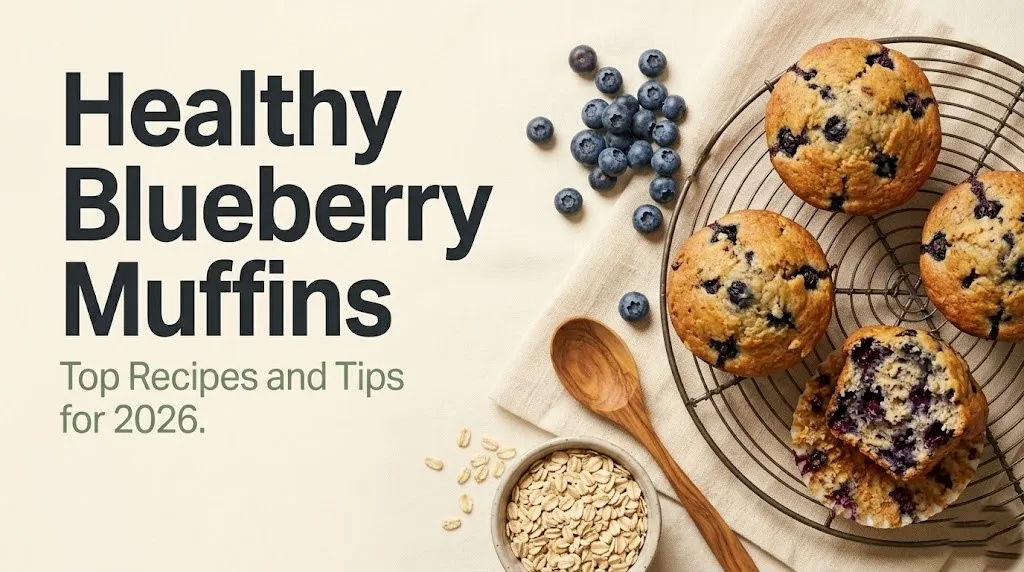
Healthy vs. standard blueberry muffin nutritional comparison:
| Nutrient | Healthy Homemade | Standard Bakery |
|---|---|---|
| Calories | 150 to 175 | 400 to 500 |
| Total sugar | 8 to 12g | 30 to 45g |
| Fiber | 3 to 5g | 1 to 2g |
| Protein | 4 to 6g | 5 to 7g |
| Fat | 4 to 6g | 16 to 22g |
| Saturated fat | 1 to 2g | 6 to 10g |
The protein difference is smaller than most people expect, because bakery muffins use eggs too. The fiber and sugar differences are where the real nutritional gap lies.
People with type 2 diabetes should note that even a healthy homemade muffin contains 22 to 28 grams of total carbohydrates per standard-size muffin. Selecting almond flour-based versions (lower carbohydrate) or mini muffin size helps manage glycemic load.
Healthy Blueberry Muffin Recipe
The base healthy blueberry muffin recipe uses whole wheat flour (Triticum aestivum, whole grain), Greek yogurt, pure maple syrup, and fresh or frozen blueberries (Vaccinium corymbosum) for a muffin that is genuinely worth making on a regular basis.
The technique matters as much as the ingredients. Muffins are a quick bread, and the quick bread method is specific: mix wet ingredients separately, mix dry ingredients separately, combine them with minimal stirring. The moment you switch to stirring aggressively to make the batter smooth is the moment you ruin the muffin. Lumpy batter is correct batter.
Healthy blueberry muffins recipe (12 standard muffins):
To make healthy blueberry muffins:
- Preheat oven to 375 degrees Fahrenheit (190 degrees Celsius). Line a 12-cup standard muffin tin with paper liners or coat with cooking spray.
- In a large bowl, whisk together 1.5 cups (180 grams) of whole wheat flour, 1.5 teaspoons baking powder, 1/2 teaspoon baking soda, and 1/4 teaspoon salt.
- In a separate medium bowl, whisk together 2 large eggs (Gallus gallus domesticus), 1/2 cup (120 grams) of plain full-fat Greek yogurt, 1/3 cup (80 milliliters) of pure maple syrup, 1/4 cup (60 milliliters) of melted coconut oil (Cocos nucifera), and 1 teaspoon of pure vanilla extract.
- Pour the wet ingredients into the dry ingredients. Fold with a spatula using 10 to 12 strokes until just combined. The batter will be thick and lumpy. Stop folding before the batter becomes smooth.
- Gently fold in 1.5 cups (225 grams) of fresh or frozen blueberries.
- Divide batter evenly among 12 muffin cups. Each cup should be approximately 3/4 full.
- Bake for 20 to 22 minutes, until a toothpick inserted in the center comes out clean and the tops are lightly golden.
- Cool in the pan for 5 minutes, then transfer to a wire rack to cool completely.
Each muffin contains approximately 165 to 175 calories, 5 grams of protein, 3 to 4 grams of fiber, and 10 to 12 grams of total sugar (primarily from maple syrup and blueberries, with minimal added sugar contribution).
Healthy Whole Wheat Blueberry Muffins
Healthy whole wheat blueberry muffins use whole wheat flour (Triticum aestivum, stone-ground or whole-grain milled) as the primary flour, which retains the bran and germ of the wheat kernel and delivers 3 to 4 grams of fiber per quarter-cup serving compared to less than 1 gram in all-purpose white flour.
Whole wheat flour produces a denser, slightly more textured muffin than white flour because of the bran particles that interrupt gluten development and the higher fiber content that absorbs more liquid. Managing this density requires one of two approaches: using white whole wheat flour (milled from white spring wheat, lighter in color and flavor but nutritionally equivalent to regular whole wheat), or replacing up to 30% of the whole wheat flour with oat flour (Avena sativa) to lighten the crumb.
According to Harvard T.H. Chan School of Public Health research on whole grain consumption, replacing refined grain servings with whole grain equivalents is consistently associated with reduced long-term risk of cardiovascular disease and type 2 diabetes in large cohort studies. Whole wheat muffins qualify as a whole grain food when the first ingredient is whole wheat flour.
Quick Tip:
- Use white whole wheat flour for a milder flavor that’s less noticeably “healthy” in taste
- Let the batter rest for 5 minutes before baking to allow the bran to hydrate, producing a less gritty texture
- Add 1 teaspoon of lemon zest to the batter to brighten flavor and balance the earthiness of whole wheat
- People with celiac disease must not use whole wheat flour in any form, as it contains gluten (gliadin and glutenin proteins)
Key Takeaway: The flour choice is the most important nutritional decision in a healthy muffin recipe. Whole wheat flour more than triples the fiber content compared to all-purpose white flour, and the texture adjustment is manageable with a few simple technique tweaks.
Healthy Blueberry Muffins with Oat Flour
Healthy blueberry muffins made with oat flour (ground from Avena sativa rolled oats) produce a tender, slightly dense crumb with a mild, naturally sweet flavor that pairs particularly well with blueberries, while adding 1.5 to 2 grams of beta-glucan soluble fiber per quarter-cup serving.
Oat flour is not a direct 1:1 substitute for whole wheat or all-purpose flour by volume. It’s less dense than wheat flour, so measuring by weight is more reliable. The standard conversion is approximately 1 cup of all-purpose flour (120 grams) equals 1.25 cups of oat flour (120 grams by weight). Going by volume without this adjustment produces muffins with too much flour that are dry and crumbly.
The FDA has authorized a health claim for oats stating that 3 grams of beta-glucan soluble fiber per day from oat products may reduce the risk of coronary heart disease as part of a diet low in saturated fat and cholesterol. Each healthy blueberry muffin made with oat flour contributes approximately 0.4 to 0.6 grams of beta-glucan, so two muffins with additional oat-containing foods can approach the clinically relevant threshold.
Making your own oat flour is approachable for anyone with a blender or food processor: blend rolled oats on high speed for 45 to 60 seconds until the texture resembles fine flour. Store-bought oat flour and homemade oat flour perform identically in baking. People with celiac disease must use certified gluten-free oat flour specifically, as standard oats and oat flour are frequently cross-contaminated with wheat in commercial milling facilities.
Healthy Mini Blueberry Muffins
Healthy mini blueberry muffins are made in a mini muffin tin (24 cups, each approximately 1.75 inches in diameter) and weigh approximately 25 to 30 grams each, delivering roughly 55 to 65 calories per mini muffin when made from the same healthy base recipe.
The mini format serves a specific practical purpose beyond portion control. Mini muffins have a higher surface-area-to-volume ratio than standard muffins, which means more crust per bite and a proportionally stronger blueberry flavor distribution throughout the muffin. They also bake faster, in 10 to 13 minutes at the same temperature (375 degrees Fahrenheit / 190 degrees Celsius), which matters when you’re baking in the morning before work.
For parents packing snacks for children, mini muffins are particularly practical: they’re sized appropriately for small hands, easy to portion, and can be made with the same recipe as the standard version without adjustment. The USDA Dietary Guidelines for Americans (2020 to 2025) recommend that added sugar comprise no more than 10% of total daily calories for children over 2. A mini muffin with 4 to 6 grams of total sugar fits comfortably within that guideline as a snack.
To make mini muffins from the standard recipe:
- Prepare batter exactly as the standard recipe.
- Fill a 24-cup mini muffin tin with liners or cooking spray.
- Divide batter into cups, filling each approximately 3/4 full (about 1 tablespoon of batter per cup).
- Bake at 375 degrees Fahrenheit for 10 to 13 minutes, until a toothpick comes out clean.
- Cool in the pan for 3 minutes, then transfer to a wire rack.
Blueberry Oat Muffins Healthy
Blueberry oat muffins use rolled oats (Avena sativa) in whole form rather than as flour, adding a chewy texture, additional beta-glucan fiber, and a heartier character that makes the muffin more filling than an all-flour version.
The structural distinction matters: using whole rolled oats versus oat flour produces a noticeably different muffin. Rolled oats added directly to the batter create pockets of chewy texture and a slightly more rustic appearance. They can be used as the primary starch or combined with a smaller amount of whole wheat or oat flour for structure.
A reliable blueberry oat muffin formula uses 1 cup rolled oats soaked in 1/2 cup plain Greek yogurt for 10 minutes before mixing. This hydration step softens the oats so they don’t remain hard in the finished muffin. Skipping this step is the most common reason oat muffins have an unpleasant, grainy texture.
Blueberry oat muffin ingredient framework (per 12 muffins):
| Category | Ingredient | Amount |
|---|---|---|
| Grain base | Rolled oats (Avena sativa) | 1 cup (90g) |
| Flour | Whole wheat flour or oat flour | 3/4 cup (90g) |
| Binder | Eggs (Gallus gallus domesticus) | 2 large |
| Protein/moisture | Greek yogurt | 1/2 cup (120g) |
| Sweetener | Pure maple syrup | 1/4 cup (60ml) |
| Fat | Coconut oil (Cocos nucifera), melted | 3 tablespoons |
| Fruit | Blueberries (Vaccinium corymbosum) | 1.5 cups (225g) |
| Leavening | Baking powder + baking soda | 1 tsp + 1/4 tsp |
Each muffin provides approximately 155 to 165 calories, 5 to 6 grams of protein, and 3 to 4 grams of dietary fiber, with beta-glucan from the rolled oats contributing to the fiber total.
Key Takeaway: The oat-soaking step separates good blueberry oat muffins from gritty, disappointing ones. Ten minutes in Greek yogurt before mixing is the difference between a muffin that has pleasant oat texture and one that feels undercooked.
Healthy Berry Muffins
Healthy berry muffins follow the same whole-grain, reduced-sugar framework as healthy blueberry muffins but use any combination of berries, with each variety contributing a different anthocyanin profile and flavor character that changes the nutritional composition slightly.
Blueberries (Vaccinium corymbosum) are highest in cyanidin-based anthocyanins. Raspberries (Rubus idaeus) contribute ellagic acid alongside anthocyanins and have 8 grams of fiber per cup, substantially more than blueberries at 3.6 grams per cup, per USDA FoodData Central. Blackberries (Rubus fruticosus) are highest in fiber of the common fresh berries at 7.6 grams per cup and have an intense tartness that works well with a small amount of natural sweetener. Strawberries (Fragaria ananassa) have the highest vitamin C (ascorbic acid) content of the common berries at approximately 89 milligrams per cup, but the higher water content can make muffins wet if used in large quantities without adjustment.
Berry substitution guide for healthy muffins:
| Berry | Fiber per Cup | Key Adjustment for Muffins |
|---|---|---|
| Blueberries (Vaccinium corymbosum) | 3.6g | No adjustment needed |
| Raspberries (Rubus idaeus) | 8g | Reduce liquid by 2 tablespoons; fold gently |
| Blackberries (Rubus fruticosus) | 7.6g | Halve or quarter to distribute evenly |
| Strawberries (Fragaria ananassa) | 3g | Dice small and pat dry; reduce by 1/4 cup |
| Mixed berries | Varies | Use as a direct 1:1 replacement for blueberries |
People with a latex-fruit allergy syndrome may react to strawberries and kiwi alongside latex; raspberries and blackberries are generally lower-risk for this population.
Healthy Blueberry Muffins with Greek Yogurt
Greek yogurt (strained yogurt with active Lactobacillus bulgaricus cultures) is the single most effective healthy swap in blueberry muffin recipes because it simultaneously replaces sour cream or butter, adds protein, increases moisture, and contributes natural acidity that activates baking soda for better rise.
Plain full-fat Greek yogurt contributes approximately 10 grams of protein per 100-gram serving, compared to less than 1 gram from an equivalent amount of sour cream. It also contains calcium (approximately 110 to 130 milligrams per 100 grams) and active probiotic cultures, though heat from baking destroys most live cultures (the protein, calcium, and other structural contributions survive baking fully intact).
The fat content choice in Greek yogurt affects texture. Full-fat Greek yogurt produces the most tender, moist crumb because fat contributes tenderness in baked goods. Low-fat Greek yogurt works acceptably but may produce a slightly drier muffin. Non-fat Greek yogurt requires a small amount of additional oil in the recipe to compensate for lost fat; otherwise the muffin can be noticeably dry, particularly when using whole wheat flour.
People who are lactose intolerant should note that strained Greek yogurt is lower in lactose than regular yogurt because the straining process removes much of the liquid whey. Many lactose-intolerant individuals tolerate Greek yogurt without symptoms, though individual responses vary. Lactose-free Greek yogurt is available in most major grocery stores and performs identically in baking.
People with a dairy allergy (distinct from lactose intolerance) should use unsweetened coconut yogurt (Cocos nucifera) or a thick, unsweetened plant-based yogurt as a direct 1:1 substitute.
Healthy Blueberry Muffins Gluten Free
Gluten-free healthy blueberry muffins work best when made with almond flour (from blanched Prunus dulcis almonds), a blend of certified gluten-free oat flour (Avena sativa) and tapioca starch, or a pre-blended gluten-free all-purpose flour mix that includes a binding agent like xanthan gum.
Gluten-free baking is fundamentally different from wheat-based baking because gluten provides the elastic network that traps carbon dioxide during leavening and gives baked goods their structure. Without it, a replacement binder is required. Almond flour relies on eggs and fat for structure. Oat-based blends typically need xanthan gum or a psyllium husk (Plantago ovata) addition to mimic gluten’s binding function.
Gluten-free flour comparison for blueberry muffins:
| Flour Type | Carbs per 1/4 cup | Protein | Key Characteristic |
|---|---|---|---|
| Almond flour (Prunus dulcis) | 6g | 6g | Low carb, high fat, dense crumb |
| Certified GF oat flour | 21g | 4g | Closest to whole wheat texture |
| Coconut flour (Cocos nucifera) | 9g | 3g | Very absorbent; use 1/4 the quantity |
| GF all-purpose blend | 22 to 24g | 2g | Most similar to conventional baking |
People with celiac disease must verify that any oat-based flour carries a certified gluten-free designation from a recognized testing organization. Cross-contamination during milling can introduce gluten at levels that trigger immune responses in people with celiac disease, even when oats themselves are technically gluten-free.
Key Takeaway: Gluten-free blueberry muffins work well with almond flour for lower-carbohydrate versions or certified gluten-free oat flour for a texture closest to conventional muffins. The binding agent (eggs, xanthan gum, or psyllium husk) is the structural key to a muffin that holds together.
Healthy Blueberry Muffins Dairy Free
Dairy-free healthy blueberry muffins replace Greek yogurt and butter with plant-based alternatives that maintain moisture, protein, and fat contributions without animal dairy products. The most effective substitutes maintain the structural role of each dairy ingredient.
Greek yogurt (the moisture and protein contributor) can be replaced with unsweetened coconut yogurt (Cocos nucifera), unsweetened almond milk yogurt (Prunus dulcis), or 1/2 cup mashed ripe banana (Musa acuminata) per 1/2 cup yogurt. Banana adds natural sweetness and moisture but also adds flavor. For a neutral dairy-free substitute, coconut yogurt is the closest match to Greek yogurt’s function.
Butter or coconut oil (already dairy-free) is the standard fat in most healthy muffin recipes. Melted coconut oil (Cocos nucifera, refined for neutral flavor or unrefined for mild coconut flavor) is the most commonly used healthy fat in this context. Extra-virgin olive oil (Olea europaea) also works and contributes monounsaturated fatty acids (oleic acid), though it has a more assertive flavor that some bakers find noticeable.
Dairy-free milk (oat milk from Avena sativa, almond milk from Prunus dulcis, or soy milk from Glycine max) can replace dairy milk directly in any recipe at a 1:1 ratio. Soy milk has the highest protein content among plant milks at approximately 7 to 8 grams per cup, making it the closest nutritional match to cow’s milk (Bos taurus) for baking purposes.
People with a soy allergy should avoid soy milk and choose oat or almond milk as the dairy-free milk alternative, noting that almond milk contains tree nut allergens.
Healthy Blueberry Muffins Low Calorie
Healthy blueberry muffins at 140 to 160 calories per standard muffin are achievable without sacrificing texture by reducing fat volume, choosing natural low-calorie sweeteners in controlled amounts, and using blueberries’ natural sugar content to partially carry the sweetness load.
The calorie reduction strategy targets three variables: fat, sweetener, and flour type. Fat is the most calorie-dense macronutrient at 9 calories per gram, so reducing added fat from 1/4 cup to 2 tablespoons saves approximately 60 calories across the batch (5 calories per muffin). Replacing 1/4 cup of maple syrup with 2 tablespoons plus 1 tablespoon mashed ripe banana reduces sweetener calories while adding natural sweetness from the fruit’s fructose and sucrose content.
According to the USDA Dietary Guidelines for Americans (2020 to 2025), added sugar should comprise no more than 10% of total daily calories, approximately 50 grams per day on a 2,000-calorie diet. A low-calorie healthy blueberry muffin with 8 to 10 grams of total sugar (including natural sugar from blueberries) contributes modestly to that budget.
Low-calorie muffin adjustments:
- Reduce oil from 1/4 cup to 2 tablespoons (saves 480 calories across the batch, or 40 calories per muffin)
- Replace 1 whole egg with 1 egg white (saves approximately 45 calories per batch, about 4 calories per muffin)
- Use 1/4 cup maple syrup instead of more; rely on blueberries’ natural sweetness for the remaining sweetness
- Choose non-fat Greek yogurt and compensate texture with 2 tablespoons additional applesauce (Malus domestica)
People following a medically supervised very low-calorie diet should discuss whether baked goods fit their specific daily calorie target, as even a low-calorie muffin may require careful accounting within a tightly structured plan.
Healthy Blueberry Muffins No Sugar
Healthy blueberry muffins without added refined sugar use natural sweeteners including pure maple syrup, raw honey, medjool date paste (Phoenix dactylifera), or very ripe mashed banana (Musa acuminata) to deliver sweetness alongside additional fiber, minerals, or potassium not present in white granulated sugar.
The distinction between “no refined sugar” and “no sugar” matters nutritionally. Pure maple syrup contains approximately 12 grams of sugar per tablespoon, primarily as sucrose with small amounts of glucose and fructose. It also contributes manganese (approximately 0.5 milligrams per tablespoon, supporting enzyme function) and trace amounts of zinc and potassium. Raw honey contains 17 grams of sugar per tablespoon but also provides antioxidant compounds and pollen-derived flavonoids. Neither is a low-sugar ingredient. They are less refined and more nutritionally active than white sugar.
For truly minimal added sugar, the best approach uses ripe banana as the primary sweetener. A very ripe medium banana (Musa acuminata, with brown spots on the skin) provides approximately 14 grams of natural sugar alongside 3 grams of dietary fiber and potassium (approximately 422 milligrams per medium banana, per USDA FoodData Central). The fiber moderates the glycemic impact of the natural sugars compared to an equivalent amount of refined sugar.
Important safety note: Raw honey should not be given to children under 12 months of age due to the risk of infant botulism (Clostridium botulinum spores). Maple syrup and mashed banana are safe sweetener alternatives for all age groups.
People with type 2 diabetes should be aware that natural sweeteners still raise blood glucose and should be counted as carbohydrates in meal planning, even when they are less refined than white sugar.
Key Takeaway: “No refined sugar” is nutritionally meaningful because natural sweeteners come with minerals, fiber, or antioxidants. But the total sugar content of any natural sweetener still matters for glycemic management, and natural sugars require the same portion awareness as refined ones.
Healthy Blueberry Muffins Meal Prep
Healthy blueberry muffins are one of the most practical meal prep baked goods because they store well at room temperature for 2 to 3 days, refrigerate for up to 5 days, and freeze for up to 3 months without losing texture or flavor, making a Sunday batch sufficient for a full week of breakfasts or snacks.
Proper storage is what separates muffins that are still pleasant on day four from ones that are dense and gummy by day two. The key issue is moisture management. Muffins stored in an airtight container with a paper towel lining absorb excess steam that would otherwise condense on the surface and make the exterior soggy. Replace the paper towel after 24 hours if it becomes saturated.
For freezer storage, a process that works reliably:
To freeze healthy blueberry muffins:
- Allow muffins to cool completely, at least 1 hour at room temperature on a wire rack.
- Place cooled muffins on a parchment-lined baking sheet in a single layer.
- Freeze uncovered for 1 to 2 hours until the surface is firm. This flash-freezing step prevents muffins from sticking together.
- Transfer frozen muffins to a zip-top freezer bag, removing as much air as possible before sealing.
- Label with the date. Muffins maintain best quality for up to 3 months but remain food-safe indefinitely when properly frozen.
- To thaw: microwave from frozen for 30 to 45 seconds, or leave at room temperature for 30 to 45 minutes, or warm in a toaster oven at 300 degrees Fahrenheit (150 degrees Celsius) for 8 to 10 minutes for a slightly crisper exterior.
People with diabetes who are counting carbohydrates should batch their calculations at the time of baking and label each storage bag or container with per-muffin carbohydrate content for easier day-of tracking.
Healthy Blueberry Muffins vs Bakery Muffins
A healthy homemade blueberry muffin contains approximately 150 to 175 calories with 3 to 5 grams of fiber and 8 to 12 grams of total sugar, while a standard coffee shop or bakery blueberry muffin typically contains 400 to 500 calories, 1 to 2 grams of fiber, and 30 to 45 grams of total sugar in the same serving.
That difference is not a matter of scale. A single bakery muffin delivers roughly the same sugar as 3 to 4 healthy homemade muffins. The sugar difference comes from three sources in bakery muffins: a refined white flour base with no fiber to slow sugar absorption, a generous amount of white or brown sugar (typically 1/2 to 3/4 cup per 12 muffins, compared to 1/4 cup natural sweetener in healthy versions), and often a sugary streusel or glaze topping.
Comprehensive comparison:
| Factor | Healthy Homemade | Bakery/Coffee Shop |
|---|---|---|
| Calories per muffin | 150 to 175 | 400 to 500 |
| Flour type | Whole wheat or oat | All-purpose white |
| Sugar content | 8 to 12g total | 30 to 45g total |
| Fiber | 3 to 5g | 1 to 2g |
| Fat | 4 to 6g | 16 to 22g |
| Saturated fat | 1 to 2g | 6 to 10g |
| Protein | 4 to 6g | 5 to 7g |
| Cost per muffin | $0.40 to $0.75 | $3.50 to $6.00 |
The protein numbers are nearly identical because both versions use eggs and a dairy-based moisture ingredient. The structural difference is in fiber and sugar, which are the nutritional variables that most affect satiety and blood glucose response.
People managing weight should treat bakery muffins as an occasional treat rather than a regular breakfast, given that a single muffin can represent 20 to 25% of a 2,000-calorie daily target.
Frequently Asked Questions About Healthy Blueberry Muffins
How do you make blueberry muffins healthier?
Replace all-purpose white flour with whole wheat or oat flour, swap refined sugar for pure maple syrup or honey, use Greek yogurt instead of sour cream or butter, and increase the blueberry quantity to at least 1.5 cups per 12 muffins.
These swaps increase fiber from approximately 1 gram to 3 to 5 grams per muffin and reduce sugar from approximately 35 grams to 8 to 12 grams per muffin.
Folding the batter minimally (10 to 12 strokes) keeps the muffins tender rather than tough, which is the most common technique mistake when using denser whole-grain flours.
How many calories are in a healthy blueberry muffin?
A healthy homemade blueberry muffin made with whole wheat flour, Greek yogurt, and maple syrup contains approximately 150 to 175 calories per standard-size muffin.
A mini healthy blueberry muffin from the same recipe weighs approximately 25 to 30 grams and contains approximately 55 to 65 calories.
Almond flour-based gluten-free versions tend to run slightly higher in calories, approximately 180 to 200 calories, due to the higher fat content in almond flour.
Can you freeze healthy blueberry muffins?
Healthy blueberry muffins freeze well for up to 3 months when cooled completely, flash-frozen in a single layer, then transferred to an airtight freezer bag.
Thaw at room temperature for 30 to 45 minutes, or microwave from frozen for 30 to 45 seconds for a quick option.
Muffins frozen without the flash-freeze step tend to clump together; separating them once frozen requires breaking them apart, which damages the texture.
What flour is best for healthy blueberry muffins?
Whole wheat flour provides the best balance of fiber (3 to 4 grams per quarter cup), structure, and nutritional value for most healthy blueberry muffin recipes.
Oat flour (Avena sativa) is the better choice for a lighter crumb and for people avoiding dense whole wheat texture, and it contributes beta-glucan soluble fiber with an FDA-authorized cardiovascular health claim.
Almond flour is the best choice for low-carbohydrate or gluten-free requirements, delivering 6 grams of protein per quarter cup alongside healthy monounsaturated fats.
Are homemade blueberry muffins healthier than store-bought?
Homemade healthy blueberry muffins contain approximately 150 to 175 calories with 3 to 5 grams of fiber and 8 to 12 grams of sugar, compared to standard bakery muffins at 400 to 500 calories, 1 to 2 grams of fiber, and 30 to 45 grams of sugar.
The difference is real and measurable: the sugar content alone is three to four times higher in a standard bakery muffin than in a well-made homemade healthy version.
Homemade muffins also cost substantially less, typically $0.40 to $0.75 per muffin versus $3.50 to $6.00 at a coffee shop or bakery.
Closing
The healthy blueberry muffin is not a compromise. When made with whole-grain flour, a natural sweetener in reasonable quantity, and real Greek yogurt for protein, it’s genuinely better than the bakery version on every nutritional measure that matters, and it costs a fraction of the price.
Make a double batch on Sunday. Store half in the refrigerator for the week and freeze the rest. Label your containers with the per-muffin calorie count at the time of baking so you don’t have to calculate it later on a busy morning.
The only technique rule worth remembering: fold until just combined, stop while the batter still looks lumpy, and your muffins will be tender every time.