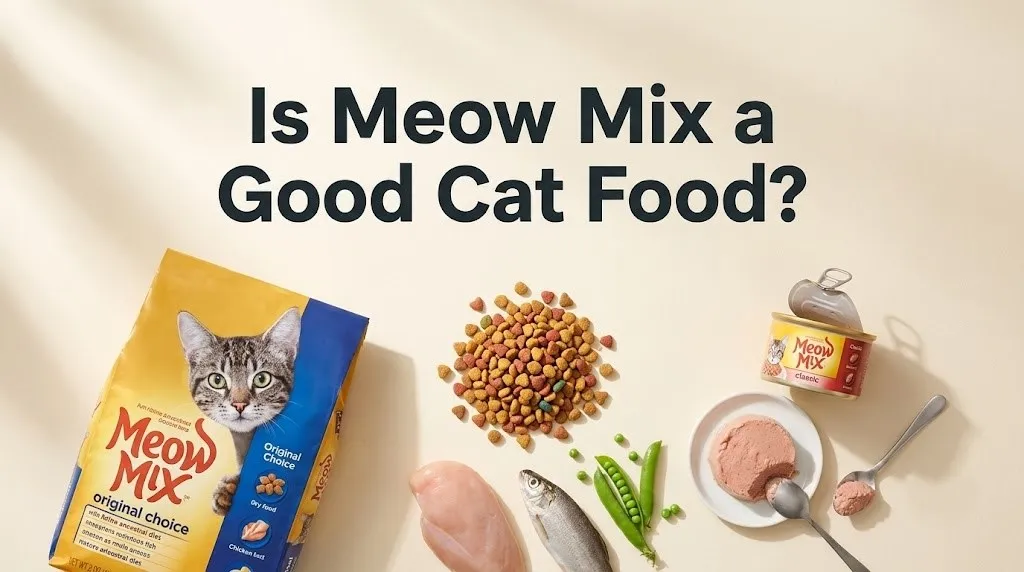
Meow Mix is a budget cat food that meets the minimum nutritional standards set by the Association of American Feed Control Officials (AAFCO) but falls short of the ingredient quality and protein sourcing that many veterinary nutritionists recommend for long-term feline health. It is an adequate food in the sense that it will not cause immediate harm to a healthy cat. It is not a good food by the standards that define optimal feline nutrition: high animal protein, low carbohydrate, and identifiable whole-food ingredients.
Cats are obligate carnivores. Their bodies are designed to derive energy from animal protein and fat, not from grains, corn, or soy. Meow Mix formulates its dry kibble with ground yellow corn, corn gluten meal, and soybean meal among the first ingredients, which pushes the total plant protein contribution higher than what is ideal for a species that evolved on a diet of small prey animals. The American Veterinary Medical Association (AVMA) and the American Association of Feline Practitioners (AAFP) emphasize that cats require specific amino acids, taurine, arginine, and methionine, that are only found in sufficient quantities in animal tissue.
This review breaks down the Meow Mix ingredient panel, compares the dry and wet food formulas, explains the nutritional trade-offs at this price point, and identifies which cats might do fine on Meow Mix and which cats should eat something better. A veterinarian is the right person to guide your individual cat’s diet, especially if your cat has kidney disease, diabetes, urinary crystals, food allergies, or inflammatory bowel disease. Breed, age, and health status all affect what constitutes a good food for a specific cat.
Who Makes Meow Mix and What Is Its Recall History?
Meow Mix is manufactured by The J.M. Smucker Company, a publicly traded packaged food conglomerate that also owns 9Lives, Rachael Ray Nutrish, Natural Balance, and the coffee brand Folgers. Smucker’s acquired Meow Mix as part of the Big Heart Pet Brands purchase in 2015. The food is produced in company-owned and co-manufacturing facilities across the United States.
The brand is positioned at the value end of the pet food market. A 16-pound bag of Meow Mix Original Choice dry cat food retails for roughly $10 to $13, which works out to less than $0.85 per pound. That price point defines nearly every ingredient choice in the bag. Premium cat foods cost three to six times more per pound and the ingredient quality difference is visible on the label.
Meow Mix has one significant recall in its history. In April 2021, The J.M. Smucker Company issued a voluntary recall of Meow Mix Original Choice Dry Cat Food in 30-pound bags with specific lot codes due to potential Salmonella contamination. The recall was limited to a single product and production window. Salmonella in dry pet food can infect both the cat eating it and the human handling it, which is why the FDA classifies such contamination as a risk to both animal and public health. No widespread or ongoing recall pattern exists, but the 2021 event is part of the brand’s safety record.
Smucker’s has the resources to maintain food safety systems across its manufacturing network. The Meow Mix formulation is the nutritional bottleneck here, not the manufacturing hygiene. The food is made safely. The question is whether the ingredient deck supports a cat’s long-term metabolic health, and on that front, the analysis is less forgiving.
Meow Mix Dry Food Ingredients: A Breakdown of the Original Choice Formula
The first ingredient in Meow Mix Original Choice dry cat food is ground yellow corn, followed by corn gluten meal, chicken by-product meal, and soybean meal. This ingredient list tells a story of cost optimization. Corn appears twice in the top three slots. Chicken by-product meal, the primary animal protein source, ranks third after two plant ingredients. Soybean meal ranks fourth. The food meets AAFCO nutrient profiles through fortification, not through the inherent nutritional density of its primary ingredients.
Ground yellow corn is a carbohydrate source that provides energy and helps the kibble hold its shape during extrusion. Cats have no dietary requirement for carbohydrates. Their natural diet, small mammals and birds, contains less than 2 percent carbohydrate by dry matter. A corn-based dry cat food pushes the carbohydrate content above 30 percent on a dry matter basis. The Journal of Animal Physiology and Animal Nutrition has published research indicating that cats have a limited ability to regulate hepatic enzyme activity in response to high carbohydrate intake, meaning their livers churn through the glucose load rather than adapting to it the way an omnivore’s would.
Corn gluten meal is a concentrated plant protein derived from corn processing. It boosts the crude protein percentage on the guaranteed analysis label without providing the full amino acid profile that a cat requires. Plant proteins are less bioavailable to cats than animal proteins and are often deficient in certain essential amino acids like methionine and taurine. Meow Mix adds synthetic taurine, DL-methionine, and other supplements to compensate. The food is complete by AAFCO standards because it is fortified. The cat’s body still has to process a large amount of plant matter that its digestive system is not optimized for.
Chicken by-product meal is the one ingredient in the top four that directly aligns with a cat’s biological needs. By-product meal includes rendered clean parts of the chicken carcass like necks, feet, and viscera. It is a concentrated protein and mineral source. The term “by-product” sounds unappealing to human ears but is nutritionally appropriate for a carnivore. The problem is not the by-product meal itself. It is that the by-product meal sits behind two corn ingredients, which means the total animal protein contribution is diluted.
Key Takeaway: Meow Mix dry food is built on corn and soy, not meat. The protein percentage on the label is real, but a meaningful portion of it comes from plants that cats did not evolve to eat.
Meow Mix Wet Food Ingredients: A Better Option Than the Dry?
Meow Mix wet food formulas generally contain more animal protein and fewer carbohydrates than the dry food, making them a better choice within the brand if Meow Mix is the only option available. The wet food line includes Meow Mix Classic Pate, Meow Mix Simple Servings, and Meow Mix Tender Favorites, each with slightly different ingredient profiles.
The Meow Mix Classic Pate Chicken and Tuna formula lists chicken, poultry broth, liver, meat by-products, and ocean fish among its first ingredients. This is a substantial improvement over the dry food ingredient deck. Chicken and liver are whole animal tissues that deliver the amino acid profile cats need. Poultry broth adds moisture, which is a genuine health benefit. Cats have a low thirst drive and evolved to get most of their water from food. Dry kibble is roughly 10 percent moisture. Wet food is 78 to 82 percent moisture. That hydration difference matters for urinary tract health, especially in male cats who are prone to urethral blockages.
The texture and flavor variety in Meow Mix wet food can also be useful for encouraging food intake in sick or senior cats who have lost their appetite. A cat who will not eat at all faces hepatic lipidosis, a potentially fatal liver condition, within 48 to 72 hours. In that clinical context, any nutritionally complete food the cat will eat is a good food. Meow Mix wet food can play that role.
The wet food still contains ingredients that are markers of a budget formulation: modified food starch, artificial colors, and added sugars appear in some varieties. Artificial colors like Red 3 and Blue 2 serve no nutritional purpose. They are included to make the food look more appealing to the human buyer. Cats do not care about the color of their pate. Sugar has no place in a cat’s diet. The American Animal Hospital Association (AAHA) recommends choosing cat foods without artificial colors, flavors, or preservatives wherever possible.
| Meow Mix Product | First Ingredients | Protein (min) | Fat (min) | Fiber (max) | Moisture (max) |
|---|---|---|---|---|---|
| Original Choice Dry | Ground yellow corn, corn gluten meal, chicken by-product meal | 31% | 11% | 4% | 12% |
| Classic Pate Chicken and Tuna (wet) | Chicken, poultry broth, liver, meat by-products | 10% | 5% | 1.5% | 78% |
| Simple Servings Tuna and Shrimp (wet) | Tuna, water, shrimp, modified tapioca starch | 9% | 2% | 1% | 85% |
Is Meow Mix Good for Cats With Urinary Problems?
Meow Mix is not a good choice for cats with a history of urinary crystals, feline lower urinary tract disease (FLUTD), or recurrent urinary tract infections. The dry food’s high carbohydrate content, plant-based protein sources, and low moisture level all create urine conditions that are less favorable for urinary tract health than a high-moisture, high-animal-protein diet.
Cats on dry food produce more concentrated urine with a higher specific gravity than cats on wet food. Concentrated urine increases the risk of struvite and calcium oxalate crystal formation. Urine pH matters too. A meat-based diet produces a mildly acidic urine, roughly pH 6.2 to 6.4, which is protective against struvite crystal formation. A plant-heavy diet can push urine pH higher into the alkaline range where struvite crystals precipitate more readily. Meow Mix does formulate to target a specific urine pH, but the high plant ingredient load works against that goal compared to a diet built primarily on animal protein.
The moisture content gap is the biggest clinical concern. A cat eating dry Meow Mix with a moisture content of 10 to 12 percent must drink enough water to compensate. Most cats do not. They produce concentrated urine as a result. A cat eating a wet food with 78 percent moisture gets water passively with every bite. The Journal of Feline Medicine and Surgery published a study in 2024 showing that cats fed a wet diet had a significantly lower recurrence rate of FLUTD symptoms compared to cats on dry food diets, even when the dry food was a premium urinary health formula.
For a cat who has already blocked from urinary crystals, which is a life-threatening emergency that requires immediate veterinary treatment, the diet after recovery is typically a prescription urinary formula from Hill’s Prescription Diet, Royal Canin, or Purina Pro Plan Veterinary Diets. Meow Mix is not a substitute for a prescription urinary diet. A veterinarian who has examined the cat and analyzed the urine and any expelled crystals should direct the long-term dietary plan.
Meow Mix and Cat Obesity: The Carb Connection
Meow Mix dry food is calorically dense, high in carbohydrates, and highly palatable in a way that can drive overeating, making it a contributor to weight gain in sedentary indoor cats. The kibble pieces are small, crunchy, and often coated with flavor enhancers. A cat can consume a day’s worth of calories in five minutes of rapid eating and still act hungry.
A cup of Meow Mix Original Choice contains roughly 330 to 350 kilocalories. The recommended feeding amount for a 10-pound adult cat is approximately 1 cup per day, which means the margin between maintenance and overfeeding is narrow. Most cat owners do not measure kibble with a standard measuring cup. They pour into a bowl and refill when it looks empty. That practice routinely leads to 20 to 40 percent overfeeding, which, on a 350-calorie daily budget, adds up to an extra pound of body weight every two to three months.
Carbohydrates in dry food contribute to weight gain through a metabolic pathway specific to cats. When a cat eats a high-carbohydrate meal, the excess glucose that is not immediately used for energy gets converted to fat through de novo lipogenesis in the liver. Cats are metabolically wired to do this efficiently because their wild ancestors ate sporadic, protein-heavy meals. The constant supply of carbohydrate from a free-fed dry food bowl keeps the fat storage pathway running around the clock.
Obesity in cats is not a cosmetic issue. It is a disease that drives insulin resistance, diabetes mellitus, arthritis, hepatic lipidosis, and a shortened lifespan. The Association for Pet Obesity Prevention reported in its 2025 survey that 61 percent of domestic cats in the United States were classified as overweight or obese by their veterinarians. That is more than three out of every five cats. Cheap, high-carbohydrate dry food available in unlimited quantities is one of the central drivers of that statistic.
Quick Tip:
- Measure Meow Mix with a standard measuring cup rather than pouring freely.
- Feed two to three portioned meals per day instead of leaving the bowl full.
- Replace half the dry food with Meow Mix wet food to increase moisture and reduce carbohydrate intake.
Key Takeaway: Meow Mix dry food is easy to overfeed and carbohydrate-heavy in a species that stores excess carbs as fat. Portion control and a mixed wet-dry feeding strategy reduce the obesity risk.
Is Meow Mix Safe for Kittens, Seniors, and Cats With Health Conditions?
Meow Mix offers limited life stage and health condition formulations, which restricts its suitability for kittens, senior cats, and cats with chronic diseases. The brand has a Meow Mix Kitten dry formula, but it does not offer senior-specific, indoor-specific, or health-condition-specific formulations that are common from premium brands.
The Meow Mix Kitten formula contains higher protein at 38 percent minimum crude protein and higher fat at 14 percent minimum crude fat to support growth and development. It meets AAFCO nutrient profiles for growth and reproduction. A kitten can grow on Meow Mix Kitten. The question is whether the ingredient quality during this critical developmental window matters for long-term health outcomes. Research in canine and feline nutrition increasingly suggests that early-life nutrition has epigenetic effects that influence disease risk decades later in the animal’s life. A kitten food built primarily on corn and by-product meal is nutritionally complete by the minimum standard. A kitten food built on named muscle meats and whole eggs is nutritionally optimal. The difference matters most during the growth phase.
Senior cats present a different challenge. Aging cats tend to lose muscle mass, a condition called sarcopenia, and benefit from highly digestible animal protein to slow that loss. Meow Mix Original Choice uses corn gluten meal and soybean meal as protein contributors, both of which are less digestible than chicken muscle meat. A senior cat with early kidney disease needs controlled phosphorus, which requires a precise formulation that Meow Mix does not provide. The International Renal Interest Society (IRIS) recommends phosphorus restriction for cats with chronic kidney disease based on staging, and prescription renal diets are formulated to those targets.
Cats with diabetes, inflammatory bowel disease, food allergies, or pancreatitis need species-appropriate diets that minimize carbohydrate and avoid common allergens like corn, soy, and wheat. Meow Mix contains all three. A diabetic cat eating high-carbohydrate dry food will have a harder time achieving glycemic control. A cat with a chicken allergy, which is one of the most common feline food allergies, will react to the chicken by-product meal and poultry fat in Meow Mix. A veterinarian should guide the diet choice for any cat with a diagnosed medical condition. Meow Mix is rarely the correct clinical answer.
How Does Meow Mix Compare to Other Budget Cat Foods?
Meow Mix sits at the bottom of the budget category alongside 9Lives, Friskies, Fancy Feast, and Purina Cat Chow. Among these, Fancy Feast wet food generally offers better ingredient quality than Meow Mix wet food, and Purina Cat Chow dry food has a slightly more balanced animal-to-plant protein ratio than Meow Mix dry food.
| Budget Brand | First Dry Ingredient | First Wet Ingredient | Protein (dry, min) | Artificial Colors | Approx. Cost per lb (dry) |
|---|---|---|---|---|---|
| Meow Mix | Ground yellow corn | Chicken (in pate) | 31% | Yes (in wet) | $0.75 to $0.85 |
| Friskies | Ground yellow corn | Meat by-products | 30% | Yes | $0.80 to $1.00 |
| 9Lives | Ground yellow corn | Meat by-products | 30% | Yes | $0.70 to $0.85 |
| Purina Cat Chow | Poultry by-product meal | Chicken (in pate) | 34% | No | $0.90 to $1.10 |
| Fancy Feast | N/A (wet only) | Chicken (in pate) | 10% (wet) | No in pate, yes in others | N/A |
Purina Cat Chow leads the budget dry category with poultry by-product meal as the first ingredient instead of corn. That single formulation choice shifts the animal protein contribution higher and the carbohydrate content lower than Meow Mix. Purina also employs board-certified veterinary nutritionists and conducts feeding trials, which adds a layer of nutritional oversight that Meow Mix does not publicly claim.
Fancy Feast Classic Pate is the standout budget wet food. The ingredient list opens with chicken, poultry broth, and liver, with no corn, wheat, or soy. It is a high-moisture, high-animal-protein food at a price point only slightly higher than Meow Mix wet food. It is widely available at grocery stores and big-box retailers. For a cat owner on a tight budget who wants to feed better quality food, Fancy Feast Classic Pate is the most nutritionally defensible budget choice on the market as of 2026.
Dollar store cat foods and generic store brands with ingredient panels that mirror Meow Mix or 9Lives are functionally equivalent. The lower price does not buy lower quality in this segment. It is the same formulation approach at a slightly different price point.
What Do Veterinarians Say About Meow Mix?
Veterinarians generally do not recommend Meow Mix as a first-choice diet for cats. The consensus view among veterinary nutritionists is that a cat food should be built around animal protein, contain minimal carbohydrates, and avoid artificial additives. Meow Mix does not meet those criteria well. It meets the AAFCO minimum. It does not meet the standard that veterinary professionals consider optimal.
The World Small Animal Veterinary Association (WSAVA) recommends choosing pet foods from brands that employ full-time board-certified veterinary nutritionists, conduct feeding trials beyond AAFCO minimums, and own their manufacturing facilities. Meow Mix, under Smucker’s corporate umbrella, likely has access to some of these resources, but the brand does not publicly market itself as WSAVA-compliant the way Hill’s Science Diet, Royal Canin, and Purina Pro Plan do. Meow Mix competes on price, not on nutritional science.
Veterinarians in clinical practice see the downstream effects of long-term poor nutrition: cats with diabetes that resolves when switched to a low-carbohydrate canned diet, cats with recurrent urinary crystals that stop forming when dry food is replaced with wet food, and obese cats that lose weight when portion-controlled, high-protein meals replace free-fed corn-based kibble. That clinical experience shapes the profession’s skepticism toward ultra-budget dry foods. The individual cat eating Meow Mix and thriving is not a myth. It happens. But the population-level patterns push veterinary recommendations toward higher-quality diets.
A veterinarian will also tell you that the best food for a cat is the best food the owner can afford and the cat will reliably eat. If the choice is between Meow Mix and no food, Meow Mix wins. If the choice is between Meow Mix and a slightly more expensive food with better ingredients and a cat owner has the extra money, the upgrade is worth it. The cat food conversation is never just about nutrition science. It is about budget, access, and the reality that a fed cat is always better than a hungry one.
Key Takeaway: Most vets would prefer that cats eat a higher-protein, lower-carbohydrate, moisture-rich diet than Meow Mix dry food. They also recognize that budget constraints are real and that Meow Mix is nutritionally complete by minimum standards.
How to Transition Your Cat Off Meow Mix to a Better Food
Transitioning a cat away from Meow Mix requires patience because the brand formulates its kibble to be highly palatable. Cats imprint on texture and flavor early in life and can be stubborn about accepting new food, especially when they have eaten the same crunchy, flavor-coated kibble for years. A slow transition over two to four weeks gives the cat’s digestive system and palate time to adjust.
To transition your cat to a higher-quality food:
- Days 1 to 5: Mix 25 percent new food with 75 percent current Meow Mix. Serve at the usual meal times. Watch for any decrease in appetite or loose stool.
- Days 6 to 10: Move to 50 percent new food and 50 percent Meow Mix. If the cat picks out the Meow Mix pieces and leaves the new food, crush a few Meow Mix pieces over the top as a flavor dust.
- Days 11 to 15: Shift to 75 percent new food and 25 percent Meow Mix. By this point, the cat should be accepting the new food’s texture and flavor profile.
- Days 16 to 21: Offer 100 percent new food. If the cat refuses, back up to the 75/25 ratio for another week and try again.
Cats who refuse all new food present a genuine health risk. A cat who does not eat for more than 48 hours can develop hepatic lipidosis, especially if overweight. If your cat flatly refuses to eat the new food, do not starve them into submission. Offer the Meow Mix and try a different new food with a texture closer to what they are used to. Cats are individuals. Some will transition smoothly to a premium pate. Others will accept only kibble and only the one they have eaten for the last decade.
Switching from dry Meow Mix to a wet food diet is a bigger adjustment than switching to a different dry food. Start with a wet food that has a similar flavor profile, chicken or fish, and warm it slightly to body temperature. Cold food straight from the refrigerator smells less appealing to a cat. Warming it to roughly 100 degrees Fahrenheit releases the aroma compounds that stimulate feline appetite. A small amount of tuna water or low-sodium chicken broth can also entice a reluctant cat.
Frequently Asked Questions About Meow Mix Cat Food
Is Meow Mix bad for cats?
Meow Mix is not immediately harmful to a healthy cat, but it is not an optimal diet for long-term feline health.
The dry food relies heavily on corn and soy protein, which are not species-appropriate for obligate carnivores.
Cats eating Meow Mix long-term may face higher risks of obesity, urinary issues, and diabetes due to the high carbohydrate content.
Is Meow Mix wet food better than Meow Mix dry food?
Meow Mix wet food is better than Meow Mix dry food because it contains more animal protein, fewer carbohydrates, and significantly more moisture.
The Classic Pate line lists chicken or fish as the first ingredient rather than corn.
The higher water content supports urinary tract health, which is a major advantage for cats prone to crystals or blockages.
Why is Meow Mix so cheap?
Meow Mix is cheap because it formulates with low-cost plant ingredients like corn, corn gluten meal, and soybean meal instead of expensive muscle meat.
The brand manufactures at high volume and does not invest in the feeding trials or veterinary nutrition research that drive up the cost of premium brands.
The price reflects the ingredient sourcing, not a lack of safety testing.
Can cats live a long life on Meow Mix?
Some cats live long lives on Meow Mix, but the diet does not actively support longevity the way a high-protein, low-carbohydrate, moisture-rich diet does.
Genetic luck, indoor housing, and regular veterinary care all affect lifespan independently of diet.
A cat eating Meow Mix can benefit from adding wet food, controlling portions, and having annual blood work to catch metabolic issues early.
What is a better cheap cat food than Meow Mix?
Fancy Feast Classic Pate is the best budget wet food upgrade over Meow Mix, with animal protein as the first ingredient and no corn, wheat, or soy.
Purina Cat Chow is a better budget dry food because poultry by-product meal, not corn, is the first ingredient.
Both options cost only slightly more than Meow Mix and offer ingredient quality improvements at the same grocery-store accessibility.
Meow Mix does what it says on the bag. It provides complete nutrition as defined by the minimum regulatory standard. That is not the same thing as providing optimal nutrition for a species that evolved on a diet of whole prey animals. The gap between adequate and optimal matters more for some cats than others. A young, healthy, active cat with good genetics might coast on Meow Mix for years without visible problems. An older cat, an overweight cat, or a cat with urinary or metabolic issues will feel the nutritional compromises sooner.
If Meow Mix is what your budget allows, choose the wet food over the dry food, measure every meal rather than free-feeding, and schedule annual veterinary checkups with blood work to monitor kidney function, liver enzymes, and blood glucose. These steps do not make Meow Mix a premium food. They limit the damage potential of a food built on corn and soy.
If your budget has even ten extra dollars a month, switching to Fancy Feast Classic Pate or Purina Cat Chow moves the needle on ingredient quality in ways that your cat’s body will register over time. Better food is one of the most direct ways to invest in a cat’s long-term health. The bag costs more. The veterinary bills later may cost less.