Thai food is the cuisine of Thailand, a Southeast Asian nation whose cooking tradition balances five distinct flavor principles: sweet, sour, salty, spicy, and savory. It’s one of the most widely eaten cuisines in the world, built on fresh herbs, aromatic roots, and rice-based foundations that differ dramatically by region.
Thai cuisine reaches every corner of the globe for good reason. The World Health Organization and culinary researchers both note that herb-forward, vegetable-rich cooking traditions from Southeast Asia tend to deliver strong micronutrient density with relatively low processed-food content, depending on preparation method. Understanding what goes into Thai food matters whether you’re ordering takeout tonight or managing dietary restrictions.
This guide covers everything from the flavor science of Thai cooking to the nutritional breakdown of common dishes, regional cooking styles, and which Thai options work for vegan, gluten-free, and low-sodium diets. The allergen landscape of Thai cuisine also gets a full airing here, because it’s genuinely complicated and no one else seems to explain it properly.
What Is Thai Food?
Thai food is a Southeast Asian cuisine from the Kingdom of Thailand, built around a philosophy of balancing contrasting flavors in every dish simultaneously.
Most Western cuisines develop flavors in sequence: a savory base, then an acid, then sweetness as a finishing note. Thai cooking does all of this at once. A single bowl of tom yum soup delivers sour from tamarind or lime, heat from fresh chilies, salt from fish sauce, and an aromatic depth from lemongrass and galangal that no single flavor dominates.
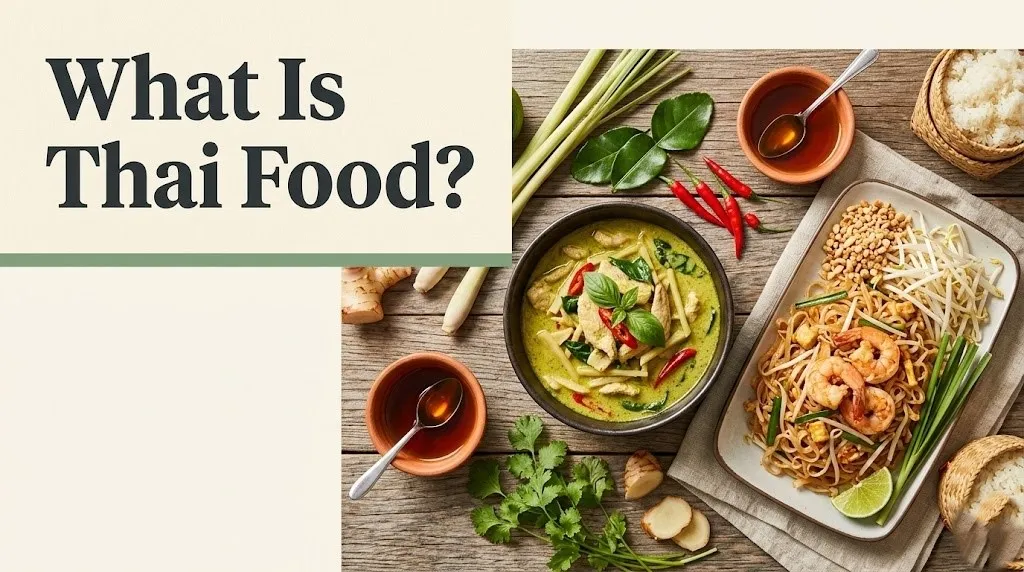
The cuisine uses fresh, mostly whole ingredients. Lemongrass (Cymbopogon citratus), galangal (Alpinia galanga), kaffir lime leaves (Citrus hystrix), Thai basil (Ocimum basilicum var. thyrsiflora), and fresh chilies form the aromatic backbone of most dishes. These are not background seasoning. They are structural ingredients.
Rice is the undisputed staple. Jasmine rice (Oryza sativa, long-grain aromatic cultivar) appears at almost every Thai meal. Rice noodles in various widths carry a separate category of dishes entirely.
Key characteristics of Thai food include:
- A mandatory balance of sweet, sour, salty, spicy, and savory (umami) in most dishes
- Heavy reliance on fresh aromatics rather than dried spice blends
- Fish sauce (nam pla) as the primary salting agent in most savory preparations
- Coconut milk as a fat and flavor base for curries and some desserts
- Tamarind (Tamarindus indica) as the primary souring agent in many dishes
- Fresh herbs used in large volumes, not as garnish
People with peanut, shellfish, soy, or gluten allergies should approach Thai food with informed caution. These ingredients appear across the cuisine in ways that aren’t always obvious from a menu description.
Is Thai Food From Thailand?
Thai food is the national cuisine of Thailand, a country located in mainland Southeast Asia bordering Myanmar, Laos, Cambodia, and Malaysia.
Thailand’s geographic position explains why its cuisine absorbed so many different influences over centuries. Chinese traders and immigrants introduced wok cooking techniques and noodle dishes. Indian trade routes brought curry paste concepts and the use of warming spices. Portuguese missionaries in the 16th century are credited with introducing chili peppers, now indispensable to Thai cooking.
The country’s own name changed from Siam to Thailand in 1939, but the cooking tradition evolved continuously long before that. What is now called Thai cuisine represents roughly 700 years of culinary development, regional adaptation, and cultural exchange across a geographically varied country spanning rainforest, mountain, plateau, and coastline.
Thai food served outside Thailand varies from the original. Restaurant adaptations in the United States, the United Kingdom, and Australia typically adjust spice levels, reduce the prominence of fermented ingredients like shrimp paste (kapi), and increase sweetness to match local palates. Dishes labeled “authentic Thai” at Western restaurants may be calibrated quite differently from what you’d eat in Bangkok or Chiang Mai.
Quick Tip:
- If you want closer-to-authentic heat levels at a Thai restaurant, ask for the dish “Thai spicy” rather than just “spicy”
- Requesting dishes without added sugar is an option at most Thai restaurants; this is often not mentioned on menus
- Street food stalls and family-run Thai restaurants generally stay closer to traditional preparation than large chain establishments
What Is Traditional Thai Food?
Traditional Thai food refers to the cooking practices, dishes, and ingredient combinations developed in Thailand before significant Western or modern commercial influence, rooted in seasonal, regional, and ceremonially significant foods.
Traditional preparation differs from most modern restaurant versions in two important ways: fermentation and freshness. Fermented ingredients play a central role in traditional Thai cooking. Fermented shrimp paste (kapi), fermented fish sauce aged for months or years, and fermented rice-based preparations all appear in regional traditional recipes. These carry intense umami depth that the bottled commercial versions approximate but don’t fully replicate.
Traditional Thai meals follow a specific structure. Individual plates of protein or vegetable dishes are served alongside communal bowls of soup, with jasmine rice as the anchor. This contrasts with the Western plating convention of one dish per person. The Thai tradition means every diner at the table samples multiple flavor profiles simultaneously.
Traditional desserts lean on coconut milk, palm sugar (derived from the Borassus flabellifer or sugar palm tree), glutinous rice (also called sticky rice, a short-grain variety of Oryza sativa), and fresh tropical fruit. Mango sticky rice (khao niao mamuang) is the most globally recognized traditional Thai dessert.
Traditional dishes that remain largely unchanged:
- Larb: a minced meat salad from northern and northeastern Thailand, seasoned with roasted rice powder, lime, fish sauce, and fresh herbs
- Som tum: green papaya salad (Carica papaya) pounded in a mortar with chilies, lime, palm sugar, fish sauce, and dried shrimp
- Gaeng massaman: a slow-cooked curry with Muslim-community origins from southern Thailand, using warm spices including cardamom (Elettaria cardamomum) and cinnamon (Cinnamomum verum)
- Khao tom: rice soup, a traditional breakfast dish across all regions
Key Takeaway: Thai food is a centuries-old Southeast Asian cuisine from Thailand built on balancing sweet, sour, salty, spicy, and savory flavors simultaneously using fresh aromatics, rice, fish sauce, and coconut milk as structural ingredients.
What Does Thai Food Taste Like?
Thai food tastes simultaneously sweet, sour, salty, spicy, and savory, with no single flavor dominating the others in a well-prepared dish.
This is the defining sensory experience and the clearest way to understand what separates Thai cooking from other Asian cuisines. Think of it like a perfectly tuned chord rather than a single melody. Remove any one note and the whole thing shifts. A Thai dish that’s too sweet lacks definition. One that’s only salty tastes flat. The balance is the point.
The aromatic layer is the second defining characteristic. Lemongrass delivers a bright citrus-herbal note. Galangal (a cousin of ginger with a sharper, more piney flavor) adds depth that ginger alone can’t achieve. Kaffir lime leaves carry a floral citrus quality. These aromatics perfume the cooking liquid, fat, or sauce they’re used in and linger in a way that dried spices don’t.
Heat in Thai food comes primarily from fresh bird’s eye chilies (Prik kee noo, a variety of Capsicum annuum) and dried chili flakes. The compound responsible for this heat, capsaicin, has been studied in relation to temporary increases in metabolic rate. A 2014 review published in the journal Chemical Senses found that capsaicin activates TRPV1 receptors in the digestive tract, producing a brief thermogenic effect, though this does not translate into a meaningful weight-loss mechanism on its own.
The taste experience also shifts by regional style. Northern Thai food is earthier and less sweet. Southern Thai food is more intensely spicy with stronger use of turmeric (Curcuma longa) and fermented shrimp paste. Central Thai food, the style most exported to Western restaurants, tends toward a softer sweetness and more coconut milk.
What Type of Food Is Thai Food?
Thai food is a Southeast Asian cuisine categorized as an herb-forward, rice-based cooking tradition that emphasizes fresh whole-food ingredients, aromatic pastes, and balanced flavor construction.
In culinary classification terms, Thai food sits within Southeast Asian cuisine alongside Vietnamese, Cambodian, Lao, and Malaysian cooking. It shares some ingredient overlap with these neighbors but maintains a distinct identity through its specific flavor balance principle and its use of particular aromatics not common in neighboring cuisines.
In dietary terms, Thai food is largely whole-food-based in its traditional form. The base proteins are fish, shellfish, chicken, pork, and tofu. The carbohydrate base is jasmine rice or rice noodles. Fats come primarily from coconut milk and cooking oils, with minimal processed-fat additions in traditional preparation.
Where Thai food diverges from what nutritionists might consider a straightforwardly balanced dietary pattern is in two areas: sodium content from fish sauce and oyster sauce, and saturated fat from coconut milk in curry-heavy meals. Both of these are addressed in specific sections below.
| Category | Thai Food Classification |
|---|---|
| Cuisine origin | Southeast Asian, Thailand |
| Primary carbohydrate | Jasmine rice, rice noodles |
| Primary proteins | Fish, shellfish, chicken, pork, tofu |
| Primary fats | Coconut milk, vegetable oil |
| Primary flavor method | Fresh aromatic pastes, fish sauce, tamarind |
| Dietary pattern overlap | Predominantly whole-food; some high-sodium elements |
| Common allergens present | Peanuts, shellfish, soy, gluten (in some sauces) |
People following a Mediterranean diet will find significant overlap in the herb-forward, fish-centric elements of Thai cooking. People following a low-sodium diet will need to make deliberate modifications.
Main Ingredients in Thai Food
The main ingredients in Thai food are jasmine rice, fish sauce, coconut milk, fresh chilies, lemongrass, galangal, kaffir lime leaves, Thai basil, tamarind, and shrimp paste.
These ten ingredients appear across more Thai dishes than any others. Understanding what each one does clarifies why Thai food tastes the way it does.
Fish sauce (nam pla) is fermented anchovies or small fish pressed into a liquid. It delivers sodium and deep umami simultaneously. One tablespoon contains approximately 1,190 to 1,500 milligrams of sodium per USDA FoodData Central data, making it one of the highest-sodium condiments in any cuisine.
Coconut milk (from the coconut, Cocos nucifera) provides fat, creaminess, and a mild sweetness. It contains medium-chain triglycerides (MCTs), which the liver metabolizes differently from long-chain fatty acids found in animal fats. A standard half-cup serving of full-fat coconut milk contains approximately 200 calories and 21 grams of fat, most of which is saturated. People managing cardiovascular risk factors should account for this in their overall dietary pattern.
The fresh aromatic trio of lemongrass, galangal, and kaffir lime leaves is used primarily in curry pastes and soups. They are not typically eaten whole; they infuse flavor into the cooking liquid and are removed or left to the side.
Other ingredients that appear frequently:
- Tamarind (Tamarindus indica): a fruity, sour paste from the tamarind pod; provides the souring element in pad thai and many sauces
- Palm sugar (from Borassus flabellifer): less refined than white cane sugar, with a mild molasses-like flavor; provides the sweet element
- Shrimp paste (kapi): fermented, dried shrimp compressed into a paste; intensely savory; a major shellfish allergen source
- Rice noodles: made from rice flour and water; gluten-free in pure form but may be cross-contaminated in manufacturing
- Peanuts (Arachis hypogaea): used as a garnish and in sauces; a tree nut allergen that is distinct from tree nuts but equally serious for allergic individuals
Key Takeaway: The flavor identity of Thai food comes from its aromatics (lemongrass, galangal, kaffir lime), its fermented salt source (fish sauce), and the interplay of tamarind and palm sugar. Knowing these ten core ingredients tells you everything about why Thai dishes taste the way they do.
Most Popular Thai Dishes
The most popular Thai dishes worldwide are pad thai, green curry (gaeng khiao wan), massaman curry, tom yum soup, and som tum (green papaya salad).
These five dishes appear on virtually every Thai restaurant menu internationally and represent a reasonable cross-section of the cuisine’s range: noodles, curries, soups, and salads each appear at least once.
Here is a practical breakdown of the most commonly ordered Thai dishes:
| Dish | Primary Ingredients | Flavor Profile | Allergen Notes |
|---|---|---|---|
| Pad thai | Rice noodles, egg, tofu or shrimp, peanuts, tamarind, fish sauce | Sweet-sour-savory | Peanuts, shellfish, soy, gluten (some sauces) |
| Green curry | Coconut milk, green chili paste, vegetables, protein | Spicy, creamy, aromatic | Shellfish (shrimp paste in paste), soy |
| Massaman curry | Coconut milk, potato, peanuts, warm spices, protein | Mild, sweet, nutty | Peanuts, shellfish (shrimp paste) |
| Tom yum soup | Lemongrass, galangal, kaffir lime, mushroom, shrimp | Sour, spicy, aromatic | Shellfish |
| Som tum | Green papaya, dried shrimp, peanuts, lime, chilies | Sour, spicy, crunchy | Peanuts, shellfish |
| Khao pad | Jasmine rice, egg, vegetables, protein | Savory, mild | Soy, shellfish (if shrimp added) |
| Larb | Minced meat, roasted rice powder, herbs, lime | Sour, herby, spicy | Gluten (in some versions) |
| Mango sticky rice | Glutinous rice, coconut milk, fresh mango, palm sugar | Sweet, creamy, fruity | Tree nut allergy risk if sesame added |
This table reflects standard restaurant versions. Preparation varies by chef and location, and allergen content can differ based on specific sauce brands used. Readers with dietary restrictions should confirm ingredients with their specific restaurant.
What Is Pad Thai Made Of?
Pad thai is made of thin flat rice noodles stir-fried with egg, a protein (typically tofu, shrimp, or chicken), bean sprouts, green onions, and a sauce combining tamarind, fish sauce, and palm sugar, then finished with crushed peanuts and lime.
It is the dish most Western diners encounter first. The name translates directly: “pad” means stir-fried and “thai” means Thai. The dish was popularized in Thailand in the 1940s as part of a government campaign to reduce rice consumption and promote noodles as a less expensive staple. Its current global dominance is partly political history.
The sauce ratio determines everything about quality. A proper pad thai sauce uses tamarind concentrate for sourness, fish sauce for salt and depth, and palm sugar for sweetness in a ratio that hits all three flavor notes clearly. Restaurant versions in Western countries often increase the sugar disproportionately, which explains why many people find pad thai “too sweet” compared to versions eaten in Thailand.
To build a solid pad thai sauce at home:
- Combine 3 tablespoons of tamarind concentrate with 3 tablespoons of fish sauce and 2 tablespoons of palm sugar (or coconut sugar as a substitute).
- Heat in a small saucepan over medium heat for 2 to 3 minutes until the sugar dissolves fully.
- Taste and adjust: more tamarind for sour, more fish sauce for salt, more sugar for sweet.
- Soak 200 grams of flat rice noodles in room-temperature water for 30 minutes until pliable but not fully soft.
- Stir-fry protein in a wok over high heat until cooked through, then push to the side.
- Add noodles and sauce, toss over high heat for 2 to 3 minutes until sauce absorbs.
- Push everything aside, scramble 2 eggs in the cleared pan space, then fold into noodles.
- Finish with bean sprouts, green onion, crushed peanuts, and fresh lime juice at the table.
For a vegan version, replace fish sauce with coconut aminos or a mix of soy sauce and a small amount of seaweed for umami depth. Replace shrimp with extra-firm tofu pressed dry before cooking.
Four Regional Styles of Thai Food
Thai food divides into four distinct regional styles: Central, Northern, Northeastern (Isaan), and Southern, each shaped by local geography, climate, and cultural history.
Understanding these regions explains why “Thai food” is not a single thing.
Central Thai cuisine is the style most familiar to international diners. It’s centered around Bangkok and the Chao Phraya river valley, a region of abundant jasmine rice cultivation. Dishes here tend toward softer sweetness, refined presentation, and heavy coconut milk use. Green curry, massaman curry, and pad thai all originated in or were popularized through the Central tradition.
Northern Thai cuisine reflects the mountainous terrain and cooler climate of Chiang Mai and the surrounding highlands. Coconut milk use is minimal compared to the south. The signature dish is khao soi: a rich, golden curry broth served over egg noodles with crispy fried noodles on top and a protein, usually chicken or beef. Northern food tends toward earthier, more fermented flavors. Sticky rice replaces jasmine rice as the everyday staple.
Northeastern Thai cuisine (Isaan) borders Laos and shares many dishes with Lao cooking. Som tum (green papaya salad), larb, and sticky rice define this region. The food is intensely sour and spicy with minimal sweetness. Fermented fish (pla ra), raw ingredients, and grilled meats are Isaan staples. This regional style has the lowest coconut milk use of all four.
Southern Thai cuisine runs along the narrow peninsula bordering Malaysia. It’s the spiciest of the four regions and the most heavily influenced by Malay and Muslim cooking traditions. Turmeric (Curcuma longa) features prominently, as does a stronger use of shrimp paste and seafood. Gaeng massaman has Muslim-community roots in this region. Southern Thai food frequently uses yellow curry pastes enriched with dried spices including coriander seed (Coriandrum sativum) and cumin (Cuminum cyminum).
| Region | Signature Dishes | Heat Level | Coconut Milk Use | Staple Carb |
|---|---|---|---|---|
| Central | Green curry, pad thai, tom yum | Medium | High | Jasmine rice |
| Northern | Khao soi, larb, sai oua (sausage) | Mild to medium | Low | Sticky rice |
| Northeastern (Isaan) | Som tum, larb, grilled meats | High | Very low | Sticky rice |
| Southern | Massaman curry, fish curries | Very high | Medium | Jasmine rice |
Key Takeaway: Thai food is actually four distinct regional cuisines under one name: Central Thai is sweet and coconut-rich, Northern is earthy and fermented, Isaan is sour and fiercely spicy, and Southern is the hottest with strong Malay influences.
Is Thai Food Healthy?
Thai food is generally considered a health-supportive cuisine when eaten in traditional forms, but restaurant versions can carry high sodium loads and significant saturated fat from coconut milk that affect its nutritional picture.
The honest assessment is this: it depends entirely on what you order and how it’s prepared. A grilled chicken larb with fresh herbs and sticky rice is a genuinely strong nutritional choice. A large portion of massaman curry with coconut milk-heavy sauce over jasmine rice lands closer to a calorie-dense, high-saturated-fat meal.
The herb-forward foundation of Thai cooking does deliver genuine nutritional value. Fresh chilies provide ascorbic acid (vitamin C). Lemongrass contains citral, a compound with studied antioxidant properties. Galangal contains active compounds including galangin, which has been studied in laboratory settings for antimicrobial properties, though research in humans remains early-stage.
According to the Academy of Nutrition and Dietetics, dietary patterns built around fresh vegetables, lean proteins, herbs, and minimal ultra-processed ingredients are associated with lower rates of chronic disease. Traditional Thai cooking fits this description more closely than its Western restaurant adaptations typically do.
| Thai Dish | Relative Health Positioning | Key Nutritional Note |
|---|---|---|
| Tom yum soup (clear) | Strong choice | High sodium; low calorie |
| Green papaya salad (som tum) | Strong choice | High sodium; high vitamin C |
| Larb with grilled chicken | Strong choice | High protein; moderate sodium |
| Pad thai with shrimp | Moderate | High sodium; moderate fat |
| Green curry with coconut milk | Moderate | High saturated fat; nutrient-dense |
| Massaman curry | Moderate to high calorie | High fat; high sodium |
| Mango sticky rice | Occasional treat | High sugar and carbohydrate |
People managing type 2 diabetes should pay attention to the jasmine rice and palm sugar components, as jasmine rice has a relatively high glycemic index. Pairing rice-based Thai dishes with protein and vegetable-heavy sides reduces the glycemic impact of the meal.
Thai Food Calorie Count
A standard single-serving Thai meal at a restaurant ranges from approximately 350 to 800 calories depending on the dish, portion size, and preparation method.
This range is wide because Thai food spans from clear herb soups with relatively few calories to rich coconut milk curries served over rice with significantly more. Understanding the per-dish calorie landscape helps when making ordering decisions.
According to USDA FoodData Central data and published nutritional analyses of Thai restaurant dishes:
| Dish | Approximate Calories per Serving | Approximate Portion Size |
|---|---|---|
| Tom yum soup (clear) | 90 to 150 calories | 1.5 cups (360 ml) |
| Som tum (green papaya salad) | 100 to 150 calories | 1 cup (240 g) |
| Pad thai (restaurant portion) | 400 to 550 calories | 300 to 400 g |
| Green curry with chicken | 350 to 500 calories | 1 cup curry + 1 cup rice |
| Massaman curry with beef | 450 to 650 calories | 1 cup curry + 1 cup rice |
| Khao pad (Thai fried rice) | 450 to 600 calories | 300 g |
| Mango sticky rice | 350 to 450 calories | 1 standard serving |
| Chicken satay (4 skewers) | 200 to 280 calories | 4 skewers with peanut sauce |
These figures are estimates for standard restaurant portions. Actual calorie content varies based on oil quantity, coconut milk volume, portion size, and added sauces. People tracking caloric intake closely should treat these as directional ranges rather than precise measurements.
Dishes lower in calories tend to be broth-based (tom yum, tom kha with reduced coconut milk), protein-centered salads (larb, yum woon sen glass noodle salad), or grilled preparations. Dishes higher in calories tend to involve full-fat coconut milk, deep-frying, or large rice portions.
Is Thai Food High in Sodium?
Thai food is among the higher-sodium cuisines in the world due to its structural reliance on fish sauce, oyster sauce, and shrimp paste, all of which carry concentrated sodium levels.
This is the most important nutritional caution for Thai food. It’s not the chilies or the coconut milk that most people need to watch. It’s the salt.
Fish sauce (nam pla) contains approximately 1,190 to 1,500 milligrams of sodium per tablespoon per USDA FoodData Central. A single restaurant portion of pad thai can use two to three tablespoons of fish sauce in preparation. A standard green curry paste may contain shrimp paste and fish sauce in combination. A single Thai restaurant meal can easily deliver 2,000 to 3,000 milligrams of sodium, which meets or exceeds the American Heart Association’s recommended limit of 2,300 milligrams per day for generally healthy adults and well exceeds the 1,500 milligrams the AHA recommends for people managing hypertension or existing cardiovascular disease.
People managing high blood pressure, heart failure, kidney disease, or fluid retention should be specifically aware of this. These conditions require active sodium restriction, and a standard Thai restaurant meal can make that restriction very difficult to maintain without specific modification.
Ways to reduce sodium in Thai cooking or ordering:
- Ask restaurants to reduce fish sauce and use no added salt
- At home, use low-sodium fish sauce (available from most Asian grocery stores) at half the standard volume
- Replace fish sauce with coconut aminos in home cooking, which contains approximately 90 milligrams of sodium per teaspoon compared to fish sauce’s roughly 480 milligrams per teaspoon
- Choose clear broth dishes (tom yum without coconut milk) over curry-based dishes, which use more saucing agents
- Skip the dipping sauces at the table, which add additional sodium on top of already-seasoned dishes
Key Takeaway: Thai food’s biggest nutritional watch point is sodium, not fat or calories. A single restaurant Thai meal can easily exceed the American Heart Association’s daily sodium limit, making informed ordering or home modification important for anyone managing blood pressure or cardiovascular health.
Is Thai Food Gluten Free?
Thai food is not reliably gluten-free at restaurants, despite many of its traditional base ingredients being naturally gluten-free, because fish sauce, oyster sauce, soy sauce, and prepared curry pastes frequently contain wheat-derived gluten.
This surprises many people. The logic seems clear: rice noodles are made from rice, jasmine rice is rice, so Thai food should be gluten-free. The problem is the sauces.
Traditional Thai fish sauce made only from fermented fish and salt is naturally gluten-free. However, many commercial fish sauce brands produced at scale include small amounts of wheat or are processed in facilities shared with gluten-containing products. Oyster sauce, used in many stir-fried Thai dishes, almost universally contains wheat starch as a thickener. Prepared curry pastes sold in jars may also include wheat-derived thickening agents.
Soy sauce, used in some Thai dishes that have absorbed Chinese cooking influence, contains wheat in its traditional brewed form. Tamari is the wheat-free alternative, but restaurants don’t always stock it.
For people with celiac disease (an autoimmune condition triggered by gluten ingestion), cross-contamination risk in Thai restaurant kitchens is also a practical concern. Woks and utensils used across multiple dishes containing gluten-based sauces may carry trace gluten even when a specific dish doesn’t include it directly.
Dishes most likely to be gluten-free in careful preparation:
- Tom yum soup (clear version, no oyster sauce)
- Som tum (green papaya salad, if made without soy sauce)
- Larb (confirm no soy sauce or oyster sauce added)
- Grilled meats with nam jim (dipping sauce made from fish sauce, lime, and chilies only)
Anyone with celiac disease should discuss kitchen protocols directly with the restaurant before ordering, rather than relying on menu descriptions alone.
Is Thai Food Vegan Friendly?
Thai food is not automatically vegan-friendly, but it offers more genuinely adaptable dishes than most other Asian cuisines because its primary flavor base can be rebuilt without animal products.
The obstacle for vegans is the same one that catches gluten-free diners: the sauces. Fish sauce is in almost everything. Shrimp paste is a component of most traditional green, red, and yellow curry pastes. Even dishes that appear vegetable-only at a restaurant may be seasoned with fish sauce as a baseline.
That said, Thailand has a growing community of Buddhist vegetarian practitioners, and Jay (the Thai term for strict Buddhist vegetarian food) is a distinct category in Thai cooking that excludes all animal products including eggs. Jay restaurants and Jay-labeled products exist across Thailand and in Thai communities internationally. Dishes following Jay principles replace fish sauce with fermented soy sauce or mushroom-based seasoning sauces.
For home cooking, a fully vegan Thai pantry is achievable:
- Replace fish sauce with coconut aminos or mushroom soy sauce for umami depth
- Replace shrimp paste in curry paste with a combination of miso paste and nori (dried seaweed) for fermented, oceanic flavor
- Use vegetable broth in place of chicken or shrimp-based stocks
- Choose tofu or tempeh as protein; both absorb Thai curry sauces effectively when pressed and cooked at high heat first
At restaurants, the clearest vegan-safe Thai dishes when prepared without fish sauce are:
- Steamed jasmine rice
- Stir-fried vegetables with garlic and oil (request no oyster sauce or fish sauce)
- Tofu pad thai prepared with soy sauce only (confirm no fish sauce)
- Mango sticky rice (confirm coconut milk used, no egg or dairy added)
Vegans should always confirm preparation details directly, as kitchen practice varies by restaurant and individual cook.
Thai Food vs. Chinese Food: What’s the Difference?
Thai food and Chinese food are both East and Southeast Asian cuisines, but they differ in their primary flavor philosophy, signature ingredients, sauce structures, and spice intensity.
Think of it this way: Chinese cooking seeks to highlight and enhance the natural flavor of each primary ingredient. Thai cooking seeks to create a new composite flavor from the interaction of multiple contrasting elements. Neither is more sophisticated; they’re operating on different design principles.
The clearest differences:
| Feature | Thai Food | Chinese Food |
|---|---|---|
| Primary salt source | Fish sauce (fermented fish) | Soy sauce (fermented soy and wheat) |
| Primary souring agent | Tamarind, lime juice | Rice vinegar, sometimes black vinegar |
| Aromatic base | Lemongrass, galangal, kaffir lime | Ginger, garlic, scallion |
| Primary fat | Coconut milk, vegetable oil | Sesame oil, lard (traditionally), vegetable oil |
| Chili heat | Integral and high | Present but variable; often moderate |
| Sweetener | Palm sugar, coconut sugar | White sugar, hoisin sauce |
| Staple starch | Jasmine rice, rice noodles | White rice, wheat noodles, dumplings |
| Common allergens | Peanuts, shellfish, soy | Soy, shellfish, gluten (wheat) |
| Regional variation | 4 major regional styles | 8 major regional styles (Cantonese, Sichuan, etc.) |
Chinese cuisine encompasses eight major regional traditions with vastly different flavor profiles, from the delicate steamed preparations of Cantonese cooking to the numbing, spicy Sichuan tradition. Thai cuisine’s four regional styles are similarly varied but operate within a narrower shared flavor framework.
Both cuisines present allergen complexity for people with soy, gluten, or shellfish sensitivities. Neither is reliably safe for those allergies without specific ingredient verification.
Key Takeaway: Thai and Chinese cuisines share some techniques and ingredients but differ fundamentally in flavor philosophy: Thai cooking builds a balanced chord of five simultaneous tastes, while Chinese cooking generally highlights the natural character of its primary ingredients. The allergen landscapes overlap but are not identical.
Frequently Asked Questions About Thai Food
What does Thai food taste like?
Thai food tastes like a simultaneous balance of sweet, sour, salty, spicy, and savory flavors in every dish.
The aromatic elements of lemongrass, galangal, kaffir lime, and Thai basil create a distinct herbal-citrus character that defines the cuisine’s smell and taste.
The intensity of each flavor element varies by dish and region, but the five-flavor principle is the constant thread across all Thai cooking.
Is Thai food spicy?
Thai food ranges from mild to very spicy depending on the dish and regional style.
Dishes like massaman curry and khao soi tend toward mild heat; green papaya salad (som tum) and southern Thai curries are among the spiciest preparations.
Most Thai restaurants outside Thailand will adjust spice level on request, and heat in Thai cooking comes from chilies that can be reduced or omitted without fundamentally breaking the dish.
What is the most popular Thai dish?
Pad thai is the most recognized and widely ordered Thai dish internationally.
It’s a stir-fried rice noodle dish with egg, protein (shrimp, chicken, or tofu), peanuts, tamarind sauce, and fish sauce, served with lime and bean sprouts.
Green curry and tom yum soup are the next most globally popular dishes from the Thai culinary tradition.
Is Thai food healthy for weight loss?
Thai food can fit into a weight-management eating plan, but it’s not automatically a low-calorie choice.
Clear broth soups, herb-forward salads like som tum or larb, and grilled protein dishes are the lower-calorie options; rich coconut curries and pad thai in large restaurant portions run from 400 to over 600 calories per serving.
The high sodium content of most Thai dishes is a more pressing concern than calories for many people, and anyone managing blood pressure or fluid retention should account for this specifically.
What Thai dishes are safe for peanut allergies?
Many Thai dishes contain peanuts (Arachis hypogaea) as a garnish or sauce ingredient, but several traditional preparations do not.
Dishes most likely to be peanut-free include tom yum soup, tom kha gai (coconut milk soup), larb (in most versions), grilled chicken satay skewers without peanut sauce, and jasmine rice with stir-fried vegetables.
Anyone with a peanut allergy should confirm with the specific restaurant that no shared equipment or cross-contamination risk applies, as peanuts are used widely across most Thai restaurant kitchens.
The Practical Takeaway
Thai food is one of the most ingredient-rich, flavor-specific cuisines you can eat, and understanding its structure makes you a much better orderer and home cook. The five-flavor balance, the aromatic base, and the fermented salt sources explain everything about why it tastes the way it does.
If you’re eating it regularly, the sodium picture deserves your attention. A home-cooked version using reduced-sodium fish sauce or coconut aminos gives you the same flavor architecture with far better control over what you’re actually consuming.
Start with the dishes you already know, then branch into regional styles. Khao soi from the North and a properly spiced Isaan larb are two of the best meals Thai food has to offer, and neither requires a plane ticket to find.