To make red food coloring, you can mix equal parts of magenta and yellow gel food coloring, or reduce beet juice to a concentrated syrup. The synthetic route takes 30 seconds. The natural route takes 20 minutes. Both produce a vibrant, usable red for frosting, batter, and icing.
The California Food Safety Act, which took effect in 2024, banned Red 3 from food products sold in the state. By 2026, several other states have introduced similar legislation targeting Red 40. The push toward natural and homemade food colorings is no longer a niche wellness trend. It is becoming the standard home kitchen practice.
We will walk through the exact primary color mixing ratios, the step-by-step beet reduction method, the scientific reason your natural red dye turned brown, and how to fix it with a single ingredient.
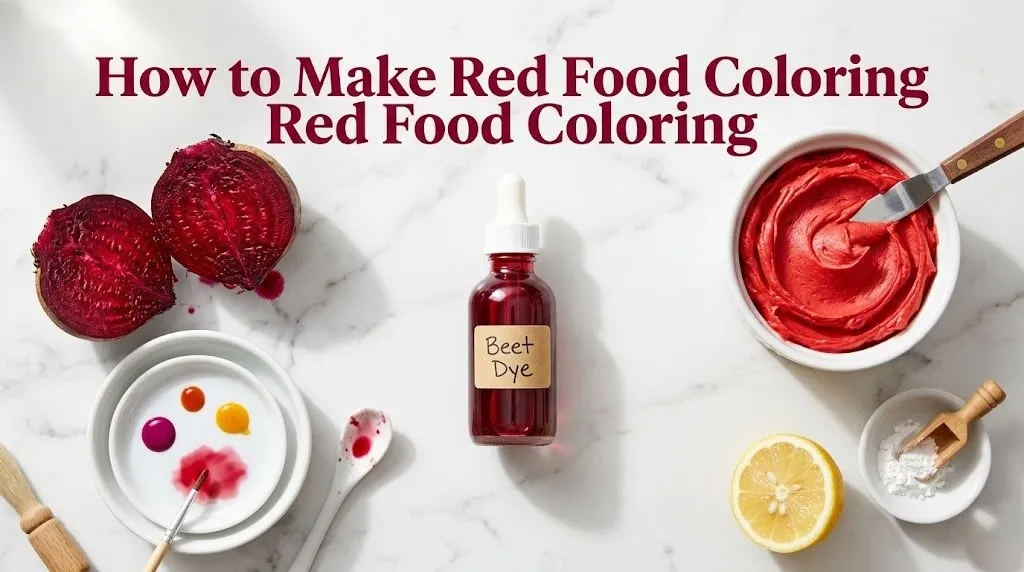
How to Make Red Food Coloring
The simplest method is mixing primary food coloring drops. Combine 5 drops of magenta or pink gel food coloring with 3 drops of yellow gel food coloring in a small dish. Stir with a toothpick until uniform. The mixture creates a true primary red.
If you only have standard four-color liquid food dye sets with red, blue, green, and yellow, you cannot make red. Red is a primary color in that system. You must start with magenta as your base. Gel food colorings offer the truest magenta, which is why they are the better choice for red mixing.
This mixed red works identically to store-bought red in frosting, batter, and royal icing. The color is heat-stable. It will not fade in the oven. It is the most reliable emergency red food coloring when you open the cupboard and the red bottle is empty.
What Colors Make Red Food Coloring
Magenta and yellow make red food coloring. Magenta provides the cool pinkish-red base. Yellow warms the tone and pulls it toward a true primary red. The ratio is roughly 60 percent magenta to 40 percent yellow.
If your magenta is a deep, cool pink, use less yellow. If your magenta is a warm, coral pink, use more yellow. The exact ratio depends on the brand of food coloring. Wilton gel magenta requires slightly more yellow than AmeriColor soft gel paste magenta. Test on a white plate before committing to the full batch.
The color theory is the same principle that works in paint and ink. Magenta, yellow, and cyan are the subtractive primary colors. Red is a secondary color in this system, created by mixing magenta and yellow. Understanding this means you can mix any color you need from three gel tubes rather than buying a dozen individual colors.
Key Takeaway: Magenta plus yellow equals red in food coloring, just like in printer ink; a 60/40 ratio is the starting point, adjusted by brand.
How to Make Red With Food Coloring
If you do not have magenta and yellow, you can make a version of red using pink and orange food colorings. Start with 4 drops of pink. Add 2 drops of orange. Stir. Add one more drop of orange at a time until the color reads as red rather than pink-orange.
This method produces a warmer, more tomato-toned red than the magenta-yellow combination. It works well for tomato soup, pasta sauce, or any savory application where a slightly orange-leaning red is desirable. It is less successful for Christmas red frosting, which demands a cooler, blue-based red.
The limitation of mixing with pink and orange is that you are working with pre-mixed secondary colors. You cannot achieve a cool, crimson red this way. The warm undertones are locked in. For the truest, most versatile red, the magenta and yellow starting point is the correct approach.
How to Make Dark Red With Food Coloring
To make dark red or burgundy food coloring, start with your true red base. Add one drop of blue or one drop of black gel food coloring. Blue produces a cooler, wine-toned dark red. Black produces a deeper, brick-toned dark red.
Blue gel is the better choice for red velvet cake and elegant Christmas desserts. The cool undertones create the visual perception of depth. The red reads as sophisticated and rich rather than bright and candy-like. The amount of blue must be measured with extreme care. Half a drop too much turns the red muddy.
Black gel creates a dirtier dark red that works for Halloween baking or a natural-looking meat substitute coloring. It lacks the visual pop of the blue-modified dark red. Use it when the goal is a muted, earthy red rather than a jewel-toned crimson.
| Desired Red Shade | Magenta Drops | Yellow Drops | Blue/Black Drops |
|---|---|---|---|
| True Primary Red | 5 | 3 | 0 |
| Dark Crimson | 5 | 3 | 1 blue |
| Burgundy/Wine | 5 | 2 | 2 blue |
| Brick Red | 5 | 3 | 1 black |
| Tomato Red | 3 pink | 2 orange | 0 |
What Food Colors Make Red
Beet juice, pomegranate juice, hibiscus powder, and carmine are the four natural food colors that make red. Each produces a different shade and has different stability characteristics.
Beet juice produces a true, bright red that leans slightly cool. It is the most accessible and least expensive natural red food coloring. The pigment is betalain, which is water-soluble and heat-sensitive. Beet red fades with prolonged heat exposure and turns brown in alkaline environments.
Carmine, also labeled as cochineal extract or carmine color, produces a deep, stable magenta-red. It is derived from the cochineal insect. It is not vegan. It is heat-stable and pH-stable, making it the most reliable natural red for baking applications. It is widely used in commercial yogurts, candies, and beverages.
Natural Red Food Coloring Recipe
To make natural red food coloring from beets, roast two medium beets at 400 degrees Fahrenheit for 45 minutes. Peel and roughly chop them. Blend with 1/4 cup of water until smooth. Strain the puree through a fine-mesh sieve lined with cheesecloth. Pour the strained juice into a small saucepan.
Simmer the beet juice over low heat until it reduces by half, roughly 10 to 15 minutes. Do not boil. Boiling destroys the betalain pigment and dulls the color to a muddy brown. A gentle simmer concentrates the color without thermal degradation.
Cool the reduction completely. Transfer it to a clean glass dropper bottle. Store it in the refrigerator for up to two weeks. The concentrated beet syrup adds negligible flavor when used in small amounts, 1/4 teaspoon at a time, in frosting or batter.
How to Make Red Food Coloring at Home
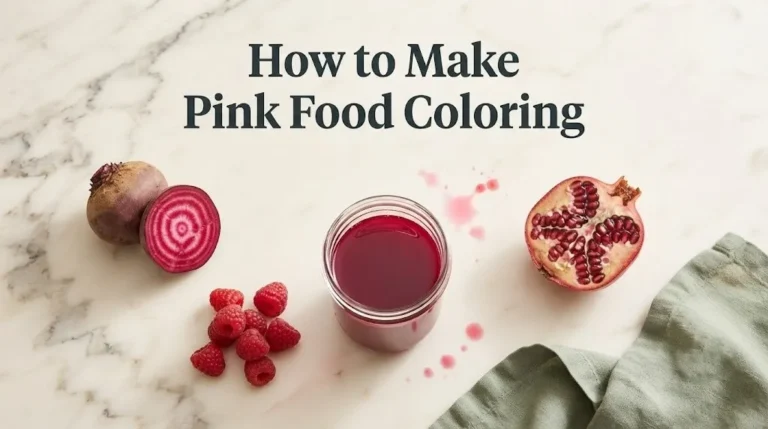
The home kitchen has four reliable red dye sources: beets, pomegranate juice, raspberries, and hibiscus tea. Beets produce the truest red. Pomegranate juice produces a bluish-red or magenta tone. Raspberries produce a pinkish-red. Hibiscus produces a deep cranberry red.
Hibiscus powder is a 2026 pantry staple for natural dye makers. Steep 1 tablespoon of dried hibiscus flowers or 1 teaspoon of hibiscus powder in 1/4 cup of boiling water for 10 minutes. Strain. The resulting liquid is a deep, slightly bluish cranberry red. It is intensely pigmented and requires only a few drops to tint a batch of vanilla frosting.
Raspberry puree works for a soft pink-red. Strain the seeds out through a fine sieve. Reduce the puree by half over low heat to concentrate the color. The result is a pale red that tints frosting a soft rose. It is not suitable for achieving a deep, saturated red.
Homemade Red Food Coloring
Store homemade red food coloring in a glass dropper bottle in the refrigerator. The cold temperature slows the degradation of the betalain pigment. The glass container prevents any chemical interaction with plastic that can alter the color.
The homemade version is additive-free. It contains no propylene glycol, no parabens, and no synthetic azo dyes. This matters in 2026 because several states have introduced labeling requirements for foods containing synthetic dyes, and some school districts have banned Red 40 from cafeteria items.
The homemade version is also inconsistent. Batch-to-batch color variation is inevitable. The redness of beets changes with the season, the variety, and the growing conditions. A batch made in June may be slightly more pink than a batch made in October. Accept this imperfection as the trade-off for avoiding synthetic chemistry.
Key Takeaway: Homemade red food coloring is additive-free and regulation-proof, but it requires refrigeration and varies in color from batch to batch.
Red Food Coloring Without Red 40
Red food coloring without Red 40 is the fastest-growing category in the 2026 baking aisle. Brands like Color Kitchen, Watkins, and Whole Foods 365 now offer plant-based food coloring sets that use turmeric, spirulina, and beetroot powder.
These commercial natural food colorings are more stable than homemade versions. They are formulated with stabilizers like maltodextrin and citric acid that preserve the pigment and prevent the pH-induced browning that plagues homemade beet dye. They are more expensive, roughly $6 to $8 per set of four colors.
The performance gap between natural and synthetic has narrowed significantly. A 2024 study in the Journal of Food Science found that microencapsulated beetroot powder retained 85 percent of its color intensity after 30 minutes at 350 degrees Fahrenheit, compared to 40 percent for non-encapsulated beet juice.
Beet Red Food Coloring
Beet red food coloring is made from the betalain pigments in beetroot. Betalain is a class of pigments that includes betacyanins, which are red-violet, and betaxanthins, which are yellow-orange. The red color comes primarily from the betacyanin fraction.
The stability of beet red is its weakness. Betalain degrades in the presence of heat, light, and high pH. A 2019 study in the journal Food Chemistry found that betalain degrades by 50 percent after 30 minutes at 176 degrees Fahrenheit. This is why beet-dyed red velvet cake often fades to a brownish-pink after baking.
To stabilize beet red in baked goods, add 1/4 teaspoon of lemon juice or cream of tartar per cup of batter. The acid lowers the pH, shifting the betalain molecule to a more stable, intensely red form. This is the single most important technical tip for successful beet-based natural dye baking.
How to Make Red Food Coloring From Beets
To make red food coloring from beets with maximum color intensity, roast the beets rather than boiling them. Roasting concentrates the sugars and the pigments. Boiling leaches the betalain into the cooking water and dilutes the final product.
To make beet red food coloring step by step:
- Preheat the oven to 400 degrees Fahrenheit. Wash and trim 2 medium red beets.
- Wrap the beets in aluminum foil and roast for 50 to 60 minutes until fork-tender.
- Peel the cooled beets and roughly chop them into 1-inch pieces.
- Blend the beets with 3 tablespoons of cold water until a smooth puree forms.
- Strain the puree through a fine-mesh sieve lined with cheesecloth into a small saucepan.
Simmer the strained juice over low heat until it reduces by half and coats the back of a spoon. Cool completely. Transfer to a glass dropper bottle and refrigerate. Use within 2 weeks.
How to Make Red Frosting With Natural Food Coloring
Red frosting with natural food coloring requires a thicker, more concentrated dye than batter. The white base of the frosting dilutes the red, so the starting dye must be deeply saturated.
To make red frosting with beet dye, reduce the beet juice to a thick syrup, roughly one-quarter of the original volume. The syrup should be the consistency of maple syrup. Add the syrup to the frosting 1/2 teaspoon at a time, beating thoroughly after each addition.
The frosting will deepen in color as it rests. Natural dyes oxidize and develop a richer hue over 30 to 60 minutes. Make the frosting an hour before serving. Do not judge the final color immediately after mixing. The color you see at 10 minutes is not the color your guests will see at the party.
How to Make Red Velvet Food Coloring
Traditional red velvet cake relies on a chemical reaction between natural cocoa powder and buttermilk to create a reddish-brown hue. The modern version relies on an entire bottle of red food coloring. A natural 2026 version uses beet reduction and a specific cocoa powder.
To make natural red velvet food coloring, combine 2 tablespoons of reduced beet syrup with 1 tablespoon of natural cocoa powder. Dutch-processed cocoa is alkaline and will turn the beet red brown. Natural cocoa powder is acidic and will stabilize the red.
Mix the beet syrup and cocoa powder into a paste before adding it to the batter. This pre-mixing ensures even color distribution. The resulting cake will be a subtle, earthy red rather than the electric red of a Red 40 cake. It is a different aesthetic. It is the color that red velvet cake was in the 1940s before synthetic dyes became available.
How to Fix Brown Natural Red Dye
Brown natural red dye is caused by an alkaline environment. The betalain pigment in beet juice changes its molecular structure in a pH above 7, shifting from red to brownish-yellow.
Add lemon juice or cream of tartar, one drop or a tiny pinch at a time, until the red color returns. The acid lowers the pH and shifts the betalain molecule back to its red structural form. This is a reversible chemical reaction.
If the dye has turned brown after baking, the reaction is likely also thermal. The heat of the oven pushed the pigment past its stability threshold. In this case, the color cannot be recovered. Prevention is the only solution. Add acid to the batter before baking.
Key Takeaway: Brown natural red dye is a pH problem, not a permanent failure; add lemon juice or cream of tartar to bring back the red.
Frequently Asked Questions About Making Red Food Coloring
What can I use if I don’t have red food coloring?
Mix magenta and yellow gel food coloring in a 5:3 ratio to create a true primary red.
Reduce beet juice to a thick syrup for a natural alternative that tints frosting and batter.
Pomegranate juice concentrate or hibiscus tea steeped strong also work in a pinch.
How do you make red food coloring without beets?
Use pomegranate juice reduced to a syrup for a bluish-red or magenta tone.
Hibiscus powder steeped in boiling water creates a deep cranberry red liquid.
Raspberry puree, strained and reduced, produces a soft pink-red suitable for frosting.
Why did my natural red food coloring turn brown?
The beet-based dye encountered an alkaline environment, shifting the betalain pigment from red to brownish-yellow.
Baking soda and Dutch-processed cocoa powder are common alkaline ingredients that cause this reaction.
Add 1/4 teaspoon of lemon juice or cream of tartar per cup of batter to prevent browning.
Can I use pomegranate juice as red food coloring?
Yes, pomegranate juice reduced to a syrup works as a natural red food coloring.
It produces a slightly bluer, more magenta-toned red than beet juice.
It is more heat-stable than beet juice but more expensive.
How do you make red food coloring darker?
Add one drop of blue gel food coloring to your red base to create a dark crimson or burgundy.
Add one drop of black gel food coloring to create a darker, more brick-toned red.
For natural dyes, reduce the beet or pomegranate juice further to a thicker, more concentrated syrup.
The red food coloring in your future is probably in your refrigerator, not the baking aisle. A roasted beet, a glass dropper bottle, and a squeeze of lemon juice are the 2026 replacements for the little plastic squeeze bottles of Red 40.
The color will not be electric. It will be softer, more nuanced, and slightly different every time. That is the trade-off. The beet red does not look like a fire truck. It looks like a beet. And in 2026, for a growing number of home bakers, that is exactly the point.
Make the beet reduction. Store it cold. Use it within two weeks. The plant-based kitchen is colorful if you know how to unlock the pigments hiding in the produce drawer.