Nutella is not a healthy food by nutritional standards. One standard 2-tablespoon (37g) serving contains approximately 20 grams of added sugar, roughly half a day’s limit for most adults under current dietary guidelines. That does not make it forbidden, but it does mean calling it a health food, which Ferrero’s own marketing has historically implied, does not hold up to scrutiny.
The question “is Nutella healthy” matters because Nutella is one of the best-selling spreads in the world, and it is routinely served to children at breakfast as if it were comparable to peanut butter. According to the American Heart Association (AHA), added sugar is one of the primary dietary contributors to cardiovascular risk, obesity, and metabolic disease in the United States.
This article covers every ingredient in Nutella, the full per-serving nutrition breakdown, the palm oil and sugar debate grounded in actual research, and how it compares to peanut butter and almond butter. You’ll also find out how much is reasonable to eat, who should be most cautious, and how to make a version at home with significantly less sugar.
Is Nutella Healthy
Nutella is not nutritionally healthy as a daily staple, primarily because of its high added sugar content and the presence of palm oil, a source of saturated fat. It is best treated as an occasional treat rather than a protein-rich or nutrient-dense spread.
The word “healthy” gets stretched significantly in food marketing. Ferrero, Nutella’s manufacturer, has faced regulatory and legal scrutiny in multiple countries for marketing it as part of a nutritious breakfast. In 2012, a class-action settlement in the United States resulted in Ferrero paying $3.05 million to consumers who argued the product was marketed misleadingly as healthful.
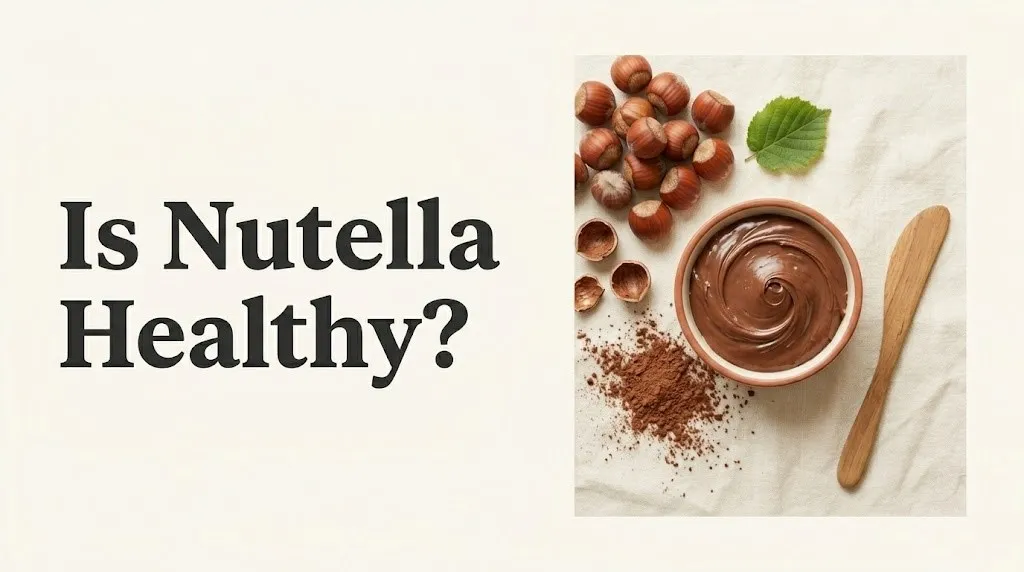
Nutritionally, the issue is one of composition. Nutella’s two largest ingredients by weight are sugar and palm oil, in that order. Hazelnuts, the ingredient most associated with potential nutritional benefit, are the third ingredient. At a 2-tablespoon serving, the amount of hazelnut actually consumed is modest.
There is nuance here. Eating Nutella occasionally as a treat within an otherwise balanced diet is not a health crisis for most healthy adults. The concern is consistent daily consumption, particularly in children, where the added sugar load is proportionally more impactful relative to their smaller total daily calorie needs.
The Academy of Nutrition and Dietetics describes highly sweetened spreads as “discretionary calories,” meaning foods that add pleasure without contributing meaningfully to daily nutrient targets.
Quick Tip:
- Use no more than 1 tablespoon as a portion if eating Nutella regularly.
- Pair it with a higher-fiber food (whole grain bread, apple slices) to slow the sugar absorption rate.
- Check the full ingredient label on your specific regional product. Formulations vary slightly by country.
What Is Nutella Made Of
Nutella contains seven core ingredients: sugar, palm oil, hazelnuts, skim milk powder, cocoa powder, soy lecithin, and vanillin.
Sugar is the first and largest ingredient by weight. In food labeling, ingredients are listed in descending order of quantity. Sugar coming before hazelnuts tells you this product is primarily a confection, not a nut spread.
Palm oil (from Elaeis guineensis) is the second ingredient. It provides the spreadable texture at room temperature that hazelnut oil alone could not deliver as consistently. Palm oil contains a roughly equal split between saturated fatty acids and unsaturated fatty acids, with palmitic acid (C16:0) as its dominant saturated component.
Hazelnuts (Corylus avellana) are the third ingredient, at approximately 13% of the product by weight per Ferrero’s published formulation. They contribute natural hazelnut oil (rich in oleic acid), a small amount of vitamin E (as alpha-tocopherol), and the distinctive flavor of the product. Skim milk powder adds a dairy creaminess and a small amount of protein. Cocoa powder (from Theobroma cacao) contributes flavor and trace flavanols.
Soy lecithin (E322) is an emulsifier that keeps the fat and non-fat components blended uniformly. Vanillin is a synthetic vanilla-flavor compound, distinct from real vanilla extract.
People with allergies to tree nuts (hazelnuts), dairy, or soy cannot eat Nutella safely. It is not appropriate for individuals with any of those diagnosed allergies.
| Ingredient | Role in Product | Nutritional Note |
|---|---|---|
| Sugar (sucrose) | Primary sweetener | 20g added sugar per 2 tbsp serving |
| Palm oil | Fat base, spreadable texture | Source of palmitic acid (saturated fat) |
| Hazelnuts (13%) | Flavor, natural fat | Provides oleic acid, small amount of vitamin E |
| Skim milk powder | Texture, mild protein | Contains dairy; not suitable for lactose-intolerant |
| Cocoa powder | Chocolate flavor | Trace flavanols at this serving size |
| Soy lecithin | Emulsifier | Soy allergen; present in very small quantity |
| Vanillin | Flavor | Synthetic compound, not real vanilla |
Nutella Nutrition Facts Per Serving
One standard serving of Nutella is 2 tablespoons (37 grams), containing approximately 200 calories, 12 grams of fat, 21 grams of carbohydrate, and 2 grams of protein.
These numbers place Nutella firmly in the high-calorie, high-sugar, low-protein category among spreads. For comparison, a 2-tablespoon serving of standard peanut butter contains roughly the same calories but delivers 7 to 8 grams of protein and only 1 to 3 grams of natural sugar (with no added sugar in natural varieties).
The micronutrient contribution from a standard serving is modest. You get approximately 4% of the Daily Value (DV) for both calcium and iron per serving, according to USDA nutrient data. There is no meaningful contribution to vitamin C (ascorbic acid), vitamin D, potassium, or dietary fiber at this serving size.
| Nutrient | Per 2 tbsp (37g) serving | % Daily Value (2,000 cal diet) |
|---|---|---|
| Calories | 200 kcal | 10% |
| Total Fat | 12g | 15% |
| Saturated Fat | 4g | 20% |
| Total Carbohydrate | 21g | 8% |
| Total Sugars | 21g | N/A |
| Added Sugar | 20g | 40% |
| Protein | 2g | 4% |
| Calcium | 40mg | 4% |
| Iron | 0.72mg | 4% |
| Dietary Fiber | 1g | 4% |
The 40% of Daily Value for added sugar in a single 2-tablespoon serving is the number that carries the most practical weight. Many people spread more than 2 tablespoons on a single slice of bread, which means the real-world serving often doubles these figures.
People managing calorie-restricted diets or anyone with a structured daily carbohydrate target should note that this spread contributes calories rapidly with minimal satiety return from protein or fiber.
Key Takeaway: Nutella’s biggest nutritional problem is not fat, it’s added sugar. One serving alone uses up 40% of the daily added sugar limit on a 2,000-calorie diet, and most people eat more than one serving at a time.
How Much Sugar Is in Nutella
A 2-tablespoon serving of Nutella contains approximately 21 grams of total sugar, of which roughly 20 grams are added sugar.
To put that in context: the American Heart Association (AHA) recommends that women consume no more than 25 grams of added sugar per day, men no more than 36 grams per day, and children between the ages of 2 and 18 should stay well below 25 grams per day, with children under 2 consuming no added sugar at all.
A single standard serving of Nutella therefore represents 80% of the AHA’s daily added sugar limit for women and a very high proportion of the recommended daily ceiling for older children. If a child eats two slices of toast with Nutella spread on each, the added sugar from that one meal alone can exceed the AHA’s recommended daily total.
The World Health Organization (WHO) recommends limiting free sugars (which includes added sugars and sugars naturally present in syrups, honey, and fruit juices) to below 10% of total energy intake, and further notes that reducing to below 5% provides additional health benefits. For a child eating 1,500 calories per day, 5% is just 18 grams of free sugar for the entire day.
The sugar in Nutella is sucrose, a disaccharide that breaks down to glucose and fructose during digestion. There is no fiber in the product to slow this process meaningfully.
Key Fact: According to the USDA Dietary Guidelines for Americans 2020-2025, added sugars should account for less than 10% of daily calories. On a 2,000-calorie diet, that ceiling is 50 grams of added sugar. Nutella uses 40% of that ceiling in a single serving.
Is Palm Oil in Nutella Bad for You
The palm oil in Nutella is nutritionally relevant because it is a source of palmitic acid, a saturated fatty acid that research consistently links to elevated LDL cholesterol levels.
Palm oil from Elaeis guineensis contains approximately 44% palmitic acid (a saturated fat) and 39% oleic acid (a monounsaturated fat). The saturated portion is what generates the most concern from cardiovascular nutrition researchers. Unlike lauric acid, the saturated fat in coconut oil that has some contested beneficial effects, palmitic acid has been repeatedly associated with raising LDL (low-density lipoprotein) cholesterol in peer-reviewed research.
Research published in the American Journal of Clinical Nutrition has found that replacing saturated fat from sources like palmitic acid with unsaturated fat is associated with a reduced risk of cardiovascular events. The Harvard T.H. Chan School of Public Health notes specifically that palmitic acid is among the saturated fatty acids most clearly associated with LDL elevation.
The amount of palm oil in a single 2-tablespoon serving of Nutella is meaningful but not catastrophic for most healthy adults. The issue is cumulative. Someone eating Nutella daily, combined with other dietary sources of saturated fat (cheese, fatty meat, butter), can easily exceed the AHA’s recommendation of no more than 5 to 6% of daily calories from saturated fat (approximately 11 to 13 grams on a 2,000-calorie diet).
A 2-tablespoon serving of Nutella alone delivers 4 grams of saturated fat, or roughly 31 to 36% of that daily saturated fat ceiling.
People with elevated LDL cholesterol or a family history of cardiovascular disease should be aware that daily consumption of Nutella can contribute meaningfully to their saturated fat intake. Discussing specific dietary fat limits with a registered dietitian is appropriate for those managing these conditions.
Key Fact: 4 grams of saturated fat per 2-tablespoon serving equals approximately one-third of the AHA’s daily recommended saturated fat ceiling for a 2,000-calorie diet.
Is Nutella Bad for You
Nutella is not inherently dangerous to eat, but it is a high-sugar, moderately high-saturated-fat product that offers limited nutritional value relative to its calorie content.
Think of Nutella the same way you’d think of a chocolate truffle or a caramel sauce. Nobody debates whether those are nutritional powerhouses. The confusion around Nutella comes from its positioning as a “breakfast spread” rather than a dessert topping, which implies it belongs in the same category as peanut butter or almond butter. It does not, nutritionally.
The specific risks from eating Nutella regularly and in typical real-world portions are:
- High added sugar intake contributing to blood glucose spikes, dental caries, and over time, potential insulin resistance with excessive habitual consumption
- Saturated fat from palm oil contributing to LDL cholesterol elevation when total dietary saturated fat intake is already at or above recommended levels
- Low protein content (2g per serving) providing minimal satiety, making it easy to consume more than intended
- Caloric density of 200 calories per 2 tablespoons with very little fiber, protein, or micronutrient return
None of these effects are triggered by occasional consumption. Eating Nutella on a croissant once a month is categorically different from spreading a generous layer on toast every morning for a child.
The practical verdict: Nutella is a treat, not a staple. Treating it as such eliminates most of the health concern.
Key Takeaway: Palm oil’s palmitic acid and Nutella’s high added sugar content are the two genuine nutritional concerns. Neither is a crisis at occasional consumption, but daily use, especially for children, warrants serious consideration of alternatives.
Is Nutella Healthier Than Peanut Butter
Nutella is not healthier than peanut butter. Natural peanut butter contains more protein, more fiber, less sugar, and no added sugar, all in the same serving size and calorie range.
This comparison is one of the most searched questions about Nutella, and the data is fairly clear. The table below compares a 2-tablespoon (32g) serving of natural peanut butter (no added sugar, no added oil) against the same serving size of Nutella:
| Nutrient | Nutella (2 tbsp / 37g) | Natural Peanut Butter (2 tbsp / 32g) |
|---|---|---|
| Calories | 200 kcal | 190 kcal |
| Total Fat | 12g | 16g |
| Saturated Fat | 4g | 3g |
| Total Sugar | 21g | 3g (naturally occurring) |
| Added Sugar | 20g | 0g |
| Protein | 2g | 7g |
| Dietary Fiber | 1g | 2g |
| Iron (% DV) | 4% | 4% |
Peanut butter has more total fat, but that fat is predominantly oleic acid (monounsaturated) and linoleic acid (polyunsaturated omega-6), both associated with neutral-to-beneficial effects on cardiovascular markers compared to the palmitic acid from palm oil in Nutella.
Almond butter is similarly favorable: per 2-tablespoon serving it provides approximately 7 grams of protein, 3.5 grams of fiber, zero added sugar, and a fat profile dominated by oleic acid.
People with peanut allergies should avoid peanut butter, obviously, but sunflower seed butter (from sunflower seeds, Helianthus annuus) provides a comparable nutritional profile without tree nuts or peanuts, making it a practical alternative for most allergy households.
Is Nutella Good for Weight Loss
Nutella is not a good choice for someone actively managing calorie intake or working toward weight loss.
At 200 calories per 2 tablespoons with only 2 grams of protein and 1 gram of fiber, Nutella provides very little satiety return for its calorie cost. Satiety from a food is primarily driven by protein, fiber, and volume. Nutella is low in all three.
Calorie density works like parking spaces at a busy mall during the holidays. The more calorie-dense a food, the less physical volume you get before hitting your limit. Nutella is roughly five times more calorie-dense per gram than a whole apple and delivers almost none of the fiber or water content that makes fruit filling.
The high added sugar content is also relevant to weight management. The Dietary Guidelines for Americans 2020-2025 emphasize reducing added sugar intake as one of the primary strategies for managing calorie balance, because added sugars contribute calories without triggering the hormonal satiety signals that protein and fat do.
This does not mean Nutella must be eliminated from a weight-management eating plan. A teaspoon (roughly 5 grams, about 27 calories) spread on a high-fiber cracker can be part of a satisfying snack without derailing a calorie budget. The problem is that real-world portion sizes almost never stay at one teaspoon.
People tracking macros or following a specific dietary plan (keto, low-carb, calorie-deficit) should treat Nutella as a planned occasional indulgence and measure it precisely if including it. At 21 grams of carbohydrate per 2-tablespoon serving, it is not compatible with very low-carbohydrate approaches.
Key Fact: A 2-tablespoon serving of Nutella contains 200 calories with only 2g protein and 1g fiber, a combination that dietary science consistently identifies as low-satiety and high-displacement of more nutritious foods.
Can Diabetics Eat Nutella
People managing type 2 diabetes or pre-diabetes should approach Nutella with significant caution, because its high added sugar content and limited fiber deliver a high glycemic load per serving.
The glycemic response to a food depends not just on total carbohydrate but on the type, the amount of fiber present, and what it’s eaten with. Nutella’s 21 grams of carbohydrate per serving come primarily from sucrose (a rapidly absorbed disaccharide) with minimal fiber (1g) to slow absorption. This combination produces a relatively fast blood glucose rise.
The American Diabetes Association recommends that people with diabetes limit added sugar intake and monitor carbohydrate load at each meal. A food that delivers 20 grams of added sugar in 2 tablespoons fits poorly into a carbohydrate-managed meal plan without careful accounting.
This is not an absolute prohibition. A small amount of Nutella as part of a mixed meal with protein, fat, and high-fiber foods will have a more blunted glycemic effect than eating it alone. Context always matters in dietary management. But the default advice from most registered dietitians working with diabetic patients is to choose spreads with higher protein and no added sugar as daily staples, reserving Nutella as an occasional, measured addition if desired.
Anyone managing blood glucose with medication, including insulin or oral hypoglycemics, should discuss specific carbohydrate targets with their prescribing clinician or a registered dietitian rather than relying on a general article for precise guidance on individual meal planning.
Key Takeaway: Nutella is not a diabetic-friendly staple. Its high added sugar and low fiber content produce a rapid glycemic load that conflicts with standard blood sugar management strategies.
Is Nutella Safe for Kids
Nutella is not appropriate as a daily food for young children, and the American Heart Association recommends that children under 2 years consume no added sugar at all.
For older children, the context matters. A school-age child eating 1,500 to 1,800 calories per day has an AHA-recommended added sugar ceiling of roughly 25 grams per day. One 2-tablespoon serving of Nutella provides 20 grams of added sugar, leaving almost no room for any other sweetened food that day, whether fruit juice, a cookie, flavored yogurt, or a sports drink.
The practical problem is that children eating Nutella on toast rarely eat exactly 2 tablespoons. A standard thick spread over two pieces of bread can easily double to 40 grams of added sugar in a single breakfast, which exceeds the AHA’s entire daily limit for children in one meal.
There is also a dental health consideration. The American Dental Association (ADA) notes that frequent exposure to sugar in any form, including sticky or spreadable foods, increases the risk of tooth decay (dental caries). Children whose teeth are still developing are particularly vulnerable to cariogenic dietary patterns.
Nutella is not toxic for children. An occasional birthday crepe with Nutella is a reasonable treat. The issue is when it becomes a daily breakfast staple. Parents looking for a daily spread that provides actual nutrition should reach for peanut butter (for children over 12 months without nut allergies), unsweetened almond butter, or tahini (ground sesame seeds, Sesamum indicum) as more nutritionally sound alternatives.
| Spread (2 tbsp) | Added Sugar | Protein | Notes |
|---|---|---|---|
| Nutella | 20g | 2g | Not suitable as daily children’s spread |
| Natural Peanut Butter | 0g | 7g | Avoid under 12 months; check allergy history |
| Unsweetened Almond Butter | 0g | 7g | Tree nut; check allergy before introducing |
| Tahini | 0g | 5g | Sesame allergen; introduce carefully |
| Sunflower Seed Butter | 0 to 2g | 6g | Nut-free; suitable for most allergy households |
Is Nutella Vegan
Nutella is not vegan because it contains skim milk powder, a dairy-derived ingredient that makes it unsuitable for people following a strictly vegan diet.
Soy lecithin in Nutella is plant-derived and vegan-acceptable. The hazelnut, palm oil, cocoa, sugar, and vanillin components are also plant-based. But skim milk powder is the ingredient that removes Nutella from vegan consideration.
Ferrero does not currently produce a dairy-free or vegan version of Nutella under that brand name. Several independent brands produce hazelnut and cocoa spreads that are specifically formulated without dairy, using oat-based powder or omitting milk solids entirely. Checking the ingredient label is the only reliable way to confirm dairy status for any specific product.
Nutella is also not suitable for those following a halal diet in some interpretations, depending on whether the vanillin source is considered compliant under local halal certification standards. Nutella carries halal certification in some markets and not others. Anyone requiring certified halal food should verify the specific product’s certification on the country-of-purchase packaging.
For vegans and those avoiding dairy for lactose intolerance, homemade hazelnut cocoa spread made without dairy is a straightforward alternative.
Quick Tip:
- Look for hazelnut spreads labeled “dairy-free” or “vegan” specifically; not all dark chocolate-based spreads are dairy-free.
- Lactose intolerance is different from a dairy allergy. The amount of lactose in skim milk powder in Nutella is relatively low per serving, but individuals vary in their tolerance.
Is Nutella an Ultra-Processed Food
Yes, Nutella qualifies as an ultra-processed food under the NOVA food classification system, the most widely cited research framework for categorizing foods by the degree and purpose of industrial processing.
The NOVA classification, developed by researchers at the University of São Paulo and adopted by the Pan American Health Organization (PAHO), places foods into four groups. Group 4, ultra-processed foods, includes products that contain ingredients rarely or never used in home kitchens, particularly additives added for cosmetic or stability purposes. Nutella contains soy lecithin (an industrial emulsifier) and vanillin (a synthetic flavor compound), both of which are NOVA Group 4 markers.
This classification matters because research linking ultra-processed food consumption to adverse health outcomes has grown substantially. A study published in The BMJ found that higher ultra-processed food intake was associated with increased all-cause mortality, cardiovascular disease, and type 2 diabetes risk in large observational cohorts. The mechanism is not fully resolved, but researchers point to the cumulative effect of high sugar, high saturated fat, low fiber, and additive-heavy profiles that characterize Group 4 foods.
Calling Nutella ultra-processed does not mean eating it occasionally causes measurable harm. The concern from the NOVA research framework is about dietary patterns, specifically what happens when ultra-processed foods make up a large proportion of total calorie intake habitually.
People who consume mostly whole and minimally processed foods can include a discretionary amount of Nutella without meaningfully changing their dietary quality. The problem arises when ultra-processed foods like Nutella displace nutritionally substantive foods at the same meal, which happens routinely when it replaces eggs, plain nut butter, or other higher-protein breakfast options.
Key Takeaway: Nutella meets the definition of an ultra-processed food under NOVA classification. As an occasional treat within a predominantly whole-food diet, the health impact is minimal. As a daily staple, it displaces foods that deliver more nutritional value per calorie.
How Much Nutella Per Day Is Safe
There is no universally defined safe upper limit for Nutella consumption, but a practical guideline based on the AHA’s added sugar recommendations is no more than 1 tablespoon (approximately 10 grams of added sugar) per day for adults, and much less or none for young children.
Working backward from the AHA’s daily added sugar recommendation of 25 grams for women and 36 grams for men: a single tablespoon of Nutella contributes approximately 10 grams of added sugar. For a woman at the AHA limit, that one tablespoon uses 40% of her daily added sugar budget. A man at the higher limit could accommodate two tablespoons while still staying within the guideline, provided no other added sugar appears in the rest of his diet.
Real diets almost never contain only one source of added sugar. Coffee with sweetener, a glass of juice, flavored yogurt, a commercial bread, and a dipping sauce can each contribute added sugar. Nutella in that context rarely fits as a daily addition without exceeding the AHA limit by day’s end.
The practical guideline most registered dietitians would offer: treat Nutella the way you would a dessert topping. Use it occasionally, measure it when you do use it, and don’t frame it as a protein source or a nutritious breakfast component.
Key Fact: The WHO’s recommendation for free sugars below 5% of total energy translates to approximately 25 grams per day on a 2,000-calorie diet. One standard 2-tablespoon serving of Nutella provides 80% of that entire daily total.
Healthy Alternatives to Nutella
The healthiest alternatives to Nutella are natural nut butters with no added sugar, or homemade hazelnut cocoa spreads made with significantly less sugar and no palm oil.
The goal of a healthy alternative is to match the spreadable texture and chocolate-hazelnut flavor profile while delivering more protein, less added sugar, and a better fat quality. Here are the most practical options:
- Natural hazelnut butter (unsweetened): Made from 100% roasted hazelnuts (Corylus avellana). Provides the genuine hazelnut flavor with 4 grams of protein, 2 grams of fiber, and 0 grams of added sugar per 2-tablespoon serving. Harder to find than peanut butter but available at most health food stores.
- Natural peanut butter with a small drizzle of honey and unsweetened cocoa powder: Delivers 7 grams of protein, minimal added sugar, and the chocolate flavor without the palm oil. Takes 30 seconds to mix in a bowl.
- Almond butter (unsweetened): Provides 7 grams of protein, 3.5 grams of fiber, and zero added sugar. The flavor is different from hazelnut but widely enjoyed as a spread.
- Sunflower seed butter: A tree-nut-free alternative with approximately 6 grams of protein and zero to minimal added sugar (check labels, as some brands add sugar). Suitable for households managing nut allergies.
- Tahini (sesame paste): Made from ground sesame seeds (Sesamum indicum). Provides 5 grams of protein, 1.4 grams of fiber, and no added sugar. Less sweet, but works well with a small drizzle of honey or date paste.
People seeking a commercial product with a similar flavor to Nutella but lower added sugar should look for hazelnut spreads with an ingredient list where hazelnuts appear first, not sugar, and where the added sugar per serving falls below 5 grams.
Homemade Healthy Nutella Recipe
A homemade hazelnut cocoa spread can be made with just five ingredients and contains significantly less added sugar and no palm oil compared to commercial Nutella.
This recipe yields approximately 16 tablespoons (about 1 cup) at 8 servings of 2 tablespoons each, with roughly 130 to 155 calories per serving, 4 grams of protein, 2 grams of fiber, and approximately 3 to 5 grams of added sugar depending on the sweetener used. That’s a notable improvement over commercial Nutella’s 20 grams of added sugar per serving.
Ingredients (for 8 servings of 2 tablespoons each):
- 200g (about 1.5 cups) raw hazelnuts
- 3 tablespoons unsweetened cocoa powder (from Theobroma cacao)
- 2 to 3 tablespoons honey or pure maple syrup (adjust to taste; maple syrup makes this fully vegan)
- 1 tablespoon neutral coconut oil (optional, for smoother texture)
- 1/4 teaspoon fine sea salt
- 1 teaspoon pure vanilla extract (optional; use instead of vanillin)
To make the homemade hazelnut cocoa spread:
- Preheat oven to 350°F (175°C). Spread hazelnuts in a single layer on a baking sheet.
- Roast for 10 to 12 minutes, shaking the pan halfway through. Hazelnuts are ready when skins crack and they smell toasty. Watch closely after 10 minutes to avoid burning.
- Remove from oven and cool for 5 minutes. Transfer to a clean kitchen towel and rub vigorously to remove loose skins. Not all skins need to come off.
- Transfer hazelnuts to a high-powered food processor. Process for 3 to 5 minutes, scraping down the sides every 60 seconds. The hazelnuts will go through a crumbly stage, then a clumpy paste stage, then finally a smooth, oily butter. Do not stop before reaching the smooth stage.
- Add cocoa powder, honey or maple syrup, salt, coconut oil (if using), and vanilla extract. Process for another 60 to 90 seconds until fully integrated.
- Taste and adjust sweetener or salt. Transfer to a clean glass jar.
- Store at room temperature for up to 2 weeks, or refrigerate for up to 1 month. The spread will firm slightly when cold; let it sit at room temperature for 5 minutes before using.
Allergen note: This recipe contains hazelnuts (tree nut allergen). For a tree nut-free version, substitute sunflower seeds (raw, roasted the same way) for a comparable texture and a slightly different flavor profile.
Key Takeaway: A homemade hazelnut cocoa spread made with whole hazelnuts, cocoa, and minimal sweetener delivers the same flavor experience as Nutella with four times less added sugar per serving and a superior fat profile.
Frequently Asked Questions About Nutella
How many calories are in one tablespoon of Nutella?
One tablespoon (approximately 18 to 19 grams) of Nutella contains roughly 100 calories.
It also provides approximately 10 grams of added sugar and 2 grams of saturated fat in that single tablespoon.
Most people spread considerably more than one tablespoon, so real-world calorie intake from Nutella is typically higher than the label serving suggests.
Is Nutella healthier than peanut butter?
Nutella is not nutritionally comparable to natural peanut butter.
Natural peanut butter provides 7 grams of protein per 2-tablespoon serving with zero added sugar, while Nutella provides 2 grams of protein and 20 grams of added sugar in the same amount.
The fat in natural peanut butter is predominantly monounsaturated and polyunsaturated, while Nutella’s fat profile includes palmitic acid from palm oil, a saturated fat associated with LDL elevation.
Can I eat Nutella every day and stay healthy?
Eating Nutella daily is not advisable as part of a health-focused diet because of its high added sugar content.
A single 2-tablespoon serving already uses 40% of the daily added sugar limit on a 2,000-calorie diet per USDA Dietary Guidelines.
Occasional consumption as a treat is not harmful for most healthy adults, but daily use as a staple spread consistently pushes added sugar intake beyond recommended levels.
Is Nutella safe for a child’s daily breakfast?
Nutella is not appropriate as a daily breakfast food for children.
One 2-tablespoon serving contains 20 grams of added sugar, which approaches or exceeds the American Heart Association’s entire recommended daily added sugar limit for children.
Natural nut butters with no added sugar, tahini, or sunflower seed butter are more nutritionally appropriate daily choices for children’s breakfasts.
What is the healthiest alternative to Nutella?
The healthiest direct alternative to Nutella is unsweetened natural hazelnut butter, which delivers the hazelnut flavor with zero added sugar and a better protein and fiber profile.
A homemade hazelnut cocoa spread made with roasted hazelnuts, unsweetened cocoa, and a small amount of honey or maple syrup is the best way to match the flavor while controlling the sugar content precisely.
For a nut-free household, sunflower seed butter with a small amount of cocoa powder mixed in is a practical and nutritionally sound substitute.
The Verdict on Nutella
Nutella is a dessert spread wearing a breakfast spread’s clothing. That distinction matters practically. Used occasionally as a treat, it is not a health problem for most healthy adults. Used daily as a breakfast staple, especially for children, it delivers a sugar load that consistently challenges dietary guidelines from the AHA, the WHO, and the USDA.
The simplest actionable guidance: keep portions to one tablespoon, pair it with high-fiber foods, and look at the rest of your day’s added sugar intake before deciding whether there is room for it.
For anyone who eats it daily and wants a real swap, the homemade version above is genuinely close in flavor and takes under 20 minutes. Make a jar on Sunday and the decision is already made for the week.