Knowing how much food to feed a puppy comes down to three things: your puppy’s current weight, their age, and the caloric density of the food you’re using. Most puppies between 8 and 16 weeks need three to four measured meals per day, with total daily portions ranging from about one-third of a cup to over two cups of dry kibble depending on their size.
Getting the amount right matters more than most new owners realize. The American Animal Hospital Association (AAHA) Nutritional Assessment Guidelines identify overfeeding during puppyhood as a direct contributor to obesity, joint stress, and bone development problems, particularly in large and giant breed dogs. Puppy obesity doesn’t just affect their comfort now. It sets physiological patterns that are genuinely difficult to reverse in adulthood.
This guide covers portion sizes by age and weight, a full feeding chart, breed-specific differences, how food type changes your math, how to count treats in the daily budget, signs you’re off course, and when to make the switch to adult food. Everything here is based on current veterinary nutrition guidelines and backed by named sources.
How Much Food to Feed a Puppy: The Core Answer
The right amount of food to feed a puppy depends on their weight, age, breed size, and the specific food’s caloric density, not a single universal number. A general starting point from the Association of American Feed Control Officials (AAFCO) framework is approximately 55 to 60 kilocalories (kcal) per pound of body weight per day for most puppies under 4 months, decreasing as they grow.
That number sounds precise, but it requires one critical piece of information: how many kilocalories are in your specific puppy food. Every commercially sold puppy food bag or can is required by AAFCO to display a caloric content statement, usually listed as kcal per cup or kcal per kilogram. Find that number before you measure a single portion.
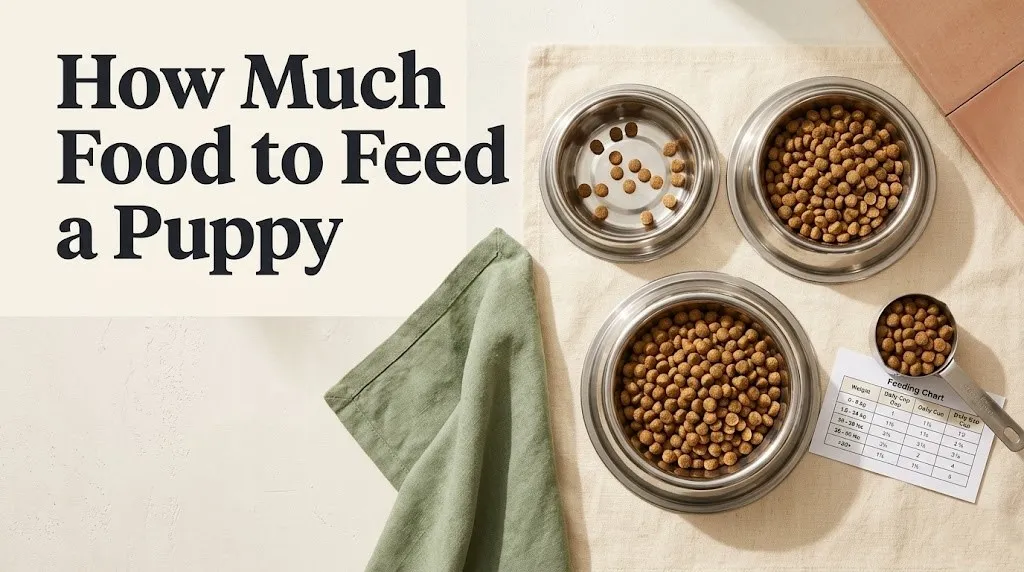
The feeding guide printed on the back of the bag is a starting range, not a fixed prescription. According to guidance from the World Small Animal Veterinary Association (WSAVA), bag feeding guides are intentionally set wide to prevent underfeeding across a diverse population of dogs. Many puppies, especially those with lower activity levels or a calmer temperament, do well at the lower end of the printed range.
A veterinarian is the right person to confirm your puppy’s ideal portion if they’re growing unusually fast, unusually slow, or have any digestive sensitivities. This is especially true for giant breed puppies, where the stakes around overfeeding are highest.
Quick Tip:
- Find the kcal/cup figure on your puppy food bag or can before estimating portions
- Compare it to your puppy’s estimated daily caloric need based on their weight
- Divide the total daily calories by the number of meals to get each meal size
How Much Food Should a Puppy Eat a Day?
A puppy’s total daily food intake should supply enough calories to support growth without accelerating it unnaturally. For most puppies, that means between 200 kcal and 1,400 kcal per day, with the wide range explained entirely by the massive difference in size between a 2-pound Chihuahua puppy and a 60-pound Labrador puppy at 12 weeks.
The simplest way to calculate your puppy’s daily caloric need is to use their current body weight in kilograms and apply the Resting Energy Requirement (RER) formula: RER = 70 x (body weight in kg)^0.75. For a growing puppy, multiply that RER by a factor of 2.0 to 3.0, with younger puppies and very small breeds sitting closer to 3.0 and older, larger puppies sitting closer to 2.0.
A 5-pound (2.3 kg) puppy has an RER of roughly 82 kcal. Multiply by 2.5 and you get approximately 205 kcal per day. If your dry kibble contains 400 kcal per cup, that puppy needs about half a cup of food per day, split across meals.
| Puppy Weight | Estimated Daily kcal | Approx. Daily Dry Kibble (at 400 kcal/cup) |
|---|---|---|
| 2 lbs (0.9 kg) | 100 to 130 kcal | ~1/4 to 1/3 cup |
| 5 lbs (2.3 kg) | 195 to 250 kcal | ~1/2 cup |
| 10 lbs (4.5 kg) | 325 to 420 kcal | ~3/4 to 1 cup |
| 20 lbs (9 kg) | 540 to 700 kcal | ~1.25 to 1.75 cups |
| 40 lbs (18 kg) | 900 to 1,150 kcal | ~2.25 to 2.75 cups |
Note: These figures are estimates based on standard caloric density. Always verify against your food’s actual kcal/cup statement.
Puppy Food: How Much to Feed by Weight
Feeding by weight is more reliable than feeding by age alone because puppies of the same age can vary enormously in size. A 10-week-old Great Dane puppy and a 10-week-old Yorkshire Terrier puppy have almost nothing in common when it comes to how much food they need.
The standard veterinary approach is to feed based on expected adult weight, not just current weight. This matters because it prevents overfeeding a large-breed puppy that is currently small but will ultimately weigh 80 pounds. According to the WSAVA Global Nutrition Guidelines, puppies should be fed to maintain a body condition score (BCS) of 4 to 5 out of 9, meaning you should be able to feel their ribs without pressing hard, but not see them prominently.
The rib check is the most practical daily assessment tool you have. Run your fingers along your puppy’s ribcage. If you can feel each rib easily with light pressure but the ribs aren’t visually prominent, your puppy is at a healthy weight. If you have to press firmly to feel ribs, they’re likely being overfed.
| Current Puppy Weight | Daily Portion Estimate (Dry Kibble at 400 kcal/cup) |
|---|---|
| Under 3 lbs | 1/4 to 1/3 cup |
| 3 to 6 lbs | 1/3 to 2/3 cup |
| 6 to 12 lbs | 2/3 to 1 cup |
| 12 to 25 lbs | 1 to 1.5 cups |
| 25 to 50 lbs | 1.5 to 2.5 cups |
| Over 50 lbs | 2.5 to 4 cups |
Key Takeaway: Puppy feeding amounts are not one-size-fits-all. Calculate daily caloric needs from your puppy’s body weight and your food’s specific kcal/cup figure, then use the body condition score as your ongoing calibration tool.
How Much Food to Feed a Puppy Chart
A puppy feeding chart works as a useful reference point, but every chart in existence is built on one assumption: that the food being used contains approximately 380 to 420 kcal per cup of dry kibble. If your kibble contains 300 kcal per cup or 500 kcal per cup, the chart’s recommended volume is wrong.
The chart below is structured around age and expected adult weight, both of which are equally useful inputs. Use it as a calibration starting point, then adjust based on your puppy’s BCS over two to three weeks.
| Age | Expected Adult Size | Daily Portions (Dry Kibble) | Meals Per Day |
|---|---|---|---|
| 6 to 8 weeks | Toy (under 10 lbs) | 1/4 to 1/3 cup | 4 |
| 6 to 8 weeks | Small (10 to 25 lbs) | 1/3 to 1/2 cup | 4 |
| 6 to 8 weeks | Medium (25 to 50 lbs) | 1/2 to 1 cup | 4 |
| 6 to 8 weeks | Large (50 to 100 lbs) | 3/4 to 1.5 cups | 4 |
| 2 to 4 months | Toy | 1/3 to 1/2 cup | 3 to 4 |
| 2 to 4 months | Small | 1/2 to 3/4 cup | 3 |
| 2 to 4 months | Medium | 1 to 1.5 cups | 3 |
| 2 to 4 months | Large | 1.5 to 2.5 cups | 3 |
| 4 to 6 months | Toy | 1/3 to 1/2 cup | 3 |
| 4 to 6 months | Small | 2/3 to 1 cup | 3 |
| 4 to 6 months | Medium | 1.5 to 2 cups | 2 to 3 |
| 4 to 6 months | Large | 2.5 to 4 cups | 2 to 3 |
| 6 to 12 months | Toy | 1/4 to 1/2 cup | 2 |
| 6 to 12 months | Small | 2/3 to 1 cup | 2 |
| 6 to 12 months | Medium | 1.5 to 2 cups | 2 |
| 6 to 12 months | Large | 2.5 to 4 cups | 2 |
Think of this chart the way a baker uses a recipe as a baseline: follow it closely the first time, then adjust based on what you actually observe in front of you.
How Much Food for an 8 Week Old Puppy
An 8-week-old puppy needs four meals per day, with each meal sized based on their body weight and expected adult size. Most 8-week-old puppies of medium breeds need approximately one-third to three-quarters of a cup of dry kibble per day, split across those four meals.
At 8 weeks, puppies have just been weaned or are finishing the weaning process. Their digestive systems are adjusting from mother’s milk to solid food. Starting with smaller, more frequent meals reduces the risk of digestive upset, loose stools, and food refusal.
Tufts University Cummings School of Veterinary Medicine notes that 8-week-old puppies are in a rapid growth window where consistent nutrition timing matters as much as volume. Skipping meals or feeding irregularly at this age can lead to low blood sugar (hypoglycemia) in small and toy breeds, which is a genuine medical concern.
Key points for 8-week-old feeding:
- Feed four times daily: morning, midday, afternoon, and evening
- Measure every meal with a standard kitchen measuring cup, not by eye
- Use food labeled with AAFCO’s “growth” or “all life stages” statement
- Soak dry kibble in warm water for 5 to 10 minutes if your puppy is struggling to chew
- Avoid adding human food, table scraps, or unsupervised treats at this age
Puppies with grain sensitivities or known food allergies may show loose stools or skin irritation within the first few weeks on a new food. A veterinarian should evaluate any persistent digestive issues.
How Much Food Should a 9 Week Old Puppy Eat
A 9-week-old puppy’s food needs are nearly identical to an 8-week-old puppy, still requiring four meals per day and portions calibrated to their current body weight. The main difference at 9 weeks is that most puppies are now fully weaned and eating solid food exclusively.
If your puppy came home at 8 weeks, they’re now one week into eating only the food you provide. This is when many owners notice inconsistency in appetite. Puppies at 9 weeks may eat eagerly at some meals and ignore food at others. According to AAHA guidelines, mild appetite variation in the first two weeks with a new owner is common due to environmental stress.
The adjustment period typically resolves within 7 to 14 days. If a 9-week-old puppy refuses two or more consecutive meals entirely, that warrants a veterinary check, not an immediate food change.
Quick Tip:
- Serve food in a quiet space away from other household pets during this adjustment window
- Set a 15-minute mealtime limit: if food isn’t eaten, remove it and offer again at the next meal
- Do not add strong flavor enhancers or broth at every meal to encourage eating; this can create picky eating habits that are hard to correct later
How Much Food for a 4 Month Old Puppy
At 4 months old, most puppies can move from four meals per day to three meals per day, with slightly larger individual portions per sitting. Total daily calories increase significantly at this age because 4-month-old puppies are in one of their steepest growth phases.
A medium-breed puppy at 4 months might weigh 15 to 20 pounds and need approximately 1 to 1.5 cups of dry kibble per day, while a large-breed puppy of the same age might weigh 30 to 40 pounds and need 2 to 3 cups per day. These are estimates; always cross-reference against your food’s caloric content label.
The 4-month mark is also when many puppies start teething in earnest. Some puppies become briefly finicky about eating hard kibble during this period. Softening kibble with a small amount of warm water for 5 minutes can help without significantly altering the nutritional profile.
| Breed Size | Expected Adult Weight | Approx. Daily Food at 4 Months |
|---|---|---|
| Toy | Under 10 lbs | 1/3 to 1/2 cup |
| Small | 10 to 25 lbs | 3/4 to 1 cup |
| Medium | 25 to 50 lbs | 1 to 1.5 cups |
| Large | 50 to 100 lbs | 2 to 3 cups |
| Giant | Over 100 lbs | 2.5 to 4 cups |
Giant breed puppies at 4 months need particular attention to calcium levels. The Journal of Veterinary Internal Medicine has published research linking excessive dietary calcium in large and giant breed puppies to developmental orthopedic disease (DOD), a group of bone and cartilage disorders. Feed a food specifically formulated for large or giant breed puppies, and avoid calcium supplements unless prescribed.
Key Takeaway: From 8 weeks through 4 months, your puppy’s daily food volume increases steadily while meal frequency holds at three to four times per day. The key variable at each stage is caloric density of the specific food, not just the volume you pour.
How Much Food Should an 11 Week Old Puppy Eat
An 11-week-old puppy still needs three to four meals per day, with daily portions that are slightly larger than at 8 or 9 weeks because their body weight and metabolic demand have both increased. Most puppies gain weight rapidly between 8 and 12 weeks, often doubling or tripling their birth weight during this window.
At 11 weeks, a small-breed puppy might weigh 4 to 6 pounds and need around one-third to one-half cup of dry kibble per day. A medium-breed puppy might weigh 10 to 15 pounds and need three-quarters to one full cup per day. Recalibrate your portions every one to two weeks at this age; growth is fast enough that last week’s portion may no longer be adequate.
One practical check: weigh your puppy weekly at this stage. Most pharmacies and veterinary clinics have floor scales suitable for small animals. If your puppy’s weight gain slows or stops between 8 and 12 weeks while eating normally, that’s worth discussing with your vet.
Key nutrition markers at 11 weeks:
- Protein content in food: minimum 22.5% dry matter basis per AAFCO growth standards
- Fat content: minimum 8.5% dry matter basis
- DHA (docosahexaenoic acid): should be listed as an ingredient; supports brain and retinal development
- Calcium: within AAFCO recommended range for growth; avoid supplementing separately
How Much Food Should a 15 Week Old Puppy Eat
At 15 weeks, most puppies are settling into three meals per day and showing more stable appetite patterns than in the early weeks. Daily food amounts have increased notably from the 8-week baseline, reflecting the puppy’s growing lean muscle mass and skeletal development.
A medium-breed puppy at 15 weeks (typically 15 to 25 pounds) needs approximately 1 to 1.5 cups of dry kibble per day. A large-breed puppy at 15 weeks (typically 30 to 50 pounds) may need 2 to 3 cups per day. Toy breeds at 15 weeks are usually fully weaned and eating independently, typically needing one-quarter to one-half cup per day divided across three meals.
The 15-week stage is often when owners first notice their puppy gaining visible body condition. This is the right time to do a BCS assessment. Place your hands around your puppy’s ribcage from above. If you feel ribs easily with light pressure, BCS is appropriate. If you see visible waist definition from above, that’s also a good sign. Puppies that feel round and padded without easily palpable ribs are likely being overfed.
According to the American Animal Hospital Association, establishing a healthy BCS in early puppyhood is one of the most protective factors against adult canine obesity, which affects an estimated 50% of adult dogs in the United States.
Key Takeaway: From 11 to 15 weeks, portion sizes increase week by week. Weighing your puppy weekly and performing a monthly BCS check are the two most reliable tools for staying calibrated without relying solely on the bag label.
How Much Food Does a 5 Month Old Puppy Need
A 5-month-old puppy needs two to three meals per day, with total daily intake reflecting their fastest period of lean muscle development. For most breeds, 5 months is the midpoint of the primary growth phase, where caloric needs per unit of body weight are still high.
A medium-breed puppy at 5 months might weigh 20 to 30 pounds and need approximately 1.5 to 2 cups of dry kibble per day. A large-breed puppy at 5 months might weigh 40 to 60 pounds and need 2.5 to 4 cups per day, depending on their energy level and the kcal/cup of their food.
At 5 months, many owners start introducing training treats in earnest. This is where daily caloric math gets underestimated. If you’re giving 20 to 30 small training treats per day, those can add 50 to 150 kcal, which represents a meaningful percentage of a small breed puppy’s daily budget. The standard veterinary guideline, referenced in AAHA nutritional guidelines, is that treats should represent no more than 10% of total daily caloric intake.
A treat like a small training biscuit may contain 10 to 15 kcal. Giving 15 of those across a training day adds 150 to 225 kcal. For a small-breed puppy with a 300 kcal daily budget, that’s 50 to 75% of their food in treats. Adjust your kibble portions downward to compensate.
How Much Food and Water Does a Puppy Need
Puppies eating dry kibble need access to fresh water at all times, not just around mealtimes. Dry kibble contains only about 10% moisture, compared to wet food at 70 to 80% moisture and a puppy’s natural milk source at roughly 87% moisture. Moving to dry food without adequate water access creates a real hydration gap.
The general veterinary guideline is that puppies need approximately 1 ounce of water per pound of body weight per day as a minimum baseline. A 10-pound puppy needs at least 10 ounces, or just over 1 cup of water, daily. Active puppies, puppies in warm environments, and puppies eating dry food exclusively need more.
Signs of inadequate water intake include:
- Dark yellow urine during outdoor bathroom breaks
- Dry or tacky gums
- Lethargy or reduced interest in play
- Loss of skin elasticity (skin tenting test: gently lift a pinch of skin at the back of the neck; it should spring back immediately)
Puppies on wet food diets get substantially more moisture from their food and typically drink less water. This is normal. It does not mean they’re getting too much or too little hydration; it means the food itself is contributing to fluid intake.
Puppies transitioning from wet food to dry kibble should have water bowls made more accessible during the transition period, and portions should be monitored for the first two to three weeks.
How Often to Feed a Puppy
Feeding frequency for puppies should follow a clear age-based schedule, moving from four meals per day in the earliest weeks to two meals per day by 6 months for most breeds. The reason for high frequency early on is blood sugar stability, digestive capacity, and nutrient delivery to rapidly developing tissues.
Think of a puppy’s early metabolism the way you’d think of a small fuel tank in a high-performance engine. The tank empties faster than an adult dog’s, so you need to refuel more often to keep performance steady. Letting the tank run completely empty creates problems: low blood sugar, digestive cramping, and in very small breeds, genuine hypoglycemia.
| Puppy Age | Meals Per Day | Meal Spacing |
|---|---|---|
| 6 to 8 weeks | 4 | Every 4 to 5 hours |
| 8 to 12 weeks | 3 to 4 | Every 4 to 6 hours |
| 3 to 6 months | 3 | Every 5 to 7 hours |
| 6 to 12 months | 2 to 3 | Every 8 hours |
| Over 12 months | 2 | Every 12 hours |
Free feeding, where food is left out all day, is not recommended for puppies. According to WSAVA nutritional guidelines, scheduled meal feeding gives you clear information about your puppy’s appetite and makes house training significantly easier because food intake timing predicts bathroom timing.
Toy breeds and breeds prone to hypoglycemia (including Chihuahuas, Yorkshire Terriers, and Maltese) may need to maintain three meals per day even past 6 months. A veterinarian familiar with your dog’s specific breed should guide that decision.
Key Takeaway: Meal frequency matters as much as meal size. Four meals per day in the first weeks prevents blood sugar crashes and supports consistent nutrient delivery during the most rapid growth window.
Wet Food vs Dry Food: How Much to Feed a Puppy
Wet food and dry food are not interchangeable in volume. A cup of wet canned puppy food delivers far fewer calories than a cup of dry kibble because wet food is 70 to 80% water. Feeding the same volume of wet food that you’d feed of dry kibble will significantly underfeed your puppy.
Standard dry kibble runs approximately 300 to 420 kcal per cup. Standard wet puppy food runs approximately 90 to 130 kcal per 3.5-ounce (100g) serving, depending on the brand and protein source. That means you need roughly three to four times the volume of wet food to match the calories in one cup of dry kibble.
| Food Type | Typical Caloric Density | Volume Needed Per Day (10-lb puppy) |
|---|---|---|
| Dry kibble | 350 to 420 kcal/cup | ~3/4 to 1 cup |
| Wet canned food | 90 to 130 kcal/100g | ~300 to 450g (roughly 3 to 5 cans) |
| Raw food (meat-based) | 100 to 150 kcal/100g | ~250 to 400g |
| Mixed (50% dry + 50% wet) | Variable | Adjust per kcal content of each |
Wet food is not inherently better or worse than dry kibble for puppies, provided it meets AAFCO’s nutrient profile for growth. Wet food can be beneficial for puppies with dental sensitivities, very small mouths, or low water intake. It can also be easier for recently weaned puppies to transition onto.
Puppies being fed primarily wet food may develop softer stools than those on dry kibble. This is largely due to moisture content and does not indicate a health problem unless accompanied by mucus, blood, or persistent diarrhea.
Signs You Are Overfeeding a Puppy
Overfeeding a puppy is far more common than underfeeding, largely because the bag feeding guides err on the side of generosity, treats get forgotten in the daily tally, and puppies almost always eat whatever is in front of them. Recognizing the signs early prevents long-term structural and metabolic consequences.
The clearest physical sign of overfeeding is a BCS above 6 out of 9. At this level, your puppy will have a visible rounding of the belly that persists even after digestion, ribs that are hard to feel through fat padding, and a lack of visible waist when viewed from above.
Signs you may be overfeeding your puppy:
- You can’t easily feel each rib without applying firm pressure
- The puppy has a rounded belly throughout the day, not just immediately after eating
- Soft, loose, or frequent stools not explained by food change or illness
- Rapid unexpected weight gain between weekly weigh-ins
- The puppy consistently leaves some food in the bowl then gains weight anyway (sign that portions are exceeding need)
- Lethargy or reduced interest in play in a puppy that should be active
According to research published in the Journal of Veterinary Internal Medicine, overfeeding during early puppyhood, particularly of large and giant breeds, increases the risk of hip dysplasia, elbow dysplasia, and osteochondritis dissecans. These are structural joint conditions that develop during bone growth and are directly influenced by caloric and calcium intake.
If you suspect your puppy is gaining too quickly, reduce daily food by 10 to 15% for two weeks and reassess their BCS. Do not reduce by more than 20% without veterinary guidance.
When to Switch Puppy to Adult Dog Food
Most puppies should transition to adult dog food when they reach approximately 80 to 90% of their expected adult size, which varies significantly by breed. Feeding puppy food beyond this point, especially to medium and large breeds, often oversupplies calories, protein, and calcium for a dog whose growth plates are closing.
For small and toy breeds, this transition typically happens between 10 and 12 months. For medium breeds, it’s usually at 12 months. For large breeds, the transition is appropriate between 12 and 18 months. Giant breeds (expected adult weight over 100 lbs) should typically stay on large-breed puppy or all-life-stages food until 18 to 24 months, as their growth period is substantially longer.
| Breed Size | Expected Adult Weight | Switch to Adult Food Around |
|---|---|---|
| Toy | Under 10 lbs | 10 to 12 months |
| Small | 10 to 25 lbs | 12 months |
| Medium | 25 to 50 lbs | 12 months |
| Large | 50 to 100 lbs | 12 to 18 months |
| Giant | Over 100 lbs | 18 to 24 months |
The transition should happen gradually over 7 to 10 days to avoid digestive upset. Start by replacing 25% of the puppy food with adult food, then move to 50%, then 75%, then 100% over that window.
Puppies who are neutered or spayed before reaching adult size may have lower caloric needs after the procedure due to hormonal changes affecting metabolism. A veterinarian can help adjust portions at that point to prevent post-surgery weight gain.
Key Takeaway: The switch to adult food is not about age alone; it’s about growth stage. Transitioning too early can disrupt development. Transitioning too late can cause weight gain. Match the timing to your puppy’s breed size and consult your vet if you’re uncertain.
Frequently Asked Questions About Puppy Feeding
How much food should I feed my 8 week old puppy?
An 8-week-old puppy needs four meals per day, with total daily portions ranging from one-quarter cup to one full cup of dry kibble depending on breed size.
Find the kcal/cup figure on your food bag and calculate based on your puppy’s current weight using the RER formula.
A veterinarian can give you a specific target for your puppy’s size and breed.
How do I know if I’m feeding my puppy enough?
The most reliable check is the body condition score (BCS): you should be able to feel your puppy’s ribs easily with light hand pressure but not see them prominently.
Weekly weigh-ins during the first 6 months help confirm that growth is steady and on track.
If your puppy is consistently uninterested in food, losing weight, or showing low energy, consult a veterinarian to rule out health causes before adjusting portions.
Can I leave food out all day for my puppy?
Free feeding is not recommended for puppies because it makes portion control, house training, and appetite monitoring much harder.
Scheduled meals, offered for 15 minutes and then removed, give you clear information about how much your puppy is eating and when.
Very small breed puppies at risk of hypoglycemia may benefit from more frequent scheduled meals rather than free access, which still provides no useful appetite feedback.
How many cups of food does a puppy need per day?
The number of cups depends entirely on your puppy’s size and your food’s caloric density, not a single universal number.
A toy breed puppy may need as little as one-quarter cup per day, while a large breed puppy at 4 to 6 months may need 2.5 to 4 cups per day.
Always check the kcal/cup figure on your specific food and calculate based on your puppy’s body weight.
When should a puppy eat 3 meals a day instead of 4?
Most puppies can move from four meals to three meals per day between 8 and 12 weeks, once they’re fully weaned and eating solid food comfortably.
Toy breeds and breeds with documented hypoglycemia risk should stay at four meals until at least 12 weeks, and sometimes longer per veterinary recommendation.
Giant breed puppies can typically move to three meals around 10 to 12 weeks without issue, then to two meals per day around 6 months.
Getting Your Puppy’s Feeding Right
The single most practical thing you can take from this guide: find the kcal/cup number on your puppy food bag, calculate your puppy’s estimated daily caloric need based on their body weight, and check their BCS every two to three weeks to see if the math is working in real life. The chart on the bag is a starting point, not a guarantee.
Adjust as you go. Puppies grow fast, their needs change quickly, and the right portion at 8 weeks will be too small by 12 weeks. Build the habit of monthly reassessment and you’ll stay ahead of both overfeeding and underfeeding without stress.
If your puppy has a health condition, an unusual growth pattern, or a breed-specific concern, a veterinarian or a board-certified veterinary nutritionist (DACVN) is the right specialist to give you a personalized feeding plan.