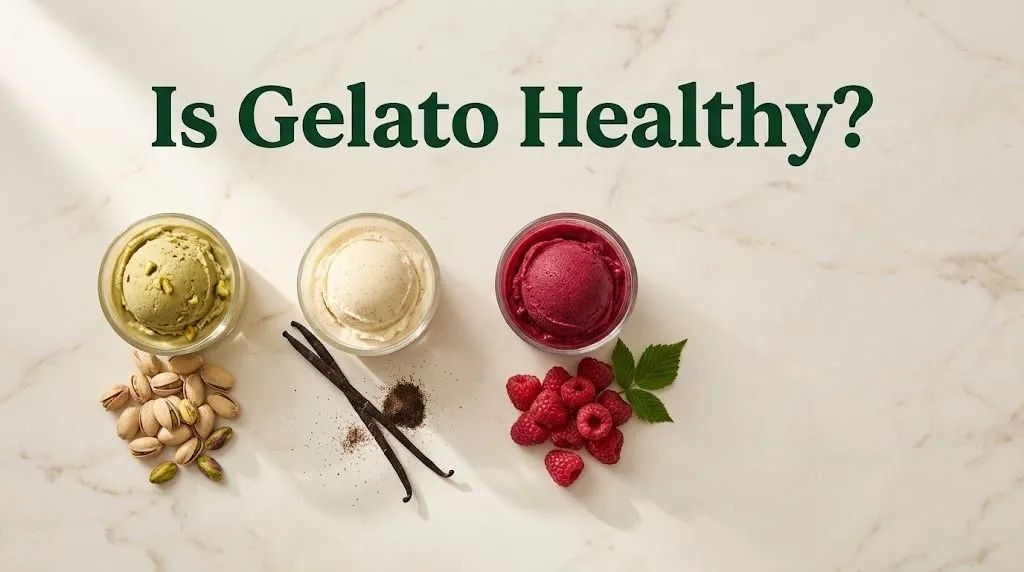
Gelato can be a healthier choice than standard ice cream if your main goal is cutting saturated fat and total calories. The trade-off sits squarely in its sugar and calorie density per spoonful. You get a dense, intense dessert where a small portion provides high sensory satisfaction.
This matters because frozen desserts are a top source of added sugar and saturated fat in American diets. The Dietary Guidelines for Americans consistently flag both as nutrients to limit for heart health and metabolic function. Gelato’s nutritional profile forces a conversation about what you actually need less of and what you truly enjoy more of.
This article breaks down real gelato nutrition data, unpacks authentic ingredients, and walks you through every major dietary pattern. You will learn how gelato interacts with weight loss goals, lactose intolerance, a ketogenic diet, and specific flavor choices. A practical recipe and a guide to buying better store-bought gelato in 2026 sit at the end.
Is Gelato Healthy? The Direct Answer
Gelato is neither a health food nor a dietary villain. It falls into a middle category where your personal health goal determines whether its nutritional profile is a smart match or a poor fit for your eating pattern.
Authentic gelato contains less butterfat than standard ice cream, often 4 to 8 percent fat versus ice cream’s 10 to 18 percent. The reduction in saturated fat is a genuine plus for cardiovascular health. The American Heart Association (AHA) recommends limiting saturated fat intake to 5 to 6 percent of daily calories, and a small serving of gelato uses less of that budget.
The flip side is sugar. Gelato’s dense texture and clean flavor delivery require a solid sugar structure. Many formulations pack 20 to 26 grams of sugar per half-cup serving. That is comparable to or slightly more than premium ice cream by volume. A person managing insulin resistance or watching added sugar intake closely will find this number significant.
What makes gelato practical for an otherwise healthy diet is the portion psychology. Gelato is traditionally served at a warmer temperature than ice cream and in smaller portions. The intense flavor density and silky texture encourage slower, more deliberate eating. You may feel fully satisfied with a 3-ounce scoop where a 6-ounce bowl of fluffy ice cream just leaves you wanting more.
Key Takeaway: Gelato trades fat for sugar in a dense format. For lowering saturated fat, it is a smart swap. For managing sugar and carbohydrates, proceed with careful portioning and read the label on commercial products.
Gelato Nutrition Facts: A Full Macro and Micro Breakdown
A standard 100-gram serving of traditional dairy gelato contains a specific nutritional profile that distinguishes it from both ice cream and sorbetto. The values shift depending on whether the base is custard-style with egg yolks or a starch-thickened Sicilian style.
The macros in a 100-gram serving of vanilla custard gelato break down as follows. You get roughly 180 to 210 calories, 4 to 8 grams of total fat, 3 to 5 grams of saturated fat, 25 to 30 grams of carbohydrates, 20 to 26 grams of sugar, and 3 to 5 grams of protein. The protein content, while modest, comes from milk proteins casein and whey, which contribute to the smooth mouthfeel and blood sugar response.
The micronutrient story is often overlooked but worth knowing. Dairy gelato is a meaningful source of bioavailable calcium, delivering about 100 to 150 milligrams per serving, roughly 10 to 12 percent of the daily value. You also receive phosphorus, which supports bone mineralization alongside calcium, and vitamin A from the milkfat. Fruit-based gelato and sorbetto variants contribute vitamin C and specific polyphenols depending on the fruit used.
Below is a comparison of three gelato formats per 100-gram serving.
| Nutrient | Custard Gelato (Vanilla) | Sicilian Starch Gelato | Fruit Sorbetto |
|---|---|---|---|
| Calories | 190 | 160 | 130 |
| Total Fat | 7g | 3g | 0g |
| Saturated Fat | 4g | 2g | 0g |
| Carbohydrates | 28g | 30g | 32g |
| Sugar | 22g | 25g | 28g |
| Protein | 4g | 2g | 0g |
| Calcium | 120mg | 100mg | 5mg |
| Key Micronutrient | Vitamin A (150 IU) | Phosphorus (80mg) | Vitamin C (15mg) |
The sugar content in dairy-free sorbetto appears highest here because fruit purees concentrate natural sugars and often need more added sugar to prevent an icy texture without the benefit of milk proteins. Never assume fruit-based automatically means lower sugar. Always check the specifics.
What Is in Authentic Gelato? Ingredients That Matter
Authentic gelato uses a short ingredient list built on whole milk, sugar, and a flavor base. There is a world of difference between an artisanal gelato made fresh that morning and an ultra-processed shelf-stable product designed to sit in a supermarket freezer for six months.
The traditional base consists of whole milk, heavy cream or no cream at all for some Sicilian styles, sucrose or dextrose, and a stabilizer. Old-world gelato makers use egg yolks in custard styles or a small amount of cornstarch or carob seed flour in starch-thickened versions. The protein in milk and egg yolk provides the velvety body without relying on high butterfat.
Commercial mass-produced gelato tells a different story. These products often replace a portion of the milkfat with refined vegetable oils like palm oil or coconut oil to cut cost. They add emulsifiers such as mono- and diglycerides and stabilizers like guar gum, locust bean gum, and carrageenan to mimic the creamy texture of fresh gelato over a long frozen shelf life. The flavor list may include natural and artificial flavorings instead of real vanilla bean, pistachio paste, or fresh fruit.
The nutrition label reveals the difference. Authentic fresh gelato lists milk, sugar, and the named flavoring like hazelnut paste as the first ingredients. An ultra-processed commercial product often lists water, sugar, refined vegetable oil, and milk solids, with a long string of gums and emulsifiers behind them.
Quick Tip:
- Look for gelato where milk is the first ingredient on the label.
- The ingredient list should be short enough to read aloud in under ten seconds.
- If you see vegetable oils before any dairy ingredient, the product is structurally more similar to frozen dessert than traditional gelato.
- A short best-by window, meaning weeks not months, signals a fresher product.
People with milk protein allergies must avoid all traditional dairy gelato. The milk proteins casein and whey are present even in low-fat formulations. No amount of artisanal craftsmanship removes the allergenic protein structure.
Is Gelato More Healthy Than Ice Cream? The Key Differences
Gelato is healthier than ice cream for lowering saturated fat intake and total calorie density per gram. Ice cream is often a better choice for minimizing sugar spikes and increasing protein intake per serving. The winner depends entirely on which health metric you are managing.
The structural difference comes from a physical characteristic called overrun. Overrun is the amount of air whipped into a frozen dessert during the churning and freezing process. Cheap commercial ice cream can have an overrun of 50 to 100 percent, meaning half the volume you pay for is air. Gelato is churned slowly and intentionally, producing an overrun of 20 to 30 percent maximum. You are eating a denser product with more actual ingredients and flavor per spoonful.
The table below breaks down the key nutritional differences per 100-gram serving, which highlights the density effect.
| Nutritional Factor | Gelato (Dense) | Standard Ice Cream | Premium Ice Cream |
|---|---|---|---|
| Overrun (Air %) | 20-30% | 50-100% | 30-40% |
| Total Fat | 4-8g | 10-14g | 14-18g |
| Saturated Fat | 3-5g | 6-8g | 9-11g |
| Sugar | 20-26g | 14-20g | 17-22g |
| Calories | 180-210 | 200-220 | 230-270 |
| Serving Temp | 10-15°F | 0-5°F | 0-5°F |
The warmer serving temperature of gelato is a functional advantage. It melts faster on the tongue, delivering flavor compounds directly to your palate before the cold numbs your taste receptors. The AHA’s emphasis on limiting saturated fat makes gelato’s lower butterfat profile a pragmatic daily choice for heart-conscious consumers.
However, an individual with reactive hypoglycemia or type 2 diabetes monitoring glycemic response might find the sugar density of gelato more problematic than the fat load of a smaller, slower-digesting premium ice cream. The higher protein content in ice cream also marginally blunts the blood sugar spike through delayed gastric emptying.
Key Takeaway: For saturated fat reduction, pick gelato. For lower sugar and higher protein, a high-quality ice cream with a short ingredient list might actually align better with your metabolic needs.
Gelato Sugar Content vs. Ice Cream: What the Data Shows
Gelato often contains more sugar per gram than standard ice cream. A 100-gram serving of vanilla gelato averages 22 to 26 grams of total sugar, while a comparable serving of vanilla ice cream averages 17 to 21 grams. The sugar needs are a direct result of the lower fat content and denser physical matrix.
Fat carries flavor and creates the perception of creaminess. When you remove a significant portion of butterfat, as gelato does, you must rely on sugar to build body, lower the freezing point, and prevent the mixture from freezing into a solid block. Dextrose or glucose syrup is often used alongside sucrose because its smaller molecular structure depresses the freezing point more effectively without making the dessert taste overwhelmingly sweet.
The freezing point depression function of sugar is the key technical insight. A gelato base with insufficient sugar becomes a hard, icy mass that shatters under a scoop. An ice cream base can rely partially on fat for scoopability. Gelato cannot. Sugar serves a structural role, not just a flavor role.
A 2022 analysis published in the journal Nutrients examining commercial frozen desserts found that products marketed as “low-fat” or “gelato-style” frequently matched or exceeded the sugar content of full-fat alternatives. The sugar content per serving size was the great equalizer that eliminated the perceived health advantage.
For someone following the USDA Dietary Guidelines for Americans, which cap added sugar at less than 10 percent of daily calories, a single 100-gram scoop of gelato can supply 40 to 50 percent of that entire daily budget. Pairing the gelato with a source of fiber, fat, or additional protein at the same eating occasion slows the absorption rate and moderates the insulin response.
Quick Tip: Pair a small scoop of pistachio gelato with a handful of raw almonds. The fiber and healthy fats from the nuts slow gastric emptying and reduce the rapid blood sugar spike.
Is Gelato Good for Weight Loss? How to Fit It Into Your Plan
Gelato can fit into a weight loss eating plan if you exploit its sensory density to feel satisfied with a smaller absolute portion. The key is using the intense flavor delivery to your advantage, not letting it justify a larger serving.
Weight loss hinges on a sustained caloric deficit. Any food can be included if the overall energy intake stays below your expenditure. Gelato’s dense, slow-churning nature means a 3-ounce scoop weighing roughly 85 grams delivers a complete dessert experience for about 150 to 180 calories. A similarly satisfying volume of whipped, airy light ice cream might require a 6-ounce serving to feel like you ate something substantial.
The behavioral science around eating speed supports this approach. Gelato served at a warmer temperature melts quickly and demands you eat it in small, deliberate spoonfuls. This slow consumption pace gives your body’s satiety signaling pathways, like the release of cholecystokinin, time to register intake and reduce the desire for more. The ritual of eating gelato from a small cup with a small spoon becomes an automatic portion control tool.
Stick to a serving frequency that matches your deficit goals. Having a 150-calorie scoop of gelato two or three times a week as a planned indulgence will not derail a weight loss effort. Eating a 400-calorie large cup nightly while finishing off the day’s stress will. The food is not the problem. The context and quantity are.
Key Takeaway: Pick plain flavors you truly love, buy the smallest cup available, and eat it slowly with full attention. The portion is the strategy.
Is Gelato Dairy-Free? Traditional and Modern Options
Traditional gelato is not dairy-free. Authentic recipes rely on whole milk and sometimes cream as the foundation for the custard base. However, two specific categories within the gelato tradition are genuinely dairy-free and widely available.
The first is fruit sorbetto. Sorbetto is an Italian frozen dessert made from fruit puree, water, and sugar. It contains no milk, no cream, and no eggs. The texture is lighter and icier than dairy gelato, but a well-made sorbetto using high-pectin fruits like mango, raspberry, or pear achieves a surprisingly smooth and dense mouthfeel. Lemon sorbetto, the classic palate cleanser served between courses, is fundamentally a dairy-free gelato-adjacent product.
The second category is modern plant-based gelato made with alternative milks. In 2026, high-quality gelato shops and premium grocery brands routinely produce bases from almond milk, oat milk, cashew milk, and coconut cream. The best versions use a blend of plant milks and added plant fats to mimic the density and slow melt of traditional dairy gelato without relying on water-thin nut juices that freeze into solid ice blocks.
The table below compares three dairy-free gelato format options per 100 grams.
| Base Ingredient | Texture Quality | Typical Calories | Key Nutritional Note |
|---|---|---|---|
| Fruit Sorbetto | Dense, smooth, quick-melting | 110-140 | High in vitamin C, zero fat, high natural sugar |
| Almond Milk Gelato | Light, slightly icy | 150-180 | Lower protein, often uses added oils for creaminess |
| Oat Milk Gelato | Creamy, dense, closest to dairy | 170-200 | Higher carbohydrate, contains soluble fiber beta-glucan |
| Coconut Cream Gelato | Very rich, slow-melting | 190-230 | High saturated fat from coconut, minimal protein |
Dairy-free does not mean sugar-free or low-calorie by default. Many plant-based frozen desserts add significant refined sugar or syrups to compensate for the absence of lactose and milk proteins. Read the label with the same care you would for any frozen dessert.
Gelato and Lactose Intolerance: Can You Eat It?
Some people with lactose intolerance can eat small amounts of traditional dairy gelato without symptoms. The dense, lower-volume serving format and the milk processing method both work in your favor.
Lactose is the primary sugar in milk, and people with lactose intolerance lack sufficient lactase enzyme to break it down efficiently in the small intestine. When undigested lactose reaches the colon, gut bacteria ferment it, producing gas, bloating, and discomfort. The threshold for symptoms varies widely by individual. Many people can handle 6 to 12 grams of lactose in a sitting, especially if consumed with other foods.
A standard 100-gram serving of dairy gelato contains roughly 4 to 7 grams of lactose. This falls within the tolerance range for a significant portion of people with mild to moderate lactose intolerance. The simultaneous presence of milk fat in traditional gelato further slows gastric emptying, which can reduce the rapid delivery of lactose to the colon.
The custard-making process offers another layer of protection. Authentic gelato bases are heated to pasteurization temperatures of 85°C or 185°F and held there. This heating process partially breaks down some of the lactose into its constituent simpler sugars, glucose and galactose, which are easier to absorb. It is not a lactase enzyme treatment, but it does provide a marginal reduction in total lactose load.
Sicilian-style starch-thickened gelato, which uses no egg yolks and often less milkfat, may still be made with whole milk. The lactose content remains similar to custard-style versions. Commercially, more brands in 2026 are offering “lactose-free gelato” made by adding the lactase enzyme directly to the base during production, just as lactose-free milk is made. If you are highly sensitive, seek out a clearly labeled lactose-free product or a plant-based alternative.
Is Gelato Keto Friendly? The Carb Reality
Traditional dairy gelato and fruit sorbetto are not compatible with a ketogenic diet. A single small scoop of standard gelato delivers more carbohydrates than an entire day’s budget on a strict keto plan.
A ketogenic diet typically limits daily carbohydrate intake to 20 to 50 grams of total carbs to maintain a state of nutritional ketosis. A 100-gram serving of dairy gelato contains 25 to 30 grams of carbohydrates, almost entirely from sugars, with negligible fiber. You would consume your entire carb allowance in three or four bites. The protein in gelato is too low, and the insulin response from the sugar load is too high for the macronutrient math to work.
However, the food industry has responded to the keto trend. In 2026, you can find specifically formulated keto gelato in the frozen aisle. These products swap sugar for sugar alcohols like erythritol and allulose, and they increase the fat content using MCT oil, coconut cream, or avocado oil to match the texture of traditional gelato. Inulin, a prebiotic soluble fiber, is frequently added to improve body and mouthfeel.
A keto-labeled gelato might contain 5 to 8 grams of net carbs per 100-gram serving, with a significant portion of the sweetness coming from allulose or monk fruit extract. Allulose is particularly effective because it depresses the freezing point similarly to sugar, yielding a scoopable, soft product straight from the freezer.
Key Fact: The FDA allows allulose to be excluded from the “Total Sugars” and “Added Sugars” lines on the Nutrition Facts panel in the U.S. Check the ingredient list for it. A product labeled “keto” is only as good as your individual tolerance to the specific sugar alcohol or fiber used. Some people experience significant digestive distress from large amounts of erythritol or chicory root inulin.
Is Pistachio Gelato Healthy? A Flavor-Specific Analysis
Pistachio gelato can offer more nutritional upside than a plain dairy base if it is made with real pistachio paste. The key distinction is between artisanal pistachio gelato made from ground pistachios and a commercial version colored green with artificial dye and flavored with almond extract.
Real pistachio paste brings a meaningful nutrient contribution. Pistachios are a complete protein source and one of the highest-protein nuts, containing all nine essential amino acids. In a high-percentage pistachio gelato, the ground nuts add plant protein, dietary fiber, potassium, and the antioxidants lutein and zeaxanthin. The vibrant green color in a true pistachio gelato comes from chlorophyll in the nuts themselves, not from added food coloring.
The fat profile also shifts favorably. Pistachios are rich in monounsaturated fatty acids, the same heart-healthy fats found in olive oil. Replacing some of the milk’s saturated fat with pistachio oil in the gelato base improves the overall ratio of unsaturated to saturated fat in your spoonful.
Commercial “pistachio flavor” gelato is a completely different product. These versions often use almond paste as a cheaper base nut flavor, add green and yellow food dyes, and include a tiny percentage of pistachio for label purposes. The nutritional benefits of the actual nut are effectively absent. The ingredient label tells the truth in seconds. Real pistachio gelato lists pistachio paste as the second or third ingredient after milk and sugar.
For someone on a Mediterranean-style diet, a small cup of artisanal pistachio gelato made with real nuts fits the pattern as an occasional treat. It is not just empty calories. It supplies bioactive compounds from the nuts, including gamma-tocopherol, a form of vitamin E with anti-inflammatory properties.
Key Takeaway: Seek out gelato that lists pistachio paste explicitly and has a naturally dull, brownish-green hue. Bright green gelato is almost always a colored, flavored impersonation.
Best Healthy Gelato Brands: What to Look For in 2026
The healthiest gelato brands in 2026 share a few clear label characteristics. You look for a short ingredient list starting with milk, a protein content above 3 grams per serving, and the absence of refined vegetable oils early in the list.
Gelato is a product category with massive quality variance. Some brands are artisanal products made in small batches and sold within a week of production. Others are multinational “Italian-style” frozen desserts manufactured on the same lines as economy ice cream, filled with stabilizers, mono- and diglycerides, and high-fructose corn syrup. Your ability to distinguish between them at the freezer door determines whether you get a nutritious dessert or an ultra-processed one.
Below is a framework for evaluating any gelato brand instantly.
| Label Feature | What to Look For | What to Avoid |
|---|---|---|
| First Ingredient | Whole milk, reduced-fat milk | Water, skim milk, vegetable oil |
| Fat Source | Milkfat, cream, named nut paste | Palm oil, coconut oil (unless plant-based), non-specific vegetable oil |
| Sugar Source | Cane sugar, dextrose, honey | High-fructose corn syrup, glucose-fructose syrup |
| Stabilizer Count | 0 to 2 recognizable items (e.g., carob gum, rice starch) | 4+ gums, carrageenan, cellulose gel |
| Color Source | Real vanilla bean flecks, pistachio paste | Artificial colors (Yellow 5, Blue 1) |
| Protein per Serving | 3 to 5 grams per 100 grams | Less than 2 grams per 100 grams |
Higher-protein gelato formulations have become a distinct subcategory. Some brands add micellar casein or whey protein isolate to their base to boost the protein content to 8 to 12 grams per serving. These products often market themselves as a post-workout recovery dessert or a high-protein snack. They fit well for active individuals, but the taste and texture trade-off can be chalky or overly firm if the formulation is not expertly balanced.
Read the actual Nutrition Facts panel, not the front-of-pack callouts. A product may loudly advertise “60% Less Fat than Ice Cream” while delivering 30 grams of added sugar per serving. The front of the pack is marketing. The back of the pack is reality.
Healthy Homemade Gelato Recipe: A Lighter Custard-Style Base
Making gelato at home gives you full control over the sugar quantity, the fat percentage, and the flavor quality. This recipe produces a dense, smooth vanilla gelato that cuts added sugar by about 30 percent compared to standard commercial formulations without using any artificial sweeteners.
The recipe relies on a Sicilian-inspired starch-thickened custard base rather than an egg-yolk-heavy French custard. This reduces the total fat and cholesterol while keeping the protein structure needed for a soft, slow-melting texture. Allulose is used in combination with regular cane sugar to lower the total caloric and glycemic impact while maintaining the proper freezing point depression.
Ingredients:
- 2 cups whole milk
- 1/2 cup heavy cream
- 1/3 cup cane sugar
- 1/4 cup allulose (granular)
- 2 tablespoons non-GMO cornstarch
- 1/4 teaspoon fine sea salt
- 1 vanilla bean or 1.5 teaspoons pure vanilla extract
To make the gelato:
- Whisk the cornstarch into 1/4 cup of the cold milk until completely smooth with no lumps. Set this slurry aside.
- Pour the remaining milk and cream into a medium saucepan. Add the sugar, allulose, and salt. Split the vanilla bean, scrape the seeds into the pot, and drop in the pod.
- Heat the mixture over medium heat, stirring occasionally, until it reaches a bare simmer and you see small bubbles around the edge. Do not let it boil hard.
- Whisk the cornstarch slurry again briefly and pour it into the hot milk in a thin stream while whisking constantly.
- Continue whisking over medium-low heat for 3 to 4 minutes. The mixture will thicken enough to coat the back of a spoon. You should feel resistance in the whisk.
- Remove from heat. Remove the vanilla pod. Stir in vanilla extract if using instead of bean.
- Strain the base through a fine-mesh sieve into a clean bowl set over an ice bath. Cool it down quickly, stirring occasionally for 15 minutes.
- Cover and refrigerate the base for at least 4 hours, ideally overnight. Cold aging develops the texture.
- Churn the aged base in your ice cream or gelato machine according to the manufacturer’s instructions. Stop the churn when the gelato reaches the consistency of soft-serve. Do not over-churn.
- Scoop the gelato into a chilled container, press parchment paper directly onto the surface, and freeze for 2 hours to set to a scoopable firmness.
The total caloric load per 100-gram serving for this recipe is approximately 165 calories. The sugar content nets out around 16 grams, with a significant portion of the sweetness coming from allulose, which does not affect blood glucose. The fat content remains around 5 grams per serving with about 3 grams of saturated fat.
Frequently Asked Questions About Gelato
Is gelato healthy or fattening?
Gelato is not inherently fattening when eaten in a 3-ounce portion as part of an overall balanced diet. It is lower in fat than ice cream but dense in sugar, so its health impact depends entirely on the quantity and the rest of your daily intake.
No single food causes fat gain. A consistent caloric surplus over time is the driver.
Is gelato less fattening than ice cream?
Gelato contains less total fat and fewer calories per gram than premium ice cream. A 100-gram serving of gelato averages 180 calories and 5 to 7 grams of fat.
The same weight of premium ice cream averages 240 calories and 15 grams of fat.
Can people with diabetes eat gelato?
People with diabetes can eat small amounts of gelato occasionally if they account for the 20 to 26 grams of carbohydrates per half-cup serving.
Pairing gelato with protein or fiber from nuts or eating it after a mixed meal slows the blood sugar response.
Is gelato a good source of calcium?
Dairy gelato provides a modest calcium boost at roughly 100 to 150 milligrams per serving.
It is a contribution to your daily calcium needs, not a primary source. A cup of milk still provides double that amount for a comparable calorie load.
What is the healthiest flavor of gelato?
Pistachio gelato made with real pistachio paste offers the best nutrient density per spoonful. You get added plant protein, monounsaturated fats, fiber, potassium, and antioxidants from the nuts.
Bright green artificially colored pistachio flavor does not share these benefits.
The single most practical takeaway from this entire analysis is that gelato’s health value is not fixed. It shifts depending entirely on what you need less of in your diet. If your priority is cutting saturated fat, a small scoop of authentic dairy gelato is a genuine win over a bowl of premium ice cream. If your priority is reducing sugar, it may be a step in the wrong direction compared to a high-protein lower-sugar frozen alternative.
The label never lies once you know what to read. Look at the ingredient list first, the sugar line second, and the protein content third. That sequence tells you immediately whether the product in your hand is an artisanal food or an ultra-processed factory dessert dressed in Italian marketing. Good gelato spoils faster and tastes more intensely of its named flavor.
For your next step, walk into your local gelato shop or grocery freezer aisle and treat the experience as an ingredient scavenger hunt. Pick the gelato with the shortest list. Order the small cup. Sit down and eat it slowly without a phone in your other hand. That tiny ritual shift from mindless consumption to deliberate enjoyment does more for your relationship with food than any perfect macronutrient ratio ever could.