Capers are the small, pickled or salt-cured flower buds of the Capparis spinosa plant, a shrubby perennial native to the Mediterranean region. They’re used across Italian, Greek, Spanish, and North African cuisines to add a sharp, briny, faintly tangy punch to sauces, pasta, fish dishes, and dressings.
They may look like a garnish, but capers carry real nutritional weight. According to USDA FoodData Central, capers provide measurable amounts of vitamin K, iron, copper, and a class of plant antioxidants called flavonoids, including quercetin and rutin, both of which have been studied for cardiovascular and anti-inflammatory effects.
This guide covers what capers are, what they taste like, how they’re made and graded, their full nutritional profile, health research, sodium considerations, cooking uses, storage tips, and the best substitutes. Whether you’ve spotted them on a restaurant menu or found them in a recipe, you’ll know exactly what to do with them after reading this.
What Are Capers in Food?
Capers are the unopened flower buds of Capparis spinosa, a drought-tolerant plant that grows wild and in cultivation across the Mediterranean basin, including southern Italy, Spain, Morocco, and Greece.
The buds are harvested by hand before they bloom, typically in spring and early summer. Once picked, they’re too bitter to eat raw. They require curing, either in brine or dry salt, to become the pleasantly pungent ingredient you find in jars at the grocery store.
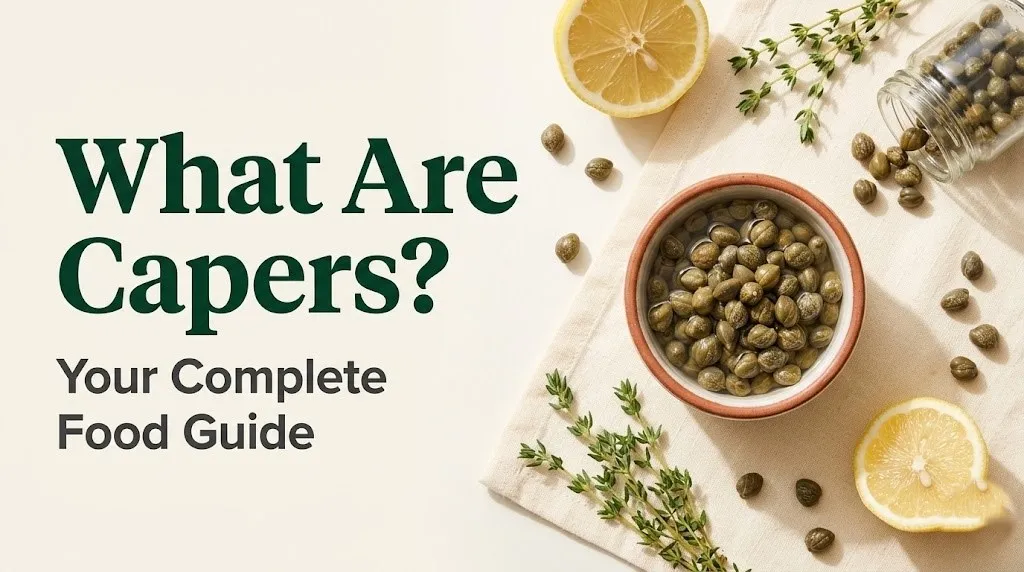
Culinary capers are not a spice, not a seed, and not a berry (though caperberries, a related product, do come from the same plant). They’re botanically a flower bud and gastronomically a condiment, used in small quantities to season and flavor dishes rather than eaten in large amounts.
| Feature | Detail |
|---|---|
| Plant | Capparis spinosa (caper bush) |
| Part used | Unopened flower buds |
| Native region | Mediterranean basin |
| Harvest season | Spring to early summer |
| Edible raw | No, requires curing |
| Primary use | Condiment and seasoning ingredient |
People occasionally confuse capers with green peppercorns or even small olives. Capers are in their own category: they taste different, come from a different plant, and behave differently in cooking. Size matters for flavor too, and the smaller the caper, the more concentrated and refined the taste.
What Do Capers Taste Like?
Capers taste intensely briny, tangy, and savory, with a floral bitterness that comes through when you bite into them.
The flavor profile is often described as a combination of olive brine and lemon zest with an herbal, almost fermented edge. The bitterness is milder in smaller capers and more pronounced in larger ones. Good-quality capers from southern Italy or the Sicilian island of Pantelleria often carry an extra floral note that’s noticeably more complex than average supermarket jars.
Think of capers like volume knobs for savory food. Used sparingly, they add a background hum of salty brightness. Use too many, and they take over the whole dish. That’s why most recipes call for just one or two tablespoons even for a full portion of pasta or a fillet of fish.
Brining affects flavor more than most people realize. Capers packed in salt instead of brine taste cleaner, less vinegary, and more intensely of the bud itself. Many professional cooks prefer salt-packed capers when they want the floral quality to come forward.
How Are Capers Made?
Capers are made through a preservation process, either salt-curing or brining, that transforms the raw, bitter bud into the pantry staple used in cooking.
Fresh-picked buds are left to wilt for 12 to 24 hours after harvest to reduce moisture. They’re then packed in either coarse sea salt or a solution of water, vinegar, and salt. Salt-packed capers cure for at least a month before they’re ready. Brine-packed capers go into jars with a vinegar-salt solution and are typically shelf-stable within a few weeks.
The curing process does more than preserve them. It breaks down bitter compounds in the raw bud, develops the characteristic flavor, and activates some of the aromatic compounds that make capers distinctive. Enzymatic reactions during curing are responsible for the pungent, mustard-like note some people detect, similar to the glucosinolate chemistry in horseradish and wasabi.
Salt-packed capers require rinsing before use. Brine-packed capers can go straight from the jar into a recipe, though a quick rinse reduces their sodium contribution to the dish.
Key Takeaway: Capers are hand-harvested flower buds from the Capparis spinosa plant. They require salt or brine curing to become edible, and the preservation method directly affects their flavor intensity and sodium content.
Types of Capers: Nonpareil, Surfines, and Caperberries
Capers are graded by size, and size determines both flavor concentration and the best culinary use for each type.
The nonpareil grade, under 7mm in diameter, is the most prized and widely used. Their smaller size means higher enzyme activity during curing, which produces the most refined, complex flavor. Nonpareils are the standard for fine dining dishes and are what most American recipes mean when they say “capers.”
| Grade | Size | Flavor | Best Use |
|---|---|---|---|
| Nonpareil | Under 7mm | Delicate, floral, complex | Sauces, pasta, fish, dressings |
| Surfines | 7 to 8mm | Balanced, slightly more pungent | General cooking, salads |
| Capucines | 8 to 9mm | Bolder, earthier | Hearty meat dishes, stews |
| Caperberries | 2 to 3cm (whole fruit) | Milder, more vinegary | Charcuterie boards, cocktails |
| Caperberries (stem on) | Large | Mild, crunchy | Antipasto, garnishes |
Caperberries deserve their own explanation. They’re not capers. A caperberry is the mature fruit of the same Capparis spinosa plant, harvested after the flower has bloomed and the plant has set seed. They’re much larger, contain small edible seeds inside, and have a milder, less pungent flavor than true capers. You’ll often see them served as a bar garnish with cocktails or on charcuterie boards.
Buying tip: If a recipe calls for capers without specifying grade, buy nonpareil. They’re the most versatile and reliably available in most supermarkets.
Capers Nutrition Facts
Capers are low in calories and contain meaningful micronutrients, especially for a condiment used in such small amounts.
According to USDA FoodData Central, one tablespoon of canned (brine-packed) capers weighing approximately 9 grams contains:
| Nutrient | Amount per 1 tbsp (9g) |
|---|---|
| Calories | 2 |
| Total fat | 0.1g |
| Carbohydrates | 0.4g |
| Dietary fiber | 0.3g |
| Protein | 0.2g |
| Sodium | 202 to 255mg |
| Vitamin K | 3.1mcg (approximately 3% DV) |
| Iron | 0.2mg (approximately 1% DV) |
| Copper | Trace amounts |
| Magnesium | 3mg |
The calorie count is essentially negligible. Even using two tablespoons in a full recipe adds fewer than 5 calories to a dish. What matters nutritionally is the micronutrient and phytonutrient content relative to that near-zero calorie density.
Capers are not a primary source of vitamins or minerals when used at typical condiment servings. Their health relevance comes more from the bioactive compounds they contain than from hitting daily values for any single nutrient. That said, vitamin K in capers supports blood clotting function, and people taking warfarin or similar anticoagulant medications should maintain consistent (not zero) intake of vitamin K-containing foods. Any changes to vitamin K intake should be discussed with the prescribing physician because consistency matters more than avoidance.
Capers Health Benefits
Capers offer several health-relevant properties, primarily from their flavonoid and polyphenol content, though the evidence is strongest at supplement-level doses rather than typical culinary serving sizes.
Research published in the journal Nutrients has examined the antioxidant activity of Capparis spinosa extracts, finding that quercetin and rutin, two flavonoids present in capers, demonstrate meaningful free-radical scavenging activity in laboratory and animal studies. This suggests potential protective effects against oxidative stress, though human clinical trial evidence at dietary doses remains limited.
The anti-inflammatory properties of quercetin specifically have been studied more broadly in human research. A review in the American Journal of Clinical Nutrition noted that habitual dietary quercetin intake from food sources (including capers, onions, apples, and green tea) was associated with lower markers of systemic inflammation. Capers are one of the more concentrated dietary sources of quercetin per gram.
Key health-relevant properties of capers include:
- Quercetin: Anti-inflammatory and antioxidant flavonoid; one of the highest concentrations per gram among commonly eaten foods
- Rutin: A glycoside form of quercetin with potential capillary-strengthening effects studied in venous insufficiency research
- Kaempferol: A flavonol associated with reduced cardiovascular disease risk in epidemiological studies
- Chlorogenic acid: A polyphenol also found in coffee; associated with improved glucose metabolism in some research
Capers should be understood as a flavonoid-rich seasoning ingredient, not a medicinal food. At one or two tablespoons per serving, their contribution is real but modest. They work best as part of a broader dietary pattern rich in vegetables, legumes, and whole grains.
Key Takeaway: The nutritional value of capers is concentrated in their bioactive flavonoids, especially quercetin and rutin, rather than their macronutrient profile. Their health benefit is cumulative over time as part of a varied diet.
Capers and Heart Health
Capers contain plant compounds with properties relevant to cardiovascular health, particularly through their flavonoid content and their role in Mediterranean eating patterns.
Quercetin, found at high concentrations in capers, has been studied for its effects on blood vessel function and LDL oxidation. Research in the Journal of Nutrition indicates that quercetin may help reduce the oxidation of LDL cholesterol, a step in the development of arterial plaque. The American Heart Association recognizes polyphenol-rich diets, including those following a Mediterranean pattern, as associated with lower cardiovascular disease risk.
Rutin, another flavonoid in capers, has been examined specifically for its effects on capillary fragility and venous tone. European clinical research has used rutin-based supplements at doses far higher than what you’d get from capers alone. At culinary serving sizes, capers contribute to overall dietary rutin intake rather than delivering a therapeutic dose independently.
The cardiovascular benefit of capers in practice comes from what they replace as much as what they contain. Using capers to add bold flavor can reduce reliance on salt, butter, or high-calorie sauces, which has its own dietary logic. That’s the same principle behind the Mediterranean diet’s use of olives, preserved lemon, and herbs to build depth without relying on excess saturated fat or sodium.
One practical caution: the sodium in brine-packed capers works against cardiovascular goals if not managed. See the section below on sodium content for specific guidance.
Capers Sodium Content and Blood Pressure
Capers are high in sodium, specifically in their standard brine-packed form, and this is the most important dietary consideration for regular consumers.
One tablespoon of brine-packed capers contains approximately 200 to 255mg of sodium, according to USDA FoodData Central. The American Heart Association recommends no more than 2,300mg of sodium per day for the general population, with an ideal limit of 1,500mg per day for adults managing hypertension. Two tablespoons of capers could account for 20 to 35% of the lower recommended limit before anything else is eaten.
This doesn’t mean capers are off-limits for people managing blood pressure. It means portion awareness and one key preparation step matter.
How to reduce sodium in capers:
- Place capers in a fine-mesh strainer.
- Rinse under cold running water for 30 to 60 seconds.
- For salt-packed capers, soak in cold water for 15 minutes, then drain and rinse again.
- Pat dry gently before adding to the recipe.
- Reduce or eliminate additional salt in the dish to compensate.
Rinsing brine-packed capers removes a meaningful portion of surface sodium. While no standardized culinary study has quantified the exact reduction, food science guidance consistently recommends rinsing brined vegetables and legumes to lower sodium content before cooking.
People with chronic kidney disease, those following a medically supervised low-sodium diet, or anyone with stage 2 hypertension should account for caper sodium within their daily tracked intake. Confirming appropriate intake levels with a registered dietitian or treating physician is the right step when sodium limits are clinically specific.
Capers and Antioxidants: Quercetin and Rutin
Capers are among the most concentrated dietary sources of quercetin per gram of food, which makes them nutritionally relevant even at small serving sizes.
Quercetin is a flavonol found across many plant foods, including onions, apples, broccoli, and berries. Capers contain exceptionally high quercetin concentrations compared to other common foods. Research published in Nutrients found that capers (particularly those from Capparis spinosa) contain quercetin levels that rank among the highest measured in any edible plant food on a per-gram basis.
Rutin is quercetin bound to the sugar rutinose. This glycoside form has different absorption kinetics than free quercetin and has been studied specifically for its effects on platelet aggregation, capillary permeability, and venous circulation. Most clinical rutin research uses isolated rutin supplements at 500mg to 1,000mg doses, far beyond what capers provide at a tablespoon. However, habitual dietary intake from rutin-containing foods, including capers, buckwheat, and asparagus, contributes to cumulative flavonoid exposure over time.
Think of the antioxidant content in capers like compound interest. A tablespoon today and a tablespoon next week don’t move the needle by themselves. But consistent inclusion in a varied, plant-forward diet adds up to meaningful polyphenol intake across months and years.
Kaempferol, a third flavonol in capers, has been associated with anti-inflammatory effects and reduced cancer risk in several large epidemiological reviews, though causal human trial data is still emerging. It’s present in capers at lower concentrations than quercetin but contributes to the overall flavonoid profile.
Key Takeaway: The antioxidant value of capers is real and measurable, driven primarily by quercetin, rutin, and kaempferol. Their benefit is cumulative as a regular part of a plant-rich diet, not a one-serving effect.
Capers in the Mediterranean Diet
Capers are a traditional ingredient in the Mediterranean diet, one of the most extensively studied dietary patterns for cardiovascular health, longevity, and metabolic outcomes.
Research from Harvard T.H. Chan School of Public Health and several large European cohorts supports the Mediterranean diet as associated with lower rates of cardiovascular disease, type 2 diabetes, and all-cause mortality. The diet emphasizes vegetables, legumes, whole grains, olive oil, fish, nuts, and herbs and condiments including capers, preserved lemon, and olives.
Capers appear in foundational Mediterranean dishes: pasta puttanesca, Sicilian caponata, Greek salad with preserved fish, Moroccan chermoula, and the classic Niçoise salad. They’re used to add brightness and complexity with virtually no added calories, which aligns well with the Mediterranean approach to seasoning through high-flavor, low-volume ingredients rather than added fats or refined sauces.
The Academy of Nutrition and Dietetics recognizes the Mediterranean dietary pattern as one of the best-supported eating approaches for overall health, and capers function as a legitimate component of that pattern rather than an exotic peripheral ingredient.
Including capers regularly as part of a Mediterranean-style plate doesn’t require elaborate cooking. A tablespoon stirred into lentils, scattered over baked fish, or added to a simple tomato sauce contributes their flavor and bioactive content without complicating a weeknight meal.
Are Capers Keto, Vegan, and Allergy-Friendly?
Capers fit several major dietary frameworks, though a few specific considerations apply depending on the diet and the individual.
| Dietary Pattern | Capers Compatible? | Notes |
|---|---|---|
| Keto / low-carb | Yes | Approximately 0.4g net carbs per tablespoon |
| Vegan | Yes | Plant-based; no animal products |
| Vegetarian | Yes | No animal products |
| Gluten-free | Yes | Naturally gluten-free |
| Halal | Yes | No forbidden ingredients in plain brine |
| Kosher | Generally yes | Check specific brand certification |
| Low-sodium diet | With caution | Rinse thoroughly; count sodium carefully |
| FODMAP diet | Generally low | Capers are typically low-FODMAP at 1 tbsp serving |
| Diabetic diet | Yes | Low glycemic; negligible carbohydrates |
| Pregnancy | Yes, in moderation | High sodium; rinse before use |
Capers are not among the top 14 allergens identified by the European Food Safety Authority or the top 9 by the FDA. Reactions to capers are rare but not unheard of. Individuals with known sensitivities to vinegar-preserved foods or mustard-family plants should introduce capers cautiously and observe their response.
The vinegar in commercial brine is typically white wine vinegar or white vinegar, both of which are gluten-free. However, people with celiac disease should verify individual brand processing practices, as shared facilities can be a cross-contamination concern.
Pregnant individuals can eat capers safely in typical culinary amounts. The sodium content warrants attention, particularly in the third trimester when fluid management becomes more clinically relevant. Rinsing capers before use is a straightforward way to keep sodium lower without avoiding them entirely.
How to Use Capers in Cooking
Capers work best as a finishing or secondary flavor element, added at the end of cooking or used sparingly in sauces, dressings, and assembled dishes.
Heat affects capers significantly. Brief exposure to a warm sauce mellows their brininess and integrates the flavor into the dish. Prolonged direct high heat makes them bitter and can destroy some of the delicate floral compounds that distinguish good capers. Add capers in the last 2 to 3 minutes of cooking, or off heat entirely, for the best result.
The most effective culinary pairings for capers include:
- Fatty fish: Smoked salmon, anchovies, swordfish, halibut, and tuna all benefit from capers’ acidity cutting through richness.
- Eggs: Capers on scrambled eggs or a poached egg bowl add savory depth with no effort.
- Tomato-based sauces: Pasta puttanesca is the classic example. Capers give the sauce complexity that tomatoes alone can’t achieve.
- Butter sauces: Caper butter (beurre noisette with capers) is one of the simplest, most effective pan sauces for fish or chicken.
- Dressings and vinaigrettes: Minced capers in a lemon-olive oil dressing bring a briny, savory note that replaces the need for extra salt.
- Cold dishes: Capers in a potato salad, tuna salad, or grain bowl add a burst of flavor without added calories.
One tablespoon is enough for two to four servings in most recipes. If you’re new to capers, start with half that amount and taste before adding more. Their flavor is assertive.
Capers Recipes
Three practical caper recipes follow, ranging from a fast weeknight sauce to a versatile dressing.
Recipe 1: Classic Caper Butter Sauce (serves 4)
- Melt 3 tablespoons (42g) of unsalted butter in a light-colored skillet over medium heat.
- Cook the butter, swirling gently, until it turns golden-brown and smells nutty, approximately 4 to 5 minutes.
- Remove the pan from heat immediately.
- Add 1.5 tablespoons (14g) of rinsed nonpareil capers and 1 tablespoon (15ml) of fresh lemon juice directly into the pan.
- Swirl to combine. The capers will sizzle briefly in the residual heat.
- Season with freshly cracked black pepper. Do not add salt; the capers provide enough.
- Spoon over pan-seared fish, chicken breast, or steamed vegetables. Serve immediately.
Approximate calories per serving: 100 to 115kcal.
Recipe 2: Caper and Lemon Vinaigrette (makes approximately 6 tablespoon servings)
- Whisk together 2 tablespoons (30ml) of fresh lemon juice and 1 teaspoon (5ml) of Dijon mustard in a small bowl.
- Slowly drizzle in 4 tablespoons (60ml) of extra virgin olive oil while whisking constantly.
- Stir in 1 tablespoon (9g) of finely chopped rinsed capers, 1 small garlic clove (minced), and black pepper to taste.
- Taste before adding any salt. The capers usually make added salt unnecessary.
- Store covered in the refrigerator for up to 3 days. Whisk again before serving.
Recipe 3: Quick Pasta with Capers, Olives, and Tomatoes (serves 2)
- Cook 180g (6 oz) of pasta in a large pot of boiling water to al dente per package instructions. Reserve 60ml (¼ cup) pasta water before draining.
- Heat 2 tablespoons (30ml) of olive oil in a wide pan over medium heat.
- Add 2 garlic cloves (thinly sliced) and cook for 60 seconds until fragrant.
- Add 200g (7 oz) canned whole peeled tomatoes, crushing them by hand into the pan.
- Stir in 1.5 tablespoons (14g) of rinsed capers and 2 tablespoons (30g) of pitted Kalamata olives.
- Simmer for 5 minutes. Add pasta water to loosen if needed.
- Toss drained pasta into the sauce. Finish with fresh basil and a drizzle of olive oil.
Approximate calories per serving: 420 to 480kcal.
Key Takeaway: Adding capers to existing recipes is one of the fastest ways to introduce Mediterranean-style flavors. One tablespoon at the end of cooking is enough for most dishes; rinsing first keeps sodium in check without losing flavor.
How to Store Capers
Proper storage preserves both the flavor and safety of capers through their entire useful life.
Unopened jars: Store in a cool, dark pantry at room temperature. Most commercially brined capers have a shelf life of two to three years from production date. Salt-packed capers in sealed containers last comparably long.
Opened jars: Refrigerate immediately after opening. Keep brine-packed capers submerged in their liquid. Opened brine-packed capers keep well for up to 12 months in the refrigerator when the lid is tightly sealed. Salt-packed capers, once opened and exposed to air, should be used within 3 to 6 months and kept tightly covered.
Signs that capers have turned and should be discarded:
- Off smell (sulfurous beyond the normal brine scent)
- Visible mold on any caper or on the brine surface
- Mushy or dissolved texture when a caper is pressed
- Brine that has become thick, cloudy, or discolored beyond normal
Always use a clean spoon to remove capers from the jar. Double-dipping a utensil introduces bacteria that shorten the product’s usable life.
Freezing capers is technically possible but not recommended. Freezing causes cell damage that makes the texture soft and watery after thawing, compromising their characteristic firm bite. If long-term storage is the concern, an unopened jar in the pantry is the better option.
What to Substitute for Capers
The best caper substitute depends on which quality you most need to replicate: the brininess, the acidity, the savory depth, or the texture.
| Substitute | Ratio | Best for | What it replicates |
|---|---|---|---|
| Chopped green olives | 1:1 | Pasta, salads, meat dishes | Brininess, savory depth |
| Green peppercorns in brine | 1:1 | Sauces, fish dishes | Texture, brine flavor |
| Finely chopped dill pickles | 1:1 | Cold dishes, dressings | Acidity, crunch |
| Chopped Kalamata olives | Use 1.5x | Heartier dishes | Bold savory flavor |
| Preserved lemon (rind only) | Use sparingly | Moroccan and fish dishes | Salty citrus brightness |
| Minced anchovies | Use half the amount | Umami-forward sauces | Savory depth only |
No substitute is perfect. Green olives come closest to replicating both the brininess and the texture. They lack the distinctive floral bitterness of capers but work well in most savory applications.
For people avoiding capers specifically due to sodium, the substitutes above all carry their own sodium content. Low-sodium versions of dill pickles or olives are more widely available than low-sodium capers and can be a practical workaround for sodium-restricted diets.
If you can’t find capers at a local store, Italian or Mediterranean grocery stores reliably carry nonpareil capers in brine. Many supermarkets stock them in the condiment aisle near olives and pickles, not in the international foods section, which is where many people mistakenly look.
Frequently Asked Questions About Capers
What are capers and what do they taste like?
Capers are the pickled or salt-cured flower buds of the Capparis spinosa plant, native to the Mediterranean region.
They taste sharply briny and tangy, with a faintly floral, pungent bite that’s sometimes compared to a combination of olive brine and lemon.
Smaller capers (nonpareil grade) have a more refined, complex flavor than larger ones.
Are capers healthy for you?
Capers are low in calories and contain plant antioxidants, including quercetin, rutin, and kaempferol, which have been studied for anti-inflammatory and cardiovascular effects.
At typical condiment serving sizes, their nutritional contribution is modest but meaningful as part of a varied, plant-rich diet.
Their main dietary concern is sodium content, which is high in brine-packed forms and should be factored into daily intake.
Are capers high in sodium?
Yes, one tablespoon of brine-packed capers contains approximately 200 to 255mg of sodium, according to USDA FoodData Central.
Rinsing capers under cold water for 30 to 60 seconds before use reduces surface sodium meaningfully.
People managing hypertension or following a clinically supervised low-sodium diet should account for caper sodium within their tracked daily intake.
What can I use instead of capers?
Chopped green olives are the closest substitute for capers in most recipes, replicating the brininess and savory depth at a 1:1 ratio.
Green peppercorns in brine, finely chopped dill pickles, or preserved lemon rind all work in specific applications depending on the dish.
No substitute fully captures capers’ floral bitterness, but the alternatives perform well in most cooked and cold preparations.
Do you eat capers raw or cooked?
You can eat capers both raw and cooked; brine-packed capers are fully preserved and ready to eat straight from the jar.
Raw capers work well in cold dishes like salads, dressings, and smoked fish plates, where their texture and briny punch stay intact.
In cooked dishes, capers should be added at the end of cooking to prevent bitterness from prolonged heat exposure.
Closing
Capers punch well above their weight for a tiny condiment. They add genuine flavor complexity, carry real bioactive compounds with studied health relevance, and fit almost every major dietary pattern when used thoughtfully.
The practical rules are straightforward: buy nonpareil for most cooking, rinse before adding to dishes if sodium is a concern, add them near the end of cooking to protect their flavor, and think of them as a flavor amplifier rather than a main ingredient.
Start with a jar of brined nonpareil capers, try them in a simple pasta or on baked fish, and adjust from there. You’ll likely keep them stocked after the first use.