Most people can begin eating normal food roughly 7 to 10 days after wisdom teeth removal, but “normal” does not mean crunchy, hard, or sharp foods on day 7. The timeline varies based on the complexity of your extraction, the number of teeth pulled, your age, and how well you follow post-operative care instructions.
Getting this timeline wrong is not a minor mistake. Returning to chips, nuts, crusty bread, or raw carrots too early is the single most controllable risk factor for dislodging the protective blood clot and developing alveolar osteitis, commonly called dry socket. According to the American Association of Oral and Maxillofacial Surgeons, dry socket occurs in roughly 2 to 5 percent of routine extractions, but the rate rises sharply with impacted lower wisdom teeth and poor post-operative diet compliance. Dry socket is not a stomach ache from eating too fast. It is an intensely painful exposed bone condition that will send you back to the surgeon’s office for medicated packing and a reset on your entire recovery clock.
This article gives you the exact day-by-day food timeline, specific foods to eat at each stage, the nutritional strategy your body needs to heal faster, and the clear warning signs that tell you whether you are ready to take the next textural step forward. Your oral surgeon’s specific instructions always override general guidance, since your surgical complexity is unique.
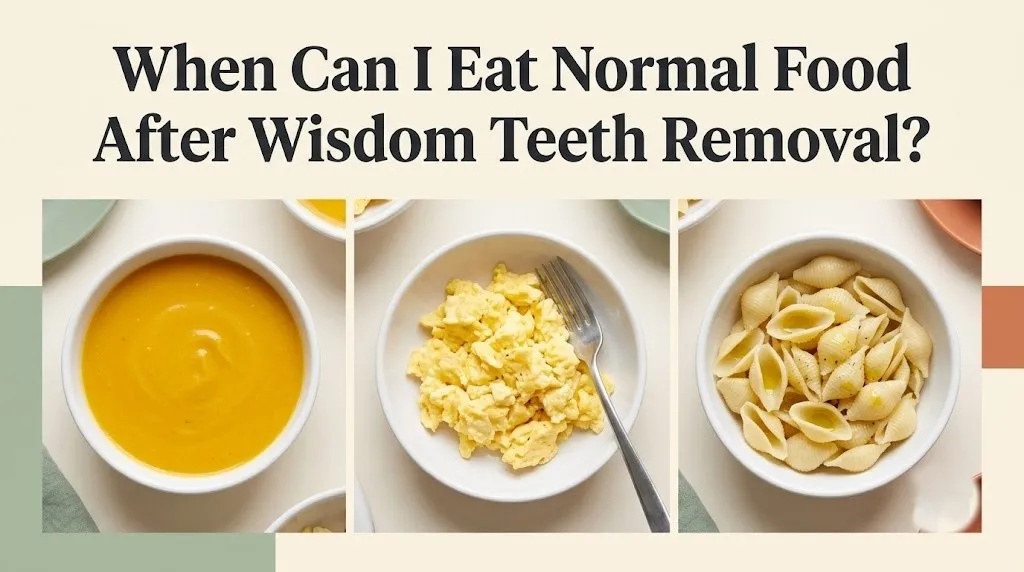
When Can I Eat Normal Food After Wisdom Teeth Removal?
You can generally reintroduce “normal” soft solid foods between day 5 and day 7, and true unrestricted normal eating returns around day 14 for most patients. The phrase “normal food” needs a precise definition here because it means different things to different people. A soft pasta dish is normal food. A baguette or a handful of almonds is not.
The first 24 to 48 hours post-extraction are strictly a liquid and pureed food period. Days 3 through 5 introduce mechanical soft foods that require minimal or no chewing. Days 6 through 10 allow progressively more texture, including foods you can gently chew with your front teeth or the side of your mouth opposite the extraction sites. By the end of week two, most people can eat nearly everything they ate before surgery, with the exception of extremely hard or sharp-edged foods like tortilla chips, popcorn, and nuts, which many oral surgeons recommend avoiding for a full three to four weeks.
The limiting factor is not your appetite or your boredom with mashed potatoes. It is the speed at which granulation tissue forms over the exposed bone in the socket and the epithelial layer closes across the top. That biological process cannot be accelerated beyond its natural pace. Chewing forces create negative pressure and physical abrasion that can strip away the fragile early tissue before it anchors securely.
When Can You Eat Normal Food After Wisdom Teeth Removal?
The answer is the same whether the question is “when can I” or “when can you.” The recovery timeline is roughly 7 to 10 days for soft normal food and 2 to 4 weeks for hard, crunchy, or sharp normal food. The reason for the range is biological variability. A 17-year-old with four fully erupted wisdom teeth removed without bone drilling will heal faster than a 35-year-old with four bony impactions that required sectioning the teeth and placing sutures.
Your personal recovery speed depends on factors that no online guide can assess for you. These include your age, overall nutritional status, whether you smoke or vape, your oral hygiene during recovery, and whether you have a condition like diabetes that slows wound closure. The American Dental Association notes that smoking is a major independent risk factor for delayed healing and dry socket. If you smoke, your timeline likely shifts later, and your surgeon’s advice about smoking cessation during the first 72 hours is non-negotiable from a healing standpoint.
Rather than fixating on a specific calendar day, learn to read your own mouth. The absence of throbbing pain, the visible closure of the socket site, and the ability to rinse gently without bleeding are better indicators than a calendar. Your surgeon can confirm tissue progress at a follow-up appointment, typically scheduled between day 7 and day 10.
When to Eat Normal Food After Wisdom Tooth Extraction
The standard clinical recommendation from oral and maxillofacial surgeons is to remain on a soft food diet for the first 7 days following a wisdom tooth extraction, and to avoid hard, crunchy, or chewy foods for at least 14 days. This timeline reflects the rate of soft tissue healing documented in post-operative wound studies.
During the first week, the empty socket is transitioning from an open bony defect protected only by a fibrin clot into a site covered by fragile granulation tissue. That tissue is highly vascular, meaning it bleeds easily. It also has almost no tensile strength. Biting into something chewy like a bagel or a piece of steak applies shear forces directly to the socket rim. The tissue can tear. If it tears, the clot underneath is exposed and can be lost.
Between days 7 and 14, the granulation tissue matures and the overlying epithelium begins to creep across the socket opening. This epithelial layer provides a smoother, more resilient surface. By day 14, most sockets are fully epithelialized, though the bone underneath continues remodeling for months. Once the socket is sealed by epithelium, the risk of dry socket essentially drops to zero, though the area may still feel tender when you bite down directly on it for several more weeks.
Key Takeaway: The 7-day mark is when most people feel ready, but the 14-day mark is when the socket is biologically sealed. Pushing too fast between those two dates is where complications happen.
When Can I Eat Normal Food After Wisdom Tooth Extraction?
You can start eating soft normal foods around day 5 to 7 after a straightforward extraction, but you should wait until at least day 10 to 14 before attempting anything hard, crunchy, or sharp. This guidance applies to the extraction of a single wisdom tooth or all four. Having four sites healing at once means four opportunities for a problem.
A useful rule of thumb is the “pasta test.” If you can comfortably eat a bowl of well-cooked penne without directing the food toward your back molars or pressing it into the socket area, you are likely ready for that texture. If pasta feels uncomfortable, you are not ready for anything firmer. If soft pasta goes well, you can gradually introduce flaky fish, tender shredded chicken, steamed vegetables, and soft bread over the following days.
The order of food reintroduction matters. You are not going from yogurt directly to tortilla chips. The progression is liquid, then puree, then soft solids that dissolve or mash easily against the tongue or palate, then foods that require gentle front-tooth biting, then foods that require actual molar chewing. Rushing the sequence is what causes problems, not the total number of days since surgery.
When Can I Eat Normal Food After Wisdom Teeth Surgery?
Surgery, as distinct from a simple extraction, implies impaction, bone removal, and often more extensive suturing. If your procedure involved surgical sectioning of the tooth, the recovery timeline for returning to normal food typically extends to 10 to 14 days for soft normal food and 3 to 4 weeks for hard foods.
Surgical extractions create a larger bony defect, more soft tissue trauma, and a greater inflammatory response. The sutures placed by the surgeon help approximate the gum tissue over the socket, but they do not create an instant seal. The tissue still has to heal beneath and between the sutures. Sutures that dissolve too early or are pulled by chewing forces can open the wound before the underlying granulation tissue is ready to stand on its own.
If your surgeon placed resorbable sutures, expect them to begin loosening or dissolving between day 5 and day 10. This is a normal part of healing and does not mean you can immediately eat normal food. In fact, the period when sutures loosen is a vulnerable window. The wound edges are no longer mechanically held together, and the new tissue is still fragile. Continue the soft food progression through this period even if the stitches are gone and the discomfort is minimal.
Healing Stage Overview:
| Healing Stage | Approximate Day | What Is Happening | Food Texture Safe |
|---|---|---|---|
| Clot formation | Day 0 to 2 | Fibrin clot stabilizes in socket | Liquids only |
| Granulation | Day 3 to 7 | New tissue fills socket from bottom up | Purees, soft solids |
| Epithelialization | Day 7 to 14 | Gum tissue seals over the top | Soft normal food |
| Bone remodeling | Week 4 to 6+ | Underlying bone fills in | Unrestricted eating |
When Can I Eat Normal Food Wisdom Teeth
This is the conversational search version of the main question, often typed by someone in a hurry or in pain. The answer remains that normal food, reasonably defined, returns around day 7 to 10, but true unrestricted eating takes two to four weeks. The gap between how long people want to wait and how long they should wait is the entire source of post-operative food complications.
Hunger is a legitimate problem during the first few days. A liquid diet, especially one that relies on broth and watered-down juice, is often calorically inadequate. When you are hungry and frustrated, the temptation to test a piece of bread or a French fry is strong. This is exactly how many dry sockets happen. The person feels fine on day 3, eats something with more texture than advised, feels a sharp pain later that night, and wakes up with a throbbing empty socket and a note to call the surgeon.
The solution is not to white-knuckle through hunger. It is to eat calorie-dense, protein-rich soft foods that actually satisfy your appetite and fuel tissue repair. A thin vegetable broth is not a meal during recovery. Blended lentil soup with olive oil, a protein shake with Greek yogurt and banana, or room-temperature scrambled eggs with mashed avocado are meals. Plan your soft food menu the same way you would plan normal meals, just with a blender and a texture check.
When Can I Start Chewing Food After Wisdom Teeth Removal?
You can begin gentle chewing of soft foods around day 4 to 5, but you must chew with your front teeth or on the side of your mouth opposite the extraction sites. Chewing directly on the surgical site before the socket has epithelialized, roughly day 10 to 14, risks dislodging the clot and causing dry socket.
Chewing is not an all-or-nothing activity. It is a spectrum of force and location. Biting into a soft scrambled egg requires minimal force and can be managed with the tongue and palate. Chewing a piece of grilled chicken requires sustained molar pressure and lateral tongue movement that shifts food directly over the extraction site. These are different events, and the safe window for the first opens much earlier than the safe window for the second.
When you first reintroduce chewing, be deliberate. Cut food into very small pieces before it enters your mouth. Do not rely on your teeth to tear or reduce the food. Bring the fork to your mouth with pieces no larger than a pea. Let saliva and the tongue do most of the breakdown work. Think of the first few days of chewing as a texture exploration, not a meal experience. If you feel any pulling sensation on the sutures or a sharp ache in the socket, stop immediately and step back to softer foods for another day or two.
Can I Eat Solid Food 5 Days After Tooth Extraction?
Yes, you can eat soft solid food 5 days after a routine wisdom tooth extraction. This does not mean you can eat any solid food you want. “Solid” at day 5 means foods that hold their shape but yield easily to gentle pressure without fracturing into sharp pieces.
Safe day 5 solids include foods like well-cooked pasta without chunky vegetables, flaky baked fish, soft scrambled eggs, pancakes with syrup, oatmeal, steamed and mashed sweet potatoes, ripe banana, cottage cheese, and soft bread with the crust removed. Unsafe day 5 solids include raw vegetables, nuts, seeds, chips, crusty bread, tough meat, chewy candy, and anything that could produce sharp crumbs or require significant grinding with the molars.
The distinction between safe and unsafe solid food at this stage is not about the food being “solid” but about whether it produces painful negative pressure, requires grinding, or breaks into sharp-edged fragments. A chip is a solid. A soft pasta shell is a solid. One will destroy a fibrin clot in five seconds. The other will dissolve harmlessly against your palate. The caloric density of food does not determine safety. The mechanical properties do.
Day 5 Food Safety Table:
| Safe to Eat at Day 5 | Unsafe at Day 5 |
|---|---|
| Scrambled eggs | Toast or bagels |
| Flaky fish (baked cod, tilapia) | Grilled chicken breast |
| Mashed sweet potato | Raw carrots or celery |
| Soft pasta with butter | Popcorn |
| Ripe banana | Nuts and seeds |
| Cottage cheese | Tortilla chips |
| Pancakes with syrup | Crusty bread or rolls |
Key Takeaway: Day 5 is the turning point, but only if you respect the difference between soft solid food and mechanically challenging solid food. Your mouth decides the pace. Your calendar is just a rough guide.
Soft Food Diet Timeline After Wisdom Teeth Removal
The soft food diet follows a predictable 14-day progression from liquids to unrestricted eating, and skipping a stage is the most common dietary mistake patients make. Here is exactly what each stage looks like with named foods.
Days 0 to 2 (Liquid and Pureed Stage):
Everything must be pourable or spoonable with zero chewing. Room temperature or cool foods only. No straws, no spitting, no suction. Acceptable options include smooth yogurt, blended protein shakes with no seeds, thin applesauce, lukewarm broth, pudding, and smooth cream soups with no particulate. Avoid any fruit with small seeds like strawberries or raspberries even blended, because the seeds can lodge in the socket.
Days 3 to 5 (Mechanical Soft Stage):
Foods that hold a shape but mash easily with the tongue or a fork. Scrambled eggs, mashed potatoes with sour cream, polenta, oatmeal, hummus, cottage cheese, ricotta, well-cooked pasta shells with butter, soft meatballs in sauce, flaky baked salmon, and avocado. Cut or break everything into pieces no larger than a pea before eating.
Days 6 to 10 (Soft Normal Food Stage):
Foods that require gentle chewing but no grinding. Soft bread without crust, pancakes, tender shredded chicken, steamed vegetables like zucchini or spinach, soft cheese, and casseroles. Still avoid direct chewing on the extraction site.
Days 10 to 14 and Beyond (Progressive Return to Normal):
Gradually reintroduce firmer foods as comfort allows. Steak, raw apples, nuts, and chips should wait until at least day 14, and many surgeons recommend day 21 or longer for truly hard or sharp foods.
Protein-Rich Soft Foods for Dental Surgery Recovery
Protein is the single most important macronutrient during post-surgical recovery, yet most people accidentally under-eat protein during the first week because their default soft foods are carbohydrate-heavy. Mashed potatoes, applesauce, popsicles, and broth are comfort foods, but they are not recovery foods. The Academy of Nutrition and Dietetics identifies protein as the primary substrate for tissue repair, collagen synthesis, and immune function following surgery.
Your body is literally rebuilding gum tissue and generating new blood vessels in the socket. That process requires amino acids, especially glycine, proline, and lysine, which are abundant in animal proteins and also available through complementary plant protein combinations. A person recovering from wisdom tooth extraction should aim for roughly 1.2 to 1.5 grams of protein per kilogram of body weight per day during the first week of healing. For a 150-pound adult, that is approximately 80 to 100 grams of protein daily. A cup of broth contains about 5 grams. A cup of Greek yogurt contains roughly 20 grams. The math favors real food.
Greek yogurt, cottage cheese, ricotta, silken tofu, scrambled eggs, protein shakes, bone broth with added unflavored collagen, pureed lentil soup, hummus, and soft-cooked ground meat are all protein-dense and texture-appropriate. If you blend a smoothie, add a scoop of plain whey or pea protein. If you make oatmeal, stir in an egg while it is hot and stir vigorously to create a custard texture. These small protein additions make a meaningful difference in healing speed and energy levels during the recovery week.
High-Protein Soft Food Ideas:
- Full-fat Greek yogurt with honey and smooth almond butter
- Scrambled eggs with melted cream cheese folded in
- Blended lentil soup with olive oil and a scoop of collagen peptides
- Silken tofu blended into a smoothie with banana and peanut butter
- Cottage cheese whipped until smooth, topped with avocado puree
Foods That Prevent Dry Socket After Extraction
No food can guarantee dry socket prevention, but food choices and eating mechanics directly influence your risk level. Dry socket occurs when the protective fibrin clot in the extraction socket is dislodged or dissolved prematurely, exposing the underlying bone to air, food debris, and oral bacteria. The pain is severe and typically requires professional intervention to pack the socket with a medicated dressing.
Foods that mechanically threaten the clot are the primary dietary risk factor. Small, hard, sharp, or particulate foods can physically scrape the clot out of the socket. Popcorn kernels, nut fragments, chip shards, and even granola or seeded breadcrumbs are high-risk items that should be avoided for a minimum of two weeks, and preferably longer for popcorn and nuts which produce sharp, durable fragments.
Suction and negative pressure are equally dangerous. Drinking through a straw, sucking on hard candy, or even forcefully swishing liquid while rinsing can generate enough negative oral pressure to lift the clot out of the socket. The no-straw rule is not arbitrary. A 2021 review of post-extraction complications in the Journal of Oral and Maxillofacial Surgery reaffirmed that suction forces are a well-documented risk factor for alveolar osteitis. Eat slowly. Let food dissolve. Do not suck, spit, or swish aggressively for the first 7 days.
Dry Socket Prevention Checklist:
- No straws for at least 7 days
- No smoking or vaping for at least 72 hours, ideally the full first week
- No carbonated beverages for the first 5 days
- No hard, crunchy, or particulate foods for at least 14 days
- Rinse gently with warm salt water after day 2, do not swish forcefully
Day by Day Food Guide After Wisdom Teeth Removal
This day-by-day guide translates the clinical timeline into specific meals. Every person heals at a different rate, and your surgeon’s instructions take precedence, but this structure reflects the standard clinical progression.
Day 1: Cold and room-temperature liquids only. Smooth yogurt, pudding, thin applesauce, blended protein shake, lukewarm broth. Apply ice packs to the jaw on a 20-minutes-on, 20-minutes-off cycle. Do not use a straw. Do not rinse your mouth.
Day 2: Continue liquids and very smooth purees. Slightly thicker options like full-fat Greek yogurt, blended soup, and smoothies with no seeds or pulp. Begin gentle warm salt water rinses after 24 hours if your surgeon approves, tipping your head side to side rather than swishing.
Day 3: Introduce true purees and the first extremely soft solids. Mashed potatoes with butter, scrambled eggs, polenta, hummus, and whipped cottage cheese. Calories and protein should increase today.
Day 4: Soft foods that require minimal tongue manipulation. Well-cooked pasta with olive oil, flaky baked fish, soft meatballs, and ripe avocado. Cut everything into small pieces.
Day 5: Soft solids with more variety. Pancakes with syrup, soft bread without crust, macaroni and cheese, shredded chicken in sauce, steamed spinach. Still avoid chewing near the extraction sites.
Day 6 to 7: Progressively normal soft foods. Tender ground beef, soft cheese, well-cooked vegetables, and casseroles. The socket should be filling in with granulation tissue.
Day 8 to 14: Gradually reintroduce firmer foods based on comfort. Avoid hard, crunchy, and sharp foods until at least day 14.
Key Takeaway: Days 3 through 5 are the danger zone where you feel better but the socket is still vulnerable. Those are the days when most people push too fast and trigger a dry socket.
When Can I Eat Crunchy Food After Wisdom Tooth Removal?
Crunchy foods like chips, raw carrots, nuts, popcorn, hard crackers, and crusty bread should be avoided for at least 14 to 21 days after wisdom tooth removal. Even if the socket appears closed on the surface, the underlying tissue is still soft and the bone underneath continues remodeling for months.
Crunchy foods present a unique hazard because they fracture into sharp, irregular fragments under the pressure of biting. A tortilla chip does not dissolve like pasta. It shatters into hard, pointed shards that can be driven directly into the healing socket by normal chewing forces. This is not a theoretical risk. It is a common mechanism of post-operative wound disruption.
Popcorn deserves a special warning because it combines two hazards. The kernel hulls are thin, sharp, and durable enough to slip between the gum and the tooth. The popped portion is light and easily sucked toward the back of the mouth where it can lodge in the socket. Even fully healed months later, popcorn hulls are a notorious cause of gum irritation. During the first month post-extraction, they are a legitimate hazard. Wait at least 3 to 4 weeks, and when you do reintroduce popcorn, rinse thoroughly afterward.
Signs You Are Ready to Eat Normal Food After Extraction
Your mouth will tell you when it is ready for normal food, and the signs are specific. The primary indicator is the absence of pain when gently pressing a soft piece of food against the extraction site. If you can press a piece of soft bread or pasta against the socket area with your tongue and feel no sharp ache, the tissue is likely epithelialized.
Visual inspection helps. In the first few days, the socket looks like a dark hole or a blood-filled crater. By day 7, you should see whitish or pinkish tissue filling the space. This is granulation tissue, and it is a good sign. By day 10 to 14, the socket opening should appear significantly smaller, with gum-colored tissue closing across the top. If you see exposed white material that looks like bone, or if the socket is empty and painful, you may have lost the clot and need to see your surgeon.
Functional readiness matters too. If you can chew soft food comfortably on the opposite side without feeling pain referred to the extraction site, you can progress. If chewing causes a dull ache that lingers after the meal, your body is telling you to slow down. Pain that increases over several hours after eating is a red flag for food debris impaction or early dry socket. Rinse gently with warm salt water and step back to softer foods for the rest of the day. If the pain persists or intensifies, contact your surgeon’s office.
Readiness Checklist:
- No throbbing or sharp pain when pressing soft food against the socket
- Socket appears filled with pink or white tissue, not a deep dark hole
- Gentle salt water rinsing causes no bleeding or pain
- Chewing on the opposite side feels comfortable and pain-free
- No increase in pain, swelling, or foul taste several hours after eating
Nutritional Needs During Oral Surgery Recovery
The body’s demand for calories, protein, vitamin C, and zinc increases measurably during post-surgical wound healing. Eating only comfort foods like ice cream, broth, and applesauce during the first week can leave a patient malnourished at precisely the moment their body needs repair substrates.
Vitamin C, also known as ascorbic acid, is a required cofactor for collagen synthesis. Collagen is the structural protein that forms the scaffolding for new tissue in the socket. Without adequate vitamin C, collagen cross-linking is impaired, and wound tensile strength is reduced. The National Institutes of Health Office of Dietary Supplements recommends a daily intake of 75 to 90 milligrams for adults, but surgical recovery may temporarily increase demand. Smooth pureed foods that are rich in vitamin C include well-blended mango, cantaloupe, and cooked red bell pepper puree. Avoid raw citrus, which is too acidic for the first few days and can sting the wound.
Zinc is another wound-healing micronutrient that is often under-consumed during a soft food diet. Zinc supports cell proliferation, immune function, and protein synthesis. Good soft food sources include pureed chickpeas or hummus, well-cooked ground beef or lamb, and soft scrambled eggs. A single serving of hummus with olive oil provides protein, zinc, and calorie density in a texture that is safe by day 3 or 4.
Key Takeaway: Do not let the soft food restriction trick you into a nutrient-poor recovery week. Blend soups with beans and olive oil. Add protein powder to smoothies. Eat eggs. Your body is building tissue out of what you feed it.
Frequently Asked Questions About Eating After Wisdom Teeth Removal
How many days after wisdom teeth removal can I eat solid food?
You can eat soft solid food around day 5 to 7 after a routine extraction.
Hard or crunchy solid foods should wait until day 14 or longer.
The exact timing depends on your healing speed and the complexity of your surgery.
What happens if I eat normal food too soon after wisdom teeth removal?
Eating hard, crunchy, or chewy food too soon can dislodge the protective blood clot.
This causes alveolar osteitis, or dry socket, which is a painful exposed bone condition.
A dislodged clot also delays overall healing and may require additional treatment from your surgeon.
Can I eat pizza 5 days after wisdom teeth removal?
Pizza is not recommended 5 days after wisdom teeth removal.
The crust is too hard and crunchy, and chewing cheese can pull on the healing sockets.
Wait until at least day 10 to 14, and start with a very soft, thin-crust piece cut into small bites.
What are the best high-protein soft foods after dental surgery?
Greek yogurt, scrambled eggs, cottage cheese, and blended lentil soup are excellent protein sources.
Protein shakes with added collagen or whey protein also work well.
Silken tofu blended into smoothies provides plant-based protein in a completely safe texture.
How do I know my wisdom teeth sockets are healed enough for normal food?
The socket should appear filled with pink tissue, not a dark empty hole.
Gently pressing soft food against the area with your tongue should cause no pain.
If chewing produces no discomfort during or after eating, your socket is likely ready for normal textures.
Recovery from wisdom teeth removal is a two-week nutritional project, not just a waiting game. The person who eats strategically, prioritizing protein and calories in safe textures, heals faster and with fewer complications than the person who subsists on popsicles and hope. The oral surgeons have done their part by removing the teeth under sterile conditions. Your part is to protect the clot, fuel the repair process, and not let impatience at the dinner table undo the expensive work that was just done inside your jaw.
When you feel frustrated on day 4, remember that the socket heals from the bottom up, not the top down. The fragile new tissue you cannot see is doing its job. Give it the soft, nutrient-dense foods it needs and keep crunchy, sharp, and chewy foods off the menu for a full two weeks. Your follow-up appointment will confirm what your body already knows if you feed it right and leave the chips alone.