A soft food diet is a medically prescribed eating plan consisting of foods that are tender, moist, and easy to mash with a fork, requiring minimal chewing to form a safe, cohesive bolus for swallowing. This diet is not a weight-loss fad. It is a temporary therapeutic intervention designed to protect healing tissue in the mouth, throat, or digestive tract while preventing malnutrition. A person on this diet might be recovering from a wisdom tooth extraction, managing a painful flare of diverticulitis, or navigating the swallowing difficulties of dysphagia after a stroke.
The International Dysphagia Diet Standardisation Initiative (IDDSI) provides a global framework for texture-modified diets, ranging from Level 0 (thin liquids) to Level 7 (regular food). A standard soft food diet typically aligns with IDDSI Level 6 (Soft and Bite-Sized) . Food must be soft enough to be broken apart with the side of a fork or spoon, and pieces should be no larger than 1.5 centimeters by 1.5 centimeters for adults to reduce choking risk.
This guide covers the full spectrum of the soft food diet, from the basic definition to detailed lists of what you can eat, specific answers about rice, pasta, chicken, and bread, and the critical nutritional strategies for getting enough protein and fiber. This is educational information for managing a prescribed diet. The specific texture and progression of your diet should be confirmed with your treating physician or speech-language pathologist based on your individual condition.
what is a soft food diet
A soft food diet is a texture-modified diet that eliminates hard, crunchy, chewy, and fibrous foods, replacing them with options that can be easily mashed with a fork and swallowed with minimal effort. The goal is to provide adequate nutrition while minimizing the mechanical work of chewing and the risk of food particles irritating or obstructing sensitive tissues.
The physiological principle behind the diet is reducing the “bolus load.” A bolus is the mass of chewed food that the tongue presses against the palate and propels backward into the pharynx. Hard, dry, or crumbly foods create a rough, fragmented bolus that requires precise muscular control to swallow safely. Soft, cohesive foods create a smooth, unified bolus that slides easily down the esophagus. This is why mashed potatoes are a classic soft diet staple and dry toast is not.
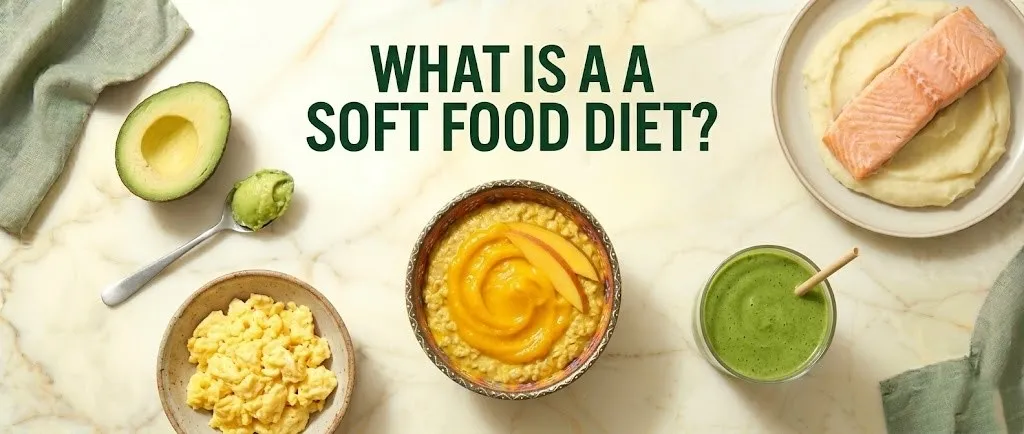
The clinical applications of a soft food diet span multiple medical disciplines. Dentists prescribe it after extractions, implants, and jaw surgery. Gastroenterologists recommend it during acute diverticulitis, Crohn’s disease flares, and esophageal strictures. Speech-language pathologists use it as a transitional diet for patients regaining swallowing function after a stroke. The underlying principle, protect the tissue and prevent aspiration, is the same across all these applications.
| Medical Reason | Purpose of Soft Food Diet |
|---|---|
| Dental Surgery | Prevent dry socket, protect sutures |
| Dysphagia (Stroke, Parkinson’s) | Prevent aspiration pneumonia |
| Diverticulitis Flare | Reduce intestinal residue |
| Bariatric Surgery | Allow staple line to heal |
| Esophageal Stricture | Prevent food impaction |
what does a soft food diet consist of
A soft food diet consists of tender, moist proteins, well-cooked or canned vegetables and fruits, refined grains, dairy products, and smooth nut butters, all prepared without hard crusts, seeds, skins, or tough fibers. The diet is not nutritionally restrictive. It is texturally restrictive.
The protein category forms the foundation of the soft food diet. Scrambled eggs are the perfect soft protein: tender, moist, and easy to swallow. Poached or baked fish, particularly flaky white fish like cod and tilapia, separates easily with a fork. Ground meats cooked in a moist sauce, like a bolognese or a sloppy joe filling, are safe. Tofu and tempeh are naturally soft. Legumes like lentils and refried beans are excellent. The key is moisture. A dry, overcooked chicken breast is not a soft food, even though it is chicken. A chicken thigh braised in chicken stock until it falls apart is a soft food.
The grain and starch category must be cooked until tender. Oatmeal, cream of wheat, soft-cooked pasta, well-cooked white rice, mashed potatoes, and soft bread without crust or seeds are all acceptable. The vegetable and fruit category requires peeling, seeding, and cooking. Applesauce, mashed banana, canned peaches, steamed carrots, and mashed winter squash are safe. Raw vegetables and fruits with tough skins are not.
- Protein: Scrambled eggs, flaky fish, ground meats, silken tofu, refried beans.
- Grains: Oatmeal, cream of rice, soft pasta, moist rice, soft bread.
- Vegetables: Mashed potatoes, steamed carrots, pureed squash, avocado.
- Fruits: Applesauce, mashed banana, canned peaches, smoothies.
- Dairy: Yogurt, cottage cheese, pudding, milkshakes.
what is considered a soft food diet
A soft food diet is considered a medically necessary, short-term therapeutic diet that prioritizes food texture and safety over culinary variety. It is defined by what it excludes as much as what it includes. A soft food diet is a cohesive framework of protein, starch, fruit, vegetables, and fat, all modified to a fork-tender consistency.
The medical definition excludes any food that requires incisive biting (like a raw apple), grinding (like nuts), or prolonged chewing (like a tough steak). It also excludes foods that are sticky (like thick peanut butter or caramel), dry (like crackers or popcorn), or have sharp edges (like tortilla chips). These foods pose a physical risk to healing tissues and a functional risk to impaired swallowing mechanisms.
The diet is considered “mechanical soft” when the food requires some light chewing. It is considered “puréed” when the food is blended to a smooth, pudding-like consistency with no lumps. The distinction between these two levels is critical for a person with dysphagia. A person on a mechanical soft diet can safely manage a small, soft piece of carrot. A person on a puréed diet might aspirate that same piece. Your medical team will specify which level of texture modification you require.
- Mechanical soft: Soft, fork-tender, requires some chewing.
- Puréed: Blended smooth, no lumps, pudding consistency.
- Both exclude: Hard, crunchy, sticky, fibrous, dry, or sharp foods.
Key Takeaway: A soft food diet is a medical prescription, not a lifestyle choice. The precise texture level, mechanical soft or puréed, is a safety instruction, not a suggestion.
what can you eat on a soft food diet
You can eat scrambled eggs, oatmeal, yogurt, applesauce, mashed potatoes, flaky fish, ground meat in sauce, smoothies, and well-cooked pasta on a soft food diet. The list of permissible foods is long and varied. The rule is that every food must pass the “fork test”: it can be easily mashed with the side of a fork and holds its shape on a spoon without dripping.
Breakfast on a soft food diet can include a bowl of warm oatmeal made with milk and stirred with a spoonful of smooth almond butter for protein. A scrambled egg with melted cheese is a protein-rich option that takes seconds to prepare. A smoothie made with yogurt, a ripe banana, and a splash of milk is a cool, soothing option for a sore throat.
Lunch and dinner options are where creativity is required to avoid palate fatigue. A shepherd’s pie made with very finely minced ground lamb and topped with creamy mashed potatoes is a complete, satisfying soft meal. A brothy soup with shredded chicken, overcooked rice, and pureed vegetables, like a classic chicken and rice soup with the vegetables blended into the broth, is nourishing and safe. Canned tuna mixed with a generous amount of mayonnaise or mashed avocado and served with the soft inside of a baked potato is another filling option.
- Breakfast: Oatmeal, scrambled eggs, yogurt, smoothies, cream of wheat.
- Lunch: Cottage cheese with canned peaches, tuna salad, pureed lentil soup.
- Dinner: Shepherd’s pie, braised flaky fish, ground chicken in marinara over soft polenta.
- Desserts: Pudding, ice cream, gelatin, applesauce.
what can i eat on a soft food diet
You can eat anything that is tender, moist, and not crunchy, chewy, or spicy. The “I” in this search query reveals a person who is currently on the diet, standing in their kitchen, hungry, and looking for an immediate answer. The answer is a list of safe, satisfying foods that do not taste like bland hospital food.
You can eat the inside of a baked potato loaded with sour cream, butter, and shredded cheese. The skin is too fibrous, but the fluffy interior is perfect. You can eat avocado, which is nature’s soft food, scooped right from the shell with a spoon. You can eat hummus, which is smooth and protein-rich, paired with the soft inside of pita bread rather than crunchy pita chips. You can eat a bowl of chili if the meat is finely ground and the beans are well-cooked and slightly mashed.
You can also eat dessert. Ice cream, pudding, and gelatin are classic soft diet foods, but they are nutritionally empty. For a more nutritious dessert, try a smoothie bowl made with frozen mango, yogurt, and a splash of milk, blended until thick and creamy. You can also bake a cored apple or pear until it is completely soft and serve it with a drizzle of honey and a dollop of whipped cream. The soft diet is not a punishment. It is an exercise in creative, texture-conscious cooking.
- Inside of a baked potato with toppings.
- Avocado, hummus, baba ghanoush.
- Smoothies and smoothie bowls.
- Baked apples or pears.
- Pudding, ice cream, gelatin.
what to eat on a soft food diet
What to eat on a soft food diet is a rotation of soft proteins, cooked produce, and refined grains, ensuring each meal contains adequate calories and protein to promote healing and prevent the unintentional weight loss that often accompanies this diet. The question is about meal planning.
Protein must be the star of every meal. Wound healing, whether from a tooth extraction or abdominal surgery, requires a significant amount of amino acids. The body’s demand for protein increases during recovery. A person who eats only applesauce and popsicles after oral surgery will experience prolonged healing and significant muscle loss. Every meal should be built around a protein source, with the grains and produce added for energy and micronutrients.
A sample day on a soft food diet might look like this. For breakfast, scrambled eggs with cheese and a small bowl of oatmeal. For lunch, a bowl of cream of tomato soup with a scoop of protein powder or collagen peptides stirred in, and a cup of cottage cheese. For an afternoon snack, a smoothie made with full-fat Greek yogurt, banana, and peanut butter. For dinner, braised, shredded chicken thighs mixed with a soft-cooked pasta and a drizzle of olive oil. This meal plan delivers protein, fat, and calories in a form that requires almost no chewing.
- Build meals around protein: eggs, fish, ground meat, tofu, dairy.
- Add calorie boosters: olive oil, butter, cream, avocado.
- Cook produce: steam, boil, or roast until fork-tender.
- Snack strategically: smoothies, yogurt, cottage cheese.
Key Takeaway: The biggest risk of a soft food diet is not boredom. It is malnutrition. Build every meal around a protein source and add extra calories wherever you can.
what is considered soft food
Soft food is any food that can be easily mashed with a fork into a smooth, cohesive paste without leaving hard lumps or fibrous strands. The fork test is the practical, at-home standard for determining whether a food is safe for a soft diet. If you can easily mash it with the side of a fork, it is a soft food.
The characteristics of a soft food are tenderness, moisture, and cohesiveness. Tenderness means the food yields to gentle pressure. Moisture means it is not dry or crumbly. Cohesiveness means it holds together in a ball rather than separating into pieces in the mouth. A dry, overcooked hard-boiled egg yolk is crumbly and not cohesive. It is not a soft food. A soft-scrambled egg is tender, moist, and cohesive. It is a perfect soft food.
The fork test is reliable for most foods but has limits. A slice of soft white bread passes the fork test. A thick, crusty sourdough does not. A banana passes easily. A fresh, crispy apple does not. Steamed broccoli florets might pass, but the fibrous stalk definitely does not. The fork test must be applied to the exact piece of food you are about to eat.
- Fork test: Can it be easily mashed with the side of a fork?
- Tender: Yields to gentle pressure.
- Moist: Not dry, crumbly, or sticky.
- Cohesive: Holds together in a smooth mass.
what soft food can i eat
You can eat mashed potatoes, yogurt, scrambled eggs, oatmeal, applesauce, refried beans, avocado, cottage cheese, pudding, smoothies, well-cooked pasta, flaky fish, ground meat, and canned fruit. This is the specific, actionable list. Print this section and put it on your refrigerator.
The soft food diet is compatible with almost any cuisine. For a Mexican-inspired meal, eat refried beans, guacamole, sour cream, and the soft inside of a tortilla. For an Italian-inspired meal, eat soft polenta with a ground meat ragu, or ricotta cheese mixed with marinara sauce and soft pasta. For an Asian-inspired meal, eat congee (rice porridge) with a soft-poached egg and a drizzle of soy sauce, or silken tofu with a ginger-scallion sauce.
The psychological challenge of the soft diet is the monotony of sweet, bland foods. The solution is savory, flavorful soft foods. Season your mashed potatoes generously with garlic powder and butter. Add hot sauce to your scrambled eggs if your mouth can tolerate it. Use soy sauce, miso paste, and smooth pesto to add flavor to soft proteins and grains.
- Savory: Refried beans, guacamole, soft polenta, congee, silken tofu.
- Sweet: Applesauce, canned peaches, yogurt, smoothies, pudding.
- Flavor boosters: Garlic powder, smooth pesto, soy sauce, miso paste.
is rice a soft food
Well-cooked, moist white rice is a soft food, but dry, al dente, or wild rice is not. The softness of rice depends entirely on the water-to-rice ratio and the cooking time. Overcooked rice that is slightly sticky and clumps together is ideal for a soft diet. The grains should be plump, tender, and yield completely to the pressure of a fork or the tongue.
The safety risk with rice on a soft food diet is the individual grain. A single grain of rice is small and soft, but it is also a discrete particle. For a person with dental pain, rice grains can easily become lodged in extraction sockets or between teeth. For a person with dysphagia, a large number of loose individual rice grains can be difficult to form into a cohesive bolus. The solution is to serve rice mixed with a generous amount of sauce, gravy, or broth, which helps the grains clump together.
For those on a puréed diet, rice is not suitable unless it is blended into a soup or a smooth porridge. Congee, the Asian rice porridge, is the ideal puréed rice dish. It is made by boiling rice in a large volume of water or broth for an hour or more until the grains break down completely into a smooth, easily swallowed porridge.
- Soft rice: Overcooked white rice, sticky rice, rice in sauce.
- Not soft rice: Dry steamed rice, wild rice, brown rice, al dente risotto.
- Puréed alternative: Congee (rice porridge).
Key Takeaway: Rice is soft and safe only when it is overcooked and moist enough to clump together. A dry pile of separate grains is a choking risk.
is pasta a soft food
Well-cooked pasta is a soft food, particularly small shapes like ditalini, orzo, or elbows, and large flat noodles like lasagna when baked with ample sauce. Overcooked pasta, cooked past the al dente stage until it is completely tender, is safe for a soft diet. The pasta should yield completely to a fork and require minimal chewing.
The shape and size of the pasta matter for safety. Long, thin noodles like spaghetti and linguine can be difficult to manage for someone with a sore jaw or a weak swallow. They tend to dangle and require a coordinated lip and tongue movement to gather into the mouth. Short, small shapes are much safer. Orzo, pastina, and ditalini can be eaten with a spoon and swallowed easily.
Pasta must be served with a sauce. Dry, sticky pasta is difficult to swallow and can trigger a gag reflex. A generous coating of olive oil, butter, marinara sauce, or a cream-based sauce lubricates the pasta and ensures it slides smoothly. Baked pasta dishes like lasagna, when cooked until the noodles are completely soft, are excellent soft diet options. The combination of soft noodles, ricotta cheese, and sauce is cohesive and easy to manage.
- Soft pasta: Overcooked small shapes, lasagna, macaroni and cheese.
- Not soft pasta: Al dente spaghetti, baked ziti with dry edges, cold pasta salad.
- Sauce is non-negotiable: Olive oil, butter, marinara, cream sauce.
is chicken a soft food
Chicken is not inherently a soft food. A dry, grilled chicken breast is one of the most difficult foods to manage on a soft diet. However, chicken can be prepared to be a soft food when it is ground, finely minced, or slow-cooked until the meat falls apart completely.
The texture of chicken is determined by the cooking method. Slow-cooking methods, like braising and stewing, break down the collagen in the chicken’s connective tissue, transforming it from a tough, fibrous protein into a tender, shreddable texture. Chicken thighs, which have more fat and connective tissue than breasts, are better suited for a soft diet. Cook them in a slow cooker or a Dutch oven with broth until the meat shreds easily with a fork.
Ground chicken is the safest option for a soft diet. It can be cooked in a pan with broth or sauce until it is finely crumbled and moist. Avoid large chunks of ground chicken that form during cooking. Break them up continuously with a spatula. The cooked ground chicken can be mixed into pasta sauce, soup, or mashed potatoes for a protein boost. Canned chicken, which is pressure-cooked and very tender, is also an acceptable option when mixed with mayonnaise or avocado for moisture.
- Soft chicken: Ground chicken, braised and shredded thighs, canned chicken.
- Not soft chicken: Grilled breast, fried chicken, dry baked chicken.
- Preparation rule: Always cook with liquid (broth, sauce) to ensure moisture.
is bread soft food
Soft, white sandwich bread without crusts, seeds, or nuts is a soft food, but it requires caution because bread can form a sticky, gummy bolus in the mouth that is difficult to swallow for people with impaired oral control. Bread is a borderline soft food. It passes the fork test. It does not always pass the swallow test.
The danger of bread on a soft food diet is the “gumming effect.” When bread mixes with saliva, it can become a sticky, doughy mass that adheres to the palate and the back of the throat. For a person recovering from a tonsillectomy, this sticky bolus is painful to swallow. For a person with dysphagia, it can be an aspiration risk. The risk is highest with fresh, spongy white bread. Toasting the bread lightly and cutting off the crusts reduces the gumming effect, but it also makes the bread slightly harder.
If you choose to eat bread on a soft food diet, it must be soaked. Dip the soft bread into soup, broth, milk, or a sauce until it is fully saturated and spoon-soft. This eliminates the gumming risk and turns the bread into a safe, easy-to-swallow mush. Biscuits, pancakes, and muffins that have been soaked in milk or syrup are also acceptable when prepared this way.
- Soft bread: Soft white bread, soaked in liquid until spoon-soft.
- Not soft bread: Crusty artisan bread, bagels, toast with hard crust.
- Preparation rule: Soak it. Do not eat bread dry.
Key Takeaway: Bread is safe only when it is soft, crustless, and thoroughly soaked in liquid. Dry bread can become a sticky, dangerous bolus.
how to get enough protein on a soft diet
You get enough protein on a soft diet by incorporating a soft, high-protein food into every meal and snack, using nutritional supplements if necessary, and fortifying soft foods with unflavored protein powders or collagen peptides. The protein target for a healing adult is 1.2 to 1.5 grams of protein per kilogram of body weight per day, which is significantly higher than the standard 0.8 grams.
The most effective strategy is to identify your “protein anchors.” These are the foods that naturally pack protein into a soft format. Greek yogurt delivers 15 to 20 grams of protein per cup. Cottage cheese delivers 25 grams per cup. Scrambled eggs deliver 12 grams for two eggs. Silken tofu delivers 10 grams per half-cup. These foods should appear at least twice a day.
Protein fortification is the hidden weapon of the soft food diet. Unflavored collagen peptides dissolve completely in hot liquids and add 10 grams of protein per scoop without changing the taste or texture of coffee, soup, or oatmeal. Whey protein isolate can be blended into smoothies and yogurt bowls. Bone broth, simmered for 24 hours, contains collagen and protein and can be used as the cooking liquid for rice and pasta.
- Greek yogurt: 15 to 20g protein per cup.
- Cottage cheese: 25g protein per cup.
- Scrambled eggs: 12g for two eggs.
- Collagen peptides: 10g per scoop, dissolves invisibly in liquids.
high-fiber soft foods for constipation
High-fiber soft foods that prevent constipation on a soft food diet include mashed beans, avocado, well-cooked oatmeal, smooth nut butters, pureed prunes, and ground flaxseed. Constipation is a common side effect of the soft food diet because many soft foods are low in fiber and residue.
The mechanism of constipation on a soft food diet is straightforward. Fiber adds bulk to stool and stimulates peristalsis, the wave-like muscle contractions that move waste through the colon. A diet of white rice, white pasta, and dairy products contains very little fiber. The gut slows down. Adding specific, soft sources of fiber is necessary to keep the digestive system moving.
Ground flaxseed is the most effective fiber supplement for a soft food diet. A tablespoon of ground flaxseed provides 3 grams of fiber and can be stirred into oatmeal, yogurt, or smoothies without affecting texture. Mashed beans, like refried black beans or hummus, provide both protein and fiber. Avocado is a soft, calorie-dense source of both soluble and insoluble fiber. Pureed prunes are a traditional remedy for constipation and remain effective on a soft diet.
- Ground flaxseed: 3g fiber per tablespoon. Stir into everything.
- Mashed beans: Protein and fiber in one soft package.
- Avocado: Soft, calorie-dense, high in fiber.
- Pureed prunes: Classic, effective, naturally sweet.
soft food diet recipes 2026
Soft food diet recipes in 2026 focus on high-protein, high-flavor meals that look and taste like real food, not an afterthought. The trend has moved away from plain, underseasoned mush toward globally inspired, nutritionally fortified soft meals. A standout recipe is the “Golden Milk Oatmeal with Collagen and Mango Purée.”
This recipe combines the anti-inflammatory benefits of turmeric with the protein punch of collagen and the fiber of oatmeal. Cook 1/2 cup of rolled oats in 1 cup of milk with 1/2 teaspoon of turmeric, a pinch of black pepper, and 1 scoop of unflavored collagen peptides. Stir constantly until the oatmeal is thick and creamy. Pour it into a bowl and top with a swirl of mango purée. The oatmeal is soft, golden, and packed with roughly 25 grams of protein.
A savory dinner option is the “Miso-Glazed Salmon and Cauliflower Purée.” Steam or poach a salmon fillet until it flakes easily with a fork. Glaze it with a mixture of white miso paste, a drop of honey, and warm water. Serve it on a bed of cauliflower purée made by steaming cauliflower until completely soft and blending it with butter, salt, and a splash of cream. The salmon is tender, the purée is smooth, and the miso glaze provides a deep savory flavor that masks the “soft diet” feel.
- Golden Milk Oatmeal: Oats, milk, turmeric, collagen, mango purée.
- Miso-Glazed Salmon and Cauliflower Purée: Flaky fish, umami glaze, smooth vegetable base.
- Tuscan Chicken and White Bean Purée: Ground chicken, white beans, broth, Italian seasoning.
Key Takeaway: The 2026 soft food diet is about flavor and protein density, not deprivation. Blend, braise, and season aggressively.
Frequently Asked Questions About Soft Food Diets
What is the difference between a mechanical soft diet and a pureed diet?
A mechanical soft diet includes foods that require light chewing but are fork-tender.
A puréed diet consists of foods blended to a smooth, pudding-like consistency with absolutely no lumps.
The choice between them depends on the individual’s ability to chew and safely propel a food bolus.
Can I eat eggs on a soft food diet?
Yes, scrambled eggs, poached eggs, and soft omelets are ideal soft food diet options.
Hard-boiled eggs are not recommended because the yolk can be dry and crumbly, and the white can be rubbery.
Eggs are an excellent, high-biological-value protein source for healing.
How long do I need to stay on a soft food diet?
The duration depends entirely on the underlying medical condition.
A wisdom tooth extraction typically requires 3 to 7 days on a soft diet.
Dysphagia following a stroke may require a texture-modified diet for weeks, months, or indefinitely, as determined by a speech-language pathologist.
Can you lose weight on a soft food diet?
Unintentional weight loss is a significant risk on a soft food diet because people often eat fewer calories due to limited food choices and suppressed appetite.
Intentional weight loss should not be the goal of this therapeutic diet.
Calorie boosters like olive oil, butter, and full-fat dairy should be added to prevent weight loss during recovery.
Is ice cream a soft food?
Ice cream is a soft food and is often recommended for its soothing, cold temperature, particularly after a tonsillectomy.
However, it is nutritionally poor and high in sugar, which can promote inflammation.
Dairy-free frozen desserts made from coconut or banana are good alternatives that provide more nutrition.
A soft food diet is a bridge, not a destination. It is the temporary, medically necessary structure that allows your body to heal while you continue to eat. The softness of the food is the priority, but the nutrition inside the food is what drives recovery. Protein, calories, and fiber must be deliberately engineered into every meal, or the diet will fail at its primary job.
Make the miso-glazed salmon tonight. Stir the collagen into your morning oatmeal. Add a tablespoon of olive oil to your mashed potatoes. These small nutritional upgrades keep your body in an anabolic, healing state while you wait to bite into a crisp apple again.
The soft food diet ends. Your jaw heals, your swallowing improves, your diverticulitis quiets down. What you do with the diet while it lasts determines how quickly you reach the day when you can eat normally again. Treat it as a nutritional challenge, not a flavor punishment, and you will cross that bridge well-fed.