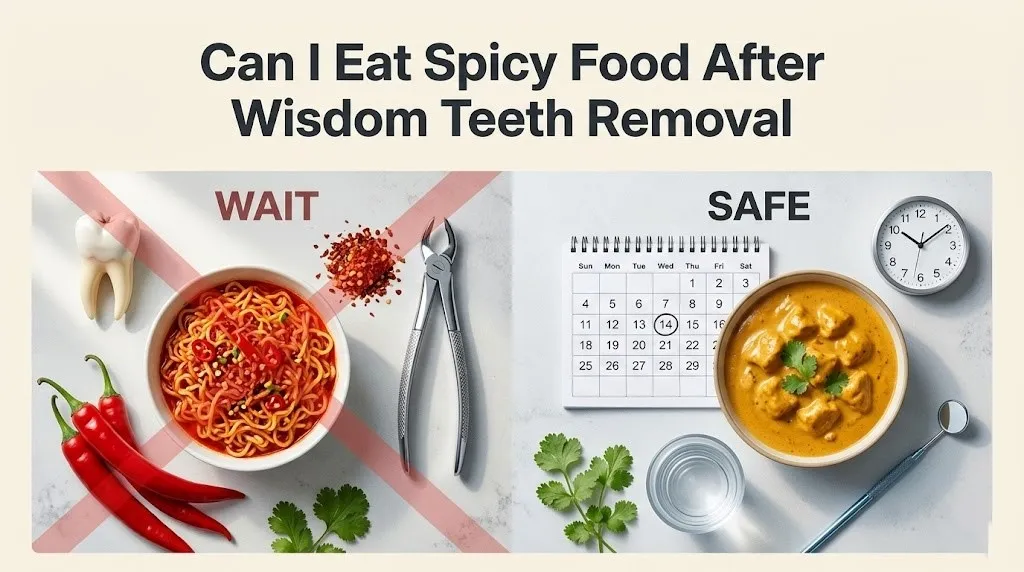
No, you should not eat spicy food immediately after wisdom teeth removal. You need to wait until the extraction sockets have fully closed with a protective layer of soft tissue, which typically takes at least two weeks for simple extractions and often three to four weeks for impacted surgical removals. The chili flakes on your favorite noodles are not worth a dry socket.
What you are really asking is not just about a calendar date. You want to know when the burning, throbbing, or sharp pain will stop punishing you for eating the wrong thing. The specific compound in chili peppers, capsaicin, binds directly to pain receptors called TRPV1 channels that are fully exposed in your open gum tissue. That heat you love on your tongue becomes a genuine chemical injury signal in a healing wound. According to the American Association of Oral and Maxillofacial Surgeons, mechanical and chemical irritation are both recognized disruptors of the fibrin clot that protects the underlying bone and nerve endings.
This article explains the precise biological reason spicy food hurts a healing extraction site, gives you a realistic week-by-week timeline for reintroducing heat, distinguishes between the different levels of spice from mild paprika to ghost pepper, and walks you through a graduated plan for safely testing your tolerance so you can get back to the food you love without undoing days of healing.
Can I Eat Spicy Food After Wisdom Teeth Removal
You cannot eat spicy food safely in the days immediately following wisdom teeth removal because the capsaicin in chili peppers will chemically burn the exposed, unprotected granulation tissue in the open socket, triggering acute pain and potentially disrupting the blood clot that must remain intact to prevent dry socket. The answer is a hard no for the first week.
The pain you feel is not a minor irritation. Capsaicin is a selective agonist for the transient receptor potential vanilloid 1 (TRPV1) receptor, the same ion channel that detects actual physical heat above 109 degrees Fahrenheit. When capsaicin touches the raw nerve endings inside an empty tooth socket, your brain receives an identical signal to being burned. Your mouth is not being dramatic. It is reporting a genuine chemical assault on unprotected tissue. The sensation is indistinguishable from thermal injury at the cellular signaling level.
Beyond the immediate pain, there is a secondary inflammatory consequence. TRPV1 activation triggers the release of substance P, a neuropeptide that promotes vasodilation, plasma extravasation, and immune cell recruitment. In intact skin or mucosa, this is a normal defense mechanism. In a surgical wound filled with a fragile fibrin clot, the sudden influx of inflammatory cells and fluid can physically dislodge the clot or dissolve it prematurely. The clot is your body’s natural bandage over the bony socket. Lose it, and you expose the alveolar bone and nerve endings to air, food debris, and bacteria. That exposure is the clinical definition of alveolar osteitis, commonly called dry socket, and it is as painful as it sounds.
| Time After Extraction | Tissue Status | Spicy Food Recommendation |
|---|---|---|
| Day 1 to 3 | Open wound, fibrin clot forming | Absolutely no spicy food, zero capsaicin |
| Day 4 to 7 | Granulation tissue filling socket | No spicy food, clot remains fragile |
| Week 2 | Soft tissue covering socket | Very mild spice possible if no pain, confirm with dentist |
| Week 3 to 4 | Epithelialization complete or near complete | Gradual reintroduction of moderate spice |
| Week 4+ | Mature soft tissue coverage | Most patients can return to normal spice tolerance |
Key Takeaway: Spicy food after wisdom teeth removal is a chemical burn on an open wound. The pain is real and the risk to the protective blood clot is genuine. Wait.
Can You Eat Spicy Food After Wisdom Teeth Removal
You cannot eat spicy food after wisdom teeth removal until the extraction site is covered by a continuous layer of new gum tissue, which takes a minimum of 10 to 14 days for a simple extraction and often longer for surgical cases. This is not a personal opinion. It is the consensus post-operative guidance from oral surgery clinics based on wound healing physiology.
The guidance is the same whether the question is phrased as “can I” or “can you.” The restriction applies universally to all patients, regardless of their personal spice tolerance. Even someone who eats ghost peppers recreationally and feels no oral burn has the same vulnerable wound biology as someone who finds black pepper too hot. A desensitized palate does not mean desensitized granulation tissue. The TRPV1 receptors in your healing gum do not care how many hot wing challenges you have won. They will fire pain signals and trigger substance P release just the same.
The only variable that changes the timeline is the complexity of the extraction. A fully erupted, simple extraction where the tooth was lifted out with forceps in under a minute leaves a smaller, shallower socket that closes faster. A fully bony impacted wisdom tooth that required a surgical drill to section the tooth and remove bone leaves a larger, deeper defect that takes longer to fill in with granulation tissue and epithelial cells. A responsible oral surgeon will give you a personalized timeline at your follow-up appointment, usually scheduled around day seven. That appointment is the moment when a clinician looks directly at your specific wound and tells you whether the tissue has closed enough to expand your diet. Listen to that advice, not to a friend who ate spicy food on day five and “turned out fine.”
Why Can’t You Eat Spicy Food After Wisdom Teeth Removal
You cannot eat spicy food after wisdom teeth removal because the active compound capsaicin binds to pain receptors on the exposed nerve endings in the open socket, causing direct chemical irritation and triggering an inflammatory cascade that can dissolve or dislodge the protective blood clot. The restriction is a mechanical and biochemical wound management strategy, not a precautionary suggestion.
Think of the extraction socket like a deep cut on your arm that is trying to scab over. You would not pour hot sauce into an open wound on your skin. You would understand immediately that the pain signals danger and that the liquid could physically wash away the fragile scab. The inside of your mouth is the same tissue type, mucosal epithelium, just adapted for a wet environment. The extraction socket is an open wound. The capsaicin in spicy food is a chemical irritant. The clot is the scab. The mouth’s wet environment makes the clot more fragile than a dry scab on your arm, not less. The logic is identical.
The secondary risk is mechanical. Spicy food is rarely just chili powder sprinkled on bland mush. Spicy dishes often involve crunchy textures, such as chili crisp, or small particulate spices, such as crushed red pepper flakes, that can physically lodge in the socket. A flake of dried chili trapped in an extraction site is a foreign body. It mechanically irritates the wound, introduces bacteria, and creates a nidus for infection. Even if the capsaicin were somehow neutralized, the physical particle is a problem. The soft diet that your surgeon prescribed is not just about jaw comfort. It is about keeping foreign material out of a hole in your jawbone that has no natural drainage.
- Capsaicin binds to TRPV1 receptors on exposed nerve endings, mimicking a burn.
- The resulting neurogenic inflammation releases substance P, which can destabilize the fibrin clot.
- Small chili flakes and spice particles can physically lodge in the socket, acting as foreign bodies.
Is Spicy Food Bad After Wisdom Teeth Removal
Yes, spicy food is categorically bad for a healing wisdom tooth extraction site because it provides zero nutritional benefit that cannot be obtained from non-spicy sources while introducing a direct chemical irritant and a particulate foreign body risk to a vulnerable surgical wound. There is no upside that offsets the downside during the healing period.
The question often implies a trade-off. Is the enjoyment worth the risk? The answer during the first two weeks is no, because the risk is a dry socket, a condition universally described by patients as the worst pain of the entire surgical experience, worse than the initial post-operative pain, and one that requires an emergency return visit to the oral surgeon for medicated packing placement. A dry socket is not a brief moment of discomfort. It is a complication that extends your recovery by another week or more and converts a healing process that was trending toward comfort back into one dominated by pain medication and sleepless nights. The chili oil on your noodles is not worth that outcome.
After the two-week mark, the risk profile shifts. Once the socket is covered by intact mucosa, spicy food is no longer chemically burning exposed nerve endings or mechanically threatening a clot that no longer exists. At that point, spicy food transitions from “harmful” to “potentially uncomfortable.” Some patients report a lingering sensitivity to capsaicin at the healed site for weeks or even months after surgery. This is not dangerous. It is a quirk of nerve regeneration. The newly formed epithelium may have a temporarily lower threshold for TRPV1 activation, meaning mild spice feels hotter than it used to. This sensitivity fades gradually, and eating moderately spicy food does not reverse healing at this stage. It just might feel unpleasant.
Key Takeaway: Spicy food is unambiguously bad for the first two weeks because of dry socket risk. After that, it is a question of personal comfort, not wound safety, as long as the socket is closed.
When Can You Eat Spicy Food After Tooth Extraction
You can eat spicy food approximately two to four weeks after a tooth extraction, with the exact timing depending on whether the extraction was a simple removal, which heals faster, or a surgical impacted extraction, which requires more time for the socket to fill with protective tissue. The two-week minimum is the standard clinical guidance from the American Association of Oral and Maxillofacial Surgeons for returning to a normal diet.
This timeline assumes a healthy patient with no clotting disorders, no smoking habit, and no post-operative complications such as infection or dry socket. Any of these complicating factors resets the clock. A dry socket treated at day five means the healing process essentially restarts from the point of treatment. You do not get to count the days before the dry socket toward your spicy food timeline. The wound has to form a new clot and begin granulation again. If you have had a complication, ask your oral surgeon for a revised timeline specific to your case.
The two-week milestone is not an automatic green light. It is the point at which you can cautiously test a very mild level of spice on a small, soft food item and see how the site responds. The testing process matters. Do not celebrate day 14 with a bowl of extra-hot Thai curry. Start with a teaspoon of mildly spiced, completely smooth soup. Wait several minutes. If there is no sharp, localized pain at the extraction site, no throbbing, and no delayed aching later that day, you have passed the first tolerance test. If there is any sensation beyond mild warmth, stop and wait another week. The wound is telling you it is not ready.
After Wisdom Teeth Removal When Can I Eat Spicy Food
After wisdom teeth removal, the earliest you can eat spicy food is 14 days for a simple extraction of a fully erupted tooth and more realistically 21 to 28 days for a surgical extraction of an impacted tooth that required bone removal and multiple sutures. The more tissue trauma that occurred during surgery, the longer you should wait.
The first seven days are a strict no. The fibrin clot is maturing into granulation tissue, but the socket is still an open defect. Days 7 through 14 involve epithelial cells migrating across the surface of the granulation tissue from the wound edges inward, gradually covering the socket. This epithelial layer is thin and fragile when it first closes. It does not have the full thickness or nerve protection of mature gum tissue. A blast of capsaicin at day 14 can still cause discomfort and theoretically disrupt the nascent epithelial seal, though the risk of full dry socket is much lower once the socket is covered.
The second two weeks, days 14 through 28, are when the tissue matures and thickens. The epithelial covering gains strength, and the underlying granulation tissue remodels into denser connective tissue. By day 21 to 28, most patients can eat moderately spicy food without any sensation at the extraction site. This does not mean you should immediately order the hottest dish on the menu. Reintroduction should be gradual, starting with mild spice and working upward. The healing socket is not a training ground for heat tolerance.
| Extraction Type | Example | Earliest Mild Spice Test | Full Spice Tolerance |
|---|---|---|---|
| Simple fully erupted | Tooth lifted with forceps only | Day 10 to 14 | Day 14 to 21 |
| Soft tissue impaction | Minor gum incision, no bone removed | Day 14 to 17 | Day 21 to 28 |
| Partial bony impaction | Some bone removal required | Day 17 to 21 | Day 28 to 35 |
| Full bony impaction | Extensive bone drilling, multiple sutures | Day 21 to 28 | Day 35 to 42 |
When Can I Eat Spicy Food After Wisdom Tooth Extraction
You can eat spicy food after wisdom tooth extraction when a follow-up examination by your oral surgeon confirms that the socket is fully covered by intact soft tissue with no visible defect, which typically occurs between day 14 and day 28 depending on surgical complexity and individual healing speed. The clinical exam is the gold standard for clearance.
Healing speed varies between individuals. A healthy 18-year-old nonsmoker with a simple extraction may be ready at day 10. A 35-year-old smoker with a fully bony impaction may not be ready until day 35. Factors that slow healing include smoking, which causes vasoconstriction and reduces oxygen delivery to the wound, diabetes with poor glycemic control, corticosteroid use, and any condition that impairs collagen synthesis or immune function. Factors that support faster healing include good oral hygiene, proper hydration, adequate protein and vitamin C intake, and strict adherence to the soft diet and no-straw rules during the first week.
The follow-up appointment, typically scheduled around day 7 to 10, is the moment to ask your surgeon directly: “Is my socket closed enough to try mildly spiced food?” A surgeon who looks at the site with a light and a mirror can see whether granulation tissue has filled the socket to the gum line and whether epithelium has closed over the top. They may irrigate the socket to remove debris and assess the tissue quality. The answer they give you is more accurate than any generic timeline in an article. Individual variation in wound healing is real, and your specific extraction site is the only evidence that matters for your dietary decisions.
Key Takeaway: Healing speed varies by age, smoking status, surgical complexity, and overall health. Your oral surgeon’s visual confirmation that the socket is closed overrides any calendar estimate.
How Long to Eat Spicy Food After Wisdom Teeth
The minimum duration to wait before eating spicy food after wisdom teeth removal is two weeks, and the safe duration to wait is three to four weeks for most surgical cases. The clock starts on the day of surgery, and any post-operative complication resets it.
The question of “how long” is deceptive because it implies a single number that applies to everyone. The clinical reality is a range. The lower end of the range, 10 to 14 days, applies to the simplest extractions in the healthiest patients. The upper end of the range, 4 to 6 weeks, applies to the most complex surgical extractions in patients with healing risk factors. Most people fall somewhere in the middle. If you are uncertain where you fall, waiting the full four weeks is the most risk-averse strategy.
The cost of waiting an extra week is a few more bland meals. The cost of not waiting long enough is a dry socket, which involves an emergency dental visit, medicated gauze packed into the socket, and potentially another week or more of intense pain. The trade-off is extremely lopsided. When in doubt, wait. Your favorite spicy dish will still exist in a month. The extraction sites will eventually heal, and you will eventually eat everything you love again. The goal is to arrive at that future without having doubled your recovery time through impatience.
Can You Have Spicy Food After Wisdom Teeth Removal
You can have spicy food after wisdom teeth removal only once the surgical site is healed enough that the gum tissue forms a continuous protective barrier over the socket, a milestone that is typically reached no earlier than two weeks post-surgery and should ideally be confirmed by your treating oral surgeon. The word “have” implies eating a normal portion of a normally spiced dish, not just a tiny test bite, and this requires a higher level of healing than a single experimental taste.
A tolerance test at day 14 might involve dipping a spoon into a mildly spiced soup and touching it to the back of your mouth, away from the extraction site, before swallowing a small amount. That is not “having” spicy food. That is a diagnostic procedure. Having a full bowl of spicy ramen or a plate of spicy curry involves sustained exposure to capsaicin across the entire oral cavity, which inevitably includes the healing socket. Sustained exposure requires a higher confidence that the socket is sealed.
The practical reality is that most people who love spicy food will attempt to return to it before the ideal timeline. If you are going to do this, be methodical. Choose a dish where the spice level is fully under your control, such as a homemade soup or curry where you added a measured amount of mild chili paste. Do not order a “medium” spice level at a restaurant where you do not know the chef’s definition of medium. Do not eat anything with visible chili flakes that could physically lodge in the socket. And if you feel any sharp or throbbing pain at the site, stop eating immediately, rinse gently with warm salt water, and wait another full week before attempting again.
Can I Have Spicy Food After Wisdom Teeth Removal
You should not have spicy food after wisdom teeth removal until your oral surgeon confirms at a follow-up visit that the extraction site is sufficiently healed, which generally means the socket is filled with granulation tissue and covered by epithelium. Asking permission from a professional who has looked inside your mouth is the correct standard of care.
The urge to eat spicy food after surgery is often driven by sensory deprivation. Days of applesauce, yogurt, mashed potatoes, and broth create a craving for intense flavor. This craving is real and valid. It is also not a medical necessity. Your body needs calories, protein, fluids, and micronutrients to heal. You can get all of those from non-spicy sources. The craving for capsaicin is a want, not a need, and satisfying a want is not worth the risk of a surgical complication that will prolong your recovery and genuinely increase your suffering.
The psychological component of post-surgical food restrictions is underdiscussed in dental care. People feel frustrated, restricted, and sometimes genuinely sad about not being able to eat the foods that bring them comfort or joy. This is normal. Acknowledge it. Then plan a non-spicy food that still feels like a treat. A high-quality vanilla milkshake without a straw, eaten with a spoon. A creamy risotto. A silky chocolate pudding. The goal is to find sensory pleasure within the safety constraints until the constraints are lifted.
Can Spicy Food Cause Dry Socket
Yes, spicy food can contribute to dry socket, or alveolar osteitis, because the capsaicin-induced neurogenic inflammation and the physical action of small spice particles can dislodge or dissolve the protective fibrin clot in the extraction socket before granulation tissue has stabilized the wound. While spicy food is not the most common cause, which is smoking and straw use, it is a recognized chemical and particulate risk.
The most common cause of dry socket is negative pressure, such as sucking on a straw or cigarette, that physically pulls the clot out of the socket. The second most common cause is the chemical dissolution of the clot by fibrinolytic enzymes. Research in the Journal of Oral and Maxillofacial Surgery has identified that inflammatory mediators, including those triggered by chemical irritants, can increase local fibrinolytic activity in the socket. Capsaicin’s activation of TRPV1 receptors and the subsequent release of substance P creates exactly the kind of localized inflammatory environment that increases fibrinolytic risk.
The physical particulate risk is separate. A small fragment of dried chili, a seed from a chili pepper, or a piece of crushed red pepper can lodge in the socket. The body treats this as a foreign body. The immune response to a foreign body includes the release of enzymes and reactive oxygen species that can degrade the fibrin clot. The physical particle also mechanically occupies space in the socket, preventing the clot from maintaining contact with the bone walls. A dislodged or partially dissolved clot equals a dry socket. The pain from dry socket is typically described as radiating, constant, and unresponsive to over-the-counter pain medication. It requires a return visit to the oral surgeon for medicated packing.
Quick Tip:
- Never use a straw for any liquid, including water or smoothies, during the first week.
- Avoid smoking or vaping for at least 72 hours, preferably the full first week.
- Spicy food is an additional risk on top of these primary causes, and the risks compound.
When Can You Have Spicy Food After Wisdom Teeth
You can have spicy food after wisdom teeth removal starting around the third to fourth week for most surgical extractions, with the caveat that you should begin with a tiny tolerance test at the two-week mark before committing to a full spicy meal. The shift from “cannot” to “can” is a process, not a single date on the calendar.
The reintroduction process should be gradual for a reason. The newly healed epithelium covering the socket has regenerated nerve endings that may be hypersensitive. A level of spice that felt normal before surgery may feel significantly hotter on the healed site. This is transient and resolves over weeks to months as the nerve endings recalibrate. If you blast the site with high-heat capsaicin the moment the tissue closes, you will experience a disproportionate burn that is unnecessarily unpleasant and may cause you to worry that you have damaged the site, even if you have not.
Start with foods that contain a background level of spice rather than a forward heat. A mild butter chicken or tikka masala, where the chili is minimal and the cream buffers the capsaicin. A spoonful of miso soup with a tiny dab of mild gochujang dissolved in it. These dishes deliver flavor with low capsaicin concentration and no particulate risk. Pay attention to the extraction site specifically. Generalized mouth heat from a spicy meal is normal. Sharp, localized pain at one specific spot where a tooth used to be is not normal and means the tissue barrier is not yet sufficient.
Can U Eat Spicy Food After Wisdom Teeth Removal
No, you cannot eat spicy food immediately after wisdom teeth removal. The answer does not change based on how the question is abbreviated in a text message or search bar. The biological wound healing constraints are the same regardless of spelling.
The informal spelling suggests a younger demographic, likely someone in their teens or early twenties, which is the typical age range for wisdom tooth extraction. Younger patients generally heal faster, which works in their favor, but they are also more likely to underestimate risk and overestimate their own healing speed. A 19-year-old who feels great on day five and thinks the surgical sites “look fine” from the outside has no way to assess the depth of the socket or the integrity of the clot at the base of the wound. Feeling good is not the same as being healed.
The rules do not bend for age or subjective recovery perception. The socket needs time. The granulation tissue needs to fill from the bottom up, a process that cannot be rushed. The epithelial covering needs to migrate from the edges inward. These are biological processes with fixed minimum timelines. You cannot speed them up by eating well, staying hydrated, and following post-op instructions, all of which prevent delays. You can only slow them down by introducing irritants. The question is not “am I healed enough yet” on day six. The question is “can I wait another week to be certain.”
Key Takeaway: Feeling recovered and being healed are not the same thing. The socket heals from the bottom up over weeks, and the surface appearance does not reflect the depth of the wound.
Spicy Food Burning Extraction Site
Spicy food causes a sharp, localized burning sensation at an extraction site because capsaicin directly activates exposed TRPV1 pain receptors on the sensory nerve endings that are normally protected by gum tissue and are now temporarily exposed in the healing socket. This burning is a neurochemical event, not a metaphor.
The sensation is often described by patients as uniquely intense compared to the normal mouth burn from spicy food. It is not the diffuse, warming glow of eating a curry. It is a sharp, stabbing heat localized to one specific spot that feels like it is being poked with a hot needle. This is because TRPV1 receptors are clustered on nerve endings that are normally buried several layers deep in intact mucosa. In an extraction socket, those nerve endings are naked, covered only by a thin fibrin clot and a layer of granulation tissue that is less protective than mature gum tissue. The capsaicin has a direct line to the nerves.
The burning is not causing new damage once the socket is covered by epithelium at the two to three week mark. It is an exaggerated sensory response from freshly regenerated nerves that have a temporarily lower activation threshold. The pain is real but not harmful at this stage. It will decrease with repeated, gentle exposure over weeks, similar to the way a healed skin scar is often hypersensitive to temperature for months before normalizing. If the burning is mild and fades within minutes, you are in the discomfort phase, not the danger phase. If the burning is severe and persists or throbs for hours, the spice has penetrated a still-open socket, and you should stop and wait longer.
Can You Eat Spicy Food After Wisdom Teeth
No, you cannot eat spicy food after wisdom teeth removal until the extraction sites have closed, which takes a minimum of two weeks and is more reliably complete at three to four weeks for surgical cases. The question is phrased in the present tense, implying “can I eat spicy food right now, today,” and the answer for anyone in the first two weeks after surgery is definitively no.
After the healing period is complete, there are no permanent dietary restrictions related to wisdom tooth extraction. You will eventually be able to eat spicy food again at whatever heat level you enjoyed before surgery. The extraction does not create a lifelong sensitivity to capsaicin. The temporary hypersensitivity of the healed site fades over months, and most people return to their baseline spice tolerance within six to twelve weeks of surgery. The nerves adapt. The tissue matures. The mouth forgets.
The only exception is if the extraction resulted in permanent nerve damage, a rare complication called paresthesia that affects the inferior alveolar nerve or lingual nerve. If you have persistent numbness, tingling, or altered sensation in your lower lip, chin, or tongue weeks after surgery, the sensory experience of spicy food may be permanently altered in those areas. This is uncommon, occurring in less than 1 to 2 percent of cases for the inferior alveolar nerve and even less for the lingual nerve, but it is a recognized risk that your oral surgeon should have discussed with you before the procedure. If you are experiencing these symptoms, discuss dietary modifications with the surgeon managing your nerve recovery.
Safe Spicy Foods After Wisdom Teeth
Safe spicy foods to reintroduce after the two-week minimum healing period are smooth, creamy, mildly spiced dishes with no particulate chili flakes or seeds, such as mild butter chicken, korma curry, or a small amount of sriracha stirred thoroughly into a soup or mashed potato. The safety comes from the smooth texture and the low, controlled spice concentration.
The goal is to satisfy the craving for flavor without challenging the healing tissue. The ideal reintroduction food has three characteristics. First, it is completely smooth, with no seeds, flakes, fibers, or crunchy elements that could lodge in the socket. Second, the spice level is mild enough that you can comfortably eat it without your eyes watering or your nose running. Third, the spice is thoroughly distributed in a liquid or creamy base so there are no concentrated pockets of capsaicin. A pureed lentil soup with a small amount of mild curry powder bloomed in oil and then fully incorporated is a good starting point.
Foods to avoid during the reintroduction phase include anything with visible chili seeds or flakes, such as chili crisp, gochugaru-dusted dishes, or crushed red pepper, any heavily spiced dry rub on meat that creates a particulate surface, and any dish where the spice level is uncontrolled by a restaurant kitchen. Buffet-style or steam-table spicy dishes are also risky because they have been sitting at a temperature that may concentrate the spice level unpredictably.
- Safe early reintroduction: mild korma, butter chicken, a dab of sriracha in soup, mild curry powder in pureed lentils.
- Avoid during reintroduction: chili crisp, crushed red pepper, gochugaru as a garnish, spicy dry rubs, any dish with visible chili seeds.
Mild Spice vs Hot Spice After Extraction
Mild spice and hot spice are biologically different insults to a healing extraction site, with mild spice, defined as dishes flavored with a small amount of paprika, annatto, or a pinch of mild curry powder, posing minimal risk after the two-week mark, while hot spice, defined as capsaicin-forward heat from fresh chilies or concentrated chili pastes, remains capable of causing significant pain and potential tissue disruption. The distinction is not about flavor. It is about capsaicin concentration.
Mild spices like paprika, made from dried and ground mild Capsicum annuum cultivars, contain negligible capsaicin. They add color and a gentle sweetness without activating TRPV1 receptors in a meaningful way. Turmeric and cumin are not capsaicin-containing spices at all. They are dried rhizomes and seeds with aromatic compounds but no heat. A dish seasoned with turmeric, cumin, coriander, and a pinch of mild paprika is “spiced” food in the culinary sense but is not “spicy” in the capsaicin sense. This kind of food is reasonable to try at the two-week mark for most patients.
Hot spice from fresh jalapeno, serrano, bird’s eye chili, habanero, or concentrated products like sambal oelek, gochujang, or harissa contains enough capsaicin to provoke a strong TRPV1 response even on intact oral mucosa. On a newly healed or still-healing extraction site, this level of capsaicin will burn intensely and may cause prolonged discomfort even if it does not reopen the wound. The threshold for “too hot” is much lower for healing tissue than it was for your intact mouth before surgery. Something you could eat comfortably before surgery may be genuinely painful on the healed site. Respect that difference.
Key Takeaway: The culinary distinction between “spiced” and “spicy” matters here. Turmeric, cumin, and paprika are flavor. Capsaicin is a chemical signal. The healing site only cares about the second one.
How to Reintroduce Spicy Food After Tooth Extraction
To safely reintroduce spicy food after a tooth extraction, follow a graduated, five-step process starting no earlier than day 14 for simple extractions or day 21 for surgical extractions, and stop immediately at any sign of sharp, localized pain at the extraction site. The process is designed to test the tissue’s tolerance without committing to a full spicy meal that you will regret.
Step one is the passive tolerance test. Prepare a mildly spiced, completely smooth soup or puree. Dip a clean spoon into it and touch a small amount to the area of your mouth near the extraction site without directly swishing it into the socket. Wait two to three minutes. If you feel no burning, stinging, or throbbing, proceed to step two. If you feel any discomfort, rinse gently with warm salt water and wait another full week.
Step two is the small-volume swallow. Take a single teaspoon of the mildly spiced food and swallow it, allowing it to pass over the extraction area naturally without aggressive swishing. Wait 15 minutes. Monitor for any delayed burning or aching. Step three is the small serving. If step two passes, eat a small bowl of the mildly spiced food, about a quarter to a half of a normal portion. Do not eat anything else spicy for the rest of the day. Monitor the site for several hours and the next morning for any delayed pain or swelling.
Step four is the spice level increase. If mild spice is tolerated without incident, wait another few days to a week and then try a food with a moderate spice level, such as a medium-spiced curry with a creamy base. Repeat the small portion test. Step five is the normal diet return. If moderate spice is tolerated, gradually return to your preferred spice level over the following weeks. The entire process from first test to full return may take two to four weeks. The reward for patience is a healed socket that does not hurt when you eat the food you love.
- Step 1: Passive contact test with a tiny amount of mild, smooth spiced food at day 14+.
- Step 2: Single teaspoon swallow, wait 15 minutes for delayed reaction.
- Step 3: Small bowl serving, monitor for 24 hours before repeating.
- Step 4: Gradual spice level increase over subsequent weeks.
- Step 5: Full return to normal spice tolerance once all levels are tolerated.
Frequently Asked Questions About Spicy Food and Wisdom Teeth Removal
What happens if I eat spicy food 3 days after wisdom teeth removal?
Eating spicy food three days after wisdom teeth removal will almost certainly cause intense, sharp pain at the extraction site because the capsaicin directly contacts exposed nerve endings in the open socket.
You also risk dislodging the fibrin clot through chemical inflammation or particulate irritation, which can cause dry socket.
If you accidentally ate something spicy, rinse very gently with warm salt water and monitor for increasing pain over the next 24 hours, which would warrant a call to your oral surgeon.
Can I eat Takis or hot chips after wisdom teeth removal?
No, you cannot eat Takis, hot chips, or any crunchy spicy snack after wisdom teeth removal for at least three to four weeks.
These foods combine capsaicin with a hard, sharp texture that can physically puncture the healing socket and lodge particulate debris deep in the wound.
Even after the socket has closed, the abrasive texture of chips can irritate freshly healed gum tissue.
Is black pepper okay after wisdom teeth removal?
A small amount of finely ground black pepper cooked into a soft dish is generally acceptable after the first few days, but whole or cracked peppercorns should be avoided.
Black pepper’s active compound, piperine, is a milder TRPV1 agonist than capsaicin and is less likely to cause intense pain.
However, visible pepper particles can still lodge in the socket, so use only finely ground pepper in pureed or soft foods and rinse gently after eating.
How do I know if my extraction site is healed enough for spicy food?
You know your extraction site is healed enough for spicy food when you can touch the area with your tongue and feel smooth gum tissue with no depression or hole, and when a follow-up exam by your oral surgeon confirms the socket is closed.
A visual check with a mirror in good light can show you whether the dark hole has been replaced by pink gum tissue.
The definitive answer comes from your surgeon, who can irrigate the site and assess tissue integrity.
What spices are safe right after wisdom teeth removal?
Immediately after wisdom teeth removal, safe spices include ground turmeric, ground cumin, ground coriander, mild paprika, and small amounts of garlic powder or onion powder, all cooked thoroughly into soft, smooth foods.
These spices provide flavor without capsaicin or particulate texture that could irritate the wound.
Avoid any chili powder, cayenne, crushed red pepper, black pepper with visible particles, and any spice blend that contains chili as an ingredient.
The question of when you can eat spicy food again has a single right answer for the first two weeks: you cannot. The capsaicin in chili peppers binds to pain receptors on nerves that are sitting unprotected in an open wound. The inflammatory response that follows can dissolve the clot that stands between you and a dry socket. No craving is worth that outcome.
The question shifts after the two-week mark from “can I” to “should I try a small test.” At that point, the answer comes from your own mouth. A tiny taste of a mild, smooth dish. A careful wait to see if the site protests. A slow, patient reintroduction that respects the fact that new tissue is more sensitive than old tissue. The people who have the easiest recoveries are the ones who treat the extraction site like it is still healing even after it looks closed from the outside.
Your favorite spicy food will still exist when your mouth is ready for it. The extraction sites are temporary wounds that heal in a matter of weeks. Dry socket pain is an avoidable complication. Keep your eye on the long-term goal: a fully healed mouth that can eat anything, including the spiciest dish on the menu, without a trace of pain at the place where teeth used to be.