Honey is the only food that never spoils. Properly stored, it remains edible for thousands of years. Archaeologists excavating Egyptian tombs from 3,000 years ago found pots of honey that were still perfectly preserved and safe to eat.
The National Honey Board confirms that honey’s eternal shelf life is due to three specific chemical properties: a water activity of 0.6, a pH of 3.9, and the natural production of hydrogen peroxide by the enzyme glucose oxidase. Together, these factors create an environment where no bacteria, yeast, or mold can survive.
We will walk through the exact science, the proper storage method, the truth about crystallization, and the list of other near-immortal foods that can outlast a human lifetime.
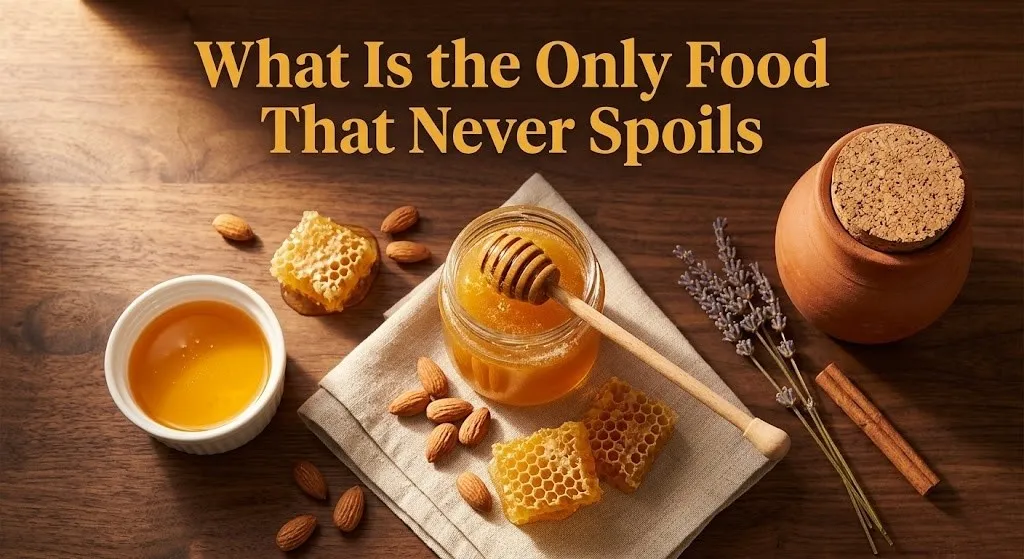
What Is the Only Food That Never Spoils
Honey is the only food that never spoils. It is the only food product known to remain edible indefinitely without refrigeration, freezing, or chemical preservatives. The honey found in King Tut’s tomb was analyzed by modern scientists and found to be unspoiled.
The definition of “never spoils” is specific. The food must remain safe to eat and nutritionally stable without spoilage organisms growing in it. Honey meets this definition because its chemical properties are actively hostile to microbial life.
Other foods can last for years or decades under ideal conditions. Dried beans, white rice, and salt can last for 30 years or more. But none of these foods are eternal in the way honey is. They degrade slowly. Honey does not.
What Is the Only Food That Never Goes Bad
The answer is honey. The phrasing “never goes bad” means the food does not rot, mold, ferment, or become unsafe to eat through microbial action. Honey resists all of these forms of spoilage.
The distinction between “going bad” and “changing” is important. Honey crystallizes. Crystallized honey is not bad honey. It is honey in a different physical state. The sugar molecules have arranged themselves into a solid crystal lattice. The honey is perfectly safe.
The only way honey goes bad is if water is introduced. If enough moisture enters the jar, the water activity rises above the threshold where yeast can ferment the sugars. A jar of honey left open in a humid environment can eventually spoil. Properly sealed, it cannot.
Key Takeaway: Honey never goes bad in a sealed jar; crystallization is a physical change, not spoilage; water contamination is the only thing that can cause honey to ferment.
What Food Doesn’t Expire
Honey is the canonical answer to the question “what food doesn’t expire.” But several other foods have functionally indefinite shelf lives when stored properly.
Salt is a mineral, not a food in the biological sense. It does not expire. It can absorb moisture and clump, but it never spoils. Sugar has a similar property. Its water activity is too low for microbial growth. It can last indefinitely in a sealed container.
White rice, when stored in oxygen-free containers with desiccants, can last 30 years or more. The fats in brown rice will go rancid within 6 to 12 months, which is why white rice is the survival food, not brown rice.
What Is the Only Food That Never Expires
Honey is the only food that never expires. Expiration dates on honey jars are a regulatory formality, not a food safety requirement. The USDA does not require an expiration date on honey. Most brands print a “best by” date for inventory management, not because the honey will spoil.
The Codex Alimentarius, the international food standards body, recognizes that honey has an indefinite shelf life when stored under appropriate conditions. The standard is global. Honey does not need a “use by” date.
The expiration date myth persists because consumers are conditioned to look for dates on all packaged foods. A jar of honey with a “best by” date from 2024 is identical in safety and nutritional quality to a jar from 2018. The date is a suggestion, not a deadline.
Why Does Honey Never Spoil
Honey never spoils because of three chemical properties that work together. First, honey has an extremely low water activity of 0.6. Most bacteria require a water activity of 0.9 or higher. Mold requires 0.8. Yeast requires 0.87. Honey is simply too dry.
Second, honey is acidic with a pH of 3.9. This acidity comes from gluconic acid, produced by the enzyme glucose oxidase that bees add to the nectar. Most spoilage organisms cannot survive in an acidic environment.
Third, the same glucose oxidase enzyme produces hydrogen peroxide slowly over time. This is a mild, natural antimicrobial that continuously disinfects the honey. The combination of dryness, acidity, and hydrogen peroxide production makes honey an active antimicrobial substance, not just a passive sugar syrup.
Honey Shelf Life
The shelf life of properly stored honey is indefinite. The National Honey Board confirms that honey stored in a sealed container at room temperature remains safe and stable essentially forever.
Crystallization is the most common change. Honey is a supersaturated sugar solution. Over time, the glucose separates from the water and forms crystals. The honey becomes grainy and eventually solid. This is not spoilage. It is a physical phase change.
The flavor may change slowly. Honey darkens and develops a slightly stronger, more caramelized flavor over years. This is the natural Maillard reaction between sugars and amino acids, accelerated by heat. Cool storage slows this process.
Does Honey Go Bad
Honey does not go bad under normal storage conditions. The only way honey spoils is through water contamination. If moisture is introduced, the water activity rises, yeast can ferment the sugars, and the honey can spoil.
Signs of spoiled honey include a sour, fermented smell, visible mold on the surface, or bubbling and foam that indicates active fermentation. Spoiled honey is rare. Most people go their entire lives without encountering a jar of genuinely spoiled honey.
The fermentation process turns honey into mead. In a controlled environment, this is how mead is made. In a contaminated jar, the result is a sour, alcoholic, unpleasant mess.
Is Crystallized Honey Safe to Eat
Yes, crystallized honey is safe to eat. The crystals are glucose molecules that have precipitated out of the supersaturated solution. The honey is nutritionally identical to liquid honey.
Crystallized honey is often preferred by bakers and tea drinkers. The solid form is easier to measure and spreads on toast without dripping. Some honey varieties, like clover honey, crystallize faster than others, like acacia honey.
To re-liquefy crystallized honey, place the jar in a bowl of warm, not boiling, water. Heat the water to 95 to 110 degrees Fahrenheit. Boiling water destroys the enzymes and the delicate aromatic compounds. A gentle, low-temperature re-liquefication preserves the honey’s quality.
How to Store Honey
Store honey in a sealed glass jar at room temperature in a dark cabinet. The three enemies of honey are moisture, heat, and light.
Do not refrigerate honey. The cold accelerates crystallization. Refrigerated honey will turn into a solid, grainy block within weeks. It is still safe to eat, but it is inconvenient to use.
Do not leave honey open. Honey is hygroscopic. It absorbs moisture from the air. An open jar in a humid kitchen will slowly dilute itself and eventually become vulnerable to fermentation. Keep the lid tightly sealed.
Foods That Last Forever
The list of foods that last forever, or functionally forever, is short. Honey is the only food that never spoils. Salt is a mineral and never expires. Sugar lasts indefinitely. White rice lasts 30 years. Dried beans last 30 years. Vinegar lasts indefinitely.
These foods share common characteristics. They have low water activity. They are acidic or salty. They are inhospitable to microbial life. The science of food preservation is the science of making food inhospitable to bacteria, yeast, and mold.
A 2026 survival pantry should include all six of these foods. They provide sweetness, salt, starch, protein, and acid, the building blocks of cooking, and they will be edible when your grandchildren are adults.
| Food | Shelf Life | Storage Requirement |
|---|---|---|
| Honey | Indefinite | Sealed, room temp, dark |
| Salt | Indefinite | Dry |
| Sugar | Indefinite | Sealed, dry |
| White Rice | 30+ years | Oxygen-free, cool, dry |
| Dried Beans | 30 years | Cool, dry, sealed |
| Vinegar | Indefinite | Sealed, room temp |
Key Takeaway: Honey, salt, sugar, white rice, dried beans, and vinegar are the six foods that can outlast a human lifetime when stored correctly.
Salt Shelf Life
Salt has an indefinite shelf life. Sodium chloride is a mineral, stable on geological timescales. The salt in your shaker is millions of years old already.
Salt can absorb moisture and form a hard clump. This is not spoilage. The salt is still salt. Break up the clump with a fork or a pestle. Iodized salt has a slightly shorter shelf life because the iodine can oxidize and evaporate over 5 to 10 years.
Pure sea salt, kosher salt, and pickling salt without additives last forever. Salt does not support microbial life. In fact, salt is used to preserve other foods precisely because it is antimicrobial.
Sugar Shelf Life
Sugar has an indefinite shelf life. The water activity of granulated sugar is too low for any microorganism to survive. Sugar is a natural preservative.
Brown sugar hardens into a brick when exposed to air because the molasses coating the sugar crystals dries out. The hardened sugar is still safe to eat. A slice of bread or a damp paper towel placed in the sealed container for 24 hours softens it again.
Powdered sugar contains cornstarch as an anti-caking agent. The cornstarch can degrade over years. Pure granulated sugar has no additives and no expiration.
White Rice Shelf Life
White rice has a shelf life of 30 years or more when stored in an oxygen-free, cool, dry environment. The key is the removal of the bran. Brown rice contains oils in the bran that go rancid within 6 to 12 months.
The optimal storage method for white rice is a Mylar bag with an oxygen absorber, sealed inside a food-grade bucket. This creates an anaerobic environment that prevents insect eggs from hatching and slows the oxidation of the remaining rice oils.
A 2026 emergency food supply should include white rice. It is calorie-dense, versatile, and shelf-stable for decades. It lacks protein, vitamins, and minerals, so it must be paired with dried beans and a multivitamin for long-term survival.
Dried Beans Shelf Life
Dried beans have a shelf life of 30 years under optimal storage conditions. The beans are seeds in a dormant state. They are alive but metabolically inactive.
Over decades, the beans lose moisture and the seed coat becomes impermeable. Very old beans take longer to cook and may never soften fully. A pressure cooker is the best tool for cooking decade-old beans.
The nutritional value degrades slightly over decades. The protein is stable. The B vitamins, particularly thiamine and folate, degrade slowly. Old beans are still food. They are not optimal food.
Vinegar Shelf Life
Vinegar has an indefinite shelf life. The acetic acid content, typically 5 to 8 percent, creates a pH of roughly 2.5. No pathogen can survive in that acidity.
Vinegar may develop a harmless cloudiness or a “mother,” a gelatinous mass of acetic acid bacteria. This is not spoilage. The mother is the same culture used to produce vinegar. It is safe and can be strained out or left in.
Vinegar is self-preserving. It is used to pickle and preserve other foods. An unopened bottle of white distilled vinegar will be identical in 50 years to the day it was bottled.
Frequently Asked Questions About Foods That Never Spoil
What is the only food that never spoils?
Honey is the only food that never spoils.
Properly stored in a sealed container, it remains edible for thousands of years.
Ancient Egyptian tomb honey was found unspoiled after 3,000 years.
Why does honey never go bad?
Honey never goes bad because of low water activity, high acidity, and natural hydrogen peroxide production.
These three chemical properties create an environment where bacteria, yeast, and mold cannot survive.
Crystallization is a physical change, not spoilage.
Can you eat 3,000 year old honey?
Yes, archaeologists have confirmed that 3,000 year old honey from Egyptian tombs was still edible.
The honey had crystallized but was chemically and microbially identical to fresh honey.
Modern honey will last equally long if stored in a sealed container.
Is crystallized honey safe to eat?
Yes, crystallized honey is perfectly safe to eat.
The crystals are glucose molecules that have solidified, not a sign of spoilage.
Warm the jar in a bowl of warm water to re-liquefy it if desired.
What foods can you store for 20 years?
Honey, salt, sugar, white rice, dried beans, and vinegar can all be stored for 20 years or more.
White rice and dried beans require oxygen-free storage with desiccants for maximum longevity.
These six foods form the foundation of a long-term emergency pantry.
Honey is a miracle of natural chemistry. A jar of honey in your pantry is chemically identical to a jar of honey from an Egyptian tomb. The bees did the work. The glucose oxidase, the low pH, the low water activity. You just need to keep the lid on and the water out.
The crystallization is not a defect. The darkening is not a flaw. The honey is alive in a chemical sense, slowly producing hydrogen peroxide, slowly shifting its sugar structure, but never rotting, never molding, never spoiling.
The jar in the back of your cabinet from three years ago is fine. Stir it into tea. Spread it on toast. It is the same honey the bees made. It always will be.