What to make when you have no food starts with taking a breath and looking at what you actually have, not what you wish you had. An empty fridge is not the same thing as an empty kitchen. The pantry, the freezer, and even the condiment shelf of the refrigerator door often contain the components of a meal that you simply have not assembled yet. A can of beans, a half-box of pasta, a jar of tomato sauce, and a few spices is dinner. It may not be the dinner you planned, but it is real food that will feed you.
Food insecurity affects a significant portion of American households. According to the USDA, 12.8% of U.S. households were food insecure at some point during 2022, meaning they lacked consistent access to enough food for an active, healthy life. The experience of opening the refrigerator and finding it bare is not a personal failure. It is a common situation that millions of people navigate every day, whether because of a tight week before payday, an inability to get to the store, or deeper financial constraints. Knowing how to cook from limited ingredients is a practical skill, not an admission of defeat.
This guide gives you a system for inventorying what you have, matching ingredients to meal types, and cooking satisfying food from minimal supplies. You will find specific recipe ideas organized by the staples you are most likely to own, food safety guidance for older pantry items, and resources for food assistance if you need support beyond what your kitchen can provide.
What to do when you have no food
The first thing to do when you have no food is to take a complete inventory of everything edible in your kitchen, including the pantry, freezer, refrigerator, and the condiment shelf. Pull everything out where you can see it. Group items into categories: proteins, carbohydrates, vegetables and fruits, fats and oils, and flavorings. You will almost certainly find more than you expected. A single can of tuna, a forgotten bag of rice pushed to the back of the cabinet, a jar of peanut butter with one serving left, these are the building blocks of a meal.
The second step is to identify what you can make with what you have. The most common pantry staples, rice, pasta, canned beans, canned tomatoes, flour, oats, eggs, and frozen vegetables, combine into dozens of possible meals. A can of beans and a can of tomatoes with some dried spices becomes chili. Rice and a can of tuna with soy sauce becomes a simple rice bowl. Flour and water with a pinch of salt becomes flatbread or pasta. The constraint is not your ingredients. It is your mental library of what those ingredients can become.
The third step is to accept that the meal will not be perfect or balanced by ideal nutritional standards. A meal of pasta with butter and salt is better than no meal. A bowl of oatmeal with a spoonful of peanut butter is a reasonable breakfast or dinner. The Academy of Nutrition and Dietetics emphasizes that eating enough calories to meet your immediate energy needs is the priority when food is scarce. Nutritional optimization is a problem for when the pantry is full. Right now, the goal is fed.
Key Takeaway: Inventory everything you have, match ingredients to simple meal concepts, and prioritize getting enough to eat over nutritional perfection.
What to eat when you have no food
What to eat when you have no food depends on which staple ingredients you have available. The most reliable pantry-to-meal pathways start with a carbohydrate base, add a protein source if available, include any vegetable matter you can find, and use fat and seasoning to make it taste like a meal rather than a pile of ingredients. This formula, carb, protein, vegetable, fat, flavor, produces a reasonably complete meal from almost any combination of staples.
Carbohydrate bases include rice, pasta, oats, flour (as flatbread, pancakes, or dumplings), tortillas, bread, potatoes, and crackers. Protein sources include canned beans, canned tuna or chicken, eggs, peanut butter, canned chili, and frozen meat if the freezer has anything left. Vegetable sources include canned tomatoes, canned corn, canned green beans, frozen vegetables, onions, garlic, and canned mushrooms. Fats include olive oil, vegetable oil, butter, mayonnaise, and the oil from a jar of peanut butter. Flavorings include salt, pepper, soy sauce, hot sauce, dried herbs, bouillon cubes, and vinegar.
A decision tree for pantry meals works from the carbohydrate outward. If you have rice, can you add beans, tomatoes, and spices to make a rice bowl? If you have pasta, can you add canned tuna, oil, and garlic for a pantry pasta? If you have flour, can you mix it with water, salt, and oil to make flatbread, then top it with whatever canned or frozen ingredients you have? The carbohydrate is the anchor. The other ingredients build the meal around it.
Key Takeaway: Start with your carbohydrate base, add whatever protein and vegetables you have, and finish with fat and seasoning. This formula works for almost any combination.
What to make when your hungry and have no food
What to make when you are hungry and have no food is something fast, filling, and made from ingredients that require minimal preparation. Hunger makes decision-making harder. When you are hungry and staring at an empty kitchen, the cognitive load of planning a multi-step recipe can be paralyzing. The solution is to have a mental list of five-minute meals that require no recipe and minimal cooking.
The fastest pantry meals rely on a single pot or pan and ingredients that cook quickly or require no cooking at all. Peanut butter toast with a glass of milk is a meal if you have bread, peanut butter, and milk. Scrambled eggs on tortillas with hot sauce is a meal if you have eggs and tortillas. Canned beans heated with a spoonful of oil and salt is a meal if you have beans. Instant oatmeal with a scoop of peanut butter and a pinch of salt is a meal if you have oats and peanut butter. These are not aspirational meals. They are functional meals that stop the hunger so you can think clearly about what to cook next.
A pot of rice takes 20 minutes and fills the kitchen with the smell of food cooking, which helps psychologically when the cupboards are bare. Top it with a fried egg if you have one. Mix in a can of drained beans and a spoonful of oil. Stir in a can of tuna and a splash of soy sauce. Rice is the most versatile and affordable pantry staple. If you have rice, you have the foundation of a meal.
Key Takeaway: Choose fast, filling foods that require minimal preparation. Peanut butter toast, scrambled eggs, heated beans, and rice with toppings all take under 10 minutes.
What to make with no food in the house
What to make with no food in the house depends on what “no food” actually means in your kitchen right now. If it means no fresh produce, no meat, and no dairy, but you have dry and canned goods, you have plenty of options. If it means literally a few random condiments and a half-empty bag of flour, you have fewer options but you are not entirely out of luck. The distinction matters because the advice that helps someone with a stocked pantry does not help someone with truly empty cabinets.
If you have flour and water, you can make flatbread, tortillas, pasta, or dumplings. Flour, water, a pinch of salt, and a small amount of oil if available, combine into a dough that can be rolled flat and cooked in a dry pan. The resulting flatbread can wrap anything else you find, peanut butter, a can of beans, the last spoonful of jam. If you have flour, salt, and a little more water, you can make a simple egg noodle dough that cooks in boiling salted water in two minutes.
If you have rice and one or two flavorings, you can make congee, a Chinese rice porridge that stretches a small amount of rice into a filling meal. Use 1 part rice to 6 parts water, simmer for 45 minutes until the rice breaks down into a creamy porridge, and season with whatever you have: soy sauce, a bouillon cube, salt, a splash of vinegar, hot sauce. A half-cup of dry rice makes enough congee for two filling bowls.
Key Takeaway: Flour and water make flatbread or pasta. Rice and extra water make congee. These techniques stretch the most basic ingredients into meals.
How to make food out of nothing
How to make food out of nothing is less about magical creation and more about recognizing that “nothing” is almost never truly nothing. A kitchen that appears empty usually contains flour, oil, salt, and at least one or two other items. The cooking techniques that turn these minimal ingredients into meals are worth knowing because they apply to situations far beyond the empty pantry.
A roux, flour cooked in fat, is the foundation of countless sauces, soups, and gravies. Melt a tablespoon of butter or heat a tablespoon of oil in a pan. Whisk in a tablespoon of flour and cook for one minute. Slowly whisk in a cup of milk, broth, or even water. Add salt, pepper, and any seasoning you have. The result is a basic white sauce that can be poured over toast, pasta, rice, or vegetables. Add a can of tuna and a handful of frozen peas, and you have a reasonable approximation of creamed tuna on toast.
Soup is the most forgiving format for minimal ingredients. Water, a bouillon cube or salt, and any vegetables, grains, or proteins you can find become soup. A single carrot, an onion, a potato, and some rice or pasta in a pot of water with salt is a meal. The liquid stretches the solid ingredients across more servings. Soup is how cooks have managed scarcity for centuries, because water is the ingredient that costs nothing and fills the stomach.
Key Takeaway: A roux makes sauce from flour and fat. Soup stretches minimal ingredients with water. Both techniques turn scarcity into a meal.
What to cook when you have no food
What to cook when you have no food breaks down into categories based on the primary staple you have available. Each category has multiple meal options that require minimal additional ingredients beyond the staple itself. The categories are pasta-based meals, rice-based meals, bean-based meals, egg-based meals, flour-based meals, and canned-protein meals.
Pasta-based meals work when you have dry pasta. Boil it in salted water. Save a cup of the pasta water before draining. The starchy pasta water is a sauce base. Toss the pasta with oil, garlic if you have it, and any canned or frozen vegetables. The hot pasta water helps the oil coat the noodles. If you have a can of tuna, a can of tomatoes, or a jar of pesto, those are sauces. If you have butter and salt, that is also a sauce.
Bean-based meals work when you have canned or dried beans. If the beans are dried, soak them overnight or for at least 6 hours if possible, then simmer until tender. Canned beans can be heated and eaten as is with oil and salt, mashed into a rough spread for toast or tortillas, mixed with rice, or cooked with canned tomatoes and spices into a simple chili. Beans provide protein and fiber that make a meal satisfying even when other ingredients are scarce.
Egg-based meals work when you have eggs. Fried eggs on rice, scrambled eggs in a tortilla, an omelet with whatever bits of vegetable or cheese you can find, French toast made from stale bread, or a simple egg drop soup made by drizzling beaten egg into simmering broth. Eggs cook in minutes and provide high-quality protein that anchors a meal.
Key Takeaway: Match your cooking strategy to your primary staple. Pasta, rice, beans, eggs, and flour each unlock a different set of meals.
Recipes when you have no food
Recipes when you have no food are templates more than precise formulas. The quantities are flexible. The substitutions are endless. The goal is a hot, reasonably satisfying meal from the ingredients you actually own. The following templates assume you have salt, oil or butter, and at least one seasoning beyond salt.
Pantry pasta: Boil 8 ounces of pasta in salted water. While it cooks, heat 2 tablespoons of oil in a pan. Add 1 minced garlic clove or 1/2 teaspoon garlic powder and cook for 30 seconds. Add 1 can of drained tuna or 1 can of drained beans. Toss with the cooked pasta and a splash of pasta water. Add salt, pepper, and any dried herbs you have.
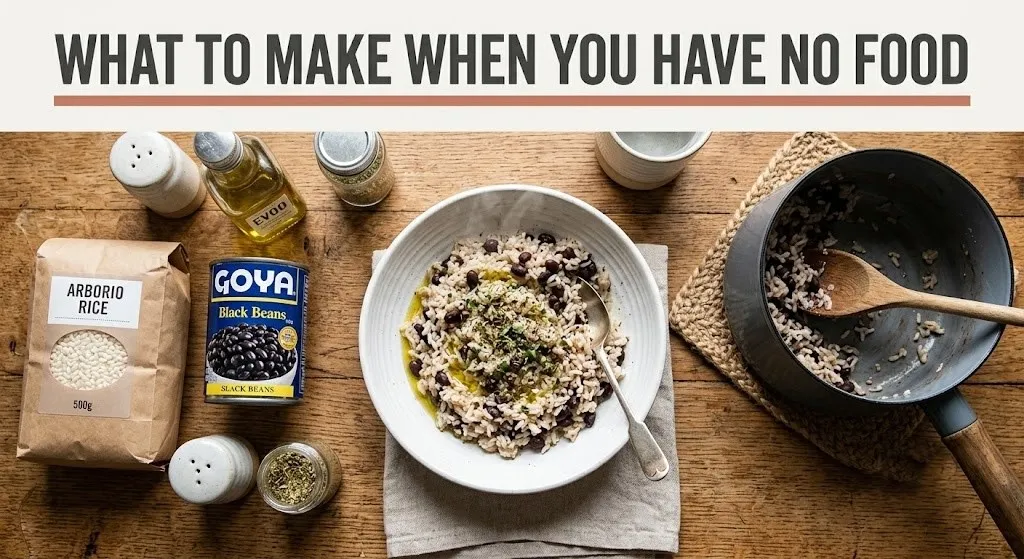
Pantry rice bowl: Cook 1 cup of rice according to package directions. Top with 1 can of drained beans, a fried egg if you have one, and a drizzle of soy sauce or hot sauce. If you have frozen vegetables, cook them in the rice pot during the last 5 minutes of cooking.
Pantry soup: In a pot, heat 1 tablespoon of oil. Cook 1 diced onion if you have one, or skip to the next step. Add 4 cups of water, 1 bouillon cube, 1 can of drained beans, 1 can of diced tomatoes, and 1/2 cup of rice or small pasta. Simmer for 20 minutes until the rice or pasta is cooked. Season with salt, pepper, and any dried herbs.
Emergency flatbread: Mix 1 cup of flour, 1/3 cup of water, 1 tablespoon of oil, and a pinch of salt. Knead briefly. Divide into 4 pieces and roll each as thin as possible. Cook in a dry skillet over medium-high heat for 1 to 2 minutes per side. Eat with whatever spread or topping you have.
Key Takeaway: These four template recipes, pantry pasta, rice bowl, soup, and flatbread, cover most ingredient combinations you are likely to have.
Recipes for when you have no food
Recipes for when you have no food expand on the basic templates with variations that account for the specific ingredients you might find in a sparse kitchen. These recipes are organized by the most likely staple you have in abundance.
If you have rice: Fried rice uses cold cooked rice, oil, and whatever else you can find. Heat oil in a pan. Add cold rice and stir-fry for 2 minutes. Push the rice to the side and scramble an egg in the empty space if you have one. Add frozen peas, canned corn, a splash of soy sauce, and any leftover bits of meat. Rice pudding uses rice, milk or water, sugar, and cinnamon if available. Simmer 1 cup of cooked rice with 1 cup of milk and 1 tablespoon of sugar for 10 minutes until creamy.
If you have canned beans: Bean mash is heated beans mashed with oil, salt, and any seasoning. Spread on toast or eat with a spoon. Bean salad is drained beans mixed with oil, vinegar or lemon juice, salt, and any fresh or dried herbs. Let it sit for 10 minutes for the flavors to combine.
If you have flour: Drop dumplings cook in simmering soup or salted water. Mix 1 cup of flour, 1/2 teaspoon of baking powder if you have it, a pinch of salt, and enough water to form a thick batter. Drop spoonfuls into simmering liquid and cook for 10 minutes. Pancakes require flour, baking powder or baking soda, salt, water or milk, and oil for the pan. Even without egg, they hold together and fill a plate.
Key Takeaway: Each pantry staple unlocks multiple recipe variations. Fried rice from leftover rice, bean mash from canned beans, and drop dumplings from flour are reliable starting points.
Easy recipes when you have no food
Easy recipes when you have no food minimize the number of steps, the number of pots, and the number of ingredients while still producing a hot, satisfying meal. These recipes assume you have salt, oil or butter, and water. Everything else is flexible.
3-ingredient pasta: Boil pasta in salted water. Drain, reserving some pasta water. Toss with butter, salt, and pepper. If you have garlic powder, add that. If you have parmesan cheese, add that. The base recipe is three ingredients: pasta, butter, salt. The additions make it better but are not required.
Microwave baked potato: Wash a potato, pierce it with a fork several times, and microwave on high for 5 minutes. Turn it over and microwave for another 3 to 5 minutes until soft. Split it open and top with butter, salt, and whatever else you have: canned chili, cheese, sour cream, beans, or just more butter and salt.
Egg drop soup: Bring 3 cups of water to a simmer with a bouillon cube or a pinch of salt. Beat 2 eggs in a small bowl. Stir the simmering water in one direction to create a whirlpool. Slowly drizzle the beaten egg into the moving water. The egg cooks instantly into ribbons. Serve with a splash of soy sauce or a pinch of pepper.
Canned tuna salad: Drain a can of tuna. Mix with a spoonful of mayonnaise or oil, a pinch of salt, and any of the following you have: diced onion, diced celery, pickle relish, lemon juice, pepper. Eat with crackers, on toast, or straight from the bowl.
Key Takeaway: Easy pantry recipes use three to five ingredients and one pot. Butter pasta, microwave baked potatoes, and egg drop soup are the fastest options.
Dinner ideas when you have no food
Dinner ideas when you have no food need to feel like a meal, not a snack, because dinner carries psychological weight. A bowl of oatmeal for breakfast is normal. A bowl of oatmeal for dinner can feel like defeat. The solution is to prepare the same limited ingredients in a way that signals “dinner” through warmth, savoriness, and the ritual of sitting down to a bowl or plate of hot food.
Pantry chili feels like dinner. Combine a can of beans, a can of diced tomatoes, a spoonful of chili powder or any spices you have, and water or broth. Simmer for 15 minutes. Serve in a bowl. If you have rice, serve it over rice. If you have crackers, crumble them on top. The bowl format and the warm, savory flavor signal dinner to your brain.
Savory oatmeal transforms breakfast oats into dinner. Cook oats with water and salt instead of milk and sugar. Top with a fried egg if you have one. Add a splash of soy sauce, a drizzle of oil, and any savory topping available: canned vegetables, a sprinkle of cheese, hot sauce. Savory oatmeal is common in many cultures and is nutritionally reasonable for dinner.
Lentil soup works if you have dried lentils, which cook faster than dried beans and do not require soaking. Simmer 1 cup of lentils with 4 cups of water, a bouillon cube, and any vegetables or spices you have for 25 to 30 minutes. The result is a protein-rich, filling soup that feels substantial.
Key Takeaway: Dinner from no food requires the ritual of a hot, savory bowl. Pantry chili, savory oatmeal, and lentil soup fit the need.
Easy dinner when you have no food
Easy dinner when you have no food combines speed, minimal cleanup, and enough substance to end the day feeling fed. These dinners use one pot or pan and take 20 minutes or less.
One-pot pasta and beans: In a pot, combine 2 cups of water, 1 cup of pasta, 1 can of drained beans, 1 can of diced tomatoes, and a pinch of salt. Bring to a boil and cook for the time listed on the pasta package, stirring occasionally. The pasta absorbs the water and the tomato liquid, creating a sauce as it cooks. No draining required.
Rice and lentil pilaf: In a pot, heat oil and cook any diced onion or garlic you have. Add 1 cup of rice and 1/4 cup of dried lentils. Add 2.5 cups of water and a bouillon cube. Bring to a boil, cover, reduce heat, and simmer for 20 minutes. The lentils and rice cook together. Fluff with a fork and serve.
Tuna patties: Drain a can of tuna. Mix with 1 egg, 2 tablespoons of flour or breadcrumbs, and salt. Form into two patties. Fry in oil for 3 to 4 minutes per side until golden. The egg and flour bind the tuna into a burger-like patty that feels more like dinner than tuna salad.
Key Takeaway: One-pot pasta, rice and lentil pilaf, and tuna patties are easy dinners that use minimal dishes and common pantry staples.
Meals to make when you have no food
Meals to make when you have no food should prioritize satiety, the feeling of fullness that lasts beyond the meal itself. When ingredients are scarce, every calorie and gram of protein matters. The combination of protein, fiber, and fat in a meal determines how long you will stay full. A bowl of plain rice will leave you hungry in an hour. A bowl of rice with beans and a drizzle of oil will keep you satisfied for several hours.
Protein-fiber-fat combinations from pantry staples:
- Rice and beans with oil: carbohydrate, protein, fiber, and fat in one bowl.
- Peanut butter on whole wheat toast: protein, fat, and fiber if using whole wheat bread.
- Oatmeal with peanut butter: fiber from oats, protein and fat from peanut butter.
- Lentil soup with olive oil: protein and fiber from lentils, fat from oil.
- Eggs with tortilla and beans: protein from eggs, fiber from beans, fat from oil used to cook.
The portion sizes for pantry meals can be larger than standard servings because the meal may be the only food available for a significant stretch of time. A double portion of rice and beans is a reasonable dinner when breakfast and lunch were small or skipped. The Academy of Nutrition and Dietetics notes that eating to satiety from available foods, rather than artificially restricting portions, is appropriate when food access is unpredictable.
Key Takeaway: Combine protein, fiber, and fat from available pantry staples to maximize satiety. Rice and beans with oil is the classic complete protein pantry meal.
What to cook with no food
What to cook with no food comes down to the three universal pantry staples that are present in almost every American kitchen: flour, oil, and salt. These three ingredients, plus water, are the foundation of bread, which has sustained human populations through scarcity for thousands of years. If you have flour, oil, salt, and water, you have the ability to make food.
Bread from these four ingredients requires no yeast, no baking powder, and no special equipment. Mix 2 cups of flour, 1/2 teaspoon of salt, 2 tablespoons of oil, and about 3/4 cup of water into a dough. Knead for a few minutes. Divide into pieces and roll flat. Cook in a dry or lightly oiled skillet over medium heat for a couple of minutes per side. The result is a flatbread that is chewy, warm, and filling. It is not sandwich bread. It is survival bread, and it works.
Beyond bread, flour, oil, and salt can become crackers by rolling the dough thinner and cooking it longer, dumplings by dropping spoonfuls of a wetter batter into boiling water or soup, or pasta by rolling the dough thin, cutting it into strips, and boiling it. The techniques are simple. The result is food where there was flour. This is the literal answer to how to make food out of nothing.
Key Takeaway: Flour, oil, salt, and water make flatbread, crackers, dumplings, or pasta. These four ingredients are the irreducible minimum for making food.
Things to eat when you have no food
Things to eat when you have no food include items that are not typically considered “food” on their own but become components of a meal when combined. The condiment shelf, the spice rack, and the back corners of the pantry often contain flavor-dense ingredients that can anchor a simple meal.
Bouillon cubes or broth concentrate dissolved in hot water is a basic soup base that can be enhanced with any solid ingredient. Soy sauce on rice is a meal with a complete amino acid profile if you add a drizzle of oil. Hot sauce adds flavor and capsaicin to an otherwise bland bowl of beans. Salad dressing can be used as a marinade or sauce for pasta or rice. Peanut butter stirred into hot water with a splash of soy sauce becomes a sauce for noodles or rice.
Single items that function as a meal with minimal additions:
- Canned chili heated and eaten as is, or poured over rice or a potato.
- Canned soup with an extra half-can of water and a handful of rice or pasta to stretch it.
- Instant noodles with a spoonful of peanut butter and a splash of soy sauce for protein and flavor.
- Canned corned beef hash fried until crispy and served with a fried egg if available.
Key Takeaway: Condiments and flavorings transform basic starches into meals. Peanut butter, soy sauce, bouillon, and salad dressing are the most versatile.
How to make a meal from nothing
How to make a meal from nothing is a process of inventory, combination, and technique. The inventory tells you what you have. The combination tells you what those things can become together. The technique turns the combination into food. This three-step process works regardless of what “nothing” means in your kitchen today.
The inventory step requires looking at everything with fresh eyes. The half-jar of salsa pushed to the back of the fridge is not just a condiment. It is tomato, onion, and chili that can become soup if blended with water and heated. The end of a bag of frozen vegetables is not just a side dish. It is the vegetable component of fried rice, soup, or pasta. The packet of soy sauce from last month’s takeout is flavor for a bowl of rice.
The combination step uses the carbohydrate-protein-fat-flavor framework. Pick a carbohydrate. Pick a protein if you have one. Pick a fat. Pick a flavoring. Those four decisions create the outline of a meal. Rice, beans, oil, and salt is a complete meal decision tree that took ten seconds to walk through.
The technique step is cooking. Boiling water for pasta or rice. Heating oil in a pan for a stir-fry or a roux. Simmering ingredients together for soup. The technique is the least important variable. If you can boil water, you can make a meal from almost anything.
Key Takeaway: Inventory what you have, combine carbohydrate with protein, fat, and flavor, and cook using the simplest technique available.
Cheap meals with no food
Cheap meals with no food rely on the lowest-cost pantry staples available at grocery stores, food banks, and convenience stores. The most affordable foods per calorie in the United States are rice, dried beans, pasta, flour, oats, potatoes, eggs, and peanut butter. A dollar spent on any of these ingredients produces more calories than a dollar spent on almost any fresh or prepared food.
The cost per serving for pantry meals is measured in cents, not dollars. A pound of dried rice costs approximately $0.70 to $1.00 and produces 10 servings. A pound of dried beans costs approximately $1.00 to $1.50 and produces 12 servings. A rice and bean meal costs approximately $0.15 to $0.25 per serving. Oatmeal with a spoonful of peanut butter costs approximately $0.20 to $0.30 per bowl. These numbers are approximate and vary by location and brand, but they demonstrate that eating on a very small budget is possible when you cook from basic staples.
Food banks and food pantries are resources for when the pantry is empty and the budget will not stretch to the next grocery trip. Feeding America operates a network of 200 food banks and 60,000 food pantries across the United States. Food pantries distribute shelf-stable staples, fresh produce, dairy, and protein. Using a food pantry is not a failure. It is the reason food pantries exist.
Key Takeaway: Rice, beans, pasta, flour, oats, and peanut butter are the cheapest calories available. Food banks and pantries are community resources designed for exactly this situation.
Recipes using only pantry staples
Recipes using only pantry staples are meal templates that draw exclusively from shelf-stable ingredients. These recipes assume no fresh produce, no fresh meat, no dairy, and no frozen foods. They rely on canned goods, dried goods, and condiments.
Pantry puttanesca: Cook pasta according to package directions. In a pan, heat oil and cook 1 can of diced tomatoes, 1 can of drained tuna or anchovies if available, 1/2 teaspoon of garlic powder, a pinch of red pepper flakes if available, and 1/4 cup of sliced olives if you have them. Simmer for 10 minutes. Toss with the pasta.
Canned bean curry: In a pot, heat oil and cook 1 teaspoon of curry powder or any spice blend you have for 30 seconds. Add 1 can of diced tomatoes and 1 can of coconut milk if available, or 1 cup of water. Add 2 cans of drained beans and simmer for 15 minutes. Serve over rice or with flatbread.
Pantry shepherd’s pie: In a pot, heat 1 can of mixed vegetables, 1 can of cream of mushroom soup, and 1 can of drained canned chicken or beef. Pour into a baking dish. Top with instant mashed potatoes prepared according to package directions. Bake at 375°F for 20 minutes until bubbling.
Key Takeaway: Puttanesca, bean curry, and shepherd’s pie are complete meals made entirely from canned and dried pantry staples without fresh ingredients.
Frequently Asked Questions About Cooking With No Food
What can I eat when I literally have no food?
If you have flour, oil, salt, and water, you can make flatbread or pasta.
Check the condiment shelf for soy sauce, bouillon, peanut butter, or salad dressing that can flavor rice or bread.
If you truly have nothing, food banks, food pantries, and community meal programs are available to help.
How do I make a meal out of nothing?
Take inventory of everything edible in your kitchen, including condiments, spices, and forgotten pantry items.
Combine a carbohydrate base with whatever protein, fat, and flavoring you have.
Boil, fry, or simmer the ingredients together. The simplest cooking technique is all you need.
What are the most important pantry staples to always have?
Rice, pasta, dried or canned beans, canned tomatoes, flour, oats, oil, salt, and peanut butter form a complete emergency pantry.
Eggs, onions, garlic, and frozen vegetables are the next tier.
With these staples, you can make dozens of different meals.
Can I eat canned food past its expiration date?
Low-acid canned goods like meat, vegetables, and beans are generally safe for 2 to 5 years past the date on the can if stored properly and undamaged.
High-acid canned goods like tomatoes and fruit last 12 to 18 months past the date.
Never eat from cans that are bulging, leaking, heavily rusted, or that spurt liquid when opened. These are signs of botulism.
How do I get food assistance if I need it?
Call 211 or visit Feeding America’s website to find food banks and pantries near you.
SNAP benefits provide monthly funds for groceries through an application process with your state.
School meal programs, senior nutrition programs, and community kitchens are additional resources.
Cooking when you have no food is not a cooking show. It is not aspirational. It is functional, practical, and sometimes the difference between going to bed hungry and going to bed fed. The skills that matter in this situation are not knife cuts or sauce reductions. They are the ability to look at a can of beans and a bag of rice and see dinner. They are knowing that flour, oil, salt, and water equal bread.
The most practical thing you can do right now is take an honest inventory of your kitchen. Write down what you have. Match it to the templates in this guide. Make the meal. Eat. When you have the capacity, add a few shelf-stable staples to your pantry so that next time the fridge is empty, the cupboard is not. Rice, beans, pasta, canned tomatoes, oil, salt. These six items are the difference between nothing to eat and a pantry that will feed you for a week.