
Top 5 Ranking Pages AnalysisZucchini bread is healthy when made with the right ingredients, but standard recipes can contain 16 to 20 grams of added sugar per slice and more calories than most people expect from a vegetable-based baked good.
The gap between a nutritionally solid loaf and a dessert wearing a vegetable disguise comes down almost entirely to recipe choices. According to the USDA Dietary Guidelines for Americans (2020 to 2025), most adults already exceed the daily added sugar recommendation of less than 10% of total calories, and a couple of slices of traditional zucchini bread can account for a meaningful portion of that limit.
This article covers what zucchini actually contributes nutritionally, exactly what drives the calorie and sugar count in standard recipes, a fully tested lighter recipe with real measurements and macros, and specific adaptations for gluten-free, vegan, diabetic-friendly, and high-protein needs.
Is Zucchini Bread Healthy
Zucchini bread can be a genuinely nutritious baked good, but whether it qualifies depends almost entirely on the recipe rather than the vegetable ingredient itself.
The zucchini (Cucurbita pepo) in the loaf contributes real nutritional value: dietary fiber, vitamin C (ascorbic acid), vitamin K1 (phylloquinone), potassium, and folate (vitamin B9). Those contributions are real. The problem is that in most standard recipes, the zucchini is outnumbered by 1 to 1.5 cups of added sugar, 0.5 to 0.75 cup of refined oil, and 1.5 to 2 cups of white all-purpose flour.
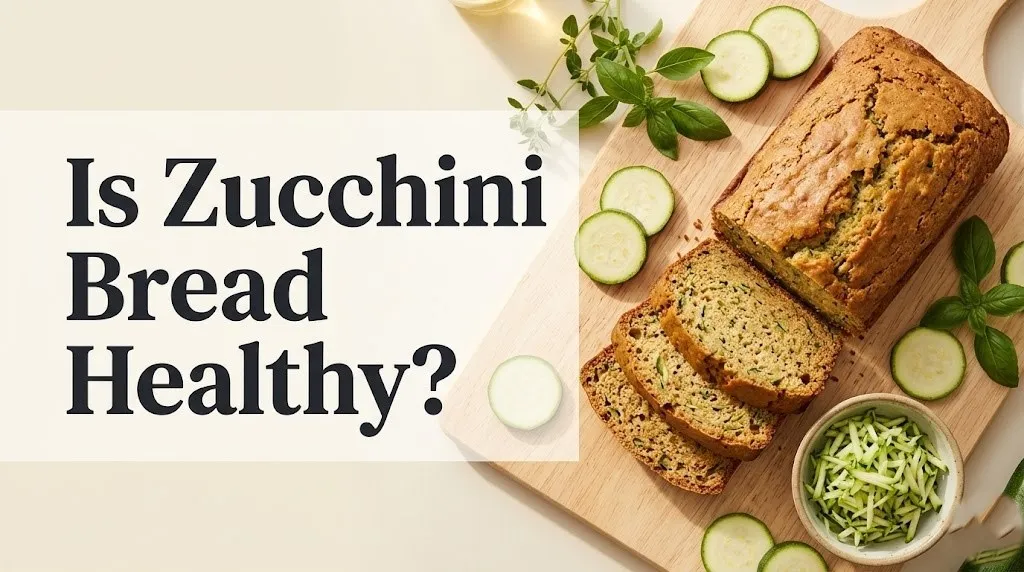
Think of it this way: adding a handful of spinach to a chocolate milkshake does not make the milkshake a health food. The context of the surrounding ingredients matters as much as the vegetable itself.
A lighter version made with whole grain flour, reduced sugar, and unsweetened applesauce as a partial oil replacement changes the nutritional picture substantially. That version can deliver roughly 130 to 160 calories per slice with 2 to 3 grams of fiber and 4 to 5 grams of protein, which fits comfortably into a balanced diet.
The answer to “is zucchini bread healthy” is genuinely recipe-dependent. This article gives you the tools to evaluate any recipe or build a better one.
| Version | Calories per Slice | Added Sugar | Fiber | Protein |
|---|---|---|---|---|
| Standard recipe | 190 to 230 | 16 to 20 g | 1 g | 3 g |
| Lighter recipe (this article) | 130 to 160 | 6 to 8 g | 2 to 3 g | 4 to 5 g |
Zucchini Bread Nutrition Facts and Calories per Slice
A standard slice of zucchini bread (approximately 70 grams, or 1/12 of a 9×5 inch loaf) contains roughly 190 to 230 calories, 28 to 32 grams of carbohydrates, 9 to 12 grams of fat, and only 1 gram of dietary fiber.
These figures come from USDA FoodData Central data on standard quick bread recipes and are consistent with the nutrition panels of commercially produced zucchini bread products. The numbers shift considerably based on the specific recipe, but the standard version is nutritionally closer to a sweet muffin than to a slice of whole grain bread.
The macronutrient profile that concerns most nutrition researchers is the combination of low fiber, high refined carbohydrate, and high added sugar. According to the Academy of Nutrition and Dietetics, the recommended daily intake of dietary fiber is 25 grams for women and 38 grams for men. A slice of standard zucchini bread contributing only 1 gram does little to move that needle.
The fat content deserves attention too. Standard recipes call for 0.5 to 0.75 cup of vegetable oil for a single loaf. At roughly 120 calories per tablespoon, that oil adds 960 to 1,440 calories to the loaf total before any other ingredients are counted.
| Nutrient | Standard Slice (~70 g) | Lighter Slice (~65 g) | % Daily Value (Lighter) |
|---|---|---|---|
| Calories | 190 to 230 | 130 to 160 | 7 to 8% |
| Carbohydrates | 28 to 32 g | 20 to 24 g | 7 to 9% |
| Added Sugar | 16 to 20 g | 6 to 8 g | 12 to 16% |
| Dietary Fiber | 1 g | 2 to 3 g | 7 to 11% |
| Protein | 3 g | 4 to 5 g | 8 to 10% |
| Fat | 9 to 12 g | 5 to 7 g | 7 to 9% |
What Nutrients Does Zucchini Add to Bread
Zucchini (Cucurbita pepo) adds meaningful amounts of vitamin C (ascorbic acid), vitamin K1 (phylloquinone), potassium, folate (vitamin B9), and manganese to bread, along with dietary fiber and water content that contributes to moisture without added fat.
One cup of raw shredded zucchini, which is the typical amount used per loaf, contains approximately 22 mg of vitamin C (about 24% of the daily value), 325 mg of potassium, and 29 mcg of folate. It contributes only 21 calories to the whole loaf. The nutritional density relative to caloric contribution is genuinely favorable.
The baking process does reduce some heat-sensitive nutrients. Vitamin C in particular degrades with heat. The NIH notes that ascorbic acid (vitamin C) is water-soluble and heat-sensitive, with losses of 15 to 55% expected during baking at temperatures above 300°F (150°C). Potassium, manganese, and most B vitamins are more heat-stable and survive baking better.
Zucchini also contributes carotenoids, including beta-carotene and lutein, which are fat-soluble antioxidants. Their bioavailability actually increases when consumed with fat, which the oil in zucchini bread provides. The anti-inflammatory properties of dietary carotenoids are documented in a 2020 review published in the journal Nutrients.
Quick Tip:
- Use the skin of the zucchini when shredding. It contains higher concentrations of carotenoids and chlorophyll than the flesh.
- Dark green zucchini skin contributes chlorophyll (a natural source of magnesium) that is absent from the pale interior.
- Do not peel zucchini before grating for bread; the skin shreds easily and becomes invisible once baked.
Key Takeaway: Zucchini itself is a low-calorie vegetable with real micronutrient value, but the surrounding recipe ingredients in a standard loaf can easily overshadow those benefits. The flour, oil, and sugar choices matter far more than the zucchini content does.
What Makes Standard Zucchini Bread Less Healthy
Standard zucchini bread is less healthy primarily because of three recipe ingredients: refined all-purpose flour, high added sugar content, and excess refined vegetable oil.
Refined all-purpose flour (milled from Triticum aestivum with the bran and germ removed) has a higher glycemic index than whole grain alternatives. A 2019 study published in the American Journal of Clinical Nutrition found that substituting whole grain flour for refined white flour reduced postprandial (post-meal) blood glucose response by a measurable degree in healthy adults. Most standard zucchini bread recipes use 1.5 to 2 cups of all-purpose flour, contributing roughly 90 to 120 grams of refined carbohydrate per loaf.
The sugar picture is even more direct. A typical recipe calls for 1 to 1.5 cups of granulated white sugar per loaf. That amounts to 192 to 288 grams of added sugar in a single 12-slice loaf, or 16 to 24 grams per slice. The American Heart Association (AHA) recommends no more than 25 grams of added sugar per day for women and 36 grams for men. One or two slices of standard zucchini bread approaches or exceeds those limits before any other food in the day is considered.
The oil contribution adds calorie density without protein, fiber, or micronutrients. A full half-cup of standard vegetable oil adds 960 calories of mostly omega-6 polyunsaturated fat to the loaf. Partial replacement with unsweetened applesauce or plain Greek yogurt reduces this significantly without creating a dry or gummy texture when done with the correct ratios.
| Ingredient | Standard Recipe | Health Concern |
|---|---|---|
| All-purpose flour | 1.5 to 2 cups | High glycemic index, minimal fiber |
| Granulated white sugar | 1 to 1.5 cups | 16 to 24 g added sugar per slice |
| Vegetable oil | 0.5 to 0.75 cup | 960 to 1,440 cal of fat per loaf |
| White sugar + oil combined | Dominant ingredients | Outweigh the vegetable content |
How to Make Zucchini Bread Healthier
The most effective way to make zucchini bread healthier is to replace refined flour with a whole grain or high-fiber alternative, reduce added sugar by at least half, and substitute part of the oil with unsweetened applesauce or plain Greek yogurt.
These three changes, applied together, reliably reduce the calorie count per slice by 50 to 80 calories and increase fiber by 1.5 to 2 grams, while keeping the bread moist and tender. The texture change is minor. The nutritional change is not.
Reducing sugar requires some technique awareness. Sugar in quick breads does more than sweeten. It contributes to browning (the Maillard reaction), moisture retention, and tenderness. Cutting sugar by more than 60% without other adjustments produces a dry, pale loaf. The sweet spot is reducing by 40 to 50% and adding 1 teaspoon of pure vanilla extract and 1 teaspoon of ground cinnamon (Cinnamomum verum) to maintain perceived sweetness without extra sugar.
Replacing oil with applesauce works well at a 1:1 ratio by volume for up to half the oil called for. Going beyond that (replacing all the oil with applesauce) produces a noticeably gummy texture in the finished bread because applesauce lacks the fat’s lubricating effect on the gluten structure.
- Replace 1 cup white flour with 1 cup whole wheat flour (Triticum aestivum whole grain): adds approximately 3 g fiber per slice
- Replace 1 cup sugar with 0.5 cup coconut sugar or maple syrup: reduces added sugar load by approximately 40 to 50%
- Replace 0.5 cup oil with 0.25 cup applesauce plus 0.25 cup oil: reduces fat by approximately 5 g per slice
- Add 0.5 cup plain Greek yogurt: adds approximately 1.5 g protein per slice, improves moisture, replaces some fat
Best Flour Substitutes for Healthy Zucchini Bread
The best flour substitutes for healthy zucchini bread are whole wheat flour (Triticum aestivum whole grain), oat flour (ground from Avena sativa), and almond flour (ground from Prunus dulcis), each producing a distinct texture and nutritional profile.
Whole wheat flour is the most straightforward swap because it behaves nearly identically to all-purpose flour in the batter. It absorbs moisture at the same rate, responds to leavening similarly, and produces a slightly denser crumb with a mild nutty flavor. Per quarter-cup serving, whole wheat flour provides approximately 3 grams more fiber than refined white flour with only a modest increase in calories.
Oat flour produces a lighter, more tender crumb than whole wheat and has a naturally mild, slightly sweet flavor that complements the cinnamon and vanilla in zucchini bread well. It is naturally lower in gluten than wheat flour, which means the structure is softer. For every 1 cup of all-purpose flour, use 1.25 cups of oat flour to compensate for the lower protein and gluten content. Oat flour is not safe for people with celiac disease unless it is specifically certified gluten-free.
Almond flour (ground Prunus dulcis blanched almonds) is the best option for grain-free and low-carbohydrate versions. It produces a moist, dense crumb with a subtly rich flavor. Almond flour cannot be substituted 1:1 for wheat flour; a typical ratio is 1.5 cups almond flour per 1 cup wheat flour, with an additional egg added for structure. People with tree nut allergies must avoid almond flour entirely.
| Flour Type | Fiber per 1/4 Cup | Protein per 1/4 Cup | Gluten-Free | Best For |
|---|---|---|---|---|
| All-purpose flour | 0.8 g | 3.6 g | No | Standard recipe |
| Whole wheat flour | 3.6 g | 4 g | No | General healthier swap |
| Oat flour | 2 g | 3 g | If certified | Tender, lighter crumb |
| Almond flour | 3 g | 6 g | Yes | Grain-free, low-carb |
| Coconut flour | 5 g | 2.5 g | Yes | Very high fiber, dense |
Key Takeaway: Swapping all-purpose flour for whole wheat flour is the single fastest way to improve the nutritional profile of any zucchini bread recipe without changing the technique, texture, or baking time by more than a few minutes.
How to Reduce Sugar in Zucchini Bread
Reducing sugar in zucchini bread by 40 to 50% from standard recipes is achievable without compromising texture, provided you compensate with spices, vanilla extract, and a touch of natural sweetener.
The most practical approach is to replace 1 cup of white granulated sugar with 0.5 cup of coconut sugar or pure maple syrup. Coconut sugar has a lower glycemic index than white sugar (approximately 35 vs. 65, per glycemic index tables) because it contains small amounts of inulin (a prebiotic fiber) that slightly slows glucose absorption. This does not make it a free food for people managing blood sugar, but the difference is measurable.
Maple syrup adds a light caramel depth that works well with cinnamon and nutmeg in zucchini bread. When using a liquid sweetener like maple syrup to replace a dry one like granulated sugar, reduce the other liquid in the recipe (milk or water) by 3 tablespoons per 0.25 cup of syrup used to maintain the correct batter consistency.
Ripe mashed banana or unsweetened applesauce can contribute perceived sweetness while reducing the need for added sugar. Adding 0.5 cup of applesauce to the batter allows a further reduction in sugar of approximately 2 to 3 tablespoons before the bread tastes noticeably less sweet.
Quick Tip:
- Add 1 teaspoon of pure vanilla extract per loaf to amplify perceived sweetness without adding sugar calories.
- Cinnamon (Cinnamomum verum) enhances the sweetness perception in baked goods, allowing for a further reduction of approximately 2 tablespoons of sugar per loaf without noticeable flavor loss.
- Taste your batter after reducing sugar; it should taste slightly less sweet than you want the finished bread to be, because baking concentrates flavors.
Healthy Zucchini Bread Recipe
This healthy zucchini bread recipe uses whole wheat flour, reduced sugar, Greek yogurt, and a partial oil substitution to deliver roughly 140 calories per slice with improved fiber and protein compared to a standard loaf.
The recipe requires basic baking equipment: a 9×5 inch loaf pan, a box grater or food processor shredding attachment, a large mixing bowl, and a medium bowl for dry ingredients. The technique requires no advanced baking skill, though the critical step of squeezing the zucchini completely dry is non-negotiable for the right texture.
Ingredients (makes 12 slices):
- 1.5 cups whole wheat flour (Triticum aestivum whole grain)
- 1 teaspoon baking soda (sodium bicarbonate)
- 0.5 teaspoon baking powder
- 1.5 teaspoons ground cinnamon (Cinnamomum verum)
- 0.25 teaspoon ground nutmeg
- 0.25 teaspoon fine sea salt
- 2 large eggs (or 2 flax eggs for vegan version)
- 0.33 cup coconut sugar (or maple syrup)
- 0.25 cup avocado oil (or light olive oil)
- 0.25 cup unsweetened applesauce
- 0.5 cup plain full-fat Greek yogurt
- 1 teaspoon pure vanilla extract
- 1.5 cups shredded zucchini (Cucurbita pepo), squeezed very dry
To bake this healthy zucchini bread:
- Preheat the oven to 350°F (175°C). Grease a 9×5 inch loaf pan with a light coating of oil and line it with parchment paper, leaving an overhang on the long sides.
- Shred the zucchini using the large holes of a box grater. Place the shredded zucchini into the center of a clean kitchen towel and squeeze firmly until no more liquid releases. Measure out 1.5 cups of squeezed zucchini.
- In a medium bowl, whisk together the whole wheat flour, baking soda, baking powder, cinnamon, nutmeg, and salt. Set aside.
- In a large bowl, whisk together the eggs, coconut sugar, avocado oil, applesauce, Greek yogurt, and vanilla extract until smooth.
- Add the squeezed zucchini to the wet ingredients and stir to combine.
- Pour the dry ingredients into the wet ingredients and fold gently with a spatula until just combined. Stop mixing the moment no dry flour streaks remain. Do not overmix.
- Transfer the batter to the prepared loaf pan and smooth the top with the spatula.
- Bake at 350°F (175°C) for 55 to 60 minutes, until a toothpick inserted into the center of the loaf comes out with only a few moist crumbs (not wet batter).
- Cool in the pan for 10 minutes, then use the parchment overhang to lift the loaf onto a wire rack. Cool for at least 30 minutes before slicing.
For egg-free and vegan bakers, prepare flax eggs by mixing 1 tablespoon ground flaxseed meal with 3 tablespoons water per egg; allow to rest for 5 minutes until gel-like before adding to the wet ingredients.
High-Protein Zucchini Bread
High-protein zucchini bread delivers 8 to 10 grams of protein per slice by incorporating unflavored or vanilla protein powder, Greek yogurt, and additional eggs into the base recipe.
Standard zucchini bread provides only 3 grams of protein per slice, which is low for a baked good eaten as a snack or breakfast. Boosting the protein content makes it a more balanced option for people who use baked goods as a practical source of macronutrients rather than just a treat.
The most effective approach is to replace 0.5 cup of flour with 0.5 cup of unflavored whey protein isolate or plant-based pea protein powder. Protein powders absorb liquid differently than flour, so an additional 2 to 3 tablespoons of milk (dairy or plant-based) should be added to the batter to prevent a dry, crumbly texture.
Greek yogurt (strained, full-fat) contributes approximately 3 grams of protein per quarter-cup serving and doubles as a moisture source. Using 0.5 cup of Greek yogurt in place of some oil adds protein without significantly altering the crumb.
Adding a third egg (for a 3-egg total instead of 2) provides an additional 6 grams of protein for the whole loaf. The extra egg also improves structure, which becomes important when protein powder replaces some of the flour’s binding capacity.
People following a plant-based diet can use pea protein powder and flax eggs to achieve similar protein gains. Pea protein isolate blends well into quick bread batter without the grittiness of some other plant proteins.
| Protein Source | Added Protein per Loaf | Notes |
|---|---|---|
| 0.5 cup whey protein isolate | 50 to 55 g (4 to 5 g per slice) | Reduces flour; add extra liquid |
| 0.5 cup Greek yogurt | 6 to 8 g total (0.5 to 1 g per slice) | Also adds moisture |
| 1 extra large egg | 6 g total (0.5 g per slice) | Also improves structure |
| 0.25 cup almond flour added | 6 g total | Also adds fiber and healthy fats |
Key Takeaway: Adding Greek yogurt, a partial protein powder substitution, and one extra egg to any zucchini bread recipe more than doubles the protein per slice compared to a standard loaf, which matters most for people eating it as a snack or breakfast item.
Gluten-Free Zucchini Bread Healthy Version
A healthy gluten-free zucchini bread can be made with certified gluten-free oat flour or almond flour, both of which produce a tender, moist loaf without the use of any wheat-derived ingredients.
People with celiac disease (an autoimmune condition triggered by gluten, the protein complex in wheat, barley, and rye) must ensure not only that the flour is gluten-free but that every other ingredient in the recipe, including baking powder, oats (if used), and even vanilla extract, carries a certified gluten-free label. Cross-contamination in manufacturing facilities is a real risk for people with celiac disease; oats labeled “gluten-free” are processed separately from wheat to prevent it.
For a gluten-free version using oat flour: use 1.75 cups of certified gluten-free oat flour in place of 1.5 cups all-purpose flour (the extra volume compensates for oat flour’s lower binding capacity). Add 0.5 teaspoon of xanthan gum if the recipe does not already contain a binder; this helps replicate the structural role gluten plays in holding the crumb together.
For an almond flour version: use 2 cups of blanched almond flour and 1 extra egg beyond the standard recipe quantity. The additional egg is necessary for structure, as almond flour has no gluten and very little starch to bind the batter. Almond flour versions produce a denser, moister crumb with a richer flavor. People with tree nut allergies cannot use almond flour.
Quick Tip:
- Certified gluten-free oat flour produces the most bread-like texture of all gluten-free options for zucchini bread.
- Almond flour produces the most nutrient-dense version (higher fat, fiber, protein, and lower carbohydrate).
- Neither version requires specialty equipment; standard mixing bowls and a loaf pan work for both.
Vegan Zucchini Bread Healthy Substitutions
Vegan zucchini bread replaces eggs with flax eggs or chia eggs and uses plant-based milk and oil to produce a loaf with a comparable crumb to the standard egg-containing version.
Eggs perform three functions in quick bread: binding the structure, adding moisture, and contributing to lift from proteins that set during baking. Flax eggs (made from ground flaxseed meal, Linum usitatissimum) replicate the binding function through their gel-forming mucilage. Each flax egg is made by combining 1 tablespoon of ground flaxseed meal with 3 tablespoons of water and allowing it to rest for 5 minutes until it forms a thick gel.
Chia eggs (from Salvia hispanica seeds) work by the same mechanism and can be used interchangeably with flax eggs in the same ratio. Chia seeds have no noticeable flavor in the finished bread, while flaxseed contributes a very subtle nutty undertone.
For dairy components like Greek yogurt: replace with plain coconut yogurt (full-fat) or plain oat-based yogurt at a 1:1 substitution. Both maintain the moisture contribution and slight acidity that helps activate the baking soda properly.
The finished vegan loaf will be slightly denser than one made with whole eggs because of the difference in protein structure, but the texture is satisfying and the slice holds together well. From a nutritional standpoint, flaxseed meal adds omega-3 fatty acids (alpha-linolenic acid/ALA) and additional fiber to each slice.
| Standard Ingredient | Vegan Substitute | Ratio | Notes |
|---|---|---|---|
| 1 large egg | 1 flax egg | 1 tbsp flaxseed + 3 tbsp water | Rest 5 min before using |
| 1 large egg | 1 chia egg | 1 tbsp chia seeds + 3 tbsp water | Rest 5 min before using |
| Plain Greek yogurt | Plain coconut yogurt | 1:1 | Full-fat for best moisture |
| Butter (if used) | Avocado oil or coconut oil | 1:1 by volume | Coconut oil adds mild sweetness |
Can Diabetics Eat Zucchini Bread
People managing type 2 diabetes can eat zucchini bread in moderation when the recipe uses whole grain flour, minimal added sugar, and controlled portion sizes that keep the per-serving carbohydrate load manageable.
The American Diabetes Association (ADA) emphasizes total carbohydrate quality and quantity per meal rather than a blanket avoidance of baked goods. A slice of standard zucchini bread with 28 to 32 grams of carbohydrate and 16 to 20 grams of added sugar is a meaningful glycemic event. A lighter version with 20 to 24 grams of carbohydrate, 3 grams of fiber, and 6 to 8 grams of sugar has a lower glycemic impact and fits more readily into a carbohydrate-managed meal plan.
Dietary fiber slows the rate of glucose absorption from the digestive tract. A 2019 study published in the journal Nutrients found that increasing dietary fiber intake was associated with a measurable reduction in postprandial blood glucose levels in people with type 2 diabetes. Choosing a zucchini bread recipe with 2 to 3 grams of fiber per slice versus 1 gram does make a practical difference in glycemic response.
Portion control is the other key variable. A half-slice of even a standard zucchini bread reduces the carbohydrate contribution to roughly 14 to 16 grams, which may fit within a managed carbohydrate target for a snack. People managing blood glucose with medication or insulin should discuss dietary carbohydrate goals with their registered dietitian or endocrinologist, particularly if they are making recipe changes that affect total carbohydrate content.
| Recipe Factor | Standard Loaf | Diabetic-Friendlier Version |
|---|---|---|
| Flour | All-purpose (high GI) | Whole wheat or oat flour (lower GI) |
| Sugar per slice | 16 to 20 g | 4 to 8 g (coconut sugar or small amount of maple syrup) |
| Fiber per slice | 1 g | 2 to 3 g |
| Carbohydrate per slice | 28 to 32 g | 20 to 24 g |
| Best portion | Half slice for blood sugar management | 1 slice fits most snack targets |
Key Takeaway: Diabetics are not excluded from enjoying zucchini bread, but the standard recipe’s 16 to 20 grams of added sugar per slice is genuinely problematic at a full serving. A lighter recipe with whole grain flour and halved sugar changes the calculus considerably.
Is Zucchini Bread Good for Weight Loss
Zucchini bread is not a weight loss food in its standard form, but a modified lighter version can fit into a calorie-conscious diet as an occasional snack or breakfast component when portion size is controlled.
Weight management comes down to total caloric intake and dietary pattern over time, not the presence or absence of any single food. A slice of lighter zucchini bread at 130 to 160 calories can work within a calorie target if it replaces a higher-calorie snack rather than being added on top of normal intake.
The fiber content of a properly made lighter loaf (2 to 3 grams per slice) contributes to satiety through slowed gastric emptying. According to a 2020 meta-analysis published in the American Journal of Clinical Nutrition, higher dietary fiber intake was consistently associated with greater satiety and reduced overall caloric intake at subsequent meals in controlled studies.
The practical question is not whether one slice of zucchini bread causes weight gain, but whether a person can realistically stop at one slice. The combination of sugar, fat, and refined flour in a standard recipe activates reward pathways in a way that makes portion control genuinely harder. A lighter recipe made with whole grain flour, less sugar, and more protein (from Greek yogurt or an extra egg) produces a more filling slice that is easier to eat in a controlled portion.
Quick Tip:
- Pair a slice of lighter zucchini bread with a protein source (two eggs, a serving of Greek yogurt, or a small handful of walnuts) to slow glucose absorption and extend satiety.
- Slice the loaf when fully cooled and freeze individual slices. Taking one slice out at a time prevents casual second-slice eating.
- A half-slice at approximately 70 to 80 calories is a practical portion for a structured weight management plan.
Zucchini Bread vs. Banana Bread: Which Is Healthier
Zucchini bread made with a lighter recipe is generally lower in calories, sugar, and carbohydrates per slice than banana bread made with a standard recipe, though the gap narrows considerably when both are made with whole grain flour and reduced sugar.
Banana bread’s nutritional profile is shaped largely by the ripe bananas, which contribute natural sugars (fructose and glucose), potassium, vitamin B6 (pyridoxine), and vitamin C (ascorbic acid). A standard banana bread slice contains approximately 196 to 220 calories and 33 to 37 grams of carbohydrate, with natural sugars from banana plus added sugar from the recipe.
Zucchini contributes far fewer natural sugars than banana. One cup of shredded zucchini contains approximately 3.9 grams of carbohydrate total, compared to one medium ripe banana at approximately 27 grams of carbohydrate. This means zucchini bread starts with a lower natural sugar base, giving the recipe more room for improvement before the total carbohydrate and sugar load becomes a concern.
However, standard zucchini bread recipes compensate for the zucchini’s low sweetness by adding larger amounts of sugar than banana bread typically requires. The result is that both standard versions end up in a similar calorie and sugar range. The lighter recipes for each are roughly comparable when made with the same flour and sweetener modifications.
| Comparison | Banana Bread (Standard) | Zucchini Bread (Standard) | Zucchini Bread (Lighter) |
|---|---|---|---|
| Calories per slice | 196 to 220 | 190 to 230 | 130 to 160 |
| Carbohydrates | 33 to 37 g | 28 to 32 g | 20 to 24 g |
| Natural sugar | 10 to 14 g (from banana) | 2 to 3 g (from zucchini) | 2 to 3 g |
| Added sugar | 10 to 14 g | 16 to 20 g | 6 to 8 g |
| Fiber | 1 to 1.5 g | 1 g | 2 to 3 g |
| Potassium | Higher (from banana) | Moderate | Moderate |
How to Store Zucchini Bread and Keep It Fresh
Zucchini bread stays fresh at room temperature for 2 to 3 days, in the refrigerator for up to 1 week, and in the freezer for up to 3 months when wrapped properly.
The high moisture content of zucchini bread, which is one of its best textural qualities, is also what makes it prone to mold faster than lower-moisture baked goods. Proper storage is straightforward but specific.
At room temperature, wrap the cooled loaf tightly in plastic wrap or place it in an airtight container. Keep it out of direct sunlight and away from heat sources. Slicing the loaf before storing and separating slices with small pieces of parchment paper makes it easier to pull individual portions without disturbing the rest.
For freezer storage, wrap individual slices in plastic wrap, then place them in a zip-close freezer bag with as much air removed as possible. Individual slices thaw at room temperature in 30 to 45 minutes or can be warmed in a toaster oven at 325°F (165°C) for 8 to 10 minutes directly from frozen. Avoid microwaving frozen slices for more than 30 to 40 seconds at a time; longer microwave times make the bread rubbery rather than soft.
Quick Tip:
- Always cool the loaf completely before wrapping. Sealing in warm bread traps steam and accelerates surface mold growth.
- The lighter recipe (with Greek yogurt and reduced oil) may dry out slightly faster than the standard oil-heavy version. A light brush of avocado oil on cut surfaces before wrapping helps retain moisture in the refrigerator.
- Lighter recipes with less sugar may have a shorter room-temperature shelf life because sugar acts as a mild preservative through its hygroscopic (moisture-retaining) properties.
Key Takeaway: Zucchini bread freezes exceptionally well. Slicing the entire loaf before freezing and pulling single slices as needed is the best strategy for portion control and freshness simultaneously.
Frequently Asked Questions About Zucchini Bread Healthy
Is zucchini bread healthier than banana bread?
Lighter zucchini bread is generally lower in carbohydrates and added sugar than standard banana bread because zucchini contributes almost no natural sugar.
Standard versions of both breads land in a similar calorie range (190 to 230 calories per slice) because traditional zucchini bread recipes compensate for the vegetable’s low sweetness with extra added sugar.
When both are made with whole grain flour and reduced sugar, zucchini bread tends to come out slightly lower in total carbohydrates due to the lower natural sugar content of zucchini versus ripe banana.
How many calories are in a slice of zucchini bread?
A standard slice of zucchini bread (approximately 70 grams, or 1/12 of a 9×5 loaf) contains roughly 190 to 230 calories depending on the specific recipe.
A lighter version made with whole wheat flour, reduced sugar, and partial applesauce substitution contains approximately 130 to 160 calories per slice of the same size.
Calorie counts from commercial zucchini bread products vary widely, so checking the nutrition label for the specific product and serving size is the only way to get an accurate figure.
Can I eat zucchini bread if I have diabetes?
People with type 2 diabetes can eat zucchini bread made with whole grain flour and reduced added sugar, in controlled portions that fit within their carbohydrate management targets.
Standard zucchini bread with 16 to 20 grams of added sugar per slice is a high glycemic load choice that is harder to fit into a blood sugar management plan without careful portion control.
A registered dietitian familiar with the individual’s medication and meal targets is the right resource for specific carbohydrate portion guidance.
Does the zucchini in zucchini bread actually count as a vegetable serving?
The zucchini in a slice of zucchini bread does not constitute a meaningful vegetable serving in the way that half a cup of cooked zucchini does.
One slice contains roughly 2 tablespoons of shredded zucchini (after squeezing out moisture), which is a small fraction of the half-cup vegetable serving size recommended by the USDA Dietary Guidelines.
Zucchini bread delivers some of the micronutrients from zucchini but in amounts too small to replace vegetable servings in a balanced diet.
How do I keep zucchini bread moist without adding a lot of oil?
Plain Greek yogurt and unsweetened applesauce both maintain moisture in zucchini bread without the calorie load of a full measure of oil.
Replace up to half the oil in any zucchini bread recipe with unsweetened applesauce at a 1:1 ratio by volume, and add 0.5 cup of full-fat Greek yogurt to the wet ingredients.
Squeezing the shredded zucchini only moderately (not bone dry) also allows a small amount of vegetable moisture to contribute to the crumb without destabilizing the batter structure.
Baking with Purpose
Zucchini bread lands on the healthy side of the scale when the recipe is built with intention. Whole wheat flour, halved sugar, and a spoonful of Greek yogurt cost almost nothing in effort and pay back meaningfully in nutritional quality.
Start with the recipe in this article. Bake it once exactly as written. Then adjust to your taste: more cinnamon, less sugar, walnuts stirred in for omega-3 fatty acids (alpha-linolenic acid) and crunch.
A good loaf of lighter zucchini bread feeds a household for a week of breakfasts or snacks. That kind of practical, repeatable nutrition is worth knowing how to do well.