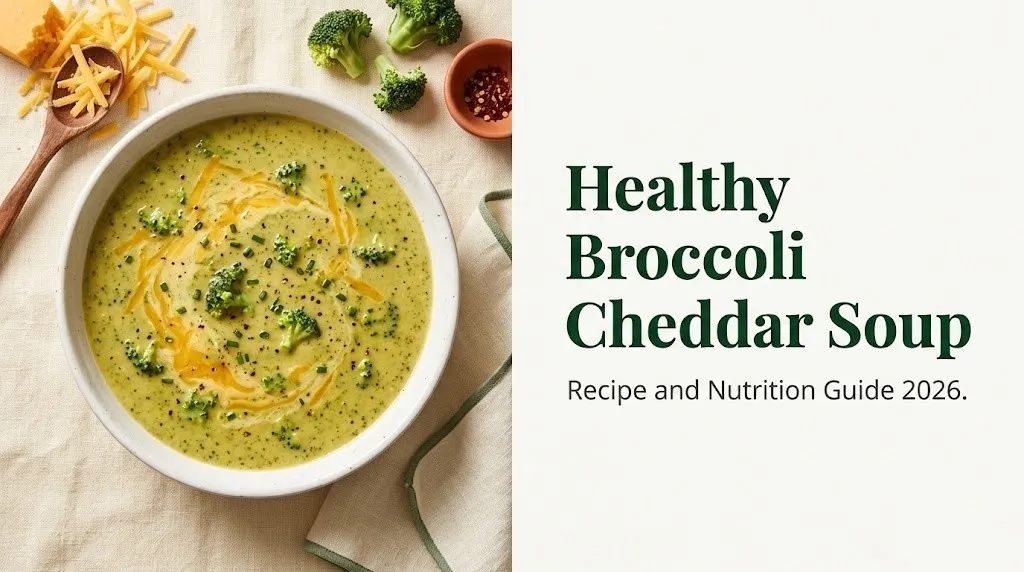
Healthy broccoli cheddar soup is genuinely achievable at home, and it delivers substantially better nutrition than most restaurant versions without sacrificing the creamy, cheesy texture that makes this soup worth eating in the first place.
The numbers back this up. A homemade version made with reduced-fat cheddar, low-sodium vegetable broth, and 1% evaporated milk can clock in at around 190 to 240 calories per 1.25-cup serving, compared to roughly 290 calories and 900 milligrams of sodium in Panera Bread’s standard bowl, according to the chain’s published nutrition data.
This article covers the full nutritional profile, a tested step-by-step recipe, the science behind the ingredient swaps that actually work, and a clear breakdown of who benefits most from this soup and what to watch for if you’re managing sodium, saturated fat, or specific dietary restrictions.
Is Broccoli Cheddar Soup Healthy?
Broccoli cheddar soup can be a genuinely nutritious meal when made with the right ingredients and portion sizes, though the healthfulness varies widely depending on preparation method.
The standard restaurant version tends to be high in sodium and saturated fat. Panera Bread’s Broccoli Cheddar Soup contains approximately 9 grams of saturated fat per regular bowl (12 oz), which represents about 45% of the American Heart Association’s recommended daily maximum of 20 grams. The homemade version, built around real broccoli florets and a lighter dairy base, changes that picture considerably.
What actually makes a version “healthy” comes down to three factors: the type and amount of dairy used, the sodium level of the broth, and the ratio of vegetables to thickener. A soup with at least 1.5 cups of broccoli (Brassica oleracea var. italica) per serving brings meaningful fiber, folate, and vitamin C to the bowl. The cheese, when used in a controlled amount, contributes calcium and protein rather than empty calories.
People managing cardiovascular health should pay specific attention to the sodium content, since cheese and commercial broth both contribute meaningfully. Those with lactose intolerance may tolerate aged sharp cheddar better than fresh dairy, since the aging process reduces lactose content significantly.
| Version | Calories (per serving) | Sodium (mg) | Saturated Fat (g) | Protein (g) |
|---|---|---|---|---|
| Homemade healthy version | 190-240 | 350-450 | 4-6 | 11-14 |
| Standard homemade recipe | 280-350 | 600-750 | 8-11 | 10-13 |
| Panera Bread regular bowl (12 oz) | 290 | ~900 | 9 | 12 |
| Panera Bread bread bowl | 850-920 | ~1,500+ | 14 | 28 |
Panera Bread data reflects published nutrition information as of early 2026. Figures may vary by location and are subject to menu changes.
Healthy Broccoli Cheddar Soup Nutrition Facts
A single 1.25-cup serving of homemade healthy broccoli cheddar soup provides a meaningful spread of vitamins and minerals alongside its macronutrients.
According to USDA FoodData Central data, one cup of raw broccoli florets contains approximately 81 mg of vitamin C (ascorbic acid), which covers nearly 90% of the daily recommended intake for most adults. Cooking reduces some of that vitamin C content, but a serving of this soup still contributes a notable amount.
The combination of broccoli and cheese delivers calcium from two distinct sources. Broccoli provides a plant-based form of calcium alongside vitamin K1 (phylloquinone), which the National Institutes of Health Office of Dietary Supplements notes plays a role in bone metabolism. Cheddar cheese adds a concentrated calcium hit. Together, a serving of this soup can contribute 200 to 280 mg of calcium, roughly 20 to 28% of the daily target for adults.
People on anticoagulant medications such as warfarin should be aware that broccoli is a notable source of vitamin K1. This does not mean avoiding broccoli, but maintaining a consistent weekly intake matters for medication stability. Anyone in this situation should raise it with their prescribing provider as part of routine dietary review.
Key nutrients per 1.25-cup serving (homemade healthy version):
- Calories: 190 to 240
- Protein: 11 to 14 g
- Total fat: 8 to 12 g (saturated fat 4 to 6 g)
- Carbohydrates: 14 to 18 g
- Dietary fiber: 3 to 4 g
- Vitamin C (ascorbic acid): 35 to 55 mg (approximately 40 to 60% DV)
- Folate (vitamin B9): 70 to 100 mcg (approximately 18 to 25% DV)
- Calcium: 200 to 280 mg (approximately 20 to 28% DV)
- Potassium: 380 to 480 mg (approximately 8 to 10% DV)
Broccoli Cheddar Soup Calories Per Serving
Broccoli cheddar soup ranges from about 190 to 920 calories per serving depending on the recipe and format, with portion size being the single largest variable.
The calorie spread is almost entirely driven by four ingredients: the type of dairy base, the amount of cheese, whether a roux is used and how much, and whether the soup is served in a bread bowl. Swapping heavy cream for 1% evaporated skim milk removes roughly 100 to 120 calories per cup of liquid used. Reducing sharp cheddar from 2 cups to 1 cup while choosing a stronger-flavored aged variety cuts another 100 to 150 calories from the whole batch without noticeably reducing the cheese flavor.
Think of the calorie difference between recipe versions like the difference between a full espresso and a diluted cup of instant coffee. You can get the same flavor punch from less volume if you choose better quality.
For weight management purposes, serving size context matters more than the per-calorie figure. A 1.25-cup serving of a well-made healthy version at 220 calories is satisfying, protein-rich, and fiber-dense. The same soup consumed as a 3-cup portion shifts the equation entirely.
The Academy of Nutrition and Dietetics recommends pairing calorie-moderate soups with a protein-forward side, such as a hard-boiled egg or a small serving of legumes, to create a complete meal that sustains satiety for three to four hours.
Broccoli Cheddar Soup Macros and Protein
The macronutrient breakdown of healthy broccoli cheddar soup positions it well as a lunch or light dinner, particularly for people who need moderate protein without excessive fat.
Protein comes from two sources in this soup: the cheddar cheese and the dairy base. A 1-ounce serving of cheddar provides approximately 7 grams of protein. Using 3 ounces per batch (a reasonable amount for a full pot) distributes roughly 2 to 3 grams of cheese-sourced protein per serving. Greek yogurt as a partial cream substitute adds another 2 to 3 grams of protein per serving while reducing fat, making it a macronutrient-efficient swap.
| Macro | Homemade Healthy Version | Standard Homemade | Panera Regular Bowl |
|---|---|---|---|
| Calories | 190-240 | 280-350 | 290 |
| Protein (g) | 11-14 | 10-13 | 12 |
| Total Fat (g) | 8-12 | 16-22 | 18 |
| Carbohydrates (g) | 14-18 | 18-24 | 16 |
| Fiber (g) | 3-4 | 2-3 | 2 |
| Sodium (mg) | 350-450 | 600-750 | ~900 |
The carbohydrate content is moderate rather than low. People following ketogenic or very low-carbohydrate diets should note that even a lighter version contains 14 to 18 grams of carbs per serving, primarily from broccoli, onion, and any thickener used. A cauliflower base swap reduces this by 3 to 5 grams per serving.
Key Takeaway: Homemade healthy broccoli cheddar soup delivers a meaningful calcium, folate, and vitamin C payload per serving, cuts sodium by roughly half compared to the Panera standard bowl, and lands at under 240 calories per serving when built with the right dairy swaps.
Nutritional Benefits of Broccoli in Soup
Broccoli brings far more to this soup than color and texture; it delivers a specific group of bioactive plant compounds that no amount of cheese can replicate.
The most researched of these is sulforaphane, an isothiocyanate compound formed when glucosinolates in Brassica oleracea are broken down by the enzyme myrosinase. Research published in the Journal of Nutrition has investigated sulforaphane’s behavior at the cellular level, with multiple studies noting its interaction with oxidative stress pathways. Cooking does reduce myrosinase activity, but consuming broccoli alongside raw mustard seed or lightly cooked broccoli in the same meal can partially restore sulforaphane formation.
Broccoli is also one of the better plant-based sources of folate (vitamin B9), a nutrient the NIH’s Office of Dietary Supplements identifies as essential for DNA synthesis and repair. One cup of cooked broccoli supplies approximately 84 micrograms of folate, about 21% of the 400 mcg daily value recommended for most adults. This makes the soup particularly relevant for people of reproductive age, for whom folate adequacy matters year-round.
The carotenoids in broccoli, specifically beta-carotene and lutein, are fat-soluble compounds. They absorb far more effectively when consumed alongside dietary fat, such as the fat naturally present in cheddar cheese. This is one of the few cases where the cheese in this soup actively improves the nutritional return on the vegetable.
People who follow low-FODMAP diets should note that broccoli florets (as opposed to the stalk) are generally tolerated in servings up to 3/4 cup (75 grams) per meal, according to Monash University’s FODMAP guidelines. Larger amounts may trigger symptoms in people with irritable bowel syndrome.
Cheddar Cheese in Soup: What You Need to Know
Cheddar cheese contributes calcium, protein, and saturated fat to this soup, and the type of cheddar you choose affects all three in ways that matter nutritionally.
Sharp or extra-sharp aged cheddar contains the same fat and protein per ounce as mild cheddar, but its significantly more concentrated flavor means you can use less and still achieve a pronounced cheese character. Using 2 ounces of extra-sharp cheddar produces roughly the same flavor impact as 3 to 4 ounces of mild cheddar, saving 70 to 140 calories per batch.
Reduced-fat cheddar (often labeled 2% or 50% reduced fat) contains approximately 4.5 grams of fat per ounce compared to 9 grams per ounce in full-fat versions. The American Heart Association recommends limiting saturated fat to less than 10% of total daily calories. For someone on a 2,000-calorie diet, that means staying under about 22 grams of saturated fat daily. A full-fat recipe might use up to 3 ounces of cheddar per serving in some restaurant-style preparations; a smarter home version targets 0.75 to 1 ounce of reduced-fat sharp cheddar per serving.
One thing to know about reduced-fat cheese in hot applications: it melts less smoothly than full-fat versions. The fat in cheese acts as a plasticizer for the protein network. When fat is reduced, the proteins can bind more tightly under heat, creating a stringy or grainy result. The fix is to always remove the pot from heat completely, wait 60 seconds, then stir in cheese a small handful at a time.
People managing high LDL cholesterol should discuss dietary saturated fat targets with their healthcare provider before making significant changes to dairy intake, since individual responses to saturated fat from dairy vary based on the overall dietary pattern.
Healthy Broccoli Cheddar Soup Recipe
This tested healthy broccoli cheddar soup recipe produces a creamy, deeply flavored soup at approximately 200 to 220 calories per serving, with no heavy cream and no compromised texture.
Ingredients (makes 6 servings):
- 5 cups broccoli florets (Brassica oleracea var. italica), cut into 1-inch pieces (about 2 medium heads)
- 1 medium yellow onion, finely diced (approximately 1 cup)
- 3 garlic cloves, minced
- 2 tablespoons unsalted butter or olive oil
- 2 tablespoons all-purpose flour (or cornstarch for gluten-free; see Section 11)
- 2.5 cups low-sodium vegetable broth (or low-sodium chicken broth)
- 1.5 cups 1% evaporated milk (not sweetened condensed milk)
- 1 large carrot, shredded (approximately 1/2 cup)
- 6 ounces (170 g) reduced-fat sharp cheddar, freshly grated
- 1/2 cup plain 2% Greek yogurt
- 1/2 teaspoon smoked paprika
- 1/4 teaspoon ground black pepper
- Salt to taste (start with 1/4 teaspoon given the low-sodium broth)
- 1 teaspoon Dijon mustard (deepens cheese flavor; optional but recommended)
Instructions:
- Place a heavy-bottomed pot or Dutch oven over medium heat. Add butter and let it melt fully before adding onion.
- Add diced onion and cook for 5 to 6 minutes, stirring occasionally, until softened and translucent but not browned.
- Add minced garlic and shredded carrot. Cook for 2 minutes, stirring constantly to prevent garlic from burning.
- Sprinkle flour over the vegetables. Stir continuously for 1 to 2 minutes to cook out the raw flour taste. The mixture will look dry and slightly paste-like.
- Pour in the vegetable broth gradually, whisking to dissolve the flour-vegetable mixture into a smooth base. Add evaporated milk. Stir to combine.
- Add broccoli florets. Bring to a gentle simmer (not a rolling boil) over medium heat. Cook for 10 to 12 minutes until broccoli is tender when pierced with a fork.
- Use an immersion blender to partially blend the soup, leaving roughly half the broccoli pieces intact for texture. Alternatively, transfer 2 cups of soup to a countertop blender, blend until smooth, and return it to the pot.
- Reduce heat to the absolute lowest setting. Stir in Dijon mustard and smoked paprika.
- Remove pot from heat entirely. Wait 60 seconds. Stir in grated cheddar a small handful at a time, allowing each addition to melt before adding the next.
- Fold in Greek yogurt. Taste and adjust salt and pepper. Serve immediately or allow to cool before refrigerating.
Key Takeaway: The two non-negotiable decisions in this recipe are using evaporated milk instead of heavy cream (which prevents curdling and reduces fat by roughly 60%) and adding cheese off the heat (which prevents the grainy texture that frustrates most home cooks).
How to Make Broccoli Cheddar Soup Without Heavy Cream
Replacing heavy cream in broccoli cheddar soup without compromising texture is entirely achievable once you understand why cream works in the first place.
Heavy cream contributes three things: fat for richness, heat stability (it resists curdling due to its high fat-to-protein ratio), and a neutral flavor that lets the cheese dominate. Any successful substitute needs to address at least the first two of those properties.
Best dairy-based cream substitutes:
- 1% evaporated skim milk: The most reliable substitute. Evaporated milk has been heat-processed to remove about 60% of its water, which concentrates the proteins and makes them far more heat-stable than fresh milk. It doesn’t curdle at simmering temperatures and contributes a light creaminess with roughly 60% fewer calories per cup than heavy cream.
- Full-fat coconut milk (canned): Works well and is dairy-free. Adds a faint coconut flavor that most people don’t notice against the strong cheese and broccoli background. Reduces saturated fat vs. heavy cream slightly, though coconut cream is itself moderately high in saturated fat.
- Plain 2% Greek yogurt (stirred in off-heat): Adds protein and tang. Must be added off heat to prevent curdling. Contributes a slight sour note that works well with sharp cheddar.
- Silken tofu, blended smooth: A high-protein, low-fat option that creates a convincingly creamy texture through blending. Works best when combined with a small amount of cheese rather than as a standalone swap.
| Substitute | Calories per Cup | Saturated Fat | Heat Stability | Flavor Impact |
|---|---|---|---|---|
| Heavy cream | 800 | 55 g | Excellent | Neutral |
| 1% Evaporated milk | 200 | 3 g | Excellent | Very light |
| Full-fat coconut milk | 445 | 41 g | Good | Faint coconut |
| 2% Greek yogurt | 130 | 2 g | Poor (add off-heat) | Slightly tangy |
| Silken tofu (blended) | 80 | 1 g | Good | Very neutral |
People with dairy allergies should note that evaporated milk and Greek yogurt both contain milk proteins (casein and whey). The only completely dairy-free options in this table are coconut milk and silken tofu.
Best Cheese for Healthy Broccoli Cheddar Soup
The best cheese for healthy broccoli cheddar soup is extra-sharp aged cheddar, used in a smaller quantity than most recipes call for.
Aged cheddar has a lower moisture content and a more concentrated, sharper flavor than mild cheddar. This means 1 ounce of extra-sharp cheddar delivers more perceivable cheese flavor than 1.5 to 2 ounces of mild cheddar, which lets you cut the total cheese volume by 30 to 40% without the soup tasting under-cheesed.
From a nutritional standpoint, 1 ounce of standard sharp cheddar contains approximately:
- Calories: 113
- Protein: 7 g
- Total fat: 9 g (saturated fat: 5.5 g)
- Calcium: 200 mg (about 20% DV)
- Sodium: 175 mg
Reduced-fat sharp cheddar (labeled 50% less fat) cuts total fat to about 4.5 grams per ounce while keeping protein around 6 grams. The calorie reduction per ounce is roughly 40 calories (about 113 down to 72). Over 6 servings, switching from full-fat to reduced-fat sharp cheddar removes approximately 240 calories from the batch without dramatically affecting flavor when the aged variety is used.
One cheese to avoid in this application is pre-shredded cheddar from a bag. Most commercial pre-shredded cheeses are coated with cellulose (an anti-caking agent) and sometimes potato starch. Both interfere with smooth melting, increasing the likelihood of a grainy or clumpy result. Always buy a block and grate it yourself immediately before using.
People with a sensitivity to tyramine (found in aged cheeses) and those managing certain headache disorders may want to limit the amount of aged cheddar used or choose a milder, younger cheddar instead.
Key Takeaway: Extra-sharp aged cheddar freshly grated from a block, used in a smaller quantity than mild cheddar, delivers better flavor and fewer calories while dramatically improving the soup’s final texture.
How to Thicken Broccoli Cheddar Soup Without Flour
Broccoli cheddar soup thickens without flour through several reliable methods, each with a different calorie cost and texture outcome.
Traditional recipes use a roux (equal parts butter and all-purpose flour cooked together) as the thickener. This works well but adds gluten and approximately 50 to 70 extra calories per serving depending on quantity. For those reducing carbs or avoiding gluten, the alternatives below produce comparable results.
Think of soup thickening like different kinds of road grip. A roux is asphalt: dense, reliable, and familiar. Blending is more like textured rubber. Each works differently, but both get the job done depending on conditions.
Flourless thickening methods:
- Partial blending: Blend one-third to one-half of the soup and stir back in. The starch from broccoli and any added vegetables creates a naturally thick, creamy base with zero extra calories. This is the most recommended method for a healthy version.
- Cornstarch slurry: Mix 1.5 tablespoons of cornstarch with 2 tablespoons of cold water to create a smooth slurry. Stir into the simmering soup (before adding dairy) and cook for 2 to 3 minutes until thickened. Cornstarch is gluten-free. It adds approximately 10 to 15 calories per serving at this ratio.
- Arrowroot powder: Works identically to cornstarch but produces a slightly more translucent, glossy finish. Use the same 1:1 ratio. Does not hold well when reheated, so best for soups consumed immediately.
- Mashed potato or cauliflower: Stir in 1/2 cup of mashed cooked potato or cauliflower per batch. Adds body, some fiber, and a neutral flavor. Increases the carbohydrate content by approximately 4 to 6 grams per serving.
- Pureed white beans (cannellini): Add 1/2 cup pureed white beans per batch for a protein and fiber boost alongside thickening. Contributes approximately 3 grams of protein and 2.5 grams of fiber per serving at this amount.
| Thickener | Gluten-Free | Calories Added (per serving) | Effect on Texture |
|---|---|---|---|
| All-purpose flour roux | No | 50-70 | Rich, opaque, traditional |
| Partial blending | Yes | 0 | Creamy, natural |
| Cornstarch slurry | Yes | 10-15 | Smooth, slightly glossy |
| Arrowroot powder | Yes | 10-15 | Glossy, less heat-stable |
| Mashed cauliflower | Yes | 15-25 | Thick, very mild |
| Pureed white beans | Yes | 35-45 | Dense, protein-rich |
Gluten-Free Broccoli Cheddar Soup
Gluten-free broccoli cheddar soup is straightforward to produce, since the only gluten-containing ingredient in a standard recipe is the flour used as a thickener.
The most common mistake in gluten-free soup preparation is assuming that commercial broths are automatically gluten-free. Many vegetable and chicken broths include yeast extract or flavor additives that contain wheat-derived glutamate compounds. According to celiac disease management guidelines from the Celiac Disease Foundation, people with celiac disease should look for broths explicitly labeled certified gluten-free, not just “no gluten ingredients,” since cross-contamination during processing is a real and documented risk.
Pre-shredded cheddar from a bag should also be checked. Some brands use wheat starch as an anti-caking agent. Again, block cheese grated at home eliminates this variable entirely.
Gluten-free swaps for this recipe:
- Replace all-purpose flour with cornstarch (1 tablespoon = 2 tablespoons flour) or arrowroot powder in a cold-water slurry
- Use certified gluten-free vegetable broth
- Buy block cheddar and grate it fresh
- Confirm that any condiments added (Worcestershire sauce, Dijon mustard) are labeled gluten-free; many traditional Worcestershire sauces contain malt vinegar from barley
With those four checks in place, this soup is reliably gluten-free. The texture and flavor are indistinguishable from the wheat-flour version when using a cornstarch slurry properly.
People with both celiac disease and lactose intolerance should note that aged cheddar is very low in lactose (under 0.5 grams per ounce in most aged varieties), making it generally well-tolerated compared to fresh dairy, according to the NIH’s lactose intolerance guidance.
Low Sodium Broccoli Cheddar Soup
Low sodium broccoli cheddar soup requires managing three distinct sodium sources, not just switching to a reduced-sodium broth.
The three significant sodium contributors in a standard recipe are: commercial broth (300 to 900 mg per cup depending on brand and type), cheddar cheese (approximately 175 mg per ounce), and any added salt during cooking. A four-serving batch using a standard broth and 3 ounces of cheddar can easily contain 700 to 900 mg of sodium per serving before a single shake of the salt shaker.
The American Heart Association recommends keeping daily sodium intake below 2,300 mg for most adults, with a target of 1,500 mg for those managing hypertension. A high-sodium restaurant bowl of broccoli cheddar soup alone can consume 40 to 65% of those limits in one sitting.
Steps to genuinely reduce sodium:
- Use unsalted or low-sodium broth (look for products with 140 mg or less per cup)
- Choose Swiss cheese or reduced-sodium cheddar as a partial substitute; Swiss cheese contains approximately 54 mg of sodium per ounce, compared to 175 mg in standard cheddar
- Build flavor with garlic, onion, smoked paprika, and Dijon mustard rather than relying on salt
- Add a squeeze of lemon juice at the end; acidity sharpens flavor perception in a way that reduces the need for salt
- Season at the table rather than during cooking, which consistently reduces total salt use
A soup built on these guidelines can land at 300 to 400 mg of sodium per serving, well within a reasonable daily range even for people monitoring sodium intake. People managing heart failure, kidney disease, or hypertension on a medically prescribed low-sodium diet should use specific sodium targets provided by their care team rather than general public guidelines, since individual needs vary considerably.
Key Takeaway: The biggest sodium wins in broccoli cheddar soup come from choosing low-sodium broth and using aged Swiss or reduced-sodium cheddar, not just cutting the salt shaker.
Dairy-Free Broccoli Cheddar Soup
Dairy-free broccoli cheddar soup is achievable, though it requires accepting that the flavor profile will shift meaningfully since cheddar cheese has no truly replicable plant-based equivalent.
The most successful approach uses full-fat canned coconut milk as the cream base (which provides heat stability and richness) combined with a blend of nutritional yeast and a small amount of cashew cream to approximate the savory, slightly sharp quality of cheddar. Nutritional yeast contains glutamates that produce umami depth; it does not taste like cheese, but it creates a satisfying savory roundness that dairy-free eaters often find convincing.
Dairy-free substitution guide:
| Dairy Ingredient | Dairy-Free Substitute | Notes |
|---|---|---|
| Heavy cream or milk | Full-fat coconut milk | Slight coconut note; very heat-stable |
| Cheddar cheese | Nutritional yeast + cashew cream | Provides umami; different flavor profile |
| Butter (for roux) | Olive oil or coconut oil | Olive oil produces a slightly thinner roux |
| Greek yogurt | Unsweetened oat-based yogurt | Check for gluten-free certification if needed |
| Shredded vegan cheese | Violife, Daiya, or similar | Melts variably; add off-heat same as dairy cheddar |
Commercially available vegan cheddar shreds vary considerably in melt quality and sodium content. Some brands contain 300 to 500 mg of sodium per ounce, which is significantly higher than dairy cheddar. Reading the nutrition label before purchasing is worth the 30 seconds.
People with tree nut allergies should note that cashew cream (raw cashews blended with water) is not appropriate for this substitution. Sunflower seed cream (raw sunflower seeds blended with water and a small amount of lemon juice) produces a functionally similar result at a lower allergen risk.
Healthy Broccoli Cheddar Soup vs Panera Bread
The comparison between homemade healthy broccoli cheddar soup and Panera Bread’s version reveals meaningful differences in sodium and saturated fat, with protein content being roughly comparable.
Panera Bread’s Broccoli Cheddar Soup in a regular bowl (12 oz / 340 g) contains approximately 290 calories, 18 g total fat, 9 g saturated fat, 900 mg sodium, and 12 g protein, according to Panera’s published nutrition data. Those figures reflect a single standard bowl, not the bread bowl, which adds substantially more calories and sodium from the bread itself.
A well-made homemade healthy version in the same 12-oz volume sits at approximately 220 to 260 calories, 9 to 12 g total fat, 4 to 6 g saturated fat, 380 to 450 mg sodium, and 11 to 14 g protein. The saturated fat reduction is roughly 33 to 55%. The sodium reduction is roughly 50%.
The broccoli content difference is worth noting. Panera’s version is known to contain relatively small broccoli pieces distributed through a cream-heavy base. A homemade version built with 1.5 cups of broccoli per serving delivers more fiber and more of the vitamin C, folate, and sulforaphane-forming glucosinolates that make broccoli nutritionally worthwhile.
Panera’s menu and nutrition data may vary by location, by season, and following any recipe reformulations the company undertakes. Readers who want current figures should verify directly on Panera Bread’s official nutrition page, since third-party databases often reflect outdated data.
One practical point: if you’re eating at Panera and want a lower-sodium option, ordering a cup rather than a bowl cuts the sodium roughly in half, since the smaller size is approximately 6 oz (170 g) with around 450 mg of sodium.
Meal Prep and Storage for Broccoli Cheddar Soup
Healthy broccoli cheddar soup stores well in the refrigerator for up to four days and can be frozen with some texture caveats.
Dairy-based soups thickened with flour or cornstarch will often separate or become grainy after freezing and thawing. This happens because the starch granules that create the smooth texture can rupture during freezing, and the dairy proteins can aggregate when the temperature drops below 32°F (0°C). The soup remains safe to eat but the texture suffers noticeably.
Refrigerator storage:
- Cool completely before refrigerating (within 2 hours of cooking, per USDA food safety guidance)
- Store in an airtight container for up to 4 days
- Reheat gently over low heat, stirring frequently. Do not boil. High heat causes cheese proteins to seize.
- If the soup looks broken or separated upon reheating, whisk in 1 to 2 tablespoons of low-sodium broth to re-emulsify
Freezer storage:
- For best results, freeze the soup before adding cheese and dairy. Add those components fresh when reheating.
- Freeze in individual 1.25-cup portions for easier meal prep
- Label with the date. Use within 2 to 3 months for best quality.
- Thaw overnight in the refrigerator, not on the countertop. USDA food safety guidance advises against thawing soups at room temperature due to the risk of bacterial growth in the temperature danger zone (40°F to 140°F / 4°C to 60°C).
Meal prep efficiency tips:
- Batch-cook a full pot on Sunday. Divide into six 1.25-cup glass containers.
- Store grated cheese separately and stir in at reheating time for best texture.
- Pack with a small salad or a portion of legumes for a complete weekday lunch under 400 calories.
People managing foodborne illness risk due to pregnancy, immunosuppression, or advanced age should follow the 2-hour cooling rule strictly and discard any soup that has been at room temperature for longer than that window.
Frequently Asked Questions About Healthy Broccoli Cheddar Soup
Can broccoli cheddar soup be part of a healthy diet?
Broccoli cheddar soup can absolutely be part of a nutritious eating pattern when made with reduced-fat dairy, low-sodium broth, and plenty of real broccoli florets.
The key variables are sodium content, saturated fat level, and portion size, all of which are controllable in a homemade version.
A 1.25-cup serving of a well-built homemade recipe contributes meaningful amounts of calcium, vitamin C (ascorbic acid), and folate alongside moderate protein and calories.
How many calories are in a bowl of healthy broccoli cheddar soup?
A homemade healthy version contains approximately 190 to 240 calories per 1.25-cup serving, depending primarily on the type and amount of dairy used.
Panera Bread’s standard bowl (12 oz) contains approximately 290 calories, while a Panera bread bowl version rises to 850 to 920 calories once the bread is included.
Choosing reduced-fat cheddar, 1% evaporated milk as the cream base, and Greek yogurt as a partial thickener keeps homemade versions at the lower end of that range.
What can I use instead of heavy cream in broccoli cheddar soup?
1% evaporated skim milk is the most reliable heavy cream substitute in this soup because it is heat-stabilized and resists curdling at simmering temperatures.
It contributes a light creaminess at approximately 200 calories per cup compared to 800 calories per cup for heavy cream.
Plain full-fat coconut milk and blended silken tofu also work well for dairy-free versions, though each changes the flavor profile slightly.
Is broccoli cheddar soup good for weight loss?
Broccoli cheddar soup made with a lighter dairy base and generous broccoli content can fit into a calorie-managed eating plan, particularly as a satisfying, protein-moderate lunch.
At 190 to 240 calories and 3 to 4 grams of fiber per serving, it produces reasonable satiety relative to its calorie cost.
The soup alone does not drive weight loss; its usefulness depends entirely on total daily calorie and nutrient intake, and pairing it with a protein-forward side makes it more likely to sustain satiety for three to four hours.
How do you keep broccoli cheddar soup from getting grainy?
The single most effective step is removing the pot from heat completely before adding any cheese, then stirring in small amounts at a time.
High heat causes the proteins in cheddar to seize and separate from the fat, producing the grainy, broken texture that frustrates most home cooks.
Using freshly grated block cheddar rather than pre-shredded cheese also makes a significant difference, since pre-shredded cheese contains anti-caking coatings that interfere with smooth melting.
Final Thoughts
Healthy broccoli cheddar soup earns its place as a regular weeknight meal when it’s built right. The difference between a genuinely nutritious bowl and a restaurant-style calorie bomb comes down to a few specific choices: the dairy base, the cheese type and quantity, the broth sodium level, and how you handle the heat when adding cheese.
Start with the recipe in this guide, grate your cheese from a block, and use evaporated milk the first time you make it. That single dairy swap will change your results more than any other substitution.
If sodium is your primary concern, building from unsalted broth and adding Swiss alongside a smaller amount of sharp cheddar gets you well under 400 mg per serving without sacrificing the flavor that makes this soup worth coming back to.