
Greek food is a Mediterranean cuisine built on fresh vegetables, quality olive oil, legumes, seafood, and lean meats, seasoned with herbs like oregano and thyme and finished with lemon. It is one of the oldest documented culinary traditions in the world, and it remains one of the most studied from a nutritional standpoint.
The Mediterranean diet, which places Greek eating patterns at its center, has been linked to reduced risk of cardiovascular disease by multiple large-scale studies. The landmark PREDIMED trial, published in the New England Journal of Medicine, found that a Mediterranean dietary pattern was associated with a significantly lower risk of major cardiovascular events compared to a control low-fat diet.
This guide covers what Greek food is made of, what it tastes like, which dishes define it, how it stacks up nutritionally, and what you need to know if you have dietary restrictions. Whether you are ordering at a Greek restaurant for the first time or planning to cook it at home, this is the practical reference you want.
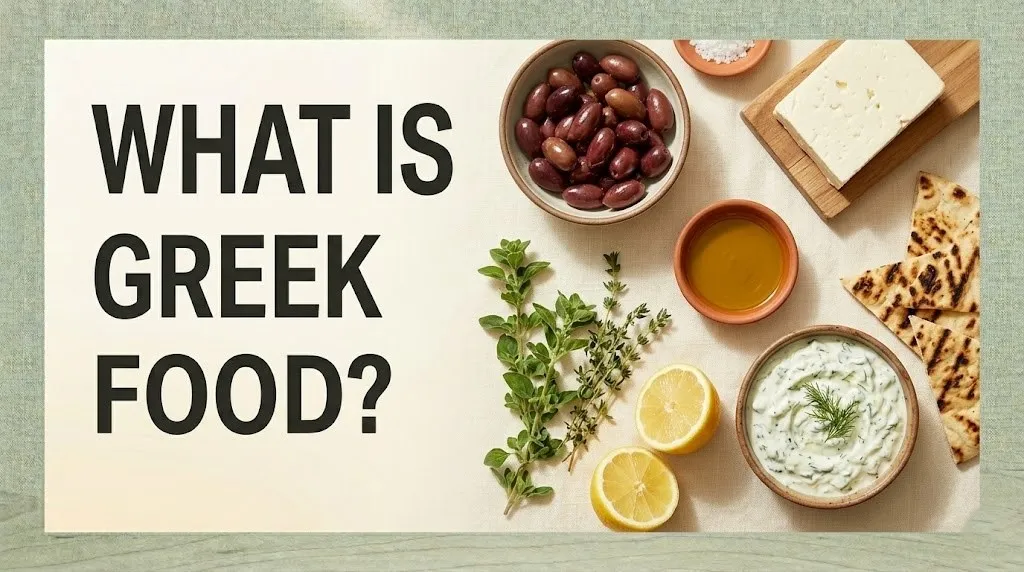
What Is Greek Food?
Greek food is a Mediterranean cuisine characterized by the use of extra virgin olive oil, seasonal vegetables, legumes, grains, fresh herbs, seafood, lamb, and dairy products like feta cheese and strained yogurt.
It is not a cuisine defined by heavy sauces or complex spice blends. The flavor philosophy is different. Greek cooking builds depth through quality raw ingredients, generous amounts of fresh lemon juice, and herbs that grow abundantly in the Greek climate.
The cuisine draws on over 4,000 years of culinary history. Ancient Greek texts reference olive oil, wine, bread, honey, and legumes as dietary staples, and those same ingredients still anchor Greek cooking today. That continuity is rare in world cuisine.
Greek food varies noticeably by region. Island communities eat more seafood. Northern Greece shows influence from its Balkan neighbors. The mainland leans more on lamb, pork, and slow-cooked meat dishes. But the core flavor profile remains consistent: bright, herb-forward, olive oil-rich, and fresh.
| Greek Cuisine Feature | Description |
|---|---|
| Primary fat source | Extra virgin olive oil (Olea europaea) |
| Dominant proteins | Lamb, pork, chicken, seafood, legumes |
| Key dairy | Feta PDO cheese, strained Greek yogurt |
| Characteristic herbs | Oregano (Origanum vulgare), thyme (Thymus vulgaris), dill |
| Typical acid source | Fresh lemon juice |
| Common cooking methods | Grilling, slow-roasting, baking, raw preparation |
What Does Greek Food Consist Of?
Greek food consists of a core set of ingredients: extra virgin olive oil, fresh and cooked vegetables, legumes, whole grains, seafood, lamb and pork, dairy products, fresh herbs, and lemon.
These aren’t just cultural habits. The combination reflects the agricultural reality of the Greek landscape, where olive trees, wild herbs, grape vines, and coastal fishing have shaped the diet for millennia. The eastern Mediterranean climate produces specific ingredients in abundance, and Greek cooking built itself around them.
Vegetables are not a side element in Greek cuisine. They are central. Eggplant, zucchini, tomatoes, bell peppers, spinach, and leafy greens appear in main dishes, not just as garnishes. A dish like briam, a slow-roasted vegetable casserole, has no meat at all and is considered a full meal.
Legumes carry significant nutritional weight in the Greek diet. Lentils, chickpeas, fava beans (broad beans, Vicia faba), and giant white beans appear in soups, stews, and cold salads. They provide plant-based protein and dietary fiber, both of which the USDA Dietary Guidelines for Americans 2020-2025 identify as nutrients most Americans consume in inadequate amounts.
Key components that make up Greek food:
- Extra virgin olive oil: Used in cooking, dressing, dipping, and finishing dishes
- Vegetables: Eggplant, tomatoes, zucchini, peppers, spinach, cucumber
- Legumes: Lentils, chickpeas, fava beans, giant white beans (gigantes)
- Dairy: Feta PDO cheese, strained Greek yogurt, kefalograviera cheese
- Proteins: Lamb, pork, chicken, octopus, sea bass (Dicentrarchus labrax), sardines
- Grains: Pita bread, phyllo pastry, orzo (kritharaki), barley rusks (paximadi)
- Flavoring: Fresh lemon juice, garlic, dried oregano, fresh dill, fresh mint, dried thyme
People with celiac disease or gluten sensitivity should know that pita, phyllo, and several Greek breads contain wheat. Lentil soups, roasted vegetables, and many seafood dishes are naturally gluten-free.
What Is Traditional Greek Food?
Traditional Greek food refers to dishes that have been prepared in recognizably similar forms across generations, often tied to religious calendars, regional geography, and seasonal ingredient availability.
Greek Orthodox religious practice has shaped the traditional food calendar more than any other single cultural force. Approximately 180 days per year of fasting in the Greek Orthodox tradition historically meant abstaining from meat, dairy, and eggs. This produced an extraordinarily rich tradition of plant-based, legume-heavy, and seafood-based dishes that are now recognized globally as being among the healthiest eating patterns studied.
Some traditional dishes like moussaka (layered eggplant, ground lamb, and béchamel sauce), pastitsio (baked pasta with meat and béchamel), and yemista (tomatoes and peppers stuffed with rice and herbs) are slow, oven-baked preparations. Others, like spanakopita (spinach and feta baked in phyllo pastry) and tiropita (cheese phyllo pie), reflect the importance of dairy and pastry craft in Greek cooking.
Traditional doesn’t always mean simple. Phyllo dough, for example, requires considerable skill and patience. Modern cooks often use store-bought phyllo, but the traditional hand-stretched version is an art form passed down through families.
Key traditional Greek dishes by category:
| Category | Traditional Dish | Primary Ingredients |
|---|---|---|
| Baked casseroles | Moussaka | Eggplant, ground lamb, béchamel |
| Phyllo pies | Spanakopita | Spinach, feta, phyllo |
| Stuffed vegetables | Yemista | Tomatoes, peppers, rice, herbs |
| Legume dishes | Fasolada | White beans, tomato, vegetables |
| Grilled meat | Souvlaki | Pork or chicken, olive oil, lemon |
| Cold appetizers | Tzatziki | Greek yogurt, cucumber, garlic, dill |
People following a strictly vegan diet should note that traditional Greek dishes frequently contain dairy and eggs, even in otherwise vegetable-heavy preparations. However, the fasting tradition means that genuinely vegan versions of many dishes exist within the classical Greek culinary framework.
Key Takeaway: Greek food is built on olive oil, vegetables, legumes, seafood, and lean meats. The religious fasting calendar produced a uniquely deep tradition of plant-forward cooking. Traditional dishes span both hearty baked casseroles and light, herb-driven preparations.
What Food Is Greece Most Known For?
Greece is most known for dishes and ingredients that have crossed into global recognition: feta cheese, tzatziki, souvlaki, moussaka, spanakopita, Kalamata olives, and extra virgin olive oil.
Feta cheese holds a Protected Designation of Origin (PDO) status from the European Union, meaning that only cheese produced in specific regions of Greece using milk from local sheep and goats can legally be called feta. This is not a marketing claim. It is a regulated geographic indication, similar to how only sparkling wine from the Champagne region of France can be called Champagne.
Kalamata olives, named after the city of Kalamata in the southern Peloponnese, are one of the most recognized olive varieties worldwide. They are a table olive, not primarily an oil olive, with a distinctive dark purple-black color and a rich, slightly fruity flavor that differs significantly from green Spanish or Italian varieties.
The global reputation of Greek food also rests heavily on the simplicity of the Greek salad (choriatiki): ripe tomatoes, cucumber, red onion, green pepper, Kalamata olives, and a slab of feta, dressed with extra virgin olive oil and dried oregano. No lettuce. No complicated dressing. Just quality ingredients in the right proportions.
World-famous Greek foods at a glance:
- Feta PDO cheese: Protected, made from sheep’s and goat’s milk
- Tzatziki: Strained yogurt with cucumber, garlic, and dill
- Souvlaki: Skewered, grilled meat, typically pork or chicken
- Moussaka: Eggplant and lamb casserole with béchamel
- Spanakopita: Spinach and feta in crisp phyllo pastry
- Kalamata olives: Protected variety, distinct flavor profile
- Greek salad (choriatiki): Tomato, cucumber, feta, olives, olive oil
- Greek yogurt (strained yogurt): Higher protein, lower lactose than regular yogurt
What Is the Most Popular Food in Greece?
Souvlaki is widely regarded as the most popular everyday food in Greece, eaten as a street food, a fast-casual meal, and a home-cooked staple across all regions and age groups.
It is Greece’s equivalent of a burger or a taco in terms of cultural ubiquity. A pork souvlaki in a pita, wrapped with tomatoes, onions, tzatziki, and sometimes french fries, costs a few euros at any street-side souvlaki shop (a “souvlatzidiko”) and represents the practical daily eating reality for millions of Greeks.
Moussaka holds the position of most iconic dish for international visitors, but day-to-day in Greece, it is souvlaki that dominates. Grilled octopus, lamb chops (paidakia), and spanakopita are all culturally prominent, but none match souvlaki’s frequency of consumption.
Fasolada, a white bean soup made with celery, tomatoes, carrots, and generous olive oil, has been called the “national dish of Greece” by food historians. It predates Christianity in documented Greek food records and remains a staple of the fasting calendar and everyday winter cooking.
| Food | Role in Greek Culture | Most Common Setting |
|---|---|---|
| Souvlaki | Daily street food staple | Souvlaki shops, fast-casual |
| Fasolada | “National dish,” fasting staple | Home cooking, winter |
| Greek salad | Universal side and appetizer | Every restaurant |
| Spanakopita | Bakery and home staple | Bakeries, home kitchens |
| Moussaka | Icon for visitors, occasion dish | Restaurants, family meals |
What Is Greek Food Like in Terms of Taste and Texture?
Greek food tastes bright, herbaceous, and clean, with olive oil providing richness and lemon providing acidity that keeps dishes from feeling heavy.
Think of it this way: if Italian food builds depth through slow reduction and concentrated tomato, Greek food builds it through fresh layering. A Greek dish rarely has a long list of spices competing for attention. It has a few ingredients doing their job at high quality: good olive oil, fresh lemon, dried oregano, garlic.
Texturally, Greek food spans a wide range. Phyllo pastry is shattering-crisp when baked properly. Slow-braised lamb in tomato sauce becomes meltingly tender. Grilled octopus gets a lightly charred exterior with a firm but yielding interior. Fresh Greek yogurt is thick, tangy, and almost spreadable compared to regular Western-style yogurts.
The presence of olive oil changes the mouthfeel of Greek food noticeably. Extra virgin olive oil has a different weight and flavor than butter or vegetable oil. It adds a slight pepperiness, a smooth finish, and a richness that doesn’t feel as cloying as saturated-fat-based richness.
Salty and tangy notes are common throughout the cuisine. Feta contributes both. Kalamata olives contribute brine. Lemon contributes acid. The overall effect is a flavor profile that feels fresh and complex without being fussy.
People who find heavy cream sauces or butter-rich French cooking overwhelming often find Greek food more comfortable and digestible. The fat is there, but it is primarily monounsaturated, and the portions of starchy or heavy elements tend to be balanced by vegetables.
What Are the Main Ingredients in Greek Food?
Extra virgin olive oil is the single most defining ingredient in Greek food, used in quantities that would surprise cooks from other culinary traditions.
Unlike many Western cuisines where oil is used sparingly as a cooking medium, in Greek cooking, olive oil is a flavor ingredient in its own right. A pot of fasolada might receive half a cup of quality extra virgin olive oil stirred in at the end. A plate of boiled greens (horta) is dressed with enough olive oil to pool on the plate. This is intentional and foundational.
The Harvard T.H. Chan School of Public Health identifies extra virgin olive oil as the primary fat source in the Mediterranean dietary pattern, noting its high concentration of oleic acid (a monounsaturated fatty acid) and polyphenolic compounds including oleocanthal, which has been studied for anti-inflammatory properties.
Main Greek cooking ingredients and their roles:
| Ingredient | Role | Key Nutrient Contribution |
|---|---|---|
| Extra virgin olive oil | Primary fat, finishing oil | Oleic acid, oleocanthal, polyphenols |
| Feta PDO cheese | Flavor, protein, salt | Calcium, protein, sodium |
| Strained Greek yogurt | Sauce base, condiment | Protein, calcium, probiotics |
| Kalamata olives | Flavor, texture | Monounsaturated fats, polyphenols |
| Lamb | Primary red meat | Protein, iron, zinc, B12 |
| Lentils and chickpeas | Protein, filler | Protein, dietary fiber, iron, folate |
| Tomatoes | Sauce, raw use | Vitamin C, lycopene, potassium |
| Eggplant | Main vegetable | Fiber, potassium, nasunin (antioxidant) |
| Lemon juice | Acid, flavor | Vitamin C (ascorbic acid) |
| Oregano (dried) | Primary herb | Rosmarinic acid, antioxidant compounds |
People managing sodium intake should be aware that feta cheese and Kalamata olives are both high in sodium. A 1-ounce (28g) serving of feta provides approximately 316mg of sodium, according to USDA FoodData Central. Rinsing olives and using feta sparingly helps manage this without eliminating these ingredients entirely.
Key Takeaway: The most popular foods in Greece range from humble street food like souvlaki to the iconic status of feta and olive oil. Taste-wise, Greek food is bright, herbaceous, and olive oil-rich. Olive oil is not just a cooking medium. It is a core flavor ingredient, and its quality matters enormously to the final dish.
Is Greek Food Healthy?
Greek food, as traditionally prepared, is one of the most nutritionally sound cuisines studied by modern dietary science.
That’s not marketing. It reflects the findings of decades of epidemiological research and the position of major health organizations. The Academy of Nutrition and Dietetics recognizes the Mediterranean dietary pattern, of which Greek cuisine is a cornerstone, as one of the most evidence-supported dietary approaches for long-term health.
The nutritional strengths of traditional Greek eating are specific. High intake of monounsaturated fats from olive oil is associated with favorable blood lipid profiles. High intake of vegetables, legumes, and whole grains provides dietary fiber, B vitamins, vitamin C (ascorbic acid), magnesium, and potassium. Regular seafood consumption provides omega-3 fatty acids, specifically docosahexaenoic acid (DHA) and eicosapentaenoic acid (EPA), which the American Heart Association recommends for cardiovascular health.
However, “Greek food” as served in some restaurants or prepared with shortcuts can look quite different from its traditional form. Gyros meat from a commercial rotating spit can be high in sodium, saturated fat, and additives. Restaurant portions of phyllo-based pastries are often larger than traditional home servings. Baklava is a dessert, not a health food, regardless of its cultural authenticity.
| Greek Food Scenario | Nutritional Profile | Notes |
|---|---|---|
| Traditional home-cooked Greek food | High fiber, high MUFA, moderate protein, moderate sodium | Reflects research-backed dietary pattern |
| Greek salad with grilled fish | Low calorie, high protein, good fats | One of the healthiest options at any restaurant |
| Restaurant souvlaki plate | 500-650 calories, 35-45g protein | Balanced if paired with salad over fries |
| Commercial gyros from rotating spit | Variable, often high sodium and saturated fat | Check restaurant sourcing where possible |
| Baklava (1 piece, ~40g) | 180-220 calories, high sugar, moderate fat | A dessert, consumed as such |
| Spanakopita | 200-270 calories per piece, moderate fat | Good source of calcium and iron from feta and spinach |
People with type 2 diabetes should note that pita bread and phyllo pastry contribute refined carbohydrates with a moderately high glycemic load. Pairing these with protein-rich fillings, olive oil, and vegetables helps moderate the glycemic response.
How Does Greek Food Relate to the Mediterranean Diet?
Greek food is the foundation of what nutrition researchers formally call the Mediterranean dietary pattern.
When scientists designed the Mediterranean diet as a study intervention, they modeled it primarily on the eating patterns observed in Crete and southern Greece in the 1960s, before the widespread adoption of Western fast food and processed foods. The 2013 PREDIMED study, one of the largest dietary intervention trials ever conducted, used a Mediterranean diet protocol and found that adherence was associated with a 30% relative risk reduction in major cardiovascular events, including heart attack, stroke, and cardiovascular death, compared to a low-fat control diet.
The Mediterranean diet as defined by the Harvard T.H. Chan School of Public Health and the USDA Dietary Guidelines includes: abundant plant foods (vegetables, fruits, legumes, whole grains, nuts, seeds), olive oil as the primary fat, moderate amounts of fish and poultry, low to moderate dairy, limited red meat, and moderate wine with meals where culturally appropriate.
Traditional Greek food hits every one of those markers. Fasolada is a plant-forward legume dish. Grilled sardines are omega-3-rich seafood. Strained Greek yogurt is moderate dairy. Lamb appears occasionally, not daily, in traditional cooking. The olive oil is ever-present and of high quality.
The Mediterranean diet is not a rigid prescription. It is a pattern. Greek cuisine is the living, practical version of that pattern, and eating it in its traditional form requires no calorie counting or macro tracking. The structure of the diet does the nutritional work.
People on plant-based or vegan diets can achieve a close approximation of the Mediterranean pattern through Greek cuisine’s extensive tradition of legume dishes, vegetable casseroles, and grain-based preparations, since these all predate and are structurally separate from the meat and dairy elements.
What Is a Typical Greek Meal?
A typical Greek meal begins with shared appetizers (mezze or meze), progresses to a main dish, and ends lightly, usually with fruit, yogurt with honey, or a small sweet.
The mezze culture is central to Greek dining. Mezze are small shared plates brought to the table at the start of a meal or as a meal in themselves. A standard mezze spread at a Greek taverna might include tzatziki, taramasalata (fish roe dip), grilled pita, Kalamata olives, a small Greek salad, fried zucchini (kolokithakia), and perhaps grilled halloumi or saganaki (pan-fried cheese).
This style of eating, sharing from common plates rather than eating individual portions, naturally moderates overeating. Researchers studying the Mediterranean dietary pattern note that the shared-plate eating structure, combined with slower eating pace and social interaction, tends to produce better satiety signaling than individual plated Western meals.
Lunch, not dinner, is traditionally the largest meal of the day in Greek culture. A proper Greek Sunday lunch can last several hours. Dinner tends to be lighter: a plate of yogurt with honey and walnuts, some leftover soup, or simple grilled vegetables.
Typical Greek meal structure:
- Mezze (shared appetizers): Tzatziki, olives, pita, taramasalata, small salads
- Salad: Usually choriatiki (Greek village salad) or a seasonal variant
- Main dish: Grilled meat or fish, slow-cooked casserole (moussaka, yemista), or a legume dish
- Side: Roasted vegetables, boiled greens with lemon and olive oil, bread
- Dessert: Fresh fruit, Greek yogurt with honey, or a small portion of traditional sweet (loukoumades, galaktoboureko)
Key Takeaway: Greek food is among the most thoroughly researched healthy eating patterns in the world. The PREDIMED study linked Mediterranean eating to a 30% lower risk of major cardiovascular events. A typical Greek meal follows a slow, shared-plate structure that supports satiety. Nutrient density comes from olive oil, legumes, vegetables, and seafood working together, not from any single “superfood.”
What Herbs and Spices Are Used in Greek Cooking?
Dried oregano (Origanum vulgare) is the most commonly used herb in Greek cooking, followed by dried thyme (Thymus vulgaris), fresh dill, fresh mint, fresh flat-leaf parsley, and rosemary.
Greek herb use is direct and confident. Where other cuisines layer many spices, Greek cooking typically commits to one or two herbs per dish and lets them define the flavor. Oregano goes on the lamb. Dill goes in the tzatziki. Mint goes in the stuffed vegetables. These pairings are not interchangeable. They reflect centuries of culinary refinement.
Cinnamon appears in some meat dishes, particularly in northern Greece and in recipes with clear Ottoman influence, such as certain versions of pastitsio and spiced lamb stews. Allspice (Pimenta dioica) appears occasionally in slow-cooked meat preparations. Bay leaves (Laurus nobilis) go into soups and braises.
Key Greek herbs and their culinary applications:
| Herb or Spice | Scientific Name | Primary Use |
|---|---|---|
| Dried oregano | Origanum vulgare | Meat marinades, salads, sauces |
| Dried thyme | Thymus vulgaris | Roasted meats, marinades |
| Fresh dill | Anethum graveolens | Tzatziki, fish, spanakopita, rice dishes |
| Fresh mint | Mentha spicata | Yemista, cheese pies, cold dishes |
| Fresh flat-leaf parsley | Petroselinum crispum | Garnish, mezze, cold salads |
| Cinnamon | Cinnamomum verum | Pastitsio, spiced lamb, some pastries |
| Bay leaf | Laurus nobilis | Soups, braises, stews |
| Garlic | Allium sativum | Tzatziki, marinades, almost everything |
Research published in the Journal of Agricultural and Food Chemistry has identified rosmarinic acid and ursolic acid in Greek oregano as compounds with antioxidant activity. This doesn’t mean oregano is a medicine. It means that cooking with it regularly, as Greeks do, adds bioactive compounds to the diet in quantities that accumulate meaningfully over time.
People with ragweed allergies may react to chamomile, which is a common Greek herbal tea (tsai tou vounou, mountain tea), as ragweed and chamomile share family-level botanical relationships.
Are There Vegetarian Options in Greek Food?
Greek cuisine has a rich, genuinely deep tradition of vegetarian and plant-based cooking, rooted in the Greek Orthodox fasting calendar.
This is not a modern adaptation. For centuries, observant Greek Orthodox Christians abstained from meat, dairy, and eggs on Wednesdays, Fridays, and during major fasting periods like Lent. This produced an entire parallel track of Greek cooking that is completely plant-based and fully developed as a culinary tradition, not a compromise.
Dishes like fasolada (white bean soup), gigantes plaki (giant baked white beans in tomato sauce), spanakorizо (spinach and rice), horta vrasta (boiled wild greens with olive oil and lemon), briam (roasted vegetable casserole), and fava santorinis (yellow split pea puree from Santorini) are all vegetarian, and in their traditional fasting form, fully vegan.
Lacto-vegetarians will find even more options. Spanakopita, tiropita (cheese pie), and most mezze spreads containing tzatziki or yogurt-based dips are vegetarian but contain dairy. Feta cheese, as a PDO product from Greece, is not suitable for vegans.
Genuinely vegan Greek dishes:
- Fasolada: White bean and vegetable soup
- Gigantes plaki: Baked white beans in tomato and herb sauce
- Briam: Roasted zucchini, eggplant, tomato, and potato casserole
- Fava (Santorini yellow split pea puree): Rich, smoky, olive oil-finished
- Horta vrasta: Boiled seasonal greens, dressed with lemon and olive oil
- Spanakorizо: Spinach and rice cooked together with tomato and dill
- Revithada: Slow-baked chickpea soup
People following a vegan diet should ask about phyllo-based dishes at restaurants, as phyllo dough itself often contains butter, and cheese is frequently added to vegetable pies. The fasting versions of these dishes traditionally use olive oil instead of butter.
What Are Traditional Greek Desserts?
Traditional Greek desserts are typically sweet and syrup-soaked, made with honey, nuts, phyllo pastry, and semolina, often flavored with cinnamon, clove, orange zest, or rosewater.
Baklava is the most internationally recognized. It layers phyllo pastry with chopped walnuts and pistachios, baked until golden, then saturated with a honey and lemon syrup. A single piece of baklava (approximately 40g) provides roughly 180-220 calories, with most of the energy coming from refined carbohydrates and fat. It is a dessert in the full sense of the word and is consumed in small portions in traditional Greek culture, not as a daily food.
Loukoumades are Greek honey doughnuts, deep-fried dough balls dipped in warm honey and dusted with cinnamon and walnuts. They are one of the oldest documented Greek desserts, with references to versions served to Olympic athletes in ancient Greece. Modern loukoumades stands across Greece sell them fresh, hot, and crisp.
Galaktoboureko is a custard slice made from semolina cream baked inside phyllo, then soaked in syrup. Rizogalo is a simple, comforting rice pudding made with milk, rice, and vanilla, dusted with cinnamon. It is lighter than most Greek desserts and is often served for breakfast as much as dessert.
| Greek Dessert | Key Ingredients | Approximate Calories (per serving) |
|---|---|---|
| Baklava (1 piece) | Phyllo, walnuts, honey, syrup | 180-220 kcal |
| Loukoumades (4-6 pieces) | Dough, honey, cinnamon, walnuts | 200-280 kcal |
| Galaktoboureko (1 slice) | Semolina custard, phyllo, syrup | 300-380 kcal |
| Rizogalo (1 cup) | Rice, milk, vanilla, cinnamon | 180-240 kcal |
| Melomakarona (1 cookie) | Semolina, honey, orange, walnuts | 120-150 kcal |
People with tree nut allergies should be cautious with baklava and loukoumades, as walnuts and pistachios are common ingredients. People with gluten sensitivity should avoid all phyllo-based desserts. Rizogalo is gluten-free but contains dairy, and people with lactose intolerance should note this.
Key Takeaway: Greek food offers a genuinely deep vegetarian tradition built on centuries of religious fasting, making it one of the few global cuisines with fully developed plant-based cooking at its core. Herbs like oregano and dill are not garnishes but structural flavor elements. Greek desserts are intensely sweet and best enjoyed in small portions.
How Does Greek Food Compare to Other Mediterranean Cuisines?
Greek food shares its foundational ingredients with other Mediterranean cuisines but differs in specific flavors, preparation methods, and dietary emphasis.
The olive oil, vegetables, legumes, seafood, and fresh herb base connects Greek cooking to Italian, Spanish, Lebanese, Turkish, and North African cuisines. But each tradition diverges in characteristic ways. Italian cooking builds more heavily on pasta and tomato-based sauces. Spanish cooking uses paprika and saffron with more frequency and leans on pork in the Iberian interior. Lebanese cuisine uses tahini (sesame paste), pomegranate molasses, and spice combinations like baharat and za’atar that don’t appear in Greek cooking.
Greek food tends to use simpler spice profiles than Lebanese or Turkish cuisine. A Greek lamb dish might use only oregano, garlic, lemon, and olive oil. A Turkish or Lebanese lamb preparation of similar tradition might include cumin, coriander, allspice, and sumac. Both are Mediterranean. Both are rooted in similar ingredients. The flavor language is distinct.
The use of phyllo pastry connects Greek cuisine to Turkish and Balkan cooking, reflecting centuries of shared cultural exchange across the Ottoman Empire. Börek in Turkey and burek in the Balkans are close cousins to Greek tiropita and spanakopita.
| Feature | Greek | Italian | Lebanese | Spanish |
|---|---|---|---|---|
| Primary fat | Extra virgin olive oil | Butter and olive oil | Olive oil | Olive oil |
| Dominant herb | Oregano, dill, thyme | Basil, rosemary, sage | Parsley, mint, za’atar | Paprika, saffron |
| Key dairy | Feta, Greek yogurt | Parmesan, mozzarella, ricotta | Labneh, halloumi | Manchego, fresh cheese |
| Signature technique | Grilling, slow-roasting | Pasta-making, slow reduction | Raw preparation, mezze | Sauteing, slow frying |
| Vegetarian tradition | Deep (fasting tradition) | Moderate | Very strong | Moderate |
People navigating both Greek and Turkish restaurants should be aware that many dishes appearing on both menus, such as stuffed grape leaves (dolmades in Greek, dolma in Turkish), have versions in both traditions that differ subtly in seasoning and preparation.
Allergens and Dietary Considerations in Greek Food
Greek food contains several common allergens that appear consistently across traditional dishes: dairy, gluten, tree nuts, eggs, and sesame in preparations using tahini.
Knowing this before you order at a Greek restaurant or cook Greek food at home avoids unpleasant surprises. The good news is that Greek cuisine also has extensive naturally allergen-friendly options, particularly within its plant-based fasting tradition.
Dairy is present in feta cheese, strained Greek yogurt, béchamel sauce, tiropita, and many desserts. Greek yogurt is generally better tolerated by people with lactose intolerance than regular yogurt because straining removes much of the whey and reduces the lactose content. Feta still contains lactose, though generally in lower amounts than soft fresh cheeses.
Gluten appears in pita bread, phyllo pastry, orzo, and any breaded or battered preparations. Many core Greek dishes are naturally gluten-free: all the bean soups, roasted vegetables, grilled meats and fish, horta, and most mezze dips. Always confirm with the restaurant, as cross-contamination is possible in kitchens that prepare both phyllo and gluten-free dishes.
Tree nuts are most common in desserts. Baklava uses walnuts and pistachios prominently. Loukoumades are typically garnished with walnuts. Confirm with the kitchen whether nut-free preparations are possible.
Sesame can appear when tahini is used in dips or dressings, which is more common in Greek restaurants serving a broader Mediterranean menu than in strictly Greek cooking.
| Allergen | Common Greek Sources | Naturally Free Alternatives |
|---|---|---|
| Dairy | Feta, yogurt, béchamel | Fasolada, briam, grilled fish |
| Gluten | Pita, phyllo, orzo | Horta, lentil soup, grilled meats |
| Tree nuts | Baklava, loukoumades | Rizogalo, fresh fruit, fava dip |
| Eggs | Béchamel, some pastries | Bean dishes, vegetable dishes |
| Sesame | Tahini-based dips | Most traditional Greek dips (tzatziki, taramasalata) |
People following a halal diet can eat most traditionally prepared Greek food without issue, since pork is the one commonly used non-halal protein. Lamb, chicken, seafood, and the full range of vegetarian dishes are available. People following a kosher diet should note that mixing of meat and dairy occurs in dishes like moussaka, which contains both meat and béchamel.
Frequently Asked Questions About Greek Food
Is Greek food spicy?
Greek food is not spicy in the hot-pepper sense.
It is robustly flavored with herbs, garlic, and olive oil, but it does not typically use chili peppers or spice blends that create heat.
The one exception is boukovo, a dried red pepper flake used in some northern Greek and island preparations, but it is not a standard feature of the national cuisine.
What is the healthiest Greek food to order at a restaurant?
Grilled fish or chicken souvlaki with a Greek salad and a side of boiled greens (horta) is one of the most nutritionally balanced restaurant meals you can order anywhere.
This combination provides lean protein, monounsaturated fats from olive oil, dietary fiber from vegetables, and a broad range of micronutrients including vitamin C, calcium, iron, and potassium.
Avoid dishes with heavy béchamel sauce or deep-fried preparations if you are managing calorie intake or saturated fat consumption.
Is Greek food good for weight loss?
Greek food eaten in its traditional form, with an emphasis on vegetables, legumes, fish, and olive oil, is compatible with a calorie-appropriate eating plan.
The high fiber and protein content of dishes like fasolada, lentil soup, and grilled fish supports satiety, which can help with eating less overall.
Restaurant portions of phyllo pies, baklava, and fried appetizers add calories quickly, so the context and portion size matter as much as the cuisine itself.
What does tzatziki taste like?
Tzatziki tastes creamy, cooling, and tangy, with a mild garlic presence and a fresh, herbal note from dill.
The base is thick strained Greek yogurt, which gives it a dense, rich texture that holds its shape rather than running like a thin dip.
It is notably mild compared to most dips and works as a sauce, a spread, and a cooling contrast to grilled meats.
What is the difference between Greek and Lebanese food?
Greek and Lebanese food share the same foundational Mediterranean ingredients but differ in spice use, specific preparations, and flavor profiles.
Lebanese cooking uses a broader spice palette that includes cumin, coriander, allspice, sumac, and za’atar, while Greek cooking centers on oregano, dill, and thyme.
Both cuisines have strong vegetarian and seafood traditions, shared mezze culture, and a reliance on quality olive oil, but the taste of each dish is distinct once you’ve eaten both.
A Final Word on Greek Food
Greek food rewards the same thing in the kitchen that it rewards at the table: patience and quality ingredients. You can make a reasonable spanakopita with grocery-store phyllo and block feta. You cannot make a great one without giving the phyllo time to thaw properly, squeezing the moisture from the spinach, and using a feta worth eating on its own.
Start with the simplest dishes. A pot of fasolada, a Greek salad, and a piece of grilled fish with olive oil and lemon will tell you more about what this cuisine actually is than any restaurant menu.
The nutritional case for this way of eating is among the most thoroughly documented in dietary science. The flavor case makes itself the moment you taste real extra virgin olive oil on a ripe summer tomato.