Spiders can live without food for a few days to over a year, depending on the species, its size, its age, and the temperature of its environment. A tiny, fast-metabolizing jumping spider may need to eat every 2 to 3 days. A large, mature tarantula can comfortably fast for 6 to 12 months, and in some recorded cases, longer than a year. The range is vast because spider metabolism is fundamentally different from that of mammals.
Spiders are ectothermic arthropods. Their body temperature, and therefore their metabolic rate, is determined by the ambient temperature. A spider in a cool basement at 60°F burns energy at a fraction of the rate of a spider in a hot attic at 90°F. They are also “sit-and-wait” predators by evolutionary design. Their bodies are engineered for feast and famine, capable of gorging on a large meal and then shutting down their metabolism for weeks until the next prey wanders into the web.
This guide covers the exact fasting timelines for common house spiders, cellar spiders, and tarantulas, along with the specific biological mechanisms that allow an arachnid to survive months on a single cricket. You will learn why the spider in your bathroom is not starving, and why dehydration is a much bigger threat than hunger.
how long can spiders live without food
Spiders can live without food for 2 weeks to 6 months on average, with the duration determined primarily by the spider’s body mass and the ambient temperature. A large spider has a larger reserve of hemolymph, the arthropod equivalent of blood, and stored fat in its opisthosoma, or abdomen. A smaller spider has a proportionally higher metabolic rate and burns through its reserves much faster.
The biological state that allows spiders to fast for such extended periods is called metabolic depression. When food is scarce, a spider’s metabolic rate can drop to as low as 10 percent of its active rate. The spider becomes nearly motionless, conserving every calorie. Its book lungs open and close less frequently. Its heart rate slows. It can remain in this torpid state for months, waiting for the vibration of prey in the web or on the ground.
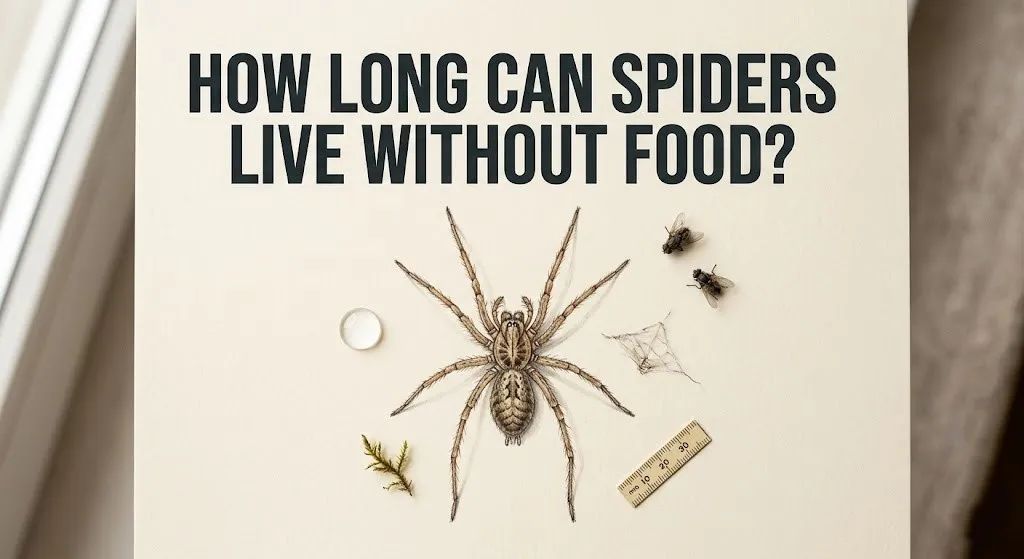
The spider’s abdomen is the visible indicator of its nutritional status. A well-fed spider has a plump, round, or elongated abdomen. A starving spider has a shrunken, wrinkled abdomen that may appear deflated. This is because the abdomen is the primary storage site for the spider’s energy reserves. When those reserves are depleted, the spider dies. The transition from plump to shrunken can take weeks or months, depending on the spider.
| Spider Type | Average Fasting Tolerance | Maximum Recorded |
|---|---|---|
| Small jumping spider | 3 to 7 days | 2 weeks |
| Common house spider | 2 to 4 weeks | 2 months |
| Cellar spider (daddy longlegs) | 3 to 6 weeks | 3 months |
| Wolf spider | 2 to 4 weeks | 2 months |
| Tarantula | 3 to 6 months | 12+ months |
how long can a spider go without food
A spider can go without food for a few weeks to several months, and the question is functionally identical to “how long can spiders live without food.” The phrase “go without food” implies a less extreme scenario than “survive without food.” A spider that “goes without food” for two weeks is hungry but not in danger. A spider that “survives without food” for two months is near starvation.
The spider’s evolutionary history as an ambush predator explains its tolerance for fasting. Unlike a bird or a mammal, which must eat daily or near-daily to maintain a constant internal body temperature, a spider can afford to wait. Its exoskeleton prevents water loss. Its low resting metabolism burns almost no calories. A spider that built a web in a corner of your kitchen can sit motionless in that web for two weeks, waiting for a single fly to blunder into it.
The meal itself is what enables the long fast. When a spider catches and liquefies a prey item, it extracts the protein, fat, and glycogen from the insect’s body. A single large meal can provide enough energy for weeks of waiting. This is the “boom and bust” cycle of spider life: eat a large meal, digest it slowly, and wait for the next one.
- Feast and famine: Adapted to gorge and then fast.
- Low metabolism: Burns almost no energy at rest.
- Single meal longevity: One large insect can sustain a spider for weeks.
Key Takeaway: A spider going without food for a week is not an emergency. It is a Tuesday.
how long can a small spider live without food
Small spiders can live without food for 3 to 10 days before reaching a critical energy deficit. A small spider, defined here as a spider weighing less than 50 milligrams, has a high surface-area-to-volume ratio. It loses heat and moisture faster than a large spider, and its metabolic rate is correspondingly higher.
The physics of size governs the fasting tolerance of small spiders. An organism’s metabolic rate scales with its body mass to the power of approximately 0.75. This means that a spider that is half the mass of another spider does not have half the metabolic rate. It has a metabolic rate that is proportionally higher. The smaller the spider, the faster it burns through its energy reserves, even at rest.
Small spiders also lose water more rapidly than large spiders. Their exoskeletons are thinner, and their book lungs have a larger surface area relative to their volume. Dehydration accelerates starvation because the metabolic processes required for life depend on a hydrated cellular environment. A small spider in a dry room may die of dehydration before it dies of starvation. This is why you often find dead spiders near windowsills. They were not hungry. They were dry.
- Small spider: Under 50 mg. Examples: jumping spiders, young spiderlings.
- Fasting window: 3 to 10 days.
- Dehydration risk: Higher than larger spiders.
how long can a spider last without food
A spider can last without food for 1 month to over a year, with the upper limit applying to large, mature tarantulas in cool environments. The phrase “last without food” probes the extreme end of the fasting spectrum. It asks about the spider’s final limit, not its comfortable tolerance.
The record holders for spider fasting are the large theraphosid tarantulas. A well-fed adult female Chilean rose tarantula, Grammostola rosea, can survive a fast of 12 to 18 months under the right conditions. There are documented cases in captivity of tarantulas refusing food for over a year and eventually resuming normal feeding with no apparent ill effects. This is not a healthy state, but it is survivable.
The environmental conditions that enable extreme fasting are cool temperatures and high humidity. Cool temperatures suppress the spider’s metabolism. High humidity prevents water loss through the book lungs and the exoskeleton. A tarantula in a cool, humid burrow can enter a state of near-suspended animation. A tarantula in a hot, dry enclosure will die within weeks without food and water.
- Typical fasting limit: 2 to 6 months for most species.
- Extreme limit: 12 to 18 months for large tarantulas.
- Enabling conditions: Cool temperature, high humidity.
how long can a house spider go without food
A common house spider can go without food for 2 to 4 weeks under normal indoor conditions. The house spider category includes several species: the American house spider, Parasteatoda tepidariorum, the cellar spider, Pholcus phalangioides, and the giant house spider, Eratigena atrica. Each has a slightly different fasting tolerance.
The American house spider is a cobweb spider, a member of the Theridiidae family. It builds a tangled, irregular web in corners and waits for prey. It is small to medium-sized, with females reaching roughly 6 to 8 millimeters in body length. Its fasting tolerance is moderate. It can survive 2 to 4 weeks without food, provided it has access to water or sufficient humidity.
The cellar spider, often called the daddy longlegs spider, is even more resilient. It thrives in basements, crawl spaces, and garages. It feeds on small insects and other spiders. Its long, spindly legs support a relatively small body, which reduces its energy requirements. Cellar spiders can survive 3 to 6 weeks without a meal.
- American house spider: 2 to 4 weeks.
- Cellar spider: 3 to 6 weeks.
- Giant house spider: 3 to 4 weeks.
Key Takeaway: The spider in your bathroom corner is not starving. It can comfortably wait a month for the next gnat to fly into its web.
how long can tarantulas go without food
Tarantulas can go without food for 3 to 6 months as a routine matter, and large adult females can survive fasts of 12 months or longer. Tarantulas are the champions of the spider fasting world. Their large body mass, slow metabolism, and burrowing lifestyle make them extraordinarily resistant to starvation.
The Grammostola and Brachypelma genera, both popular in the pet trade, are particularly known for their fasting tolerance. A healthy adult Grammostola rosea or Brachypelma hamorii will often refuse food for weeks or months, particularly during the cooler winter months or during the pre-molt period. This is normal behavior, not a sign of illness. Tarantula keepers learn not to panic when their spider skips a meal.
The pre-molt fast is a specific and predictable period of starvation. A tarantula preparing to shed its exoskeleton will stop eating for 2 weeks to 2 months before the molt. During this time, the new exoskeleton is forming beneath the old one, and the spider’s digestive system is effectively shut down. The spider will resume eating a week or two after the molt is complete.
- Routine fast: 3 to 6 months.
- Pre-molt fast: 2 weeks to 2 months.
- Extreme fast: 12 to 18 months.
spider metabolism and fasting
Spider metabolism is an ectothermic, low-energy system that allows the arachnid to survive on a fraction of the calories required by a similarly sized mammal. The resting metabolic rate of a spider is roughly 10 to 25 percent of the active metabolic rate, meaning the spider burns almost no energy when it is sitting still in its web.
The mechanism behind this efficiency is the spider’s reliance on anaerobic metabolism during periods of rest. Mammals require a constant supply of oxygen to fuel their high metabolic rates. Spiders can switch to a low-oxygen metabolic pathway that produces energy slowly but steadily from stored glycogen and fat. This allows the spider to remain motionless for extended periods without needing to breathe heavily or burn through its reserves.
The metabolic cost of web-building is the exception to the spider’s energy efficiency. Producing silk is energetically expensive. The spider must consume extra protein to replenish the silk glands after constructing a web. This is why orb-weaver spiders, which build large, intricate webs, have shorter fasting tolerances than burrowing spiders that simply wait in a hole. The orb-weaver invests energy in its trap. The burrower invests nothing.
- Resting metabolic rate: 10 to 25 percent of active rate.
- Anaerobic metabolism: Allows long periods of near-total stillness.
- Web-building cost: High energy expenditure, shorter fasts.
do spiders need water
Spiders need water to survive, and for many species, access to water is a more immediate survival requirement than access to food. A spider can survive weeks without food. It can survive only days without water. The dehydration risk is particularly acute for small spiders.
Spiders obtain water from three primary sources: their prey, environmental moisture, and direct drinking. The liquefied internal tissues of the insects they eat contain water, roughly 70 to 75 percent of the prey’s body weight. In the absence of prey, a spider can absorb moisture from the air through its book lungs, but this requires a humid environment. A spider in a dry house with no prey is dying of thirst, not hunger.
The spider’s exoskeleton is covered in a waxy cuticle that reduces evaporative water loss. This is why spiders can survive in deserts and dry attics. However, the cuticle is not impermeable. Over days and weeks, water slowly evaporates through the book lungs and the joints of the exoskeleton. A spider in a dry environment must replace this lost water.
- Prey: Provides 70 to 75 percent of water needs.
- Environmental humidity: Absorbed through book lungs.
- Direct drinking: Spiders will drink from water droplets.
Key Takeaway: If you want to help a spider, leave a small droplet of water near its web. Water is the real limiting factor for survival, not food.
Frequently Asked Questions About Spiders and Food
Can a spider starve in my house?
Yes, a spider can starve in your house if it cannot find prey, particularly during winter when flying insects are absent.
Most house spiders are adapted to indoor environments and will survive by finding hidden insects like silverfish or carpet beetles.
A lack of both food and water will kill a spider within a few weeks for small species.
Do spiders need to eat every day?
No, spiders do not need to eat every day.
Their ectothermic metabolism allows them to survive on a single large meal for days or weeks.
A spider that eats daily is likely overfed and will become obese in captivity.
Why don’t I see spiders eating?
Spiders are primarily nocturnal and liquefy their prey externally before ingesting it.
The feeding process can take hours, and most of it happens while you are asleep.
The empty exoskeletons of their prey are often the only visible evidence of a spider’s meal.
How do spiders catch food without a web?
Hunting spiders, like wolf spiders and jumping spiders, actively stalk and pounce on their prey.
They rely on speed, venom, and powerful legs to subdue insects.
These spiders have excellent eyesight and do not need a web to catch their food.
Can spiders die of dehydration?
Yes, dehydration is a more common cause of spider death than starvation.
Spiders lose water through their book lungs and exoskeleton and need to replenish it from prey or environmental humidity.
A spider in a dry, heated house in winter will die of thirst within days.
Spiders are the masters of metabolic patience. They have evolved over hundreds of millions of years to thrive on an unpredictable food supply. A spider in your house is not suffering. It is waiting. It is sitting in its web, heart rate slowed, metabolism idling at 10 percent, waiting for the vibration of a single fly.
The next time you see a spider in a corner that has not moved in what feels like forever, understand that it is not dead. It is not dying. It is executing a survival strategy that predates the dinosaurs. It can wait longer than you can imagine. It is waiting right now.
If you feel a pang of concern, leave a droplet of water. It will drink. It will go back to waiting. And in a few weeks, a fly will blunder into the web, and the spider will feast.