The seven lucky New Year’s food traditions are black-eyed peas for coins, collard greens for dollar bills, pork for progress, lentils for wealth, long noodles for longevity, twelve grapes for each month of the year, and a hidden-treasure cake for whoever finds the token inside. These traditions span the American South, Italy, Japan, Spain, and Greece. Each food carries a specific symbolic meaning, and each has been eaten on the first day of the year for centuries.
The psychology of eating lucky foods on New Year’s Day is a form of hopeful, positive superstition. The act of preparing and consuming these foods sets an intention for the year ahead. The black-eyed peas are not just fiber. They are a wish for prosperity. The long noodles are not just carbohydrates. They are a wish for a long, unbroken life.
This guide provides the historical origin of each tradition, the specific nutritional benefit that makes each food genuinely healthy, and a modern recipe twist for your 2026 celebration. You will learn why Southerners eat Hoppin’ John, why Italians eat lentils, and why the Spanish eat twelve grapes at the stroke of midnight.
what are the 7 lucky new year’s food traditions
The seven lucky New Year’s food traditions are a global collection of symbolic dishes believed to bring wealth, health, longevity, and good fortune. They include black-eyed peas and greens from the American South, pork from Germany and Eastern Europe, lentils from Italy, long noodles from Japan, twelve grapes from Spain, and a hidden-treasure cake from Greece.
The common thread across these traditions is the visual symbolism of the food. Black-eyed peas, lentils, and grapes resemble coins. Greens resemble folded paper money. Pork represents forward progress because pigs root forward when they eat. Long noodles represent a long, unbroken life. The cake represents the sweetness of the coming year and the hidden surprise of good fortune.
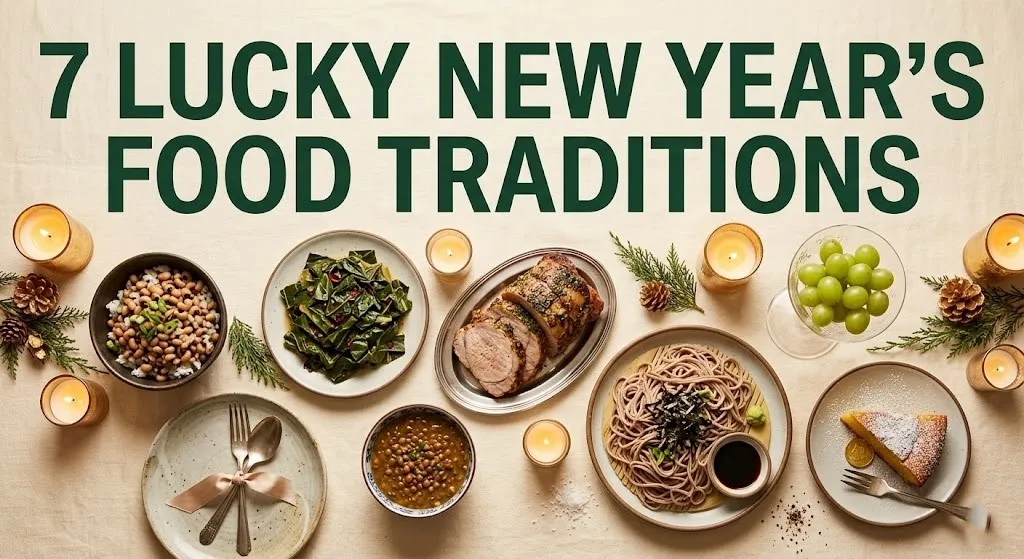
The number seven is not arbitrary. It is a number of completion and perfection in many cultural and religious traditions. The seven days of the week, the seven wonders, the seven seals. A list of seven lucky foods feels complete, sufficient, and auspicious. These seven traditions, each from a different part of the world, form a complete and balanced New Year’s feast.
| Tradition | Country of Origin | Symbolism |
|---|---|---|
| Black-Eyed Peas | American South | Coins, prosperity |
| Collard Greens | American South | Dollar bills, wealth |
| Pork | Germany, Eastern Europe | Forward progress |
| Lentils | Italy | Coins, wealth |
| Long Noodles | Japan | Longevity |
| 12 Grapes | Spain | 12 months of luck |
| King Cake | Greece | Hidden treasure, good fortune |
black-eyed peas for luck
Black-eyed peas are eaten on New Year’s Day in the American South because they symbolize coins and prosperity. The tradition dates back to the Civil War era, when Union soldiers considered the peas as animal feed and left them behind, allowing the Southerners to survive on them. The peas were a food of resilience and survival.
The nutritional reality of black-eyed peas supports their lucky status. A cup of cooked black-eyed peas provides 11 grams of fiber and 13 grams of protein. They are rich in folate, a B vitamin that supports cell division and heart health. The fiber in black-eyed peas lowers cholesterol and stabilizes blood sugar.
The classic Southern dish is Hoppin’ John, a one-pot meal of black-eyed peas, rice, and pork. The tradition of adding a coin to the pot, a dime or a penny, for extra luck is an old and widely practiced custom. The person who finds the coin in their bowl is said to have the most luck in the coming year.
- Civil War origin story.
- 11 grams of fiber per cup.
- Hoppin’ John is the classic preparation.
greens represent money
Collard greens, and other leafy greens like kale and turnip greens, are eaten on New Year’s Day because their green color and flat shape resemble folded dollar bills. The tradition is that the more greens you eat, the more money you will have in the coming year.
The nutritional symbology of greens is profound. Collard greens are rich in vitamin K, which supports bone health and blood clotting. They are a cruciferous vegetable, containing glucosinolates that have been studied for their anti-cancer properties. The iron in greens supports oxygen transport in the blood.
The classic Southern preparation involves slow-cooking the greens with a ham hock or a piece of pork fatback. The greens cook down into a tender, savory, potlikker-rich dish. The potlikker, the cooking liquid, is itself a prized part of the meal, often soaked up with cornbread.
- Resemble folded dollar bills.
- Rich in vitamin K and iron.
- Slow-cooked with pork for flavor.
Key Takeaway: Greens are money and health in the same bowl. The money symbolism is charming. The vitamin K, fiber, and iron are real and measurable.
pork for progress
Pork is eaten on New Year’s Day in Germany, Eastern Europe, and the American South because pigs root forward with their snouts, symbolizing forward movement and progress into the new year. A pig never moves backward. It always pushes ahead.
The nutritional consideration of pork has changed in 2026. Lean cuts of pork, such as the tenderloin and the loin chop, are rich in thiamine and selenium. Thiamine supports energy metabolism. Selenium is a powerful antioxidant. A 4-ounce serving of pork tenderloin contains roughly 22 grams of protein and 3 grams of fat.
The classic German preparation is a roast pork with sauerkraut. The sauerkraut is fermented cabbage, rich in probiotics that support gut health. The strands of sauerkraut also resemble shredded money, adding an extra layer of wealth symbolism to the dish.
- Pigs root forward, symbolizing progress.
- Lean pork is rich in thiamine and selenium.
- Sauerkraut adds probiotics and another layer of wealth symbolism.
lentils for coins
Lentils are eaten on New Year’s Eve in Italy because their flat, round shape resembles tiny coins. The tradition of eating lentils at midnight is believed to bring wealth and prosperity in the coming year. The more lentils you eat, the more coins you will accumulate.
The tradition has ancient roots. The Roman philosopher Pliny the Elder wrote about the consumption of lentils for good fortune. The Jewish Sephardic tradition also includes lentils as a food for Rosh Hashanah, the Jewish New Year. The round shape of the lentil represents the cyclical nature of time and the hope for a full, rich year.
A cup of cooked lentils provides 16 grams of fiber and 18 grams of protein. They are one of the most nutrient-dense foods on the planet. The classic Italian preparation is cotechino con lenticchie, a large pork sausage served on a bed of lentils. The sausage provides the richness. The lentils provide the coin symbolism.
- Roman and Sephardic Jewish origins.
- 16 grams of fiber per cup.
- Cotechino con lenticchie is the classic dish.
noodles for longevity
Long noodles, specifically toshikoshi soba in Japan, are eaten on New Year’s Eve because their length represents a long and unbroken life. The tradition is to eat the noodles without biting through them. Biting a noodle in half is believed to cut short your longevity.
The Japanese Buddhist tradition of toshikoshi soba dates back to the Kamakura period. The word “toshikoshi” means “year-crossing.” The buckwheat noodles, soba, are a symbol of resilience because buckwheat grows back stronger after being flattened by wind and rain. Eating soba is an act of internalizing that resilience.
Soba noodles are healthier than standard wheat pasta. Buckwheat is a pseudo-grain rich in rutin, an antioxidant that supports blood vessel health. Soba noodles provide complex carbohydrates and roughly 5 grams of protein per serving. They are naturally gluten-free when made from 100 percent buckwheat flour.
- Japanese Buddhist tradition.
- Eat without biting to preserve longevity.
- Buckwheat provides rutin for blood vessel health.
Key Takeaway: Long noodles are a wish for a long, unbroken life. The tradition of not biting through the noodle is a physical prayer for longevity.
12 grapes at midnight
Twelve grapes are eaten at the stroke of midnight in Spain and many Latin American countries because each grape represents one month of the coming year. The tradition is to eat one grape with each of the twelve chimes of the clock. Successfully eating all twelve grapes by the final chime ensures twelve months of good luck.
The tradition originated in the late 19th century among Spanish grape farmers who had a bumper harvest and needed to market their surplus. The practice spread throughout the Spanish-speaking world and is now a central part of the New Year’s Eve celebration, broadcast live from the Puerta del Sol in Madrid.
Twelve grapes is roughly 60 to 80 calories and a significant amount of vitamin C and antioxidants. The challenge of eating twelve grapes in twelve seconds is a fun, frantic ritual. The taste of the grapes, sweet or sour, is said to predict the nature of each corresponding month.
- Spanish tradition, late 19th century.
- One grape per chime, twelve months of luck.
- A fun, frantic, vitamin C-rich ritual.
king cake and hidden treasures
A cake with a hidden coin or trinket baked inside is eaten on New Year’s Day in Greece, where it is called Vasilopita, or St. Basil’s Cake. The person who finds the coin in their slice is blessed with good luck for the entire year.
The tradition honors St. Basil, a Greek bishop who lived in the 4th century. When a tyrant demanded the town’s valuables, St. Basil intervened and the valuables were returned. Unsure how to return the items, he baked them into a cake and distributed the slices. The coin in the modern Vasilopita represents those returned valuables.
The cake itself is a rich, sweet bread similar to brioche, flavored with orange zest and mahlab, an aromatic spice made from cherry pits. A coin, wrapped in foil, is pressed into the dough before baking. The cake is sliced at midnight or on New Year’s Day.
- Greek Orthodox tradition, 4th century.
- Coin hidden inside for luck.
- Rich, sweet brioche-style cake.
Frequently Asked Questions About New Year’s Food Traditions
Why do we eat black-eyed peas on New Year’s?
Black-eyed peas are eaten on New Year’s because they resemble coins and symbolize prosperity.
The tradition originated during the Civil War, when the peas were one of the few foods left behind and became a symbol of survival.
Hoppin’ John is the classic Southern preparation.
What is the luckiest food to eat on New Year’s Day?
Black-eyed peas are widely considered the luckiest food.
Lentils are a close second in Italian and Jewish traditions.
Both foods resemble coins and are associated with wealth.
Why do you eat 12 grapes at midnight?
The 12 grapes represent the 12 months of the coming year.
One grape is eaten with each chime of the clock at midnight.
The Spanish tradition dates back to the late 19th century.
What do lentils symbolize for New Year?
Lentils symbolize coins and wealth because of their flat, round shape.
The tradition of eating lentils for New Year has Roman and Sephardic Jewish origins.
Cotechino con lenticchie is the classic Italian dish.
Is it bad luck to eat chicken on New Year’s?
Some traditions consider chicken bad luck because chickens scratch backward.
Foods that move forward, like pork, are preferred.
Lobster is also considered unlucky because it moves sideways.
The seven lucky foods are a dinner party waiting to happen. A bowl of Hoppin’ John, a side of collard greens, a roast pork loin, a pot of lentil soup, a platter of cold soba noodles, a bowl of twelve grapes, and a Vasilopita cake. The table covers four continents and two thousand years of human hope.
The luck is not in the food itself. The luck is in the gathering. The luck is in the hands that prepared the meal, the mouths that eat the twelve grapes, the laughter when the coin is found in the cake.
Cook these foods this New Year. Share them with the people you love. The black-eyed peas will provide the fiber. The tradition will provide the meaning.