
Spicy food makes you hiccup because capsaicin, the active compound in chili peppers, activates TRPV1 pain receptors in your mouth and throat. These receptors send a flood of signals through your phrenic nerve and vagus nerve, which irritate the diaphragm and trigger an involuntary spasm. That spasm is a hiccup.
The TRPV1 receptor, short for Transient Receptor Potential Vanilloid 1, is the same receptor that detects physical heat. Capsaicin chemically tricks it into firing as if your mouth is burning. The neurological chaos that follows does not stay in your mouth. It travels down the vagus nerve to the diaphragm.
We will walk you through the exact anatomical pathway from the chili pepper to the hiccup, explain why your friend can eat ghost peppers without a spasm, and give you the fastest, evidence-backed remedies to stop the hiccups when they hit.
Why Does Spicy Food Make You Hiccup
The hiccup reflex from spicy food is a neurological accident. Capsaicin binds to the TRPV1 receptors on the sensory nerve endings in your tongue, throat, and esophagus. These nerves are branches of the vagus and glossopharyngeal nerves.
The vagus nerve runs from the brainstem down through the neck and chest to the diaphragm and the digestive organs. When capsaicin irritates the vagus nerve endings in the throat, the nerve carries that irritation signal back up to the brainstem. The brainstem, the medulla oblongata, houses the hiccup reflex center.
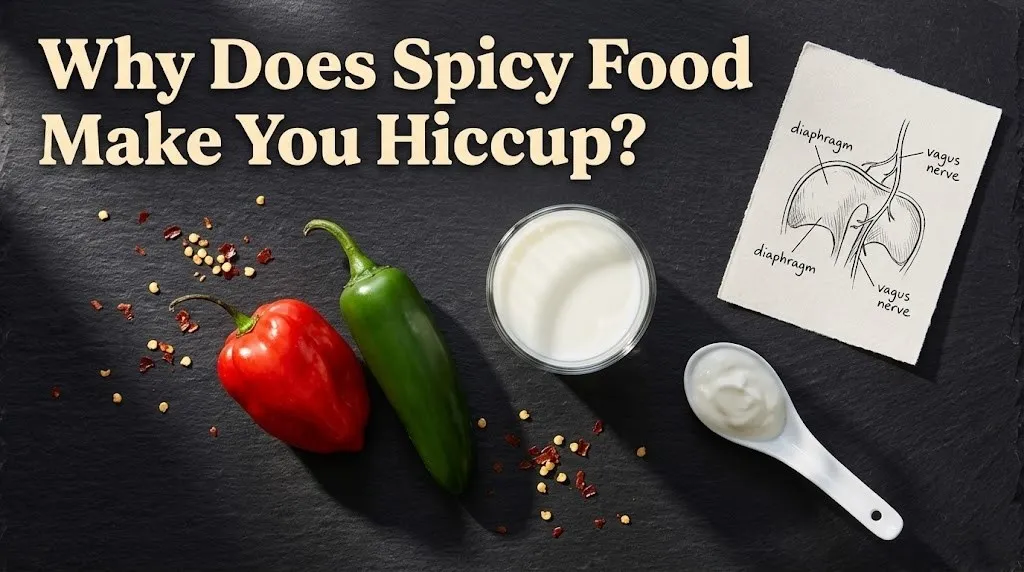
The brainstem responds to the irritation by sending a motor signal down the phrenic nerve to the diaphragm. The diaphragm contracts suddenly and involuntarily. A fraction of a second later, the glottis, the opening between the vocal cords, snaps shut. The air rushing in meets the closed glottis and produces the characteristic “hic” sound.
Why Does Spicy Food Cause Hiccups
Spicy food causes hiccups because the chemical irritation from capsaicin mimics the physical sensation of burning. The nervous system responds to the chemical burn the same way it would respond to actual thermal injury, with a protective reflex.
The hiccup reflex is evolutionarily ancient. Human fetuses hiccup in the womb. The reflex is present in amphibians and reptiles. The leading theory is that the hiccup is a vestigial reflex from our evolutionary ancestors who used gill ventilation. The brainstem circuitry for hiccuping is old, primitive, and easily triggered by strong sensory inputs.
Capsaicin is a uniquely strong sensory input. It activates nociceptors, the pain-sensing nerve endings, in addition to the TRPV1 thermoreceptors. The combination of pain and heat signals overwhelms the normal sensory processing in the brainstem. The hiccup reflex is a misfire, an accidental output from an overloaded neurological circuit.
Key Takeaway: The hiccup is a primitive brainstem reflex triggered by the sensory overload of capsaicin activating both pain and heat receptors simultaneously.
Can Spicy Food Cause Hiccups
Yes, spicy food can cause hiccups in susceptible individuals. Not everyone experiences this reaction. The variability depends on the density of TRPV1 receptors in the individual’s mouth, throat, and esophagus, which is influenced by genetics.
A 2018 study in the journal Nature identified several single-nucleotide polymorphisms, or SNPs, in the human TRPV1 gene. These genetic variations affect how densely the TRPV1 protein is expressed on the surface of nerve cells. A person with high TRPV1 expression feels more burn from a jalapeno and is more likely to hiccup.
Desensitization occurs with repeated exposure. People who eat spicy food regularly have lower sensitivity to capsaicin over time. The TRPV1 receptors become less responsive. This is the same mechanism by which people build spice tolerance. The chronic chili eater hiccups less not because their nerves are different but because their receptors are downregulated.
Can Spicy Food Give You Hiccups
Yes, spicy food can give you hiccups, often within 30 seconds to 2 minutes of the first bite. The speed of onset points to a direct neural reflex rather than a secondary digestive process.
The rapid response is triggered by the capsaicin contacting the oropharyngeal mucosa, the lining of the mouth and throat. The TRPV1 receptors on the surface of the nerve endings are directly exposed to the capsaicin as the food is chewed and swallowed. The signal travels from the mouth to the brainstem and back to the diaphragm in a fraction of a second.
Liquid spicy foods, like hot sauce or spicy soup, trigger hiccups faster than solid foods. The liquid makes immediate contact with a larger surface area of the throat. The capsaicin is distributed rapidly across the mucosa. A spicy chicken wing takes a few bites to coat the mouth. A spoonful of spicy tom yum soup hits the entire pharynx at once.
Does Spicy Food Give You Hiccups
Spicy food gives roughly 20 to 30 percent of people hiccups, based on observational data from sensory studies on capsaicin. The percentage increases with the Scoville Heat Unit level of the pepper. A poblano pepper at 1,500 SHU rarely triggers hiccups. A habanero at 200,000 SHU triggers hiccups in a larger fraction of eaters.
The dose-response relationship is not perfectly linear. Some individuals hiccup from a mild jalapeno but tolerate a hot Thai chili without reaction. The specific capsaicinoid profile of the pepper matters. Different Capsicum species contain different ratios of capsaicin to dihydrocapsaicin, nordihydrocapsaicin, and other capsaicinoids. These varying chemical cousins bind to the TRPV1 receptor with slightly different affinities.
The food matrix also plays a role. Capsaicin dissolved in oil, as in chili oil, adheres to the mucosa longer than capsaicin in a water-based hot sauce. The prolonged contact time increases the likelihood of triggering the hiccup reflex.
Why Do I Hiccup When I Eat Spicy Food
You hiccup when you eat spicy food because your TRPV1 receptor density is likely on the higher end of the normal human range. Your nerves are more sensitive to capsaicin than the nerves of someone who does not hiccup from spice.
The phrenic nerve is the specific motor nerve that controls your diaphragm. It originates from the C3, C4, and C5 cervical spinal nerves in your neck. Irritation of the vagus nerve in your throat can cross-activate the phrenic nerve nucleus in the brainstem. The diaphragm contracts. You hiccup.
Personal sensitivity also depends on your current physiological state. Eating quickly, swallowing air, drinking carbonated beverages, and experiencing stress all lower the threshold for triggering the hiccup reflex. A spicy meal eaten quickly after a stressful day is a perfect storm for hiccups.
Key Takeaway: Your personal TRPV1 receptor density, combined with your eating speed and stress level, determines whether that jalapeno gives you hiccups.
Why Do I Get the Hiccups When I Eat Spicy Food
You get the hiccups because your vagus nerve is being chemically irritated by the capsaicin and mechanically irritated by the act of swallowing. The combination of chemical and mechanical stimulation is a potent trigger.
The vagus nerve carries sensory information from the pharynx, larynx, and esophagus. Swallowing a large bite of spicy food stretches the esophagus. The capsaicin simultaneously chemically irritates the esophageal lining. The vagus nerve reports both the stretch and the chemical burn to the brainstem. The brainstem, receiving an abnormally intense signal, defaults to the primitive hiccup reflex.
The temperature of the food can amplify the effect. Hot soup or a steaming curry adds thermal heat to the chemical heat of the capsaicin. The TRPV1 receptor is activated by temperatures above 109 degrees Fahrenheit and by capsaicin. The combination of high temperature and high capsaicin produces a stronger receptor activation than either stimulus alone.
Why Do You Get Hiccups When You Eat Spicy Food
The collective “you” refers to the general mechanism applicable to anyone. Spicy food irritates the sensory nerves of the throat and esophagus. The irritation signal travels to the brainstem. The brainstem activates the hiccup reflex arc. The diaphragm spasms.
The reflex arc is a three-neuron chain. The sensory neuron carries the capsaicin irritation signal from the throat to the brainstem. The interneuron in the medulla oblongata processes the signal and connects to the motor neuron. The motor neuron carries the contraction signal from the spinal cord to the diaphragm.
The glottis closure is a separate, coordinated event. The brainstem simultaneously signals the diaphragm to contract and the laryngeal muscles to close the glottis. The timing is precise and involuntary. A study in the Journal of Applied Physiology found that the latency between diaphragm contraction and glottis closure in a hiccup is approximately 35 milliseconds.
Why Do I Hiccup After Eating Spicy Food
You hiccup after eating spicy food because the capsaicin residue remains on the esophageal lining even after the food has been swallowed. The irritation persists. The vagus nerve continues to fire.
The after-eating hiccup often begins several minutes after the meal. This delayed onset suggests that gastric distension, the stretching of the stomach from the volume of food, is contributing to the reflex. The vagus nerve innervates both the esophagus and the stomach. Capsaicin irritation in the lower esophagus combined with stomach distension from a full meal creates a sustained trigger.
Acid reflux can contribute. Capsaicin relaxes the lower esophageal sphincter, the valve between the stomach and the esophagus. Stomach acid can splash up into the irritated esophagus. The acid is an additional chemical irritant on top of the capsaicin. The irritated, acid-exposed vagus nerve continues to signal the brainstem, prolonging the hiccup episode.
Why Does Spicy Food Give You Hiccups
Spicy food gives you hiccups because capsaicin is a neurotoxin in high doses, and the hiccup reflex is a low-dose neurological response to a perceived chemical threat. The brainstem interprets the intense TRPV1 activation as a sign of potential tissue damage and activates the protective reflex.
This is the evolutionary logic of the response. The hiccup is an inspiratory spasm. In our amphibian ancestors, a similar reflex was used to move water across the gills. In mammals, the reflex may serve to dislodge irritants from the esophagus. A sudden, sharp inhalation could theoretically pull an irritant upward and away from the airway.
The protective theory is supported by the fact that hiccups are often triggered by esophageal irritants, not just capsaicin. Alcohol, carbonation, and large food boluses all trigger hiccups through similar vagal irritation. The spicy food hiccup is a specific case of a general protective reflex.
Why Do You Hiccup When You Eat Spicy Food
The singular “you” hiccup when eating spicy food because of a specific sequence of events. Capsaicin touches the tongue and throat. TRPV1 receptors activate. Sensory nerves fire. The brainstem receives the signal. The phrenic nerve activates. The diaphragm spasms. The glottis closes. The hiccup sound occurs.
The entire sequence from capsaicin contact to the first hiccup takes 500 milliseconds to 2 seconds. The speed of the reflex is a hallmark of a brainstem-mediated response. It does not require conscious processing. It does not require the cerebral cortex. It is a hardwired reflex, like the knee-jerk response or the blink reflex.
The intensity of the hiccup correlates with the intensity of the capsaicin stimulus. A mild jalapeno produces small, soft hiccups. A ghost pepper produces violent, whole-body hiccups that can be painful. The strength of the diaphragm contraction is proportional to the strength of the TRPV1 activation signal.
Key Takeaway: The hiccup reflex from spicy food is a 500-millisecond neurological loop: capsaicin binds TRPV1, the vagus nerve fires, the brainstem triggers the diaphragm, and the glottis snaps shut.
Does Spicy Food Make You Hiccup
Spicy food makes approximately one in four to one in three people hiccup, depending on the pepper variety and the individual’s TRPV1 sensitivity. The remaining majority can eat the same dish without a single hiccup.
The individual variation is genetic. A 2016 study in the journal Pain identified over 20 single-nucleotide polymorphisms in the human TRPV1 gene. These genetic variations affect the receptor’s sensitivity to capsaicin, its density on nerve cells, and its rate of desensitization. Some people are born with capsaicin-resistant TRPV1 receptors.
Desensitization through exposure is trainable. Regular consumption of capsaicin downregulates TRPV1 receptor expression. The nerves become less responsive. The hiccup reflex fades over weeks or months of regular spicy food consumption. This is the neurological basis of building spice tolerance.
How to Stop Hiccups From Spicy Food
The fastest way to stop spicy food hiccups is to drink a small amount of whole milk or full-fat yogurt. The casein protein in dairy binds to capsaicin and washes it away from the TRPV1 receptors on the nerve endings.
Dairy works by a specific chemical mechanism. Capsaicin is a hydrophobic molecule. It dissolves in fat. The fat globules in whole milk surround the capsaicin molecules and pull them off the nerve endings. Casein, the primary protein in milk, also binds directly to capsaicin. The combination of fat and casein makes dairy the most effective capsaicin remover.
A spoonful of peanut butter or coconut cream works similarly. The fat content coats the mucosa and dissolves the capsaicin. The thick texture physically scrapes the capsaicin off the throat lining. A teaspoon of sugar or honey absorbs the capsaicin oil and provides rapid relief.
To stop spicy food hiccups quickly:
- Swallow 1 to 2 tablespoons of full-fat yogurt or whole milk.
- Hold the liquid in your mouth for 5 seconds before swallowing to maximize mucosal contact.
- If dairy is unavailable, eat a spoonful of peanut butter or a piece of bread soaked in olive oil.
- Follow with slow, deep breaths to calm the phrenic nerve.
How to Prevent Hiccups When Eating Spicy Food
Prevent spicy food hiccups by coating the mouth and throat with a protective fat layer before the first bite. A small spoonful of yogurt, sour cream, or a sip of whole milk taken 2 to 3 minutes before eating primes the mucosa.
Eating slowly prevents the combined mechanical and chemical irritation that triggers the reflex. Small bites reduce esophageal stretch. Slow chewing allows the saliva to dilute the capsaicin concentration before swallowing. Saliva itself is a mild capsaicin buffer.
Starting with milder dishes and working up to the spiciest dish in the meal allows the TRPV1 receptors to partially desensitize. The first exposure reduces the receptor’s responsiveness to the subsequent, more intense exposures.
- Eat a spoonful of plain yogurt 2 to 3 minutes before the first spicy bite.
- Take small, slow bites. Avoid swallowing large boluses of spicy food.
- Avoid carbonated drinks during the meal. Carbonation adds mechanical irritation.
- Start with milder dishes and progress to the hottest dish last.
Frequently Asked Questions About Spicy Food Hiccups
Is it normal to hiccup after eating spicy food?
Yes, hiccuping after spicy food is a normal physiological reflex.
It affects roughly one in four to one in three people.
The hiccup is caused by capsaicin activating TRPV1 receptors, not by a medical problem.
Why does spicy food make me hiccup but not my friend?
Your TRPV1 receptor density and sensitivity are likely higher than your friend’s.
Genetic variation in the TRPV1 gene determines how strongly you react to capsaicin.
Your friend may also have desensitized their receptors through regular spicy food consumption.
Can spicy food hiccups be dangerous?
Spicy food hiccups are rarely dangerous in themselves.
They are uncomfortable and can cause chest muscle soreness if prolonged.
If hiccups persist for more than 48 hours after a spicy meal, seek a medical evaluation.
What stops spicy food hiccups fast?
A tablespoon of full-fat yogurt or whole milk is the fastest remedy.
The fat and casein protein bind to capsaicin and remove it from the nerve endings.
Peanut butter, coconut cream, or a teaspoon of sugar also work as secondary options.
How do you prevent hiccups before eating spicy food?
Eat a spoonful of yogurt or sour cream a few minutes before the first spicy bite.
Eat slowly and take small bites to reduce esophageal irritation.
Avoid carbonated drinks during the meal to prevent adding mechanical irritation.
The hiccup after a bite of jalapeno is not a personal failing. It is a 500-millisecond neurological reflex hardwired into your brainstem. The capsaicin in the pepper chemically deceives your TRPV1 receptors into screaming “fire,” and your ancient, primitive hiccup center responds with a diaphragm spasm.
Dairy is the antidote. The fat and casein strip the capsaicin off your nerve endings. A spoonful of yogurt before the meal and a glass of milk after the first hiccup is the evidence-backed protocol.
You can train your receptors with repeated exposure. The chronic chili eater hiccups less. The occasional spice adventurer hiccups more. Both are normal. The pepper does not care about your genetics. It only knows how to bind to TRPV1. The rest is your nervous system’s story.